Info-Tech Research Group 1Info-Tech Research Group 1
Info-Tech Research Group, Inc. is a global leader in providing IT research and advice.
Info-Tech’s products and services combine actionable insight and relevant advice with
ready-to-use tools and templates that cover the full spectrum of IT concerns.
© 1997-2017 Info-Tech Research Group Inc.
Strengthen your service desk to build a strong ITSM foundation.
Info-Tech's products and services combine actionable insight and relevant advice with ready-to-use tools
and templates that cover the full spectrum of IT concerns.© 1997-2017 Info-Tech Research Group
Info-Tech Research Group 2Info-Tech Research Group 2
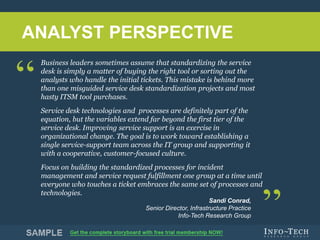
Business leaders sometimes assume that standardizing the service
desk is simply a matter of buying the right tool or sorting out the
analysts who handle the initial tickets. This mistake is behind more
than one misguided service desk standardization projects and most
hasty ITSM tool purchases.
Service desk technologies and processes are definitely part of the
equation, but the variables extend far beyond the first tier of the
service desk. Improving service support is an exercise in
organizational change. The goal is to work toward establishing a
single service-support team across the IT group and supporting it
with a cooperative, customer-focused culture.
Focus on building the standardized processes for incident
management and service request fulfillment one group at a time until
everyone who touches a ticket embraces the same set of processes and
technologies.
Sandi Conrad,
Senior Director, Infrastructure Practice
Info-Tech Research Group
ANALYST PERSPECTIVE
Info-Tech Research Group 3Info-Tech Research Group 3
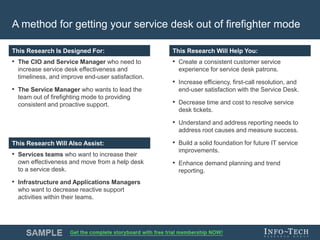
This Research is Designed For: This Research Will Help You:
This Research Will Assist:
This Research Is Designed For: This Research Will Help You:
This Research Will Also Assist:
A method for getting your service desk out of firefighter mode
• The CIO and Service Manager who need to
increase service desk effectiveness and
timeliness, and improve end-user satisfaction.
• The Service Manager who wants to lead the
team out of firefighting mode to providing
consistent and proactive support.
• Create a consistent customer service
experience for service desk patrons.
• Increase efficiency, first-call resolution, and
end-user satisfaction with the Service Desk.
• Decrease time and cost to resolve service
desk tickets.
• Understand and address reporting needs to
address root causes and measure success.
• Build a solid foundation for future IT service
improvements.
• Enhance demand planning and trend
reporting.
• Services teams who want to increase their
own effectiveness and move from a help desk
to a service desk.
• Infrastructure and Applications Managers
who want to decrease reactive support
activities within their teams.
Info-Tech Research Group 4Info-Tech Research Group 4
Resolution
Situation
Complication
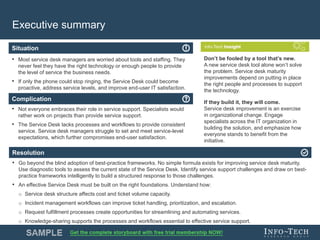
Executive summary
• Most service desk managers are worried about tools and staffing. They
never feel they have the right technology or enough people to provide
the level of service the business needs.
• If only the phone could stop ringing, the Service Desk could become
proactive, address service levels, and improve end-user IT satisfaction.
• Not everyone embraces their role in service support. Specialists would
rather work on projects than provide service support.
• The Service Desk lacks processes and workflows to provide consistent
service. Service desk managers struggle to set and meet service-level
expectations, which further compromises end-user satisfaction.
• Go beyond the blind adoption of best-practice frameworks. No simple formula exists for improving service desk maturity.
Use diagnostic tools to assess the current state of the Service Desk. Identify service support challenges and draw on best-
practice frameworks intelligently to build a structured response to those challenges.
• An effective Service Desk must be built on the right foundations. Understand how:
o Service desk structure affects cost and ticket volume capacity.
o Incident management workflows can improve ticket handling, prioritization, and escalation.
o Request fulfillment processes create opportunities for streamlining and automating services.
o Knowledge-sharing supports the processes and workflows essential to effective service support.
Don’t be fooled by a tool that’s new.
A new service desk tool alone won’t solve
the problem. Service desk maturity
improvements depend on putting in place
the right people and processes to support
the technology.
If they build it, they will come.
Service desk improvement is an exercise
in organizational change. Engage
specialists across the IT organization in
building the solution, and emphasize how
everyone stands to benefit from the
initiative.
Info-Tech Research Group 5Info-Tech Research Group 5
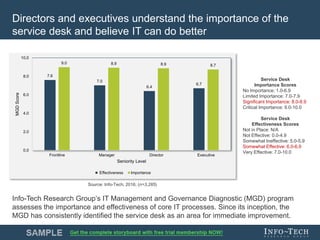
Directors and executives understand the importance of the
service desk and believe IT can do better
Info-Tech Research Group’s IT Management and Governance Diagnostic (MGD) program
assesses the importance and effectiveness of core IT processes. Since its inception, the
MGD has consistently identified the service desk as an area for immediate improvement.
Service Desk
Importance Scores
No Importance: 1.0-6.9
Limited Importance: 7.0-7.9
Significant Importance: 8.0-8.9
Critical Importance: 9.0-10.0
Service Desk
Effectiveness Scores
Not in Place: N/A
Not Effective: 0.0-4.9
Somewhat Ineffective: 5.0-5.9
Somewhat Effective: 6.0-6.9
Very Effective: 7.0-10.0
Source: Info-Tech, 2016; (n=3,285)
7.6
7.0
6.4
6.7
9.0 8.9 8.9 8.7
0.0
2.0
4.0
6.0
8.0
10.0
Frontline Manager Director Executive
MGDScore
Seniority Level
Effectiveness Importance
Info-Tech Research Group 6Info-Tech Research Group 6
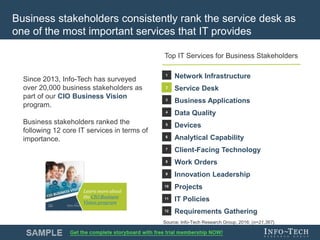
Since 2013, Info-Tech has surveyed
over 20,000 business stakeholders as
part of our CIO Business Vision
program.
Business stakeholders ranked the
following 12 core IT services in terms of
importance.
Network Infrastructure
Service Desk
Business Applications
Data Quality
Devices
Analytical Capability
Client-Facing Technology
Work Orders
Innovation Leadership
Projects
IT Policies
Requirements Gathering
11
10
12
1
2
4
5
8
9
7
6
3
Top IT Services for Business Stakeholders
Source: Info-Tech Research Group, 2016; (n=21,367)
Learn more about
the CIO Business
Vision program.
Business stakeholders consistently rank the service desk as
one of the most important services that IT provides
Info-Tech Research Group 7Info-Tech Research Group 7
Increase business satisfaction:
• Improve confidence that the service desk can meet service levels.
• Create a single point of contact for incidents and requests, and
escalate quickly.
Increase efficiency and lower operating costs:
• Empower end users and technicians with a targeted knowledgebase.
• Cross-train to improve service consistency.
Reduce recurring issues:
• Create tickets for every task and categorize them accurately.
• Generate reliable data to support root-cause analysis.
Enhance demand planning:
• Analyze trends to forecast and meet shifting business requirements.
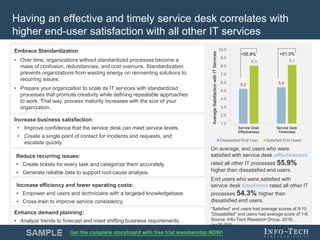
Having an effective and timely service desk correlates with
higher end-user satisfaction with all other IT services
“Satisfied” end users had average scores of 8-10.
“Dissatisfied" end users had average score of 1-6.
Source: Info-Tech Research Group, 2016;
(n=25,998)
On average, end users who were
satisfied with service desk effectiveness
rated all other IT processes 55.9%
higher than dissatisfied end users.
End users who were satisfied with
service desk timeliness rated all other IT
processes 54.3% higher than
dissatisfied end users.
Embrace Standardization
• Over time, organizations without standardized processes become a
mass of confusion, redundancies, and cost overruns. Standardization
prevents organizations from wasting energy on reinventing solutions to
recurring issues.
• Prepare your organization to scale its IT services with standardized
processes that promote creativity while defining repeatable approaches
to work. That way, process maturity increases with the size of your
organization.
5.2 5.4
8.0 8.1
1.0
2.0
3.0
4.0
5.0
6.0
7.0
8.0
9.0
10.0
Service Desk
Effectiveness
Service Desk
Timeliness
AverageSatisfactionwithITServices
Dissatisfied End User Satisfied End Users
+55.9% +51.3%
Info-Tech Research Group 8Info-Tech Research Group 8
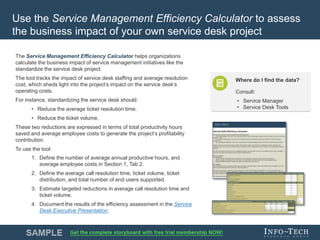
Use the Service Management Efficiency Calculator to assess
the business impact of your own service desk project
The Service Management Efficiency Calculator helps organizations
calculate the business impact of service management initiatives like the
standardize the service desk project.
The tool tracks the impact of service desk staffing and average resolution
cost, which sheds light into the project’s impact on the service desk’s
operating costs.
For instance, standardizing the service desk should:
• Reduce the average ticket resolution time.
• Reduce the ticket volume.
These two reductions are expressed in terms of total productivity hours
saved and average employee costs to generate the project’s profitability
contribution.
To use the tool:
1. Define the number of average annual productive hours, and
average employee costs in Section 1, Tab 2.
2. Define the average call resolution time, ticket volume, ticket
distribution, and total number of end users supported.
3. Estimate targeted reductions in average call resolution time and
ticket volume.
4. Document the results of the efficiency assessment in the Service
Desk Executive Presentation.
Where do I find the data?
Consult:
• Service Manager
• Service Desk Tools
Info-Tech Research Group 9Info-Tech Research Group 9
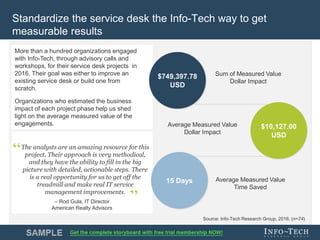
More than a hundred organizations engaged
with Info-Tech, through advisory calls and
workshops, for their service desk projects in
2016. Their goal was either to improve an
existing service desk or build one from
scratch.
Organizations who estimated the business
impact of each project phase help us shed
light on the average measured value of the
engagements.
Sum of Measured Value
Dollar Impact
Average Measured Value
Dollar Impact
$10,127.00
USD
Source: Info-Tech Research Group, 2016; (n=74)
Standardize the service desk the Info-Tech way to get
measurable results
Average Measured Value
Time Saved
$749,397.78
USD
The analysts are an amazing resource for this
project. Their approach is very methodical,
and they have the ability to fill in the big
picture with detailed, actionable steps. There
is a real opportunity for us to get off the
treadmill and make real IT service
management improvements.
– Rod Gula, IT Director
American Realty Advisors
15 Days
Info-Tech Research Group 10Info-Tech Research Group 10
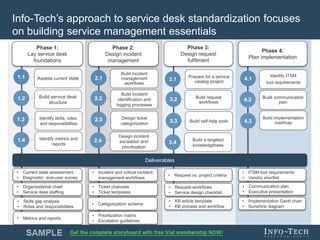
Info-Tech’s approach to service desk standardization focuses
on building service management essentials
Phase 1:
Lay service desk
foundations
Phase 2:
Design incident
management
Phase 3:
Design request
fulfilment
Build service desk
structure
Assess current state
1.2
1.1
Build incident
identification and
logging processes
Build incident
management
workflows
2.2
2.1
Build request
workflows
Prepare for a service
catalog project
3.2
3.1
• Current state assessment
• Diagnostic: end-user survey
• Organizational chart
• Service desk staffing
• Incident and critical incident
management workflows
• Categorization scheme
• Prioritization matrix
• Escalation guidelines
• Request vs. project criteria
• Ticket channels
• Ticket templates
Phase 4:
Plan implementation
Build communication
plan
Identify ITSM
tool requirements
4.2
4.1
• ITSM tool requirements
• Vendor shortlist
• Communication plan
• Executive presentation
• Implementation Gantt chart
• Sunshine diagram
Identify skills, roles,
and responsibilities
Identify metrics and
reports
1.4
1.3
• Skills gap analysis
• Roles and responsibilities
• Metrics and reports
Deliverables
Design ticket
categorization
2.3
Design incident
escalation and
prioritization
2.4
Build self-help tools3.3
Build implementation
roadmap4.3
3.4
Build a targeted
knowledgebase
• KB article template
• KB process and workflow
• Request workflows
• Service design checklist
Info-Tech Research Group 11Info-Tech Research Group 11
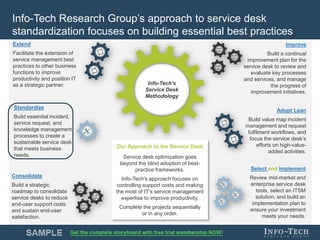
Info-Tech Research Group’s approach to service desk
standardization focuses on building essential best practices
Consolidate
Build a strategic
roadmap to consolidate
service desks to reduce
end-user support costs
and sustain end-user
satisfaction.
Standardize
Build essential incident,
service request, and
knowledge management
processes to create a
sustainable service desk
that meets business
needs.
Extend
Facilitate the extension of
service management best
practices to other business
functions to improve
productivity and position IT
as a strategic partner.
Our Approach to the Service Desk
Service desk optimization goes
beyond the blind adoption of best-
practice frameworks.
Info-Tech’s approach focuses on
controlling support costs and making
the most of IT’s service management
expertise to improve productivity.
Complete the projects sequentially
or in any order.
Info-Tech’s
Service Desk
Methodology
Adopt Lean
Build value map incident
management and request
fulfilment workflows, and
focus the service desk’s
efforts on high-value-
added activities.
Improve
Build a continual
improvement plan for the
service desk to review and
evaluate key processes
and services, and manage
the progress of
improvement initiatives.
Select and Implement
Review mid-market and
enterprise service desk
tools, select an ITSM
solution, and build an
implementation plan to
ensure your investment
meets your needs.
Info-Tech Research Group ‹#›
Info-Tech Research Group Helps IT Professionals To:
 Quickly get up to speed
with new technologies
 Make the right technology
purchasing decisions – fast
 Deliver critical IT
projects, on time and
within budget
 Manage business expectations
 Justify IT spending and
prove the value of IT
 Train IT staff and effectively
manage an IT department
Toll Free: 1-888-670-8889

Standardize the Service Desk

  • 1.
    Info-Tech Research Group1Info-Tech Research Group 1 Info-Tech Research Group, Inc. is a global leader in providing IT research and advice. Info-Tech’s products and services combine actionable insight and relevant advice with ready-to-use tools and templates that cover the full spectrum of IT concerns. © 1997-2017 Info-Tech Research Group Inc. Strengthen your service desk to build a strong ITSM foundation. Info-Tech's products and services combine actionable insight and relevant advice with ready-to-use tools and templates that cover the full spectrum of IT concerns.© 1997-2017 Info-Tech Research Group
  • 2.
    Info-Tech Research Group2Info-Tech Research Group 2 Business leaders sometimes assume that standardizing the service desk is simply a matter of buying the right tool or sorting out the analysts who handle the initial tickets. This mistake is behind more than one misguided service desk standardization projects and most hasty ITSM tool purchases. Service desk technologies and processes are definitely part of the equation, but the variables extend far beyond the first tier of the service desk. Improving service support is an exercise in organizational change. The goal is to work toward establishing a single service-support team across the IT group and supporting it with a cooperative, customer-focused culture. Focus on building the standardized processes for incident management and service request fulfillment one group at a time until everyone who touches a ticket embraces the same set of processes and technologies. Sandi Conrad, Senior Director, Infrastructure Practice Info-Tech Research Group ANALYST PERSPECTIVE
  • 3.
    Info-Tech Research Group3Info-Tech Research Group 3 This Research is Designed For: This Research Will Help You: This Research Will Assist: This Research Is Designed For: This Research Will Help You: This Research Will Also Assist: A method for getting your service desk out of firefighter mode • The CIO and Service Manager who need to increase service desk effectiveness and timeliness, and improve end-user satisfaction. • The Service Manager who wants to lead the team out of firefighting mode to providing consistent and proactive support. • Create a consistent customer service experience for service desk patrons. • Increase efficiency, first-call resolution, and end-user satisfaction with the Service Desk. • Decrease time and cost to resolve service desk tickets. • Understand and address reporting needs to address root causes and measure success. • Build a solid foundation for future IT service improvements. • Enhance demand planning and trend reporting. • Services teams who want to increase their own effectiveness and move from a help desk to a service desk. • Infrastructure and Applications Managers who want to decrease reactive support activities within their teams.
  • 4.
    Info-Tech Research Group4Info-Tech Research Group 4 Resolution Situation Complication Executive summary • Most service desk managers are worried about tools and staffing. They never feel they have the right technology or enough people to provide the level of service the business needs. • If only the phone could stop ringing, the Service Desk could become proactive, address service levels, and improve end-user IT satisfaction. • Not everyone embraces their role in service support. Specialists would rather work on projects than provide service support. • The Service Desk lacks processes and workflows to provide consistent service. Service desk managers struggle to set and meet service-level expectations, which further compromises end-user satisfaction. • Go beyond the blind adoption of best-practice frameworks. No simple formula exists for improving service desk maturity. Use diagnostic tools to assess the current state of the Service Desk. Identify service support challenges and draw on best- practice frameworks intelligently to build a structured response to those challenges. • An effective Service Desk must be built on the right foundations. Understand how: o Service desk structure affects cost and ticket volume capacity. o Incident management workflows can improve ticket handling, prioritization, and escalation. o Request fulfillment processes create opportunities for streamlining and automating services. o Knowledge-sharing supports the processes and workflows essential to effective service support. Don’t be fooled by a tool that’s new. A new service desk tool alone won’t solve the problem. Service desk maturity improvements depend on putting in place the right people and processes to support the technology. If they build it, they will come. Service desk improvement is an exercise in organizational change. Engage specialists across the IT organization in building the solution, and emphasize how everyone stands to benefit from the initiative.
  • 5.
    Info-Tech Research Group5Info-Tech Research Group 5 Directors and executives understand the importance of the service desk and believe IT can do better Info-Tech Research Group’s IT Management and Governance Diagnostic (MGD) program assesses the importance and effectiveness of core IT processes. Since its inception, the MGD has consistently identified the service desk as an area for immediate improvement. Service Desk Importance Scores No Importance: 1.0-6.9 Limited Importance: 7.0-7.9 Significant Importance: 8.0-8.9 Critical Importance: 9.0-10.0 Service Desk Effectiveness Scores Not in Place: N/A Not Effective: 0.0-4.9 Somewhat Ineffective: 5.0-5.9 Somewhat Effective: 6.0-6.9 Very Effective: 7.0-10.0 Source: Info-Tech, 2016; (n=3,285) 7.6 7.0 6.4 6.7 9.0 8.9 8.9 8.7 0.0 2.0 4.0 6.0 8.0 10.0 Frontline Manager Director Executive MGDScore Seniority Level Effectiveness Importance
  • 6.
    Info-Tech Research Group6Info-Tech Research Group 6 Since 2013, Info-Tech has surveyed over 20,000 business stakeholders as part of our CIO Business Vision program. Business stakeholders ranked the following 12 core IT services in terms of importance. Network Infrastructure Service Desk Business Applications Data Quality Devices Analytical Capability Client-Facing Technology Work Orders Innovation Leadership Projects IT Policies Requirements Gathering 11 10 12 1 2 4 5 8 9 7 6 3 Top IT Services for Business Stakeholders Source: Info-Tech Research Group, 2016; (n=21,367) Learn more about the CIO Business Vision program. Business stakeholders consistently rank the service desk as one of the most important services that IT provides
  • 7.
    Info-Tech Research Group7Info-Tech Research Group 7 Increase business satisfaction: • Improve confidence that the service desk can meet service levels. • Create a single point of contact for incidents and requests, and escalate quickly. Increase efficiency and lower operating costs: • Empower end users and technicians with a targeted knowledgebase. • Cross-train to improve service consistency. Reduce recurring issues: • Create tickets for every task and categorize them accurately. • Generate reliable data to support root-cause analysis. Enhance demand planning: • Analyze trends to forecast and meet shifting business requirements. Having an effective and timely service desk correlates with higher end-user satisfaction with all other IT services “Satisfied” end users had average scores of 8-10. “Dissatisfied" end users had average score of 1-6. Source: Info-Tech Research Group, 2016; (n=25,998) On average, end users who were satisfied with service desk effectiveness rated all other IT processes 55.9% higher than dissatisfied end users. End users who were satisfied with service desk timeliness rated all other IT processes 54.3% higher than dissatisfied end users. Embrace Standardization • Over time, organizations without standardized processes become a mass of confusion, redundancies, and cost overruns. Standardization prevents organizations from wasting energy on reinventing solutions to recurring issues. • Prepare your organization to scale its IT services with standardized processes that promote creativity while defining repeatable approaches to work. That way, process maturity increases with the size of your organization. 5.2 5.4 8.0 8.1 1.0 2.0 3.0 4.0 5.0 6.0 7.0 8.0 9.0 10.0 Service Desk Effectiveness Service Desk Timeliness AverageSatisfactionwithITServices Dissatisfied End User Satisfied End Users +55.9% +51.3%
  • 8.
    Info-Tech Research Group8Info-Tech Research Group 8 Use the Service Management Efficiency Calculator to assess the business impact of your own service desk project The Service Management Efficiency Calculator helps organizations calculate the business impact of service management initiatives like the standardize the service desk project. The tool tracks the impact of service desk staffing and average resolution cost, which sheds light into the project’s impact on the service desk’s operating costs. For instance, standardizing the service desk should: • Reduce the average ticket resolution time. • Reduce the ticket volume. These two reductions are expressed in terms of total productivity hours saved and average employee costs to generate the project’s profitability contribution. To use the tool: 1. Define the number of average annual productive hours, and average employee costs in Section 1, Tab 2. 2. Define the average call resolution time, ticket volume, ticket distribution, and total number of end users supported. 3. Estimate targeted reductions in average call resolution time and ticket volume. 4. Document the results of the efficiency assessment in the Service Desk Executive Presentation. Where do I find the data? Consult: • Service Manager • Service Desk Tools
  • 9.
    Info-Tech Research Group9Info-Tech Research Group 9 More than a hundred organizations engaged with Info-Tech, through advisory calls and workshops, for their service desk projects in 2016. Their goal was either to improve an existing service desk or build one from scratch. Organizations who estimated the business impact of each project phase help us shed light on the average measured value of the engagements. Sum of Measured Value Dollar Impact Average Measured Value Dollar Impact $10,127.00 USD Source: Info-Tech Research Group, 2016; (n=74) Standardize the service desk the Info-Tech way to get measurable results Average Measured Value Time Saved $749,397.78 USD The analysts are an amazing resource for this project. Their approach is very methodical, and they have the ability to fill in the big picture with detailed, actionable steps. There is a real opportunity for us to get off the treadmill and make real IT service management improvements. – Rod Gula, IT Director American Realty Advisors 15 Days
  • 10.
    Info-Tech Research Group10Info-Tech Research Group 10 Info-Tech’s approach to service desk standardization focuses on building service management essentials Phase 1: Lay service desk foundations Phase 2: Design incident management Phase 3: Design request fulfilment Build service desk structure Assess current state 1.2 1.1 Build incident identification and logging processes Build incident management workflows 2.2 2.1 Build request workflows Prepare for a service catalog project 3.2 3.1 • Current state assessment • Diagnostic: end-user survey • Organizational chart • Service desk staffing • Incident and critical incident management workflows • Categorization scheme • Prioritization matrix • Escalation guidelines • Request vs. project criteria • Ticket channels • Ticket templates Phase 4: Plan implementation Build communication plan Identify ITSM tool requirements 4.2 4.1 • ITSM tool requirements • Vendor shortlist • Communication plan • Executive presentation • Implementation Gantt chart • Sunshine diagram Identify skills, roles, and responsibilities Identify metrics and reports 1.4 1.3 • Skills gap analysis • Roles and responsibilities • Metrics and reports Deliverables Design ticket categorization 2.3 Design incident escalation and prioritization 2.4 Build self-help tools3.3 Build implementation roadmap4.3 3.4 Build a targeted knowledgebase • KB article template • KB process and workflow • Request workflows • Service design checklist
  • 11.
    Info-Tech Research Group11Info-Tech Research Group 11 Info-Tech Research Group’s approach to service desk standardization focuses on building essential best practices Consolidate Build a strategic roadmap to consolidate service desks to reduce end-user support costs and sustain end-user satisfaction. Standardize Build essential incident, service request, and knowledge management processes to create a sustainable service desk that meets business needs. Extend Facilitate the extension of service management best practices to other business functions to improve productivity and position IT as a strategic partner. Our Approach to the Service Desk Service desk optimization goes beyond the blind adoption of best- practice frameworks. Info-Tech’s approach focuses on controlling support costs and making the most of IT’s service management expertise to improve productivity. Complete the projects sequentially or in any order. Info-Tech’s Service Desk Methodology Adopt Lean Build value map incident management and request fulfilment workflows, and focus the service desk’s efforts on high-value- added activities. Improve Build a continual improvement plan for the service desk to review and evaluate key processes and services, and manage the progress of improvement initiatives. Select and Implement Review mid-market and enterprise service desk tools, select an ITSM solution, and build an implementation plan to ensure your investment meets your needs.
  • 12.
    Info-Tech Research Group‹#› Info-Tech Research Group Helps IT Professionals To:  Quickly get up to speed with new technologies  Make the right technology purchasing decisions – fast  Deliver critical IT projects, on time and within budget  Manage business expectations  Justify IT spending and prove the value of IT  Train IT staff and effectively manage an IT department Toll Free: 1-888-670-8889