Lean Construction
Transforming current forms of Project Management
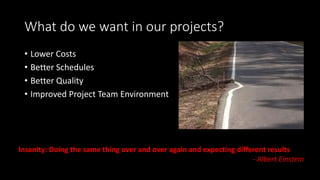
What do we want in our projects?
• Lower Costs
• Better Schedules
• Better Quality
• Improved Project Team Environment
Insanity: Doing the same thing over and over again and expecting different results
- Albert Einstein
Why do we need a different approach?
• Construction industry has fallen
behind other industries for
productivity improvement
• Lean targets the Removal of
behaviors and activities that
contribute to Waste and loss of
Productivity
• Lean Construction brings the
needed methodologies and
culture for improvement
Value
added
62%
Support
Activity
12%
Waste
26%
Manufacturing Value Stream Value
added,
10%
Support
Activity ,
33%
Waste,
57%
Construction "Supply Chain"
CII Data
Global Challenges
• Mass urbanization – by 2030 there are likely to be 41 mega-cities of
10m+ people
• Need 30% more water and 45% more energy
• Buildings generate 40% carbon foot print
Why in India?
Significant increase in construction volume
• As per 12th Five-year plan estimated spend on construction industry is $ 1 Trillion,
which is double of 11th Five-year plan
• Share of private investment is about 50% in 12th Five-year plan compared to 30%
in 11th Five-year plan
According to the World Bank report, India’s construction industry is
expected to face a labor shortage of 18-28% if the country grows at a
medium rate and a shortage of nearly 55-60% if it sees high growth
If the current trends continue, India could suffer a GDP loss of $200
Billions in the fiscal year 2017 due to inefficiencies
- McKinsey 2009
The Real Estate Regulation and Development Act, 2016(RERA),
that came in to force on May 1, 2016 (Central Act 16 of 2016)
What is Lean Construction?
• Definition of Lean
‒ A production approach that preserves Value with less Waste
‒ “To produce the right product at the right time in the right quantity for the customers
and to provide exactly what you need and nothing more”
Taiichi Ohno, Creator of Toyota Production System
• Lean Construction
‒ A design and execution methodology to minimize Waste of material and effort in order
to generate the maximum Value
Value defined by the customer
Value added activity
‒ Pouring concrete
‒ Bolting structural steel in place
Incidental support activity (Non-value added)
‒ Drawings and standards developed
‒ Order and invoicing process
‒ Reports and presentation
‒ Setting concrete forms
‒ Hoisting and positing of steel
Waste (Non-value added)
‒ Waiting for information and decisions
‒ Design and filed rework
‒ Ineffective and too many meetings
‒ Storing and moving material
Digging deeper into waste
The seven types of waste plus one
‒ Defects/rework/Reconciliation; scrap and fixing errors
‒ Transport; unnecessary material movement
‒ Motion; unnecessary and awkward movement
‒ Waiting; delay for an upstream activity to complete
‒ Inventory; excessive work in process inventory
‒ Over production; making more just in case
‒ Over processing; beyond what customer wants
‒ Unused human capital; lost innovation opportunities
Waste is often difficult to see because…
• People appear to be busy
• We do not stop to look at the
causes
• There is a comfort in legacy
systems and old ways
Challenges for Lean ….
• We are not Toyota
• We are not manufacturing
• We are not hospitals
• We are not….
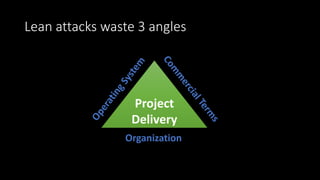
Lean attacks waste 3 angles
Project
Delivery
Organization
Integrated Project Delivery
Project
Delivery
Organization
Integrated Project Delivery (IPD)
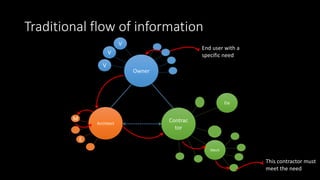
Traditional flow of information
Architect
Owner
Contrac
tor
Traditional flow of information
Architect
Owner
Contrac
tor
Ele
Mech
M
E
V
V
V
End user with a
specific need
This contractor must
meet the need
How do we Improve Information Flow?
RIGHT design, Less Rework, fewer RFIs and Change Orders
Early collaboration reduces the Project cost
Benefits of early team assembly
‒ Information is shared at the phase of
heights influence and low cost for
making changes
‒ High attention is given to high impact
activities that generate and exchange
information
Core Group
Lean Construction Arrangement
Owner
ContractorArchitect
Structural Steel
Alignment / Integration / Collaboration
Structural Engineer
Landscape Architect
Civil Engineer
Mechanical Engineer
Electrical Engineer
PHE EngineerAV Consultant
Interior Joinery
Electrical
HVAC
Fire Protection
Plumbing
Concrete
Concrete
Lean teams are different..
Traditional Approach Lean Approach
Silos – Task is #1 Team Structure Integrated – Project is first
Getting my part done Focus Customer Value
Command & Control Leadership Collaborative
Transactional Oriented Commitments Relational Oriented
Status quo –
Failures punished
Learning Innovation encouraged –
Failures are lessons
Isolated mainly to individuals Outcomes Shared as team
Integrated Project Delivery is the foundation of Lean
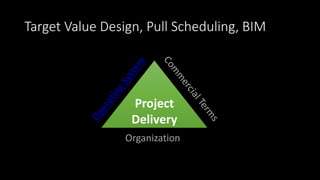
Target Value Design, Pull Scheduling, BIM
Project
Delivery
Organization
Lean Design focuses on Value
• The Target Value Design (TVD) Approach
‒ Design to detailed estimate, not estimating to a detailed design
‒ The design team is organized in clusters (MEP, Structure etc.,)
‒ Cost is element of design
‒ Each target cluster designs to a target cost
‒ The Cardinal rule: the Target cost can never be exceeded
• TVD benefits
‒ Reduces rework of redesign and value engineering
‒ Focuses team to make right decisions at the right time
Real value is not the low bid on a High cost design. It is the low True cost on the Right design
BIM Facilitates Collaborative Design
• The Building Information Modeling (BIM) approach
‒ Build virtually in 4D (time)
‒ Real Time cost in 5D
• BIM Benefits
‒ Reduces conflicts, misunderstandings, and change orders
‒ Enables innovation, prefabrication, and modularization
‒ Facilitates planning and logistics
Pull Planning Optimizes the schedule
Critical Path Programs offer a
great way for designers and
constructors to test the feasibility
of completing a program in a
given time frame. That is where
the utility stops. CPM is no way to
manage a program.
Pull Planning Optimizes the schedule
• The Pull Planning & Last Planner® Approach
‒ The objective is to create Reliable work flow
‒ Plans are made by those who execute the work
‒ Pull: plan and execute only what is needed for the next task
• The Benefits
‒ Effective work planning, scheduling and work sequencing
‒ Reliability allows Supt/Forman to plan instead of chasing down other trades
work & commitments
‒ Collaboration among trades that leads to innovation
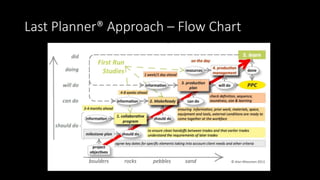
Last Planner® Approach
• Five Elements of Last Planner®
‒ Master Scheduling (setting milestones and strategy; identification of long
lead items);
‒ Phase "Pull" planning (specify handoffs; identify operational conflicts);
‒ Make Work Ready Planning (look ahead planning to ensure that work is
made ready for installation; re-planning as necessary);
‒ Weekly Work Planning (commitments to perform work in a certain manner
and a certain sequence); and
‒ Learning (measuring percent of plan complete (PPC), deep dive into reasons
for failure, developing and implementing lessons learned).
Last Planner® Approach – Flow Chart
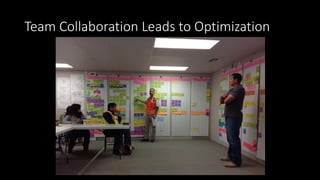
Team Collaboration Leads to Optimization
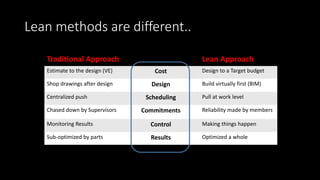
Lean methods are different..
Traditional Approach Lean Approach
Estimate to the design (VE) Cost Design to a Target budget
Shop drawings after design Design Build virtually first (BIM)
Centralized push Scheduling Pull at work level
Chased down by Supervisors Commitments Reliability made by members
Monitoring Results Control Making things happen
Sub-optimized by parts Results Optimized a whole
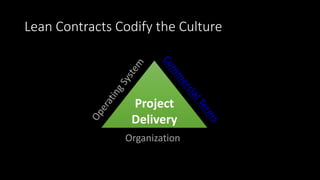
Lean Contracts Codify the Culture
Project
Delivery
Organization
Typical Construction Arrangement
A/E
Owner
Contract
This relationship has
become increasingly
ambiguity
Parties act
against each
other’s
interest
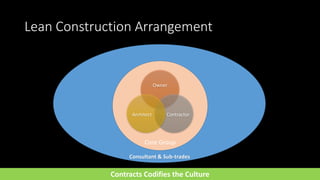
Core Group
Lean Construction Arrangement
Owner
ContractorArchitect
Consultant & Sub-trades
Contracts Codifies the Culture
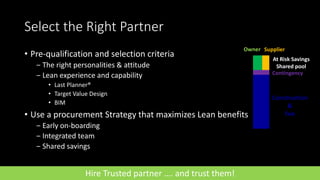
What about Risk?
OWNER SUPPLIER
Savings
Risk
Lump Sum
₹
Item Rate
₹
₹₹
Shared
Savings
At Risk Savings
Shared pool
Construction
&
Fee
Contingency
SupplierOwner
Select the Right Partner
• Pre-qualification and selection criteria
‒ The right personalities & attitude
‒ Lean experience and capability
• Last Planner®
• Target Value Design
• BIM
• Use a procurement Strategy that maximizes Lean benefits
‒ Early on-boarding
‒ Integrated team
‒ Shared savings
At Risk Savings
Shared pool
Construction
&
Fee
Contingency
SupplierOwner
Hire Trusted partner …. and trust them!
Lean methods are different..
Traditional Approach Lean Approach
Transactional Focus Relational
Commodities Suppliers Partners
Parochial Risk & Reward Shared
Rigid Finance Flexible
Adversarial Language Trust-Based
Low Bid Selection Best Value
We must be informed buyers of Lean supplier and be Lean in our internal behavior and process
The Core Lean Tools
• 5Ss (Sort, Straight/Set in Order, Sweep/Shine, Schedule/Standardize,
Sustain)
• Teams (Kaizen – “Change for the good” – Continues Improvement)
• Standard Work
• Value Stream Maps (Helps identifying waste)
• A3 Team Problem Solving
• Error Proofing/Mistake Proofing (Do it first time right!)
• Office and Process Cell (De-departmentalize … by project, customer,
product or value stream)
• Kanban (Inventory replenishment system)
Final Thought - The Commitment to change
"You take the blue pill, the story ends. You wake up in your bed and believe whatever you want to believe.
You take the red pill, you stay in wonderland, and I show you how deep the rabbit hole goes."
Courtesy of Warner Brothers Pictures
Reference
Presentation by Glenn Ballard to NCC in Gothenburg, Sweden in March 22, 2013
Eric Ahlstrom – Webinar on “Why Lean Construction”
Lean Construction Institute (LCI) – Website resources & training Material
Thank You!

Lean Construction_PMI_Nov 19, 2016

  • 1.
    Lean Construction Transforming currentforms of Project Management
  • 2.
    What do wewant in our projects? • Lower Costs • Better Schedules • Better Quality • Improved Project Team Environment Insanity: Doing the same thing over and over again and expecting different results - Albert Einstein
  • 3.
    Why do weneed a different approach? • Construction industry has fallen behind other industries for productivity improvement • Lean targets the Removal of behaviors and activities that contribute to Waste and loss of Productivity • Lean Construction brings the needed methodologies and culture for improvement Value added 62% Support Activity 12% Waste 26% Manufacturing Value Stream Value added, 10% Support Activity , 33% Waste, 57% Construction "Supply Chain" CII Data
  • 4.
    Global Challenges • Massurbanization – by 2030 there are likely to be 41 mega-cities of 10m+ people • Need 30% more water and 45% more energy • Buildings generate 40% carbon foot print
  • 5.
  • 6.
    Significant increase inconstruction volume • As per 12th Five-year plan estimated spend on construction industry is $ 1 Trillion, which is double of 11th Five-year plan • Share of private investment is about 50% in 12th Five-year plan compared to 30% in 11th Five-year plan
  • 7.
    According to theWorld Bank report, India’s construction industry is expected to face a labor shortage of 18-28% if the country grows at a medium rate and a shortage of nearly 55-60% if it sees high growth
  • 9.
    If the currenttrends continue, India could suffer a GDP loss of $200 Billions in the fiscal year 2017 due to inefficiencies - McKinsey 2009
  • 11.
    The Real EstateRegulation and Development Act, 2016(RERA), that came in to force on May 1, 2016 (Central Act 16 of 2016)
  • 12.
    What is LeanConstruction? • Definition of Lean ‒ A production approach that preserves Value with less Waste ‒ “To produce the right product at the right time in the right quantity for the customers and to provide exactly what you need and nothing more” Taiichi Ohno, Creator of Toyota Production System • Lean Construction ‒ A design and execution methodology to minimize Waste of material and effort in order to generate the maximum Value
  • 13.
    Value defined bythe customer Value added activity ‒ Pouring concrete ‒ Bolting structural steel in place Incidental support activity (Non-value added) ‒ Drawings and standards developed ‒ Order and invoicing process ‒ Reports and presentation ‒ Setting concrete forms ‒ Hoisting and positing of steel Waste (Non-value added) ‒ Waiting for information and decisions ‒ Design and filed rework ‒ Ineffective and too many meetings ‒ Storing and moving material
  • 14.
    Digging deeper intowaste The seven types of waste plus one ‒ Defects/rework/Reconciliation; scrap and fixing errors ‒ Transport; unnecessary material movement ‒ Motion; unnecessary and awkward movement ‒ Waiting; delay for an upstream activity to complete ‒ Inventory; excessive work in process inventory ‒ Over production; making more just in case ‒ Over processing; beyond what customer wants ‒ Unused human capital; lost innovation opportunities
  • 15.
    Waste is oftendifficult to see because… • People appear to be busy • We do not stop to look at the causes • There is a comfort in legacy systems and old ways
  • 16.
    Challenges for Lean…. • We are not Toyota • We are not manufacturing • We are not hospitals • We are not….
  • 17.
    Lean attacks waste3 angles Project Delivery Organization
  • 18.
  • 19.
    Traditional flow ofinformation Architect Owner Contrac tor
  • 20.
    Traditional flow ofinformation Architect Owner Contrac tor Ele Mech M E V V V End user with a specific need This contractor must meet the need
  • 21.
    How do weImprove Information Flow? RIGHT design, Less Rework, fewer RFIs and Change Orders
  • 22.
    Early collaboration reducesthe Project cost Benefits of early team assembly ‒ Information is shared at the phase of heights influence and low cost for making changes ‒ High attention is given to high impact activities that generate and exchange information
  • 23.
    Core Group Lean ConstructionArrangement Owner ContractorArchitect Structural Steel Alignment / Integration / Collaboration Structural Engineer Landscape Architect Civil Engineer Mechanical Engineer Electrical Engineer PHE EngineerAV Consultant Interior Joinery Electrical HVAC Fire Protection Plumbing Concrete Concrete
  • 24.
    Lean teams aredifferent.. Traditional Approach Lean Approach Silos – Task is #1 Team Structure Integrated – Project is first Getting my part done Focus Customer Value Command & Control Leadership Collaborative Transactional Oriented Commitments Relational Oriented Status quo – Failures punished Learning Innovation encouraged – Failures are lessons Isolated mainly to individuals Outcomes Shared as team Integrated Project Delivery is the foundation of Lean
  • 25.
    Target Value Design,Pull Scheduling, BIM Project Delivery Organization
  • 26.
    Lean Design focuseson Value • The Target Value Design (TVD) Approach ‒ Design to detailed estimate, not estimating to a detailed design ‒ The design team is organized in clusters (MEP, Structure etc.,) ‒ Cost is element of design ‒ Each target cluster designs to a target cost ‒ The Cardinal rule: the Target cost can never be exceeded • TVD benefits ‒ Reduces rework of redesign and value engineering ‒ Focuses team to make right decisions at the right time Real value is not the low bid on a High cost design. It is the low True cost on the Right design
  • 27.
    BIM Facilitates CollaborativeDesign • The Building Information Modeling (BIM) approach ‒ Build virtually in 4D (time) ‒ Real Time cost in 5D • BIM Benefits ‒ Reduces conflicts, misunderstandings, and change orders ‒ Enables innovation, prefabrication, and modularization ‒ Facilitates planning and logistics
  • 28.
    Pull Planning Optimizesthe schedule Critical Path Programs offer a great way for designers and constructors to test the feasibility of completing a program in a given time frame. That is where the utility stops. CPM is no way to manage a program.
  • 29.
    Pull Planning Optimizesthe schedule • The Pull Planning & Last Planner® Approach ‒ The objective is to create Reliable work flow ‒ Plans are made by those who execute the work ‒ Pull: plan and execute only what is needed for the next task • The Benefits ‒ Effective work planning, scheduling and work sequencing ‒ Reliability allows Supt/Forman to plan instead of chasing down other trades work & commitments ‒ Collaboration among trades that leads to innovation
  • 30.
    Last Planner® Approach •Five Elements of Last Planner® ‒ Master Scheduling (setting milestones and strategy; identification of long lead items); ‒ Phase "Pull" planning (specify handoffs; identify operational conflicts); ‒ Make Work Ready Planning (look ahead planning to ensure that work is made ready for installation; re-planning as necessary); ‒ Weekly Work Planning (commitments to perform work in a certain manner and a certain sequence); and ‒ Learning (measuring percent of plan complete (PPC), deep dive into reasons for failure, developing and implementing lessons learned).
  • 31.
  • 32.
    Team Collaboration Leadsto Optimization
  • 33.
    Lean methods aredifferent.. Traditional Approach Lean Approach Estimate to the design (VE) Cost Design to a Target budget Shop drawings after design Design Build virtually first (BIM) Centralized push Scheduling Pull at work level Chased down by Supervisors Commitments Reliability made by members Monitoring Results Control Making things happen Sub-optimized by parts Results Optimized a whole
  • 34.
    Lean Contracts Codifythe Culture Project Delivery Organization
  • 35.
    Typical Construction Arrangement A/E Owner Contract Thisrelationship has become increasingly ambiguity Parties act against each other’s interest
  • 36.
    Core Group Lean ConstructionArrangement Owner ContractorArchitect Consultant & Sub-trades Contracts Codifies the Culture
  • 37.
    What about Risk? OWNERSUPPLIER Savings Risk Lump Sum ₹ Item Rate ₹ ₹₹ Shared Savings At Risk Savings Shared pool Construction & Fee Contingency SupplierOwner
  • 38.
    Select the RightPartner • Pre-qualification and selection criteria ‒ The right personalities & attitude ‒ Lean experience and capability • Last Planner® • Target Value Design • BIM • Use a procurement Strategy that maximizes Lean benefits ‒ Early on-boarding ‒ Integrated team ‒ Shared savings At Risk Savings Shared pool Construction & Fee Contingency SupplierOwner Hire Trusted partner …. and trust them!
  • 39.
    Lean methods aredifferent.. Traditional Approach Lean Approach Transactional Focus Relational Commodities Suppliers Partners Parochial Risk & Reward Shared Rigid Finance Flexible Adversarial Language Trust-Based Low Bid Selection Best Value We must be informed buyers of Lean supplier and be Lean in our internal behavior and process
  • 40.
    The Core LeanTools • 5Ss (Sort, Straight/Set in Order, Sweep/Shine, Schedule/Standardize, Sustain) • Teams (Kaizen – “Change for the good” – Continues Improvement) • Standard Work • Value Stream Maps (Helps identifying waste) • A3 Team Problem Solving • Error Proofing/Mistake Proofing (Do it first time right!) • Office and Process Cell (De-departmentalize … by project, customer, product or value stream) • Kanban (Inventory replenishment system)
  • 41.
    Final Thought -The Commitment to change "You take the blue pill, the story ends. You wake up in your bed and believe whatever you want to believe. You take the red pill, you stay in wonderland, and I show you how deep the rabbit hole goes." Courtesy of Warner Brothers Pictures
  • 42.
    Reference Presentation by GlennBallard to NCC in Gothenburg, Sweden in March 22, 2013 Eric Ahlstrom – Webinar on “Why Lean Construction” Lean Construction Institute (LCI) – Website resources & training Material
  • 43.