Agenda
• Intro
• 5 S
• 7 wastes
• Value and Non Value Added
• Kanban
• Heijunka
• Jidoka
• Andon
• Poka Yoka
• TPM
• Kaizen
Intro
• Managing organization – science or art?
• The three stages
– Classification
– Correlation
– Effect-Cause-Effect
Astronomy
• Classification
• Correlation
– Ptolemy
– Nicolaus Copernicus
– Kepler
• Cause-Effect-Cause
– Isaac Newton
Astronomy
• The gravity law
Managing organizations
• Classification – MRP
• Correlation – Lean
Taiichi Ohno
• The beginning of TPS
• Toyota in the 80th
• What is the secret?
• Management excellence
Lean
• What is the effective production
• Toyota and Ford
• Flexibility
• Reduce the waste
Lean – how to improve
• Reduce the waste of time and resources
• Built in quality
• Better alternatives
• Improvements in the business processes
• Self-educated organization
5 S
5 S
• Sustain is the key
5 S
5 S
5 S
5 S
5 S
5 S
5 S
5 S
5 S
5 S
Value added and Non value added
1.Specify value from the standpoint of end
customer
2. Identify the value stream for each
product family
3. Make the product flow
4. So the customer can pull
5. As you manage toward perfection
Value added and Non value added
• How to search the VA and the NVA
• Muda
• Muri
• Mura
7 wastes
• Overproduction
• Waiting
• Transportation
• Processing
• Inventory
• Motion
• Defects
Overproduction
Waiting
Transportation
Processing
Inventory
Motion
Defects
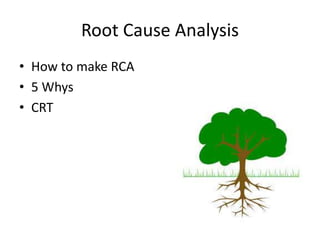
Root Cause Analysis
• How to make RCA
• 5 Whys
• CRT
Mass Production vs Lean
• Value added
• Large batch vs Short batch
• U shape cells
One-Piece-Flow
• Receive an order
• Group of machines and operators
Takt Time
• Why we need
• How to calculate
One-Piece-Flow
• Benefits:
– Built in quality
– Enhanced overall manufacturing flexibility
– Improves productivity
– Requires less space
– Ensures a safer work environment
– Improves employee morale
– Reduced Inventory
Pull vs Push
• Managing buffers
• Just-In-Time
Kanban
• Why we need it
• How does it work
• Examples from everyday
Kanban
Kanban
Kanban
Kanban
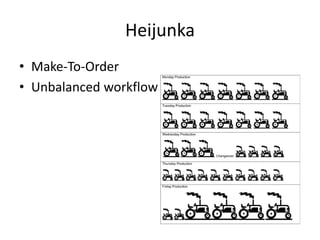
Heijunka
• Make-To-Order
• Unbalanced workflow
Muda, Muri and Mura
• Muda – non value added activities
• Muri - overburdening of people and
equipment
• Mura - unevenness in operations
Heijunka
• Reducing only Muda
• Disadvantages in unbalanced production
• Advantages in balanced production
Implementing Lean
• Eliminate the 7 wastes
• Work on the 3 M
• Heijunka - achieving a smoother production
flow
• MTO and Heijunka
Jidoka
• Principles of jidoka
- Discover an abnormality
- STOP
- Fix the immediate problem
- Investigate and correct root cause
Jidoka
• Built in quality
• Line stop
• Problem solving
Andon
Andon
Poka-Yoke
Poka-Yoke
Poka-Yoke
Poka-Yoke
Poka-Yoke
TPM
Total Productive Maintenance
• No Breakdowns
• No Small Stops or Slow Running
• No Defects
TPM model
Autonomous Maintenance
• Gives operators greater “ownership” of their
equipment.
• Increases operators’ knowledge of their
equipment.
• Ensures equipment is well-cleaned and
lubricated.
• Identifies emergent issues before they become
failures.
• Frees maintenance personnel for higher-level
tasks.
Planned Maintenance
• Significantly reduces instances of unplanned
down time.
• Enables most maintenance to be planned for
times when equipment is not scheduled for
production.
• Reduces inventory through better control of
wear-prone and failure-prone parts.
Quality Maintenance
• Specifically targets quality issues with
improvement projects focused on removing
root sources of defects.
• Reduces number of defects.
• Reduces cost by catching defects early (it is
expensive and unreliable to find defects
through inspection).
Focused Improvement
• Recurring problems are identified and
resolved by cross-functional teams.
• Combines the collective talents of a company
to create an engine for continuous
improvement.
Early Equipment Management
• New equipment reaches planned performance
levels much faster due to fewer startup issues.
• Maintenance is simpler and more robust due
to practical review and employee involvement
prior to installation.
Training and Education
• Operators develop skills to routinely maintain
equipment and identify emerging problems.
• Maintenance personnel learn techniques for
proactive and preventative maintenance.
• Managers are trained on TPM principles as
well as on employee coaching and
development.
Safety, Health, Environment
• Eliminates potential health and safety risks,
resulting in a safer workplace.
• Specifically targets the goal of an accident-free
workplace.
TPM in Administration
• Extends TPM benefits beyond the plant floor
by addressing waste in administrative
functions.
• Supports production through improved
administrative operations (e.g. order
processing, procurement, and scheduling).
OEE
OEE = Availability * Performance * Quality
Plant Operating Time
Planned Production Time
Operating Time
Net Operating Time
Fully Productive Time
pl.shut
down
downtime
speed loss
quality
loss
OEE
Availability =
Operating Time/Planned Production Time
Performance =
(Ideal Cycle Time * Total Pieces)/Operating Time
Quality = Good Pieces/Total Pieces
Kaizen
Thank you !
Eng. Vlady Velikov
vlady@improvinn.com
00359-885-833-629
www.improvinn.com

Lean basics