Lean Awareness
1
Objectives
By the end of this session you will be able to:
• Explain the five key principles in your own
words
• Recognise some of the basic Lean tools and
techniques
• Identify waste using the seven process wastes
2
3
4
5
6
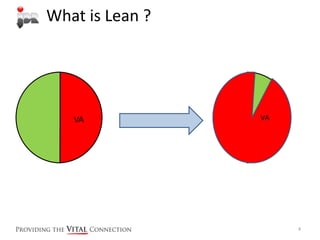
What is Lean ?
8
VA
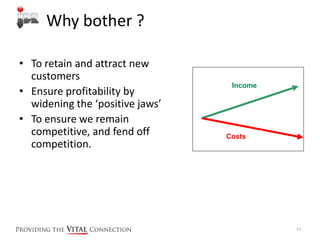
Why bother ?
11
• To retain and attract new
customers
• Ensure profitability by
widening the ‘positive jaws’
• To ensure we remain
competitive, and fend off
competition.
Income
Costs
13
1. Specify Value
14
Q C D
2. Identify the value stream
15
?
3. Create Flow
16
Lift transit time: 20 seconds Escalator transit time: 20 seconds
4. Create Pull
17
5. Seeking perfection
18
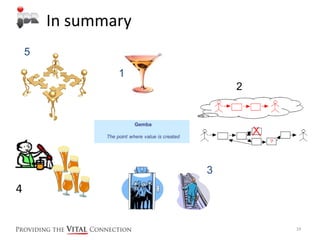
In summary
19
1
2
3
4
5
Tools and Techniques
20
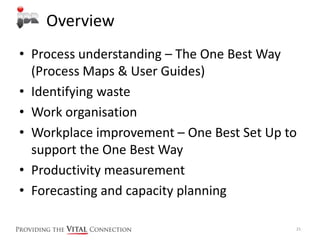
Overview
• Process understanding – The One Best Way
(Process Maps & User Guides)
• Identifying waste
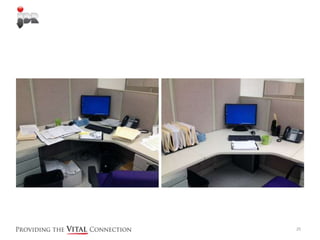
• Work organisation
• Workplace improvement – One Best Set Up to
support the One Best Way
• Productivity measurement
• Forecasting and capacity planning
21
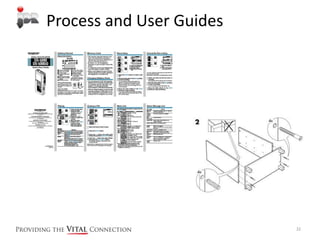
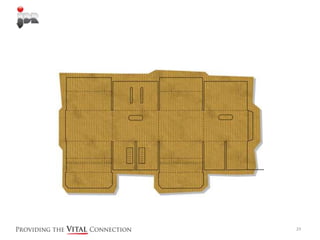
Process and User Guides
22
23
24
25
26
Waste
What is it?
• Waste (Muda) is anything that does not add value to the
customer. Identifying and removing waste will improve our value
stream, and help create flow and pull in our processes.
How does it work?
To help us manage waste we break it into two types:
• Type 1: waste we can identify, but cannot easily remove. This will
include geographical, IT and legislative constraints.
• Type 2: waste that we can eliminate now
27
7 forms of process waste
Transport-e.g moving work, hand offs between
departments
Inventory-e.g stock-too much
Motion-e.g walking to printer – on another floor?
Waiting e.g waiting for work-calls
Over Production e.g producing more than required
Over / Under Processing e.g checking the checkers
Defects e.g rejects/rework.
28
Visual management-Skills Matrix
Skills Matrix
I,L,U,O
29
Visual Management
QCD Board
30
Objectives
You are now able to:
• Explain the five key principles in your own
words
• Recognise some of the basic Lean tools and
techniques
• Identify waste using the seven process wastes
31

Lean awareness handouts

  • 1.
  • 2.
    Objectives By the endof this session you will be able to: • Explain the five key principles in your own words • Recognise some of the basic Lean tools and techniques • Identify waste using the seven process wastes 2
  • 3.
  • 4.
  • 5.
  • 6.
  • 7.
  • 8.
    Why bother ? 11 •To retain and attract new customers • Ensure profitability by widening the ‘positive jaws’ • To ensure we remain competitive, and fend off competition. Income Costs
  • 9.
  • 10.
  • 11.
    2. Identify thevalue stream 15 ?
  • 12.
    3. Create Flow 16 Lifttransit time: 20 seconds Escalator transit time: 20 seconds
  • 13.
  • 14.
  • 15.
  • 16.
  • 17.
    Overview • Process understanding– The One Best Way (Process Maps & User Guides) • Identifying waste • Work organisation • Workplace improvement – One Best Set Up to support the One Best Way • Productivity measurement • Forecasting and capacity planning 21
  • 18.
  • 19.
  • 20.
  • 21.
  • 22.
  • 23.
    Waste What is it? •Waste (Muda) is anything that does not add value to the customer. Identifying and removing waste will improve our value stream, and help create flow and pull in our processes. How does it work? To help us manage waste we break it into two types: • Type 1: waste we can identify, but cannot easily remove. This will include geographical, IT and legislative constraints. • Type 2: waste that we can eliminate now 27
  • 24.
    7 forms ofprocess waste Transport-e.g moving work, hand offs between departments Inventory-e.g stock-too much Motion-e.g walking to printer – on another floor? Waiting e.g waiting for work-calls Over Production e.g producing more than required Over / Under Processing e.g checking the checkers Defects e.g rejects/rework. 28
  • 25.
  • 26.
  • 27.
    Objectives You are nowable to: • Explain the five key principles in your own words • Recognise some of the basic Lean tools and techniques • Identify waste using the seven process wastes 31