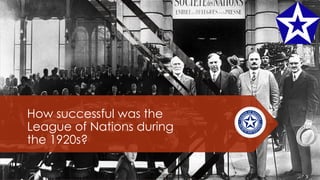
How successful was the
League of Nations during
the 1920s?
Introduction
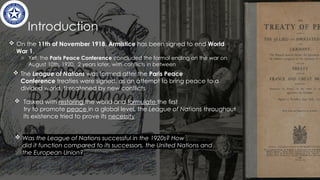
 On the 11th of November 1918, Armistice has been signed to end World
War 1.
o Yet, the Paris Peace Conference concluded the formal ending on the war on
August 10th, 1920, 2 years later, with conflicts in between
 The League of Nations was formed after the Paris Peace
Conference treaties were signed, as an attempt to bring peace to a
divided world, threatened by new conflicts ​
​
 Tasked with restoring the world and formulate the first
try to promote peace in a global level, the League of Nations throughout
its existence tried to prove its necessity​
​
 Was the League of Nations successful in the 1920s? How
did it function compared to its successors, the United Nations and
the European Union?​
Contents – twenty-nine slides
Committees and
Agencies
The League and the
World
Successes and
Failures: Case Study
Foundation of LoN Strengths &
Weaknesses
Structure of LoN
Aristide Briand, Premier of
France 11 times between 1909-
1929, awarded Nobel Peace
prize in 1926 for his
contribution in the League
Jean Monnet, the "father of
Europe", first deputy Secretary-
General of the League of
Nations, one of the main
founders and later critics of the
League's weaknesses
The League of
Nations, formed
 Prior to the existence of the League of Nations, a few
conferences existed to maintain European/Global
peace (Vienna Conference, Berlin Conference), in a
period known as Concert of Europe
 End of World War 1: It could be seen that this
concert failed, as it required more active
memberships without national driven sentiments
 28th June 1919: the Covenant of the League of
Nations was signed by the Big Three of the Paris
Peace Conference
 16 January 1920: Aiming over
disarmament, diplomatic negotiation,
commercial cooperation and preservation of
human rights, the League of Nations (LoN), came
to effect
Woodrow Wilson's Dream
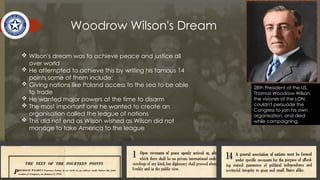
28th President of the US,
Thomas Woodrow Wilson
the visioner of the LON,
couldn't persuade the
Congress to join his own
organisation, and died
while campaigning.
 Wilson's dream was to achieve peace and justice all
over world
 He attempted to achieve this by writing his famous 14
points some of them include;
 Giving nations like Poland access to the sea to be able
to trade
 He wanted major powers at the time to disarm
 The most important one he wanted to create an
organisation called the league of nations
 This did not end as Wilson wished as Wilson did not
manage to take America to the league
Constitution/The Covenant
• The covenant was a document that outlined the
League's aims ,structures and methods of working
• The covenant was included in each of the
separate peace treaties
• Came into effect on January 10th, 1920
• Certain states like France and United Kingdom
became members of the league by signing the
covenant
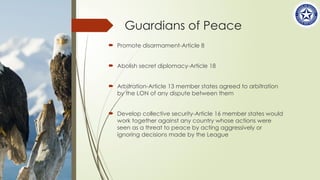
Guardians of Peace
 Promote disarmament-Article 8
 Abolish secret diplomacy-Article 18
 Arbitration-Article 13 member states agreed to arbitration
by the LON of any dispute between them
 Develop collective security-Article 16 member states would
work together against any country whose actions were
seen as a threat to peace by acting aggressively or
ignoring decisions made by the League
Major Weaknesses
of the league
One issue at the time was the absence
of a military force
Another big problem was the fact that
the league did not meet on a regular
basis and the conference was in a
remote place
The existence of another league called
the conference of ambassadors
containing all the major powers
Required individual decisive actions
that never came or came divided
The absence of the Americans from the
league
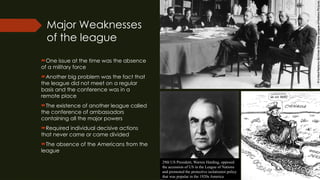
29th US President, Warren Harding, opposed
the accession of US in the League of Nations
and promoted the protective isolationist policy
that was popular in the 1920s America
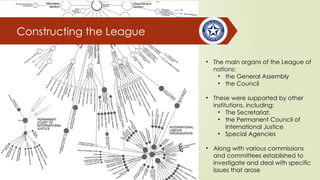
Constructing the League
• The main organs of the League of
nations:
• the General Assembly
• the Council
• These were supported by other
institutions, including:
• The Secretariat,
• the Permanent Council of
International Justice
• Special Agencies
• Along with various commissions
and committees established to
investigate and deal with specific
issues that arose
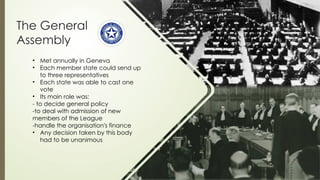
The General
Assembly
• Met annually in Geneva
• Each member state could send up
to three representatives
• Each state was able to cast one
vote
• Its main role was:
- to decide general policy
-to deal with admission of new
members of the League
-handle the organisation's finance
• Any decision taken by this body
had to be unanimous
The Council
• Its main function was to settle political disputes
between nations
• It held four ordinary sessions annually
• Decisions taken by the council had to be
unanimous
• The council was made up of permanent and non-
permanent members
• The four original permanent members were
Britain, France, Italy and Japan
• Initially there were four non-permanent members,
elected every three years
The Secretariat
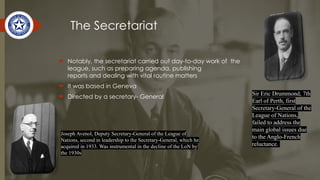
 Notably, the secretariat carried out day-to-day work of the
league, such as preparing agenda, publishing
reports and dealing with vital routine matters
 It was based in Geneva
 Directed by a secretary- General
Sir Eric Drummond, 7th
Earl of Perth, first
Secretary-General of the
League of Nations,
failed to address the
main global issues due
to the Anglo-French
reluctance.
Joseph Avenol, Deputy Secretary-General of the League of
Nations, second in leadership to the Secretary-General, which he
acquired in 1933. Was instrumental in the decline of the LoN by
the 1930s
Permanent Court of Justice
• Based at the Hague in the Netherlands
• It was designed to deal with legal disputes between
states
• The permanent court consisted of 15 judges of different
nationalities who were elected for a period of nine
years by the general assembly
• The court ran from 1922 to 1946
The Commissions and
Committees
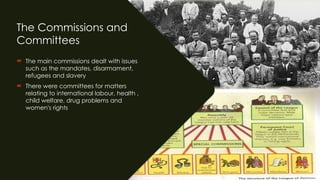
 The main commissions dealt with issues
such as the mandates, disarmament,
refugees and slavery
 There were committees for matters
relating to international labour, health ,
child welfare, drug problems and
women's rights
Agencies
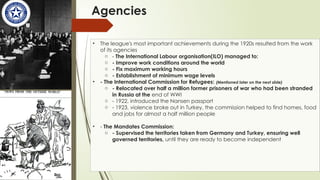
• The league's most important achievements during the 1920s resulted from the work
of its agencies
o - The International Labour organisation(ILO) managed to:
o - Improve work conditions around the world
o - Fix maximum working hours
o - Establishment of minimum wage levels
• - The International Commission for Refugees: (Mentioned later on the next slide)
o - Relocated over half a million former prisoners of war who had been stranded
in Russia at the end of WWI
o - 1922, introduced the Nansen passport
o - 1923, violence broke out in Turkey, the commission helped to find homes, food
and jobs for almost a half million people
• - The Mandates Commission:
o - Supervised the territories taken from Germany and Turkey, ensuring well
governed territories, until they are ready to become independent
The League and
Immigration
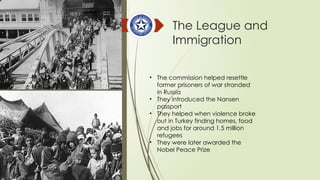
• The commission helped resettle
former prisoners of war stranded
in Russia
• They introduced the Nansen
passport
• They helped when violence broke
out in Turkey finding homes, food
and jobs for around 1.5 million
refugees
• They were later awarded the
Nobel Peace Prize
The League and financial
recovery
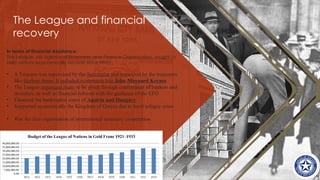
In terms of financial Assistance:​
The League, via agency of Economic and Finance Organization, sought to
help nations economically recover since WW1
• A Treasure was supervised by the Secretariat and organized by the treasurers
like Herbert Ames. It included economists like John Maynard Keynes
• The League organized loans to be given through conferences of bankers and
investors, as well as financial reforms with the guidance of the EFO
• Financed the bankrupted states of Austria and Hungary
• Supported economically the Kingdom of Greece due to local refugee crisis
• Was the first organisation of international monetary cooperation
The League and
Human Rights
- The League of Nations helped free 200 000 slaves
in places such as Sierra Leone and British Burma
(Modern Myanmar)
- 1930, the league investigated rumors of forced
labour in the independent Africa state of Liberia,
concluding that the president, Charles D.P. King
and senior government officials were guilty of
exploiting the situation, as a result the president
was forced to resign, and the League insisted for
the new government to carry out reforms.
- Had an important role on responding at women
and children exploitation
- These agencies continued to carry on the
important work during the 1930s
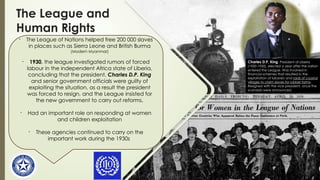
Charles D.P. King, President of Liberia
(1920-1930), elected a year after the nation
entered the League. Was involved in
financial schemes that resulted in the
exploitation of laborers and raids of coastal
villages to claim slaves for rubber farms.
Resigned with the vice president, once the
scandals were announced.
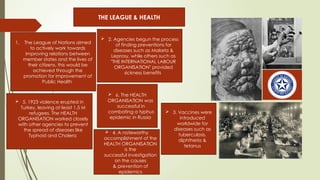
1. The League of Nations aimed
to actively work towards
improving relations between
member states and the lives of
their citizens, this would be
achieved through the
promotion for improvement of
Public Health
THE LEAGUE & HEALTH
 2. Agencies begun the process
of finding preventions for
diseases such as Malaria &
Leprosy, while others such as
"THE INTERNATIONAL LABOUR
ORGANISATION" provided
sickness benefits
 5. 1923 violence erupted in
Turkey, leaving at least 1.5 M
refugees. The HEALTH
ORGANISATION worked closely
with other agencies to prevent
the spread of diseases like
Typhoid and Cholera
 6. The HEALTH
ORGANISATION was
successful in
combating a typhus
epidemic in Russia
 4. A noteworthy
accomplishment of the
HEALTH ORGANISATION
is the
successful investigation
on the causes
& prevention of
epidemics
 3. Vaccines were
introduced
worldwide for
diseases such as
tuberculosis,
diphtheria &
tetanus
Case Studies: Resolving Disputes
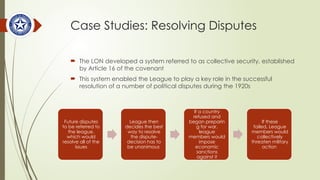
 The LON developed a system referred to as collective security, established
by Article 16 of the covenant
 This system enabled the League to play a key role in the successful
resolution of a number of political disputes during the 1920s
Future disputes
to be referred to
the league,
which would
resolve all of the
issues
League then
decides the best
way to resolve
the dispute-
decision has to
be unanimous
If a country
refused and
began preparin
g for war,
league
members would
impose
economic
sanctions
against it
If these
failed, League
members would
collectively
threaten military
action
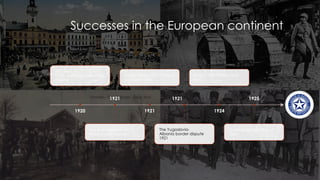
Successes in the European continent
1920
Teschen
1920- Czehoslovakia and
Poland
1921
The Aland islands 1921-
Finland and Sweden
1921
Upper Silesia 1921- Poland
and Germany
1921
The Yugoslavia-
Albania border dispute
1921
1924
Mosul 1924- Turkey and
Iraq
1925
Greco-Bulgarian War of
1925
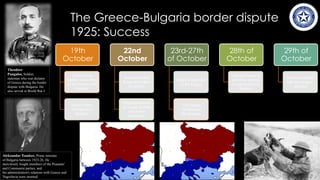
The Greece-Bulgaria border dispute
1925: Success
19th
October
Some Greek
soldiers were killed
on the border with
Bulgaria
Greece offers
Ultimatum to
Bulgaria
22nd
October
Greece invaded
Bulgaria-Incident
At Petrich
Bulgaria ordered
its troops to offer
only token
resistance
23rd-27th
of October
Bulgaria Appealed
to the League
The league
condemned
the invasion
28th of
October
Ordered Greece to
withdraw and pay
compensation to
Bulgaria
29th of
October
Greece complied
with the League's
decision
Theodore
Pangalos, Soldier,
stateman who was dictator
of Greece during the border
dispute with Bulgaria. He
also served in World War I
Aleksandar Tsankov, Prime minister
of Bulgaria between 1923-26. He
mercilessly fought members of the Peasants'
and Communist parties, and
his administration's relations with Greece and
Yugoslavia were strained
Corfu Incidence: Failure
In 1923, Italy blamed
Greece for the death of
three Italian officials
Mussolini demanded
compensation and
occupied Corfu
Greece appealed to the
LON
Mussolini refused to
accept, threatened to
withdraw Italy from the
League and referred the
matter instead to the
Council of Ambassadors
The Council decided that
Greece should pay
considerable
compensation to Italy
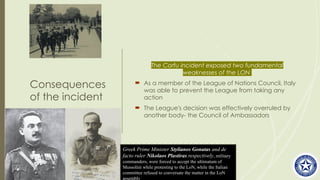
Consequences
of the incident
The Corfu incident exposed two fundamental
weaknesses of the LON
 As a member of the League of Nations Council, Italy
was able to prevent the League from taking any
action
 The League's decision was effectively overruled by
another body- the Council of Ambassadors
Greek Prime Minister Stylianos Gonatas and de
facto ruler Nikolaos Plastiras respectively, military
commanders, were forced to accept the ultimatum of
Mussolini while protesting to the LoN, while the Italian
committee refused to conversate the matter in the LoN
assembly
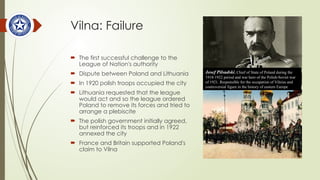
Vilna: Failure
 The first successful challenge to the
League of Nation's authority
 Dispute between Poland and Lithuania
 In 1920 polish troops occupied the city
 Lithuania requested that the league
would act and so the league ordered
Poland to remove its forces and tried to
arrange a plebiscite
 The polish government initially agreed,
but reinforced its troops and in 1922
annexed the city
 France and Britain supported Poland's
claim to Vilna
Josef Pilsudski, Chief of State of Poland during the
1918-1922 period and war hero of the Polish-Soviet war
of 1921. Responsible for the occupation of Vilnius and
controversial figure in the history of eastern Europe
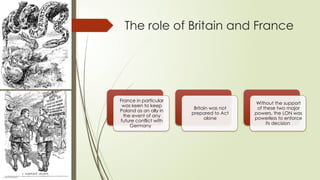
The role of Britain and France
France in particular
was keen to keep
Poland as an ally in
the event of any
future conflict with
Germany
Britain was not
prepared to Act
alone
Without the support
of these two major
powers, the LON was
powerless to enforce
its decision
League of Nations and Germany
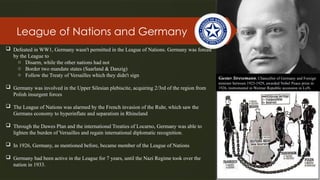
Gustav Stresemann, Chancellor of Germany and Foreign
minister between 1923-1929, awarded Nobel Peace prize in
1926, instrumental in Weimar Republic accession in LoN.
 Defeated in WW1, Germany wasn't permitted in the League of Nations. Germany was forced
by the League to
o Disarm, while the other nations had not
o Border two mandate states (Saarland & Danzig)
o Follow the Treaty of Versailles which they didn't sign
 Germany was involved in the Upper Silesian plebiscite, acquiring 2/3rd of the region from
Polish insurgent forces
 The League of Nations was alarmed by the French invasion of the Ruhr, which saw the
Germans economy to hyperinflate and separatism in Rhineland
 Through the Dawes Plan and the international Treaties of Locarno, Germany was able to
lighten the burden of Versailles and regain international diplomatic recognition.
 In 1926, Germany, as mentioned before, became member of the League of Nations
 Germany had been active in the League for 7 years, until the Nazi Regime took over the
nation in 1933.
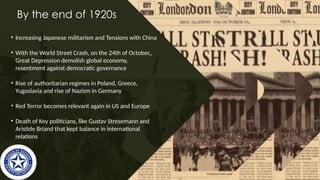
By the end of 1920s
• Increasing Japanese militarism and Tensions with China
• With the World Street Crash, on the 24th of October,,
Great Depression demolish global economy,
resentment against democratic governance
• Rise of authoritarian regimes in Poland, Greece,
Yugoslavia and rise of Nazism in Germany
• Red Terror becomes relevant again in US and Europe
• Death of Key politicians, like Gustav Stresemann and
Aristide Briand that kept balance in international
relations
Conclusion
• Between 1920 and 1930, the league was forced to deal with a plethora of
incidences and heal post-war wounds
o Some cases were successful at resolving disputes (Aland Island) and in
some not (Vilnius annexation)
• Its heritage is vital to the international cooperation, with own organisations
(ILO and Health committee) either remaining or getting modified, becoming
better following footsteps of their predecessors
• By 1930, it had managed to keep a respectable face
o Soon to change, as the 1930s prepared new dangers for the League
that made it mere puppet of its creators, leading to its cataclysmic
decline by 1936
• Its founding fathers pioneered in the creation of the United Nations and the
European Union
• Alas, have these communities of nations proven successful to their initial
aims?