LEADERSHIP Prepared By :   HITESH BAID
A Leadership Story: A group of workers and their leaders are set a task of clearing a road through a dense jungle on a remote island to get to the coast where an estuary provides a perfect site for a port.  The leaders organise the labour into efficient units and monitor the distribution and use of capital assets – progress is excellent. The leaders continue to monitor and evaluate progress, making adjustments along the way to ensure the progress is maintained and efficiency increased wherever possible.  Then, one day amidst all the hustle and bustle and activity, one person climbs up a nearby tree. The person surveys the scene from the top of the tree.
A Leadership Story: And shouts down to the assembled group below… “ Wrong Way!” (Story adapted from Stephen Covey (2004) “The Seven Habits of Highly Effective People” Simon & Schuster). “ Management is doing things right, leadership is doing the right things” (Warren Bennis and Peter Drucker)
LEADERSHIP IT IS THE PROCESS OF ENCOURAGING & HELPING OTHERS TO WORK ENTHUSIASTICALLY TOWARDS OBJECTIVES. IT IS THE RELATIONSHIP IN WHICH ONE PERSON(THE LEADER) INFLUENCES OTHERS TO WORK TOGETHER WILINGLY ON RELATED TASKS TO ATTAIN GOALS DESIRED BY THE LEADER & OR GROUP.
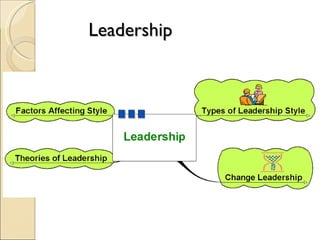
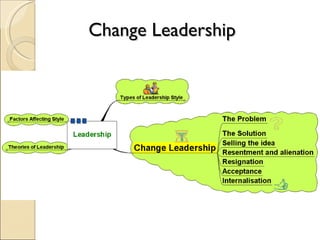
Leadership
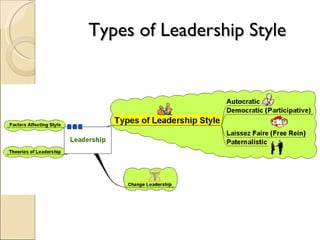
Types of Leadership Style
Types of Leadership Style Autocratic: Leader makes decisions without reference to anyone else High degree of dependency on the leader Can create de-motivation and alienation of staff May be valuable in some types of business where decisions need to be made quickly and decisively
Types of Leadership Style Democratic: Encourages decision making  from different perspectives – leadership may be emphasised throughout the organisation Consultative:  process of consultation before decisions are taken Persuasive:  Leader takes decision and seeks to persuade others that the decision is correct
Types of Leadership Style Democratic: May help motivation and involvement Workers feel ownership of the firm and its ideas Improves the sharing of ideas  and experiences within the business Can delay decision making
Types of Leadership Style Laissez-Faire: ‘ Let it be’ – the leadership responsibilities  are shared by all Can be very useful in businesses  where creative ideas are important Can be highly motivational,  as people have control over their working life Can make coordination and decision making  time-consuming and lacking in overall direction Relies on good team work Relies on good interpersonal relations
Types of Leadership Style Paternalistic: Leader acts as a ‘father figure’ Paternalistic leader makes decision but may consult Believes in the need to support staff
LEADERSHIP STYLES & THEIR IMPLICATIONS 4 TYPES 1.  STYLE  BASED ON THE  AMOUNT OF AUTHORITY  RETAINED BY LEADER 2.  STYLE BASED ON TASK VS.  PEOPLE EMPHASIS 3.  STYLE BASED ON  ASSUMPTIONS ABOUT PEOPLE 4.  ENTREPRENURSHIP  LEADERSHIP STYLE
1. STYLE BASED ON AMOUNT    OF  AUTHORITY A.  AUTHORITARIAN – RETENTION OF FULL AUTHORITY WITH LEADER. IF LEADER IS COMPETENT, ALL TASKS ARE EFFICIENTLY COMPLETED BECAUSE OF SAVING OF TWO WAY COMMUNICATION TIME.
STYLE BASED ON    AUTHORITY B. PARTICIPATIVE – 3 TYPES 1. CONSULTATIVE : LEADER SOLICIT OPINION BEFORE MAKING DECISION FROM A GROUP BUT DO NOT FEEL OBLIGED TO ACCEPT GROUP THINKING. LESS AUTHORITY VESTED WITH GROUP.
STYLE BASED ON    AUTHORITY 2. CONSENSUAL : LEADER ENCOURAGE GROUP DISCUSSION & CHOOSE GENERAL AGREEMENTED DECISIONS. MORE AUTHORITY VESTED WITH GROUP. 3. DEMOCRATIC : LEADER CONFER FINAL AUTHORITY TO GROUP , FUNCTION AS COLLECTORS OF OPINION & TAKE VOTE BEFORE MAKING OF DECISION. FULL AUTHORITY WITH GROUP.
STYLE BASED ON    AUTHORITY C. FREE REIN / LAISSEZ-FAIRE STYLE : IT ACTUALLY ABDICATES LEADER POSITION TO SOMEONE ELSE IN GROUP.POSITIVELY  IT WORKS IF GROUP HAS HIGHLY COMMITTED MEMBERS.
 
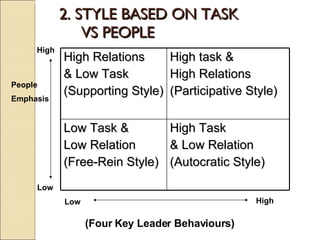
People  Emphasis High Low Low High (Four Key Leader Behaviours) 2. STYLE BASED ON TASK    VS PEOPLE High Relations  & Low Task (Supporting Style) High task & High Relations (Participative Style) Low Task & Low Relation (Free-Rein Style) High Task & Low Relation (Autocratic Style)
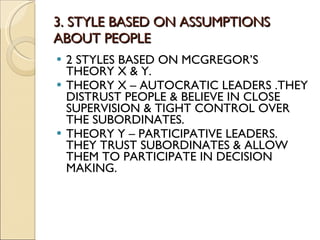
3. STYLE BASED ON ASSUMPTIONS ABOUT PEOPLE 2 STYLES BASED ON MCGREGOR’S THEORY X & Y. THEORY X – AUTOCRATIC LEADERS .THEY DISTRUST PEOPLE & BELIEVE IN CLOSE SUPERVISION & TIGHT CONTROL OVER THE SUBORDINATES. THEORY Y – PARTICIPATIVE LEADERS. THEY TRUST SUBORDINATES & ALLOW THEM TO PARTICIPATE IN DECISION MAKING.
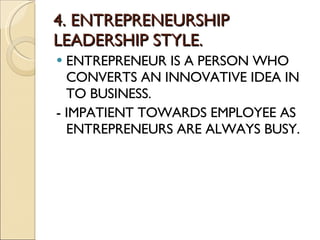
4. ENTREPRENEURSHIP LEADERSHIP STYLE. ENTREPRENEUR IS A PERSON WHO CONVERTS AN INNOVATIVE IDEA IN TO BUSINESS. - IMPATIENT TOWARDS EMPLOYEE AS ENTREPRENEURS ARE ALWAYS BUSY.
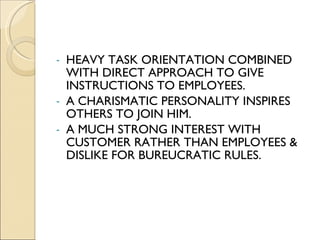
HEAVY TASK ORIENTATION COMBINED WITH DIRECT APPROACH TO GIVE INSTRUCTIONS TO EMPLOYEES. A CHARISMATIC PERSONALITY INSPIRES OTHERS TO JOIN HIM. A MUCH STRONG INTEREST WITH CUSTOMER RATHER THAN EMPLOYEES & DISLIKE FOR BUREUCRATIC RULES.
Change Leadership
Change Leadership The most challenging aspect of business is leading and managing change The business environment is subject to fast-paced economic and social change Modern business must adapt  and be flexible to survive Problems in leading change stem mainly from human resource management
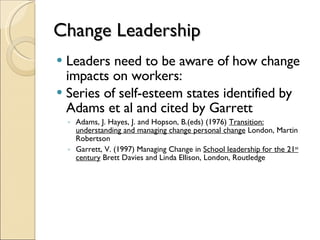
Change Leadership Leaders need to be aware of how change impacts on workers: Series of self-esteem states identified by Adams et al and cited by Garrett Adams, J. Hayes, J. and Hopson, B.(eds) (1976)  Transition: understanding and managing change personal change  London, Martin Robertson Garrett, V. (1997) Managing Change in  School leadership for the 21 st  century  Brett Davies and Linda Ellison, London, Routledge
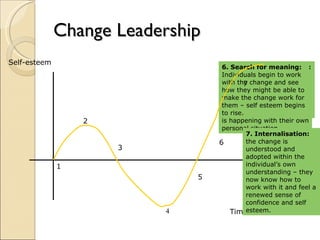
Change Leadership Self-esteem Time 1. Immobilisation  – as rumours of the change circulate, the individual feels some sense of shock and possible disbelief – so much so that they deem it worthy of doing nothing. 1 2. Minimisation:  As the change becomes clearer, people try to fit in the change with their own personal position and may try to believe that it will not affect them. 2 3. Depression:  as reality begins to dawn staff may feel alienated and angry, feelings of a lack of control of events overtake people and they feel depressed as they try to reconcile what is happening with their own personal situation. 3 4 4. Acceptance/letting go:  The lowest point in self-esteem finally sees people starting to accept the inevitable. Fear of the future is a feature of this stage. 5 5. Testing out:  Individuals begin to interact with the change, they start to ask questions to see how they might work with the change. 6 6. Search for meaning:  Individuals begin to work with the change and see how they might be able to make the change work for them – self esteem begins to rise. 7 7. Internalisation:  the change is understood and adopted within the individual’s own understanding – they now know how to work with it and feel a renewed sense of confidence and self esteem.
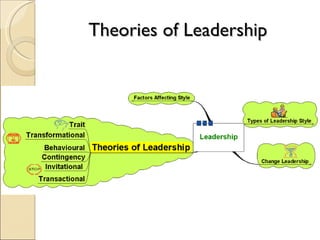
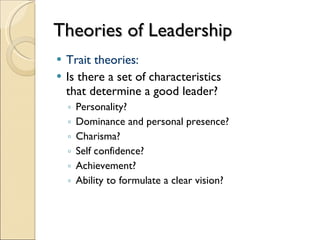
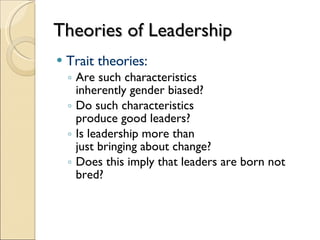
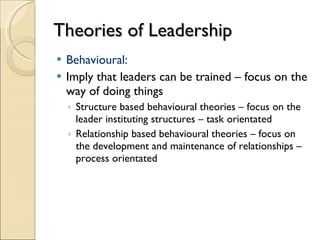
Theories of Leadership
Theories of Leadership Trait theories: Is there a set of characteristics  that determine a good leader? Personality? Dominance and personal presence? Charisma? Self confidence? Achievement? Ability to formulate a clear vision?
Theories of Leadership Trait theories: Are such characteristics  inherently gender biased? Do such characteristics  produce good leaders? Is leadership more than  just bringing about change? Does this imply that leaders are born not bred?
Theories of Leadership Behavioural: Imply that leaders can be trained – focus on the way of doing things Structure based behavioural theories – focus on the leader instituting structures – task orientated Relationship based behavioural theories – focus on the development and maintenance of relationships – process orientated
Theories of Leadership Contingency Theories: Leadership as being more flexible – different leadership styles used at different times depending on the circumstance. Suggests leadership is not a fixed series of characteristics that can be transposed into different contexts
Theories of Leadership May depend on: Type of staff History of the business Culture of the business Quality of the relationships Nature of the changes needed Accepted norms within the institution
Theories of Leadership Transformational: Widespread changes  to a business or organisation Requires: Long term strategic planning Clear objectives Clear vision Leading by example – walk the walk Efficiency of systems and processes
Theories of Leadership Invitational Leadership: Improving the atmosphere and message sent out by the organisation Focus on reducing negative messages  sent out through the everyday actions of the business both externally and, crucially, internally Review internal processes to reduce these Build relationships and sense of belonging and identity with the organisation –  that gets communicated to customers, etc.
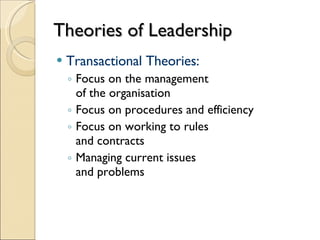
Theories of Leadership Transactional Theories: Focus on the management  of the organisation Focus on procedures and efficiency Focus on working to rules  and contracts Managing current issues  and problems
Factors Affecting Style
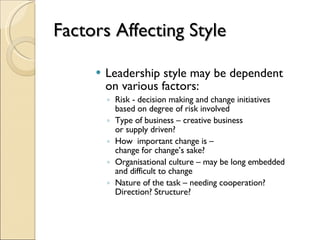
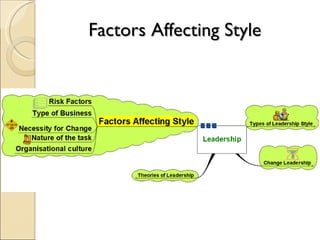
Factors Affecting Style Leadership style may be dependent  on various factors: Risk - decision making and change initiatives  based on degree of risk involved Type of business – creative business  or supply driven? How  important change is –  change for change’s sake? Organisational culture – may be long embedded  and difficult to change Nature of the task – needing cooperation? Direction? Structure?
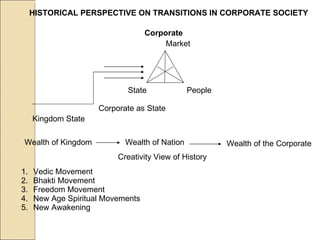
HISTORICAL PERSPECTIVE ON TRANSITIONS IN CORPORATE SOCIETY Kingdom State Corporate Corporate as State State People Market Wealth of Kingdom Wealth of Nation Wealth of the Corporate Creativity View of History Vedic Movement Bhakti Movement Freedom Movement New Age Spiritual Movements New Awakening
The Right Leadership Style ------------------------------------  Harvard - 6 Styles suits to most occasions DIRECTIVE – Command & Control Behaviour. Tell – What to do? When to do? What will happen if you fail? Appropriate in Crisis or managing poor performers. VISIONARY – Authoritative but instead of simply explaining more elaboration given to employees on challenges & responsibilities so that goals are clear and commitment increases. Used by people  with high personalize power drive under low stress situations & high socialised power drive when stress is high.
III. AFFILATIVE – EMPHASIZE the employees & his / her emotional needs over the job. Tend to avoid conflict. Most effective when used in combination  Visionary, Participative or coaching Styles. Also when manager deals  employees who are in midst of personal crisis / high stress situations. IV. PARTICIPATIVE  Collaborative & Democratic. Engage others in Decision-making process. Great for building trust & consensus, especially when team has highly competent individuals when leader has limited knowledge or lacks formal power & Authority. Favored by leaders  High Affiliation drives.
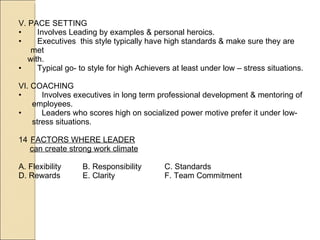
V. PACE SETTING Involves Leading by examples & personal heroics. Executives  this style typically have high standards & make sure they are met with. Typical go- to style for high Achievers at least under low – stress situations. VI. COACHING Involves executives in long term professional development & mentoring of employees. Leaders who scores high on socialized power motive prefer it under low- stress situations. FACTORS WHERE LEADER   can create strong work climate A. Flexibility B. Responsibility   C. Standards   D. Rewards E. Clarity    F. Team Commitment

Leadership

  • 1.
  • 2.
    A Leadership Story:A group of workers and their leaders are set a task of clearing a road through a dense jungle on a remote island to get to the coast where an estuary provides a perfect site for a port. The leaders organise the labour into efficient units and monitor the distribution and use of capital assets – progress is excellent. The leaders continue to monitor and evaluate progress, making adjustments along the way to ensure the progress is maintained and efficiency increased wherever possible. Then, one day amidst all the hustle and bustle and activity, one person climbs up a nearby tree. The person surveys the scene from the top of the tree.
  • 3.
    A Leadership Story:And shouts down to the assembled group below… “ Wrong Way!” (Story adapted from Stephen Covey (2004) “The Seven Habits of Highly Effective People” Simon & Schuster). “ Management is doing things right, leadership is doing the right things” (Warren Bennis and Peter Drucker)
  • 4.
    LEADERSHIP IT ISTHE PROCESS OF ENCOURAGING & HELPING OTHERS TO WORK ENTHUSIASTICALLY TOWARDS OBJECTIVES. IT IS THE RELATIONSHIP IN WHICH ONE PERSON(THE LEADER) INFLUENCES OTHERS TO WORK TOGETHER WILINGLY ON RELATED TASKS TO ATTAIN GOALS DESIRED BY THE LEADER & OR GROUP.
  • 5.
  • 6.
  • 7.
    Types of LeadershipStyle Autocratic: Leader makes decisions without reference to anyone else High degree of dependency on the leader Can create de-motivation and alienation of staff May be valuable in some types of business where decisions need to be made quickly and decisively
  • 8.
    Types of LeadershipStyle Democratic: Encourages decision making from different perspectives – leadership may be emphasised throughout the organisation Consultative: process of consultation before decisions are taken Persuasive: Leader takes decision and seeks to persuade others that the decision is correct
  • 9.
    Types of LeadershipStyle Democratic: May help motivation and involvement Workers feel ownership of the firm and its ideas Improves the sharing of ideas and experiences within the business Can delay decision making
  • 10.
    Types of LeadershipStyle Laissez-Faire: ‘ Let it be’ – the leadership responsibilities are shared by all Can be very useful in businesses where creative ideas are important Can be highly motivational, as people have control over their working life Can make coordination and decision making time-consuming and lacking in overall direction Relies on good team work Relies on good interpersonal relations
  • 11.
    Types of LeadershipStyle Paternalistic: Leader acts as a ‘father figure’ Paternalistic leader makes decision but may consult Believes in the need to support staff
  • 12.
    LEADERSHIP STYLES &THEIR IMPLICATIONS 4 TYPES 1. STYLE BASED ON THE AMOUNT OF AUTHORITY RETAINED BY LEADER 2. STYLE BASED ON TASK VS. PEOPLE EMPHASIS 3. STYLE BASED ON ASSUMPTIONS ABOUT PEOPLE 4. ENTREPRENURSHIP LEADERSHIP STYLE
  • 13.
    1. STYLE BASEDON AMOUNT OF AUTHORITY A. AUTHORITARIAN – RETENTION OF FULL AUTHORITY WITH LEADER. IF LEADER IS COMPETENT, ALL TASKS ARE EFFICIENTLY COMPLETED BECAUSE OF SAVING OF TWO WAY COMMUNICATION TIME.
  • 14.
    STYLE BASED ON AUTHORITY B. PARTICIPATIVE – 3 TYPES 1. CONSULTATIVE : LEADER SOLICIT OPINION BEFORE MAKING DECISION FROM A GROUP BUT DO NOT FEEL OBLIGED TO ACCEPT GROUP THINKING. LESS AUTHORITY VESTED WITH GROUP.
  • 15.
    STYLE BASED ON AUTHORITY 2. CONSENSUAL : LEADER ENCOURAGE GROUP DISCUSSION & CHOOSE GENERAL AGREEMENTED DECISIONS. MORE AUTHORITY VESTED WITH GROUP. 3. DEMOCRATIC : LEADER CONFER FINAL AUTHORITY TO GROUP , FUNCTION AS COLLECTORS OF OPINION & TAKE VOTE BEFORE MAKING OF DECISION. FULL AUTHORITY WITH GROUP.
  • 16.
    STYLE BASED ON AUTHORITY C. FREE REIN / LAISSEZ-FAIRE STYLE : IT ACTUALLY ABDICATES LEADER POSITION TO SOMEONE ELSE IN GROUP.POSITIVELY IT WORKS IF GROUP HAS HIGHLY COMMITTED MEMBERS.
  • 17.
  • 18.
    People EmphasisHigh Low Low High (Four Key Leader Behaviours) 2. STYLE BASED ON TASK VS PEOPLE High Relations & Low Task (Supporting Style) High task & High Relations (Participative Style) Low Task & Low Relation (Free-Rein Style) High Task & Low Relation (Autocratic Style)
  • 19.
    3. STYLE BASEDON ASSUMPTIONS ABOUT PEOPLE 2 STYLES BASED ON MCGREGOR’S THEORY X & Y. THEORY X – AUTOCRATIC LEADERS .THEY DISTRUST PEOPLE & BELIEVE IN CLOSE SUPERVISION & TIGHT CONTROL OVER THE SUBORDINATES. THEORY Y – PARTICIPATIVE LEADERS. THEY TRUST SUBORDINATES & ALLOW THEM TO PARTICIPATE IN DECISION MAKING.
  • 20.
    4. ENTREPRENEURSHIP LEADERSHIPSTYLE. ENTREPRENEUR IS A PERSON WHO CONVERTS AN INNOVATIVE IDEA IN TO BUSINESS. - IMPATIENT TOWARDS EMPLOYEE AS ENTREPRENEURS ARE ALWAYS BUSY.
  • 21.
    HEAVY TASK ORIENTATIONCOMBINED WITH DIRECT APPROACH TO GIVE INSTRUCTIONS TO EMPLOYEES. A CHARISMATIC PERSONALITY INSPIRES OTHERS TO JOIN HIM. A MUCH STRONG INTEREST WITH CUSTOMER RATHER THAN EMPLOYEES & DISLIKE FOR BUREUCRATIC RULES.
  • 22.
  • 23.
    Change Leadership Themost challenging aspect of business is leading and managing change The business environment is subject to fast-paced economic and social change Modern business must adapt and be flexible to survive Problems in leading change stem mainly from human resource management
  • 24.
    Change Leadership Leadersneed to be aware of how change impacts on workers: Series of self-esteem states identified by Adams et al and cited by Garrett Adams, J. Hayes, J. and Hopson, B.(eds) (1976) Transition: understanding and managing change personal change London, Martin Robertson Garrett, V. (1997) Managing Change in School leadership for the 21 st century Brett Davies and Linda Ellison, London, Routledge
  • 25.
    Change Leadership Self-esteemTime 1. Immobilisation – as rumours of the change circulate, the individual feels some sense of shock and possible disbelief – so much so that they deem it worthy of doing nothing. 1 2. Minimisation: As the change becomes clearer, people try to fit in the change with their own personal position and may try to believe that it will not affect them. 2 3. Depression: as reality begins to dawn staff may feel alienated and angry, feelings of a lack of control of events overtake people and they feel depressed as they try to reconcile what is happening with their own personal situation. 3 4 4. Acceptance/letting go: The lowest point in self-esteem finally sees people starting to accept the inevitable. Fear of the future is a feature of this stage. 5 5. Testing out: Individuals begin to interact with the change, they start to ask questions to see how they might work with the change. 6 6. Search for meaning: Individuals begin to work with the change and see how they might be able to make the change work for them – self esteem begins to rise. 7 7. Internalisation: the change is understood and adopted within the individual’s own understanding – they now know how to work with it and feel a renewed sense of confidence and self esteem.
  • 26.
  • 27.
    Theories of LeadershipTrait theories: Is there a set of characteristics that determine a good leader? Personality? Dominance and personal presence? Charisma? Self confidence? Achievement? Ability to formulate a clear vision?
  • 28.
    Theories of LeadershipTrait theories: Are such characteristics inherently gender biased? Do such characteristics produce good leaders? Is leadership more than just bringing about change? Does this imply that leaders are born not bred?
  • 29.
    Theories of LeadershipBehavioural: Imply that leaders can be trained – focus on the way of doing things Structure based behavioural theories – focus on the leader instituting structures – task orientated Relationship based behavioural theories – focus on the development and maintenance of relationships – process orientated
  • 30.
    Theories of LeadershipContingency Theories: Leadership as being more flexible – different leadership styles used at different times depending on the circumstance. Suggests leadership is not a fixed series of characteristics that can be transposed into different contexts
  • 31.
    Theories of LeadershipMay depend on: Type of staff History of the business Culture of the business Quality of the relationships Nature of the changes needed Accepted norms within the institution
  • 32.
    Theories of LeadershipTransformational: Widespread changes to a business or organisation Requires: Long term strategic planning Clear objectives Clear vision Leading by example – walk the walk Efficiency of systems and processes
  • 33.
    Theories of LeadershipInvitational Leadership: Improving the atmosphere and message sent out by the organisation Focus on reducing negative messages sent out through the everyday actions of the business both externally and, crucially, internally Review internal processes to reduce these Build relationships and sense of belonging and identity with the organisation – that gets communicated to customers, etc.
  • 34.
    Theories of LeadershipTransactional Theories: Focus on the management of the organisation Focus on procedures and efficiency Focus on working to rules and contracts Managing current issues and problems
  • 35.
  • 36.
    Factors Affecting StyleLeadership style may be dependent on various factors: Risk - decision making and change initiatives based on degree of risk involved Type of business – creative business or supply driven? How important change is – change for change’s sake? Organisational culture – may be long embedded and difficult to change Nature of the task – needing cooperation? Direction? Structure?
  • 37.
    HISTORICAL PERSPECTIVE ONTRANSITIONS IN CORPORATE SOCIETY Kingdom State Corporate Corporate as State State People Market Wealth of Kingdom Wealth of Nation Wealth of the Corporate Creativity View of History Vedic Movement Bhakti Movement Freedom Movement New Age Spiritual Movements New Awakening
  • 38.
    The Right LeadershipStyle ------------------------------------ Harvard - 6 Styles suits to most occasions DIRECTIVE – Command & Control Behaviour. Tell – What to do? When to do? What will happen if you fail? Appropriate in Crisis or managing poor performers. VISIONARY – Authoritative but instead of simply explaining more elaboration given to employees on challenges & responsibilities so that goals are clear and commitment increases. Used by people with high personalize power drive under low stress situations & high socialised power drive when stress is high.
  • 39.
    III. AFFILATIVE –EMPHASIZE the employees & his / her emotional needs over the job. Tend to avoid conflict. Most effective when used in combination Visionary, Participative or coaching Styles. Also when manager deals employees who are in midst of personal crisis / high stress situations. IV. PARTICIPATIVE Collaborative & Democratic. Engage others in Decision-making process. Great for building trust & consensus, especially when team has highly competent individuals when leader has limited knowledge or lacks formal power & Authority. Favored by leaders High Affiliation drives.
  • 40.
    V. PACE SETTINGInvolves Leading by examples & personal heroics. Executives this style typically have high standards & make sure they are met with. Typical go- to style for high Achievers at least under low – stress situations. VI. COACHING Involves executives in long term professional development & mentoring of employees. Leaders who scores high on socialized power motive prefer it under low- stress situations. FACTORS WHERE LEADER can create strong work climate A. Flexibility B. Responsibility C. Standards D. Rewards E. Clarity F. Team Commitment