The
                                             Management
                                             Process Today

                                                   Chapter One


McGraw-Hill/Irwin   Copyright © 2011 by the McGraw-Hill Companies, Inc. All rights reserved.
What is Management?

• Management
  – The planning, organizing, leading, and
    controlling of human and other resources to
    achieve organizational goals effectively and
    efficiently


                                                   1-2
What is Management?
• Organizations
  – Collections of people who work together and coordinate
    their actions to achieve a wide variety of goals


                                                             1-3
What is Management?

• Managers
  – The people responsible for supervising the use of
    an organization’s resources to meet its goals
  – Resources include people, skills, know-how,
    machinery, raw materials, computers and IT,
    and financial capital


                                                        1-4
Achieving High Performance

• Organizational Performance
  – A measure of how efficiently and effectively
    managers use organizational resources to satisfy
    customers and achieve goals


                                                       1-5
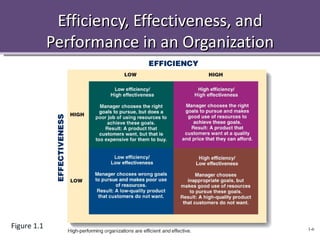
Efficiency, Effectiveness, and
             Performance in an Organization


Figure 1.1                                     1-6
Organizational Performance
• Efficiency                 • Effectiveness
   – A measure of how well      – A measure of the
     or productively              appropriateness of the
     resources are used to        goals an organization is
     achieve a goal               pursuing and the degree
                                  to which they are
                                  achieved.


                                                             1-7
Why study management?

• The more effective and efficient use an organization
  can make of resources, the greater the relative well-
  being of people
• Almost all of us encounter managers because most
  people have jobs and bosses
• Understanding management is one important path
  toward obtaining a satisfying career


                                                          1-8
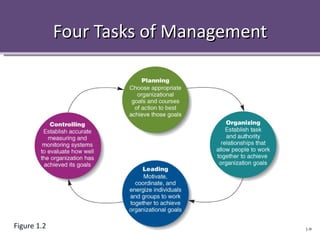
Four Tasks of Management


Figure 1.2                              1-9
Planning
• Planning
  – Process of identifying and selecting appropriate
    goals and courses of action


                                                       1-10
Organizing

• Organizing
  – structuring working relationships so organizational
    members interact and cooperate to achieve
    organizational goals.


                                                          1-11
Leading

• Leading
  – Articulating a clear vision and energizing and
    enabling organizational members so they
    understand the part they play in attaining
    organizational goals


                                                     1-12
Controlling

• Controlling
   – Evaluating how well an organization is achieving
     its goals and taking action to maintain or improve
     performance


• The outcome of the control process is the ability to
  measure performance accurately and regulate
  efficiency and effectiveness

                                                          1-13
Levels and Skills of Managers

• Department
  – A group of people who work together and
    possess similar skills or use the same knowledge,
    tools, or techniques to perform their jobs


                                                        1-14
Levels of Management

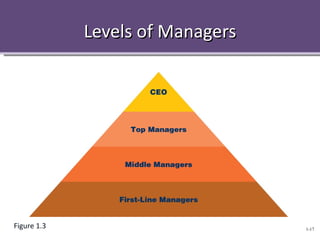
• First line managers
  – Responsible for the daily supervision of non-
    managerial employees
• Middle managers
  – Supervise first-line managers and are responsible
    for finding the best way to use resources to
    achieve organizational goals


                                                        1-15
Levels of Management

• Top managers
  – establish organizational goals, decide how
    departments should interact, and monitor the
    performance of middle managers


                                                   1-16
Levels of Managers


Figure 1.3                        1-17
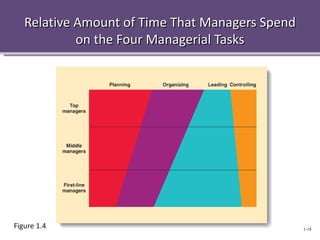
Relative Amount of Time That Managers Spend
            on the Four Managerial Tasks


Figure 1.4                                       1-18
Levels of Managers

• Top-management team
  – group composed of the CEO, COO, and the heads
    of the most important departments


                                                    1-19
Managerial Skills

• Conceptual skills
   – The ability to analyze and diagnose a situation and
     distinguish between cause and effect.
• Human skills
   – The ability to understand, alter, lead, and control the
     behavior of other individuals and groups.
• Technical skills
   – The specific knowledge and techniques required to
     perform an organizational role.


                                                               1-20
Technical Skills

• Core competency
  – Specific set of skills, abilities, and experiences that
    allows one organization to outperform its
    competitors


                                                              1-21
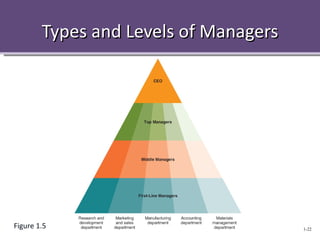
Types and Levels of Managers


Figure 1.5                             1-22
Recent Changes in Management Practices

• Restructuring
  – downsizing an organization by eliminating the jobs
    of large numbers of top, middle, or first-line
    managers and non-managerial employees


                                                         1-23
Recent Changes in Management Practices

• Outsourcing
   – contracting with another company, usually in a
     low cost country abroad, to perform an activity
     the company previously performed itself


• Increases efficiency because it lowers operating
  costs, freeing up money and resources that can be
  used in more effective ways

                                                       1-24
Empowerment and Self-Managed
            Teams
• Empowerment
  – Expansion of employees’ knowledge, tasks, and decision-
    making responsibilities


                                                              1-25
Empowerment and Self-Managed Teams

• Self-managed team
  – a group of employees with the responsibility for
    organizing, controlling, and supervising their own
    activities and for monitoring the quality of the
    goods and services they provide


                                                         1-26
Challenges for Management in
         a Global Environment
• Rise of Global            • Managing a Diverse
  Organizations.              Workforce
• Building a Competitive    • Utilizing IT and E-
  Advantage                   Commerce
• Maintaining Ethical and   • Practicing Global Crisis
  Socially Responsible        Management
  Standards


                                                         1-27
Challenges for Management in
          a Global Environment
• Global organizations
  – organizations that operate and compete in more
    than one country


                                                     1-28
Building Competitive Advantage

• Competitive advantage
  – Ability of one organization to outperform other
    organizations because it produces desired goods
    or services more efficiently and effectively than
    they do


                                                        1-29
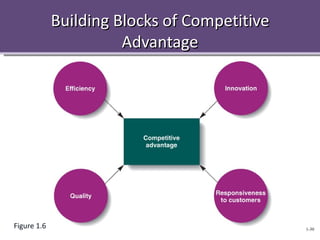
Building Blocks of Competitive
                       Advantage


Figure 1.6                                    1-30
Building a Competitive Advantage

• Innovation
  – process of creating new or improved goods and
    services or developing better ways to produce or
    provide them


                                                       1-31
Practicing Global Crisis Management

Crisis management involves making important
    choices about how to:
2. Create teams to facilitate rapid decision making
   and communication
3. Establish the organizational chain of command
4. Recruit and select the right people
5. Develop bargaining and negotiating strategies to
   manage conflicts


                                                      1-32

Management process today

  • 1.
    The Management Process Today Chapter One McGraw-Hill/Irwin Copyright © 2011 by the McGraw-Hill Companies, Inc. All rights reserved.
  • 2.
    What is Management? •Management – The planning, organizing, leading, and controlling of human and other resources to achieve organizational goals effectively and efficiently 1-2
  • 3.
    What is Management? •Organizations – Collections of people who work together and coordinate their actions to achieve a wide variety of goals 1-3
  • 4.
    What is Management? •Managers – The people responsible for supervising the use of an organization’s resources to meet its goals – Resources include people, skills, know-how, machinery, raw materials, computers and IT, and financial capital 1-4
  • 5.
    Achieving High Performance •Organizational Performance – A measure of how efficiently and effectively managers use organizational resources to satisfy customers and achieve goals 1-5
  • 6.
    Efficiency, Effectiveness, and Performance in an Organization Figure 1.1 1-6
  • 7.
    Organizational Performance • Efficiency • Effectiveness – A measure of how well – A measure of the or productively appropriateness of the resources are used to goals an organization is achieve a goal pursuing and the degree to which they are achieved. 1-7
  • 8.
    Why study management? •The more effective and efficient use an organization can make of resources, the greater the relative well- being of people • Almost all of us encounter managers because most people have jobs and bosses • Understanding management is one important path toward obtaining a satisfying career 1-8
  • 9.
    Four Tasks ofManagement Figure 1.2 1-9
  • 10.
    Planning • Planning – Process of identifying and selecting appropriate goals and courses of action 1-10
  • 11.
    Organizing • Organizing – structuring working relationships so organizational members interact and cooperate to achieve organizational goals. 1-11
  • 12.
    Leading • Leading – Articulating a clear vision and energizing and enabling organizational members so they understand the part they play in attaining organizational goals 1-12
  • 13.
    Controlling • Controlling – Evaluating how well an organization is achieving its goals and taking action to maintain or improve performance • The outcome of the control process is the ability to measure performance accurately and regulate efficiency and effectiveness 1-13
  • 14.
    Levels and Skillsof Managers • Department – A group of people who work together and possess similar skills or use the same knowledge, tools, or techniques to perform their jobs 1-14
  • 15.
    Levels of Management •First line managers – Responsible for the daily supervision of non- managerial employees • Middle managers – Supervise first-line managers and are responsible for finding the best way to use resources to achieve organizational goals 1-15
  • 16.
    Levels of Management •Top managers – establish organizational goals, decide how departments should interact, and monitor the performance of middle managers 1-16
  • 17.
  • 18.
    Relative Amount ofTime That Managers Spend on the Four Managerial Tasks Figure 1.4 1-18
  • 19.
    Levels of Managers •Top-management team – group composed of the CEO, COO, and the heads of the most important departments 1-19
  • 20.
    Managerial Skills • Conceptualskills – The ability to analyze and diagnose a situation and distinguish between cause and effect. • Human skills – The ability to understand, alter, lead, and control the behavior of other individuals and groups. • Technical skills – The specific knowledge and techniques required to perform an organizational role. 1-20
  • 21.
    Technical Skills • Corecompetency – Specific set of skills, abilities, and experiences that allows one organization to outperform its competitors 1-21
  • 22.
    Types and Levelsof Managers Figure 1.5 1-22
  • 23.
    Recent Changes inManagement Practices • Restructuring – downsizing an organization by eliminating the jobs of large numbers of top, middle, or first-line managers and non-managerial employees 1-23
  • 24.
    Recent Changes inManagement Practices • Outsourcing – contracting with another company, usually in a low cost country abroad, to perform an activity the company previously performed itself • Increases efficiency because it lowers operating costs, freeing up money and resources that can be used in more effective ways 1-24
  • 25.
    Empowerment and Self-Managed Teams • Empowerment – Expansion of employees’ knowledge, tasks, and decision- making responsibilities 1-25
  • 26.
    Empowerment and Self-ManagedTeams • Self-managed team – a group of employees with the responsibility for organizing, controlling, and supervising their own activities and for monitoring the quality of the goods and services they provide 1-26
  • 27.
    Challenges for Managementin a Global Environment • Rise of Global • Managing a Diverse Organizations. Workforce • Building a Competitive • Utilizing IT and E- Advantage Commerce • Maintaining Ethical and • Practicing Global Crisis Socially Responsible Management Standards 1-27
  • 28.
    Challenges for Managementin a Global Environment • Global organizations – organizations that operate and compete in more than one country 1-28
  • 29.
    Building Competitive Advantage •Competitive advantage – Ability of one organization to outperform other organizations because it produces desired goods or services more efficiently and effectively than they do 1-29
  • 30.
    Building Blocks ofCompetitive Advantage Figure 1.6 1-30
  • 31.
    Building a CompetitiveAdvantage • Innovation – process of creating new or improved goods and services or developing better ways to produce or provide them 1-31
  • 32.
    Practicing Global CrisisManagement Crisis management involves making important choices about how to: 2. Create teams to facilitate rapid decision making and communication 3. Establish the organizational chain of command 4. Recruit and select the right people 5. Develop bargaining and negotiating strategies to manage conflicts 1-32