Leadership
A Leadership Story:A group of workers and their leaders are set a task of clearing a road through a dense jungle on a remote island to get to the coast where an estuary provides a perfect site for a port. The leaders organise the labour into efficient units and monitor the distribution and use of capital assets – progress is excellent. The leaders continue to monitor and evaluate progress, making adjustments along the way to ensure the progress is maintained and efficiency increased wherever possible. Then, one day amidst all the hustle and bustle and activity, one person climbs up a nearby tree. The person surveys the scene from the top of the tree.
A Leadership Story:And shouts down to the assembled group below…“Wrong Way!”(Story adapted from Stephen Covey (2004) “The Seven Habits of Highly Effective People” Simon & Schuster).“Management is doing things right, leadership is doing the right things”    (Warren Bennis and Peter Drucker)
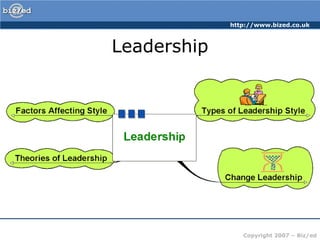
Leadership
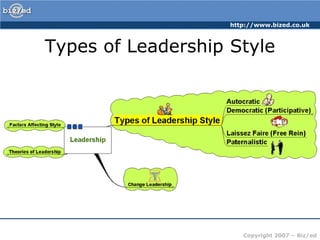
Types of Leadership Style
Types of Leadership StyleAutocratic:Leader makes decisions without reference to anyone elseHigh degree of dependency on the leaderCan create de-motivation and alienation of staffMay be valuable in some types of business where decisions need to be made quickly and decisively
Types of Leadership StyleDemocratic:Encourages decision making from different perspectives – leadership may be emphasised throughout the organisationConsultative: process of consultation before decisions are takenPersuasive: Leader takes decision and seeks to persuade others that the decision is correct
Types of Leadership StyleDemocratic:May help motivation and involvementWorkers feel ownership of the firm and its ideasImproves the sharing of ideas and experiences within the businessCan delay decision making
Types of Leadership StyleLaissez-Faire:‘Let it be’ – the leadership responsibilities are shared by allCan be very useful in businesses where creative ideas are importantCan be highly motivational, as people have control over their working lifeCan make coordination and decision making time-consuming and lacking in overall directionRelies on good team workRelies on good interpersonal relations
Types of Leadership StylePaternalistic:Leader acts as a ‘father figure’Paternalistic leader makes decision but may consultBelieves in the need to support staff
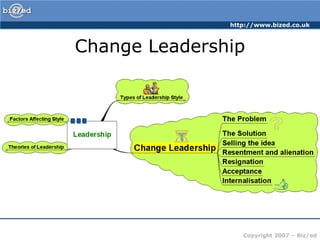
Change Leadership
Change LeadershipThe most challenging aspect of business is leading and managing changeThe business environment is subject to fast-paced economic and social changeModern business must adapt and be flexible to surviveProblems in leading change stem mainly from human resource management
Change LeadershipLeaders need to be aware of how change impacts on workers:Series of self-esteem states identified by Adams et al and cited by GarrettAdams, J. Hayes, J. and Hopson, B.(eds) (1976) Transition: understanding and managing change personal change London, Martin RobertsonGarrett, V. (1997) Managing Change in School leadership for the 21st century Brett Davies and Linda Ellison, London, Routledge
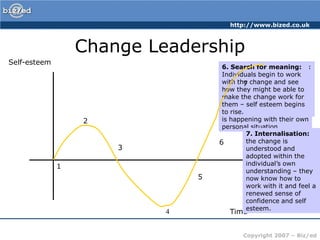
Change LeadershipSelf-esteem        1. Immobilisation – as rumours of the change circulate, the individual feels some sense of shock and possible disbelief – so much so that they deem it worthy of doing nothing.2. Minimisation: As the change becomes clearer, people try to fit in the change with their own personal position and may try to believe that it will not affect them.3. Depression: as reality begins to dawn staff may feel alienated and angry, feelings of a lack of control of events overtake people and they feel depressed as they try to reconcile what is happening with their own personal situation.4. Acceptance/letting go: The lowest point in self-esteem finally sees people starting to accept the inevitable. Fear of the future is a feature of this stage.5. Testing out: Individuals begin to interact with the change, they start to ask questions to see how they might work with the change.6. Search for meaning: Individuals begin to work with the change and see how they might be able to make the change work for them – self esteem begins to rise.727. Internalisation: the change is understood and adopted within the individual’s own understanding – they now know how to work with it and feel a renewed sense of confidence and self esteem.6315Time4
Theories of Leadership
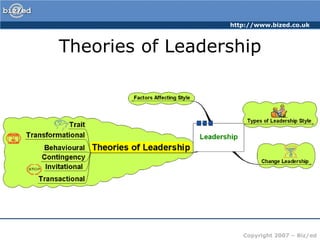
Theories of LeadershipTrait theories:Is there a set of characteristics that determine a good leader?Personality?Dominance and personal presence?Charisma?Self confidence?Achievement?Ability to formulate a clear vision?
Theories of LeadershipTrait theories:Are such characteristics inherently gender biased?Do such characteristics produce good leaders?Is leadership more than just bringing about change?Does this imply that leaders are born not bred?
Theories of LeadershipBehavioural:Imply that leaders can be trained – focus on the way of doing thingsStructure based behavioural theories – focus on the leader instituting structures – task orientatedRelationship based behavioural theories – focus on the development and maintenance of relationships – process orientated
Theories of LeadershipContingency Theories:Leadership as being more flexible – different leadership styles used at different times depending on the circumstance.Suggests leadership is not a fixed series of characteristics that can be transposed into different contexts
Theories of LeadershipMay depend on:Type of staffHistory of the businessCulture of the businessQuality of the relationshipsNature of the changes neededAccepted norms within the institution
Theories of LeadershipTransformational:Widespread changes to a business or organisationRequires:Long term strategic planningClear objectivesClear visionLeading by example – walk the walkEfficiency of systems and processes
Theories of LeadershipInvitational Leadership:Improving the atmosphere and message sent out by the organisationFocus on reducing negative messages sent out through the everyday actions of the business both externally and, crucially, internallyReview internal processes to reduce theseBuild relationships and sense of belonging and identity with the organisation – that gets communicated to customers, etc.
Theories of LeadershipTransactional Theories:Focus on the management of the organisationFocus on procedures and efficiencyFocus on working to rules and contractsManaging current issues and problems
Factors Affecting Style
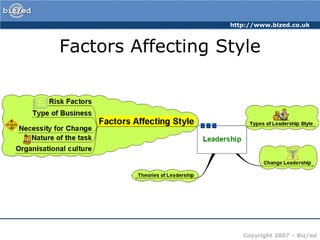
Factors Affecting StyleLeadership style may be dependent on various factors:Risk - decision making and change initiatives based on degree of risk involvedType of business – creative business or supply driven?How  important change is – change for change’s sake?Organisational culture – may be long embedded and difficult to changeNature of the task – needing cooperation? Direction? Structure?

Leadertypes

  • 1.
  • 2.
    A Leadership Story:Agroup of workers and their leaders are set a task of clearing a road through a dense jungle on a remote island to get to the coast where an estuary provides a perfect site for a port. The leaders organise the labour into efficient units and monitor the distribution and use of capital assets – progress is excellent. The leaders continue to monitor and evaluate progress, making adjustments along the way to ensure the progress is maintained and efficiency increased wherever possible. Then, one day amidst all the hustle and bustle and activity, one person climbs up a nearby tree. The person surveys the scene from the top of the tree.
  • 3.
    A Leadership Story:Andshouts down to the assembled group below…“Wrong Way!”(Story adapted from Stephen Covey (2004) “The Seven Habits of Highly Effective People” Simon & Schuster).“Management is doing things right, leadership is doing the right things” (Warren Bennis and Peter Drucker)
  • 4.
  • 5.
  • 6.
    Types of LeadershipStyleAutocratic:Leader makes decisions without reference to anyone elseHigh degree of dependency on the leaderCan create de-motivation and alienation of staffMay be valuable in some types of business where decisions need to be made quickly and decisively
  • 7.
    Types of LeadershipStyleDemocratic:Encourages decision making from different perspectives – leadership may be emphasised throughout the organisationConsultative: process of consultation before decisions are takenPersuasive: Leader takes decision and seeks to persuade others that the decision is correct
  • 8.
    Types of LeadershipStyleDemocratic:May help motivation and involvementWorkers feel ownership of the firm and its ideasImproves the sharing of ideas and experiences within the businessCan delay decision making
  • 9.
    Types of LeadershipStyleLaissez-Faire:‘Let it be’ – the leadership responsibilities are shared by allCan be very useful in businesses where creative ideas are importantCan be highly motivational, as people have control over their working lifeCan make coordination and decision making time-consuming and lacking in overall directionRelies on good team workRelies on good interpersonal relations
  • 10.
    Types of LeadershipStylePaternalistic:Leader acts as a ‘father figure’Paternalistic leader makes decision but may consultBelieves in the need to support staff
  • 11.
  • 12.
    Change LeadershipThe mostchallenging aspect of business is leading and managing changeThe business environment is subject to fast-paced economic and social changeModern business must adapt and be flexible to surviveProblems in leading change stem mainly from human resource management
  • 13.
    Change LeadershipLeaders needto be aware of how change impacts on workers:Series of self-esteem states identified by Adams et al and cited by GarrettAdams, J. Hayes, J. and Hopson, B.(eds) (1976) Transition: understanding and managing change personal change London, Martin RobertsonGarrett, V. (1997) Managing Change in School leadership for the 21st century Brett Davies and Linda Ellison, London, Routledge
  • 14.
    Change LeadershipSelf-esteem 1. Immobilisation – as rumours of the change circulate, the individual feels some sense of shock and possible disbelief – so much so that they deem it worthy of doing nothing.2. Minimisation: As the change becomes clearer, people try to fit in the change with their own personal position and may try to believe that it will not affect them.3. Depression: as reality begins to dawn staff may feel alienated and angry, feelings of a lack of control of events overtake people and they feel depressed as they try to reconcile what is happening with their own personal situation.4. Acceptance/letting go: The lowest point in self-esteem finally sees people starting to accept the inevitable. Fear of the future is a feature of this stage.5. Testing out: Individuals begin to interact with the change, they start to ask questions to see how they might work with the change.6. Search for meaning: Individuals begin to work with the change and see how they might be able to make the change work for them – self esteem begins to rise.727. Internalisation: the change is understood and adopted within the individual’s own understanding – they now know how to work with it and feel a renewed sense of confidence and self esteem.6315Time4
  • 15.
  • 16.
    Theories of LeadershipTraittheories:Is there a set of characteristics that determine a good leader?Personality?Dominance and personal presence?Charisma?Self confidence?Achievement?Ability to formulate a clear vision?
  • 17.
    Theories of LeadershipTraittheories:Are such characteristics inherently gender biased?Do such characteristics produce good leaders?Is leadership more than just bringing about change?Does this imply that leaders are born not bred?
  • 18.
    Theories of LeadershipBehavioural:Implythat leaders can be trained – focus on the way of doing thingsStructure based behavioural theories – focus on the leader instituting structures – task orientatedRelationship based behavioural theories – focus on the development and maintenance of relationships – process orientated
  • 19.
    Theories of LeadershipContingencyTheories:Leadership as being more flexible – different leadership styles used at different times depending on the circumstance.Suggests leadership is not a fixed series of characteristics that can be transposed into different contexts
  • 20.
    Theories of LeadershipMaydepend on:Type of staffHistory of the businessCulture of the businessQuality of the relationshipsNature of the changes neededAccepted norms within the institution
  • 21.
    Theories of LeadershipTransformational:Widespreadchanges to a business or organisationRequires:Long term strategic planningClear objectivesClear visionLeading by example – walk the walkEfficiency of systems and processes
  • 22.
    Theories of LeadershipInvitationalLeadership:Improving the atmosphere and message sent out by the organisationFocus on reducing negative messages sent out through the everyday actions of the business both externally and, crucially, internallyReview internal processes to reduce theseBuild relationships and sense of belonging and identity with the organisation – that gets communicated to customers, etc.
  • 23.
    Theories of LeadershipTransactionalTheories:Focus on the management of the organisationFocus on procedures and efficiencyFocus on working to rules and contractsManaging current issues and problems
  • 24.
  • 25.
    Factors Affecting StyleLeadershipstyle may be dependent on various factors:Risk - decision making and change initiatives based on degree of risk involvedType of business – creative business or supply driven?How important change is – change for change’s sake?Organisational culture – may be long embedded and difficult to changeNature of the task – needing cooperation? Direction? Structure?