MANAGEMENT ROLES
and
SKILLS
2
Define “role”
• A role is a set of behaviours associated
with a particular job
3
Mintzberg’s Managerial Roles
Henry Mintzberg studied CEOs at work
and created a scheme to define what
managers do on the job. These are
commonly referred to as Mintzberg’s
managerial roles.
These can be grouped into three primary
headings: interpersonal, informational and
decisional
4
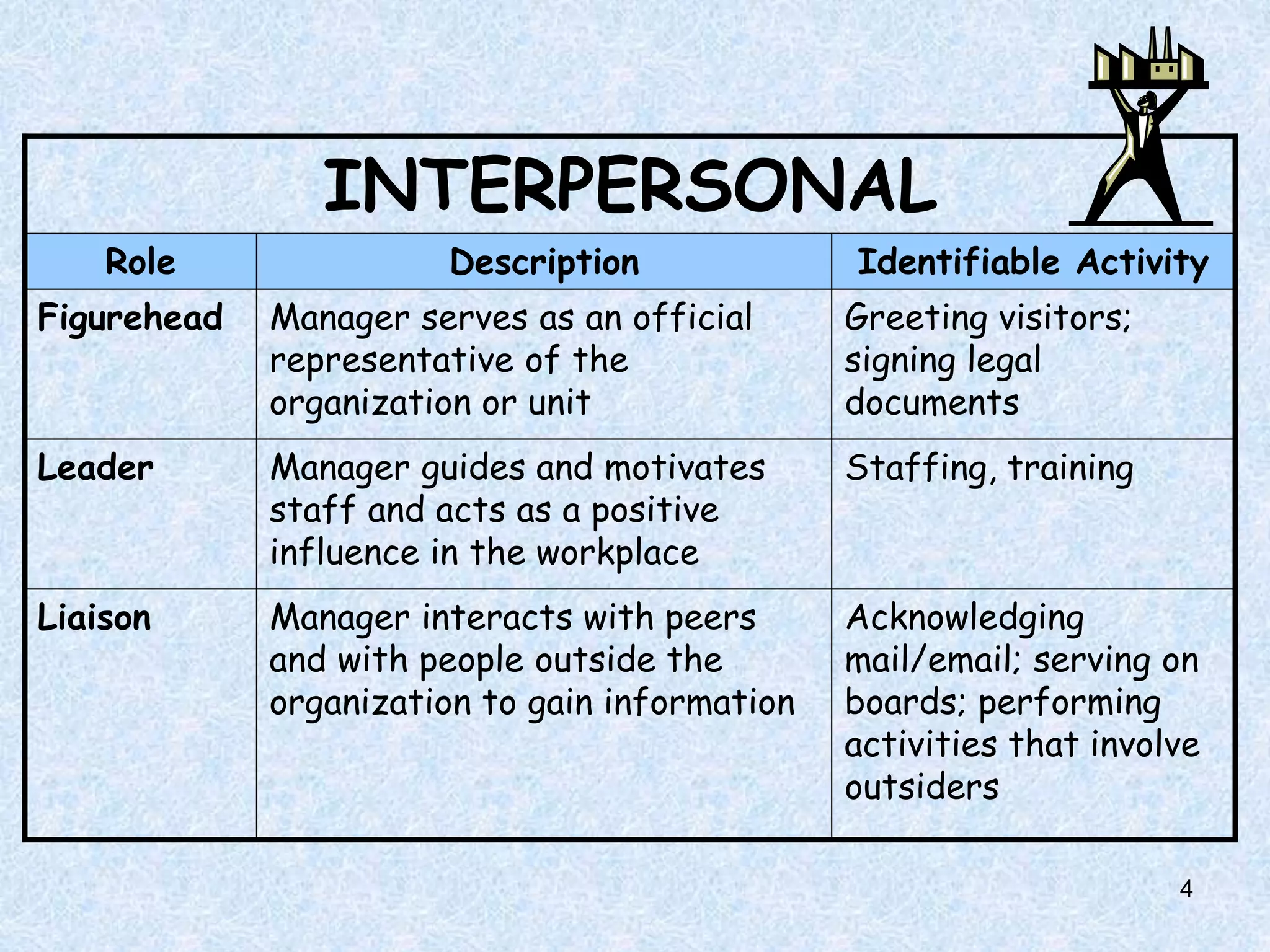
INTERPERSONAL
Role Description Identifiable Activity
Figurehead Manager serves as an official
representative of the
organization or unit
Greeting visitors;
signing legal
documents
Leader Manager guides and motivates
staff and acts as a positive
influence in the workplace
Staffing, training
Liaison Manager interacts with peers
and with people outside the
organization to gain information
Acknowledging
mail/email; serving on
boards; performing
activities that involve
outsiders
5
INFORMATIONAL
Role Description Identifiable Activity
Monitor Manager receives and
collects information
Reading magazines
and reports;
maintaining personal
contacts
Communication
(Disseminator)
Manager distributes
information within the
organization
Holding meetings;
making phone calls to
relay information;
email/memos
Spokesperson Manager distributes
information outside the
organization
Holding board
meetings; giving
information to the
media
6
DECISIONAL
Role Description Identifiable Activity
Entrepreneur Manager initiates change Organizing sessions
to develop new
programs; supervises
design of projects
Disturbance
Handler
Manager decides how
conflicts between
subordinates should be
resolved
Steps in when an
employee suddenly
leaves or an important
customer is lost
Resource
Allocator
Manager decides how the
organization will use its
resources
Scheduling;
requesting
authorization;
budgeting
Negotiator Manager decides to negotiate
major contracts with other
organizations or individuals
Participating in union
contract negotiations
or in those with
suppliers
7
• Processes or tasks (activities: planning,
organizing, leading, controlling)
• Roles (behaviours: interpersonal,
informational and decisional)
• Skills are abilities crucial to success in
a managerial position.
Review ~
8
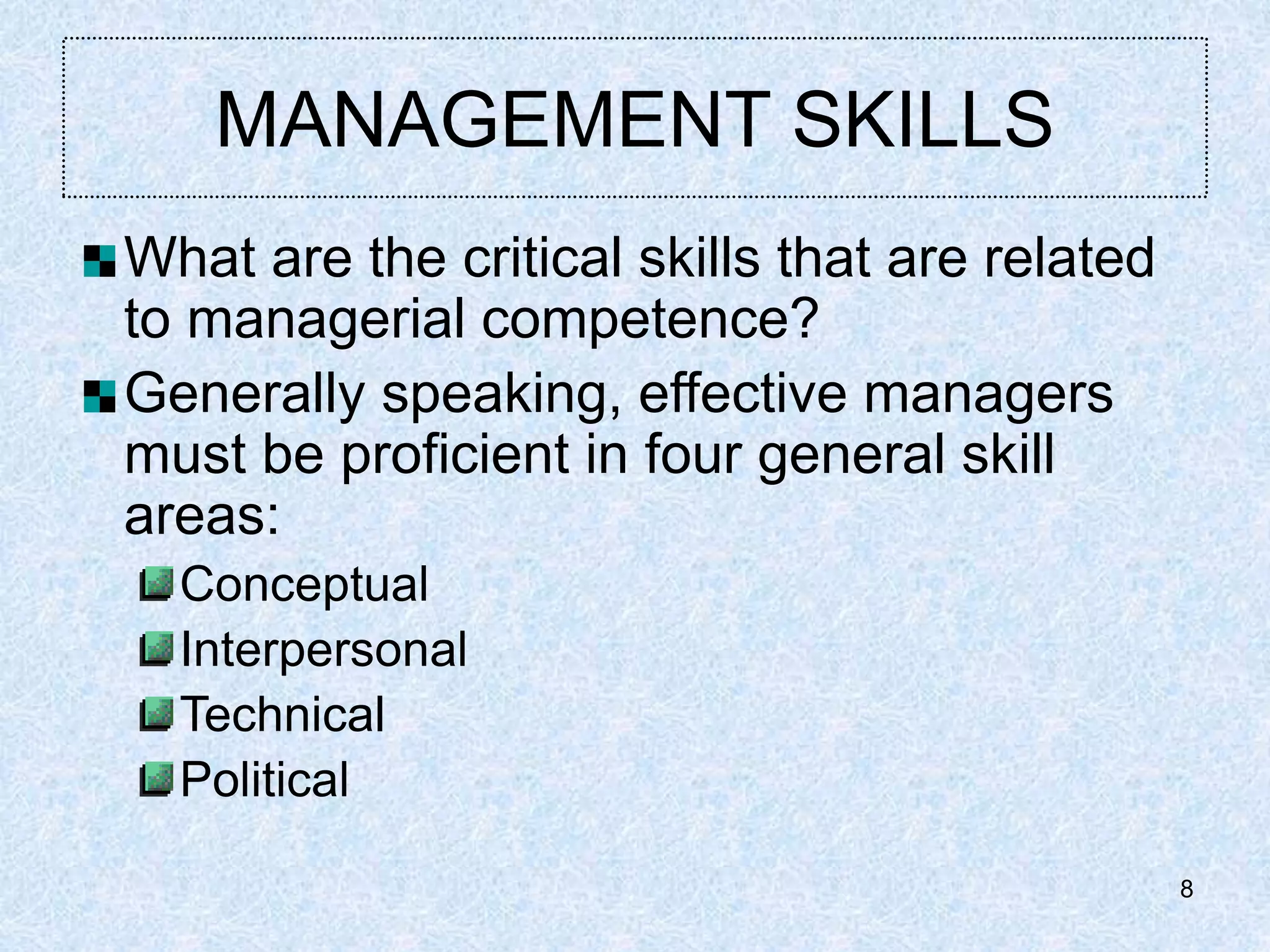
MANAGEMENT SKILLS
What are the critical skills that are related
to managerial competence?
Generally speaking, effective managers
must be proficient in four general skill
areas:
Conceptual
Interpersonal
Technical
Political
9
Conceptual skills
The mental ability to analyze and diagnose
situations.
The skills that help managers understand
how different parts of a business relate to
one another and to the business as a
whole.
Decision making, planning, and organizing
require these skills.
10
Interpersonal skills
The ability to work with, understand,
mentor, and motivate other people.
Interviewing job applicants, forming
partnerships with other businesses, and
resolving conflicts all require these skills.
11
Technical skills
The ability to apply specialized knowledge
or expertise.
Specific abilities that people use to
perform their jobs.
Operating a word processing program,
designing a brochure, training people to
use a budgeting system, understanding
manufacturing systems, etc. are examples
of technical skills.
12
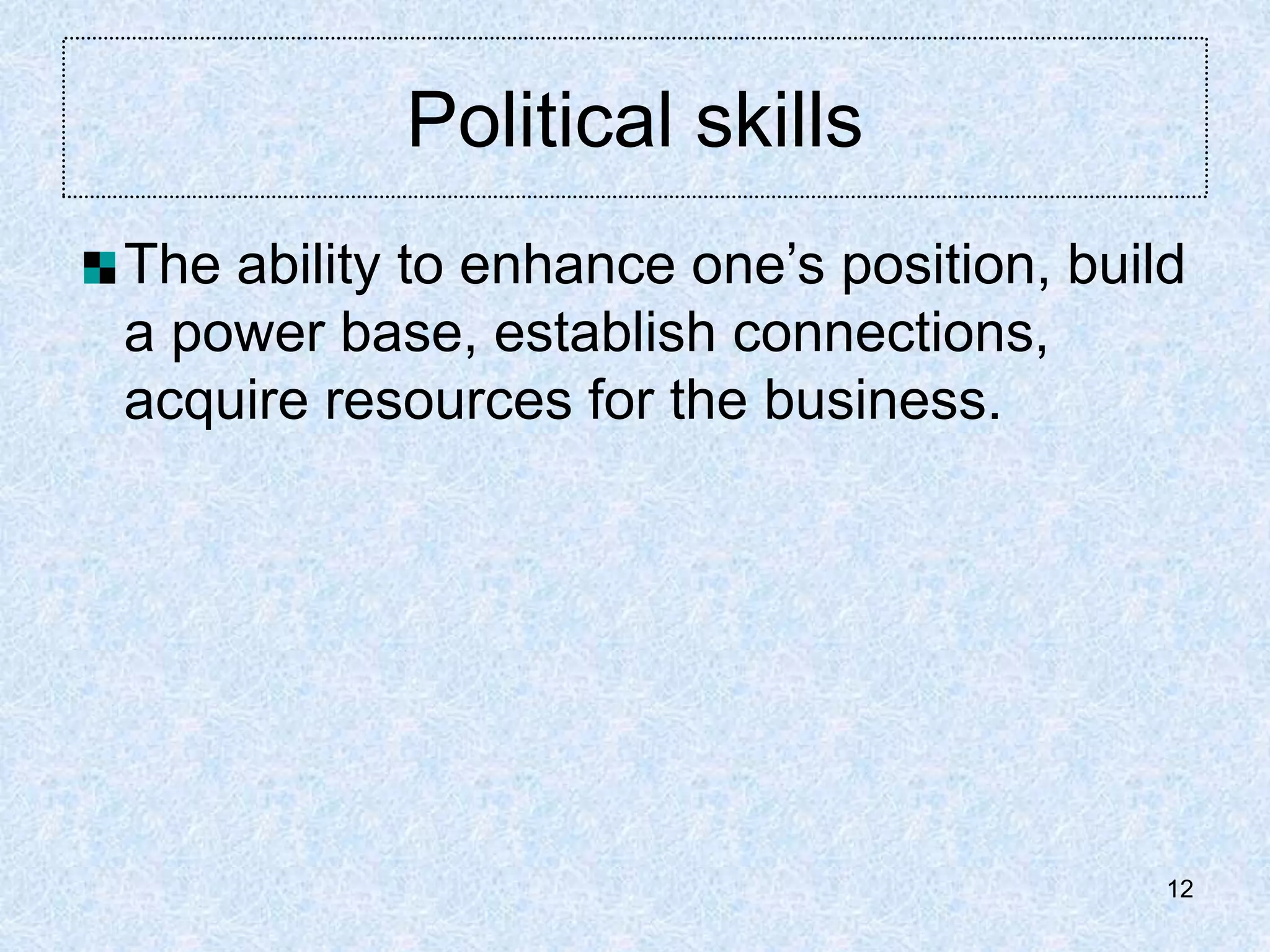
Political skills
The ability to enhance one’s position, build
a power base, establish connections,
acquire resources for the business.

management_roles.ppt

  • 1.
  • 2.
    2 Define “role” • Arole is a set of behaviours associated with a particular job
  • 3.
    3 Mintzberg’s Managerial Roles HenryMintzberg studied CEOs at work and created a scheme to define what managers do on the job. These are commonly referred to as Mintzberg’s managerial roles. These can be grouped into three primary headings: interpersonal, informational and decisional
  • 4.
    4 INTERPERSONAL Role Description IdentifiableActivity Figurehead Manager serves as an official representative of the organization or unit Greeting visitors; signing legal documents Leader Manager guides and motivates staff and acts as a positive influence in the workplace Staffing, training Liaison Manager interacts with peers and with people outside the organization to gain information Acknowledging mail/email; serving on boards; performing activities that involve outsiders
  • 5.
    5 INFORMATIONAL Role Description IdentifiableActivity Monitor Manager receives and collects information Reading magazines and reports; maintaining personal contacts Communication (Disseminator) Manager distributes information within the organization Holding meetings; making phone calls to relay information; email/memos Spokesperson Manager distributes information outside the organization Holding board meetings; giving information to the media
  • 6.
    6 DECISIONAL Role Description IdentifiableActivity Entrepreneur Manager initiates change Organizing sessions to develop new programs; supervises design of projects Disturbance Handler Manager decides how conflicts between subordinates should be resolved Steps in when an employee suddenly leaves or an important customer is lost Resource Allocator Manager decides how the organization will use its resources Scheduling; requesting authorization; budgeting Negotiator Manager decides to negotiate major contracts with other organizations or individuals Participating in union contract negotiations or in those with suppliers
  • 7.
    7 • Processes ortasks (activities: planning, organizing, leading, controlling) • Roles (behaviours: interpersonal, informational and decisional) • Skills are abilities crucial to success in a managerial position. Review ~
  • 8.
    8 MANAGEMENT SKILLS What arethe critical skills that are related to managerial competence? Generally speaking, effective managers must be proficient in four general skill areas: Conceptual Interpersonal Technical Political
  • 9.
    9 Conceptual skills The mentalability to analyze and diagnose situations. The skills that help managers understand how different parts of a business relate to one another and to the business as a whole. Decision making, planning, and organizing require these skills.
  • 10.
    10 Interpersonal skills The abilityto work with, understand, mentor, and motivate other people. Interviewing job applicants, forming partnerships with other businesses, and resolving conflicts all require these skills.
  • 11.
    11 Technical skills The abilityto apply specialized knowledge or expertise. Specific abilities that people use to perform their jobs. Operating a word processing program, designing a brochure, training people to use a budgeting system, understanding manufacturing systems, etc. are examples of technical skills.
  • 12.
    12 Political skills The abilityto enhance one’s position, build a power base, establish connections, acquire resources for the business.

Editor's Notes