LEADERSHIP
Lecture 10
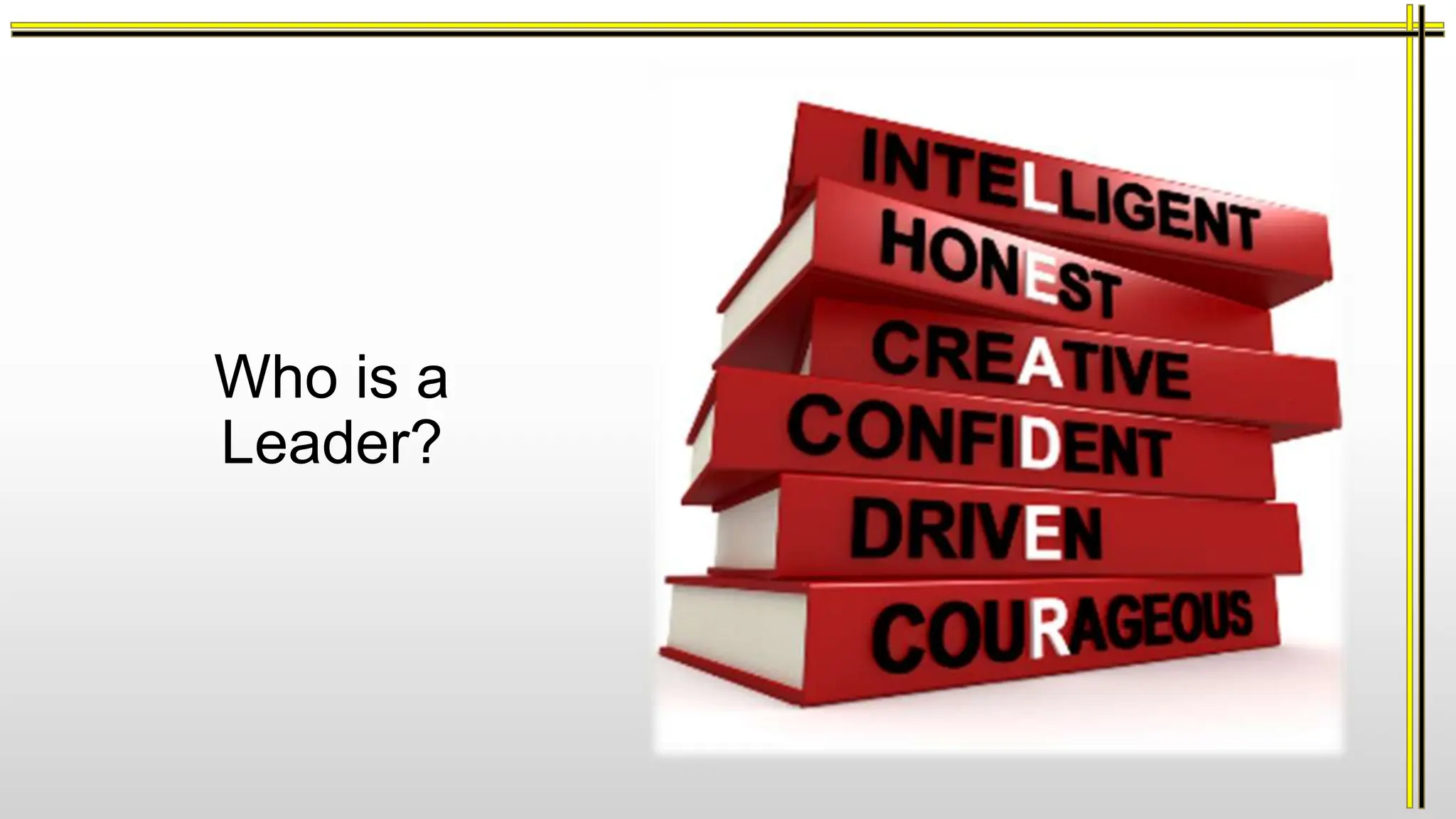
Who is a
Leader?
“There has certainly
been for you in the
Messenger of Allah an
excellent pattern for
anyone whose hope is
in Allah and the Last
Day and [who]
remembers Allah
often.” [Quran, 33: 21]
Leadership by leaders
• A leader is a dealer in hope. —Napoleon Bonaparte
• People buy into the leader before they buy into the vision. —John
Maxwell
• The art of leadership is saying no, not saying yes. It is very easy
to say yes. —Tony Blair
• Leadership and learning are indispensable to each other. —John
F. Kennedy
• Earn your leadership every day. –Michael Jordan
Leadership
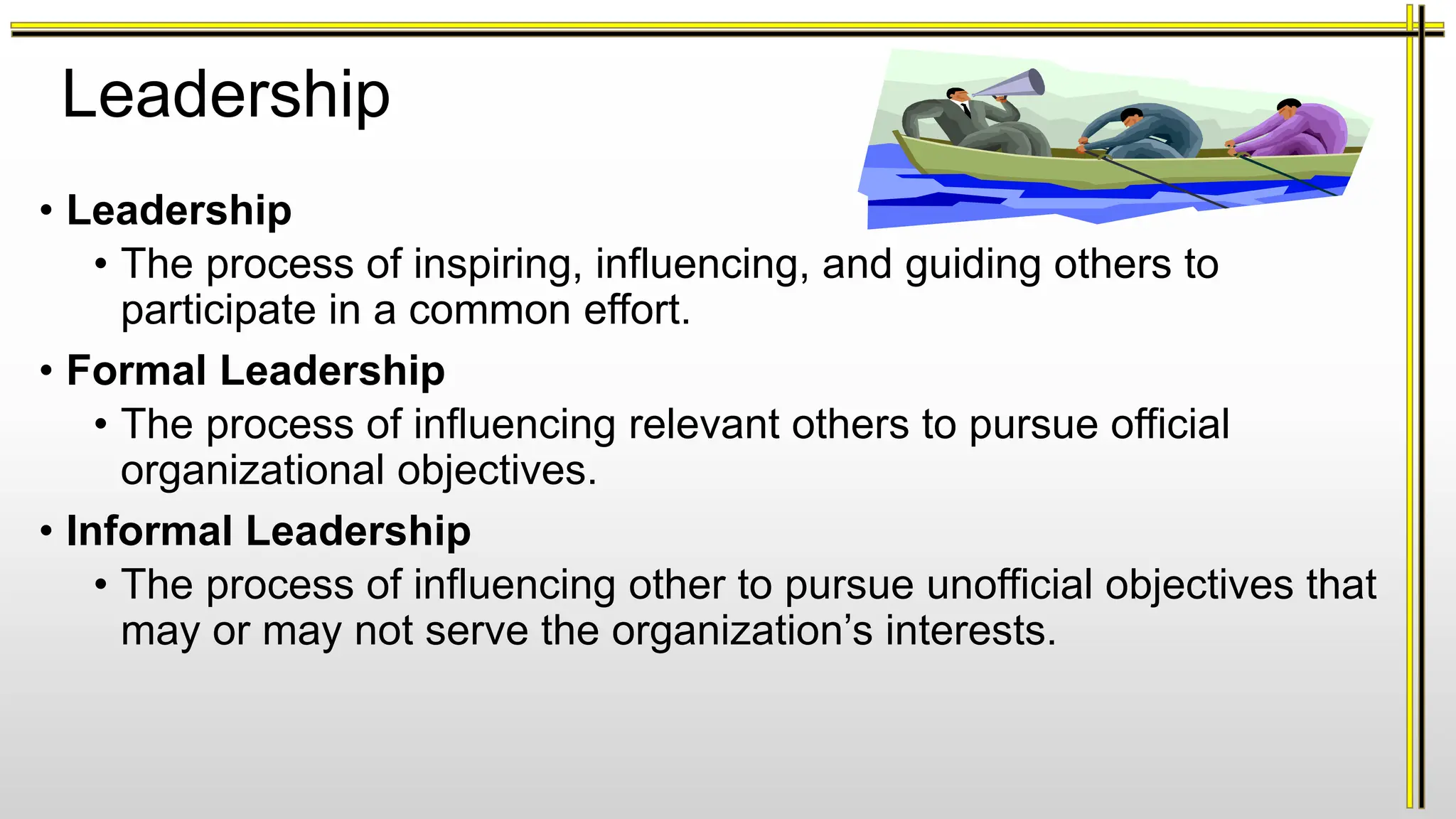
• Leadership
• The process of inspiring, influencing, and guiding others to
participate in a common effort.
• Formal Leadership
• The process of influencing relevant others to pursue official
organizational objectives.
• Informal Leadership
• The process of influencing other to pursue unofficial objectives that
may or may not serve the organization’s interests.
Leadership
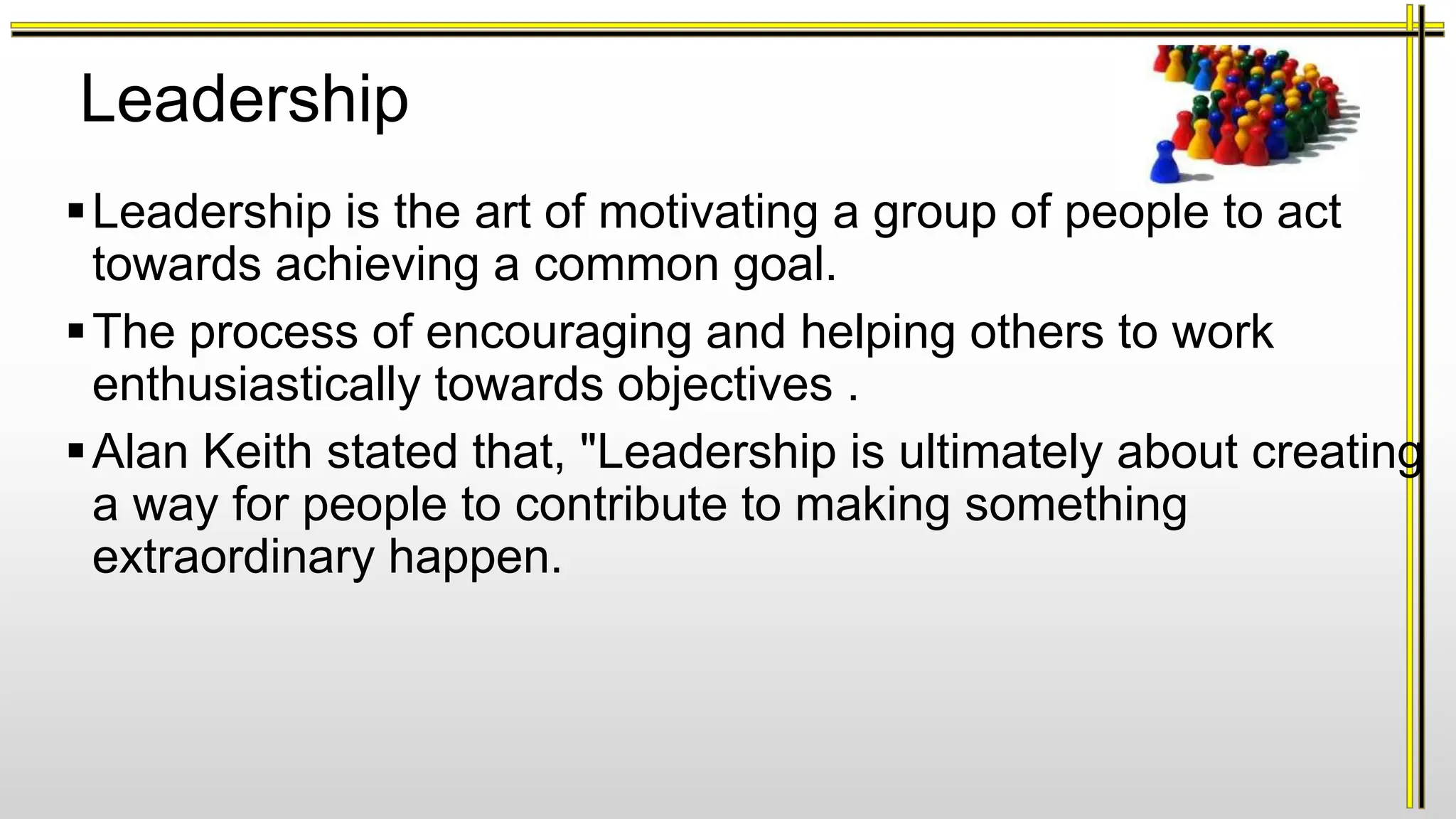
Leadership is the art of motivating a group of people to act
towards achieving a common goal.
The process of encouraging and helping others to work
enthusiastically towards objectives .
Alan Keith stated that, "Leadership is ultimately about creating
a way for people to contribute to making something
extraordinary happen.
• Leadership . . . .
• Process: what leaders actually do.
• Using non-coercive influence to shape the group’s or
organization’s goals.
• Motivating others’ behavior toward goals.
• Helping to define organizational culture.
• Property: who leaders are.
• The set of characteristics attributed to individuals perceived to
be leaders.
• Leaders “Someone who has followers."
• People who can influence the behaviors of others without having to
rely on force.
• People who are accepted as leaders by others.
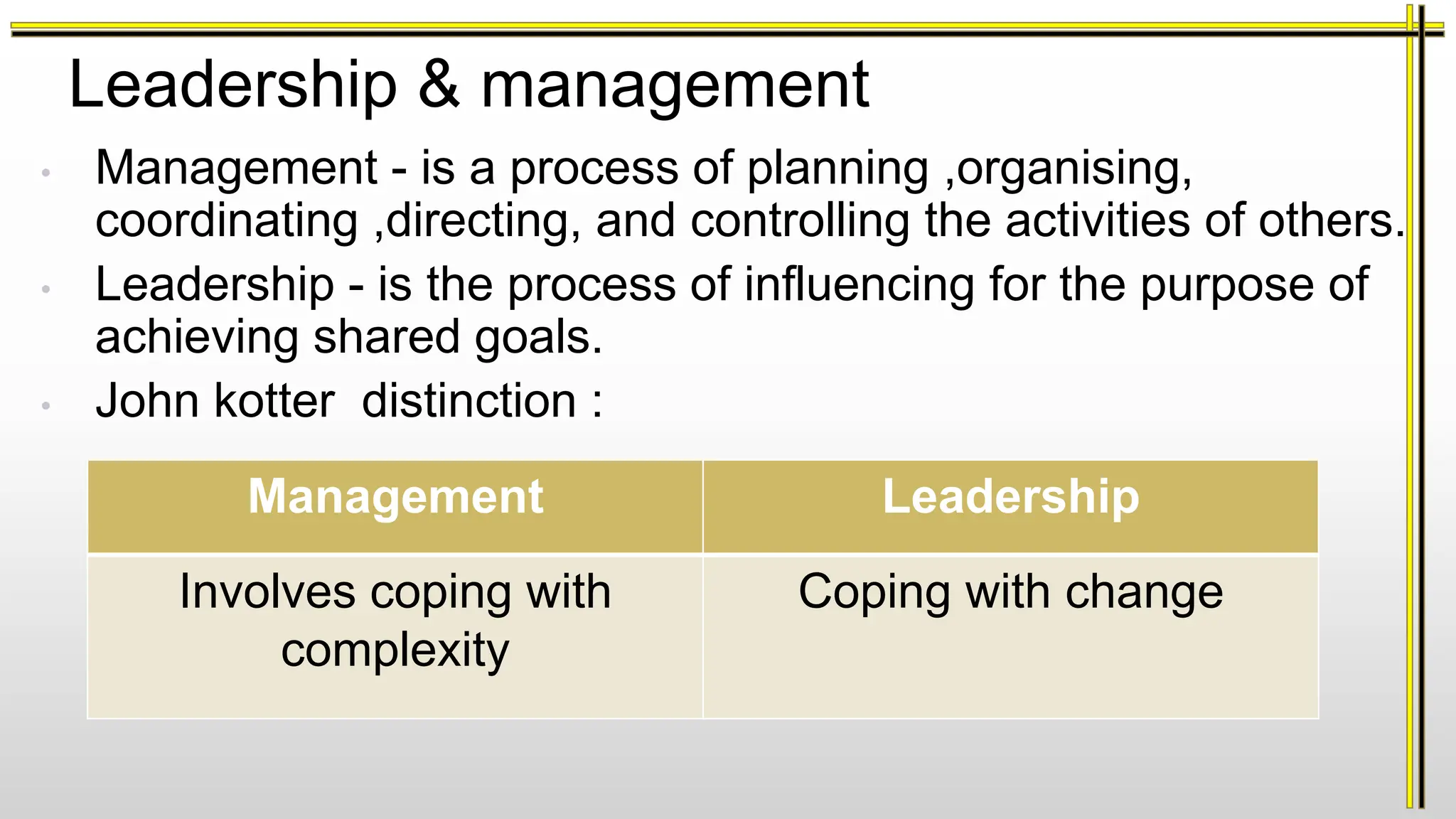
Leadership & management
• Management - is a process of planning ,organising,
coordinating ,directing, and controlling the activities of others.
• Leadership - is the process of influencing for the purpose of
achieving shared goals.
• John kotter distinction :
Management Leadership
Involves coping with
complexity
Coping with change
What's the difference between managers and
leaders?
• Managers have employees | leaders win followers.
• Managers react to change | leaders create it.
• Managers have good ideas | leaders implement them.
• Managers communicate | leaders persuade.
• Managers control groups | leaders create teamwork.
• Managers try to be heroes | leaders create heroes all
around them.
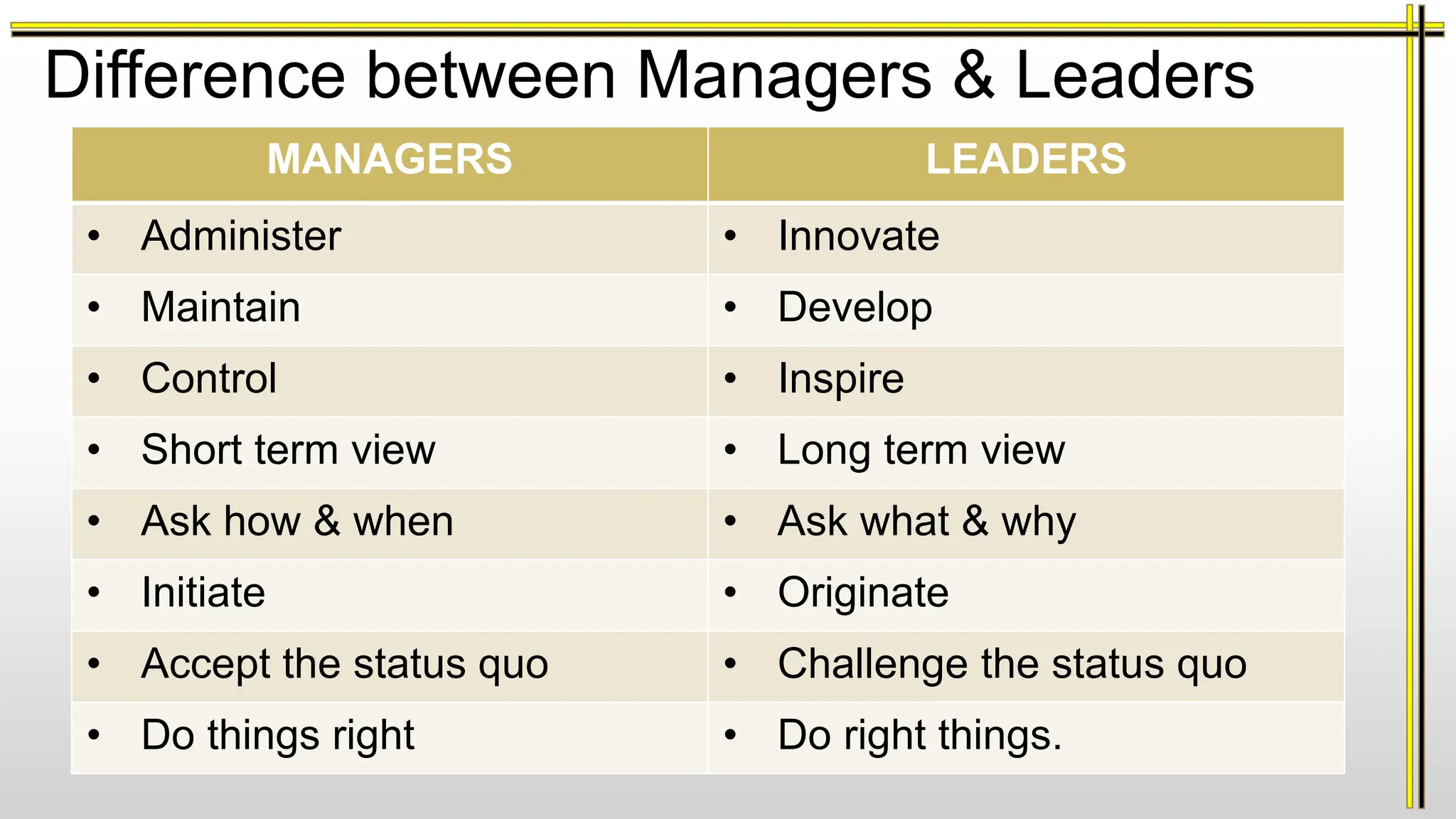
Difference between Managers & Leaders
MANAGERS LEADERS
• Administer • Innovate
• Maintain • Develop
• Control • Inspire
• Short term view • Long term view
• Ask how & when • Ask what & why
• Initiate • Originate
• Accept the status quo • Challenge the status quo
• Do things right • Do right things.
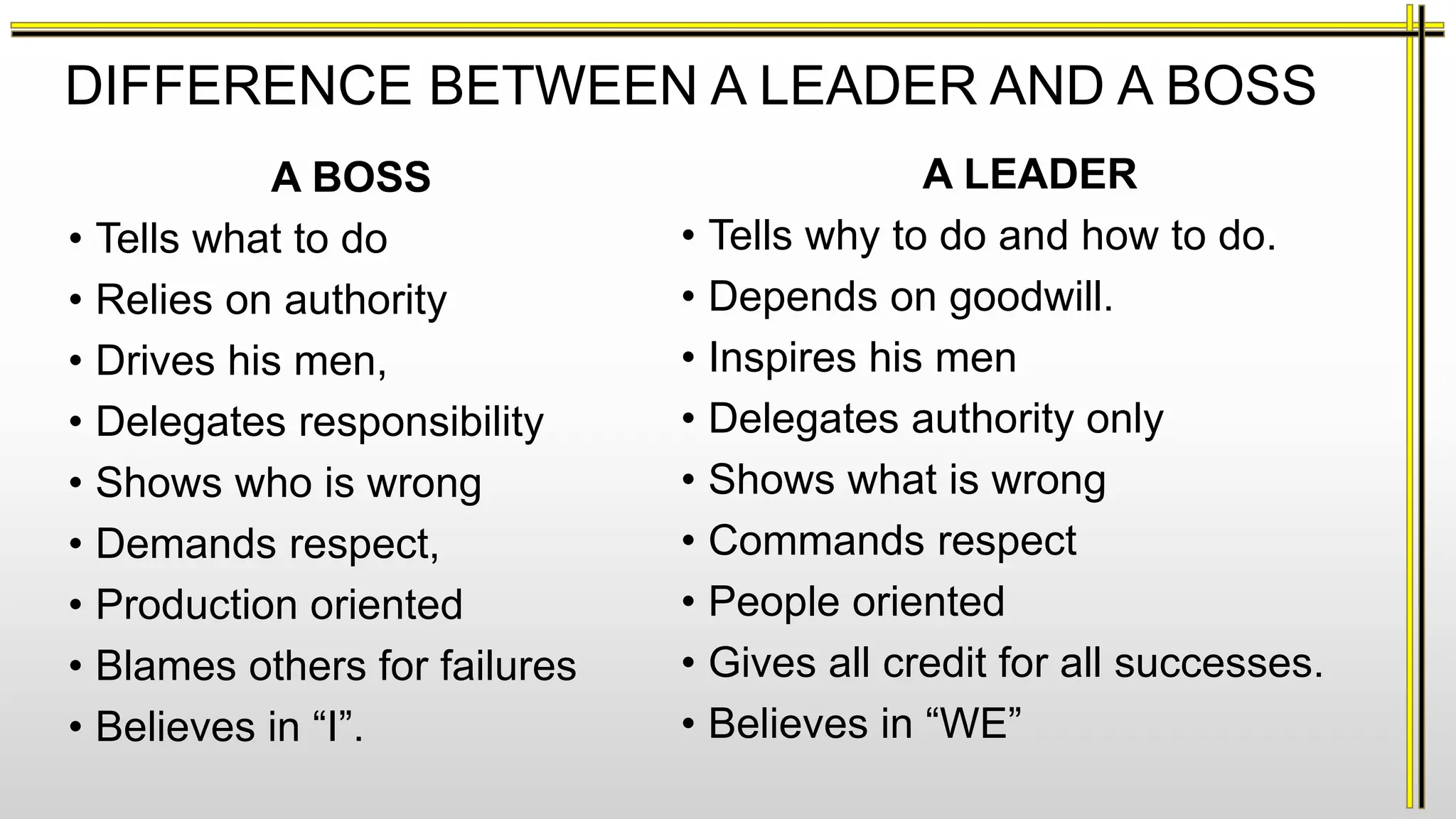
DIFFERENCE BETWEEN A LEADER AND A BOSS
A BOSS
• Tells what to do
• Relies on authority
• Drives his men,
• Delegates responsibility
• Shows who is wrong
• Demands respect,
• Production oriented
• Blames others for failures
• Believes in “I”.
A LEADER
• Tells why to do and how to do.
• Depends on goodwill.
• Inspires his men
• Delegates authority only
• Shows what is wrong
• Commands respect
• People oriented
• Gives all credit for all successes.
• Believes in “WE”
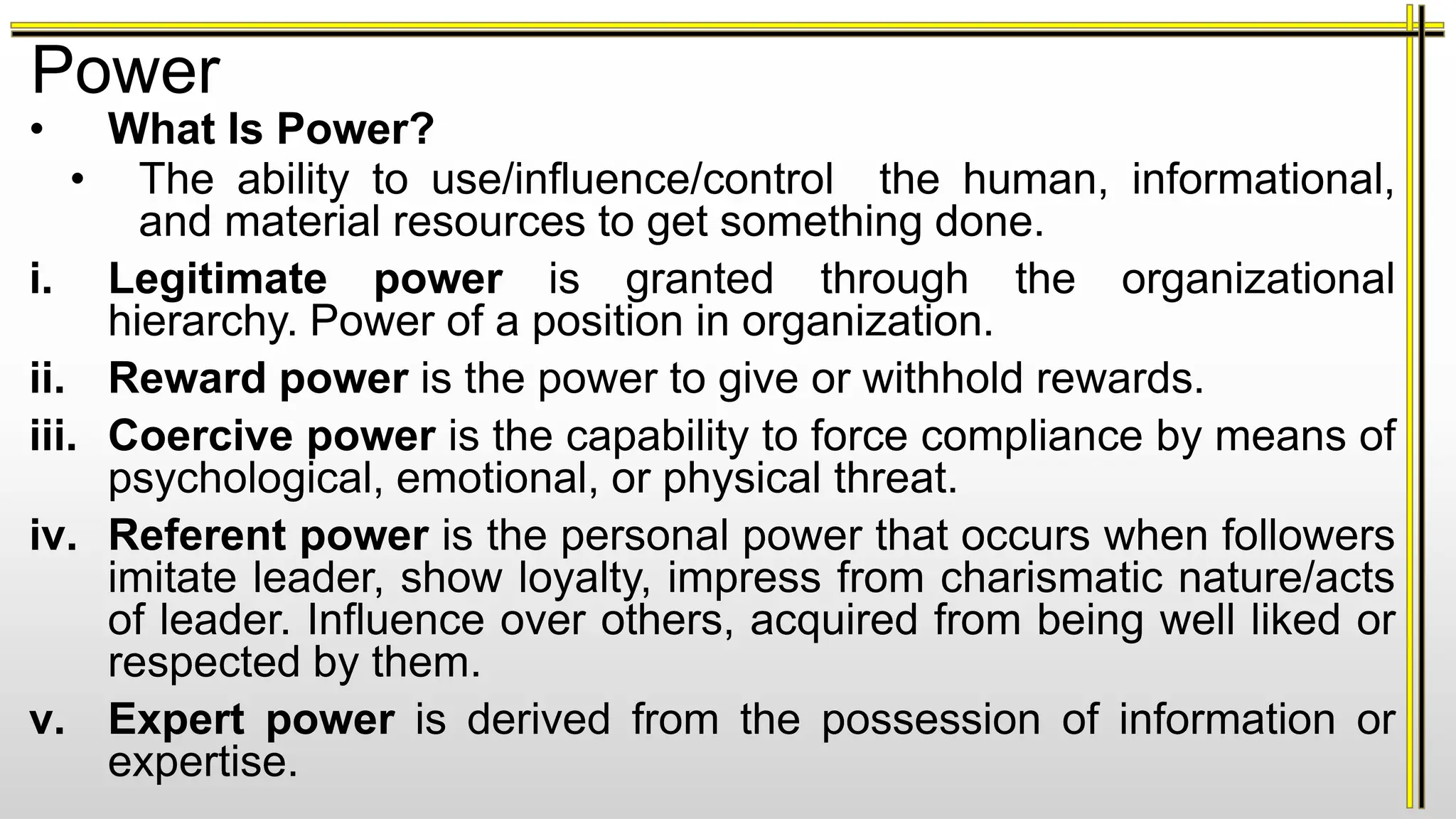
Power
• What Is Power?
• The ability to use/influence/control the human, informational,
and material resources to get something done.
i. Legitimate power is granted through the organizational
hierarchy. Power of a position in organization.
ii. Reward power is the power to give or withhold rewards.
iii. Coercive power is the capability to force compliance by means of
psychological, emotional, or physical threat.
iv. Referent power is the personal power that occurs when followers
imitate leader, show loyalty, impress from charismatic nature/acts
of leader. Influence over others, acquired from being well liked or
respected by them.
v. Expert power is derived from the possession of information or
expertise.
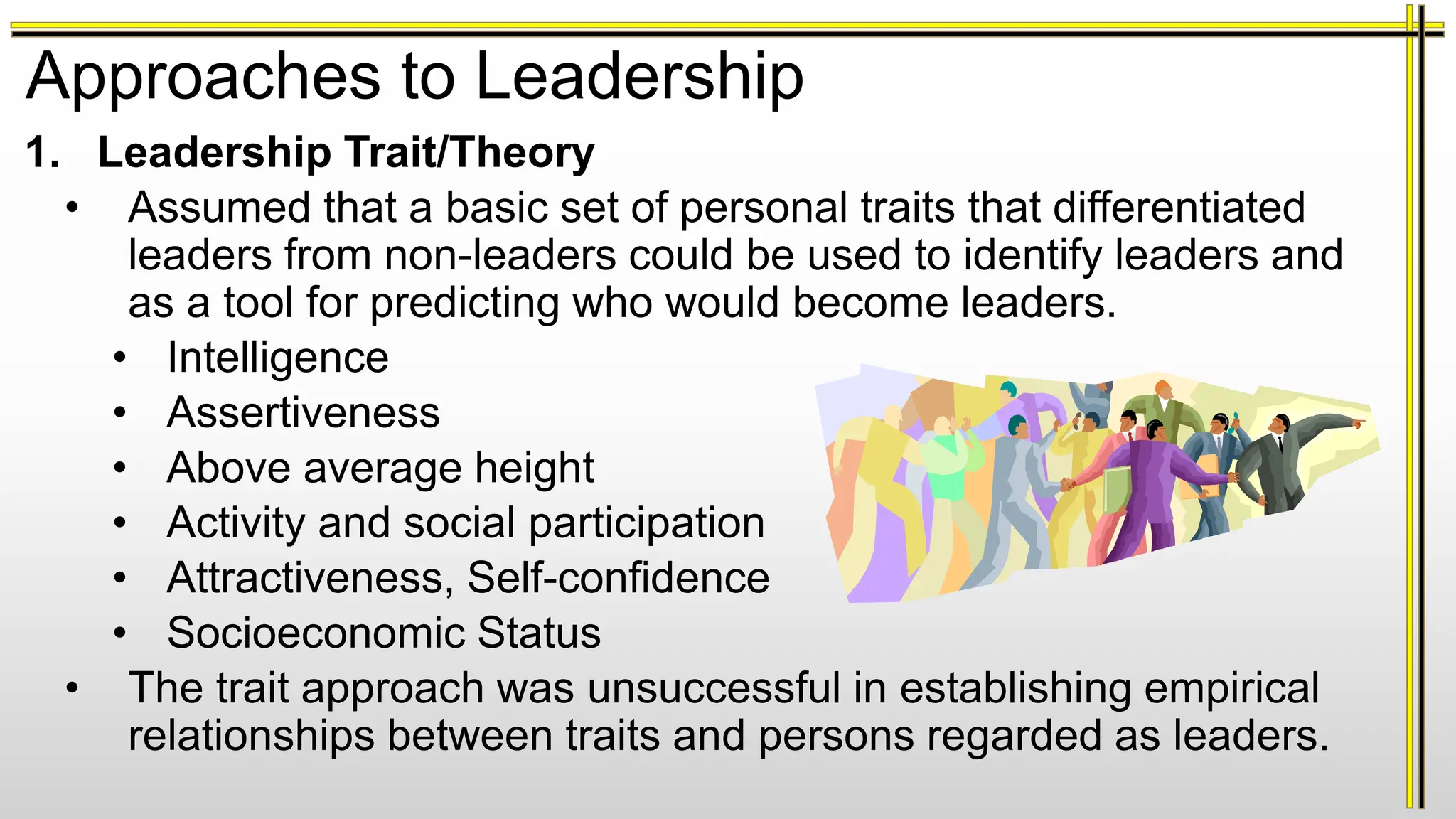
Approaches to Leadership
1. Leadership Trait/Theory
• Assumed that a basic set of personal traits that differentiated
leaders from non-leaders could be used to identify leaders and
as a tool for predicting who would become leaders.
• Intelligence
• Assertiveness
• Above average height
• Activity and social participation
• Attractiveness, Self-confidence
• Socioeconomic Status
• The trait approach was unsuccessful in establishing empirical
relationships between traits and persons regarded as leaders.
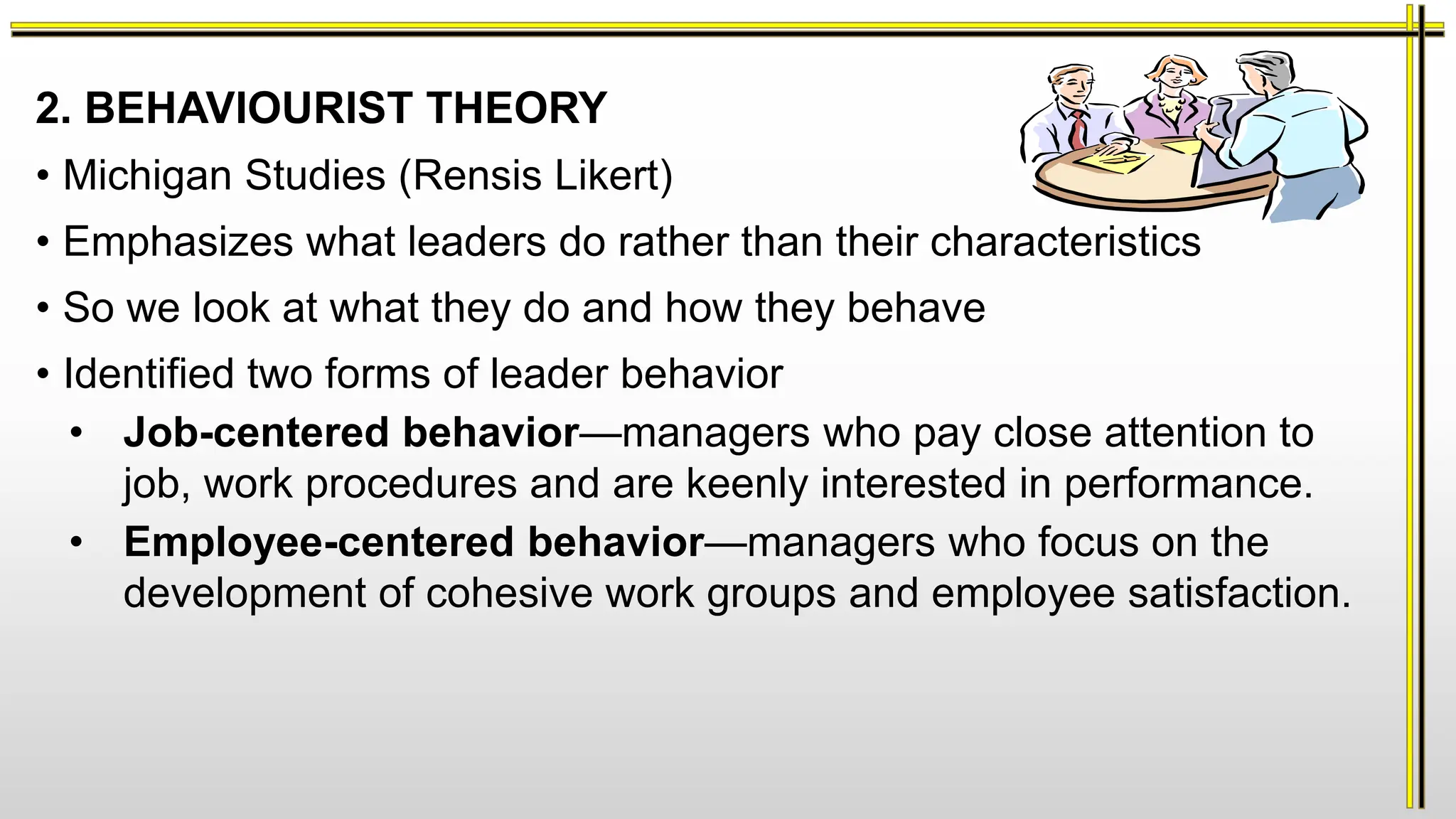
2. BEHAVIOURIST THEORY
• Michigan Studies (Rensis Likert)
• Emphasizes what leaders do rather than their characteristics
• So we look at what they do and how they behave
• Identified two forms of leader behavior
• Job-centered behavior—managers who pay close attention to
job, work procedures and are keenly interested in performance.
• Employee-centered behavior—managers who focus on the
development of cohesive work groups and employee satisfaction.
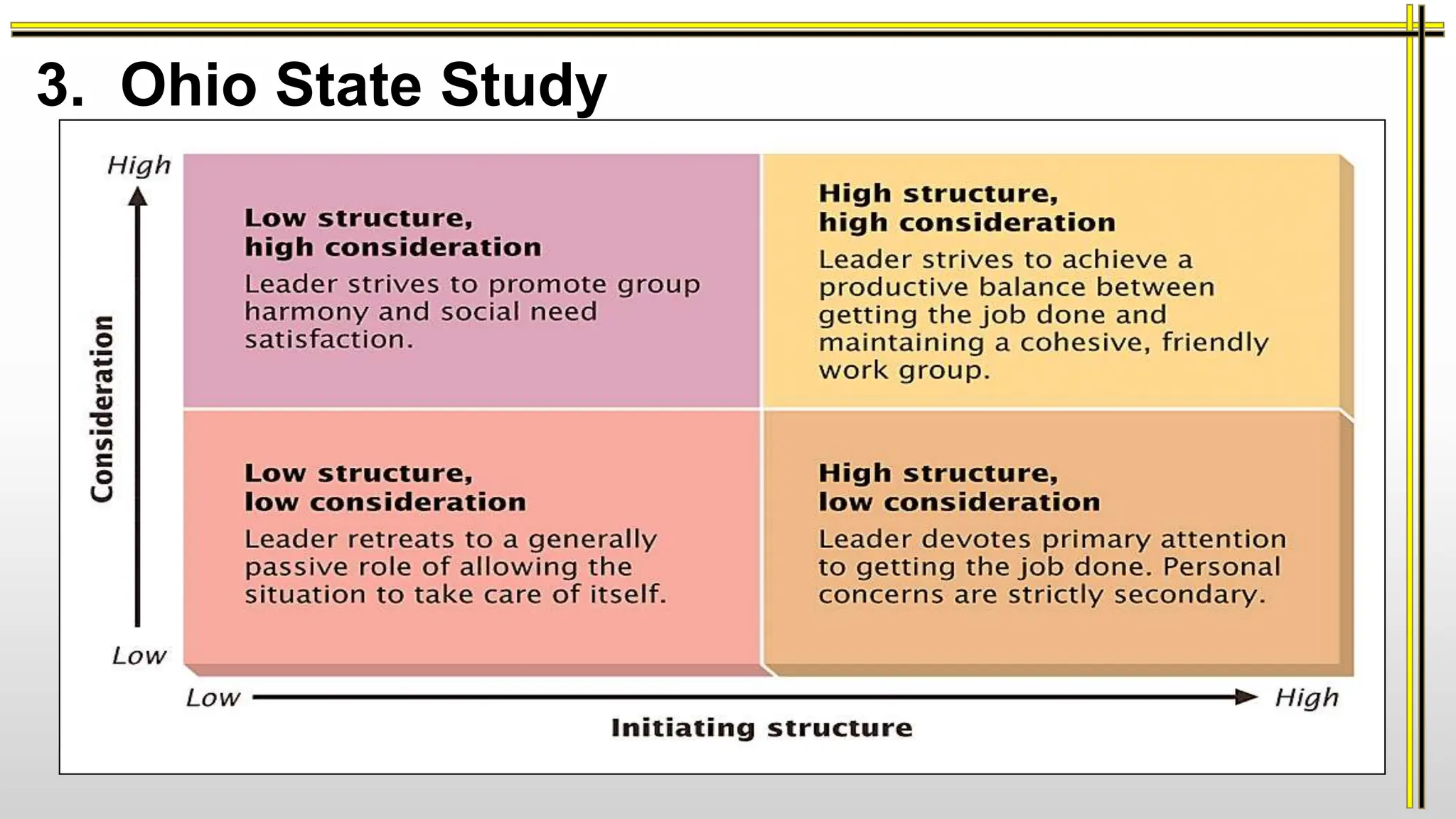
3. Ohio State Studies
• Identifies two of basic leadership styles that can be exhibited
simultaneously:
• Initiating-structure behavior—the leader clearly defines the leader-
subordinate role expectations, formalizes communications, and sets
the working agenda.
• Consideration behavior—the leader shows concern for subordinates
and attempts to establish a friendly and supportive climate.
3. Ohio State Study
• Initial assumption of the research was that leaders who exhibit high
levels of both behaviors would be most effective leaders. Subsequent
research indicated that:
• Employees of supervisors ranked highly on initiating structure
were high performers, although they expressed low levels of
satisfaction and had higher absenteeism.
• Employees of supervisors ranked highly on consideration had low-
performance ratings, but they had high levels of satisfaction and
had less absenteeism.
• Other situational variables were making consistent leader behavior
predictions difficult.
• There is no universal or “one best way” model of leadership.
4. The Leadership Grid
• A method of evaluating leadership styles to train managers
using OD techniques so that they are simultaneously more
concerned for both people and production.
• Concern for production:
• Deals with the job aspects of leader behavior.
• Concern for people:
• Deals with the people aspects of leader behavior.
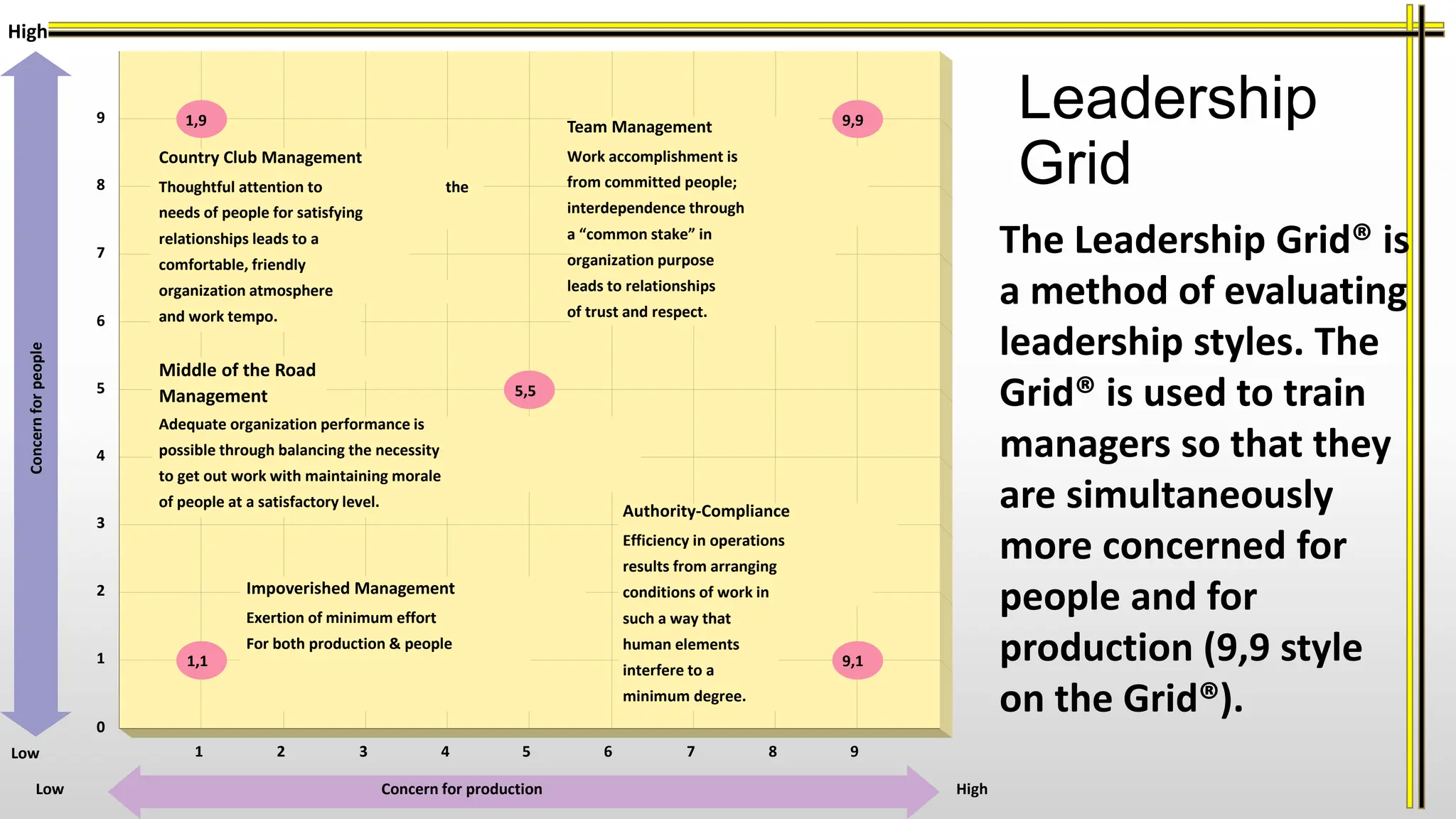
Leadership
Grid
4
6
2
1
3
5
8
7
9
0
1 4 6 9
5
2 3 8
7
Concern for production
High
Low
Low High
1,9 9,9
1,1 9,1
Team Management
Work accomplishment is
from committed people;
interdependence through
a “common stake” in
organization purpose
leads to relationships
of trust and respect.
Middle of the Road
Management
Adequate organization performance is
possible through balancing the necessity
to get out work with maintaining morale
of people at a satisfactory level.
Impoverished Management
Exertion of minimum effort
For both production & people
Authority-Compliance
Efficiency in operations
results from arranging
conditions of work in
such a way that
human elements
interfere to a
minimum degree.
5,5
Country Club Management
Thoughtful attention to the
needs of people for satisfying
relationships leads to a
comfortable, friendly
organization atmosphere
and work tempo.
Concern
for
people
The Leadership Grid® is
a method of evaluating
leadership styles. The
Grid® is used to train
managers so that they
are simultaneously
more concerned for
people and for
production (9,9 style
on the Grid®).
Situational Approaches to Leadership
• Appropriate leader behavior varies from one situation to
another.
• Key situational factors that are interacting to determine
appropriate leader behavior can be identified.
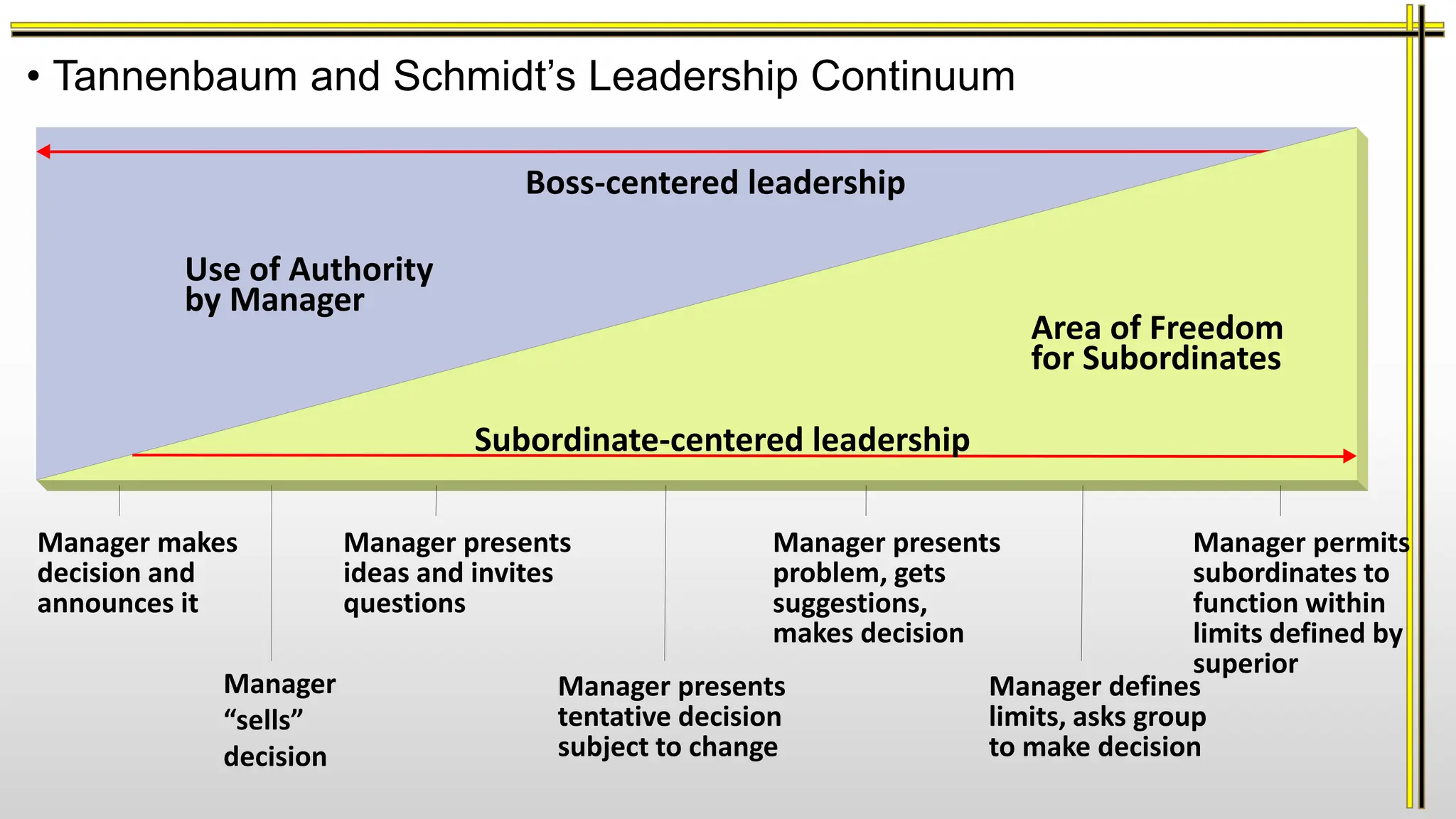
1. Leadership Continuum (Tannenbaum and
Schmidt)
• Variables influencing the decision-making continuum:
• Leader’s characteristics—value system, confidence in
subordinates, personal inclinations, and feelings of security.
• Subordinates’ characteristics—independence needs,
readiness for responsibility, tolerance of ambiguity, interest
in the problem, understanding goals, knowledge,
experience, and expectations.
• Situational Characteristics—type of organization, group
effectiveness, the problem itself, and time pressures.
• Tannenbaum and Schmidt’s Leadership Continuum
Use of Authority
by Manager
Boss-centered leadership
Manager makes
decision and
announces it
Manager permits
subordinates to
function within
limits defined by
superior
Manager defines
limits, asks group
to make decision
Manager presents
problem, gets
suggestions,
makes decision
Manager presents
tentative decision
subject to change
Manager presents
ideas and invites
questions
Manager
“sells”
decision
Area of Freedom
for Subordinates
Subordinate-centered leadership
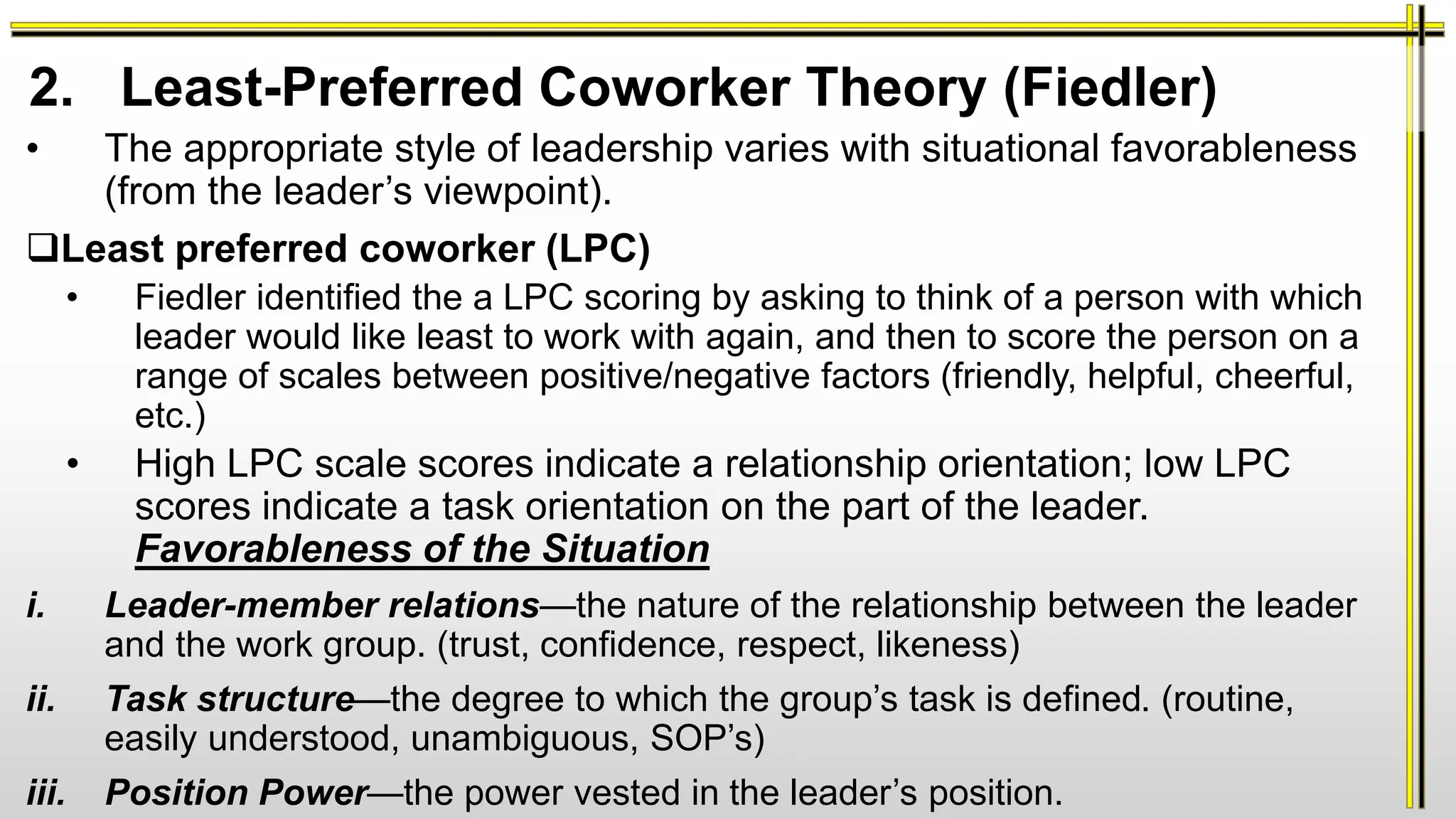
• The appropriate style of leadership varies with situational favorableness
(from the leader’s viewpoint).
Least preferred coworker (LPC)
• Fiedler identified the a LPC scoring by asking to think of a person with which
leader would like least to work with again, and then to score the person on a
range of scales between positive/negative factors (friendly, helpful, cheerful,
etc.)
• High LPC scale scores indicate a relationship orientation; low LPC
scores indicate a task orientation on the part of the leader.
Favorableness of the Situation
i. Leader-member relations—the nature of the relationship between the leader
and the work group. (trust, confidence, respect, likeness)
ii. Task structure—the degree to which the group’s task is defined. (routine,
easily understood, unambiguous, SOP’s)
iii. Position Power—the power vested in the leader’s position.
2. Least-Preferred Coworker Theory (Fiedler)
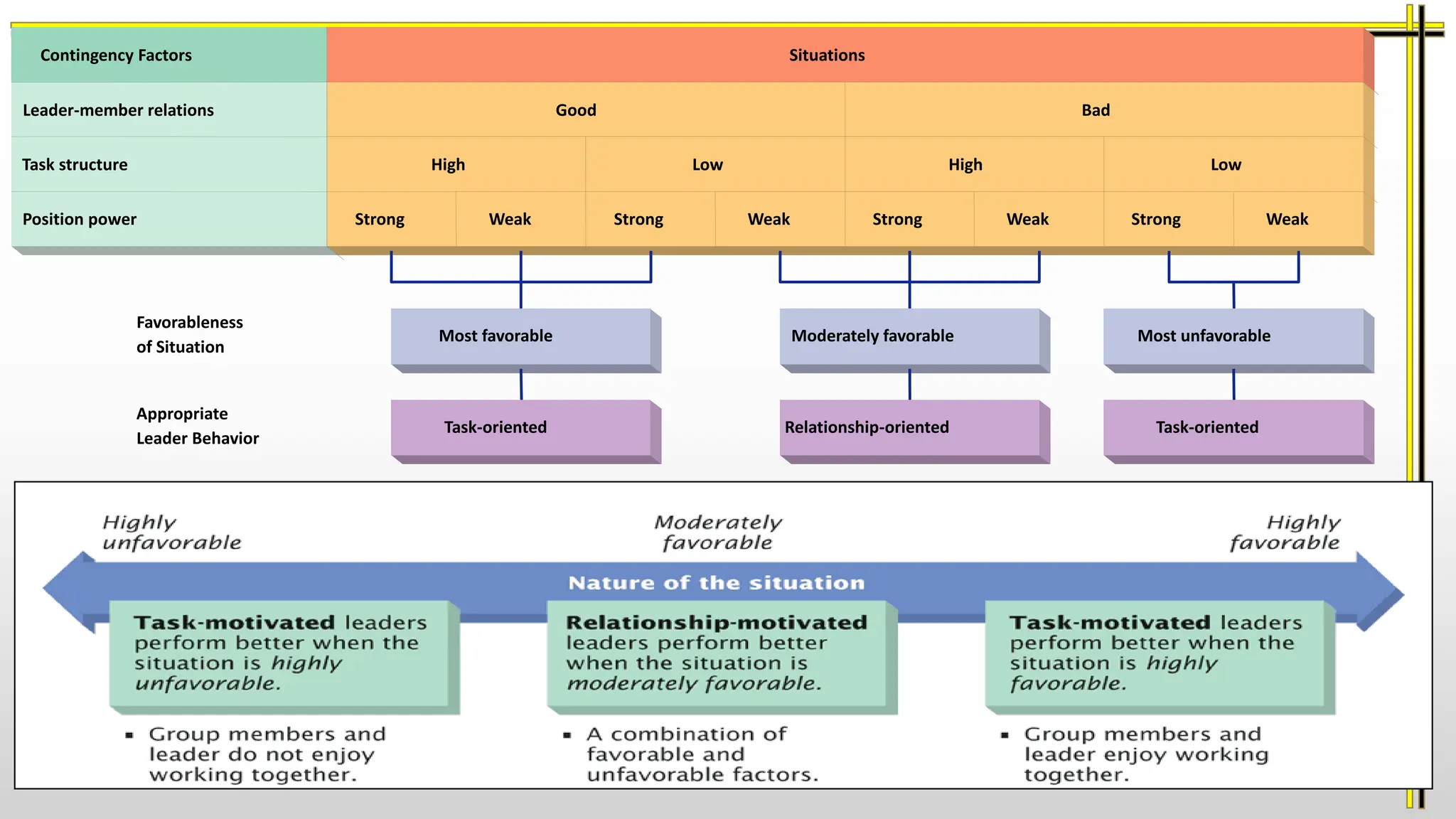
Contingency Factors Situations
Leader-member relations Good
Task structure High
Position power Strong
Bad
Low High Low
Weak Strong Weak Strong Weak Strong Weak
Favorableness
of Situation
Appropriate
Leader Behavior
Most favorable Moderately favorable Most unfavorable
Task-oriented Task-oriented
Relationship-oriented
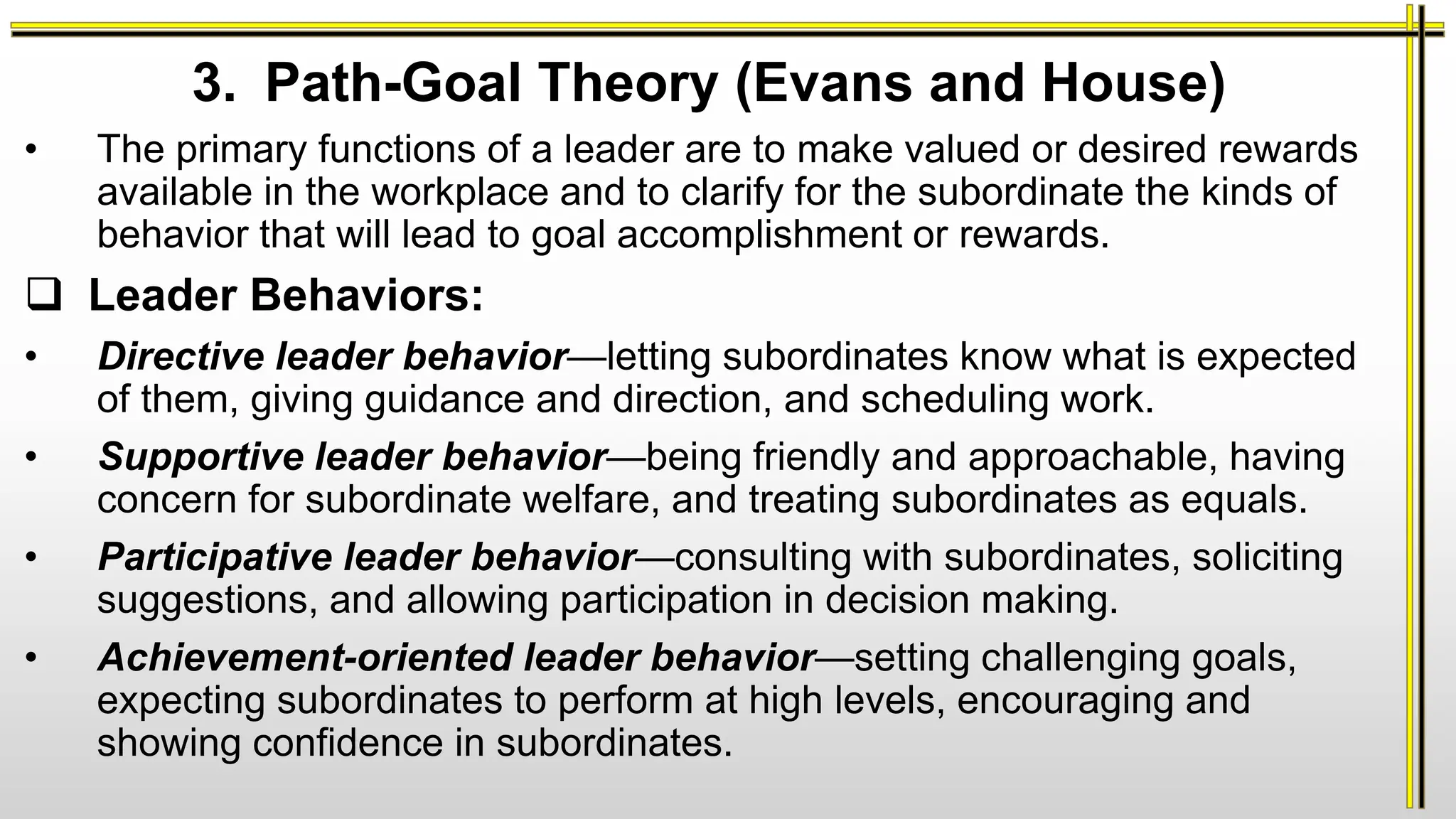
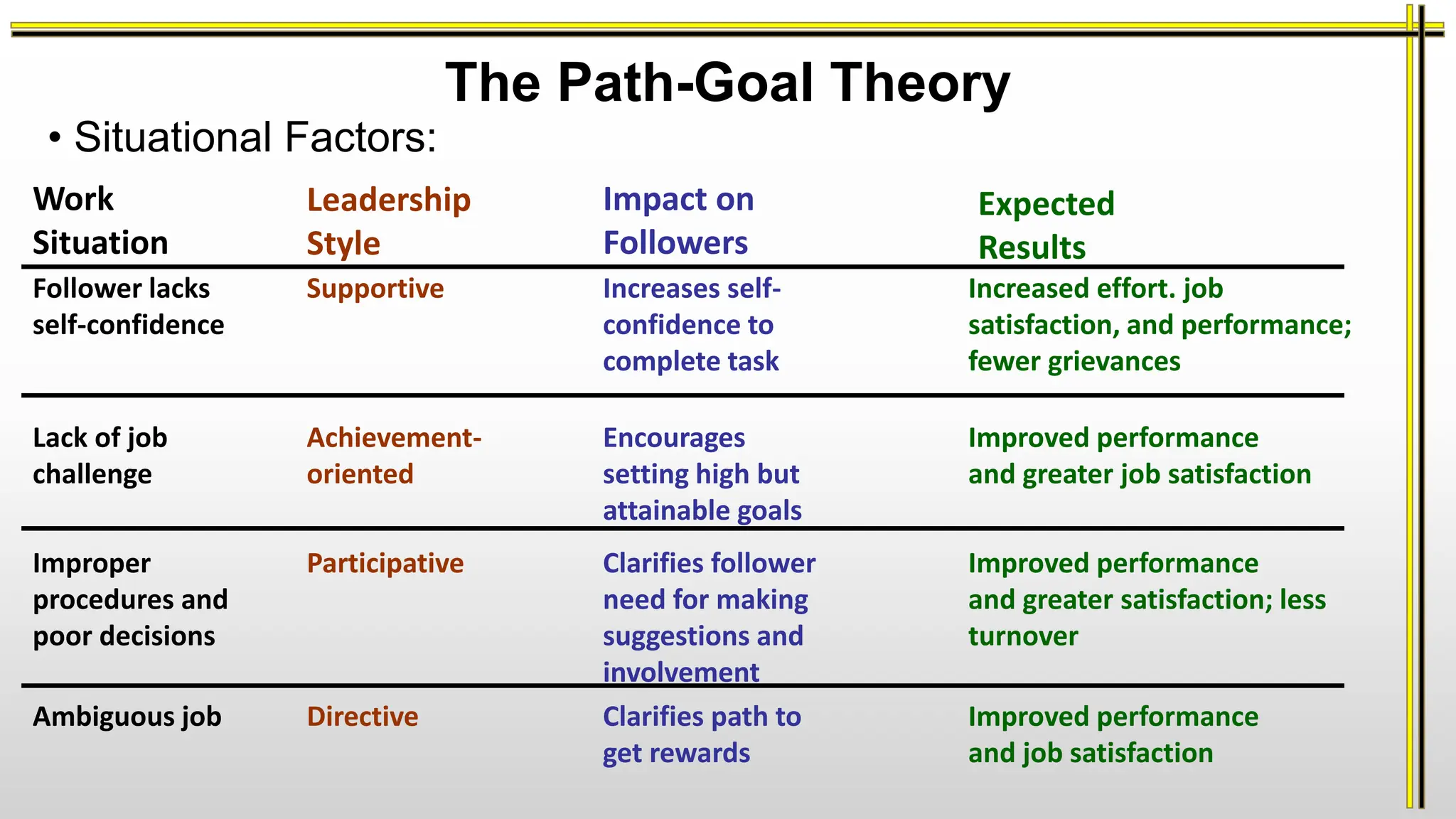
3. Path-Goal Theory (Evans and House)
• The primary functions of a leader are to make valued or desired rewards
available in the workplace and to clarify for the subordinate the kinds of
behavior that will lead to goal accomplishment or rewards.
 Leader Behaviors:
• Directive leader behavior—letting subordinates know what is expected
of them, giving guidance and direction, and scheduling work.
• Supportive leader behavior—being friendly and approachable, having
concern for subordinate welfare, and treating subordinates as equals.
• Participative leader behavior—consulting with subordinates, soliciting
suggestions, and allowing participation in decision making.
• Achievement-oriented leader behavior—setting challenging goals,
expecting subordinates to perform at high levels, encouraging and
showing confidence in subordinates.
The Path-Goal Theory
• Situational Factors:
Work
Situation
Follower lacks
self-confidence
Supportive
Achievement-
oriented
Participative
Directive
Leadership
Style
Impact on
Followers
Expected
Results
Lack of job
challenge
Improper
procedures and
poor decisions
Ambiguous job
Increases self-
confidence to
complete task
Encourages
setting high but
attainable goals
Clarifies follower
need for making
suggestions and
involvement
Clarifies path to
get rewards
Increased effort. job
satisfaction, and performance;
fewer grievances
Improved performance
and greater job satisfaction
Improved performance
and greater satisfaction; less
turnover
Improved performance
and job satisfaction
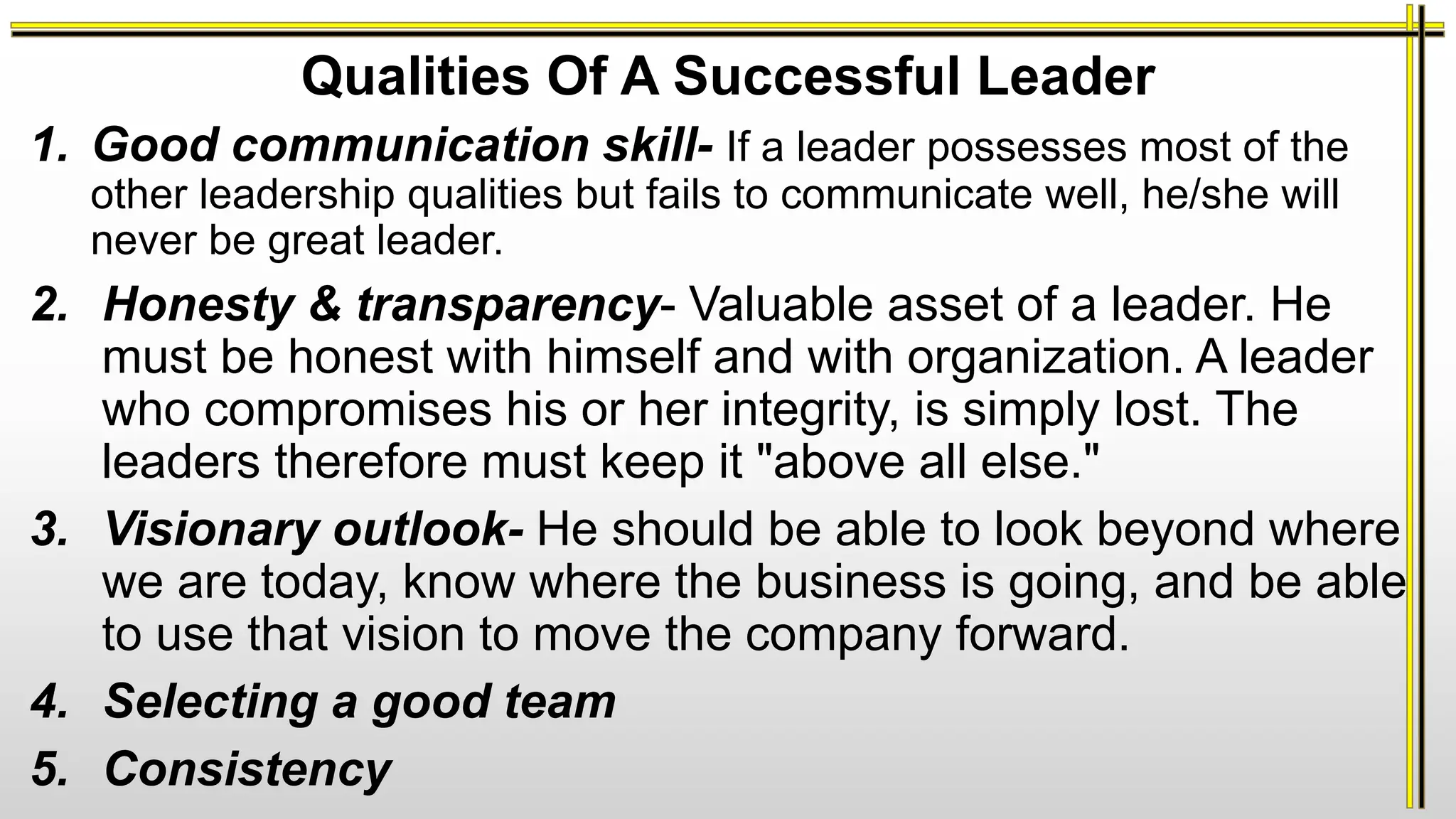
Qualities Of A Successful Leader
1. Good communication skill- If a leader possesses most of the
other leadership qualities but fails to communicate well, he/she will
never be great leader.
2. Honesty & transparency- Valuable asset of a leader. He
must be honest with himself and with organization. A leader
who compromises his or her integrity, is simply lost. The
leaders therefore must keep it "above all else."
3. Visionary outlook- He should be able to look beyond where
we are today, know where the business is going, and be able
to use that vision to move the company forward.
4. Selecting a good team
5. Consistency
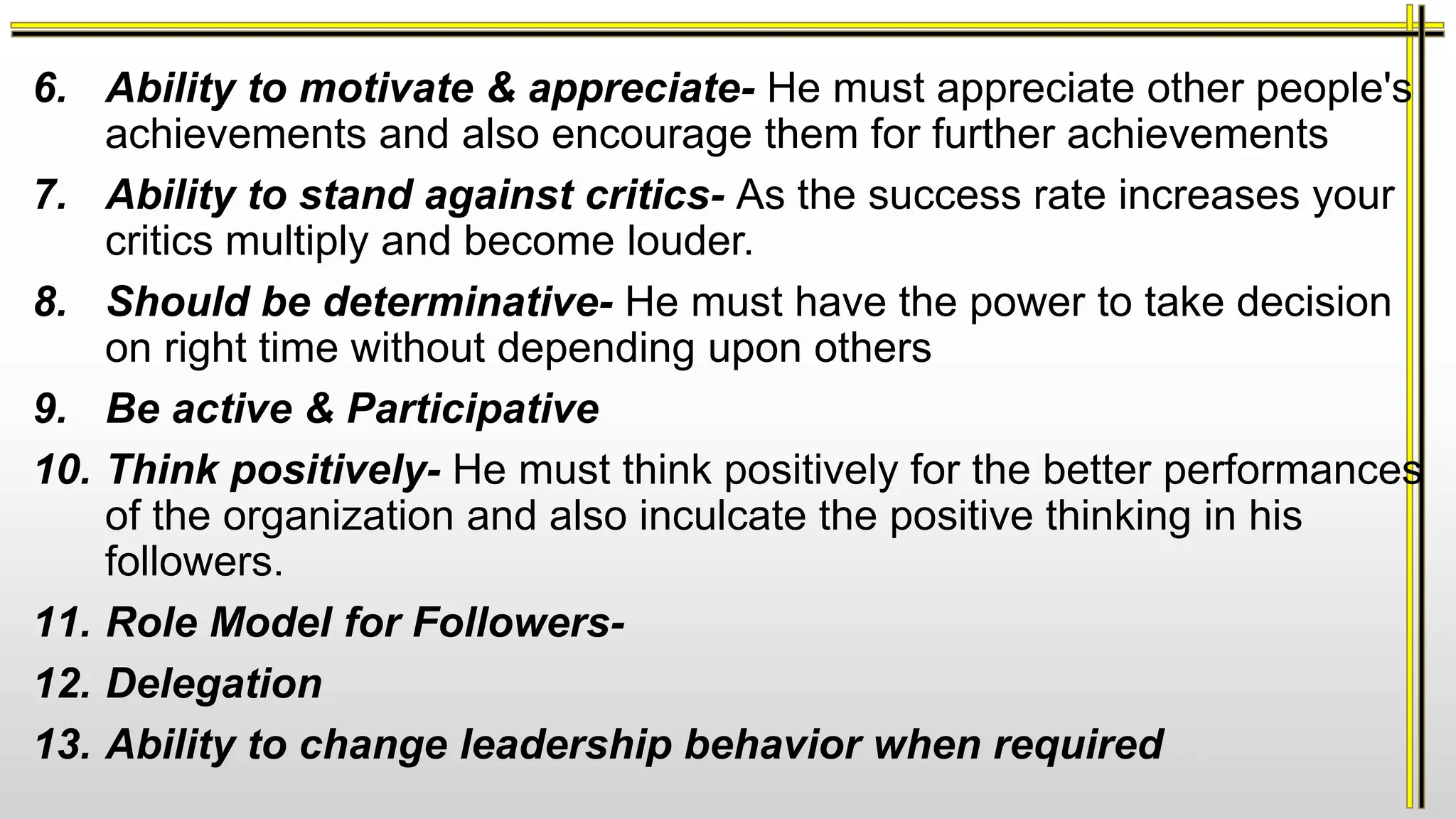
6. Ability to motivate & appreciate- He must appreciate other people's
achievements and also encourage them for further achievements
7. Ability to stand against critics- As the success rate increases your
critics multiply and become louder.
8. Should be determinative- He must have the power to take decision
on right time without depending upon others
9. Be active & Participative
10. Think positively- He must think positively for the better performances
of the organization and also inculcate the positive thinking in his
followers.
11. Role Model for Followers-
12. Delegation
13. Ability to change leadership behavior when required
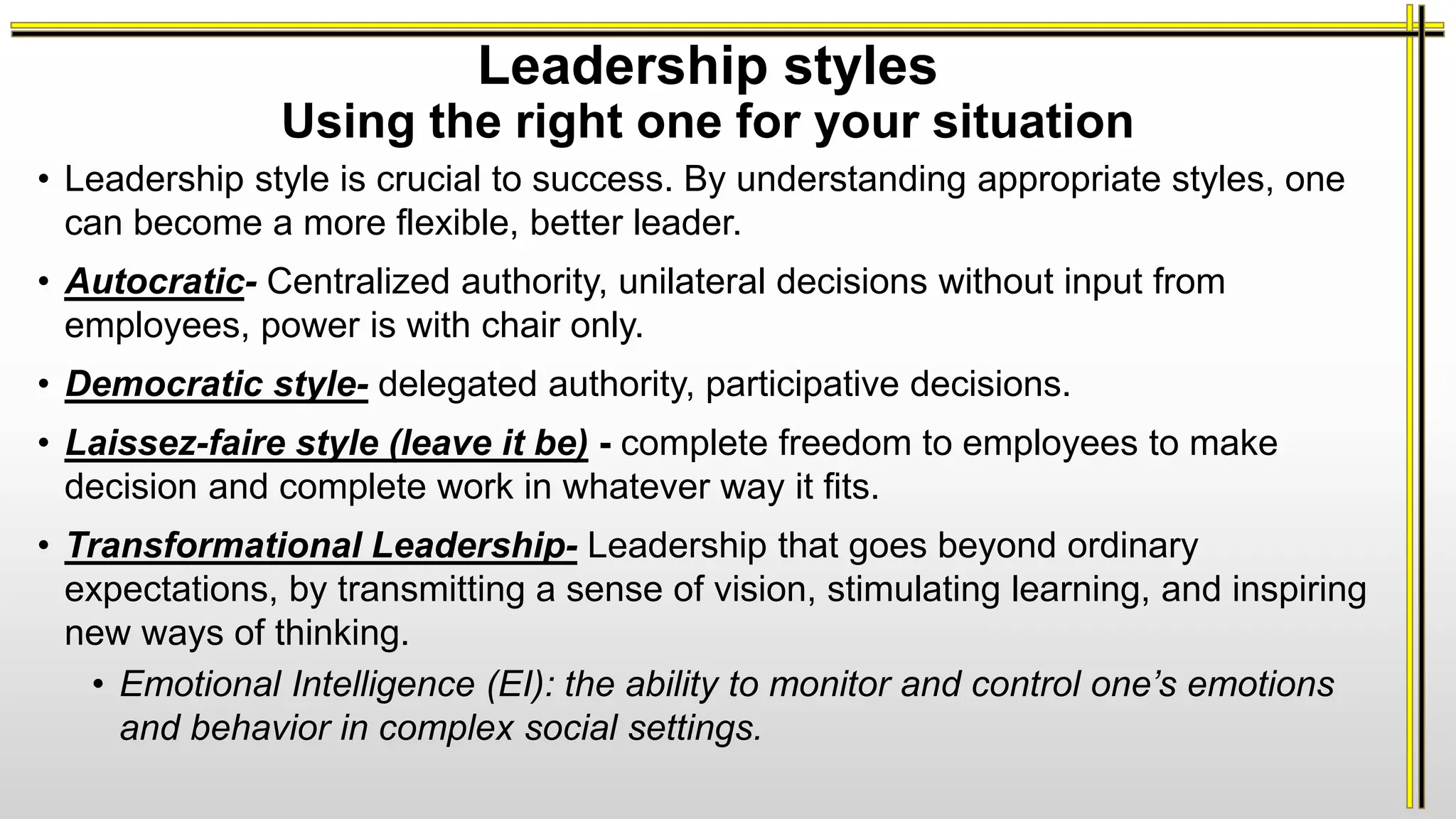
Leadership styles
Using the right one for your situation
• Leadership style is crucial to success. By understanding appropriate styles, one
can become a more flexible, better leader.
• Autocratic- Centralized authority, unilateral decisions without input from
employees, power is with chair only.
• Democratic style- delegated authority, participative decisions.
• Laissez-faire style (leave it be) - complete freedom to employees to make
decision and complete work in whatever way it fits.
• Transformational Leadership- Leadership that goes beyond ordinary
expectations, by transmitting a sense of vision, stimulating learning, and inspiring
new ways of thinking.
• Emotional Intelligence (EI): the ability to monitor and control one’s emotions
and behavior in complex social settings.
• Bureaucratic Leadership- Bureaucratic leaders work “by the book”, ensuring that
their staff follow procedures exactly. This is a very appropriate style for work
involving serious safety risks.
• Charismatic Leadership- Having ability to inspire, encourage, motivate &
influence others them to be their best and is very energetic in driving others
forward.
• Relations-Oriented Leadership- the leader is totally focused on organizing,
supporting and developing the people in the leader’s team. A participative style, it
tends to lead to good teamwork and creative collaboration. However it can lead to
failure to achieve the team's goals.
• Task-Oriented Leadership- A highly task-oriented leader focuses only on getting
the job done, and can be quite autocratic. He or she will actively define the work
and the role required, put structures in place, plan, organize and monitor.
• Servant Leadership- When someone, at any level within an organization, leads
simply by virtue of meeting the needs of his or her team, he or she is described as a
“servant leader”.
your leadership style? http://psychology.about.com/library/quiz/bl-leadershipquiz.htm
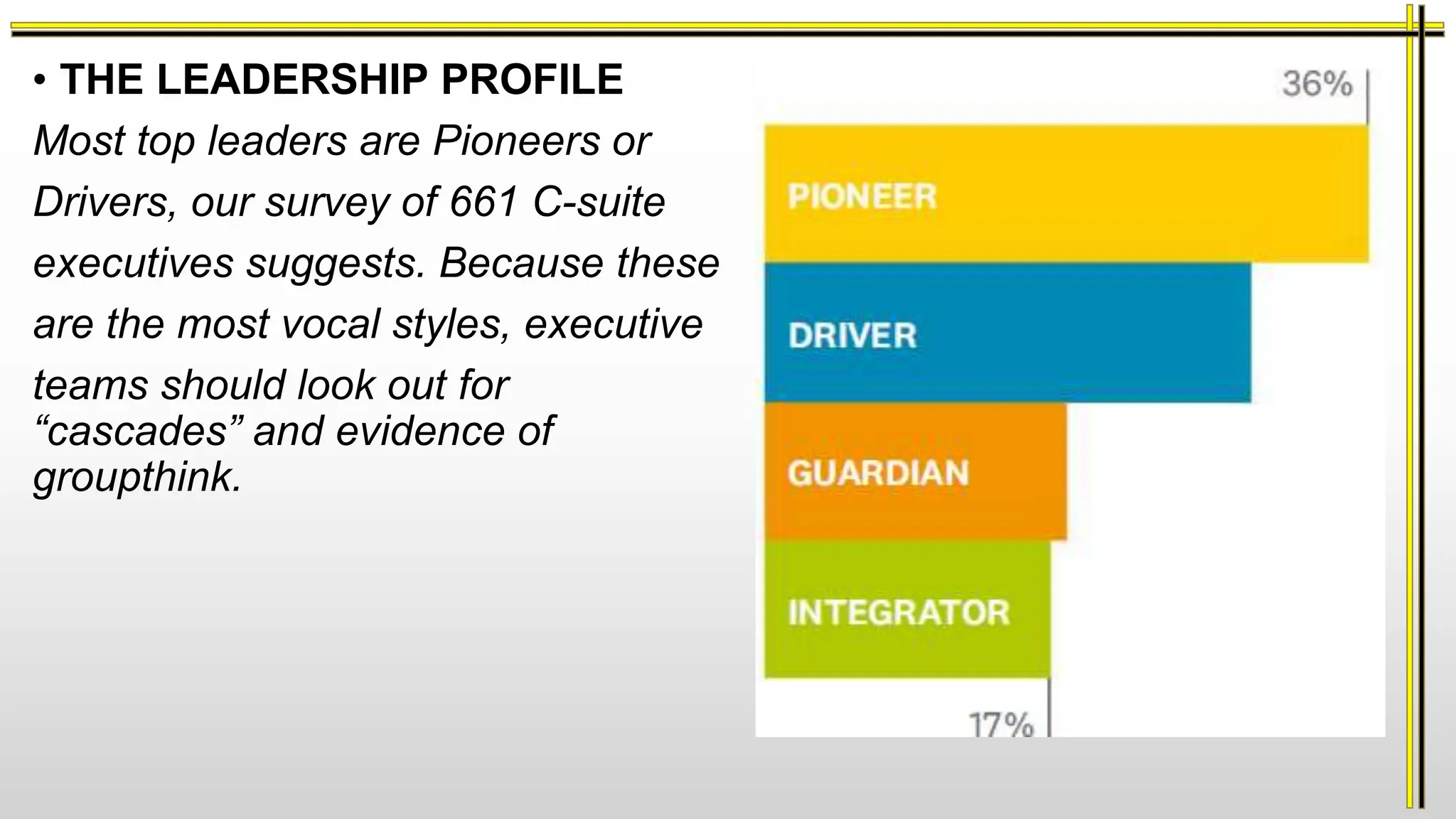
• THE LEADERSHIP PROFILE
Most top leaders are Pioneers or
Drivers, our survey of 661 C-suite
executives suggests. Because these
are the most vocal styles, executive
teams should look out for
“cascades” and evidence of
groupthink.

Lecture 10 Leadership Management Sciences

  • 1.
  • 2.
  • 3.
    “There has certainly beenfor you in the Messenger of Allah an excellent pattern for anyone whose hope is in Allah and the Last Day and [who] remembers Allah often.” [Quran, 33: 21]
  • 4.
    Leadership by leaders •A leader is a dealer in hope. —Napoleon Bonaparte • People buy into the leader before they buy into the vision. —John Maxwell • The art of leadership is saying no, not saying yes. It is very easy to say yes. —Tony Blair • Leadership and learning are indispensable to each other. —John F. Kennedy • Earn your leadership every day. –Michael Jordan
  • 5.
    Leadership • Leadership • Theprocess of inspiring, influencing, and guiding others to participate in a common effort. • Formal Leadership • The process of influencing relevant others to pursue official organizational objectives. • Informal Leadership • The process of influencing other to pursue unofficial objectives that may or may not serve the organization’s interests.
  • 6.
    Leadership Leadership is theart of motivating a group of people to act towards achieving a common goal. The process of encouraging and helping others to work enthusiastically towards objectives . Alan Keith stated that, "Leadership is ultimately about creating a way for people to contribute to making something extraordinary happen.
  • 7.
    • Leadership .. . . • Process: what leaders actually do. • Using non-coercive influence to shape the group’s or organization’s goals. • Motivating others’ behavior toward goals. • Helping to define organizational culture. • Property: who leaders are. • The set of characteristics attributed to individuals perceived to be leaders. • Leaders “Someone who has followers." • People who can influence the behaviors of others without having to rely on force. • People who are accepted as leaders by others.
  • 8.
    Leadership & management •Management - is a process of planning ,organising, coordinating ,directing, and controlling the activities of others. • Leadership - is the process of influencing for the purpose of achieving shared goals. • John kotter distinction : Management Leadership Involves coping with complexity Coping with change
  • 9.
    What's the differencebetween managers and leaders? • Managers have employees | leaders win followers. • Managers react to change | leaders create it. • Managers have good ideas | leaders implement them. • Managers communicate | leaders persuade. • Managers control groups | leaders create teamwork. • Managers try to be heroes | leaders create heroes all around them.
  • 10.
    Difference between Managers& Leaders MANAGERS LEADERS • Administer • Innovate • Maintain • Develop • Control • Inspire • Short term view • Long term view • Ask how & when • Ask what & why • Initiate • Originate • Accept the status quo • Challenge the status quo • Do things right • Do right things.
  • 11.
    DIFFERENCE BETWEEN ALEADER AND A BOSS A BOSS • Tells what to do • Relies on authority • Drives his men, • Delegates responsibility • Shows who is wrong • Demands respect, • Production oriented • Blames others for failures • Believes in “I”. A LEADER • Tells why to do and how to do. • Depends on goodwill. • Inspires his men • Delegates authority only • Shows what is wrong • Commands respect • People oriented • Gives all credit for all successes. • Believes in “WE”
  • 12.
    Power • What IsPower? • The ability to use/influence/control the human, informational, and material resources to get something done. i. Legitimate power is granted through the organizational hierarchy. Power of a position in organization. ii. Reward power is the power to give or withhold rewards. iii. Coercive power is the capability to force compliance by means of psychological, emotional, or physical threat. iv. Referent power is the personal power that occurs when followers imitate leader, show loyalty, impress from charismatic nature/acts of leader. Influence over others, acquired from being well liked or respected by them. v. Expert power is derived from the possession of information or expertise.
  • 13.
    Approaches to Leadership 1.Leadership Trait/Theory • Assumed that a basic set of personal traits that differentiated leaders from non-leaders could be used to identify leaders and as a tool for predicting who would become leaders. • Intelligence • Assertiveness • Above average height • Activity and social participation • Attractiveness, Self-confidence • Socioeconomic Status • The trait approach was unsuccessful in establishing empirical relationships between traits and persons regarded as leaders.
  • 14.
    2. BEHAVIOURIST THEORY •Michigan Studies (Rensis Likert) • Emphasizes what leaders do rather than their characteristics • So we look at what they do and how they behave • Identified two forms of leader behavior • Job-centered behavior—managers who pay close attention to job, work procedures and are keenly interested in performance. • Employee-centered behavior—managers who focus on the development of cohesive work groups and employee satisfaction.
  • 15.
    3. Ohio StateStudies • Identifies two of basic leadership styles that can be exhibited simultaneously: • Initiating-structure behavior—the leader clearly defines the leader- subordinate role expectations, formalizes communications, and sets the working agenda. • Consideration behavior—the leader shows concern for subordinates and attempts to establish a friendly and supportive climate.
  • 16.
  • 17.
    • Initial assumptionof the research was that leaders who exhibit high levels of both behaviors would be most effective leaders. Subsequent research indicated that: • Employees of supervisors ranked highly on initiating structure were high performers, although they expressed low levels of satisfaction and had higher absenteeism. • Employees of supervisors ranked highly on consideration had low- performance ratings, but they had high levels of satisfaction and had less absenteeism. • Other situational variables were making consistent leader behavior predictions difficult. • There is no universal or “one best way” model of leadership.
  • 18.
    4. The LeadershipGrid • A method of evaluating leadership styles to train managers using OD techniques so that they are simultaneously more concerned for both people and production. • Concern for production: • Deals with the job aspects of leader behavior. • Concern for people: • Deals with the people aspects of leader behavior.
  • 19.
    Leadership Grid 4 6 2 1 3 5 8 7 9 0 1 4 69 5 2 3 8 7 Concern for production High Low Low High 1,9 9,9 1,1 9,1 Team Management Work accomplishment is from committed people; interdependence through a “common stake” in organization purpose leads to relationships of trust and respect. Middle of the Road Management Adequate organization performance is possible through balancing the necessity to get out work with maintaining morale of people at a satisfactory level. Impoverished Management Exertion of minimum effort For both production & people Authority-Compliance Efficiency in operations results from arranging conditions of work in such a way that human elements interfere to a minimum degree. 5,5 Country Club Management Thoughtful attention to the needs of people for satisfying relationships leads to a comfortable, friendly organization atmosphere and work tempo. Concern for people The Leadership Grid® is a method of evaluating leadership styles. The Grid® is used to train managers so that they are simultaneously more concerned for people and for production (9,9 style on the Grid®).
  • 20.
    Situational Approaches toLeadership • Appropriate leader behavior varies from one situation to another. • Key situational factors that are interacting to determine appropriate leader behavior can be identified.
  • 21.
    1. Leadership Continuum(Tannenbaum and Schmidt) • Variables influencing the decision-making continuum: • Leader’s characteristics—value system, confidence in subordinates, personal inclinations, and feelings of security. • Subordinates’ characteristics—independence needs, readiness for responsibility, tolerance of ambiguity, interest in the problem, understanding goals, knowledge, experience, and expectations. • Situational Characteristics—type of organization, group effectiveness, the problem itself, and time pressures.
  • 22.
    • Tannenbaum andSchmidt’s Leadership Continuum Use of Authority by Manager Boss-centered leadership Manager makes decision and announces it Manager permits subordinates to function within limits defined by superior Manager defines limits, asks group to make decision Manager presents problem, gets suggestions, makes decision Manager presents tentative decision subject to change Manager presents ideas and invites questions Manager “sells” decision Area of Freedom for Subordinates Subordinate-centered leadership
  • 23.
    • The appropriatestyle of leadership varies with situational favorableness (from the leader’s viewpoint). Least preferred coworker (LPC) • Fiedler identified the a LPC scoring by asking to think of a person with which leader would like least to work with again, and then to score the person on a range of scales between positive/negative factors (friendly, helpful, cheerful, etc.) • High LPC scale scores indicate a relationship orientation; low LPC scores indicate a task orientation on the part of the leader. Favorableness of the Situation i. Leader-member relations—the nature of the relationship between the leader and the work group. (trust, confidence, respect, likeness) ii. Task structure—the degree to which the group’s task is defined. (routine, easily understood, unambiguous, SOP’s) iii. Position Power—the power vested in the leader’s position. 2. Least-Preferred Coworker Theory (Fiedler)
  • 24.
    Contingency Factors Situations Leader-memberrelations Good Task structure High Position power Strong Bad Low High Low Weak Strong Weak Strong Weak Strong Weak Favorableness of Situation Appropriate Leader Behavior Most favorable Moderately favorable Most unfavorable Task-oriented Task-oriented Relationship-oriented
  • 25.
    3. Path-Goal Theory(Evans and House) • The primary functions of a leader are to make valued or desired rewards available in the workplace and to clarify for the subordinate the kinds of behavior that will lead to goal accomplishment or rewards.  Leader Behaviors: • Directive leader behavior—letting subordinates know what is expected of them, giving guidance and direction, and scheduling work. • Supportive leader behavior—being friendly and approachable, having concern for subordinate welfare, and treating subordinates as equals. • Participative leader behavior—consulting with subordinates, soliciting suggestions, and allowing participation in decision making. • Achievement-oriented leader behavior—setting challenging goals, expecting subordinates to perform at high levels, encouraging and showing confidence in subordinates.
  • 26.
    The Path-Goal Theory •Situational Factors: Work Situation Follower lacks self-confidence Supportive Achievement- oriented Participative Directive Leadership Style Impact on Followers Expected Results Lack of job challenge Improper procedures and poor decisions Ambiguous job Increases self- confidence to complete task Encourages setting high but attainable goals Clarifies follower need for making suggestions and involvement Clarifies path to get rewards Increased effort. job satisfaction, and performance; fewer grievances Improved performance and greater job satisfaction Improved performance and greater satisfaction; less turnover Improved performance and job satisfaction
  • 27.
    Qualities Of ASuccessful Leader 1. Good communication skill- If a leader possesses most of the other leadership qualities but fails to communicate well, he/she will never be great leader. 2. Honesty & transparency- Valuable asset of a leader. He must be honest with himself and with organization. A leader who compromises his or her integrity, is simply lost. The leaders therefore must keep it "above all else." 3. Visionary outlook- He should be able to look beyond where we are today, know where the business is going, and be able to use that vision to move the company forward. 4. Selecting a good team 5. Consistency
  • 28.
    6. Ability tomotivate & appreciate- He must appreciate other people's achievements and also encourage them for further achievements 7. Ability to stand against critics- As the success rate increases your critics multiply and become louder. 8. Should be determinative- He must have the power to take decision on right time without depending upon others 9. Be active & Participative 10. Think positively- He must think positively for the better performances of the organization and also inculcate the positive thinking in his followers. 11. Role Model for Followers- 12. Delegation 13. Ability to change leadership behavior when required
  • 29.
    Leadership styles Using theright one for your situation • Leadership style is crucial to success. By understanding appropriate styles, one can become a more flexible, better leader. • Autocratic- Centralized authority, unilateral decisions without input from employees, power is with chair only. • Democratic style- delegated authority, participative decisions. • Laissez-faire style (leave it be) - complete freedom to employees to make decision and complete work in whatever way it fits. • Transformational Leadership- Leadership that goes beyond ordinary expectations, by transmitting a sense of vision, stimulating learning, and inspiring new ways of thinking. • Emotional Intelligence (EI): the ability to monitor and control one’s emotions and behavior in complex social settings.
  • 30.
    • Bureaucratic Leadership-Bureaucratic leaders work “by the book”, ensuring that their staff follow procedures exactly. This is a very appropriate style for work involving serious safety risks. • Charismatic Leadership- Having ability to inspire, encourage, motivate & influence others them to be their best and is very energetic in driving others forward. • Relations-Oriented Leadership- the leader is totally focused on organizing, supporting and developing the people in the leader’s team. A participative style, it tends to lead to good teamwork and creative collaboration. However it can lead to failure to achieve the team's goals. • Task-Oriented Leadership- A highly task-oriented leader focuses only on getting the job done, and can be quite autocratic. He or she will actively define the work and the role required, put structures in place, plan, organize and monitor. • Servant Leadership- When someone, at any level within an organization, leads simply by virtue of meeting the needs of his or her team, he or she is described as a “servant leader”. your leadership style? http://psychology.about.com/library/quiz/bl-leadershipquiz.htm
  • 32.
    • THE LEADERSHIPPROFILE Most top leaders are Pioneers or Drivers, our survey of 661 C-suite executives suggests. Because these are the most vocal styles, executive teams should look out for “cascades” and evidence of groupthink.