CARBON BASED CATALYSTS FOR
OXYGEN REDUCTION REACTION (ORR)
Lav Kumar Kasaudhan
ADVISOR :
Asst. Porf. (Dr.) Khanin Nueangnoraj
Sirindhorn International Institute of Technology,
Thammasat University, Thailand
Literature Review
Journal Paper 01
About…
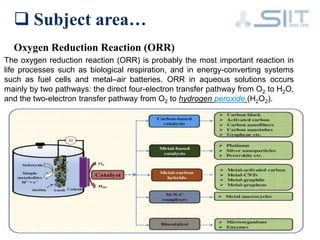
Oxygen Reduction Reaction (ORR)
The oxygen reduction reaction (ORR) is probably the most important reaction in
life processes such as biological respiration, and in energy-converting systems
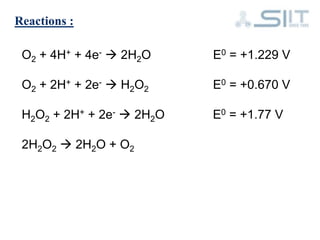
such as fuel cells and metal–air batteries. ORR in aqueous solutions occurs
mainly by two pathways: the direct four-electron transfer pathway from O2 to H2O,
and the two-electron transfer pathway from O2 to hydrogen peroxide (H2O2).
 Subject area…
O2 + 4H+ + 4e-  2H2O E0 = +1.229 V
O2 + 2H+ + 2e-  H2O2 E0 = +0.670 V
H2O2 + 2H+ + 2e-  2H2O E0 = +1.77 V
2H2O2  2H2O + O2
Reactions :
 Research gaps…
 Authors of this paper found some controversies among existing literatures
regarding this article, In the past decade, both the transition metal-based and
metal-free catalysts have crossed the volumetric activity and porous structure
requirements for the ORR.
 Nevertheless, these non-PGM catalysts cannot be implemented in the PEMFCs for
commercial applications, due to their unacceptably low stability and durability in
the operating conditions. The stability and durability of these catalysts is the
retention of initial performance and activity over the required operational lifetime.
Specifically, previous works refer to the stability and durability of the catalyst as
the performance loss at constant current and performance loss during voltage
cycling respectively.
 The U.S Department of Energy Fuel Cell Technology Office (DOE-FCTO) currently
targets PEMFC operational lifetimes of 60,000 h for the stationary applications and
5000 h for transportation applications. While the PGM-based PEMFC has
demonstrated thousands of hours of operation, current non-PGM PEMFC only
operates for hundreds of hours.
 Findings…
 This study has showed that Proton Exchange Membrane Fuel Cells (PEMFC)
emerged as the solution to the increasing CO2 emissions from the stationary
and automotive applications of combustion of fossil fuels
 The PEMFCs use hydrogen fuel to convert chemical energy into electrical
energy while producing water as a by-product, making them one of the most
environmentally benign energy conversion devices.
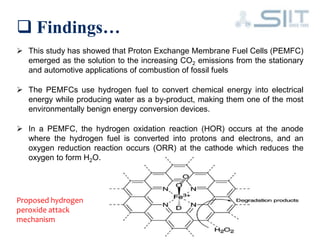
 In a PEMFC, the hydrogen oxidation reaction (HOR) occurs at the anode
where the hydrogen fuel is converted into protons and electrons, and an
oxygen reduction reaction occurs (ORR) at the cathode which reduces the
oxygen to form H2O.
Proposed hydrogen
peroxide attack
mechanism
 Findings (Cont…)
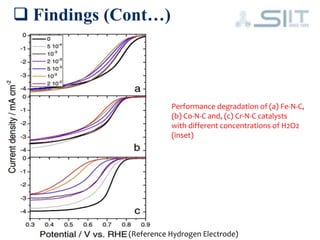
Performance degradation of (a) Fe-N-C,
(b) Co-N-C and, (c) Cr-N-C catalysts
with different concentrations of H2O2
(inset)
(Reference Hydrogen Electrode)
 Recommendations…
 It is highly recommended by authors that in order to replace
the PGM* catalysts from the PEMFCs#, the non-PGM
catalysts should exhibit both high activity and stability.
Several degradation mechanisms have been reported to
investigate the cause of the instability of these catalysts.
These mechanisms include oxidative attack of ORR
intermediates,demetallation**,protonation/neutralization,
and micropore flooding. Out of these mechanisms, the
carbon oxidation by the ORR intermediates and
demetalation are the most commonly observed degradation
mechanisms.
*PGM Platinum Group Metal
#PEMFC Proton Exchange Membrane Fuel Cell
**Demetallation Breaking of a bond between a substrate and a metal atom
Journal Paper 02
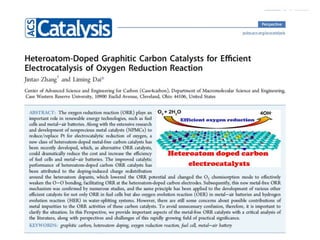
About…
 Research gaps…
Authors of this paper found some controversies
among existing literatures regarding this article,
The catalytic activity of nonprecious metal
catalysts (NPMCs) often decrease significantly
along with the metal leaching during usage,
leading to a poor durability.
There are still some concerns about possible
contributions of metal impurities to the ORR
activities of these metal-free carbon catalysts
 Findings…
 This study has showed that Nonprecious metal ORR electrocatalysts have been
developed from nitrogen and Co/Fe-containing precursors, including metal
porphyrin or phthalocyanine. Recently, NPMCs with carbon-supported, nitrogen-
rich metal complexes (M−Nx−C) were produced by high-temperature pyrolysis of
various nitrogen-rich (macro)molecules, such as polypyrrole, polyaniline,
phenanthroline, polyimide, and 2,6-diaminopyridine, incorporating iron and cobalt.
 As a building block for various carbon nanomaterials, including CNTs, graphene
sheets have also been demonstrated to show a superb ORR performance after
doping with nitrogen. Theoretical calculations indicate that the edge defects of
graphene can lower energy barriers for the oxygen adsorption and electron
transfer significantly to achieve a direct four-electron pathway for ORR.
 Phosphorus is an element of the nitrogen group with the same number of valence
electrons as nitrogen and often similar chemical properties. Like boron, the
electronegativity of P is lower than that of C. Metal-free phosphorus doped
mesoporous carbons (POMCs) with different pore sizes have also been
synthesized using SBA-15 mesoporous silica with different channel lengths as
templates as well as triphenylphosphine and phenol as phosphorus and carbon
sources, respectively.
 Findings (cont…)
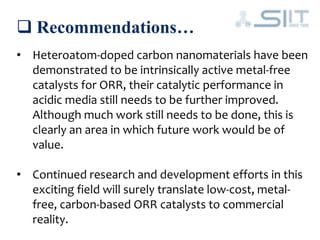
Cyclic voltammograms of sample electrodes on glassy carbon (GC)
electrodes in N2- and O2-saturated 0.1 M aq KOH solution with a scan rate
of 0.1 V/s: (a) pristine graphite; (b) HGnP; (c) CGnP; (d) SGnP; (e) CSGnP;
(f) Pt/C.
 Recommendations…
• Heteroatom-doped carbon nanomaterials have been
demonstrated to be intrinsically active metal-free
catalysts for ORR, their catalytic performance in
acidic media still needs to be further improved.
Although much work still needs to be done, this is
clearly an area in which future work would be of
value.
• Continued research and development efforts in this
exciting field will surely translate low-cost, metal-
free, carbon-based ORR catalysts to commercial
reality.
Journal Paper 03
About…
 Research gaps…
Authors of this paper found that
 the insights into the molecular mechanisms of ORR
activities can provide theoretical guidance towards
rational design of metal-free carbon-based
electrocatalysts for ORR.

 C60-frag exhibits the highest symmetry of C5v, but the
weakest adsorption of OH*/OOH* species and lowest
ORR activities among the four fragment models can be
considered.
 Findings…
This study has showed that Oxygen reduction reaction (ORR) is a key and rate-limiting
process
 In many applications associated with renewable energy conversion. The state-of-the-art
ORR catalysts include precious-group metal (PGM) Platinum (Pt) and Pt-based
catalysts, while their large-scale commercial applications are still hindered by the high
cost and scarcity and by Pt’s sensitivity to deactivation in the presence of CO.
 Another class of promising and alternative electrocatalysts for ORR is the metal-free
heteroatom-doped carbon materials (carbon nanotubes, graphene, graphite and
mesoporous carbon). It is demonstrated that bare carbon materials containing
appropriate defects or larger number of edge sites can also present outstanding ORR
activity.
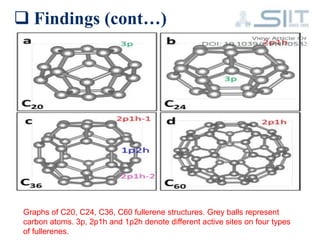
 Fullerenes are 0-dimensional carbon materials. Here, four kinds of small and mid-sized
fullerenes (C20, C24, C36 and C60), all containing pentagon carbon rings, are
considered as possible metal-free electrocatalysts for ORR. All of the four fullerenes are
not good ORR catalysts since the overpotentials of various active sites on four
fullerenes are all higher than 0.7 V. On the sites with more than two adjacent pentagon
rings of C20, C24, and C36, the step involving the last electron transfer and OH*
reduction to water is the rate-limiting step, and the corresponding ORR activities are
very poor due to too strong OH* adsorption.
 Findings (cont…)
Graphs of C20, C24, C36, C60 fullerene structures. Grey balls represent
carbon atoms. 3p, 2p1h and 1p2h denote different active sites on four types
of fullerenes.
 Recommendations…
It is highly recommended by authors that
the higher HOMO* level of the fragments
can lead to the stronger adsorption of
OH*/OOH* species.
*HOMO stands for highest occupied molecular orbital. LUMO stands for lowest
unoccupied molecular orbital.
Carbon based catalysts for oxygen reduction reaction (ORR)

Carbon based catalysts for oxygen reduction reaction (ORR)

  • 1.
    CARBON BASED CATALYSTSFOR OXYGEN REDUCTION REACTION (ORR) Lav Kumar Kasaudhan ADVISOR : Asst. Porf. (Dr.) Khanin Nueangnoraj Sirindhorn International Institute of Technology, Thammasat University, Thailand
  • 2.
  • 3.
  • 5.
  • 6.
    Oxygen Reduction Reaction(ORR) The oxygen reduction reaction (ORR) is probably the most important reaction in life processes such as biological respiration, and in energy-converting systems such as fuel cells and metal–air batteries. ORR in aqueous solutions occurs mainly by two pathways: the direct four-electron transfer pathway from O2 to H2O, and the two-electron transfer pathway from O2 to hydrogen peroxide (H2O2).  Subject area…
  • 7.
    O2 + 4H++ 4e-  2H2O E0 = +1.229 V O2 + 2H+ + 2e-  H2O2 E0 = +0.670 V H2O2 + 2H+ + 2e-  2H2O E0 = +1.77 V 2H2O2  2H2O + O2 Reactions :
  • 8.
     Research gaps… Authors of this paper found some controversies among existing literatures regarding this article, In the past decade, both the transition metal-based and metal-free catalysts have crossed the volumetric activity and porous structure requirements for the ORR.  Nevertheless, these non-PGM catalysts cannot be implemented in the PEMFCs for commercial applications, due to their unacceptably low stability and durability in the operating conditions. The stability and durability of these catalysts is the retention of initial performance and activity over the required operational lifetime. Specifically, previous works refer to the stability and durability of the catalyst as the performance loss at constant current and performance loss during voltage cycling respectively.  The U.S Department of Energy Fuel Cell Technology Office (DOE-FCTO) currently targets PEMFC operational lifetimes of 60,000 h for the stationary applications and 5000 h for transportation applications. While the PGM-based PEMFC has demonstrated thousands of hours of operation, current non-PGM PEMFC only operates for hundreds of hours.
  • 9.
     Findings…  Thisstudy has showed that Proton Exchange Membrane Fuel Cells (PEMFC) emerged as the solution to the increasing CO2 emissions from the stationary and automotive applications of combustion of fossil fuels  The PEMFCs use hydrogen fuel to convert chemical energy into electrical energy while producing water as a by-product, making them one of the most environmentally benign energy conversion devices.  In a PEMFC, the hydrogen oxidation reaction (HOR) occurs at the anode where the hydrogen fuel is converted into protons and electrons, and an oxygen reduction reaction occurs (ORR) at the cathode which reduces the oxygen to form H2O. Proposed hydrogen peroxide attack mechanism
  • 10.
     Findings (Cont…) Performancedegradation of (a) Fe-N-C, (b) Co-N-C and, (c) Cr-N-C catalysts with different concentrations of H2O2 (inset) (Reference Hydrogen Electrode)
  • 11.
     Recommendations…  Itis highly recommended by authors that in order to replace the PGM* catalysts from the PEMFCs#, the non-PGM catalysts should exhibit both high activity and stability. Several degradation mechanisms have been reported to investigate the cause of the instability of these catalysts. These mechanisms include oxidative attack of ORR intermediates,demetallation**,protonation/neutralization, and micropore flooding. Out of these mechanisms, the carbon oxidation by the ORR intermediates and demetalation are the most commonly observed degradation mechanisms. *PGM Platinum Group Metal #PEMFC Proton Exchange Membrane Fuel Cell **Demetallation Breaking of a bond between a substrate and a metal atom
  • 12.
  • 14.
  • 15.
     Research gaps… Authorsof this paper found some controversies among existing literatures regarding this article, The catalytic activity of nonprecious metal catalysts (NPMCs) often decrease significantly along with the metal leaching during usage, leading to a poor durability. There are still some concerns about possible contributions of metal impurities to the ORR activities of these metal-free carbon catalysts
  • 16.
     Findings…  Thisstudy has showed that Nonprecious metal ORR electrocatalysts have been developed from nitrogen and Co/Fe-containing precursors, including metal porphyrin or phthalocyanine. Recently, NPMCs with carbon-supported, nitrogen- rich metal complexes (M−Nx−C) were produced by high-temperature pyrolysis of various nitrogen-rich (macro)molecules, such as polypyrrole, polyaniline, phenanthroline, polyimide, and 2,6-diaminopyridine, incorporating iron and cobalt.  As a building block for various carbon nanomaterials, including CNTs, graphene sheets have also been demonstrated to show a superb ORR performance after doping with nitrogen. Theoretical calculations indicate that the edge defects of graphene can lower energy barriers for the oxygen adsorption and electron transfer significantly to achieve a direct four-electron pathway for ORR.  Phosphorus is an element of the nitrogen group with the same number of valence electrons as nitrogen and often similar chemical properties. Like boron, the electronegativity of P is lower than that of C. Metal-free phosphorus doped mesoporous carbons (POMCs) with different pore sizes have also been synthesized using SBA-15 mesoporous silica with different channel lengths as templates as well as triphenylphosphine and phenol as phosphorus and carbon sources, respectively.
  • 17.
     Findings (cont…) Cyclicvoltammograms of sample electrodes on glassy carbon (GC) electrodes in N2- and O2-saturated 0.1 M aq KOH solution with a scan rate of 0.1 V/s: (a) pristine graphite; (b) HGnP; (c) CGnP; (d) SGnP; (e) CSGnP; (f) Pt/C.
  • 18.
     Recommendations… • Heteroatom-dopedcarbon nanomaterials have been demonstrated to be intrinsically active metal-free catalysts for ORR, their catalytic performance in acidic media still needs to be further improved. Although much work still needs to be done, this is clearly an area in which future work would be of value. • Continued research and development efforts in this exciting field will surely translate low-cost, metal- free, carbon-based ORR catalysts to commercial reality.
  • 19.
  • 21.
  • 22.
     Research gaps… Authorsof this paper found that  the insights into the molecular mechanisms of ORR activities can provide theoretical guidance towards rational design of metal-free carbon-based electrocatalysts for ORR.  C60-frag exhibits the highest symmetry of C5v, but the weakest adsorption of OH*/OOH* species and lowest ORR activities among the four fragment models can be considered.
  • 23.
     Findings… This studyhas showed that Oxygen reduction reaction (ORR) is a key and rate-limiting process  In many applications associated with renewable energy conversion. The state-of-the-art ORR catalysts include precious-group metal (PGM) Platinum (Pt) and Pt-based catalysts, while their large-scale commercial applications are still hindered by the high cost and scarcity and by Pt’s sensitivity to deactivation in the presence of CO.  Another class of promising and alternative electrocatalysts for ORR is the metal-free heteroatom-doped carbon materials (carbon nanotubes, graphene, graphite and mesoporous carbon). It is demonstrated that bare carbon materials containing appropriate defects or larger number of edge sites can also present outstanding ORR activity.  Fullerenes are 0-dimensional carbon materials. Here, four kinds of small and mid-sized fullerenes (C20, C24, C36 and C60), all containing pentagon carbon rings, are considered as possible metal-free electrocatalysts for ORR. All of the four fullerenes are not good ORR catalysts since the overpotentials of various active sites on four fullerenes are all higher than 0.7 V. On the sites with more than two adjacent pentagon rings of C20, C24, and C36, the step involving the last electron transfer and OH* reduction to water is the rate-limiting step, and the corresponding ORR activities are very poor due to too strong OH* adsorption.
  • 24.
     Findings (cont…) Graphsof C20, C24, C36, C60 fullerene structures. Grey balls represent carbon atoms. 3p, 2p1h and 1p2h denote different active sites on four types of fullerenes.
  • 25.
     Recommendations… It ishighly recommended by authors that the higher HOMO* level of the fragments can lead to the stronger adsorption of OH*/OOH* species. *HOMO stands for highest occupied molecular orbital. LUMO stands for lowest unoccupied molecular orbital.