Lead Errors Reversal of limb leads
  COMMON LEAD ERRORS ERRORS INVOLVING THE LIMB LEADS Misplacement of the Einthoven limb leads -lead reversal, common (eg. Right arm- left arm reversal) - more complex misplacements (uncommon) Miplacement of the ground cable (eg. Right arm – right leg cable reversal) ERRORS INVOLVING THE CHEST LEADS Lead reversal (eg. V1-V3 reversal) -  Incorrect placement of a lead electrode
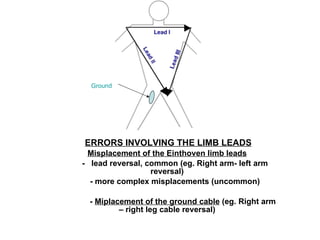
ERRORS INVOLVING THE LIMB LEADS Misplacement of the Einthoven limb leads -  lead reversal, common (eg. Right arm- left arm reversal) - more complex misplacements (uncommon) -  Miplacement of the ground cable  (eg. Right arm – right leg cable reversal) Ground
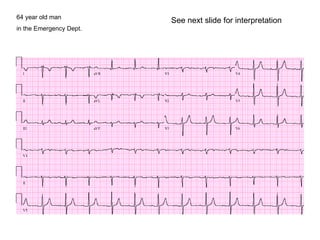
64 year old man in the Emergency Dept. See next slide for interpretation
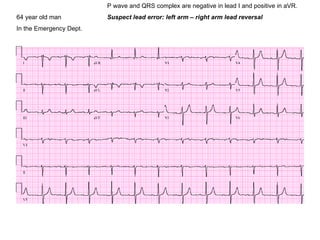
64 year old man In the Emergency Dept. P wave and QRS complex are negative in lead I and positive in aVR.  Suspect lead error: left arm – right arm lead reversal
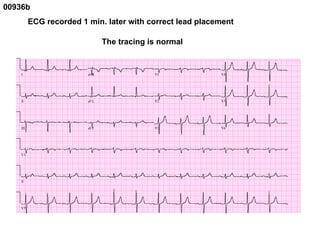
00936b  ECG recorded 1 min. later with correct lead placement The tracing is normal
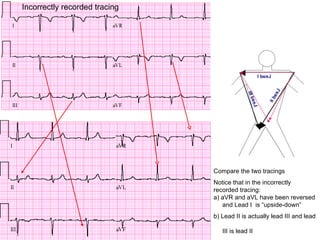
Compare the two tracings Notice that in the incorrectly recorded tracing: a) aVR and aVL have been reversed   and Lead I  is “upside-down”  b) Lead II is actually lead III and lead    III is lead II  Incorrectly recorded tracing
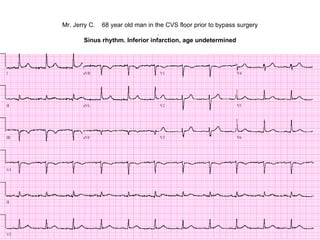
Mr. Jerry C.   68 year old man in the CVS floor prior to bypass surgery .  Sinus rhythm. Inferior infarction, age undetermined
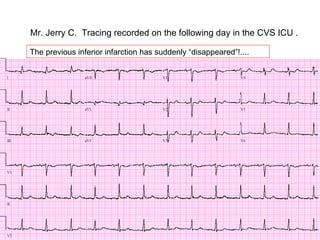
Mr. Jerry C.  Tracing recorded on the following day in the CVS ICU . The previous inferior infarction has suddenly “disappeared”!....
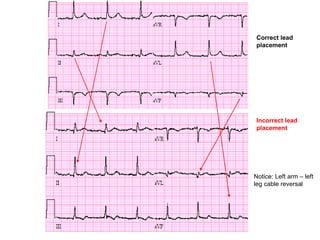
Correct lead placement Incorrect lead placement Notice: Left arm – left leg cable reversal
If unexpectedly an inferior infarction appears or disappears, check whether the left arm and left leg electrodes might  have been reversed. This lead error is frequently missed.
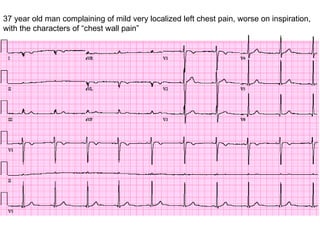
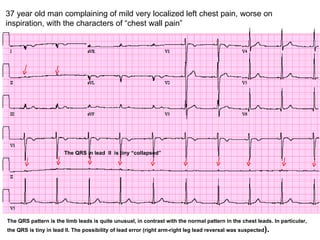
37 year old man complaining of mild very localized left chest pain, worse on inspiration, with the characters of “chest wall pain”
The QRS in lead  II  is tiny “collapsed” The QRS pattern is the limb leads is quite unusual, in contrast with the normal pattern in the chest leads. In particular, the QRS is tiny in lead II. The possibility of lead error (right arm-right leg lead reversal was suspected ).  37 year old man complaining of mild very localized left chest pain, worse on inspiration, with the characters of “chest wall pain”
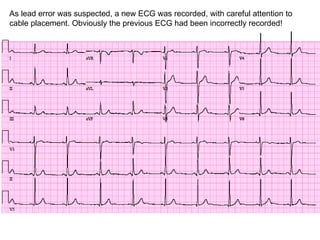
As lead error was suspected, a new ECG was recorded, with careful attention to cable placement. Obviously the previous ECG had been incorrectly recorded!
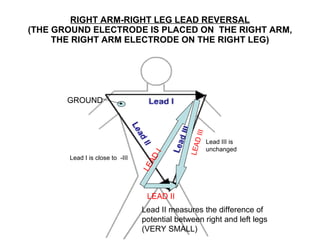
RIGHT ARM-RIGHT LEG LEAD REVERSAL (THE GROUND ELECTRODE IS PLACED ON  THE RIGHT ARM, THE RIGHT ARM ELECTRODE ON THE RIGHT LEG) GROUND Lead III is unchanged Lead II measures the difference of potential between right and left legs (VERY SMALL) LEAD II LEAD III LEAD I Lead I is close to  -III
When tracing of lead II appears “collapsed” (very small voltage),suspect that the  the placement of the right arm and right leg cables may have been reversed Please, see the “lead errors” tutorial for an animated demonstration

Lead errors: reversal of limb leads

  • 1.
    Lead Errors Reversalof limb leads
  • 2.
    COMMONLEAD ERRORS ERRORS INVOLVING THE LIMB LEADS Misplacement of the Einthoven limb leads -lead reversal, common (eg. Right arm- left arm reversal) - more complex misplacements (uncommon) Miplacement of the ground cable (eg. Right arm – right leg cable reversal) ERRORS INVOLVING THE CHEST LEADS Lead reversal (eg. V1-V3 reversal) - Incorrect placement of a lead electrode
  • 3.
    ERRORS INVOLVING THELIMB LEADS Misplacement of the Einthoven limb leads - lead reversal, common (eg. Right arm- left arm reversal) - more complex misplacements (uncommon) - Miplacement of the ground cable (eg. Right arm – right leg cable reversal) Ground
  • 4.
    64 year oldman in the Emergency Dept. See next slide for interpretation
  • 5.
    64 year oldman In the Emergency Dept. P wave and QRS complex are negative in lead I and positive in aVR. Suspect lead error: left arm – right arm lead reversal
  • 6.
    00936b ECGrecorded 1 min. later with correct lead placement The tracing is normal
  • 7.
    Compare the twotracings Notice that in the incorrectly recorded tracing: a) aVR and aVL have been reversed and Lead I is “upside-down” b) Lead II is actually lead III and lead III is lead II Incorrectly recorded tracing
  • 8.
    Mr. Jerry C. 68 year old man in the CVS floor prior to bypass surgery . Sinus rhythm. Inferior infarction, age undetermined
  • 9.
    Mr. Jerry C. Tracing recorded on the following day in the CVS ICU . The previous inferior infarction has suddenly “disappeared”!....
  • 10.
    Correct lead placementIncorrect lead placement Notice: Left arm – left leg cable reversal
  • 11.
    If unexpectedly aninferior infarction appears or disappears, check whether the left arm and left leg electrodes might have been reversed. This lead error is frequently missed.
  • 12.
    37 year oldman complaining of mild very localized left chest pain, worse on inspiration, with the characters of “chest wall pain”
  • 13.
    The QRS inlead II is tiny “collapsed” The QRS pattern is the limb leads is quite unusual, in contrast with the normal pattern in the chest leads. In particular, the QRS is tiny in lead II. The possibility of lead error (right arm-right leg lead reversal was suspected ). 37 year old man complaining of mild very localized left chest pain, worse on inspiration, with the characters of “chest wall pain”
  • 14.
    As lead errorwas suspected, a new ECG was recorded, with careful attention to cable placement. Obviously the previous ECG had been incorrectly recorded!
  • 15.
    RIGHT ARM-RIGHT LEGLEAD REVERSAL (THE GROUND ELECTRODE IS PLACED ON THE RIGHT ARM, THE RIGHT ARM ELECTRODE ON THE RIGHT LEG) GROUND Lead III is unchanged Lead II measures the difference of potential between right and left legs (VERY SMALL) LEAD II LEAD III LEAD I Lead I is close to -III
  • 16.
    When tracing oflead II appears “collapsed” (very small voltage),suspect that the the placement of the right arm and right leg cables may have been reversed Please, see the “lead errors” tutorial for an animated demonstration