Brugada Syndrome
Mamata rai
Msc. Nursing 2nd year
AIIMS
Introduction
Brugada syndrome is a genetic disease that is
characterized by sudden death associated with
abnormal electrocardiogram disorder.
One of several ECG patterns characterized by are
incomplete right bundle-branch block and ST-
segment elevations in the anterior precordial
leads(V1-V3) without ischemia.
Introduction
The cause of syncope and sudden death in Brugada
syndrome are caused by fast polymorphic ventricular
tachycardias or ventricular fibrillation. These
arrhythmias appear with no warning.
According to clinical reports, sudden death in people
with Brugada syndrome most often happens during
sleep.
Introduction
Monomorphic VT rarely occurs , especially in patients
taking antiarrhythmic drugs .
Supraventricular tachycardias are more prevalent in
Brugada syndrome .
An estimated 80% of subjects with documented VT/VF has
a history of syncope , caused by self-terminating episodes.
Epidemiology
 In parts of Asia Brugada syndrome seems to be the
most common cause of natural death in men <50
years.
 It is approximately 30 cases per 100,000 population
per year.
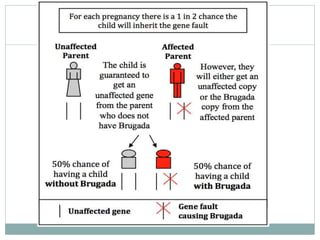
 And 8-10 times more prevalent in men than in
women, although the probability of having a mutated
gene does not differ by sex.
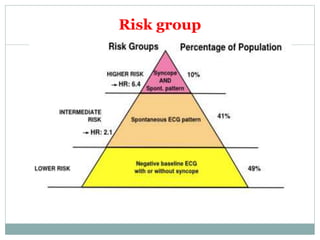
Risk group
Etiology
1. The majority of patients affected by Brugada syndrome are
not found to have known genetic mutations to explain the
disease.
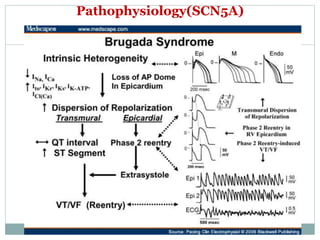
2. Approximately 20% due to alterations in the SCN5A
gene(encodes the cardiac sodium channel)
3. Mutations in the genes Glycerol-3-phosphate dehydrogenase
1-like gene(GPD1-L) and SCN1B
Pathophysiology
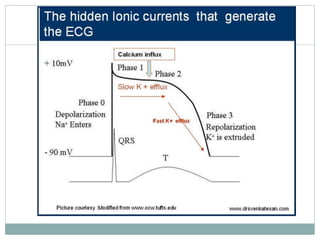
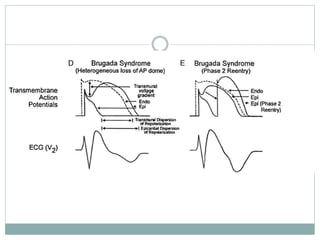
 Approximately 10-30% of the cases of Brugada
syndrome have been shown to be associated with
mutations in a gene that encodes for a sodium ion
channel in the cell membranes myocytes this is often
referred to as a sodium channelopathy.
Pathophysiology(SCN5A)
Signs and symptoms
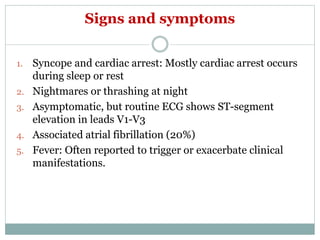
1. Syncope and cardiac arrest: Mostly cardiac arrest occurs
during sleep or rest
2. Nightmares or thrashing at night
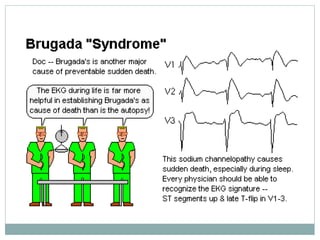
3. Asymptomatic, but routine ECG shows ST-segment
elevation in leads V1-V3
4. Associated atrial fibrillation (20%)
5. Fever: Often reported to trigger or exacerbate clinical
manifestations.
TYPES
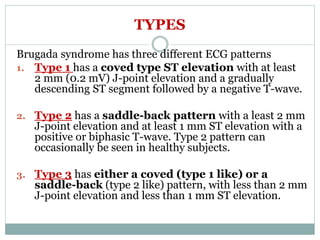
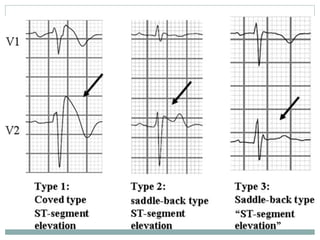
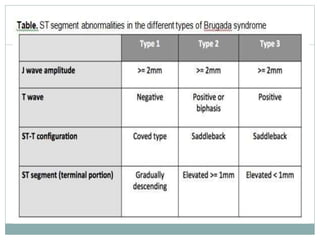
Brugada syndrome has three different ECG patterns
1. Type 1 has a coved type ST elevation with at least
2 mm (0.2 mV) J-point elevation and a gradually
descending ST segment followed by a negative T-wave.
2. Type 2 has a saddle-back pattern with a least 2 mm
J-point elevation and at least 1 mm ST elevation with a
positive or biphasic T-wave. Type 2 pattern can
occasionally be seen in healthy subjects.
3. Type 3 has either a coved (type 1 like) or a
saddle-back (type 2 like) pattern, with less than 2 mm
J-point elevation and less than 1 mm ST elevation.
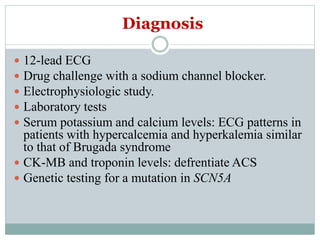
Diagnosis
 12-lead ECG
 Drug challenge with a sodium channel blocker.
 Electrophysiologic study.
 Laboratory tests
 Serum potassium and calcium levels: ECG patterns in
patients with hypercalcemia and hyperkalemia similar
to that of Brugada syndrome
 CK-MB and troponin levels: defrentiate ACS
 Genetic testing for a mutation in SCN5A
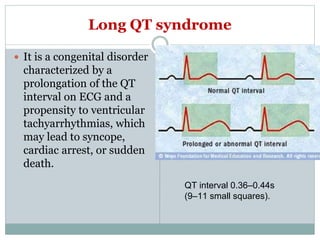
Long QT syndrome
 It is a congenital disorder
characterized by a
prolongation of the QT
interval on ECG and a
propensity to ventricular
tachyarrhythmias, which
may lead to syncope,
cardiac arrest, or sudden
death.
QT interval 0.36–0.44s
(9–11 small squares).
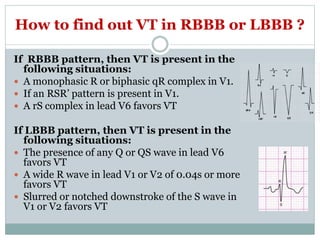
How to find out VT in RBBB or LBBB ?
If RBBB pattern, then VT is present in the
following situations:
 A monophasic R or biphasic qR complex in V1.
 If an RSR’ pattern is present in V1.
 A rS complex in lead V6 favors VT
If LBBB pattern, then VT is present in the
following situations:
 The presence of any Q or QS wave in lead V6
favors VT
 A wide R wave in lead V1 or V2 of 0.04s or more
favors VT
 Slurred or notched downstroke of the S wave in
V1 or V2 favors VT
Differential diagnosis of ST-segment elevation
1. Atypical right bundle-branch block
2. Left ventricular hypertrophy
3. Early repolarization
4. Acute pericarditis
5. Acute myocardial ischemia or infarction
6. Pulmonary embolism
7. Dissecting aortic aneurysm
8. Arrhythmogenic right ventricular dysplasia and/or cardiomyopathy
9. Various abnormalities of the central and autonomic nervous systems
10. Overdose of a antidepressant
11. Thiamine deficiency Hypercalcemia
12. Hyperkalemia
13. Effects of athletic training
Management
 There is no exact treatment modality that reliably and
totally prevents ventricular fibrillation from occurring
in this syndrome
 treatment lies in termination of this lethal arrhythmia
before it causes death.
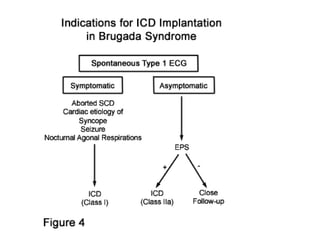
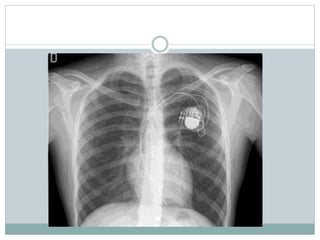
 Implantable cardioverter-defibrillator(ICD) is inserted
, which continuously monitors the heart rhythm and
will shock the wearer if ventricular fibrillation is sensed.
 Quinidine , a pharmaceutical agent that acts as a class
I antiarrhythmic agent is used.
Quinidine Sulfate
 Test Dose: 200 mg PO quinidine sulfate several hr
before full dosage
 AFib: 300-400 mg PO q6hr
 PSVT: 400-600 mg PO q2-3hr until paroxysm
terminated
 Atrial/Ventr Premature Contractions: 200-300 mg
PO TID/QID
 Maint: 200-400 mg PO
 No more than 3-4 g/d
AICD
 The automatic implantable cardioverter-defibrillator
(AICD) is a device designed to monitor the heartbeat.
This device can deliver an electrical impulse or shock
to the heart when it senses a life threatening change
in the heart’s rhythm like sustained ventricular
tachycardia or fibrillation
Complication
1. VT
2. VF
3. Cardiac arrest
4. death
Prognosis
 An estimated 4% of all sudden deaths and at least
20% of sudden deaths in patients with structurally
normal hearts are due to this syndrome.
Conclusion
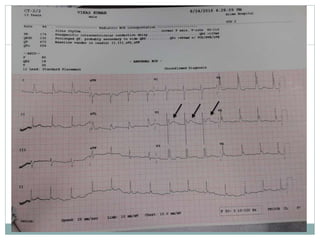
Bikash is 13 yrs male student diagnosed with
brugada syndrome type 2, managed with AICD dual
chamber is discharged in stable condition with
uneventful hospitalization period.

Brugada syndrome

  • 1.
    Brugada Syndrome Mamata rai Msc.Nursing 2nd year AIIMS
  • 2.
    Introduction Brugada syndrome isa genetic disease that is characterized by sudden death associated with abnormal electrocardiogram disorder. One of several ECG patterns characterized by are incomplete right bundle-branch block and ST- segment elevations in the anterior precordial leads(V1-V3) without ischemia.
  • 3.
    Introduction The cause ofsyncope and sudden death in Brugada syndrome are caused by fast polymorphic ventricular tachycardias or ventricular fibrillation. These arrhythmias appear with no warning. According to clinical reports, sudden death in people with Brugada syndrome most often happens during sleep.
  • 4.
    Introduction Monomorphic VT rarelyoccurs , especially in patients taking antiarrhythmic drugs . Supraventricular tachycardias are more prevalent in Brugada syndrome . An estimated 80% of subjects with documented VT/VF has a history of syncope , caused by self-terminating episodes.
  • 5.
    Epidemiology  In partsof Asia Brugada syndrome seems to be the most common cause of natural death in men <50 years.  It is approximately 30 cases per 100,000 population per year.  And 8-10 times more prevalent in men than in women, although the probability of having a mutated gene does not differ by sex.
  • 7.
  • 8.
    Etiology 1. The majorityof patients affected by Brugada syndrome are not found to have known genetic mutations to explain the disease. 2. Approximately 20% due to alterations in the SCN5A gene(encodes the cardiac sodium channel) 3. Mutations in the genes Glycerol-3-phosphate dehydrogenase 1-like gene(GPD1-L) and SCN1B
  • 9.
    Pathophysiology  Approximately 10-30%of the cases of Brugada syndrome have been shown to be associated with mutations in a gene that encodes for a sodium ion channel in the cell membranes myocytes this is often referred to as a sodium channelopathy.
  • 11.
  • 13.
    Signs and symptoms 1.Syncope and cardiac arrest: Mostly cardiac arrest occurs during sleep or rest 2. Nightmares or thrashing at night 3. Asymptomatic, but routine ECG shows ST-segment elevation in leads V1-V3 4. Associated atrial fibrillation (20%) 5. Fever: Often reported to trigger or exacerbate clinical manifestations.
  • 14.
    TYPES Brugada syndrome hasthree different ECG patterns 1. Type 1 has a coved type ST elevation with at least 2 mm (0.2 mV) J-point elevation and a gradually descending ST segment followed by a negative T-wave. 2. Type 2 has a saddle-back pattern with a least 2 mm J-point elevation and at least 1 mm ST elevation with a positive or biphasic T-wave. Type 2 pattern can occasionally be seen in healthy subjects. 3. Type 3 has either a coved (type 1 like) or a saddle-back (type 2 like) pattern, with less than 2 mm J-point elevation and less than 1 mm ST elevation.
  • 17.
    Diagnosis  12-lead ECG Drug challenge with a sodium channel blocker.  Electrophysiologic study.  Laboratory tests  Serum potassium and calcium levels: ECG patterns in patients with hypercalcemia and hyperkalemia similar to that of Brugada syndrome  CK-MB and troponin levels: defrentiate ACS  Genetic testing for a mutation in SCN5A
  • 18.
    Long QT syndrome It is a congenital disorder characterized by a prolongation of the QT interval on ECG and a propensity to ventricular tachyarrhythmias, which may lead to syncope, cardiac arrest, or sudden death. QT interval 0.36–0.44s (9–11 small squares).
  • 20.
    How to findout VT in RBBB or LBBB ? If RBBB pattern, then VT is present in the following situations:  A monophasic R or biphasic qR complex in V1.  If an RSR’ pattern is present in V1.  A rS complex in lead V6 favors VT If LBBB pattern, then VT is present in the following situations:  The presence of any Q or QS wave in lead V6 favors VT  A wide R wave in lead V1 or V2 of 0.04s or more favors VT  Slurred or notched downstroke of the S wave in V1 or V2 favors VT
  • 21.
    Differential diagnosis ofST-segment elevation 1. Atypical right bundle-branch block 2. Left ventricular hypertrophy 3. Early repolarization 4. Acute pericarditis 5. Acute myocardial ischemia or infarction 6. Pulmonary embolism 7. Dissecting aortic aneurysm 8. Arrhythmogenic right ventricular dysplasia and/or cardiomyopathy 9. Various abnormalities of the central and autonomic nervous systems 10. Overdose of a antidepressant 11. Thiamine deficiency Hypercalcemia 12. Hyperkalemia 13. Effects of athletic training
  • 22.
    Management  There isno exact treatment modality that reliably and totally prevents ventricular fibrillation from occurring in this syndrome  treatment lies in termination of this lethal arrhythmia before it causes death.  Implantable cardioverter-defibrillator(ICD) is inserted , which continuously monitors the heart rhythm and will shock the wearer if ventricular fibrillation is sensed.  Quinidine , a pharmaceutical agent that acts as a class I antiarrhythmic agent is used.
  • 23.
    Quinidine Sulfate  TestDose: 200 mg PO quinidine sulfate several hr before full dosage  AFib: 300-400 mg PO q6hr  PSVT: 400-600 mg PO q2-3hr until paroxysm terminated  Atrial/Ventr Premature Contractions: 200-300 mg PO TID/QID  Maint: 200-400 mg PO  No more than 3-4 g/d
  • 24.
    AICD  The automaticimplantable cardioverter-defibrillator (AICD) is a device designed to monitor the heartbeat. This device can deliver an electrical impulse or shock to the heart when it senses a life threatening change in the heart’s rhythm like sustained ventricular tachycardia or fibrillation
  • 28.
    Complication 1. VT 2. VF 3.Cardiac arrest 4. death
  • 29.
    Prognosis  An estimated4% of all sudden deaths and at least 20% of sudden deaths in patients with structurally normal hearts are due to this syndrome.
  • 30.
    Conclusion Bikash is 13yrs male student diagnosed with brugada syndrome type 2, managed with AICD dual chamber is discharged in stable condition with uneventful hospitalization period.

Editor's Notes

  • #4 Polymorphic ventricular tachycardia (PVT) is a form of ventricular tachycardia in which there are multiple ventricular foci with the resultant QRS complexes varying in amplitude, axis and duration. 
  • #5 Monomorphic ventricular tachycardia means that the appearance of all the beats match each other in each lead of a surfaceelectrocardiogram
  • #19 The QT interval represents electrical depolarization and repolarization of the ventricles. A lengthened QT interval is a marker for the potential of ventricular tachyarrhythmias like polymorphic ventricular tachycardia and a risk factor for sudden death.
  • #24 quinidine, which blocks the calcium-independent transient outward potassium current (Ito), has been shown to normalize the ECG pattern in patients with Brugada syndrome.[3] However, quinidine also blocks sodium (Na) currents
  • #26 Sudden cardiac arrest (SCA) and sudden cardiac death (SCD) refer to the sudden cessation of cardiac activity with hemodynamic collapse due to sustained pulseless ventricular tachycardia/fibrillation, pulseless electrical activity (PEA), or asystole. The event is referred to as SCA (or aborted SCD) agonal breathing is an abnormal pattern of breathing and brainstem reflex characterized by gasping, laboredbreathing, accompanied by strange vocalizations and myoclonus.