A Decade of
POCSO
November 2022
Knowledge Partner
2
A Decade of
POCSO
Developments,
Challenges and
Insights from
Judicial Data
Apoorva
Aditya Ranjan
Sandeep Bhupatiraju
Shareen Joshi
Daniel L. Chen
November 2022
This report is
an independent,
non-commissioned
piece of work by
theVidhi Centre for
Legal Policy,
an independent
think-tank doing
legal research to
help make
better laws.
Contents
List of Abbreviations
List of Figures
Acknowledgments
About the Authors
Executive Summary
i
ii
iii
iv
v
p. 104
p. 106
p. 118
p. 123
p. 124
p. 125
Chapter I
Making of the POCSO Act
Tracing Legislative History
Chapter III
Interpretation of POCSO
Developments and Issues
Chapter V
POCSO in Numbers
Analysing POCSO through the Lens of
Judicial Data
Chapter II
Studying POCSO
Methodology and Challenges
Chapter IV
Examining POCSO in Action
Actors, Processes and Challenges
Chapter VI
Recommendations
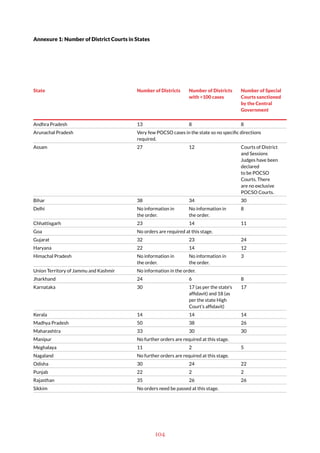
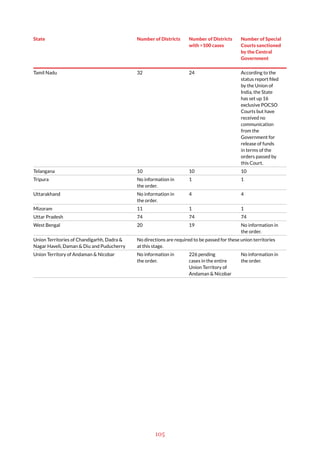
Annexure 1: Number of District Courts in States
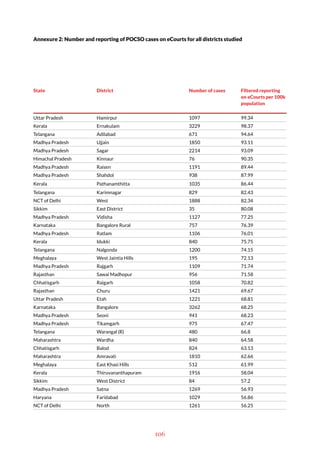
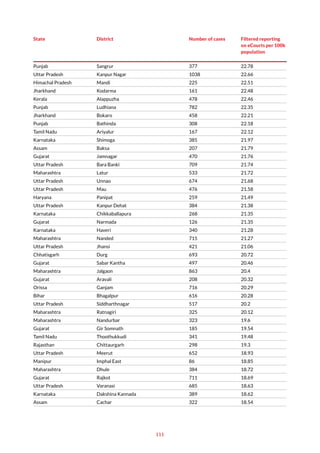
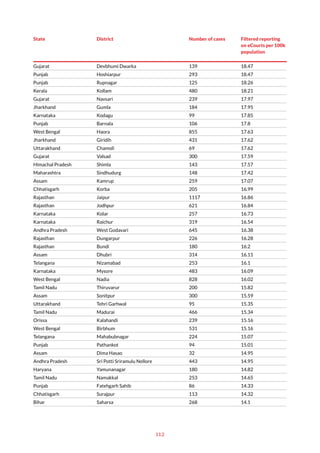
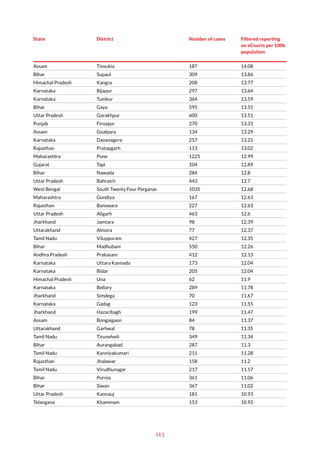
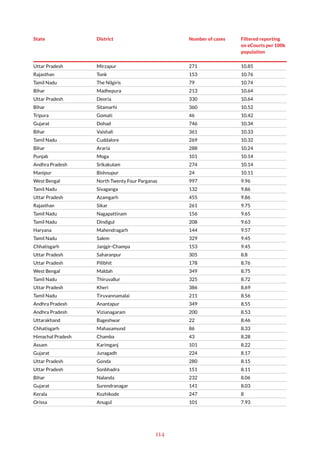
Annexure 2: Number and reporting of POCSO cases on eCourts for all districts studied
Annexure 3: How purposes of hearing were classified into various categories
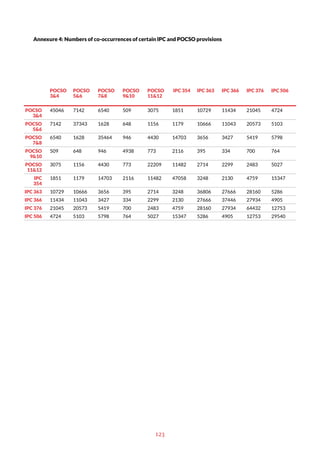
Annexure 4: Numbers of co-occurrences of certain IPC and POCSO provisions
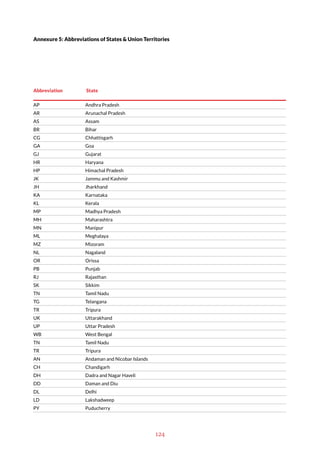
Annexure 5: Abbreviations of States & Union Territories
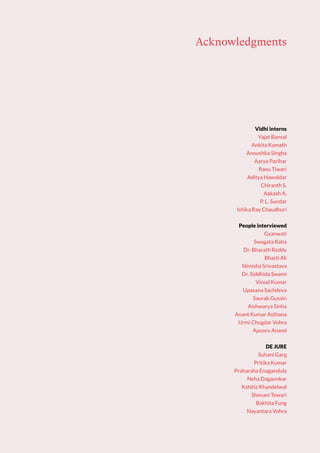
Acknowledgments
p. 1 p. 32
p. 9 p. 58
p. 19 p. 97
List of
Abbreviations
APP Additional Public Prosecutor
CCL-NLSIU Centre for Child and the Law, National Law School of India University, Bangalore
CEDAW Convention on Elimination of All Forms of Discrimination Against Women
CRC Convention on the Rights of the Child
CRC-OP-SC Optional Protocol to the Convention on the Rights of the Child on the Sale of Children, Child
Prostitution and Child Pornography
CrPC Code of Criminal Procedure
CWC Child Welfare Committee
DCPCR Delhi Commission for Protection of Child Rights
DCPU District Child Protection Unit
FIR First Information Report
FSL Forensic Science Laboratory
FTC Fast Track Court
ICCPR International Covenant on Civil and Political Rights
ICESCR International Covenant on Economic, Social and Cultural Rights
IPC Indian Penal Code
JJB Juvenile Justice Board
MHA Ministry of Home Affairs
MM Metropolitan Magistrate
NCPCR National Commission for Protection of Child Rights
NCRB National Crime Records Bureau
POCSO Act Prevention of Children from Sexual Offences Act, 2012
PP Public Prosecutor
SAARC South Asian Association for Regional Cooperation
SCC Summary Criminal Cases
SCPCR State Commission for Protection of Child Rights
SPP Special Public Prosecutor
UNICEF United Nations Children’s Fund
UoI Union of India
i
List of
Figures
Page Figure
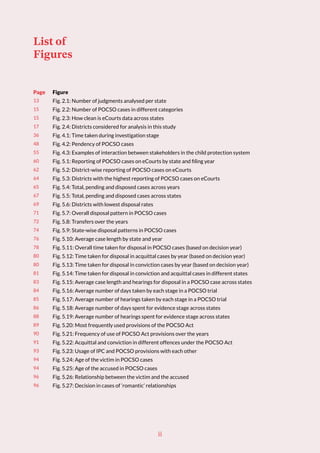
13 Fig. 2.1: Number of judgments analysed per state
15 Fig. 2.2: Number of POCSO cases in different categories
15 Fig. 2.3: How clean is eCourts data across states
17 Fig. 2.4: Districts considered for analysis in this study
36 Fig. 4.1: Time taken during investigation stage
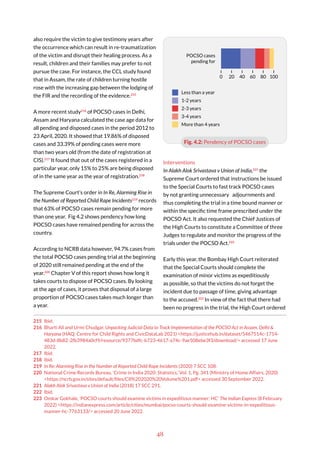
48 Fig. 4.2: Pendency of POCSO cases
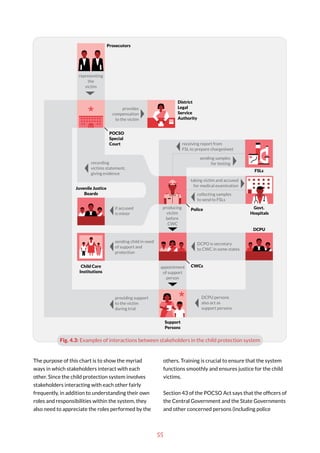
55 Fig. 4.3: Examples of interaction between stakeholders in the child protection system
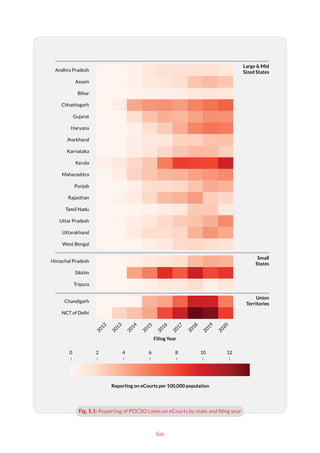
60 Fig. 5.1: Reporting of POCSO cases on eCourts by state and filing year
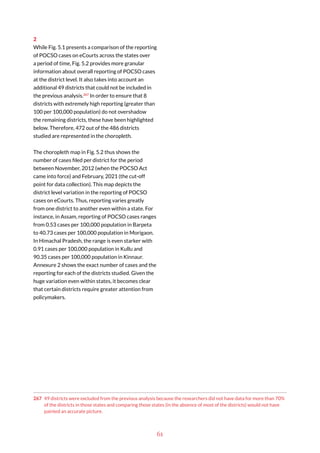
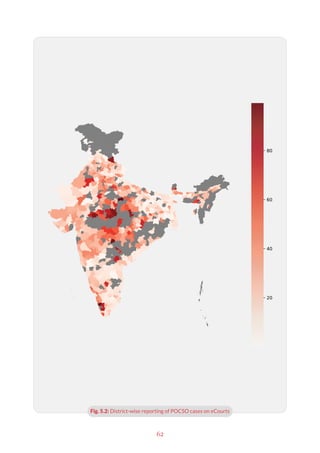
62 Fig. 5.2: District-wise reporting of POCSO cases on eCourts
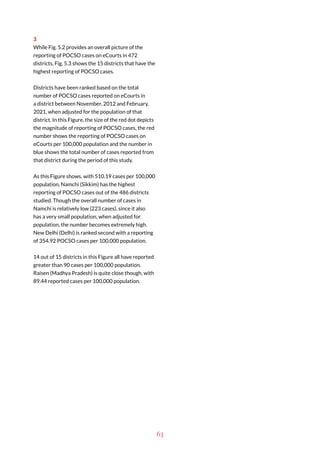
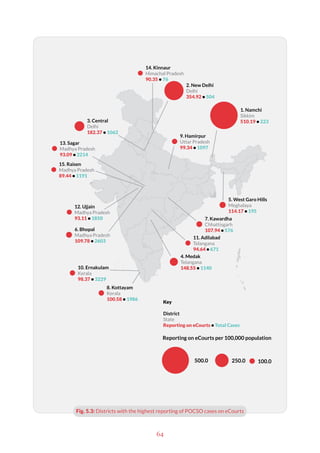
64 Fig. 5.3: Districts with the highest reporting of POCSO cases on eCourts
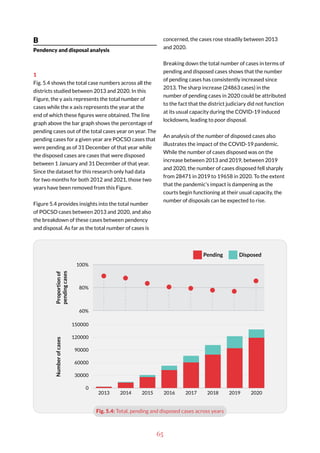
65 Fig. 5.4: Total, pending and disposed cases across years
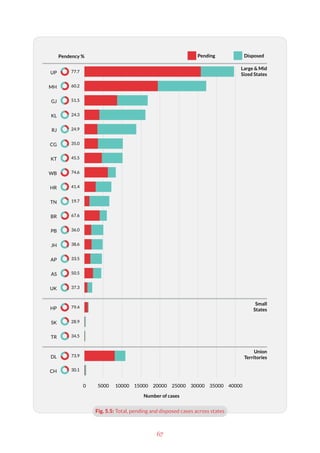
67 Fig. 5.5: Total, pending and disposed cases across states
69 Fig. 5.6: Districts with lowest disposal rates
71 Fig. 5.7: Overall disposal pattern in POCSO cases
72 Fig. 5.8: Transfers over the years
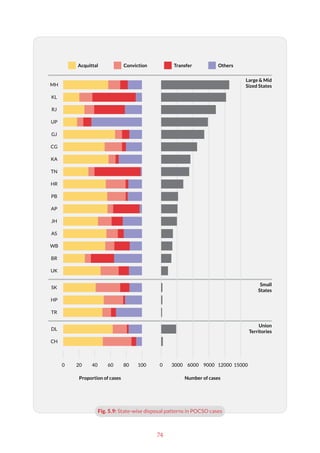
74 Fig. 5.9: State-wise disposal patterns in POCSO cases
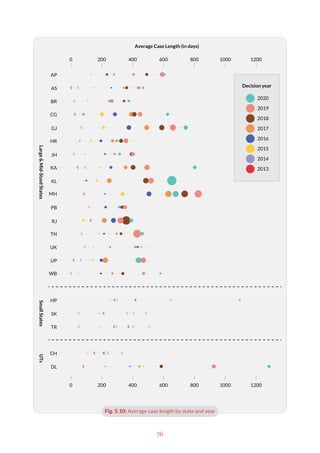
76 Fig. 5.10: Average case length by state and year
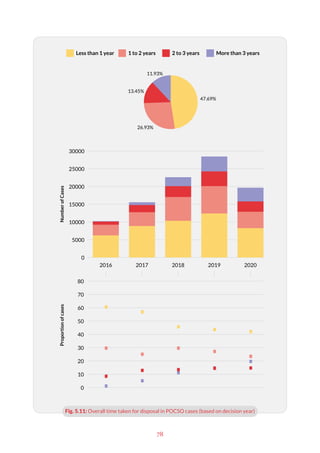
78 Fig. 5.11: Overall time taken for disposal in POCSO cases (based on decision year)
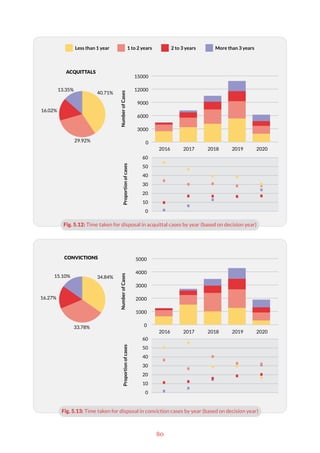
80 Fig. 5.12: Time taken for disposal in acquittal cases by year (based on decision year)
80 Fig. 5.13: Time taken for disposal in conviction cases by year (based on decision year)
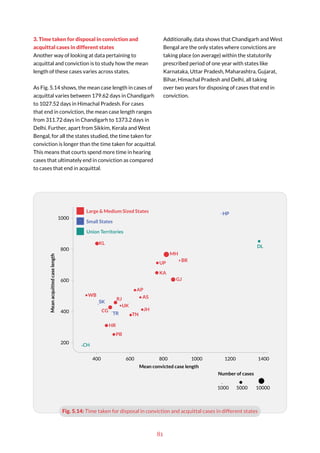
81 Fig. 5.14: Time taken for disposal in conviction and acquittal cases in different states
83 Fig. 5.15: Average case length and hearings for disposal in a POCSO case across states
84 Fig. 5.16: Average number of days taken by each stage in a POCSO trial
85 Fig. 5.17: Average number of hearings taken by each stage in a POCSO trial
86 Fig. 5.18: Average number of days spent for evidence stage across states
88 Fig. 5.19: Average number of hearings spent for evidence stage across states
89 Fig. 5.20: Most frequently used provisions of the POCSO Act
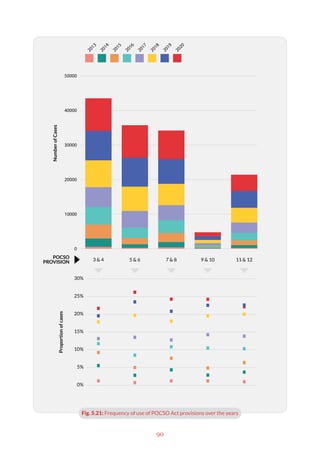
90 Fig. 5.21: Frequency of use of POCSO Act provisions over the years
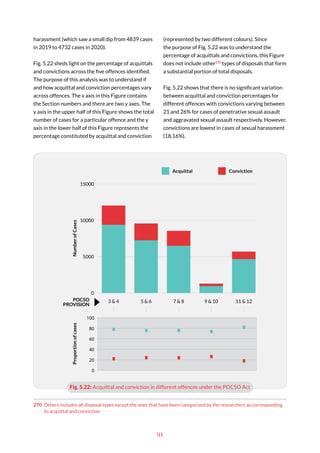
91 Fig. 5.22: Acquittal and conviction in different offences under the POCSO Act
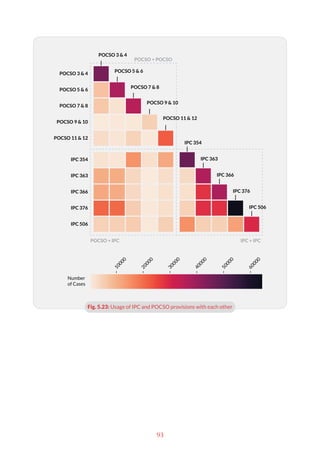
93 Fig. 5.23: Usage of IPC and POCSO provisions with each other
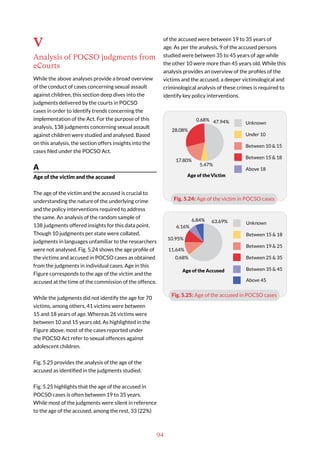
94 Fig. 5.24: Age of the victim in POCSO cases
94 Fig. 5.25: Age of the accused in POCSO cases
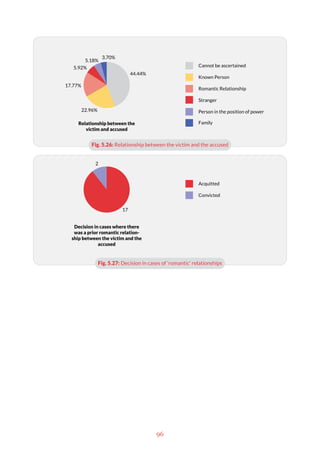
96 Fig. 5.26: Relationship between the victim and the accused
96 Fig. 5.27: Decision in cases of ‘romantic’ relationships
ii
Acknowledgments
This report has been in the making for over a year
and is the result of the efforts and inputs of a
multitude of people.
At the outset, the authors would like to thank
Deepika Kinhal (Lead, Justice, Access, and Lowering
Delays in India (JALDI) Initiative at Vidhi) for her
guidance and support throughout this process. The
authors are grateful to Vaidehi Misra (former Senior
Resident Fellow with JALDI) and Jyotika Randhawa
(Research Fellow with JALDI) for their key
contributions during various stages of this project.
The authors would also like to extend their gratitude
to the Data Evidence for Justice Reform (DE JURE)
team at the World Bank for their constant support
and feedback, without which this project would not
have been possible.
The authors are extremely thankful to Ms. Swagata
Raha and her colleagues at Enfold Proactive Health
Trust for taking out the time to review this report
and providing their invaluable feedback. The detailed
feedback we received immensely helped this report
achieve its current shape and form.
The authors are incredibly grateful to the various
key stakeholders in the child protection system who
took out their precious time for being interviewed
for this study. Practical insights gleaned from these
interviews have helped in refining the scope and
contents of this report. Their details can be found on
the last page of the report.
This endeavour has been aided by a number of
interns at both Vidhi and DE JURE, whose names are
provided on the last page of the report.
The authors would also like to thank Kunal Agnihotri
for designing the report.
We are immensely grateful for all the support we
have received. Errors, if any, are the authors’ alone.
This report is an independent, non-commissioned
study undertaken by the Vidhi Centre for Legal
Policy, an independent think-tank doing legal
research to make better laws and improve
governance for the public good in collaboration with
the DE JURE team at the World Bank.
iii
About the
Authors
Apoorva is and Aditya Ranjan was a
Research Fellow with the Justice, Access
and Lowering Delays in India (JALDI)
Initiative at Vidhi Centre for Legal Policy,
Bengaluru.
Sandeep Bhupatiraju is a researcher
at the Data and Evidence for Justice
Reforms (DE JURE) program at the World
Bank’s Development Impact Evaluation
(DIME) unit.
Shareen Joshi is an Associate Professor
at the Edmund A. Walsh School of Foreign
Service at Georgetown University.
Daniel L. Chen is the Lead Principal
Investigator, DE JURE (Data and Evidence
for Justice Reform) at the World Bank,
Director of Research at the Centre
National de la Recherche Scientifique
(CNRS), and Professor at the Toulouse
School of Economics.
iv
Executive
Summary
On November 14, 2022, the POCSO Act completes
a decade of being on the statute books in India.
When enacted, the POCSO Act marked the
culmination of years of campaigning for a dedicated
domestic legislation on child sexual abuse. 10 years
is a reasonable time period to analyse how this
legislation has been functioning and how far it has
achieved its stated objectives. This examination of
POCSO is also an opportunity to reflect on what
has worked and what needs to be improved in the
criminal justice system’s response to child sexual
abuse.
To this end, the Justice, Access and Lowering Delays
in India (JALDI) Initiative at Vidhi Centre for Legal
Policy has collaborated with the Data Evidence
for Justice Reform (DE JURE) program at the
World Bank to study the role of the judiciary in the
implementation of the POCSO Act in India. This
study assesses the implementation of the POCSO
Act in the last 10 years by analysing case laws, policy
interventions and case metadata collected from
eCourts. Since the Special Courts under the POCSO
Act perform a critical role in the achievement of the
above purpose, this study is centred around data on
POCSO courts scraped from eCourts.
Further, to understand how courts, particularly the
higher judiciary, have interpreted the provisions of
the POCSO Act, we undertook an extensive study of
judgments. We conducted interviews with multiple
stakeholders in the child protection ecosystem to
understand the ground realities. In order to lend
support to our findings from eCourts metadata, we
undertook a judgment analysis for a small sample of
cases and also analysed policy interventions.
However, what sets this study apart and enables it to
significantly contribute to the analysis undertaken
by multiple studies that have come before it is that it
examines nearly 400,000 cases (spanning 28 states
and Union Territories) collected from eCourts. After
cleaning this data, 230,730 cases have been analysed
to understand the pendency and disposal patterns of
POCSO cases. The sheer scale of this study makes it
the largest ever study undertaken on POCSO courts
yet.
v
I
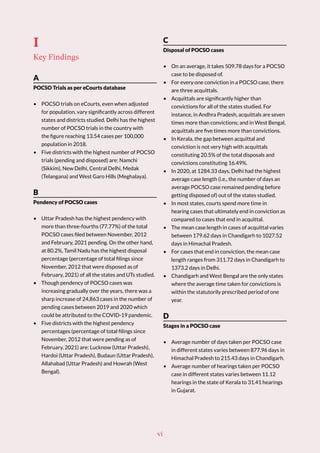
Key Findings
A
POCSO Trials as per eCourts database
• POCSO trials on eCourts, even when adjusted
for population, vary significantly across different
states and districts studied. Delhi has the highest
number of POCSO trials in the country with
the figure reaching 13.54 cases per 100,000
population in 2018.
• Five districts with the highest number of POCSO
trials (pending and disposed) are: Namchi
(Sikkim), New Delhi, Central Delhi, Medak
(Telangana) and West Garo Hills (Meghalaya).
B
Pendency of POCSO cases
• Uttar Pradesh has the highest pendency with
more than three-fourths (77.77%) of the total
POCSO cases filed between November, 2012
and February, 2021 pending. On the other hand,
at 80.2%, Tamil Nadu has the highest disposal
percentage (percentage of total filings since
November, 2012 that were disposed as of
February, 2021) of all the states and UTs studied.
• Though pendency of POCSO cases was
increasing gradually over the years, there was a
sharp increase of 24,863 cases in the number of
pending cases between 2019 and 2020 which
could be attributed to the COVID-19 pandemic.
• Five districts with the highest pendency
percentages (percentage of total filings since
November, 2012 that were pending as of
February, 2021) are: Lucknow (Uttar Pradesh),
Hardoi (Uttar Pradesh), Budaun (Uttar Pradesh),
Allahabad (Uttar Pradesh) and Howrah (West
Bengal).
C
Disposal of POCSO cases
• On an average, it takes 509.78 days for a POCSO
case to be disposed of.
• For every one conviction in a POCSO case, there
are three acquittals.
• Acquittals are significantly higher than
convictions for all of the states studied. For
instance, in Andhra Pradesh, acquittals are seven
times more than convictions; and in West Bengal,
acquittals are five times more than convictions.
• In Kerala, the gap between acquittal and
conviction is not very high with acquittals
constituting 20.5% of the total disposals and
convictions constituting 16.49%.
• In 2020, at 1284.33 days, Delhi had the highest
average case length (i.e., the number of days an
average POCSO case remained pending before
getting disposed of) out of the states studied.
• In most states, courts spend more time in
hearing cases that ultimately end in conviction as
compared to cases that end in acquittal.
• The mean case length in cases of acquittal varies
between 179.62 days in Chandigarh to 1027.52
days in Himachal Pradesh.
• For cases that end in conviction, the mean case
length ranges from 311.72 days in Chandigarh to
1373.2 days in Delhi.
• Chandigarh and West Bengal are the only states
where the average time taken for convictions is
within the statutorily prescribed period of one
year.
D
Stages in a POCSO case
• Average number of days taken per POCSO case
in different states varies between 877.96 days in
Himachal Pradesh to 215.43 days in Chandigarh.
• Average number of hearings taken per POCSO
case in different states varies between 11.12
hearings in the state of Kerala to 31.41 hearings
in Gujarat.
vi
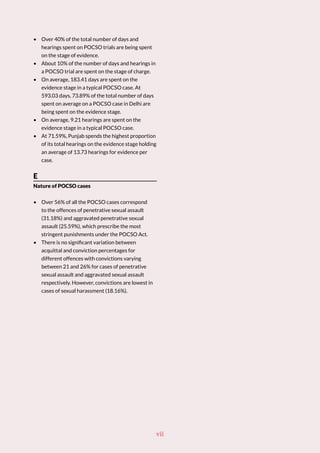
• Over 40% of the total number of days and
hearings spent on POCSO trials are being spent
on the stage of evidence.
• About 10% of the number of days and hearings in
a POCSO trial are spent on the stage of charge.
• On average, 183.41 days are spent on the
evidence stage in a typical POCSO case. At
593.03 days, 73.89% of the total number of days
spent on average on a POCSO case in Delhi are
being spent on the evidence stage.
• On average, 9.21 hearings are spent on the
evidence stage in a typical POCSO case.
• At 71.59%, Punjab spends the highest proportion
of its total hearings on the evidence stage holding
an average of 13.73 hearings for evidence per
case.
E
Nature of POCSO cases
• Over 56% of all the POCSO cases correspond
to the offences of penetrative sexual assault
(31.18%) and aggravated penetrative sexual
assault (25.59%), which prescribe the most
stringent punishments under the POCSO Act.
• There is no significant variation between
acquittal and conviction percentages for
different offences with convictions varying
between 21 and 26% for cases of penetrative
sexual assault and aggravated sexual assault
respectively. However, convictions are lowest in
cases of sexual harassment (18.16%).
vii
II
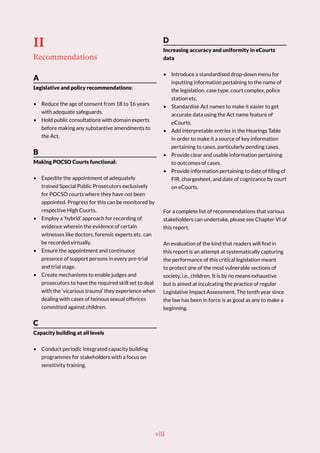
Recommendations
A
Legislative and policy recommendations:
• Reduce the age of consent from 18 to 16 years
with adequate safeguards.
• Hold public consultations with domain experts
before making any substantive amendments to
the Act.
B
Making POCSO Courts functional:
• Expedite the appointment of adequately
trained Special Public Prosecutors exclusively
for POCSO courts where they have not been
appointed. Progress for this can be monitored by
respective High Courts.
• Employ a ‘hybrid’ approach for recording of
evidence wherein the evidence of certain
witnesses like doctors, forensic experts etc. can
be recorded virtually.
• Ensure the appointment and continuous
presence of support persons in every pre-trial
and trial stage.
• Create mechanisms to enable judges and
prosecutors to have the required skill set to deal
with the ‘vicarious trauma’ they experience when
dealing with cases of heinous sexual offences
committed against children.
C
Capacity building at all levels
• Conduct periodic integrated capacity building
programmes for stakeholders with a focus on
sensitivity training.
D
Increasing accuracy and uniformity in eCourts
data
• Introduce a standardised drop-down menu for
inputting information pertaining to the name of
the legislation, case type, court complex, police
station etc.
• Standardise Act names to make it easier to get
accurate data using the Act name feature of
eCourts.
• Add interpretable entries in the Hearings Table
in order to make it a source of key information
pertaining to cases, particularly pending cases.
• Provide clear and usable information pertaining
to outcomes of cases.
• Provide information pertaining to date of filing of
FIR, chargesheet, and date of cognizance by court
on eCourts.
For a complete list of recommendations that various
stakeholders can undertake, please see Chapter VI of
this report.
An evaluation of the kind that readers will find in
this report is an attempt at systematically capturing
the performance of this critical legislation meant
to protect one of the most vulnerable sections of
society, i.e., children. It is by no means exhaustive
but is aimed at inculcating the practice of regular
Legislative Impact Assessment. The tenth year since
the law has been in force is as good as any to make a
beginning.
viii
1
Making of the POCSO Act
1 Jyoti Belur and Brijesh Bahadur Singh, ‘Child sexual abuse and the law in India – A Commentary’ (2015) Crime
Sci 4:26 <https://www.researchgate.net/publication/283154821_Child_Sexual_Abuse_and_the_Law_in_India_A_
commentary> accessed 2 December 2021; Pallavi Nautiyal and Arun Mal, ‘Towards Protection of Children against
Sexual Abuse: No Child’s Play’ (2010) 3 NUJS L. Rev. 77.
2 Centre for Child and the Law, National Law School of India University, Study on the Working of Special Courts Under
the POCSO Act, 2012 in Andhra Pradesh (28 November, 2017) <https://ccl.nls.ac.in/publications/reports/> accessed
12 September 2022; Centre for Child and the Law, National Law School of India University, Study on the Working of
Special Courts Under the POCSO Act, 2012 in Karnataka (8 August 2017) <https://ccl.nls.ac.in/publications/reports/>
accessed 12 September 2022; Centre for Child and the Law, National Law School of India University, Study on
the Working of Special Courts Under the POCSO Act, 2012 in Maharashtra (7 September 2017) <https://ccl.nls.ac.in/
publications/reports/> accessed 12 September 2022; Centre for Child and the Law, National Law School of India
University, Report of Study on the Working of Special Courts Under the POCSO Act, 2012 in Delhi (29 January 2016)
<https://ccl.nls.ac.in/publications/reports/> accessed 12 September 2022; Centre for Child and the Law, National
Law School of India University, Study on the Working of Special Courts Under the POCSO Act, 2012 in Assam (13
February 2017) <https://ccl.nls.ac.in/publications/reports/> accessed 12 September 2022; Dr. Loveleen Kacker and
others, ‘Study on Child Abuse’ (Ministry of Women and Child Development, 2007); Bharti Ali, Maharukh Adenwalla
and Sangeeta Punekar, ‘Implementation of POCSO Act – Goals, Gaps and Challenges’ (HAQ Centre for Child
Rights and Forum Against Sexual Exploitation of Children, 2018) <http://haqcrc.org/wp-content/uploads/2018/02/
implementation-of-the-pocso-act-delhi-mumbai-study-final.pdf> accessed 2 December 2021; Bharti Ali and Urmi
Chudgar, ‘#Data4Justice - Unpacking Judicial Data to Track Implementation of the POCSO Act in Assam, Delhi &
Haryana (2012 to April 2020)’ (HAQ: Centre for Child Rights and CivicDataLab, 2021) <https://www.haqcrc.org/wp-
content/uploads/2021/11/unpacking-judicial-data-to-track-implementation-of-the-pocso-act-in-assam-delhi-and-
haryana-full-report.pdf> accessed 2 December 2021.
Tracing Legislative History
Child sexual abuse has been one of the lesser talked
about criminal justice issues in India. Indian society’s
tendency to hide this menace has resulted in sparse
historical discourse around the issue.1
More recently
however, multiple studies have documented the
incidence of sexual abuse against children and the
criminal justice system’s response to it,2
especially
after the promulgation of the Protection of Children
from Sexual Offences Act, 2012 (POCSO Act). The
Act aims to curb child sexual abuse by increasing
penalties for sexual offences against children and
creating a sensitive criminal justice system to
support child victims.
The POCSO Act marks the culmination of years of
campaigning for dedicated domestic legislation on
child sexual abuse. Several actors—national and
international—have contributed to the shaping of
this Act. The section below gives an overview of
these actors, their discourses and their role in the
development of the current framework to protect
children from sexual abuse and sexual exploitation.
Chapter I
2
I
The international coalition against
child sexual assault
The global coalition against sexual abuse and
exploitation of children emerged out of the larger
movement towards recognition of child rights.3
This
movement focused on eliminating all forms of abuse
and exploitation of children and providing them
with a healthy environment for their development.
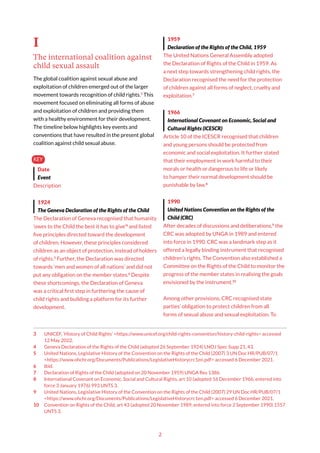
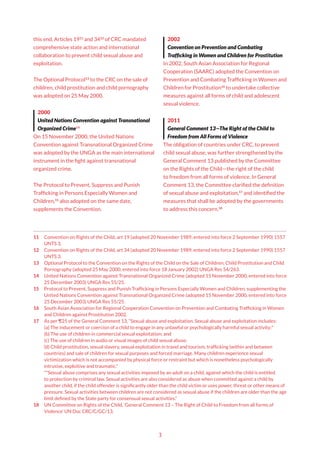
The timeline below highlights key events and
conventions that have resulted in the present global
coalition against child sexual abuse.
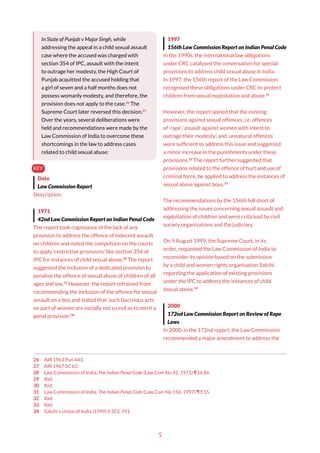
KEY
Date
Event
Description
1924
The Geneva Declaration of the Rights of the Child
The Declaration of Geneva recognised that humanity
‘owes to the Child the best it has to give’4
and listed
five principles directed toward the development
of children. However, these principles considered
children as an object of protection, instead of holders
of rights.5
Further, the Declaration was directed
towards ‘men and women of all nations’ and did not
put any obligation on the member states.6
Despite
these shortcomings, the Declaration of Geneva
was a critical first step in furthering the cause of
child rights and building a platform for its further
development.
3 UNICEF, ‘History of Child Rights’ <https://www.unicef.org/child-rights-convention/history-child-rights> accessed
12 May 2022.
4 Geneva Declaration of the Rights of the Child (adopted 26 September 1924) LNOJ Spec Supp 21, 43.
5 United Nations, Legislative History of the Convention on the Rights of the Child (2007) 3 UN Doc HR/PUB/07/1
<https://www.ohchr.org/Documents/Publications/LegislativeHistorycrc1en.pdf> accessed 6 December 2021.
6 Ibid.
7 Declaration of Rights of the Child (adopted on 20 November 1959) UNGA Res 1386.
8 International Covenant on Economic, Social and Cultural Rights, art 10 (adopted 16 December 1966, entered into
force 3 January 1976) 993 UNTS 3.
9 United Nations, Legislative History of the Convention on the Rights of the Child (2007) 29 UN Doc HR/PUB/07/1
<https://www.ohchr.org/Documents/Publications/LegislativeHistorycrc1en.pdf> accessed 6 December 2021.
10 Convention on Rights of the Child, art 43 (adopted 20 November 1989, entered into force 2 September 1990) 1557
UNTS 3.
1959
Declaration of the Rights of the Child, 1959
The United Nations General Assembly adopted
the Declaration of Rights of the Child in 1959. As
a next step towards strengthening child rights, the
Declaration recognised the need for the protection
of children against all forms of neglect, cruelty and
exploitation.7
1966
International Covenant on Economic, Social and
Cultural Rights (ICESCR)
Article 10 of the ICESCR recognised that children
and young persons should be protected from
economic and social exploitation. It further stated
that their employment in work harmful to their
morals or health or dangerous to life or likely
to hamper their normal development should be
punishable by law.8
1990
United Nations Convention on the Rights of the
Child (CRC)
After decades of discussions and deliberations,9
the
CRC was adopted by UNGA in 1989 and entered
into force in 1990. CRC was a landmark step as it
offered a legally binding instrument that recognised
children’s rights. The Convention also established a
Committee on the Rights of the Child to monitor the
progress of the member states in realising the goals
envisioned by the instrument.10
Among other provisions, CRC recognised state
parties’ obligation to protect children from all
forms of sexual abuse and sexual exploitation. To
3
this end, Articles 1911
and 3412
of CRC mandated
comprehensive state action and international
collaboration to prevent child sexual abuse and
exploitation.
The Optional Protocol13
to the CRC on the sale of
children, child prostitution and child pornography
was adopted on 25 May 2000.
2000
United Nations Convention against Transnational
Organized Crime14
On 15 November 2000, the United Nations
Convention against Transnational Organized Crime
was adopted by the UNGA as the main international
instrument in the fight against transnational
organized crime.
The Protocol to Prevent, Suppress and Punish
Trafficking in Persons Especially Women and
Children,15
also adopted on the same date,
supplements the Convention.
11 Convention on Rights of the Child, art 19 (adopted 20 November 1989, entered into force 2 September 1990) 1557
UNTS 3.
12 Convention on Rights of the Child, art 34 (adopted 20 November 1989, entered into force 2 September 1990) 1557
UNTS 3.
13 Optional Protocol to the Convention on the Rights of the Child on the Sale of Children, Child Prostitution and Child
Pornography (adopted 25 May 2000, entered into force 18 January 2002) UNGA Res 54/263.
14 United Nations Convention against Transnational Organized Crime (adopted 15 November 2000, entered into force
25 December 2003) UNGA Res 55/25.
15 Protocol to Prevent, Suppress and Punish Trafficking in Persons Especially Women and Children, supplementing the
United Nations Convention against Transnational Organized Crime (adopted 15 November 2000, entered into force
25 December 2003) UNGA Res 55/25.
16 South Asian Association for Regional Cooperation Convention on Prevention and Combating Trafficking in Women
and Children against Prostitution 2002.
17 As per ¶25 of the General Comment 13, “Sexual abuse and exploitation. Sexual abuse and exploitation includes:
(a) The inducement or coercion of a child to engage in any unlawful or psychologically harmful sexual activity;*
(b) The use of children in commercial sexual exploitation; and
(c) The use of children in audio or visual images of child sexual abuse;
(d) Child prostitution, sexual slavery, sexual exploitation in travel and tourism, trafficking (within and between
countries) and sale of children for sexual purposes and forced marriage. Many children experience sexual
victimization which is not accompanied by physical force or restraint but which is nonetheless psychologically
intrusive, exploitive and traumatic.”
*“Sexual abuse comprises any sexual activities imposed by an adult on a child, against which the child is entitled
to protection by criminal law. Sexual activities are also considered as abuse when committed against a child by
another child, if the child offender is significantly older than the child victim or uses power, threat or other means of
pressure. Sexual activities between children are not considered as sexual abuse if the children are older than the age
limit defined by the State party for consensual sexual activities.”
18 UN Committee on Rights of the Child, ‘General Comment 13 – The Right of Child to Freedom from all forms of
Violence’ UN Doc CRC/C/GC/13.
2002
Convention on Prevention and Combating
Trafficking in Women and Children for Prostitution
In 2002, South Asian Association for Regional
Cooperation (SAARC) adopted the Convention on
Prevention and Combating Trafficking in Women and
Children for Prostitution16
to undertake collective
measures against all forms of child and adolescent
sexual violence.
2011
General Comment 13—The Right of the Child to
Freedom from All Forms of Violence
The obligation of countries under CRC, to prevent
child sexual abuse, was further strengthened by the
General Comment 13 published by the Committee
on the Rights of the Child—the right of the child
to freedom from all forms of violence. In General
Comment 13, the Committee clarified the definition
of sexual abuse and exploitation,17
and identified the
measures that shall be adopted by the governments
to address this concern.18
4
II
Development of a framework
against child sexual abuse in India
Cognisant of the importance of children in our
society, the Constitution of India has incorporated
several provisions to further their rights and
eliminate all forms of exploitation. Chapter III of
the Constitution, dedicated to Fundamental Rights,
includes provisions to allow special measures for
children, overarching the right to equality.19
A
recent amendment has also included a provision
for free and compulsory education to all children
between 6 to 14 years under the Chapter III of the
Constitution.20
The Chapter also includes dedicated
Articles to prohibit the trafficking of humans and
the employment of children in factories.21
The
Constitution has further directed the government
to endeavour to provide early childhood care and
improve public health.22
Pursuant to this objective, India has also been a
signatory to landmark international instruments on
child rights and against child sexual abuse, such as
the Convention on the Rights of the Child (CRC –
date of accession – 11 December 1992), Optional
Protocol to the Convention on the Rights of the
Child on the Sale of Children, Child Prostitution
and Child Pornography (CRC-OP-SC),23
and the
SAARC Convention on Prevention and Combating
Trafficking in Women and Children for Prostitution
(signed by India on 5 January 2002).
However, despite these strong constitutional and
international law frameworks towards strengthening
child rights, India lacked any dedicated provision
against child sexual abuse till 2012. Even after
independence, the criminal law failed to recognise
sexual assault and exploitation of children as
19 Constitution of India 1950, art 15 (3).
20 Constitution of India 1950, art 21A introduced by the Constitution (Eighty-sixth Amendment) Act 2002.
21 Constitution of India 1950, art 23 and 24.
22 Constitution of India 1950, art 45 and 47.
23 Ratified by India on 16 August 2005.
24 Pallavi Nautiyal and Arun Mal, ‘Towards Protection of Children against Sexual Abuse: No Child’s Play’ (2010) 3
NUJS L. Rev. 77.
25 Ibid.
separate offences and continued to try these cases
under the generic provisions for offences affecting
the human body and sexual offences. These generic
provisions were vastly ill-equipped to address all the
instances of sexual exploitation against children.24
While the provision against rape under the Indian
Penal Code, 1860, section 375, criminalised sexual
offences against women which included penile-
vaginal penetration, other forms of aggravated
sexual assault did not attract the provision for rape
and were tried under the provisions for unnatural
offences or assault to woman with intent to outrage
her modesty.25
Further, these provisions failed
to criminalise the instances of sexual assault and
molestation of boys.
The offences under IPC, intended to criminalise
sexual offences against women, fell short of
addressing the complexities, social impact and
mental impact of sexual exploitation of children.
The nature of the criminal trial under the Code for
Criminal Procedure, 1973 did not account for the
needs of child witnesses who were victims of sexual
offences and the support they need to participate in
the criminal justice process.
5
In State of Punjab v Major Singh, while
addressing the appeal in a child sexual assault
case where the accused was charged with
section 354 of IPC, assault with the intent
to outrage her modesty, the High Court of
Punjab acquitted the accused holding that
a girl of seven and a half months does not
possess womanly modesty, and therefore, the
provision does not apply to the case.26
The
Supreme Court later reversed this decision.27
Over the years, several deliberations were
held and recommendations were made by the
Law Commission of India to overcome these
shortcomings in the law to address cases
related to child sexual abuse:
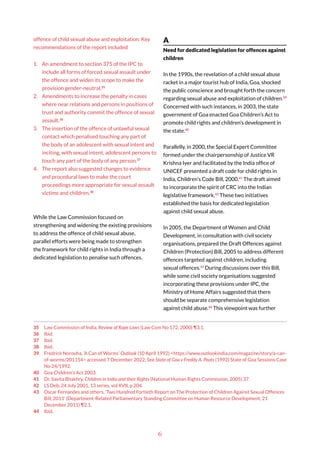
KEY
Date
Law Commission Report
Description
1971
42nd Law Commission Report on Indian Penal Code
The report took cognisance of the lack of any
provision to address the offence of indecent assault
on children and noted the compulsion on the courts
to apply ‘restrictive provisions’ like section 354 of
IPC for instances of child sexual abuse.28
The report
suggested the inclusion of a dedicated provision to
penalise the offence of sexual abuse of children of all
ages and sex.29
However, the report refrained from
recommending the inclusion of the offence for sexual
assault on a boy and stated that ‘such lascivious acts
on part of women are socially not so evil as to merit a
penal provision.’30
26 AIR 1963 Pun 443.
27 AIR 1967 SC 63.
28 Law Commission of India, The Indian Penal Code (Law Com No 42, 1971) ¶16.86.
29 Ibid.
30 Ibid.
31 Law Commission of India, The Indian Penal Code (Law Com No 156, 1997) ¶9.55.
32 Ibid.
33 Ibid.
34 Sakshi v Union of India (1999) 6 SCC 591.
1997
156th Law Commission Report on Indian Penal Code
In the 1990s, the international law obligations
under CRC catalysed the conversation for special
provisions to address child sexual abuse in India.
In 1997, the 156th report of the Law Commission
recognised these obligations under CRC to protect
children from sexual exploitation and abuse.31
However, the report opined that the existing
provisions against sexual offences, i.e. offences
of ‘rape’, ‘assault against women with intent to
outrage their modesty’, and ‘unnatural offences’
were sufficient to address this issue and suggested
a minor increase in the punishments under these
provisions.32
The report further suggested that
provisions related to the offence of hurt and use of
criminal force, be applied to address the instances of
sexual abuse against boys.33
The recommendations by the 156th fell short of
addressing the issues concerning sexual assault and
exploitation of children and were criticised by civil
society organisations and the judiciary.
On 9 August 1999, the Supreme Court, in its
order, requested the Law Commission of India to
reconsider its opinion based on the submission
by a child and women rights organisation Sakshi
regarding the application of existing provisions
under the IPC to address the instances of child
sexual abuse.34
2000
172nd Law Commission Report on Review of Rape
Laws
In 2000, in the 172nd report, the Law Commission
recommended a major amendment to address the
6
offence of child sexual abuse and exploitation. Key
recommendations of the report included
1. An amendment to section 375 of the IPC to
include all forms of forced sexual assault under
the offence and widen its scope to make the
provision gender-neutral.35
2. Amendments to increase the penalty in cases
where near relations and persons in positions of
trust and authority commit the offence of sexual
assault.36
3. The insertion of the offence of unlawful sexual
contact which penalised touching any part of
the body of an adolescent with sexual intent and
inciting, with sexual intent, adolescent persons to
touch any part of the body of any person.37
4. The report also suggested changes to evidence
and procedural laws to make the court
proceedings more appropriate for sexual assault
victims and children.38
While the Law Commission focused on
strengthening and widening the existing provisions
to address the offence of child sexual abuse,
parallel efforts were being made to strengthen
the framework for child rights in India through a
dedicated legislation to penalise such offences.
35 Law Commission of India, Review of Rape Laws (Law Com No 172, 2000) ¶3.1.
36 Ibid.
37 Ibid.
38 Ibid.
39 Fredrick Norouha, ‘A Can of Worms’ Outlook (10 April 1992) <https://www.outlookindia.com/magazine/story/a-can-
of-worms/201154> accessed 7 December 2022; See State of Goa v Freddy A. Peats (1992) State of Goa Sessions Case
No 24/1992.
40 Goa Children’s Act 2003.
41 Dr. Savita Bhakhry, Children in India and their Rights (National Human Rights Commission, 2005) 37.
42 LS Deb, 24 July 2001, 13 series, vol XVII, p 204.
43 Oscar Fernandes and others, ‘Two Hundred Fortieth Report on The Protection of Children Against Sexual Offences
Bill, 2011’ (Department-Related Parliamentary Standing Committee on Human Resource Development, 21
December 2011) ¶2.1.
44 Ibid.
A
Need for dedicated legislation for offences against
children
In the 1990s, the revelation of a child sexual abuse
racket in a major tourist hub of India, Goa, shocked
the public conscience and brought forth the concern
regarding sexual abuse and exploitation of children.39
Concerned with such instances, in 2003, the state
government of Goa enacted Goa Children’s Act to
promote child rights and children’s development in
the state.40
Parallelly, in 2000, the Special Expert Committee
formed under the chairpersonship of Justice VR
Krishna Iyer and facilitated by the India office of
UNICEF presented a draft code for child rights in
India, Children’s Code Bill, 2000.41
The draft aimed
to incorporate the spirit of CRC into the Indian
legislative framework.42
These two initiatives
established the basis for dedicated legislation
against child sexual abuse.
In 2005, the Department of Women and Child
Development, in consultation with civil society
organisations, prepared the Draft Offences against
Children (Protection) Bill, 2005 to address different
offences targeted against children, including
sexual offences.43
During discussions over this Bill,
while some civil society organisations suggested
incorporating these provisions under IPC, the
Ministry of Home Affairs suggested that there
should be separate comprehensive legislation
against child abuse.44
This viewpoint was further
7
strengthened by the Study of Child Abuse, 2007
report published by the Ministry of Women and
Child Development which helped the governments
in identifying the gravity of this concern.45
The Study of Child Abuse covered 13 states with a
sample size of 12447 children, 2324 young adults
and 2449 stakeholders. It looked at different forms
of child abuse: Physical Abuse, Sexual Abuse and
Emotional Abuse and Girl Child Neglect in five
different evidence groups, namely, children in a
family environment, children in school, children
at work, children on the street and children in
institutions.46
The study found that 50.76 per cent
of children surveyed reported having faced one or
more form of sexual abuse.47
Contrary to the general
perception, the overall percentage of boys reporting
experiencing sexual abuse was much higher48
than
that of girls. This study prompted the government
to start taking steps toward creating a sound legal
framework to address sexual abuse and sexual
exploitation of children.
B
Enactment of the Protection of Children from
Sexual Offences Act, 2012
In January 2010, during the discussions on the
Offences against Children (Protection) Bill within
the Union Government, an opinion emerged that
instead of general legislation addressing different
forms of abuse, the Bill should focus on the issue of
sexual abuse and exploitation of children.49
Further,
it was discussed that other statutes, such as the IPC
and the Indian Evidence Act, should be parallelly
45 Dr. Loveleen Kacker and others, ‘Study on Child Abuse’ (Ministry of Women and Child Development, 2007).
46 Ibid.
47 Ibid (Forms of sexual abuse includes sexual assault, making the child fondle private parts, making the child exhibit or
exhibiting private body parts and being photographed in the nude).
48 52.94% compared to 47.06% for girls. 75.
49 Oscar Fernandes and others, ‘Two Hundred Fortieth Report on The Protection of Children Against Sexual Offences
Bill, 2011’ (Department-Related Parliamentary Standing Committee on Human Resource Development, 21
December 2011) ¶2.3.
50 Ibid.
51 Ibid.
52 Ibid.
amended to prevent secondary victimisation and
ensure speedy justice to children.50
As a result of these discussions, in September 2010,
the Ministry of Women and Child Development,
along with other ministries prepared a draft
Protection of Children from Sexual Offences Bill,
2010.51
After several rounds of revisions and
discussions, the Protection of Children from Sexual
Offences Bill was presented in Rajya Sabha on 23
March 2011.
This was followed by a series of deliberations in
the Parliamentary Standing Committee52
and
the discussions in both houses of the Parliament.
Ultimately, on 22 May 2012, the POCSO Act was
passed in the Parliament and came into force
on Children’s Day, 14 November 2012. The Act
created a dedicated framework to penalise sexual
harassment and sexual abuse of children and
provided specific sections to guide different aspects
of criminal trial including recording of statements
and medical examinations in cases of child sexual
abuse.
C
The movement towards stringent punishments
under the POCSO, 2012
The POCSO Act was amended in 2013 and 2018.
More recently, in 2019, concerned with rising
cases of sexual offences against children and in
response to coming to light of certain heinous sexual
crimes committed against children, the Ministry
of Women and Child Development introduced an
amendment to the Act to deter offenders and ensure
8
safety for children. The amendment increased
the minimum punishment for penetrative sexual
assault from seven years imprisonment to ten
years53
and aggravated penetrative sexual assault
from ten years imprisonment to twenty years.54
It
has also introduced the punishment of the death
penalty for the offence of aggravated penetrative
sexual assault.55
In addition to these changes, the
amendment Act has also introduced offences for
transmitting or propagating pornographic materials
involving a child and failing to destroy or report such
pornographic materials.56
53 Protection of Children against Sexual Offences (Amendment) Act 2019, s 3.
54 Ibid s 5.
55 Section 6(1) of the POCSO 2019.
56 Ibid s 8.
9
Chapter II
Studying POCSO
Methodology and Challenges
Legal data on sexual crimes against children in
India is largely compiled by different actors in the
Indian justice delivery system. This data however,
is fragmented across a plethora of locations,
management systems and record-keeping systems.
As a case involving child sexual abuse moves through
the system, from when it first gets reported to
when it is finally disposed of by the court, multiple
institutions begin recording information. These
institutions range from police stations, private
and government hospitals, district Child Welfare
Committees, Child Care Institutions (shelter homes),
and judicial institutions such as courts and Juvenile
Justice Boards. Other monitoring departments
and agencies such as the National and State
Commissions for Protection of Child Rights, the state
department and central Ministry of Women and
Child Development and the National Crimes Records
Bureau also record aggregate statistics at their end.
Since the exact stage at which the data is being
recorded differs across these fora, aggregate
statistics on filing and pendency maintained by these
institutions are bound to vary. While examining how
each of these institutions have dealt with POCSO
cases is worthy of investigation and critical to
how the Act has been implemented, availability of
granular data continues to be a challenge.
10
I
Objective
In November, 2022, it will be 10 years since the
POCSO Act came into force. 10 years is a reasonable
time period to adjudge how a legislation has been
functioning and how far it is from achieving its stated
objectives. To this end, the primary objective of this
study is to assess the implementation of the POCSO
Act since it came into being by analysing case laws,
policy interventions and case metadata collected
from eCourts. This study is aimed at evaluating
whether the POCSO Act has achieved the purpose
for which it was enacted, i.e., expeditious disposal
of cases in a child-friendly justice delivery system.
Since the Special Courts set up under the POCSO
Act perform a critical role in the achievement of the
above purpose, this study is centred around data on
POCSO courts scraped from the eCourts website.57
Some of the key questions that this study aims to
answer are:
1. Has the POCSO Act achieved its goal of creating
a child-friendly justice delivery system?
2. If not, what have been some of the major
challenges to the effective implementation of the
POCSO Act in India?
3. Since 2012, how has the higher judiciary
interpreted certain key provisions of the POCSO
Act and any inconsistency between the POCSO
Act and other legislations?
4. Have Special POCSO Courts (courts so
designated under the POCSO Act) managed to
57 The eCourts Mission Mode Project, is a Pan-India Project, monitored and funded by the Department of Justice,
Ministry of Law and Justice, Government of India for District Courts across the country. It was conceptualised on
the basis of the “National Policy and Action Plan for Implementation of Information and Communication Technology
(ICT) in the Indian Judiciary – 2005” submitted by eCommittee, Supreme Court of India with a vision to transform
the Indian Judiciary through Information and Communications Technology enablement of Courts.
58 Bharti Ali and Urmi Chudgar, Unpacking Judicial Data to Track Implementation of the POCSO Act in Assam, Delhi
& Haryana (HAQ: Centre for Child Rights and CivicDataLab 2021) <https://justicehub.in/dataset/5467514c-
1714-483d-8b82-2fb3984a0cf9/resource/9377bdfc-b723-4617-a74c-9ae508ebe3f3/download/> accessed
29 June 2022; Vaidehi Misra and Satishwar Kedas, ‘The Delhi Court Roster Review: A Step towards Judicial
Performance Evaluations’ (2021) Vidhi Centre for Legal Policy <https://vidhilegalpolicy.in/wp-content/
uploads/2021/02/180221_DHC_upload-ready.pdf> accessed 29 June 2022; DAKSH, ‘Deciphering Judicial Data:
DAKSH’s Database’ (2020) <https://www.dakshindia.org/wp-content/uploads/2020/08/Case-categorization-
paper-FINAL.pdf> accessed 29 June 2022.
complete POCSO trials within the statutorily
prescribed period of one year? How much time
do different stages in a POCSO trial take? What
percentage of POCSO cases actually end in
acquittal and conviction? What are the most
frequently used provisions of the POCSO Act?
5. How have different states and districts fared
on different parameters to evaluate the
implementation of the Act?
While it was possible to answer some of these
questions by analysing landmark judgment passed by
the higher judiciary, looking at policy interventions
by the government and various government
agencies, and interviewing stakeholders working on
the ground, some of these questions could only be
answered with data obtained from the courts. For
this purpose, data available on eCourts was used for
this study. The next section explains why specifically
eCourts data was chosen for this study.
II
Why this study uses eCourts
POCSO data
Information available on the eCourts website
is expansive and allows for both granular and
aggregate data analysis. However, over the years
many problems in collecting and using data from
eCourts have been identified.58
These studies also
put forth a compelling case for an increased access to
information not just for research purposes but also
to inform the system itself of its performance and
to provide the private sector impetus to innovate
11
solutions using detailed data.59
While there have
been attempts to bridge the data availability gap60
and publish data sets used for empirical research61
online, the efforts are few and far between. Lack of
accessibility to reliable and complete judicial data
continues to be a pressing problem.
For legal researchers, how courts are performing to
implement a relatively new special law that directly
affects the rights of one of the most vulnerable
sections of society, i.e., children, is an important
question that deserves answering. Though judicial
data related to POCSO cases has been analysed in
a number of different studies, due to the difficulties
associated with collecting this data, studies have
remained limited to specific cities and states only.
For instance, studies have focused on Andhra
Pradesh,62
Maharashtra,63
Delhi,64
Karnataka,65
Haryana66
and Assam.67
This study is a first of its
59 Prashant Reddy T and others, ‘Open Courts in the Digital Age: A Prescription for an Open Data Policy’ (2019) Vidhi
Centre for Legal Policy <https://vidhilegalpolicy.in/wp-content/uploads/2019/11/OpenCourts_digital16dec.pdf>
accessed 29 June 2022; Sushant Sinha, ‘Indian Kanoon - The Genesis and The Legal Thirst’ (2011) Cornell University
Law School <https://blog.law.cornell.edu/voxpop/2011/04/22/indian-kanoon-the-genesis-and-the-legal-thirst/>
accessed 29 June 2022.
60 Justice, Access and Lowering Delays in India, ‘Judicial Vacancies in India’ (JALDI data portal, Vidhi Centre for Legal
Policy 2019) <https://data.vidhilegalpolicy.in/dashboard/judicial_vacancy/index.html> accessed 29 June 2022.
61 Justice hub <https://justicehub.in/dataset?publisher_name=CivicDataLab> accessed 29 June 2022.
62 Centre for Child and the Law, National Law School of India University, Study on the Working of Special Courts Under
the POCSO Act, 2012 in Andhra Pradesh (28 November, 2017) <https://ccl.nls.ac.in/publications/reports/> accessed
12 September 2022.
63 Pravin Patkar and Pooja Kandula, ‘4 Years Since POCSO: Unfolding of the POCSO Act in the State of Maharashtra’
(2016) Aarambh India <http://aarambhindia.org/wp-content/uploads/2018/05/DigitalAarambh_4-Years-Since-
POCSO.pdf> accessed 29 June 2022; Centre for Child and the Law, National Law School of India University, Study
on the Working of Special Courts Under the POCSO Act, 2012 in Maharashtra (7 September 2017) <https://ccl.nls.ac.in/
publications/reports/> accessed 12 September 2022.
64 Bharti Ali, Maharukh Adenwalla and Sangeeta Punekar, Implementation of the POCSO Act: Goals, Gaps and Challenges:
Study of cases in Special Courts in Delhi & Mumbai (2012 - 2015) (HAQ: Centre for Child Rights and FACSE 2017)
<www.haqcrc.org/publication/implementation-pocso-act/> accessed 29 June 2022; Centre for Child and the Law,
National Law School of India University, Report of Study on the Working of Special Courts Under the POCSO Act, 2012 in
Delhi (29 January 2016) <https://ccl.nls.ac.in/publications/reports/> accessed 12 September 2022.
65 Centre for Child and the Law, National Law School of India University, Study on the Working of Special Courts Under
the POCSO Act, 2012 in Karnataka (8 August 2017) <https://ccl.nls.ac.in/publications/reports/> accessed 12
September 2022.
66 Bharti Ali and Urmi Chudgar, Unpacking Judicial Data to Track Implementation of the POCSO Act in Assam, Delhi &
Haryana (HAQ: Centre for Child Rights and CivicDataLab 2021) <https://justicehub.in/dataset/5467514c-1714-
483d-8b82-2fb3984a0cf9/resource/9377bdfc-b723-4617-a74c-9ae508ebe3f3/download/> accessed 29 June
2022.
67 Bharti Ali and Urmi Chudgar, Unpacking Judicial Data to Track Implementation of the POCSO Act in Assam, Delhi &
Haryana (HAQ: Centre for Child Rights and CivicDataLab 2021) <https://justicehub.in/dataset/5467514c-1714-
483d-8b82-2fb3984a0cf9/resource/9377bdfc-b723-4617-a74c-9ae508ebe3f3/download/> accessed 29 June
2022; Centre for Child and the Law, National Law School of India University, Study on the Working of Special Courts
Under the POCSO Act, 2012 in Assam (13 February 2017) <https://ccl.nls.ac.in/publications/reports/> accessed 12
September 2022.
kind in terms of the sheer volume of eCourts data
analysed and is by far the largest study of eCourts
data pertaining to the POCSO Act.
III
Scope
For the purpose of this study, eCourts data from 486
districts spanning 28 states and Union Territories
has been collected and analysed for the period 2012
to February, 2021. Secondary data in the form of
judicial decisions and policy interventions from
across the country has also been analysed with
30-06-2022 being the cut-off date for these two
aspects.
12
IV
Methodology
A
Analysis of case law
To understand how courts, particularly the higher
judiciary, have interpreted the provisions of the
POCSO Act in order to improve its implementation,
an extensive study of judgments has been
undertaken. The literature review and interviews
with stakeholders in the child protection system
helped the researchers arrive at a list of important
issues that have a bearing on the creation of a
child-friendly justice delivery system. Thereafter,
case-laws were studied to understand the judiciary’s
stance on the issues identified.
B
Analysis of policy interventions
While courts play a crucial role in the
implementation of the POCSO Act, there are plenty
of institutions in the child protection system that are
required to work together to make the system work
for children. In this context, Rules and guidelines
framed by various government departments
(especially the Central Ministry and State
Departments of Women and Child Development and
the State Police Departments) become important.
Statutory bodies like the National and State
Commission for Protection of Child Rights (NCPCR
and SCPCRs) have also taken steps to make the
enforcement of the POCSO Act more child-friendly.
These interventions have been collated by surveying
the websites of the NCPCR and SCPCRs and using
keyword search on Google search to identify policy
interventions for specific issues.
C
Interviews
In order to supplement the information gathered
through secondary research and to understand how
the POCSO Act is being implemented on the ground,
the researchers conducted structured interviews
with multiple stakeholders in the child protection
system. Questionnaires were prepared and
circulated to the interviewees beforehand and the
interviews were conducted online. Questions ranged
from asking the stakeholders about their role in the
child protection system, the challenges faced, the
kind of training received and their suggestions for
improving the system. Questions were also tailored
in order to get a holistic understanding of the child
protection system and understand the problems it is
grappling with. Information gathered through these
interviews is used at different points in the report to
supplement the findings from other sources. Some
of the suggestions for improvement feature in the
recommendations chapter of this report.
D
Judgment Analysis
The dataset for this study comprised nearly 4,00,000
cases, out of which about 1,20,000 cases were
disposed of. Since it was not possible to read all the
judgments, a small sample was read and analysed to
obtain deeper insights into the outcomes of POCSO
cases. Not all disposed cases in eCourts have PDFs
of the judgments attached to them. For this analysis,
20 judgment/final order PDFs from disposed cases
(for which these were available) from each state
were randomly sampled. The judgments were read
after dropping cases where the documents were
not intelligible or where they were in languages
unfamiliar to the researchers. As a result of this
exercise, a total of 138 judgments that were written
in English and Hindi were read and analysed. The
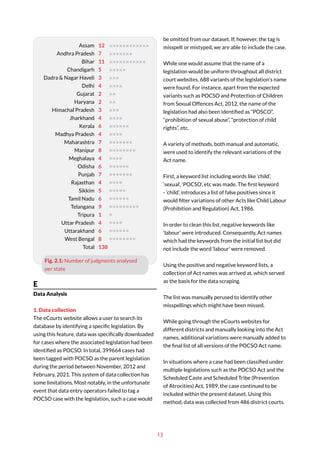
following table shows the number of judgments
analysed from each state.
13
E
Data Analysis
1. Data collection
The eCourts website allows a user to search its
database by identifying a specific legislation. By
using this feature, data was specifically downloaded
for cases where the associated legislation had been
identified as POCSO. In total, 399664 cases had
been tagged with POCSO as the parent legislation
during the period between November, 2012 and
February, 2021. This system of data collection has
some limitations. Most notably, in the unfortunate
event that data entry operators failed to tag a
POCSO case with the legislation, such a case would
be omitted from our dataset. If, however, the tag is
misspelt or mistyped, we are able to include the case.
While one would assume that the name of a
legislation would be uniform throughout all district
court websites, 688 variants of the legislation’s name
were found. For instance, apart from the expected
variants such as POCSO and Protection of Children
from Sexual Offences Act, 2012, the name of the
legislation had also been identified as “POSCO”,
“prohibition of sexual abuse”, “protection of child
rights”, etc.
A variety of methods, both manual and automatic,
were used to identify the relevant variations of the
Act name.
First, a keyword list including words like ‘child’,
‘sexual’, ‘POCSO’, etc was made. The first keyword
- ‘child’, introduces a list of false positives since it
would filter variations of other Acts like Child Labour
(Prohibition and Regulation) Act, 1986.
In order to clean this list, negative keywords like
‘labour’ were introduced. Consequently, Act names
which had the keywords from the initial list but did
not include the word ‘labour’ were removed.
Using the positive and negative keyword lists, a
collection of Act names was arrived at, which served
as the basis for the data scraping.
The list was manually perused to identify other
misspellings which might have been missed.
While going through the eCourts websites for
different districts and manually looking into the Act
names, additional variations were manually added to
the final list of all versions of the POCSO Act name.
In situations where a case had been classified under
multiple legislations such as the POCSO Act and the
Scheduled Caste and Scheduled Tribe (Prevention
of Atrocities) Act, 1989, the case continued to be
included within the present dataset. Using this
method, data was collected from 486 district courts.
12
7
11
5
3
4
2
2
3
4
6
4
7
8
4
6
7
4
5
6
9
1
4
6
8
138
Assam
Andhra Pradesh
Bihar
Chandigarh
Dadra & Nagar Haveli
Delhi
Gujarat
Haryana
Himachal Pradesh
Jharkhand
Kerala
Madhya Pradesh
Maharashtra
Manipur
Meghalaya
Odisha
Punjab
Rajasthan
Sikkim
Tamil Nadu
Telangana
Tripura
Uttar Pradesh
Uttarakhand
West Bengal
Total
Fig. 2.1: Number of judgments analysed
per state
14
2. Data cleaning
The extracted data was not immediately usable
because a preliminary glance at the data revealed
several concerning irregularities. A significant
number of cases (on the basis of their case type)
seemed completely unrelated to the POCSO Act. To
determine if the cases extracted were in fact cases
related to the POCSO Act, verification based on case
categorisation was done. The verification was aimed
at determining if the ‘case type’ did indeed pertain to
the POCSO Act. The following process was followed
in order to clean the data:
Different Excel sheets were created for all the states
with the district names, the case type name and
the count for how frequently a particular case type
occurred in that district.
From these, only ‘case types’ explicitly pertaining
to cases under the POCSO Act were retained.
Therefore, where the case type mentioned some
variation of the POCSO Act or was a Sessions Case,68
the decision to include them in the dataset was fairly
obvious.
Since the case types used across the country are very
diverse, when there was confusion about whether a
particular case type corresponds to a POCSO case or
not, the researchers spoke with advocates from the
respective jurisdictions to identify what a particular
case type meant and used that information in
order to include or exclude certain case types. For
instance, it was found that the case type ‘Spl Case’
in Maharashtra would refer to a special legislation
like the POCSO Act and was thus included. Similarly,
‘S.C.C.’ refers to Summary Criminal Cases and since
POCSO cases cannot be summarily tried, these
entries were excluded.
For jurisdictions that the researchers could not
identify practising lawyers for, a sampling exercise
was undertaken for a set of 10 random cases
corresponding to a particular case type and district.
The researchers looked at the designation of the
68 The Protection of Children from Sexual Offences Act 2012, s 28. A Court of Session is designated as a Special Court
to try the offences under the Act.
69 Some examples of such case types are: CMC, U.i. Case, Vio.Misc.case, J.g.r, and 1 C.c.
judges in these cases as well as perused the orders
passed in order to determine if the case type was
indeed one related to the POCSO Act. For example,
‘Misc Case’ and ‘Police Case PS’ were categories
of cases before the Chief Metropolitan Magistrate
and the orders showed that the cases did not relate
to the POCSO Act. Therefore, these cases were
excluded from the dataset.
Despite following this approach, there were some
case types (such as ‘Review Case’, ‘Complaint Case
(summon Trial)’, ‘U.i - U.I CASES’, ‘3CCC’ etc.) that
could not be categorised. These cases did not have
an identifiable case category (either because the
case type column was blank or because it could not
be categorised by the researchers due to lack of
information (such as many categories in Odisha69
)).
These rows were put in Category II and excluded
from the dataset.
Further, case types such as ‘Negotiable Instruments
Act’, ‘Civil Suit’, ‘Public Premises Case’, ‘Traffic Cases’
(that were clearly not related to the POCSO Act)
were removed from the dataset. These cases were
identified as Category I. While it is possible that
a data entry operator might have misclassified a
POCSO case as a Negotiable Instruments case,
a case-by-case assessment of all the possibly
misclassified cases was not feasible given the large
volume of the dataset. Therefore, it was assumed
that these cases were not POCSO cases.
The results of this exercise found that around
12.7% of cases (i.e., 50737 cases) extracted from
the eCourts website (with POCSO as the corollary
legislation) could not, with certainty, be classified as
cases filed under the POCSO Act.
While the rest of the cases were related to the
POCSO Act, they included within their ambit
all kinds of cases (such as those concerning bail
proceedings (Category III), other miscellaneous
proceedings (Category IV) and cases that have gone
through or are going through trial). While disposing
15
all these categories is a critical role that courts
have to perform, disposal of these usually shorter
proceedings can suggest better disposal figures than
if only cases for trial were to be assessed. Therefore,
Categories III and IV were not considered while
analysing data for this report.
Therefore, for the final analysis, only Category V
cases were used. Figure 2.2 below shows the final
numbers of cases arrived at after cleaning the data:
Category I in this Fig. 2.3 highlights the difference
in the quality of data entry across various states.
While it is understandable that Category II and
IV will be tagged as POCSO cases, there is a large
number of cases that are simply not POCSO cases
even though they are tagged as such. Further,
Category II cases signify lack of uniform case type
categorisation across states. A large number of cases
in this category means that the case types could not
be deciphered. As this Figure shows, the percentage
of Category II cases in certain states is much higher
than others. For instance, in Odisha, more than 80%
of the cases are Category II cases.
0 50k 100k 150k 200k 250k
Considered for Analysis
I. Scrapped cases not related to the
POCSO Act
II. Scrapped cases which could not be
classified
III. POCSO cases related to bail
applications
IV. POCSO cases related to
miscellaneous proceedings
V. POCSO cases which have gone to
trial
Fig. 2.3: How clean is eCourts data across
states
Fig. 2.2: Number of POCSO cases in
different categories
0 20 40 60 80 100
WB
UK
UP
TR
TL
TN
SK
RJ
PB
OR
MG
MN
MH
MP
KL
KT
JH
JK
HP
HR
GJ
GA
DL
DH
CG
CH
BR
AS
AP
16
IV
Challenges of dealing with data
A
Missing districts
Out of 68870
district courts in India, 202 district
courts do not form a part of the dataset for this
study. This is because the data was collected from
eCourts using the ‘Act name’ option and certain
variations of the POCSO Act (found in some
districts) might have been missed. Since there were
many ways the Act name of POCSO is recorded, a
list of possible variations was created (explained in
detail in the Data Collection section of this Chapter)
in order to identify the relevant variations of the
Act name. Using the list of possible variations, a
list of districts and courts where the case data was
scraped from was arrived at. It is important to note
that if a variation of the Act name that was being
used in a particular district was not identified by the
above-mentioned exercise, the consequence would
be missing all the cases from that particular district.
For instance, if the Act name was mis-recorded as
something other than the list of variations used by
the researchers, that would lead to the researchers
missing all the cases from that district.
Apart from the above, another reason for missing
districts is that sometimes, due to an error, the API
(Application Programming Interface) returned ‘null’.
In order to not miss cases due to this error, the same
URL was scraped three times at irregular intervals.
If it returned ‘null’ in all three instances, it was
assumed that we had no data from there. However,
this is a potential step where some cases (and
potentially districts) would have been missed out.
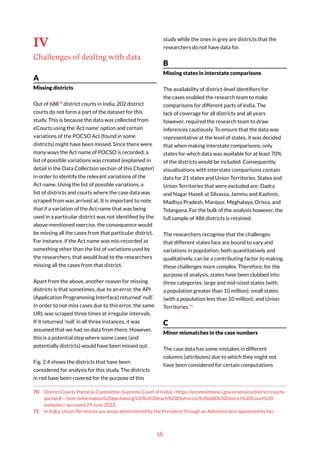
Fig. 2.4 shows the districts that have been
considered for analysis for this study. The districts
in red have been covered for the purpose of this
70 District Courts Portal (e-Committee, Supreme Court of India) <https://ecommitteesci.gov.in/service/district-courts-
portal/#:~:text=Information%20pertaining%20to%20each%20District,to%20688%20District%20Court%20
websites> accessed 29 June 2022.
71 In India, Union Territories are areas administered by the President through an Administrator appointed by her.
study while the ones in grey are districts that the
researchers do not have data for.
B
Missing states in interstate comparisons
The availability of district-level identifiers for
the cases enabled the research team to make
comparisons for different parts of India. The
lack of coverage for all districts and all years
however, required the research team to draw
inferences cautiously. To ensure that the data was
representative at the level of states, it was decided
that when making interstate comparisons, only
states for which data was available for at least 70%
of the districts would be included. Consequently,
visualisations with interstate comparisons contain
data for 21 states and Union Territories. States and
Union Territories that were excluded are: Dadra
and Nagar Haveli at Silvassa, Jammu and Kashmir,
Madhya Pradesh, Manipur, Meghalaya, Orissa, and
Telangana. For the bulk of the analysis however, the
full sample of 486 districts is retained.
The researchers recognise that the challenges
that different states face are bound to vary and
variations in population, both quantitatively and
qualitatively, can be a contributing factor to making
these challenges more complex. Therefore, for the
purpose of analysis, states have been clubbed into
three categories: large and mid-sized states (with
a population greater than 10 million); small states
(with a population less than 10 million); and Union
Territories.71
C
Minor mismatches in the case numbers
The case data has some mistakes in different
columns (attributes) due to which they might not
have been considered for certain computations
17
and graphs. Some of the issues which have led the
researchers to drop a given case are as follows:
Null data or errors in the date format for the date
of filing or date of decision: When considering cases
and grouping them by filing date or date of disposal,
for instance, such cases would be dropped. However,
these cases would not be dropped when counting the
total number of POCSO cases in a given district, for
instance.
Pre 2012 filing dates: Some cases categorised as
POCSO have filing dates before 2012 i.e., before the
enactment of the POCSO legislation. These cases
have therefore been dropped from the analysis.
Date of decision is prior to date of filing:
Consequently, when computing the case length,
these cases have a negative length. Since these are
only a handful of cases and do not change the mean
values of the statistics of interest, these have been
deleted from the computations regarding case
length.
Fig. 2.4: Districts considered for analysis in this study
Districts covered by analysis
Districts excluded from statewise analysis
Districts not included in this study
18
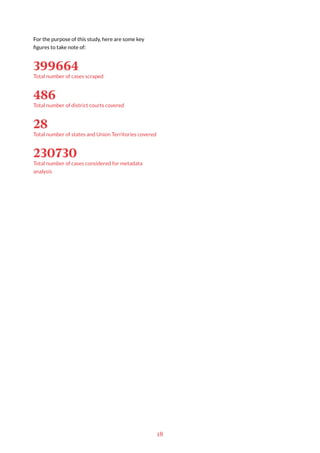
For the purpose of this study, here are some key
figures to take note of:
399664
Total number of cases scraped
486
Total number of district courts covered
28
Total number of states and Union Territories covered
230730
Total number of cases considered for metadata
analysis
19
Chapter III
Interpretation of POCSO
Developments and Issues
In the Chapter on legislative history, the researchers
have tracked how the POCSO Act came into being
and how the legislation itself has evolved with
amendments. Before looking at the findings from
data, it is important to understand the context
that the Act is working in. An important part of
understanding this context is to see how legal issues
arising from different provisions of the Act have
been adjudicated. It is the judiciary that ultimately
interprets a law and this role it performs assumes
critical importance when a new law is enacted.
Often, the enactment of a new legislation brings
to fore certain questions that need to be judicially
determined to provide greater clarity to the
meaning. The objective of this Chapter is to examine
how courts (particularly the higher judiciary) have
interpreted the legislation while deciding some
difficult legal and factual questions. The purpose
of this Chapter is not to exhaustively trace the
development of jurisprudence pertaining to the
POCSO Act but to shed light on the approach
adopted by the judiciary with regard to some key
issues that have arisen since the Act came into force.
20
I
Definition of a “child” under section
2(1)(d) of the POCSO Act
Context
In the year 2000, the Juvenile Justice (Care and
Protection of Children) Act, 2000 was enacted. This
Act defined a ‘juvenile’ or ‘child’ as ‘a person who
has not completed eighteenth year of age.’72
Section
2(1)(d) of the POCSO Act, 2012 adopted the same
approach while defining a child as ‘any person below
the age of eighteen years’. However, an important
issue that arose soon after the implementation of the
POCSO Act concerned the scope of this definition.
Did age as referred to in this provision mean
biological age or mental age?
This issue becomes important because there are
several cases where even though the victims are
biologically above the age of 18 years, their mental
age73
is below 18. Since the POCSO Act provides
greater safeguards for children by prescribing a
child-friendly procedure for trial, it can offer greater
protection to persons who are mentally challenged
or suffer from severe intellectual disability. Thus, it
fell to the courts to decide whether a person who
has crossed the biological (and not mental) age of
18 years could also be included within the holistic
conception of the term ‘child’ under the POCSO Act.
Important Judgments
In a crucial case74
at the Supreme Court, it was
argued by the appellants that the definition of a child
should be interpreted to include within its scope
the mental age of any person below the age of 18
years or the age determined by the prevalent science
pertaining to psychiatry. The case concerned a sexual
72 Juvenile Justice (Care and Protection of Children) Act 2000, s 2(k).
73 ‘Mental Age’, APA Dictionary of Psychology (APA) <https://dictionary.apa.org/mental-age> accessed 16 June 2022.
74 Eera v State (NCT of Delhi) (2017) 15 SCC 133.
assault victim whose biological age was 38 years
but whose mental age was six because she had been
suffering from cerebral palsy since her birth.
A division bench of Justice Dipak Misra and Justice
Rohinton Fali Nariman held that it would be doing
violence both to the intent and language of the
Parliament if the word ‘mental’ is read within the
definition of a child under the POCSO Act. According
to the Apex Court, the legislature never intended to
include the concept of mental age while determining
the age of a child for the purpose of the POCSO Act
and doing so would amount to encroaching upon the
function of the legislature. The court observed that
judges could not assume a ‘creative constructionist
personality’ when the provision in question was clear
and unambiguous.
Present Position of Law
Therefore, the current position of law is to consider
merely the biological age of the victim to determine
whether they fall within the definition of a child
under section 2(1)(d) of the POCSO Act.
II
Placing reliance on the sole
testimony of the victim to convict
Context
Like other sexual crimes, in POCSO cases too, the
possibility of having eyewitnesses is extremely rare.
Usually, the child victim is also the sole witness to the
crime. In such cases, an important issue that arises
is whether courts can rely on the sole testimony
of the child victim in order to convict the accused.
Since victims in POCSO cases can be very young
children, and since evidence is often recorded after
21
a considerable lapse of time,75
there can be minor
inconsistencies in the statement of the victims.
Therefore, courts have to carefully balance the
victim’s right to justice with the accused’s right to a
fair trial.
The law in India does not debar the testimony of any
witness on account of age. According to Section 118
of the Indian Evidence Act, 1872 all persons shall
be competent to testify unless the court considers
that they cannot understand the questions put to
them, or give rational answers to those questions,
by reason of tender age, extreme old age, disease,
whether of body or mind, or any other cause of the
same kind. Thus, the qualifying criteria is not the
age of the child but rather his abilities to understand
questions and form rational answers.
However, every testimony has two facets—
admissibility and credibility, and while child
witnesses are competent witnesses, their evidence
has historically been taken with a pinch of salt by the
judiciary. The Privy Council in Mohamed Sugal Esa v
The King76
opined that it is “a sound rule in practice
not to act on the uncorroborated evidence of a
child. But this is a rule of prudence and not of law.”
Over the years, courts have moved away from this
understanding and have accepted that the testimony
of a child witness is not inherently untrustworthy. A
catena of judgments has held that if the testimony of
the child is consistent and inspires confidence, then
a conviction can be based on it without the need for
corroboration.77
However, a question arose as to
75 Bharti Ali, Maharukh Adenwalla and Sangeeta Punekar, Implementation of the POCSO Act: Goals, Gaps and Challenges:
Study of cases in Special Courts in Delhi & Mumbai (2012 - 2015) (HAQ: Centre for Child Rights and FACSE 2017) 95
<www.haqcrc.org/publication/implementation-pocso-act/> accessed 17 June 2022.
A study of the Special Court orders in Delhi showed that in only about 11% of the cases is the child’s evidence
recorded within the period of 30 days from the date of cognizance. The courts also do not record the reason for
delay in recording the child’s testimony as mandated under Section 35(1) of the POCSO Act
76 AIR 1946 PC 3.
77 Dattu Ramrao Sakhare and Others v. State of Maharashtra (1997) 5 SCC 341; In State of U.P. v. Krishna Master & Ors., AIR
2010 SC 3071. State of Madhya Pradesh v. Ramesh & Anr., 2011 (3) Scale 619; Tahal Singh v. Punjab AIR 1979 SC 1347.
78 Ganesan v State (2020) 10 SCC 573.
79 The Protection of Children from Sexual Offences Act 2012, s 8.
80 Janardan Pandurang Kapse v State of Maharashtra, Criminal Appeal No. 838 of 2019 (Bom H.C.) (unreported).
whether conviction under the POCSO Act can be
based on the sole testimony of a child victim.
Important Judgments
When the question of whether reliance can be
placed on the sole testimony of a child victim came
before the Apex Court, it held78
that considering
the object and purpose of the POCSO Act, when
the evidence of the prosecutrix is reliable and
trustworthy, conviction will stand, even though
another prosecution witness has turned hostile.
In this case, the accused had been sentenced to
rigorous imprisonment of three years and fined Rs.
1 lakh under section 879
of the POCSO Act by the
trial court. The High Court upheld the conviction but
modified the order of compensation. The accused
appealed to the Supreme Court and one of the
grounds of appeal was that the mother of the victim
(a prosecution witness) had turned hostile and the
conviction was based on the sole testimony of the
victim. The Supreme Court rejected the appeal.
Despite the Supreme Court’s decision, in cases
where the child victim is extremely young, courts
have displayed more caution while relying on
their testimony. In a case80
involving a child victim
aged five years, the Bombay High Court remarked
that a child witness is amenable to tutoring and
inducement and is often prone to telling imaginative
and exaggerated stories. According to the court,
child witnesses, by reason of their tender age, are
pliable witnesses and hence their evidence needs to
be scrutinised with extreme care and caution.
22
A different approach was adopted by the Madras
High Court in a case81
involving an 11-year-old
child victim. The defence had argued that no
independent witness had been examined by the
trial court to corroborate the evidence of the child
victim. However, the High Court acknowledged
that the nature of the case was such that one could
not expect an eye witness or independent witness.
The court found no reason to disbelieve the cogent,
consistent and trustworthy evidence of the sole
witness.
In another case where there were some
inconsistencies in the statements made by the
victim, the Calcutta High Court held that the victim
is the best judge of the incident and even if there are
minor discrepancies in the evidence of the victim,
such discrepancies cannot be held to be material
contradictions that affect the credibility of the
witness.82
Present Position of Law
Therefore, as the law currently stands, conviction in
POCSO cases can be based upon the sole testimony
of the child victim as long as the victim’s evidence is
reliable.
III
Marital rape of a minor wife and the
conflict between IPC and POCSO
Act
Context
Since the introduction of the POCSO Act, an
inconsistency emerged between the provisions of
the POCSO Act and the Indian Penal Code, 1860
(the IPC). While the POCSO Act criminalised sexual
intercourse with a woman less than 18 years of age,
81 K. Ruban v State, Criminal Appeal No. 253 of 2021 (Mad H.C.) (22 October 2021) (unreported).
82 Prabir Bhuian v State of West Bengal, 2021 SCC OnLine Cal 3063.
83 Pravin Patkar and Pooja Kandula, ‘4 Years Since POCSO: Unfolding of the POCSO Act in the State of Maharashtra’
(2016) Aarambh India <http://aarambhindia.org/wp-content/uploads/2018/05/DigitalAarambh_4-Years-Since-
POCSO.pdf> accessed 29 June 2022.
84 Independent Thought v Union of India (2017) 10 SCC 800.
Exception 2 to Section 375 of the IPC carved out an
exception in cases where the ‘wife’ was more than
15 years of age. Consequently, sexual intercourse
by a man with his wife who was more than 15 years
of age, was not rape. This was problematic because
the acts falling in this exempted category would still
fall within the scope of the POCSO Act. The question
therefore was whether the ‘husband’ in such cases
could be tried under the provisions of the POCSO
Act.
A 2018 report by Aarambh India Initiative83
on
the implementation of POCSO in Maharashtra
shows that when there are conflicting provisions in
different laws, the police are often confused about
the procedures to be followed. With the police
being more familiar with the IPC than POCSO, this
anomaly, even if an academic one, could have been
potentially dangerous.
Though Section 42A of the POCSO Act was
very clear regarding the fact that the Act had an
overriding effect in case of inconsistency with
other laws, the anomaly, albeit an academic one,
was disconcerting enough to merit an authoritative
pronouncement by the Supreme Court of India.
Important Judgments
This controversy was settled by the Supreme Court
in a landmark judgment in 2017.84
The issue before
the apex court in this case was whether sexual
intercourse between a man and his wife being a girl
between 15 and 18 years of age is rape. The court
read down Exception 2 to Section 375 of the IPC
which carved out an exception for such cases. To
harmonise the system of laws relating to children,
the court required Exception 2 to Section 375 to be
meaningfully read as: ‘Sexual intercourse or sexual
acts by a man with his own wife, the wife not being
under eighteen years of age, is not rape.’
23
The court held that the Exception carved out in the
IPC creates an unnecessary and artificial distinction
between a married girl child and an unmarried girl
child. This artificial distinction, it held, is arbitrary
and discriminatory and is definitely not in the best
interest of the girl child. The court found that the
Exception was directly in conflict with the Preamble
of the POCSO Act. Referring to Section 42A85
of the
POCSO Act, the court held that the provisions of
the POCSO Act will override the provisions of any
other law (including the IPC) to the extent of any
inconsistency.
Referring to the age of consent, the court observed
that the age of consent for sexual intercourse is
definitively 18 years and under no circumstance can
a child below 18 years of age give consent, express
or implied, for sexual intercourse.86
It recognised
that statutes concerning the rights of children
are special laws concerning a special subject of
legislation and the provisions of such subject-specific
legislations must prevail and take precedence over
the provisions of a general law such as the IPC.87
This position of law, as laid down by the Supreme
Court, was applied by Madhya Pradesh High Court in
Ajay Jatav v State of Madhya Pradesh88
wherein it held
that physical relationship with a minor is rape since
age of the minor ‘wife’ under Exception 2 of Section
375 has to be read as 18 years.
Present Position of Law
Therefore, as the law currently stands, sexual
intercourse by a man with his ‘wife’ who is below 18
85 The Protection of Children from Sexual Offences Act 2012, s 42A: The provisions of this Act shall be in addition to
and not in derogation of the provisions of any other law for the time being in force and, in case of any inconsistency,
the provisions of this Act shall have overriding effect on the provisions of any such law to the extent of the
inconsistency.
86 Independent Thought v Union of India (2017) 10 SCC 800, ¶77.
87 Ibid.
88 2021 SCC OnLine MP 1776.
89 Laasya Shekhar, ‘Naming and shaming victims for ratings: What ails the Tamil media in reporting on rape and crime?’
Newslaundary (1 October 2021) <www.newslaundry.com/2021/10/01/naming-and-shaming-victims-for-ratings-
what-ails-the-tamil-media-in-reporting-on-rape-and-crime> accessed 17 June 22.
90 Varsha Rani, ‘Disclosing the Identity of Rape Victims & Survivors: What Does Indian Law Say?’ The Quint (16
September 2021) <https://www.thequint.com/neon/gender/indian-laws-on-disclosing-rape-survivors-victims-
identity#read-more> accessed 17 June 2022.
years of age would amount to an offence under the
POCSO Act as well as rape under the IPC.
IV
Disclosure of identity of child in
POCSO cases
Context
Section 23(2) of the POCSO Act prescribes the
procedure to be followed by the media while
reporting cases falling within the ambit of the Act. It
provides that no reports in any media shall disclose
the identity of a child including the name, address,
photograph, family details, school, neighbourhood or
any other particulars which may lead to disclosure
of identity of the child. Further, Section 24(5) of the
Act makes it the duty of the concerned police officer
to ensure that the identity of the child is protected
from the public media. Additionally, section 33(7)
provides that the Special Court shall ensure that
the identity of the child is not disclosed at any time
during the course of investigation or trial. Finally,
section 37 makes a provision for in camera trials in
POCSO cases though the presence of the parents of
the child or any other person in whom the child has
trust or confidence is permitted.
The purpose of these provisions is to prevent further
traumatisation of the child victim. Despite this
provision, there have been numerous instances when
the identity of child victims has been revealed by
the media89
or public figures.90
Further, sometimes
courts themselves disclose the identity of a child
24
by revealing the names of the victims or their
relatives in their judgments.91
Studies by CCL-
NLSIU in five States of India have revealed that, in
an overwhelming number of cases, Special Courts
have disclosed the identity of the victims in their
judgments. In Assam,92
the identity of the victim
was disclosed by either naming her or her family
members in 77.32% cases. In Maharashtra,93
86%
judgments revealed the identity of the victim and
in Andhra Pradesh, an alarming 96% of judgments
compromised the identity of the victim.
In small villages and tightly knit communities, where
everyone tends to know everyone else, even the
disclosure of the name of the relatives is sufficient to
identify the victim.
Important Judgments
Soon after the POCSO Act came into force in 2012,
the Delhi High Court passed an order94
approving
guidelines for media reporting on children framed
by a Committee95
constituted by it. However,
these guidelines were not followed (as can be seen
from the instances mentioned above). To protect
the interests of child victims, the Supreme Court
stepped in and pronounced a landmark ruling on the
issue. In its judgment in the case of Nipun Saxena v
Union of India,96
among other things, the Apex Court
dealt with the issue of protection of the identity of
child victims of sexual abuse.
Taking note of the provisions in Sections 24(5), 33(7)
and 37 of the POCSO Act, the apex court held that
the disclosure of the identity of a child can only be
permitted by the Special Court if it is in the best
interest of the child and for no other reason. The
91 ‘Madras HC asks POCSO courts not to reveal identity of victims’ The New Indian Express (16 April 2022) <https://
www.newindianexpress.com/states/tamil-nadu/2022/apr/16/madras-hcasks-pocso-courts-not-to-reveal-identity-
of-victims-2442536.html> accessed 17 June 2022.
92 Centre for Child and the Law, National Law School of India University, Implementation of the POCSO Act, 2012 by
Special Courts: Challenges and Issues (National Printing Press, Bengaluru, February 2018).
93 Ibid.
94 AK Asthana v Union of India, W.P.(C) No. 7871 of 2012 (Del H.C.) (unreported).
95 Comprising of Juvenile Justice Board, Union of India, Government of NCT of Delhi, NGOs working for the welfare
of children, media, Press Council of India, child rights activists, and the National Commission for Protection of Child
Rights.
96 Nipun Saxena v Union of India (2019) 2 SCC 703.
97 Ibid.
court also held that disclosure of a child’s name
to make the child a symbol of protest would not
ordinarily be considered to be in the best interest
of the child. However, the court made it clear that
it was neither feasible, nor desirable to define what
could be considered in the “interest of the child”.
Noting that it was the intention of the legislature
that the identity of the victim child should not
be directly or indirectly disclosed, the court also
elaborated on how the media should report on cases
pertaining to child sexual abuse.97
The court issued
instructions to be followed by the media and the
authorities while dealing with such cases.
Nipun Saxena v Union of India Guidelines
For the Media—The media should:
1. not sensationalise the case;
2. refrain from talking to the victim to
prevent further trauma to the child;
3. not disclose any material that might lead
to disclosure of the child’s identity
For the Police—The police should:
1. not put FIRs relating to offences under
Sections 376, 376A, 376AB, 376B, 376C,
376D, 376DA, 376DB or 376E of IPC and
offences under the POCSO Act in the
public domain.
2. keep all the documents in which the
name of the victim is disclosed, as far as
possible, in a sealed cover and replace
these documents by identical documents
after removing the name of the victim in
25
all records likely to be scrutinised in the
public domain.
For other authorities—all the authorities to
which the name of the victim is disclosed by
the investigating agency or the court shall:
1. keep the name and identity of the victim
secret and not disclose it in any manner
except in the report which should only be
sent in a sealed cover to the investigating
agency or the court.
For the general public—No person shall:
1. print or publish in print, electronic, social
media, etc. the name of the victim or
even in a remote manner disclose any
facts which can lead to the victim being
identified and which should make her
identity known to the public at large.
In a recent judgment,98
the Bombay High Court
remarked that despite issuance of these guidelines,
the print and electronic media continue to report
on these offences in such a manner that the identity
of the victim is established directly or indirectly. It
also issued additional directions for protecting the
identity of the victim during trial, including while
framing of charge, recording evidence, and recording
the statement of the accused under Section 313 of
the CrPC.99
The Calcutta High Court has also issued
detailed instructions for the protection of victims’
identity in two significant cases. In Bijoy @ Guddu
Das v State of West Bengal,100
it directed that any
particulars that may reveal such identity shall not be
disclosed in the judgment delivered by the Special
98 Sangita w/o Yeshwant Tanpure v State of Maharashtra, Criminal PIL No. 1 of 2016 (Bom H.C.) (unreported).
99 Criminal PIL No. 1 of 2016 (Bom H.C.) (unreported), ¶16.
100 CRA 663 of 2016.
101 CRA (DB) 29 of 2022.
102 2022 SCC OnLine SC 337.
103 No police officer shall investigate a non-cognizable case without the order of a Magistrate having power to try such
case or commit the case for trial.
Court unless such disclosure of identity was in the
interest of the child. Recently, in Prafulla Mura v State
of West Bengal,101
the court directed that pleadings
and affidavits containing the victim’s name must be
kept in sealed covers and only redacted copies would
be released in the public domain.
However, an important question concerning the
interpretation of Section 23 of POCSO Act is
pending before the Supreme Court. In Gangadhar
Narayan Nayak v State of Karnataka,102
the issue
before the Apex Court was whether Section
155(2)103
of the CrPC applies to the investigation of
an offence under Section 23. The case resulted in
a split verdict with Justice Indira Banerjee holding
that disclosure of identity of the victim under the
POCSO Act is a cognizable offence and Justice J.K.
Maheshwari concluding that it is not. The matter has
been placed before the Chief Justice in order to be
placed before an appropriate bench.
Present Position of Law
Strict guidelines have been put in place by the Apex
Court to ensure that the identity of a victim child is
not disclosed to the public. However, the question of
whether the offence under Section 23 is cognisable
or not remains to be answered.
26
V
Applicability of the mandatory
reporting provision
Context
Section 19104
of the POCSO Act makes a provision
for mandatory reporting of acts that are crimes
under the POCSO Act. The provision makes it
mandatory for any person who has apprehension
that an offence under this Act is likely to be
committed or has knowledge that such an offence
has been committed to report the offence to the
local police or the Special Juvenile Police Unit. This
provision has been the subject of much criticism with
studies finding that it makes it difficult for children
to seek support for fear of registration of a police
case.105
Victims of sexual abuse or their families may hesitate
to approach medical professionals, including
gynaecologists and psychiatrists, for fear of being
drawn into a criminal case, thereby negatively
impacting their right to health and medical care.106
Apart from this, mandatory reporting also has
serious implications for individuals under 18 who
are involved in consensual sexual relationships.107
104 S 19(1) Notwithstanding anything contained in the Code of Criminal Procedure, 1973 (2 of1974) any person
(including the child), who has apprehension that an offence under this Act is likely to be committed or has
knowledge that such an offence has been committed, he shall provide such information to—
(a) the Special Juvenile Police Unit; or
(b) the local police.
105 Bharti Ali, Maharukh Adenwalla and Sangeeta Punekar, Implementation of the POCSO Act: Goals, Gaps and Challenges:
Study of cases in Special Courts in Delhi & Mumbai (2012 - 2015) (HAQ: Centre for Child Rights and FACSE 2017) 39
<https://www.haqcrc.org/publication/implementation-pocso-act/> accessed 17 June 2022.
106 Centre for Reproductive Rights, Legal Barriers to Accessing Safe Abortion Services in India: A Fact Finding Study
(National Law School of India University, Bangalore, 2021) < https://reproductiverights.org/wp-content/
uploads/2021/08/Legal-Barriers-to-Accessing-Safe-Abortion-Services-in-India_Final-for-upload.pdf > accessed on
30 September 2022; Alok Prasanna Kumar, ‘Mandatory Reporting under POCSO’ Economic and Political Weekly
(17 September 2022) < https://www.epw.in/journal/2022/38/law-and-society/mandatory-reporting-under-pocso.
html > accessed on 30 September 2022.
107 Centre for Reproductive Rights, Legal Barriers to Accessing Safe Abortion Services in India: A Fact Finding Study
(National Law School of India University, Bangalore, 2021) < https://reproductiverights.org/wp-content/
uploads/2021/08/Legal-Barriers-to-Accessing-Safe-Abortion-Services-in-India_Final-for-upload.pdf > accessed on
30 September 2022.
108 Ibid.
109 Bharti Ali, Maharukh Adenwalla and Sangeeta Punekar, Implementation of the POCSO Act: Goals, Gaps and Challenges:
Study of cases in Special Courts in Delhi & Mumbai (2012 - 2015) (HAQ: Centre for Child Rights and FACSE 2017) 77
<https://www.haqcrc.org/publication/implementation-pocso-act/> accessed 17 June 2022.
110 Tessy Joseph v State of Kerala (2018) 18 SCC 292.
Medical professionals and child rights activists
have often raised the concern that it hinders
adolescents’ access to safe and legal sexual and
reproductive services, including legal abortions and
contraceptives.108
Further, in cases where a case is
mandatorily reported against the wish of the victim,
there is a greater chance of the unwilling victim
turning hostile during prosecution.109
Apart from the issues indicated above, some
concerns have arisen about the applicability of the
mandatory reporting provision. For instance, does
‘knowledge’ under this provision require a person to
actively gain that knowledge or does the obligation
to mandatorily report an offence under the Act only
mean that if something comes to one’s knowledge,
they are supposed to report it? Another issue is
whether persons charged with failure to mandatorily
report a case can be tried jointly with the person
accused of actually committing the sexual offence in
that case.
Important Judgments
Some clarity was provided on the scope of Section
19 by the Supreme Court in a case110
which dealt
with the interpretation of Section 19(1) of the
POCSO Act. In this case, the Supreme Court
quashed the proceedings against a gynaecologist, a
27
paediatrician and a hospital administrator for failing
to mandatorily report rape of a victim child who gave
birth in the hospital that they worked in. The victim
child was brought to the hospital and immediately
went into labour. The child’s age as per the hospital
records was entered as 18 years even though she
was a minor.
The entire case set up against the appellants was on
the basis that when the victim was brought to the
hospital her age was recorded as 18 years. On that
basis, the appellants could have gathered that at the
time of conception she was less than 18 years and
was, thus, a minor. Therefore, the argument was that
the appellants ought to have taken due care to find
how the victim became pregnant.
The court held that fastening criminal liability on
the basis of the aforesaid allegation was too far-
fetched.111
It went on to add that the expression
used in the POCSO Act is “knowledge” which means
that some information received by such a person
gives him/her knowledge about the commission
of the crime. There is no obligation on this person
to investigate and gather knowledge.112
Thus, the
court clarified the scope of the mandatory reporting
requirement under the Act.
Another important question that arises when it
comes to mandatory reporting is the stage at which
a person should be tried for failure to report. The
question whether a person should be tried for
failure to report only after the main offence has
been proved has seen a divergence of views from
different High Courts. The Chhattisgarh High Court
has held113
that in order to sustain a prosecution for
mandatory reporting, it must first be proved beyond
reasonable doubt that the primary offence of sexual
assault was committed, and thus a simultaneous
prosecution with the abuser would be a violation
of the due process of law. It went on to say that
the prosecuting agency should be circumspect in
initiating prosecution under Section 21(2) of the
111 Ibid.
112 Ibid.
113 Kamal Prasad Patade v State of Chhattisgarh 2016 SCC OnLine Chh 719.
114 Balasaheb v State of Maharashtra 2017 SCC OnLine Bom 1772.
POCSO Act against the head of an institution who is
entitled to a reasonable time to find out the correct
facts through an enquiry at the institutional level
before reporting the case to the police.
However, the Bombay High Court in Balasaheb
Suryakant Yashwantrao Mane v State of Maharashtra114
rejected this reasoning and held that such an
interpretation would defeat the object of enactment
of these provisions and that the person failing to
report should be tried jointly with the abuser as they
were different offences committed in the course of
the same transaction. A judicial determination of this
issue is required by the Supreme Court to ensure
some consistency in the interpretation of Section 19
by the High Courts.
Present Position of Law
Therefore, the current position of law on the issue
of mandatory reporting is that there is no obligation
on a person to investigate and gather knowledge
with respect to the commission of an offence under
the POCSO Act. However, with respect to whether
the primary accused (accused of committing the
sexual offence) and a person accused of flouting
the mandatory reporting requirement can be tried
together, there is a divergence in the views of
different High Courts. This uncertainty needs to be
addressed through a judicial pronouncement from
the Supreme Court.
VI
Interpretation of ‘sexual assault’
under the POCSO Act
Context
The provisions of the POCSO Act as to what
constitutes sexual assault under Section 7 have been
the subject of much deliberation. This is because
there is some uncertainty as to the specificity
28
of provisions applicable to different facts and
circumstances in certain cases.
The Kerala115
and Himachal Pradesh116
High Courts
have held that ‘touch’ or ‘physical contact’ through
the clothes of the victim would still amount to
‘sexual assault’ under Section 7 of the POCSO Act
and does not, in any way, reduce the gravity of the
nature of offence. However, the Bombay High Court
took a diametrically opposite view in a controversial
decision. In Satish Ragde v. State of Maharashtra,117
the Bombay High Court held that the act of pressing
the breast of a child aged 12 years without removing
her top will not fall within the definition of sexual
assault under Section 7118
of the POCSO Act and
instead upheld his conviction under Section 354 of
the IPC, 1860. The court reasoned that Section 7
requires direct physical contact (skin to skin contact
with sexual intent) and since that was absent in the
present case, the accused could not be convicted
under POCSO. In a similar case,119
the Bombay High
Court held that acts of holding the hands of the
prosecutrix or unzipping the pant of a child did not
fit the definition of sexual assault under Section 7.
This started a debate on whether skin to skin contact
between the victim and the accused was necessary
in order to constitute the offence.
Important Judgments
These judgments created a furore and were set
aside120
by the Supreme Court on the ground that
the main ingredient of the offence of sexual assault
under Section 7 was ‘sexual intent’ and not ‘skin
to skin’ contact. The court observed, ‘The very
object of enacting the POCSO Act is to protect the
children from sexual abuse, and if such a narrow
115 Geetha v State of Kerala, Criminal MC No. 1237 of 2020 (Ker H.C.) (4 May 2020) (unreported).
116 Jagar Singh v State of Himachal Pradesh, Criminal Miscellaneous Petition No. 1112 of 2014 (H.P. H.C.) (24 September
2014) (unreported).
117 Satish v State of Maharashtra, 2021 SCC OnLine Bom 72.
118 Whoever, with sexual intent touches the vagina, penis, anus or breast of the child or makes the child touch the
vagina, penis, anus or breast of such person or any other person, or does any other act with sexual intent which
involves physical contact without penetration is said to commit sexual assault.
119 Libnus v State of Maharashtra, Criminal Appeal No. 445 of 2020 (Bom H.C.) (15 January 2021) (unreported).
120 Attorney General for India v Satish (2021) 4 SCC 712.
121 Ravi v State, Criminal Appeal No. 657 of 2017 (SC) (3 October 2019) (unreported).
122 Nurai Sk. @ Nurul Sk. v State of West Bengal, Criminal Appeal No. 45 of 2019 (Cal H.C.) (unreported).
123 Sri Sanju Tanti v State of Tripura, Criminal Appeal No. 19 of 2020 (Tri H.C.) (unreported).
interpretation is accepted, it would lead to a very
detrimental situation, frustrating the very object of
the Act’.
Different High Courts have had differing
interpretations on the scope of Section 7 when it
involved instances where the accused had held the
victim’s hand. The Delhi High Court held121
that the
accused holding the hand of the victim with sexual
intent and involving physical contact would fall
within the scope of Section 7. However, the Calcutta
High Court has concluded122
that an act of dragging
a minor girl’s scarf, pulling her hand and proposing
marriage does not come within the purview of sexual
assault or sexual harassment under the POCSO
Act. Further, the Tripura High Court has gone on to
hold123
that touching the hands of a minor without
any intention to molest will not attract charges of
sexual assault under the POCSO Act. The High Court
allowed the appeal of the accused against the order
of the trial court on the ground that prosecution
witnesses, including the victim, had not ‘specifically
stated’ that there was any intention of the accused to
molest the victim.
Present Position of Law
Therefore, as the law currently stands, ‘sexual
intent’ and not ‘skin to skin contact’ constitutes the
‘touch’ required for conviction under Section 7 of the
POCSO Act. The outcome of cases under Section 7
now hinges on whether sexual intent while touching
is proved or not.
29
VII
Applicability of the POCSO Act to
‘consensual’ relationships between
minors
Context
The age of consent in India is intertwined with the
law surrounding child marriages. Until 2012, the
age of consent as per Section 375 of the IPC was 16
years.124
By defining a child as ‘any person below the
age of eighteen years’,125
the POCSO Act made any
sexual activity involving a child an offence under the
Act. However, this provision was inconsistent with
the IPC, 1860 which pegged the age of consent at 16
years.
This inconsistency was resolved with the enactment
of the Criminal Law Amendment Act, 2013,126
which
raised the age of consent from 16 to 18 years.127
This
meant that any sexual activity involving individuals
who were below the age of 18 years, irrespective of
their consent, would amount to ‘statutory rape’ as
per section 375 of the Indian Penal Code, 1860.128
This has resulted in one of the most controversial
aspects of the POCSO Act. By rendering teenagers
incapable of giving consent to sexual relationships,
consensual ‘romantic relationships’ between
teenagers often get criminalised. The seriousness
of this issue has not escaped judicial attention. In
Arhant Janardan Sunatkari v State of Maharashtra,129
the Bombay High Court observed that incidents of
124 Amita Pitre & Lakshmi Lingam, ‘Age of consent: challenges and contradictions of sexual violence laws in India’ (2020)
29 Sexual and Reproductive Health Matters.
125 The Protection of Children from Sexual Offences Act 2012, s 2(d).
126 The Criminal Law (Amendment) Act 2013.
127 When this Bill was first introduced in the Lok Sabha, the age of consent was stated to be 16, but due to protests
from certain campaign groups, it was changed to 18 at the time of introducing it in the Rajya Sabha.
128 Indian Penal Code 1860, s 375.
129 Arhant Janardan Sunatkari v State of Maharashtra, 2021 SCC OnLine Bom 136.
130 Swagata Raha, ‘Report of Study on the working of Special Courts under the POCSO Act, 2012 in Delhi’ (2016)
Centre for Child and the Law <https://ccl.nls.ac.in/wp-content/uploads/2017/01/specialcourtPOSCOAct2012.pdf>
accessed 17 June 2022.
131 Centre for Child and the Law, National Law School of India University, Implementation of the POCSO Act, 2012 by
Special Courts: Challenges and Issues (National Printing Press, Bengaluru, February 2018).
132 Ibid.
133 Ibid.
consensual sex between minors have been a grey
area under the law as a minor’s consent is not valid in
the eyes of law.
Various studies suggest that many cases filed under
the Act pertain to consenting minors. For instance,
a study conducted in Delhi found that 28% of the
complaints reported between January, 2013 and
September, 2015 were between individuals between
the age group of 16-18 years.130
90% of these
cases resulted in acquittal because the adolescent
girl failed to testify against her sexual partner.
A report by CCL-NLSIU consolidating findings
regarding the implementation of the POCSO Act in
five states found that the percentages of POCSO
cases involving consensual relationships were 5%
in the case of Karnataka, 15% in Assam, 20% in
Maharashtra and approximately 21% in Andhra
Pradesh.131
While the numbers may seem small, there is no
denying the fact that this prevents minors from
safely exhibiting and exploring their sexuality.132
The
report also notes that most of the ‘romantic cases’
were filed by the family of the victim and not the
victim herself, thus giving rise to the assumption that
these provisions were being misused by families of
adolescents to thwart relationships that they did
not approve of.133
A study of rape trials in a Fast
Track Court (FTC) in Lucknow found that 50% of
the rape trials observed for a period of eight weeks
between April, 2015 and May, 2015 were related to
consensual relationships where parents opposing
30
the relationship had filed cases for their adolescent
daughter.134
Important Judgments
Courts have often strictly interpreted135
the POCSO
Act by holding that the consent of a minor has no
value in the eyes of the law. However, over the
years, they are beginning to recognise the draconian
interpretations of the POCSO Act and tracing back
its intent to protect innocent children from sexual
offenses as opposed to a tool of abuse of the process
of law to compel a person to get out of a consensual
relationship or get into a ‘compromise marriage’.
For instance, the Calcutta High Court136
while
recognising that the consent of a minor is not a good
consent in law, interpreted the term ‘penetration’
in the POCSO Act to mean a positive, unilateral act
on the part of the accused and not sexual unions
between two persons out of their own volition.
Courts have also recognised the problems of
imposing rigorous punishments prescribed under
the POCSO Act137
and the need for creating
legal awareness given the grey area pertaining
to consensual relationships.138
The Madras High
Court has provided the most definitive to what the
position of law on the subject should be. In 2019,139
it recommended that the definition of ‘child’ under
Section 2(d) of the POCSO Act should be 16 and
not 18 years and consensual relationships after the
age of 16 years should be excluded from rigorous
punishments under the Act. Drawing from the
134 Neetika Vishwanath, ‘The Shifting Shape of the Rape Discourse’ (2018) 25(1) Indian Journal of Gender Studies
<https://doi.org/10.1177%2F0971521517738447> accessed on 17 June 2022.
135 Peer Mohammad Ghotu Mohd. Ismail v State of Maharashtra, Criminal Appeal No. 491 of 2021 (Bom H.C.)
(unreported); Rahul P.R. v State of Kerala, Criminal Miscellaneous No. 5890 of 2020 (Ker H. C.)
136 Ranjit Rajbanshi v State of W.B., 2021 SCC OnLine Cal 2470.
137 Vikramsinh Champaksinh Parmar v State of Gujarat, R/Special Criminal Application Number 765 of 2020 (Guj H.C.)
(unreported).
138 Arhant Janardan Sunatkari v State of Maharashtra, 2021 SCC OnLine Bom 136; Flavia Agnes, ‘Controversy over Age of
Consent’ (2013) 48 EPW 10.
139 Sabari v Inspector of Police, 2019 (3) MLJ Crl 110.
140 Criminal Code of Canada 1985, s 150.1(2.1)
141 Vijayalakshmi v State, 2021 SCC OnLine Mad 317.
142 Meera Emanual, ‘POCSO Act not intended to penalise adolescents or teenagers in romantic relationships: Madras
High Court’ Bar and Bench (29 January 2021) <https://www.barandbench.com/news/litigation/pocso-act-not-
intended-cover-adolescents-teenagers-romantic-relationships-madras-high-court> accessed 20 July 2021;
Mahak Tanwar and Rohan Wadhwa, ‘Revisiting The Age Of Consent In India’ Live Law (30 May 2021) <https://
www.livelaw.in/columns/article-21-indian-constitution-pocso-act-2012-section-375-indian-penal-code-
174909?infinitescroll=1> accessed 20 July 2021.
rationale of a Canadian law140
it recommended a
suitable amendment to the effect that the age of
the offender ought not to be more than five years or
so than the age of the victim girl (who should be 16
years or older).
In another case, a petition was filed by the alleged
victim under Section 482 of the Code of Criminal
Procedure, 1973, to quash the proceedings in a
POCSO case pending before the trial court. The
minor victim and the accused had eloped leading
to a registration of the case against the boy. While
quashing the criminal proceedings, the court
recognised that a law to protect and render justice to
victims and survivors of child abuse can also become
a tool in the hands of certain sections of the society
to abuse the process of law.
The Madras High Court furthered its views in
2021,141
where it held that consensual teenage
relationships are a part of biosocial dynamics and
therefore ‘painting a criminal colour to this aspect
would only serve counter-productively’ and also
that ‘punishing an adolescent boy who enters into
a relationship with a minor girl by treating him as
an offender, was never the objective of the POCSO
Act.’142
The Court thereby quashed proceedings
under Section 482 of the CrPC, 1973, Section 366
of the IPC, 1860 and Section 6 of the POCSO Act,
2012.
31
When dealing with bail applications of accused
persons, High Courts have considered the aspect
of consent. In Smti. Ephina Khonglah v State of
Meghalaya,143
the Meghalaya High Court held that
even though the consent of a minor has no legal
validity, one cannot lose sight of the matter while a
plea for bail is being considered by the court.144
While dealing with a case involving a ‘consensual’
relationship, the Delhi High Court remarked that
the police’s filing of cases under the POCSO Act
at the behest of the girl’s family who opposed the
relationship is an unfortunate practice.145
Present position of law
Even as one bench of the Madras High Court was
hailed for its progressive implementation of POCSO,
another Bench of the same court, in Maruthupandi
v State,146
favoured a more literal interpretation of
the Act and held that penalty under POCSO will be
attracted irrespective of whether the relationship
was consensual or not. This uncertainty can only
be resolved if the Supreme Court gives a ruling
on the matter or if the Parliament introduces an
appropriate amendment. Till then sexual acts
between minors will continue to be criminalised and
any decision given will be contingent on the how a
particular bench decides to interpret the law.
The above discussion shows that while some
controversies surrounding the interpretation of
various provisions of the POCSO Act that have
arisen since 2012 have been settled by judicial
pronouncements, many others remain. Even within
each individual issue, while certain elements have
acquired some form of legal certainty, there are
certain questions that still need to be settled.
It is possible that some of these questions will
eventually be answered by the courts. However, for
a few others, legislative intervention, in the form
of amendments to the law, is necessary. The last
143 B.A. No. 14 of 2021 (Meg H.C.) (unreported).
144 In Dharmander Singh v State, B.A. No. 1559 of 2020 (Del H.C.) (unreported).
The Delhi High Court granted bail to the accused while taking into consideration the possibility of a reciprocal
physical relationship between the accused and the minor victim.
145 Pradhuman v State, B.A. No. 2380 of 2021 (Del H.C.) (unreported).
146 CRL.A [MD] No. 209 of 2017.
chapter of this report lists some recommendations in
this regard.
Chapter IV
Examining POCSO in
Action
147 Constitution of India 1950, arts 15(3), 21A, 24, 39(e), 39(f) and 45.
148 Juvenile Justice (Care and Protection of Children) Act, 2015.
The Juvenile Justice Act lays down the framework for how the system should deal with children in need of care and
protection as well as children who come into conflict with the law. It deals with offences committed by minors, care
and protection of vulnerable children by providing for their basic needs, and rehabilitation in the best interests of
children.
149 Hanif Ur Rahman v State of Bihar, Criminal Writ Jurisdiction Case No. 160 of 2021 (Pat H.C.) (unreported).
Actors, Processes and Challenges
The previous chapters map the legislative history
of the POCSO Act and some of the jurisprudential
questions that have arisen so far. The goal of this
chapter is to understand the process that a POCSO
case goes through in the criminal justice system and
what are some of the challenges that arise in these
different stages. While this report is primarily aimed
at understanding how the judiciary has implemented
the POCSO Act, it is important to remember that
there are a multitude of actors who influence
implementation and hence, the responsibility for
success or failure of POCSO is not to be placed solely
at the judiciary’s doorstep.
The child protection system in India is a complex
one. While the Indian Constitution,147
the Indian
Penal Code (IPC), 1860, and the Code of Criminal
Procedure (CrPC), 1973, the Commissions for
Protection of Child Rights Act, 2005, all contain
provisions that affect the rights of children, the
system primarily lies at the cross-section of two
key legislations—the Juvenile Justice (Care and
Protection of Children) Act, 2015148
and the
POCSO Act, 2012. The year 2022 marks ten years
since the POCSO Act came into effect in India.
However, the implementation of the Act has faced
several challenges along the way, some of which
have worsened over the years. The need for better
implementation of the POCSO Act has been voiced
by several High Courts149
as well as the Supreme
Court.
This chapter examines some of the key challenges
to the implementation of the POCSO Act that
the researchers identified through stakeholder
interviews and secondary research. It is divided
into three parts, each corresponding to the three
major stages in a POCSO case identified by the
researchers: pre-trial, trial and post-trial. Each
part contains an overview of the processes and
challenges specific to each stage. Two challenges,
however, have been dealt with separately since they
pertain to all the three stages: inadequate awareness
about the POCSO Act (within the general public as
well as actors within the criminal justice system) and
the lack of training for various stakeholders involved
in the implementation of the POCSO Act.
33
I
Pre Trial
A
What happens during this stage
Reporting: offence under POCSO Act may be reported to
a. SJPU or local police (s. 19 POCSO Act and s.154 CrPC);
b. or child helplines (Rule 4(2) POCSO Rules);
by any person (including the child).
Filing of First Information Report (FIR): Report is written down, read over
to the informant and entered in a book by the police unit (s. 19 POCSO
Act). FIR is filed and a copy is given to the informant (s. 154 CrPC).
Overview of Stages and Challenges
Pre trial
Across Stages
Trial Post trial
• Delay in investigation and
filing of chargesheet
• Non-appointment of
Support Persons for victims
• Lack of Special Courts in all
districts
• Lack of Special Public
Prosecutors for Special
Courts
• Non-compliance with the
timelines prescribed by the
Act
• Inadequate awareness about the POCSO Act
• Inadequate training of various stakeholders
• Inadequate provision of
compensation to the victims
34
Recording of victim’s statement: Ideally recorded by a woman police
officer, not below the rank of sub-inspector and without uniform, in
presence of a person the child trusts at the residence of the child or at a
place where he usually resides or at the place of his choice (s. 24 POCSO
Act and s. 161 CrPC). Statement under s. 164 of the CrPC shall be
recorded by a Magistrate (s. 25 POCSO Act and s. 164 CrPC). Translators,
interpreters and special educators are employed as and when required (s.
26 POCSO Act).
Medical examination of the victim: The child must be taken to the nearest
hospital or shelter home within 24 hours (s. 19(5) POCSO Act and Rule 4(3)
(b) POCSO Rules). Victim is examined by a registered medical practitioner
(woman doctor in case of girl victim) (s. 27 POCSO Act and s. 164-A CrPC),
who should send a report to the police within 24 hours (Rule 6(5) POCSO
Rules). Forensic samples collected must be forwarded to FSL at the earliest
(Rule 4(3)(d) POCSO Rules).
Production of victim before CWC: Police to report matter to CWC and
Special Court within 24 hours (Section 19(6) POCSO Act).
Assignment of Support Person to victim by CWC: On its assessment,
CWC may assign a support person to assist the victim throughout all stages
of investigation and trial (Rule 4(8) POCSO Rules).
Investigation and collection of evidence: Investigation is conducted by
the police to collect evidence which includes spot investigation (s. 157
CrPC), search and seizure (ss. 165 and 102 CrPC), and examination of
accused and witnesses (s. 161 CrPC).
35
Arrest of accused: Accused is arrested and produced before the
Magistrate without unnecessary delay and within a maximum period of 24
hours from arrest (ss. 41 and 76 CrPC).
Medical examination of accused: Medical examination of accused is
conducted and forensic samples received therein sent to FSL (s. 53-A
CrPC).
Filing of chargesheet: On completion of investigation, a chargesheet is
filed before Special Court within 90 days (s. 173 CrPC).
Hospitals/Doctors
Magistrates
Child Care
Institutions
Child Welfare
Committees
Special Juvenile
Police Units
Police
Informant
Victim
Stakeholders involved at this stage
36
B
Challenges at the Pre Trial Stage
a. Delay in investigation and filing of chargesheet
Context
As readers will see in Chapter V, the pendency
of POCSO cases is very high. One of the primary
reasons for this high pendency150
is the slow
pace of investigation by the police and the delay
in depositing samples with the Forensic Science
Laboratories. The tables below show the time
taken by the police for completion of investigation
and for depositing samples with Forensic Science
Laboratories (FSLs) as per data recorded in a
Supreme Court order.151
It is evident from Fig 4.1 that investigation is
completed in less than 60 days only in 35% of
150 Ramya Kannan, ‘Activists press for speedy resolution of POCSO cases’ The Hindu (20 August 2021) <https://www.
thehindu.com/news/national/tamil-nadu/activists-press-for-speedy-resolution-of-pocso-cases/article36009297.
ece> accessed 20 June 2022.
151 In Re, Alarming Rise in the Number of Reported Child Rape Incidents (2020) 7 SCC 108. Report submitted by Surinder
S. Rathi, Registrar, Supreme Court of India. The report was filed in compliance to the order of the Supreme Court
dated 01-10-2019 <https://main.sci.gov.in/supremecourt/2019/24308/24308_2019_14_1_17281_Order_01-
Oct-2019.pdf> accessed on 30 September 2022.
POCSO cases. For 36% of the cases, it takes more
than six months just to complete the investigation.
If investigation itself takes as long, the possibility
Media
Accused
Legal Aid Authorities
Victim’s Lawyer
Support Person
Juvenile Justice
Boards
Forensic Science
Laboratories
Fig. 4.1: Time taken during investigation stage
Within 30 days
31-60 days
61-180 days
181-365 days
More than one year
0 20 40 60 80 100
Time taken by police
for completion of
investigation
Time taken by police
for depositing
samples with FSLs
37
of the trial concluding within one year of the date
when cognizance is taken152
becomes extremely low.
Further, it is concerning that in 49% of the cases, it
has taken the police anywhere between 31 days to
greater than one year to deposit samples with FSLs.
Delay can also be attributed to the time taken by
FSLs to prepare reports. There is often acute delay
in submitting of reports by FSLs and courts have
frequently taken them to task for its negative impact
on the proceedings. An examination of 100 district
court orders by Times of India revealed that some of
the proceedings had been held up for more than five
years solely on account of the unavailability of FSL
reports.153
Officials have often cited the reason of
lack of manpower for this, resulting in a prioritisation
of newer cases over older ones.154
NCRB data from 2020 shows that out of the 137552
cases of crimes against children, investigation was
completed for only 79297 cases, while 58186 (42%)
cases were still pending investigation by the end
of the year.155
A report on the state of policing and
law and order in Delhi by Praja found that a total of
14378 cases of crime against children were to be
investigated in Delhi as of December, 2020 out of
which 56% cases were pending for investigation at
152 The Protection of Children from Sexual Offences Act 2012, s 35(2).
153 Usha Das, ‘Courting trouble…how endless wait for forensic reports is delaying justice,’ Times of India (13 December,
2021) <https://timesofindia.indiatimes.com/city/delhi/courting-trouble-how-endless-wait-for-forensic-reports-is-
delaying-justice/articleshow/88244533.cms> last accessed 30 September 2022.
154 Ibid.
155 National Crime Records Bureau, ‘Crime in India 2020: Statistics,’ Vol. 1, Pg. 325 (Ministry of Home Affairs, 2020)
<https://ncrb.gov.in/sites/default/files/CII%202020%20Volume%201.pdf> accessed 30 September 2022.
156 Praja, ‘State of Policing and Law & Order in Delhi November 2021’ (2021) Praja and IC Centre for Governance
<https://justicehub.in/dataset/ddae969e-4278-4383-8c0f-f21b2eb29007/resource/3da4a36d-9c68-45c7-a5e1-
3d91597a1dea/download/report-on-state-of-policing-and-law-and-order-in-delhi-2021.pdf> accessed 20 June
2022.
157 Delhi Commission for Protection of Child Rights, ‘Intervention Undertaken by the POCSO Division recently’
DCPCR (29 May 2021) <https://dcpcr.delhi.gov.in/interventions-undertaken-pocso-division-recently> accessed 20
June 2022.
158 Pravin Patkar and Pooja Kandula, ‘4 Years Since POCSO: Unfolding of the POCSO Act in the State of Maharashtra’
(2016) Aarambh India 231 <http://aarambhindia.org/wp-content/uploads/2018/05/DigitalAarambh_4-Years-Since-
POCSO.pdf> accessed 23 June 2022.
159 Amit Anand Choudhary, ‘SC Concerned over 46% Vacancies in Forensic Labs, Seeks Explanation from Centre,
States’ Times of India (New Delhi, 24 November 2018) <https://timesofindia.indiatimes.com/india/sc-concerned-
over-46-vacancies-in-fsl-seeks-explanation-from-centre-states/articleshow/66774857.cms> accessed 23 June
2022; Team Herald, ‘HC pulls up director for failing to make FSL fully operational’ Herald (Panjim, 25 September
2021) <https://www.heraldgoa.in/Goa/HC-pulls-up-director-for-failing-to-make-FSL-fully-operational/180456>
accessed 23 June 2022.
the end of the year. Out of the cases investigated,
chargesheet was filed in only 2284 cases.156
It must
be noted that the figure of 14378 cases includes all
crimes against children and not just offences under
the POCSO Act. Therefore, delay in investigation is
a trend not just in POCSO cases but across all crimes
against children.
The Delhi Commission for Protection of Child
Rights (DCPCR) closely monitored the stages
of investigation where delays occur and sought
quarterly reports from the FSL, Government of
Delhi to monitor if forensic examinations were being
completed on time. The DCPCR observed that while
investigation was completed within three months in
nearly 50% of POCSO cases, the delay occurred on
part of the police in collecting these reports and filing
chargesheets.157
This showcases the lack of priority
accorded to POCSO cases by the police.
A study in Maharashtra found that because the DNA
and forensic labs are located only in some of the
metropolises like Mumbai, samples under POCSO
Act from across the state are sent there causing
serious delay in receiving reports, leading to delay
in filing of the chargesheet.158
In addition to these
problems, there is a lack of adequate experts,159
38
expertise160
and infrastructure161
in FSLs and in some
cases, there is a lack of FSLs altogether. Therefore,
apart from addressing the issue of delays162
where
FSLs exist, there is a more urgent need to increase
the number of and capacity at FSLs to ensure proper
investigation.
Interventions
Seeing the dismal state of affairs, the Supreme
Court directed the Chief Secretaries of all states
to ensure that in all POCSO cases, the forensic
science laboratories in their states send back reports
promptly and without any delay.163
Further, the order
directed the Director General of Police or the officer
of equivalent rank of the States to constitute a
Special Task Force to ensure that the investigation is
properly conducted and witnesses are produced on
the dates fixed before the trial courts.164
In a judgment passed in September 2020, the Kerala
High Court, among other things, directed the state
government to take immediate steps to fill vacancies
160 Sohini Chowdhary, ‘Forensic Science Labs need more personnel, more expertise: Supreme Court expresses concerns
about delays in FSL reports’ Live Law (24 March 2022) <https://www.livelaw.in/top-stories/supreme-court-forensic-
science-laboratories-personnels-expertise-heera-gold-exim-scam-194931?infinitescroll=1> accessed 23 June
2022.
161 The New Indian Express, ‘Delay by FSL affecting justice, says HC’ The New Indian Express (Bengaluru 11 February
2021) <https://www.newindianexpress.com/states/karnataka/2021/feb/11/delay-by-fsl-affecting-justice-says-
hc-2262430.html> accessed 23 June 2022.
The Karnataka High Court observed that the sorry state of the State FSL and the state government’s failure to
provide proper facility for the FSL is affecting the criminal justice system and fundamental rights of the accused. The
court directed the Home Secretary to file an affidavit detailing the filling of vacant posts in the FSL, making them
operative, timeline for analysis of samples/articles sent to FSL, providing modern equipment to FSL and establishing
modern regional labs or mobile labs for analysis of blood samples, etc.
162 Usha Das, ‘Delhi: Courting trouble… how endless wait for forensic reports is delaying justice’ The Times of India (New
Delhi 13 December 2021) <https://timesofindia.indiatimes.com/city/delhi/courting-trouble-how-endless-wait-for-
forensic-reports-is-delaying-justice/articleshow/88244533.cms> accessed 23 June 2022.
163 In Re: Alarming Rise in the Number of Reported Child Rape Incidents, (2020) 7 SCC 87.
164 Alakh Alok Srivastava v Union of India, (2018) 17 SCC 291.
165 Abhishek K.A @ Bhanu v. State of Kerala, Criminal Appeal No. 1087 of 2019 (Ker H.C.) (Unreported).
166 TNN, ‘Special police task force to speed up action in POCSO cases’ Times of India (23 March 2019) <https://
timesofindia.indiatimes.com/city/trichy/special-police-task-forces-to-speed-up-action-in-pocso-cases/
articleshow/68530111.cms> accessed 30 September and Mohit Kumar Gupta, ‘Is it alive only on paper – Special
Task Force/Committee (POCSO) of Delhi Police Constituted as per Alakh Alok Srivastava Judgement’ Live law (1
April 2021) <https://www.livelaw.in/law-firms/articles/special-task-forcecommittee-pocso-delhi-police-alakh-alok-
srivastava-judgement-172007> accessed on 30 September 2022.
167 Team MP, ‘LG directs cops to expedite investigation of POCSO cases,’ Millennium Post (31 may 2018) <http://www.
millenniumpost.in/delhi/lg-directs-cops-to-expedite-investigation-of-pocso-cases-302337?infinitescroll=1>
accessed on 30 September 2022.
168 S. Vijay Kumar, ‘Police adapt SOP to expedite probe in POCSO cases,’ The Hindu (7 December 2021) <https://www.
thehindu.com/news/national/tamil-nadu/police-adopt-sop-to-expedite-probe-in-pocso-cases/article37875874.
ece> accessed on 30 September 2022.
in the FSLs in the state of Kerala to ensure that
shortage of manpower in these laboratories does
not hamper investigations and trials of POCSO
cases.165
In accordance with the directions given
by courts, Delhi and Trichy police have established
Special Task Forces to ensure timely and proper
investigation of POCSO cases.166
The Delhi Police
have also taken further steps like designating
Assistant Commissioner of Police or Sub-Divisional
Police Officer as nodal officers for monitoring
investigations and alerting the Joint Commissioner
of Police (Range) and Special Commissioner of
Police (Law and Order) in case investigation is not
completed within 20 days.167
More recently, the
Chennai Police, in collaboration with the Tamil
Nadu Judicial Academy, have devised a Standard
Operating Procedure for expeditious investigation of
cases under POCSO.168
In December 2021, the Police Chief of the state
of Kerala directed that investigating officers in
the state will have the absolute right in filing the
39
chargesheet, without waiting for approval from
their senior officers.169
Senior officers were directed
to ensure the charge-sheets in POCSO cases are
filed within 60 days.170
Directions were also issued
to all district police chiefs to hold special monthly
meetings to evaluate the progress in POCSO
cases.171
An online analytic tool for police called ‘Investigation
Tracking System for Sexual Offences’ was launched
by the Ministry of Home Affairs in 2019 to monitor
and track time-bound investigation on sexual assault
cases.172
Present scenario
In its judgment in Abhishek. K.A. @ Bhanu (mentioned
above), the Kerala High Court lamented the poor
implementation of the POCSO Act and issued
detailed guidelines to protect the children involved
in POCSO cases from the risk of secondary
victimisation and to make justice delivery under the
statute effective and meaningful.173
Despite these interventions by the higher judiciary,
there continue to be instances174
where the accused
are released on bail due to the failure of the police to
file chargesheets in time.
169 G Sajith Kumar, ‘No need to wait for nod from higher-ups to file chargesheets in POCSO cases’ Mathrubhumi (11
December 2021) <https://english.mathrubhumi.com/news/kerala/pocso-cases-kerala-1.6260201> accessed 20
June 2022.
170 Ibid.
171 Ibid.
172 Press Information Bureau, ‘Sexual Cases under POCSO’ Press Information Bureau (06 December 2020) <https://pib.
gov.in/Pressreleaseshare.aspx?PRID=1595252> accessed 20 June 2022.
173 Abhishek K.A @ Bhanu v State of Kerala, Criminal Appeal No. 1087 of 2019 (Ker H.C.) (Unreported).
174 The Arunachal Times, ‘Police’s failure to file chargesheets under POCSO Act leads to release of several accused’
The Arunachal Times (23 November 2021) <https://arunachaltimes.in/index.php/2021/11/23/polices-failure-to-file-
chargesheets-under-pocso-act-leads-to-release-of-several-accused/> accessed 20 June 2022.
175 Protection of Children from Sexual Offences Rules, 2020, r 5(6).
Provided that nothing in these rules shall prevent the child and child’s parents or guardian or other person in whom
the child has trust and confidence from seeking the assistance of any person or organisation for proceedings under
the Act.
176 For details about the legal responsibilities of a support person, see Protection of Children from Sexual Offences
Rules, 2020, r 4(15).
177 Anuroopa Giliyal, Anjali Shivanand and Aneesha Johny, ‘Study on the Working of Special Courts under the POCSO
Act, 2012 in Karnataka’ (2017) Centre For Child And The Law, National Law School Of India University <https://ccl.
nls.ac.in/wp-content/uploads/2017/01/posco2012karnataka.pdf> accessed 17 June 2022.
178 Pravin Patkar and Pooja Kandula, ‘4 Years Since POCSO: Unfolding of the POCSO Act in the State of Maharashtra’
(2016) Aarambh India 20 <http://aarambhindia.org/wp-content/uploads/2018/05/DigitalAarambh_4-Years-Since-
POCSO.pdf> accessed 20 June 2022.
b. Non-appointment of Support Persons for
victims
Context
A support person may be a person or organisation
working in the field of child rights or child protection,
or an official of a children’s home or shelter home
having custody of the child, or a person employed by
the District Child Protection Unit (DCPU).175
They
can play a crucial role in handholding the victim
through interactions with the legal system.
Support persons liaise with various agencies and
update families with important information in
addition to responsibilities listed under the law.176
These include providing information relating
to available services, compensation, judicial
procedures, and potential outcomes. In addition,
they also help with school admissions, moving
houses etc. which are not strictly their responsibility
under the Act.177
However, a study conducted in Maharashtra after
four years of the implementation of the POCSO Act
found that 94% of Child Welfare Committees were
unaware of the provision of appointing a support
person as per the POCSO Rules.178
It further found
that not a single DCPU that was a part of the study
40
was aware of the provisions under which they could
be appointed as support persons under the POCSO
Rules.179
A study examining the implementation of the
POCSO Act in Delhi and Mumbai found that though
the numbers regarding awarding of compensation
under the POCSO Act were very low, these numbers
increased when a support person /organisation was
involved in the cases.180
However, support persons
are not being appointed in most POCSO cases. The
Supreme Court has noted that in 96% of POCSO
cases, a support person was not provided to the
victim.181
Interventions
Despite the crucial role that support persons play in
ensuring that the child protection system actually
helps the child, targeted interventions to increase
the quantity and quality of support provided have
been limited. In a 2020 judgment, the Supreme
Court has ruled that while drawing up the panel of
support persons for a district, care should be taken
to appoint persons who are dedicated to the cause of
child rights and apart from academic qualifications,
are oriented towards child rights and sensitive to the
needs of children.182
To what extent this judgment
is being followed by CWCs is difficult to ascertain in
the absence of an empirical study.
Present scenario
In March 2022, “The Handbook for Support
Persons 2021 – Assisting Child Victims of Sexual
Violence”183
was released by UNICEF, and child
rights NGOs Enfold Proactive Health Trust and
Prerna, to help support persons understand their
179 Ibid.
180 Bharti Ali, Maharukh Adenwalla and Sangeeta Punekar, Implementation of the POCSO Act: Goals, Gaps and Challenges:
Study of cases in Special Courts in Delhi & Mumbai (2012 - 2015) (HAQ: Centre for Child Rights and FACSE 2017) 123
<www.haqcrc.org/publication/implementation-pocso-act/> accessed 17 June 2022.
181 In Re, Alarming Rise in the Number of Reported Child Rape Incidents (2020) 7 SCC 108.
182 In Re, Alarming Rise in the Number of Reported Child Rape Incidents (2020) 7 SCC 87.
183 Enfold Trust, ‘Handbook for Support Persons’ (2021) Enfold Trust and Prerna <http://enfoldindia.org/wp-content/
uploads/2022/03/Handbook-for-Support-Persons-2021-Released-on-10_3_2022.pdf> accessed 20 June 2022.
184 The News Minute, ‘Handbook on support persons’ role in child sexual abuse cases released’ The News Minute (11
March 2022) <https://www.thenewsminute.com/article/handbook-support-persons-role-child-sexual-abuse-cases-
released-161827> accessed 20 June 2022.
185 Government of Rajasthan, ‘Notification 28.01.2021’ <http://www.crc-hcmripa.in/wp-content/uploads/knowledge_
hub/Bal-Mitre-Yojna-2020.pdf> accessed on 30 September 2022.
roles and responsibilities with respect to the POCSO
Act, the child victim, the authorities, agencies, and
other stakeholders.184
Such initiatives that will build
capacity of support persons and enable them to
provide effective support to victims in POCSO cases
are the need of the hour. The Rajasthan government
has introduced a scheme with respect to support
persons, called the Bal Mitra Yojana. The scheme
delineates the role of the support persons, the
procedures for their appointment and removal, their
remuneration, and the process of filing complaints
against them.185
Schemes like this can go a long way
in ensuring that support persons are appointed in
POCSO cases.
41
II
186 The Protection of Children from Sexual Offences Act 2012, ss 35 and 35(2).
A trial in a POCSO case is conducted in camera (s. 37 POCSO Act) and should, as far as possible, be disposed of by
the Special Court within a period of one year from the date of taking cognizance of the offence (s. 35(2) POCSO Act).
Trial
A
What happens during this stage186
Cognizance by Special Court: The Special Court takes cognizance of the
offence (s.33(1) POCSO Act and s. 193 CrPC)
Issuance of warrants: Special Court issues a warrant for the appearance of
the accused (s. 204 CrPC).
Supply of documents to the accused: The following documents are
supplied (s. 207 CrPC):
a. Police report;
b. Copy of FIR;
c. Record of statements of victim and witnesses; and
d. Other relevant documents.
Framing of charges/Discharge: After hearing submissions from both
prosecution and defence, if the Special Court finds sufficient grounds to
prosecute, charges are framed (s. 228 CrPC), otherwise the accused is
discharged (s. 227 CrPC).
42
Plea by the accused: If accused pleads ‘guilty’ to the charges, the accused
gets convicted (s. 229 CrPC). If the accused pleads ‘not guilty’, the Special
Court proceeds with evidence for prosecution.
Prosecution evidence including victim’s testimony: Testimony of the
victim (s. 231 CrPC) is recorded. During examination-in-chief, Special
Public Prosecutor and the defence counsel are required to communicate
questions to be put to the child to the Special Court which shall in turn put
those questions to the child (s. 33(2) POCSO Act). Evidence of the child
shall be recorded within 30 days of Special Court taking cognizance of the
offence and reasons for delay, if any, shall be recorded by the Special Court
(s. 35(1) POCSO Act). During examination, the court must ensure a child-
friendly atmosphere. No direct, aggressive, or defamatory questions can
be put to the child (s. 33 POCSO Act). Child should not be exposed to the
accused in any manner (s. 36 POCSO Act). Special educators, translators,
and legal aid services are provided wherever required (ss. 38, 39, and 40 of
POCSO Act). Victim can be examined at a place other than the court as well
(s. 37 POCSO Act and s. 284 CrPC).
Examination of accused: Special Court examines the accused (s. 313
CrPC).
Acquittal: at this stage, if the Judge considers that there is no evidence
that the accused committed the offence, the Judge shall record an order of
acquittal (s. 232 CrPC).
43
Defence evidence: If the accused is not acquitted under s. 232 CrPC, he
is called upon to enter on his defence and adduce any evidence in support
thereof (s. 233 CrPC).
Arguments: The Prosecutor shall sum up his case and the accused or his
pleader shall be entitled to reply (s. 234 CrPC).
Pronouncement of judgment: Judgment of conviction or acquittal is
pronounced after oral submissions from both sides (s. 235 CrPC).
Hearing on sentence (if convicted): If an accused is convicted, a sentence
of imprisonment and/or fine is passed by Special Court after giving accused
an opportunity to be heard (s. 235(2) CrPC).
Order on compensation: Compensation, both final and interim, may be
awarded to the victim irrespective of whether the trial results in conviction,
acquittal, or discharge (s. 33 POCSO Act, Rules 9 and 10 of POCSO Rules
and 357-A of CrPC).
44
B
Challenges at the Trial Stage
a. Lack of Special Courts in all districts
Context
Section 28 of the POCSO Act provides that for
the purposes of providing a speedy trial, the State
Government shall, in consultation with the Chief
Justice of the High Court, by notification in the
Official Gazette, designate for each district, a Court
of Session to be a Special Court to try the offences
under the POCSO Act.
187 Alakh Alok Srivastava v Union of India (2018) 17 SCC 291.
Since POCSO cases involving child victims are highly
sensitive, it was hoped that Special Courts would
not only provide a speedy trial, but a child-friendly
atmosphere for the victims. However, even after
the enactment of the POCSO Act and its coming
into force in 2012, designation of Special Courts (as
mandated by the Act) did not happen at the expected
pace. States were lagging behind in designating these
courts causing the Supreme Court to intervene.
Interventions
In 2018, Alakh Alok Srivastava v Union of India,187
the
Supreme Court issued certain directions so that the
legislative intent and the purpose of the POCSO Act
are actually fructified at the ground level. It directed
Child Care
Institutions
District Legal Service
Authorities
Media
Support Person
Juvenile Justice
Boards
Lawyers
(Victim, Defence)
Special Public
Prosecutors
Court Staff
POCSO Special
Court Judge
POCSO Special
Court Judge
Accused
Victim
High Courts
Stakeholders involved at this stage
45
that Special Courts, as conceived under the POCSO
Act, be established, if not already done. Further, High
Courts were ordered to ensure that cases registered
under the POCSO Act are tried and disposed of
by Special Courts and the presiding officers of
these courts are sensitised in the matters of child
protection and psychological response. Despite this
judgment, Special Courts were not designated in all
districts.
Expressing shock at the existing state of affairs, in
2019, the Supreme Court directed the Central and
State governments to take steps for creation or
assignment of dedicated courts to try POCSO cases
on top priority.188
Taking note of the various issues
with the implementation of the POCSO Act, the
Supreme Court directed that within 60 days of its
order, the Central and State governments should set
up exclusive/designated POCSO courts in all districts
if there were more than a 100 POCSO cases in the
concerned district.189
This deadline for setting up
these exclusive courts was later extended to March
1, 2020.190
Further, the Apex Court also ordered191
that in
districts having more than 300 POCSO cases
pending, at least two exclusive POCSO Courts shall
be set up. The Apex Court directed that these courts
would not try any other offence except those under
the POCSO Act.192
It said that such courts would be
set up under a Central scheme and be funded by the
Central government.193
This fund would not only take
188 In Re: Alarming Rise in the Number of Reported Child Rape Incidents (2020) 7 SCC 87, at 108.
189 Ibid.
190 Ibid.
191 Ibid.
192 Ibid.
193 Ibid.
194 Ibid.
195 Add as a footnote in the Annexure: The Supreme Court issued special instructions for the states of Uttar Pradesh
and West Bengal, the state of affairs in which the court termed “deplorable”. The court laid down the following
criteria for these two states: One exclusive POCSO Court in districts with upto 300 POCSO cases pending; two
exclusive POCSO Courts in districts with 301 to 600 POCSO cases pending; three exclusive POCSO Courts in
districts with 601 to 1000 POCSO cases pending; and four exclusive POCSO Courts in districts with 1000 or more
POCSO cases pending.
196 In Re: Alarming Rise in the Number of Reported Child Rape Incidents (2020) 7 SCC 112.
197 Department of Justice, ‘Fast track Special Courts (FTSCs)’ <https://doj.gov.in/fast-track-special-court-
ftscs/#:~:text=1572.86%20Cr.-,with%20Rs.,than%201%2C02%2C000%20pending%20cases> accessed on 30
September 2022.
care of the appointment of the Presiding Officer, but
also the appointments of support persons, Special
Public Prosecutors, court staff and infrastructure
(including creation of child-friendly environment and
vulnerable witnesses’ deposition rooms).194
Annexure 1195
is based on this order196
and shows
for each state, the number of total districts in that
state, the number of districts with greater than 100
POCSO cases and the number of Special Courts
sanctioned by the Central Government. It is clear
from this Figure that there is a huge disparity
between different states as far as the sanctioning of
Special POCSO Courts is concerned. For instance,
while the required number of courts has been
sanctioned for Andhra Pradesh, states like Madhya
Pradesh are grossly underserved. This is when
some states like Rajasthan have sanctioned Special
Courts in excess of the required number. It must be
noted that this is only the sanctioned strength and
the researchers cannot be certain about how many
Special Courts may have actually been set up with
the required judges, personnel and infrastructure.
Present scenario
Despite these orders, POCSO courts have not been
designated in all districts in the country. As of 2022,
408 POCSO courts have been set up in 28 States as
part of the Government’s Fast Track Special Court’s
Scheme.197
Though Section 28 of the Act merely
provides for the designation of Special Courts and
not setting up, the government has set up exclusive
46
courts for POCSO cases in view of the high pendency
figures.
b. Lack of Special Public Prosecutors for Special
Courts
Context
Setting up Special Courts and appointing trained
judges by themselves cannot ensure effective
implementation of the Act. Ultimately judges depend
on the capability of the Special Public Prosecutors
(‘SPP’s) who have to assist the court by presenting
the State’s case and evidence before it.
Section 32(1) of the POCSO Act provides that the
State Government shall, by notification in the Official
Gazette, appoint an SPP for every Special Court
for conducting cases only under the provisions
of this Act.198
However, according to a study of
POCSO courts in Maharashtra, only 42% courts
had a designated SPP assigned to attend to cases
under the POCSO Act.199
A study by CCL-NLSIU
found that even when SPPs were designated, they
were not working exclusively on POCSO cases, thus
compromising the quality of assistance rendered
to victims.200
In the four States of Andhra Pradesh,
198 The Protection of Children from Sexual Offences Act 2012, ss 32(2), 32(1) and 32 (3); Criminal Procedure Code,
1973 s 2(u).
Section 32(2) provides that a person shall be eligible to be appointed as a Special Public Prosecutor under section
32(1) only if he had been in practice for not less than seven years as an advocate. Section 32(3) lays down that every
person appointed as a Special Public Prosecutor under this section shall be deemed to be a Public Prosecutor within
the meaning of section 2(u) of the CrPC, 1973 and provisions of the CrPC shall have effect accordingly.
199 Pravin Patkar and Pooja Kandula, ‘4 Years Since POCSO: Unfolding of the POCSO Act in the State of Maharashtra’
(2016) Aarambh India 85 <http://aarambhindia.org/wp-content/uploads/2018/05/DigitalAarambh_4-Years-Since-
POCSO.pdf> accessed 20 June 2022.
200 CCL-NLSIU’s Studies revealed that existing PPs or Additional PPs were specified as PPs in Andhra Pradesh, Assam,
Delhi, and Maharashtra (pg. 3) In Maharashtra, by a notification dated 22 March 2013, all Public Prosecutors/
Additional Public Prosecutors appointed under Section 24(3), Code of Criminal Procedure (Cr.PC), were specified as
Special Public Prosecutors for conducting cases in the Special Court designated under the POCSO Act (Karnataka
report, Pg. 15)
201 Ibid.
202 Hannah M Varghese, ‘Abject Incompetence of Prosecution: Kerala High Court initiates Suo Moto Case to probe
appointment of Prosecutors’ Live Law (23 September 2021) <https://www.livelaw.in/news-updates/kerala-high-suo-
motu-cognizance-on-incompetence-of-prosecutors-182322> accessed 23 June 2022.
203 In Re: Alarming Rise in the Number of Reported Child Rape Incidents (2020) 7 SCC 130.
204 Giti Pratap, ‘Abject incompetence of prosecution: Kerala High Court initiates suo motu case to deal with
appointment of Public Prosecutors’ Bar and Bench (27 September 2021) <https://www.barandbench.com/
news/litigation/abject-incompetence-of-prosecution-kerala-high-court-initiates-suo-motu-case-to-deal-with-
appointment-of-public-prosecutors> accessed 20 June 2022.
205 In Re: Alarming Rise in the Number of Reported Child Rape Incidents (2020) 7 SCC 87.
Assam, Delhi, and Maharashtra, existing PPs and
Additional PPs were simply designated as SPPs
through a notification.201
The issue however is
not just the lack of dedicated SPPs. The quality of
assistance from the prosecutors has also come under
severe criticism.202
Interventions
Even when Special Public Prosecutors were being
appointed, it was noticed that they were also
required to handle non-POCSO cases. It took the
Supreme Court to reiterate that the language of
Section 32 of the POCSO Act leaves no doubt that a
Special Public Prosecutor under the Act should not
deal with other cases.203
Last year, taking note of the
‘abject incompetence’ displayed by the prosecution
in a POCSO case, the Kerala High Court initiated a
suo moto case to address the issue of appointment of
public prosecutors.204
Owing to the sensitive nature of POCSO cases,
the Supreme Court has said that while appointing
Special Public Prosecutors for a district, care should
be taken to appoint persons who are dedicated to
the cause of child rights and apart from academic
qualifications, are oriented towards child rights and
sensitive to the needs of children.205
47
Present scenario
In February, 2020, the Prosecution Department in
the state of Tamil Nadu announced the appointment
of 16 Special Public Prosecutors to handle offences
relating to the POCSO Act in 16 special courts across
the State.206
A writ petition207
seeking appointment
of Additional Public Prosecutors (APPs) for Fast
Track Special Courts (including POCSO courts) is
currently pending before the Delhi High Court.
Noting that the ‘laudable’ objective of creating fast
track courts was being hampered due to inaction
by the state government in creating the requisite
number of posts of APPs, the High Court observed
that expeditious disposal of rape and POCSO cases
was the need of the hour.208
Therefore, states are
at different levels in terms of ensuring adequacy in
terms of number and quality of prosecutors dealing
with POCSO cases. Intervention by the Supreme
Court to direct all state governments to do the
needful in a time bound manner may be necessary.
c. Non-compliance with the timelines prescribed
by the Act
Context
According to Section 35 of the POCSO Act, the
evidence of a child shall be recorded within a period
of 30 days of the Special Court taking cognizance
of the offence and reasons for delay, if any, shall be
recorded by the Special Court. This provision further
states that the Special Court shall complete the trial,
206 The Hindu, ‘Special public prosecutors appointed for POCSO cases’ The Hindu (20 February 2020) <https://www.
thehindu.com/news/cities/chennai/special-public-prosecutors-appointed-for-pocso-cases/article30865287.ece>
accessed 20 June 2022.
207 Delhi Prosecutors Welfare Association v Government of NCT of Delhi, W.P.(C) no. 2181 of 2021 (Del H.C.) (Unreported).
208 Ibid.
209 Bharti Ali, Maharukh Adenwalla and Sangeeta Punekar, Implementation of the POCSO Act: Goals, Gaps and Challenges:
Study of cases in Special Courts in Delhi & Mumbai (2012 - 2015) (HAQ: Centre for Child Rights and FACSE 2017) 95
<www.haqcrc.org/publication/implementation-pocso-act/> accessed 17 June 2022.
210 Ibid.
211 Ibid.
212 Centre for Child and the Law, National Law School of India University, ‘Study on the Working of Special Courts
under the POCSO Act, 2012 in Karnataka’ (2017) Centre for Child and the Law, National Law School of India
University, 29 <https://ccl.nls.ac.in/wp-content/uploads/2017/01/posco2012karnataka.pdf> accessed 17 June
2022.
213 Ibid.
214 Centre for Child and the Law, National Law School of India University, Implementation of the POCSO Act, 2012 by
Special Courts: Challenges and Issues (National Printing Press, Bengaluru, February 2018).
as far as possible, within a period of one year from
the date of taking cognizance of the offence.
However, this provision is followed in its breach in
a large majority of POCSO cases. A study of Special
Court orders in Delhi showed that in only about 11%
of the cases is the child’s evidence recorded within
the period of 30 days from the date of cognizance.209
The courts also do not record the reason for delay in
recording the child’s testimony as mandated under
Section 35(1) of the POCSO Act.210
Further, out of
946 cases for which delay in completion of trial was
computed, delay was observed in 682 cases from
Delhi and Mumbai (72%).211
Another study found that except for two (4%) out
of 55 cases, the time gap between the FIR and date
of evidence of the child was above six months. In 33
cases (60%), the time gap was between one year and
two years and 17(31%) cases within 7- 12 months.212
The study also found that a majority of cases (45 out
of 62) were disposed of after completion of one year
but within two years.213
As per a CCL-NLSIU study, in Maharashtra and
Assam only 37% and 29% of POCSO cases
respectively were disposed of within a year, while in
Karnataka as many as 72% cases took more than one
year to be disposed of.214
One of the repercussions
of delay in disposal could be that, as years go on, the
victims, who are often young children, might forget
key details of the case. Long drawn proceedings may
48
also require the victim to give testimony years after
the occurrence which can result in re-traumatization
of the victim and disrupt their healing process. As a
result, children and their families may prefer to not
pursue the case. For instance, the CCL study found
that in Assam, the rate of children turning hostile
rose with the increasing gap between the lodging of
the FIR and the recording of the evidence.215
A more recent study216
of POCSO cases in Delhi,
Assam and Haryana calculated the case age data for
all pending and disposed cases in the period 2012 to
23 April, 2020. It showed that 19.86% of disposed
cases and 33.39% of pending cases were more
than two years old (from the date of registration at
CIS).217
It found that out of the cases registered in a
particular year, only 15% to 25% are being disposed
of in the same year as the year of registration.218
The Supreme Court’s order in In Re, Alarming Rise in
the Number of Reported Child Rape Incidents219
records
that 63% of POCSO cases remain pending for more
than one year. Fig 4.2 shows pendency how long
POCSO cases have remained pending for across the
country.
According to NCRB data however, 94.7% cases from
the total POCSO cases pending trial at the beginning
of 2020 still remained pending at the end of the
year.220
Chapter V of this report shows how long it
takes courts to dispose of POCSO cases. By looking
at the age of cases, it proves that disposal of a large
proportion of POCSO cases takes much longer than
a year.
215 Ibid.
216 Bharti Ali and Urmi Chudgar, Unpacking Judicial Data to Track Implementation of the POCSO Act in Assam, Delhi &
Haryana (HAQ: Centre for Child Rights and CivicDataLab 2021) <https://justicehub.in/dataset/5467514c-1714-
483d-8b82-2fb3984a0cf9/resource/9377bdfc-b723-4617-a74c-9ae508ebe3f3/download/> accessed 17 June
2022.
217 Ibid.
218 ibid.
219 In Re: Alarming Rise in the Number of Reported Child Rape Incidents (2020) 7 SCC 108.
220 National Crime Records Bureau, ‘Crime in India 2020: Statistics,’ Vol. 1, Pg. 341 (Ministry of Home Affairs, 2020)
<https://ncrb.gov.in/sites/default/files/CII%202020%20Volume%201.pdf> accessed 30 September 2022.
221 Alakh Alok Srivastava v Union of India (2018) 17 SCC 291.
222 Ibid.
223 Omkar Gokhale, ‘POCSO courts should examine victims in expeditious manner: HC’ The Indian Express (8 February
2022) <https://indianexpress.com/article/cities/mumbai/pocso-courts-should-examine-victims-in-expeditious-
manner-hc-7763133/> accessed 20 June 2022.
Interventions
In Alakh Alok Srivastava v Union of India,221
the
Supreme Court ordered that instructions be issued
to the Special Courts to fast track POCSO cases
by not granting unnecessary adjournments and
thus completing the trial in a time ­bound manner or
within the specific time frame prescribed under the
POCSO Act. It also requested the Chief Justices of
the High Courts to constitute a Committee of three
Judges to regulate and monitor the progress of the
trials under the POCSO Act.222
Early this year, the Bombay High Court reiterated
that the Special Courts should complete the
examination of minor victims as expeditiously
as possible, so that the victims do not forget the
incident due to passage of time, giving advantage
to the accused.223
In view of the fact that there had
been no progress in the trial, the High Court ordered
Fig. 4.2: Pendency of POCSO cases
Less than a year
1-2 years
2-3 years
3-4 years
More than 4 years
0 20 40 60 80 100
POCSO cases
pending for
49
the sessions judge to file a report within two weeks
to explain the delay in the conclusion of the trial and
why the victim had not been examined till date.224
Present scenario
As Chapter V will show, the situation has not
changed much since the Supreme Court orders and
POCSO cases still take a long time to be disposed of.
224 Atul Gorekhnath Ambale v State of Maharashtra, Criminal Bail Application No. 3242 of 2019 (Bom H.C.) (Unreported).
50
III
Post Trial
A
What happens during this stage
Sanctioning of compensation to victim: Compensation awarded to victim
is to be paid by the State government, from the Victim Compensation
Fund or any other such fund, within a period of 30 days from the receipt
of order (Rule 9 POCSO Rules and s. 357-A CrPC). Special Courts are also
empowered to order compensation.
Disbursement of compensation to victim: If a portion of the fine is
directed to be paid to the victim, then after the lapse of period of appeal,
the CWC coordinates with DLSA to ensure its receipt by the victim (s. 357
CrPC and Rule 10 POCSO Rules). CWC is also responsible to take steps,
such as opening of bank accounts, to ensure that the compensation amount
is received by the child (Rule 10 POCSO Rules).
Stakeholders involved at this stage
National/State
Commission for
Protection of Child
Rights
Child Welfare
Committees
District Legal Service
Authorities
Victim & Guardian
State/Central
Governments
Special Court
51
B
Challenges at the Post Trial Stage
a. Inadequate compensation to the victims
Context
The payment of compensation to victims under
the POCSO Act is a complex issue because there is
often a lack of clarity on procedures for disbursing
the compensation, especially in cases where
the child has no family support, or resides in a
childcare institution without parental support,
or there is apprehension that the compensation
so awarded may be misused.225
Powers to direct
payment of compensation to victims arise from
various provisions under the POCSO Act, 2012
and the POCSO Rules, 2020 as well as the CrPC.
In the POCSO Act, Section 33(8) empowers the
Special Courts to direct payment of compensation
in addition to punishment, for physical or mental
trauma caused to the child, or for immediate
rehabilitation.
Rule 9 of the POCSO Rules, 2020 details out
the mechanism of when and how compensation
can be granted in POCSO cases and the relevant
factors that can be taken into consideration while
determining the amount of compensation to be paid.
Under the CrPC, the powers arise from Sections
357 and 357A. Under Section 357(1)(b), a court can
direct that the whole or part of the fine imposed as
part of a sentence, if recovered, be paid towards
compensation for any loss or injury caused by the
225 Bharti Ali and Urmi Chudgar, Unpacking Judicial Data to Track Implementation of the POCSO Act in Assam, Delhi &
Haryana (HAQ: Centre for Child Rights and CivicDataLab 2021) 122 <https://justicehub.in/dataset/5467514c-
1714-483d-8b82-2fb3984a0cf9/resource/9377bdfc-b723-4617-a74c-9ae508ebe3f3/download/> accessed 17
June 2022.
226 Assam Victim Compensation Scheme 2012, cl 4(3).
227 Andhra Pradesh Victim Compensation Scheme 2015, cl 5(d).
228 Neha Joshi, ‘POCSO case: Mumbai Court directs return of compensation after victim turns hostile mid-trial’ Bar
and Bench (18 October 2021) <https://www.barandbench.com/news/litigation/pocso-case-mumbai-court-directs-
return-of-compensation-after-victim-turns-hostile-mid-trial> accessed 20 June 2022.
229 State of Maharashtra v Vicky Vinod Gajabe & Others, Special Case Child Protection No. 258 of 2016 (City Civil &
Sessions Court, Borivali Div).
230 Bharti Ali, Maharukh Adenwalla and Sangeeta Punekar, Implementation of the POCSO Act: Goals, Gaps and Challenges:
Study of cases in Special Courts in Delhi & Mumbai (2012 - 2015) (HAQ: Centre for Child Rights and FACSE 2017) 129
<www.haqcrc.org/publication/implementation-pocso-act/> accessed 17 June 2022.
offence, if such compensation could be recoverable
in a Civil Court. Therefore, this section can be
attracted only in the cases where the accused was
convicted. Rule 9(4), POCSO Rules, 2020 states that
the compensation awarded should be paid from the
Victim Compensation Fund or any other government
scheme for compensating and rehabilitating victims
under section 357A of the CrPC or any other law
for the time being in force, or, where such fund or
scheme does not exist, by the State Government.
Another important issue that arises when dealing
with compensation is that the Victim Compensation
Schemes of several States and Union Territories (like
Assam226
and Andhra Pradesh227
) require the victim
to cooperate with the police and the prosecution
during investigation and trial to be eligible for grant
of compensation. Even though the POCSO Act and
Rules do not link the payment of compensation to
the child’s testimony in court, there are instances228
where return of compensation (if paid) is ordered
by the trial court because the victim turned hostile
mid-trial.229
No specific judicial ruling from the higher
judiciary has so far resolved this conflict. A judicial
determination on this issue is crucial because there
can be various reasons for a victim turning hostile,
including but not limited to threats and social
pressure.
A study analysing POCSO cases in Delhi found that
information regarding victim compensation was
not a part of most judgments or sentencing orders
or daily orders. Further, none of the daily orders
mentioned award of interim compensation.230
Another study in Karnataka found that
52
compensation orders have not been passed in
Karnataka under the POCSO Act.231
A report by CCL-NLSIU that analysed POCSO
judgments from five states found that compensation
was generally awarded in only 5 to 10% of cases. In
both Andhra Pradesh and Karnataka compensation
was given232
in just approximately 3% of cases, and
in Delhi and Maharashtra it was given in 5% and 9%
cases respectively.233
Assam was the only exception
with about 22% judgments directing compensation
to the victims.234
In none of the judgments, except
one judgment from Assam Special Court, was there a
reference to interim compensation.235
Interventions
In Nipun Saxena v Union of India,236
the Supreme
Court directed that the Special Court, upon receipt
of information as to commission of any offence
under the Act by registration of FIR, shall on his own
or on the application of the victim make an enquiry
as to the immediate needs of the child for relief or
rehabilitation and pass appropriate order for interim
compensation. It was further held that if the court
declines to grant interim or final compensation it
shall record its reasons for not doing so. Finally, the
Apex Court made it abundantly clear that the Special
Court must mandatorily take up and consider each
POCSO case for the aspect of compensation. This
does not mean that compensation must be granted
in every case, but the adjudication on compensation
231 Anuroopa Giliyal, Anjali Shivanand and Aneesha Johny, ‘Study on the Working of Special Courts under the POCSO
Act, 2012 in Karnataka’ (2017) Centre for Child and the Law, National Law School of India University 25 <https://ccl.
nls.ac.in/wp-content/uploads/2017/01/posco2012karnataka.pdf> accessed 17 June 2022.
232 Centre for Child and the Law, National Law School of India University, Implementation of the POCSO Act, 2012 by
Special Courts: Challenges and Issues (National Printing Press, Bengaluru, February 2018).
233 Ibid.
234 Ibid.
235 Ibid.
236 Nipun Saxena v Union of India (2019) 2 SCC 703, ¶37.
237 National Legal Services Authority ‘NALSA’s Compensation Scheme for Women Victims/Survivors of Sexual Assault/
other Crimes - 2018’ NALSA (2018) <https://nalsa.gov.in/services/victim-compensation/nalsa-s-compensation-
scheme-for-women-victims-survivors-of-sexual-assault-other-crimes---2018> accessed 20 June 2022.
238 Central Victim Compensation Fund Guidelines 2016.
239 In Re, Alarming Rise in the number of reported child rape incidents, Suo Moto (Criminal) No. 1 of 2019 (SC) (Unreported).
240 As of 22 June 2022.
241 Bharti Ali and Urmi Chudgar, Unpacking Judicial Data to Track Implementation of the POCSO Act in Assam, Delhi &
Haryana (HAQ: Centre for Child Rights and CivicDataLab 2021) 201 <https://justicehub.in/dataset/5467514c-
1714-483d-8b82-2fb3984a0cf9/resource/9377bdfc-b723-4617-a74c-9ae508ebe3f3/download/> accessed 17
June 2022.
must be there in every case. Further, the court said
that the NALSA’s Compensation Scheme237
should
function as a guideline to the Special Court for the
award of compensation to victims of child sexual
abuse under Rule 7 until the Rules were finalised by
the Central Government.
In addition to the Central Victim Compensation
Fund Scheme,238
most states and union territories
have framed their Victim Compensation Schemes for
POCSO victims.
In March, 2020, the Supreme Court had observed
that on the next date of hearing, it will consider the
issue of framing a national scheme for payment
of compensation to victims of offences under the
POCSO Act. For this purpose, it had requested
the Joint Secretary of the Ministry of Women and
Child Development, Government of India to remain
present in Court to assist it with regard to the
formulation of scheme for payment of compensation
to the victims.239
However, the matter has not been
heard on merits since then.240
Present scenario
A more recent study of POCSO cases in Delhi, Assam
and Haryana found that while final compensation
may still find a mention in the sentence order, interim
compensation finds no mention in any orders of
the Special Courts.241
CCL-NLSIU’s study of Special
Courts in Delhi found that the courts often deferred
53
the decision to determine interim compensation
until after the victim’s testimony to deter the victims
from turning hostile.242
In some cases, the amount of compensation to be
provided under the state scheme was left to be
determined by the DLSA, although the POCSO Act
and Rules require the Special Courts to determine
the quantum, while the role of the DLSA is limited to
disbursement.243
In one case, the Special Court had
explicitly limited the right of the victim to apply for
further compensation in direct contravention of Rule
7(6) of the POCSO Rules.244
According to the figure available in a Supreme Court
order, both final and interim compensation are only
provided in 1% of cases.245
This figure is abysmal
given the physical and mental trauma that victims
of child sexual abuse go through and the resources
that may be required for their treatment and
rehabilitation.
242 Centre for Child and the Law, National Law School of India University, Report of Study on the Working of Special Courts
Under the POCSO Act, 2012 in Delhi (29 January 2016) <https://ccl.nls.ac.in/publications/reports/> accessed 12
September 2022.
243 Bharti Ali and Urmi Chudgar, Unpacking Judicial Data to Track Implementation of the POCSO Act in Assam, Delhi &
Haryana (HAQ: Centre for Child Rights and CivicDataLab 2021) 200 <https://justicehub.in/dataset/5467514c-
1714-483d-8b82-2fb3984a0cf9/resource/9377bdfc-b723-4617-a74c-9ae508ebe3f3/download/> accessed 17
June 2022.
244 Ibid.
245 In Re: Alarming Rise in the Number of Reported Child Rape Incidents (2020) 7 SCC 108.
246 A body under the Union Ministry of Women and Children Development.
247 National Institute of Public Cooperation and Child Development, ‘Booklets for School Children to Generate
Awareness on Child Sexual Abuse (CSA)’ NIPCCD <Booklets for School Children to Generate Awareness on Child
Sexual Abuse (CSA)> accessed 20 June 2022.
248 The Times of India, ‘Bhadram to spread awareness on child rights’ The Times of India (Thiruvananthapuram, 30
December 2018) <https://timesofindia.indiatimes.com/city/thiruvananthapuram/bhadram-to-spread-awareness-
on-child-rights/articleshow/67305226.cms> accessed 20 June 2022.
249 The Times of India, ‘Campaign to create awareness on child sexual abuse catches the bus’ The Times of India (20
August, 2014) <https://timesofindia.indiatimes.com/city/trichy/campaign-to-create-awareness-on-child-sexual-
abuse-catches-the-bus/articleshow/40438086.cms> accessed 20 June 2022.
250 The Hindu, ‘Awareness campaign on POCSO Act launched’ The Hindu (16 November 2016) <https://www.thehindu.
com/news/national/andhra-pradesh/Awareness-campaign-on-POCSO-Act-launched/article16643405.ece>
accessed 20 June 2022.
IV
Inadequate awareness about the
POCSO Act
Context
For any new law, awareness about its existence
and its content, specifically amongst the target
audience, are basic requirements to ensure that the
law actually achieves its objectives. In recognition of
this, Section 43 in the Act provides that the Central
Government and every State Government, shall take
all measures to ensure that the provisions of the
POCSO Act are given wide publicity through media
including the television, radio and the print media at
regular intervals to make the general public, children
as well as their parents and guardians, aware of the
provisions of this Act.
Interventions
In order to promote awareness on child sexual abuse
among children, the National Institute of Public
Cooperation and Child Development246
has prepared
a set of booklets.247
Awareness programmes
have been undertaken by state governments248
in
collaboration with the local police249
and NGOs.250
Additionally, several Information Education
54
Communication (IEC) materials on POCSO have
been designed and published by various Civil
Society Organizations like Arpan, Tulir, Antakshari
Foundation and Kailash Satyarthi Foundation.251
In order to push the government to perform its
duty under the POCSO Act, the Supreme Court
specifically directed the Ministry of Women and
Child Development to screen a short clip for
spreading awareness on child sexual abuse in
movie halls and broadcast it on television channels
at regular intervals.252
The court also asked the
Department to prominently display child helpline
numbers to increase awareness about these
helplines.253
Present scenario
Despite these efforts, a 2020 study on Child Sexual
Abuse Awareness and Attitudes by World Vision
India found that only 35% children and 32.13%
caregivers were aware about the POCSO Act. The
awareness varied across urban, rural and tribal areas
with tribal areas being the least aware.254
In an order passed in June 2022, the Kerala High
Court remarked that the educational machinery
of the state had fallen woefully short in imparting
the required awareness to young children about
the heinous crimes covered under the POCSO
Act.255
Even though the court was dealing with a
bail application, it used its powers under Article 226
of the Constitution to suo moto implead the state
251 By the Women and Child Development Department <https://wcdhry.gov.in/iec-material-pocso-jj-act/> - interactive,
engaging materials like games and colourful booklets. One of the few child-centric materials; Antakshari Foundation
<https://www.antaksharifoundation.org/knowledge-hub/iec-material/>; Kailash Satyarthi Children’s Foundation
<https://satyarthi.org.in/brochures/>; Arpan <https://www.arpan.org.in/children-and-adolescents/> IEC materials
for both adults and children; Tulir - Centre for the Prevention and Healing of Child Sexual Abuse (CPHCSA) <https://
www.tulir.org/downloads.htm> also has audiobooks.
252 In Re: Alarming Rise in the Number of Reported Child Rape Incidents (2020) 7 SCC 87.
253 Ibid.
254 World Vision India, ‘A Study on Child Sexual Abuse Awareness and Attitudes’ WVI, <https://www.lifenews.co.in/
assets/front/pdf/CSA%20Launch%20PPT%20Final%20Updated%20-wsj%20today.pdf> accessed 20 June 2022;
The News Minute, ‘POCSO Act: Only 13.7% TN children aware, Bihar has almost nil awareness’ The News Minute
(15 September 2020) <https://www.thenewsminute.com/article/pocso-act-only-137-tn-children-aware-bihar-has-
almost-nil-awareness-133077> accessed 20 June 2022.
255 Hannah M Varghese, ‘Teens Engage In Sex Unmindful Of Drastic Consequences Under POCSO Act: Kerala High
Court Calls For Awareness In School’ LiveLaw (9 June 2022) <https://www.livelaw.in/news-updates/teenage-sex-
consensual-pocso-act-rape-kerala-high-court-201240> accessed 20 June 2022.
256 Anoop v State, Bail Application No. 3273 of 2022 (Ker H.C.) (unreported).
government, Central Board of Secondary Education
and, the Kerala State Legal Services Authority as
parties with the aim of paving the way for better
awareness on the POCSO Act in schools in Kerala.256
It noted that punishing the offender was only one of
the purposes of the POCSO Act, prevention being
the other and in order to prevent offences under
the POCSO Act, awareness amongst children was
essential.
It becomes evident from this discussion that while
attempts at spreading awareness about the POCSO
Act have been made, there is still a long way to go.
V
Inadequate training of various
stakeholders
Context
An examination of the roles played by the plethora
of actors in the child protection system reveals
the complexities involved in effectively addressing
child sexual abuse in the country. Figure 4.3 maps
some of the key interactions between stakeholders
in a typical POCSO case. While this diagram is not
comprehensive, it does show the complexity of the
processes involved in a POCSO case and some of
the major points of interaction between various
stakeholders.
55
The purpose of this chart is to show the myriad
ways in which stakeholders interact with each
other. Since the child protection system involves
stakeholders interacting with each other fairly
frequently, in addition to understanding their own
roles and responsibilities within the system, they
also need to appreciate the roles performed by the
others. Training is crucial to ensure that the system
functions smoothly and ensures justice for the child
victims.
Section 43 of the POCSO Act says that the officers of
the Central Government and the State Governments
and other concerned persons (including police
Fig. 4.3: Examples of interactions between stakeholders in the child protection system
collecting samples
to send to FSLs
taking victim and accused
for medical examination
sending samples
for testing
receiving report from
FSL to prepare chargesheet
producing
victim
before
CWC
appointment
of support
person
sending child in need
of support and
protection
DCPO is secretary
to CWC in some states
DCPU persons
also act as
support persons
if accused
is minor
recording
victims statement,
giving evidence
representing
the
victim
provides
compensation
to the victim
providing support
to the victim
during trial
DCPU
Govt.
Hospitals
FSLs
Police
POCSO
Special
Court
Prosecutors
District
Legal
Service
Authority
CWCs
Support
Persons
Child Care
Institutions
Juvenile Justice
Boards
56
officers) shall be imparted periodic training on
the matters relating to the implementation of the
provisions of the Act. Though training is currently
taking place, it is deemed inadequate by those
receiving it. Different stakeholders interviewed
by us highlighted the issues with the current
system of training. It might be useful to first take
note of these problems before trying to come up
with any solutions to the issues. The table below
shows the various stakeholders interviewed and
the shortcomings in the training they received (as
identified by them).
KEY
Stakeholder
• Training provided by
1. Lacunae
Private medical practitioners (usually the first
point of contact for child victims)
• No structured training provided.
1. No mandatory training provided to enable them
to handle cases of child sexual abuse effectively.
Government doctors
• No structured training provided.
1. Not comprehensive—only very basic instructions
are given about sample collection.
2. No specific training for dealing with child sexual
abuse cases.
3. Absence of sensitivity training.
4. No continuing training at regular intervals to
keep them updated with the latest developments.
Juvenile Justice Board (JJB) members
• State Department of Women and Child
Development
• State Police Department
257 Venkatachalam v Inspector of Police, Crimnal Appeal No. 113 of 2021 (Mad H.C.) (Unreported); Venkatachalam v
Inspector of Police, Criminal Miscellaneous Petition No.r 2925 of 2021 (Mad H.C.) (Unreported).
258 Renold Mike Tyson v State, Criminal Appeal No. 93 of 2020 (Mad H.C.) (Unreported); Nupur Thapliyal, ‘Madras Hihg
Court directs judicial academy to impart training to special judge, IO, prosecutors dealing with POCSO cases’ Live
Law (3 July 2021) <https://www.livelaw.in/news-updates/madras-high-court-judicial-academy-training-to-special-
judge-prosecutor-pocso-cases-176787> accessed 23 June 2022.
259 American Counseling Association, ‘Vicarious Trauma’ (Fact Sheet #9) <https://www.counseling.org/docs/trauma-
disaster/fact-sheet-9---vicarious-trauma.pdf?sfvrsn=2> accessed 20 June 2022.
• State Judicial Academy
1. Not of practical use to address day to day
challenges faced.
Judges
• State Judicial Academy
1. Time given for training is very short.
2. Legalistic approach with little focus on
sensitisation training.
Special Public Prosecutors
• Institute of Correctional Administration
• State Judicial Academy
1. Not held at periodic intervals to enable them to
stay abreast of the latest developments in law.
Interventions
Courts have taken note of this lack of training for
key stakeholders like courts and public prosecutors.
The Madras High Court in Venkatachalam v. Inspector
of Police257
observed that in many cases, the Special
Judges who deal with cases under POCSO Act, do
not properly understand the scope and object of
the POCSO Act. It ordered that before posting any
Sessions Judge to the Special Court which deals with
the cases under POCSO Act, they have to necessarily
be sensitised and trained through the Tamil Nadu
State Judicial Academy. In a subsequent judgment,258
the Madras High Court directed the State Judicial
Academy to impart training to stakeholders
(specifically, the Investigating Officers, Special Public
Prosecutors and, Special Judges) dealing with cases
under the POCSO Act.
Interviews with POCSO judges have thrown light on
the mental health issues that judges face due to lack
of special training to deal with POCSO cases which
often expose them to gruesome details. There is now
serious thinking about ‘vicarious trauma’259
affecting
57
judges260
and prosecutors261
involved in heinous
crimes such as rape and child sexual abuse.262
Judicial
academies must be adequately equipped to impart
suitable training263
for judges and prosecutors to
have the skills to handle these cases.
The Supreme Court has also emphasised that
Special Public Prosecutors need to understand the
psychology of children and empathise with them.
Explaining the role of Special Public Prosecutors in
POCSO cases, the Apex Court said that they need
to know how to bring out the truth from children
who are victims of sexual abuse and have to undergo
the trauma again while recounting the traumatic
experience. The court acknowledged that the job
assigned to the Public Prosecutor for POCSO cases
is a very onerous one which must be carried out with
great care and sensitivity.264
Therefore, the court recognised not only the need
to have exclusive Public Prosecutors but the need
to develop a training programme where these
Special Public Prosecutors are trained to deal with
issues which will arise in their courts, including
legal, psychological, health and other related issues.
Keeping in view these factors, the Supreme Court
directed all the States to take steps to appoint
exclusive Public Prosecutors in all POCSO courts
and requested the Chief Justices of all High Courts
to ensure that in the Judicial Academy of the State,
special programmes are developed so that these
Special Public Prosecutors attached to POCSO
Courts are imparted training not only in law but also
in child psychology, child behaviour, health issues
etc. The Supreme Court also requested the Director
of the National Judicial Academy to ensure that a
260 Debora Wood Smith, ‘Secondary and Vicarious Trauma Among Judges and Court Personnel’ (National Center for
State Courts 2017) <https://ncsc.contentdm.oclc.org/digital/api/collection/hr/id/171/page/0/inline/hr_171_0>
accessed 20 June 2022.
261 Amy Russel, ‘Vicarious Trauma in Child Sexual Abuse Prosecutors’ (2010) 2(6) Center Piece <https://www.
zeroabuseproject.org/wp-content/uploads/2019/02/39255836-centerpiece-vol-2-issue-6.pdf> accessed 20 June
2022.
262 Peter G Jaffe and others, ‘Vicarious Trauma in Judges: the Personal Challenge of Dispensing Justice’ (2009) 54(4)
Juvenile and Family Court Journal <https://onlinelibrary.wiley.com/doi/abs/10.1111/j.1755-6988.2003.tb00083.x>
accessed 20 June 2022.
263 Office for Victims of Crime, ‘The Vicarious Trauma Toolkit’ (OVC, U.S. Department of Justice) <https://ovc.ojp.gov/
program/vtt/introduction> accessed 20 June 2022.
264 In Re: Alarming Rise in the Number of Reported Child Rape Incidents (2020) 7 SCC 130.
265 Ibid.
training programme is developed in the National
Judicial Academy to train master trainers who can
then work in the Judicial Academies in each State.265
Present scenario
Despite these interventions, not a lot has changed on
the ground. In most of the stakeholder consultations
undertaken for the purpose of this study, the lack of
proper training for different stakeholders in the child
protection system was emphasised. How this lack
of proper training can be dealt with is discussed in
Chapter VI of this report.
The objective of this Chapter was to shed light
on some of the challenges that have hindered
the effective implementation of the POCSO Act
across the country. What is evident from the above
discussion is that there is no one single challenge
impeding the realisation of the goals of the POCSO
Act. There is a need for holistic reform in order to
build a system that actually works for child victims of
sexual abuse.
The next Chapter contains the analysis of POCSO
case data collected from eCourts. Based on the
implementation challenges identified above and the
findings in Chapter V, recommendations on what
needs to be done to ensure that the POCSO Act
achieves its aim of providing victims a child-friendly
justice delivery system can be found in Chapter VI.
Chapter V
Data Analysis
While the previous chapters have dealt with
the legislative history of the POCSO Act, some
important jurisprudential questions that have
emerged in the last 10 years and the implementation
of the Act (gleaned through judgments and policy
interventions), the focus of this chapter is data
collected through eCourts. The challenges pertaining
to eCourts data have been discussed in detail in the
chapter on methodology. This chapter is the heart of
this report as it analyses eCourts related data from
486 districts and 230730 cases across the country.
The analysis ranges from looking at the overall
reporting of POCSO cases on eCourts to examining
disposal data. This chapter also studies the time
spent in different stages of a POCSO trial based
on data available in the hearings table on eCourts.
An attempt has also been made to understand how
frequently different provisions of the POCSO Act
have been used over the years. Each of these analysis
posed a different set of challenges that have been
mentioned along with the findings.
59
I
Overview
A
Reporting of POCSO cases on eCourts
1
The heat map in Fig. 5.1 shows the reporting of
POCSO cases in different states (representing 437
districts) between 2013 and 2020. It is important
to bear in mind that reporting of cases on eCourts
is different from incidence of these cases in the
country (data on which is extremely difficult to
capture since child sexual abuse cases often go
unreported) and reporting of POCSO cases to
the police (data that is captured by the NCRB in
its Crime in India report). Further, not all districts
might upload data regularly and in a timely manner.
Therefore, this analysis only reflects the number
of POCSO cases reported on eCourts and may not
necessarily reflect the exact situation on the ground.
However, to answer the question of how courts
are implementing the POCSO Act throughout the
country, reliance on eCourts data (despite its many
limitations) becomes necessary. For the purpose of
this section, reporting should be understood to mean
reporting of cases on eCourts.
Reporting on eCourts is calculated by dividing the
total number of POCSO cases available on eCourts
for a particular state by the population of that state.
The figures thus arrived at provide insights about the
number of cases per 100,000 population in a given
state as reported on eCourts.
Population data for districts has been obtained from
the 2011 Census.266
States have been divided into
three categories—large and mid-sized states (that
have a population greater than 10 million); small
sized states (that have a population less than 10
million); and union territories.
266 For districts that came into existence after the 2011 Census, data has been taken from official websites of the
districts.
In Fig. 5.1, the darker the colour of each rectangle
corresponding to a year, the higher is the reporting
of POCSO cases on eCourts in that state. It is clear
from this Figure that the reporting of POCSO cases
on eCourts has varied starkly across states and
between years. States like Chhattisgarh, Haryana,
Kerala, Sikkim, Chandigarh and the NCT of Delhi
seem to have a much higher reporting of POCSO
cases when compared to the other states that form
part of the analysis. Delhi has the highest reporting
in the country with the figure reaching 13.539 per
100,000 population in 2018.
Higher reporting on eCourts means that cases of
sexual offences against children in such states are
higher than the rest. This can be driven by a variety
of factors. For instance, greater awareness of the
law could lead to greater reporting in some states,
which can lead to a higher number of cases observed.
However, this Figure can be used as an indicator
of the varying burden of POCSO cases on law
enforcement agencies and courts. Therefore, policy
interventions to improve the functioning of the Act
have to be tailored to meet the specific capacity
constraints faced by a state and a one size fits all
approach is best avoided.
60
2
0
1
2
2
0
1
3
2
0
1
4
2
0
1
5
2
0
1
6
2
0
1
7
2
0
1
8
2
0
1
9
2
0
2
0
Andhra Pradesh
Assam
Bihar
Chhattisgarh
Gujarat
Haryana
Jharkhand
Karnataka
Kerala
Maharashtra
Punjab
Rajasthan
Tamil Nadu
Uttar Pradesh
Uttarakhand
West Bengal
Himachal Pradesh
Sikkim
Tripura
Chandigarh
NCT of Delhi
0 2 4 6 8 10 12
Large & Mid
Sized States
Small
States
Union
Territories
Reporting on eCourts per 100,000 population
Filing Year
Fig. 5.1: Reporting of POCSO cases on eCourts by state and filing year
61
2
While Fig. 5.1 presents a comparison of the reporting
of POCSO cases on eCourts across the states over
a period of time, Fig. 5.2 provides more granular
information about overall reporting of POCSO cases
at the district level. It also takes into account an
additional 49 districts that could not be included in
the previous analysis.267
In order to ensure that 8
districts with extremely high reporting (greater than
100 per 100,000 population) do not overshadow
the remaining districts, these have been highlighted
below. Therefore, 472 out of the 486 districts
studied are represented in the choropleth.
The choropleth map in Fig. 5.2 thus shows the
number of cases filed per district for the period
between November, 2012 (when the POCSO Act
came into force) and February, 2021 (the cut-off
point for data collection). This map depicts the
district level variation in the reporting of POCSO
cases on eCourts. Thus, reporting varies greatly
from one district to another even within a state. For
instance, in Assam, reporting of POCSO cases ranges
from 0.53 cases per 100,000 population in Barpeta
to 40.73 cases per 100,000 population in Morigaon.
In Himachal Pradesh, the range is even starker with
0.91 cases per 100,000 population in Kullu and
90.35 cases per 100,000 population in Kinnaur.
Annexure 2 shows the exact number of cases and the
reporting for each of the districts studied. Given the
huge variation even within states, it becomes clear
that certain districts require greater attention from
policymakers.
267 49 districts were excluded from the previous analysis because the researchers did not have data for more than 70%
of the districts in those states and comparing those states (in the absence of most of the districts) would not have
painted an accurate picture.
62
Fig. 5.2: District-wise reporting of POCSO cases on eCourts
63
3
While Fig. 5.2 provides an overall picture of the
reporting of POCSO cases on eCourts in 472
districts, Fig. 5.3 shows the 15 districts that have the
highest reporting of POCSO cases.
Districts have been ranked based on the total
number of POCSO cases reported on eCourts in
a district between November, 2012 and February,
2021, when adjusted for the population of that
district. In this Figure, the size of the red dot depicts
the magnitude of reporting of POCSO cases, the red
number shows the reporting of POCSO cases on
eCourts per 100,000 population and the number in
blue shows the total number of cases reported from
that district during the period of this study.
As this Figure shows, with 510.19 cases per 100,000
population, Namchi (Sikkim) has the highest
reporting of POCSO cases out of the 486 districts
studied. Though the overall number of cases in
Namchi is relatively low (223 cases), since it also
has a very small population, when adjusted for
population, the number becomes extremely high.
New Delhi (Delhi) is ranked second with a reporting
of 354.92 POCSO cases per 100,000 population.
14 out of 15 districts in this Figure all have reported
greater than 90 cases per 100,000 population.
Raisen (Madhya Pradesh) is quite close though, with
89.44 reported cases per 100,000 population.
64
3. Central
Delhi
182.37 • 1062
6. Bhopal
Madhya Pradesh
109.78 • 2603
8. Kottayam
Kerala
100.58 • 1986
10. Ernakulam
Kerala
98.37 • 3229
12. Ujjain
Madhya Pradesh
93.11 • 1850
13. Sagar
Madhya Pradesh
93.09 • 2214
15. Raisen
Madhya Pradesh
89.44 • 1191
2. New Delhi
Delhi
354.92 • 504
14. Kinnaur
Himachal Pradesh
90.35 • 76
9. Hamirpur
Uttar Pradesh
99.34 • 1097
1. Namchi
Sikkim
510.19 • 223
5. West Garo Hills
Meghalaya
114.17 • 195
7. Kawardha
Chhattisgarh
107.94 • 576
11. Adilabad
Telangana
94.64 • 671
4. Medak
Telangana
148.55 • 1140
Key
District
State
Reporting on eCourts • Total Cases
500.0 250.0 100.0
Reporting on eCourts per 100,000 population
Fig. 5.3: Districts with the highest reporting of POCSO cases on eCourts
65
B
Pendency and disposal analysis
1
Fig. 5.4 shows the total case numbers across all the
districts studied between 2013 and 2020. In this
Figure, the y axis represents the total number of
cases while the x axis represents the year at the
end of which these figures were obtained. The line
graph above the bar graph shows the percentage of
pending cases out of the total cases year on year. The
pending cases for a given year are POCSO cases that
were pending as of 31 December of that year while
the disposed cases are cases that were disposed
between 1 January and 31 December of that year.
Since the dataset for this research only had data
for two months for both 2012 and 2021, those two
years have been removed from this Figure.
Figure 5.4 provides insights into the total number
of POCSO cases between 2013 and 2020, and also
the breakdown of these cases between pendency
and disposal. As far as the total number of cases is
concerned, the cases rose steadily between 2013
and 2020.
Breaking down the total number of cases in terms of
pending and disposed cases shows that the number
of pending cases has consistently increased since
2013. The sharp increase (24863 cases) in the
number of pending cases in 2020 could be attributed
to the fact that the district judiciary did not function
at its usual capacity during the COVID-19 induced
lockdowns, leading to poor disposal.
An analysis of the number of disposed cases also
illustrates the impact of the COVID-19 pandemic.
While the number of cases disposed was on the
increase between 2013 and 2019, between 2019
and 2020, the number of cases disposed fell sharply
from 28471 in 2019 to 19658 in 2020. To the extent
that the pandemic’s impact is dampening as the
courts begin functioning at their usual capacity, the
number of disposals can be expected to rise.
Fig. 5.4: Total, pending and disposed cases across years
0
30000
60000
90000
120000
150000
2020
2019
2018
2017
2016
2015
2014
2013
60%
80%
100%
Disposed
Pending
Proportion
of
pending
cases
Number
of
cases
66
2
Fig. 5.5 throws light on the total number of reported
POCSO cases across states for the period of study
(November, 2012 - February, 2021) and also shows
how many of these are pending and disposed.
Percentage of cases pending is also shown in the
Figure.
Fig. 5.5 clearly shows the wide variation in the
total number of POCSO cases reported on eCourts
across states. The total number of such cases varies
between 39635 in Uttar Pradesh to 249 cases in
Tripura. With a little over 32000 cases, Maharashtra
reports the second highest number of POCSO cases
on eCourts. Further, even though Delhi is relatively
much smaller in size and population than the other
states that report more cases than it, it has the sixth
highest reporting of POCSO cases out of the states
and Union Territories studied.
As far as pending and disposed cases are concerned,
a case in the dataset was considered pending if there
was a null entry in the date of decision column as
on 24 February, 2021. Cases were then grouped by
the state where they originated and the number of
pending and disposed cases was counted.
The percentage of cases disposed of varies from
20.58% in Himachal Pradesh to 80.2% in Tamil
Nadu. Uttar Pradesh has the highest pendency
with more than three-fourths (77.77%) of the total
cases pending. This means that in Uttar Pradesh,
of all the cases that were filed between 2012 and
2021, as of 24 February, 2021, less than one-fourth
were actually disposed of. Delhi is also similarly
placed with 2821 out of 10838 cases disposed of. In
Maharashtra (the only other state with a comparable
reporting of POCSO cases as that of Uttar Pradesh),
the percentage of disposed cases is significantly
higher (at 39.77%).
However, these few states do not represent the bulk
of the states studied. The picture in other states is
quite different. At 80.2%, Tamil Nadu has the highest
disposal percentage out of the states studied. Kerala,
Rajasthan, and Sikkim have all disposed of more than
70% of the cases filed since the POCSO Act came
into force. States like Chandigarh, Andhra Pradesh,
Tripura, Chhattisgarh, Punjab, Uttarakhand and
Jharkhand have all disposed of more than 60% of
the cases filed till the cut-off date for data collection.
The data thus highlights the variation between how
POCSO cases are handled across different states
and helps us identify states that are most in need of
policy interventions.
67
0 5000 10000 15000 20000 25000 30000 35000 40000
CH
DL
TR
SK
HP
UK
AS
AP
JH
PB
BR
TN
HR
WB
KT
CG
RJ
KL
GJ
MH
UP
Large & Mid
Sized States
Small
States
Union
Territories
Pendency %
Number of cases
Disposed
Pending
77.7
60.2
51.5
24.3
24.9
35.0
45.5
74.6
41.4
19.7
67.6
36.0
38.6
33.5
50.5
37.3
79.4
28.9
34.5
73.9
30.1
Fig. 5.5: Total, pending and disposed cases across states
68
3
The previous two figures provide insights about
pending and disposed cases across states and across
years. Fig. 5.6 shows 15 districts with the lowest
disposal rates out of the 486 districts studied.
It is important to note that the disposal percentage in
this Figure is calculated based on the data available
on eCourts. Apart from a slow rate of disposal, an
important factor that could be responsible for a
lower disposal percentage for a district is a lack
of regular updated information about cases from
certain districts on eCourts. However, even if that is
the case and the updated status of cases is not being
regularly updated on eCourts, it is a serious issue
that needs to be addressed.
For Fig. 5.6, the disposal percentage has been arrived
at by dividing the total number of disposed cases by
the total number of cases filed during the time period
ranging from 2013 to 2020 for each district. To
avoid bias arising from districts with very low annual
filing (which could have less caseload and therefore
higher disposals), only districts with greater than
100 average annual filings were considered for this
analysis.
Figure 5.6 shows that with a disposal percentage
of 2.17%, Lucknow (Uttar Pradesh) is the poorest
performing district in the country as far as disposals
are concerned. Hardoi (Uttar Pradesh) is a close
second with disposal percentage of 2.27%. While
districts from Uttar Pradesh and West Bengal
dominate this list, districts from NCT of Delhi,
Maharashtra and Telangana are also part of this
ranking.
Slow disposals impact the accused who might be
incarcerated. They also have a negative impact on
the child victim who might be forced to relive the
details of a traumatic incident of sexual violence
years after the abuse. Further, slow disposals
also have a bearing on the outcome of the trial.
According to the experts consulted for this report,
as more time passes, witnesses might start to forget
important details pertaining to the case, particularly
Investigating Officers, who might be transferred
to another posting during the intervening period.
Further, the main purpose of the POCSO Act was
creation of a child friendly justice delivery system
that provides faster adjudication for offences of child
sexual abuse. Such low disposal percentages only go
on to show that this goal is far from being realised.
69
North West
Delhi
Jalpaiguri
West Bengal
Bulandshahr
Uttar Pradesh
South
Delhi
Thane
Maharashtra
Moradabad
Uttar Pradesh
Sitapur
Uttar Pradesh
Karimnagar
Telangana
North Twenty Four Parganas
West Bengal
Ghaziabad
Uttar Pradesh
Howrah
West Bengal
Allahabad
Uttar Pradesh
Budaun
Uttar Pradesh
Hardoi
Uttar Pradesh
Lucknow
Uttar Pradesh
0 1000 2000 3000 4000 5000
2.17
2.27
3.02
10.28
10.45
13.03
13.49
18.08
18.11
19.08
20.06
22.00
22.07
22.53
22.87
DISTRICT DISPOSAL %
TOTAL CASES DISPOSED
TOTAL CASES FILED
Number of Cases
Fig. 5.6: Districts with lowest disposal rates
70
II
Analysis of Disposed Cases
A
Outcomes of disposed cases
1
One would assume that a “disposal” in a POCSO
case would either mean an acquittal or a conviction.
However, this presumption is far from the reality.
When a case is disposed of, its outcome can be
recorded in various ways on eCourts. In this section,
disposed POCSO cases have been analysed based on
their nature of disposal. The purpose of this analysis
is to arrive at a more nuanced understanding of
disposals in POCSO cases.
In our dataset of roughly 112000 disposed cases,
there were 717 unique types of case outcomes
ranging from “otherwise” to “FRT Accepted” to
“Settled by ADR”. To make sense of this data-set of
“disposed” cases, as a starting point, it was necessary
to club various terms that could be considered to fall
under the same outcome category.
A total of 137 outcomes corresponding to 96.7%
of cases were categorised into seven categories.
These seven categories comprise acquittal (43.44%),
conviction (14.03%), transfer (22.76%), disposed
(9.84%), allowed (2.48%), dismissal (1.06%) and
miscellaneous (3.11%). The remaining 3.28%
(corresponding to 580 outcomes) were termed
“unclassified” and added as a separate category. The
table below provides information on what each of
these categories refers to and gives some examples
of the outcomes that were clubbed in these
categories.
KEY
Final outcome category (post cleaning)
What this category includes
Examples of Outcomes clubbed in this category
Acquittal
Cases where the final outcome of the disposed
case is acquittal.
discharge; acquittal by compromise; acquitted
Conviction
Cases where the final outcome of the disposed
case is conviction.
plead guilty; convicted and fined; judgment by
conviction
Transfer
Cases where the case is transferred from one
court to another, mostly to the Special POCSO
Court.
case committed; made over; transfer cases to
other court
Disposed
Outcomes that do not provide any information
about the nature of disposal. This category could
include convictions, acquittals and all other
categories of outcomes and it does not provide
information about what the actual outcome of
the case was.
judgment; decided; disposed of
Allowed
Most likely related to bail applications and other
miscellaneous applications.
allowed; order passed, allowed; allowed
otherwise
Dismissal
Most likely related to bail applications and other
miscellaneous applications.
reject; dismissed as withdrawn; dismissed
Miscellaneous
Outcomes that could not be classified due to lack
of information.
untrace; accused absconded; admission of claim
Unclassified
Outcomes that corresponded to a small number
of cases and were not classified.
accepted; filed forever; reinvestigation
Fig. 5.7 shows the percentage and actual numbers of
disposals of different types.
71
If one only focuses on the categories of “acquittal”
and “conviction”, Fig. 5.7 shows us that in the POCSO
cases disposed of between 2012 and February, 2021,
convictions comprised just about 14% of the cases
while acquittals form over 43% of the disposals. This
means that for every one conviction, there were
three acquittals.
More than one-fifth of the cases in this dataset
ended in transfers. Since POCSO cases are supposed
to be tried by the Special Court set up under Section
28 of the POCSO Act, 2012, a POCSO case that
comes before any other court has to be transferred
to the Special POCSO Court. Fig. 5.8 shows how
the number of transfers has varied over the years.
Apart from a small dip between 2016 and 2017, the
overall number of transfers has been on an increase.
This increase, however, could be attributed to rising
number of POCSO cases in general. However, when
one looks at how the percentage of transfers as a
component of all disposals has varied, a different
trend is visible. While the percentage of transfers
out of total disposals was only around 8% in 2013, it
rose to a little over 19% in 2019 and a startling 42%
in 2020. The huge jump in 2020 might be explained
as an impact of the COVID-19 pandemic during
which Special POCSO Courts may not have been
functioning and cases came before other courts
which then transferred them to the Special POCSO
Courts. Even if one excludes 2020, transfers still
comprised more than 15% of the total disposals
between 2013 and 2019. This is concerning because
precious time is being wasted if the matter has
to be transferred from one court to another and
unnecessary delay is being caused in the trial
process.
Transfers are indicative of either administrative
mismanagement or wrongful appreciation of facts by
the police. Regarding the former, it is concerning that
even after a decade of the POCSO Act being in force,
cases are being allowed to be filed in the wrong
courts. Clear guidelines to enable the police and
prosecution to bring POCSO cases directly to the
Special Courts could solve this issue. For the latter,
there seems to be a legitimate concern regarding
identifying the age of the victim. The investigating
authorities along with medical experts need to
expedite this process, so that precious trial time is
not spent in the wrong court.
Fig. 5.7: Overall disposal pattern in POCSO cases
0 10k 20k 30k 40k 50k
Dismissal
Allowed
Miscellaneous
Unclassified
Disposed
Conviction
Transfer
Acquittal
43.44%
22.76%
14.03%
9.84%
3.28%
1.06%
2.48%
3.11%
Number of Cases Proportion of Cases
Type of disposal
72
Further, for the categories “allowed” and “dismissal”,
a study of a randomised sample of cases indicated
that a majority of them are related to applications
filed under the main POCSO case either being
allowed or dismissed by the court. Though
every effort was made to exclude bail and other
miscellaneous applications from the dataset, the
researchers are cognisant that some such cases
might have crept into the cleaned dataset as well.
Given that “allowed” and “dismissed” relate to
applications and not the main case, this might be
reflective of a deeper problem of inflated disposals.
There is a need to have uniform terminologies for
disposal types for it to lend itself to any scientific
analysis.
Fig. 5.8: Transfers over the years
0
2000
4000
6000
8000
10000
2020
2019
2018
2017
2016
2015
2014
2013
2020
2019
2018
2017
2016
2015
2014
2013
Number
of
Transfers
0
10
20
30
40
50
Proportion
of
Transfers
out
of
Total
Disposals
73
2. State-wise disposal patterns
According to our study of POCSO case disposal
data from 2012 to February, 2021, on an average, it
takes 509.78 days for a POCSO case to be disposed
of. Fig. 5.9 depicts how this figure has varied across
states by throwing light on the disposal patterns in
different states.
Disposal types have been divided into four
categories: conviction, acquittal, transfer and
others (comprising disposed, allowed, dismissal,
miscellaneous and unclassified categories). The scale
on the right side of Fig. 5.9 shows the total number of
disposed cases in a particular state while the bars on
the left show the proportion constituted by each of
the identified categories.
This figure suggests that transfers account for a
significant proportion of the total cases disposed
of by courts, particularly in states like Tamil Nadu
(58.64%), Rajasthan (38.99%), Andhra Pradesh
(33.51%) and Bihar (29.51%).
Fig. 5.9 further shows that acquittals are significantly
higher than convictions for all of the states studied.
Andhra Pradesh shows a huge disparity between
acquittal and conviction figures with 56.15% of the
total disposed cases ending in acquittals and only
7.25% convictions. In West Bengal too, acquittals
(53.38%) are nearly five times the conviction figures
(11.56%). The situation is different in Kerala where
the gap between acquittal and conviction is not very
high with acquittals constituting 20.5% of the total
cases and convictions constituting 16.49%.
74
Large & Mid
Sized States
Small
States
Union
Territories
Proportion of cases Number of cases
0 20 40 60 80 100
CH
DL
TR
HP
SK
UK
BR
WB
AS
JH
AP
PB
HR
TN
KA
CG
GJ
UP
RJ
KL
MH
0 3000 6000 9000 12000 15000
Acquittal Conviction Transfer Others
Fig. 5.9: State-wise disposal patterns in POCSO cases
75
B
Average case length by state and year
1
Fig. 5.10 represents the average case length (i.e., the
number of days it took to dispose of POCSO cases in
a given year) for different states for different years.
It shows the average case length of all the POCSO
cases that were disposed of in a year. This graph
seeks to indicate the average time the case has spent
in the court before getting disposed.
The colour of the dots connotes a specific year and
their size connotes the number of cases disposed of
in that year. For states with less than 100 cases in a
particular year, the dot has been changed to a symbol
to ensure that it is visible in the graph. In 2020, at
1284.33 days, Delhi had the highest average case
length out of the states studied. Himachal Pradesh
came a close second with average case length in
2020 being 1093.48 days.
It is natural that cases disposed in 2013 would have
smaller average pendency days as opposed to cases
disposed in 2020, given that the Act came into
effect only in 2012. However, what is concerning is
that the average pendency days of disposed cases
is increasing year on year which indicates that the
pendency case-load is preventing the court from
taking up and disposing newer POCSO cases. This
systemic issue extremely delayed cases in POCSO
courts should be tackled strategically in order to
create capacity for new POCSO cases.
It is immediately clear from this graph that the
average case length has increased from year to year
in many of the states studied (Assam, Chhattisgarh,
Gujarat, Karnataka, Tamil Nadu, West Bengal, and
Himachal Pradesh). This indicates that most of
the cases being disposed are the ones which have
been pending in the system for multiple years. The
pressure of pending case-load therefore leaves very
little time for judges to concentrate on new POCSO
cases.
In other states, the average case length has fallen
in one or two years and then again risen in the
subsequent years (Haryana, Maharashtra, Punjab,
Rajasthan, Uttarakhand, Uttar Pradesh, Sikkim,
Chandigarh, and Delhi). In Kerala, case length has
been on an increasing trend since 2017.
Andhra Pradesh presents an interesting case study.
While the average case length increased from 2012
(122 days) to 2014 (611.2 days), there was a sharp
fall in 2015 (130.01 days). From 2016, the average
case length continued to steadily increase (reaching
604.99 days in 2020). Bihar has also followed a
haphazard pattern with average case length varying
from 21.33 days in 2014 to 374.11 days in 2020. In
Jharkhand, the average case length rose from 16.51
days in 2014 to 400.77 days in 2019 before declining
to 314.49 days in 2020. This is interesting given that
2020 was a pandemic hit year.
While average case length provides important
insights into the pipeline of justice, an important
caveat of this indicator is that it aggregates disposals
for all kinds of cases, including transfer cases that
might take less time to be disposed of relative to
other cases, thereby skewing the dataset in favour of
faster disposals.
76
AP
AS
BR
CG
GJ
HR
JH
KA
KL
MH
PB
RJ
TN
UK
UP
WB
HP
SK
TR
CH
DL
0 200 400 600 800 1000 1200
0 200 400 600 800 1000 1200
Large
&
Mid-Sized
States
Small
States
UTs
Average Case Length (in days)
2013
2014
2015
2016
2017
2018
2019
2020
Decision year
Fig. 5.10: Average case length by state and year
77
C
Time taken for disposal
1. Overall time taken for disposal (based on
decision year)
Fig. 5.11 presents the age composition of disposals
based on their decision year (i.e., the year in which
a POCSO case was disposed of). It has three parts.
The pie chart shows the age of disposed POCSO
cases when aggregated. The bar graph shows the
year-on-year age of disposed cases while the line
graph shows the age of disposed cases in terms of
proportion of the total disposal in a particular year.
Each stacked bar above a decision year shows how
many cases were disposed in that year and what
the age of these disposed cases was at the time of
disposal. The age is represented by four different
colours corresponding to four age categories: yellow
for cases that were disposed of in less than one year,
pink for cases that were disposed of in one to two
years, red for cases that took two to three years
to be disposed of, and purple for cases that were
disposed of in greater than three years.
This Figure only studies cases that were decided
between 2016 and 2020. This is because in this
analysis, the cases are grouped by the date of
decision. If the graph was started from, for instance,
2013, then the cohort of cases in consideration
would be the cases filed in 2012 (since the Act came
into force in November, 2012) and disposed till 31
December 2013. All these cases would fall into the
‘less than one year’ category and the graph would be
misleading if it were to be interpreted as the courts
becoming very efficient. For this reason, this analysis
only considers cases which have had at least three
years’ time to be disposed of.
While the bars above the decision year show the
actual number of cases disposed of in a particular
year, the line graph below the decision year shows
what proportion of cases disposed in a particular
year were disposed of between the different time
periods represented by the different colours.
The pie chart in the above Figure shows that nearly
90% of POCSO cases are disposed of in less than
three years, with over 47% of these being disposed
of in less than one year.
Of the 22625 cases that were disposed of in the year
2018, 45.63% of the cases were disposed of in less
than one year, 29.67% took one to two years, 13.54%
took two to three years and 11.16% took more than
three years to be disposed of.
It is evident from this Figure that the proportion of
cases disposed of in less than one year has gradually
decreased. Thus, while over 60% of the cases
disposed of in 2016 were disposed of in less than
a year, this figure decreased to 42.07% for cases
disposed of in 2018. Further, the share of cases
disposed of in greater than three years seems to
have increased overtime. Of the cases disposed in
2016, only 1.2% were disposed of in more than three
years. However, for cases disposed of in 2020 this
figure was at 19.66%.
One of the explanations for such a small percentage
of cases taking more than three years to be disposed
of in 2016 could be that a lot of cases filed till 31
December, 2016 might not have been disposed of
till 31 December, 2021. This becomes evident in a
comparison of the filing and disposal data. Out of
the 59742 cases filed till 31 December, 2016, only
28.96% had been disposed of till 31 December,
2016. Thus, over 70% of the cases filed till 2016 (i.e.,
between 2012 and 2016) had not been disposed of
till the end of 2016.
This seems to suggest that over the years, courts
have become more inefficient in disposal of POCSO
cases. Since this Figure includes all kinds of disposals,
in order to understand how long courts take to
dispose of POCSO cases that end in acquittal or
conviction, the researchers have further analysed
the age composition of these two categories of cases
in the next section.
78
Less than 1 year 1 to 2 years 2 to 3 years More than 3 years
0
5000
10000
15000
20000
25000
30000
2016 2017 2020
2019
2018
0
10
20
30
40
50
60
70
80
Proportion
of
cases
Number
of
Cases
47.69%
26.93%
13.45%
11.93%
Fig. 5.11: Overall time taken for disposal in POCSO cases (based on decision year)
79
2. Time taken for disposal in acquittal and
conviction cases by year (based on decision year)
Fig. 5.11 shows the overall age profile of disposed
POCSO cases for cases disposed of between 2016
and 2020. Figs. 5.12 and 5.13 do a similar analysis for
cases that ended in acquittal and conviction. These
figures have three parts. The pie chart shows the age
of acquittal or conviction cases (as the case may be)
when aggregated. The bar graph shows the year-on-
year age of acquittal or conviction cases while the
line graph shows the age of acquittal or conviction
cases in terms of proportion of the total acquittal or
conviction cases in a particular year.
Different colours in the bars represent different
age categories for disposed cases. The reason for
choosing 2016 as the first year for analysis has
been discussed in the previous section. Since the
researchers only had data for two months of 2021, it
has not been included in this Figure.
In order to arrive at the number of acquittal and
conviction cases for each year, the disposed cases
where the disposal type corresponded to acquittal
or conviction respectively were grouped by disposal
year and the difference between the date of filing (as
available on eCourts) and the date of disposal was
calculated and the cases were then classified into
different age brackets.
A comparison of the pie charts in Figs. 5.12 and 5.13
shows that the outcome of the case (in the form of
acquittal or conviction) does not have a significant
relationship with how long it takes to dispose of
POCSO cases. For example, for cases ending both
in acquittal and conviction, the percentage of cases
disposed in less than three years is similar (around
85%). Similarly, around 14% of the cases ending in
acquittal and conviction take more than three years
to be disposed of. Thus, this study does not find any
significant impact of the outcome of a case on its
length (calculated in terms of date of filing and date
of disposal).
268 Centre for Child and the Law, National Law School of India University, Implementation of the POCSO Act, 2012 by
Special Courts: Challenges and Issues (National Printing Press, Bengaluru, February 2018).
This finding is different from previous studies on the
POCSO Act and from what experts opined during
the stakeholder interviews. Studies undertaken
by the CCL-NLSIU in different states found that
acquittals were higher in cases disposed within a
year as compared to convictions and that the time
taken to dispose a case was higher when it resulted
in a conviction. Further, according to these studies,
disposal time is lower in cases that end in acquittals
because the court dispenses with the examination
of formal witnesses when the victim turns hostile
or does not support the prosecution.268
Experts
interviewed also suggested that cases which end
in conviction take longer than cases where there is
acquittal.
Further, these Figures suggest that over the years,
there has been a rise in the proportion of cases
ending in conviction that take more than three years
to be disposed of. For instance, while only 1.75% of
the cases (that ended in conviction) disposed of in
2016 were aged more than three years at the time
of disposal, the percentage of such cases in 2020
was 30.92%. This suggests that the courts are taking
more time to dispose of POCSO cases with every
passing year.
80
Less than 1 year 1 to 2 years 2 to 3 years More than 3 years
0
3000
6000
9000
12000
15000
0
10
20
30
40
50
60
0
10
20
30
40
50
60
0
1000
2000
3000
4000
5000
ACQUITTALS
CONVICTIONS
Proportion
of
cases
Proportion
of
cases
2016 2017 2018 2019 2020
2016 2017 2018 2019 2020
Number
of
Cases
Number
of
Cases
40.71%
34.84%
33.78%
16.27%
15.10%
29.92%
16.02%
13.35%
Fig. 5.12: Time taken for disposal in acquittal cases by year (based on decision year)
Fig. 5.13: Time taken for disposal in conviction cases by year (based on decision year)
81
3. Time taken for disposal in conviction and
acquittal cases in different states
Another way of looking at data pertaining to
acquittal and conviction is to study how the mean
length of these cases varies across states.
As Fig. 5.14 shows, the mean case length in cases of
acquittal varies between 179.62 days in Chandigarh
to 1027.52 days in Himachal Pradesh. For cases
that end in conviction, the mean case length ranges
from 311.72 days in Chandigarh to 1373.2 days in
Delhi. Further, apart from Sikkim, Kerala and West
Bengal, for all the states studied, the time taken for
conviction is longer than the time taken for acquittal.
This means that courts spend more time in hearing
cases that ultimately end in conviction as compared
to cases that end in acquittal.
Additionally, data shows that Chandigarh and West
Bengal are the only states where convictions are
taking place (on average) within the statutorily
prescribed period of one year with states like
Karnataka, Uttar Pradesh, Maharashtra, Gujarat,
Bihar, Himachal Pradesh and Delhi, all taking
over two years for disposing of cases that end in
conviction.
Fig. 5.14: Time taken for disposal in conviction and acquittal cases in different states
400
200
400
600
800
1000
600 800 1000 1200 1400
DL
HP
MH
KL
UP
KA
AP
AS
TN
PB
HR
TR
CG
CH
WB
SK
RJ
UK
JH
BR
GJ
Mean convicted case length
Mean
acquitted
case
length
1000 5000 10000
Number of cases
Large & Medium Sized States
Small States
Union Territories
82
III
Analysis of stages in a POCSO case
A case goes through many stages during the process
of trial before the courts. For instance, a case can
be listed for framing of the charge, for charge, for
prosecution evidence, or for arguments. Fig. 4.__ in
Chapter IV discusses the stages in a POCSO trial in
detail. Ideally, a uniform and well-organised dataset
would be able to classify all cases for the above
categories based on the information provided in the
hearings table269
for each case (available on eCourts).
However, that is far from reality. Since the terms
used for the purpose of hearing are discretionary,
with no pan-India uniform key or standardised
nomenclature, the terminology used for the purpose
of hearing across courts, districts and states varies
greatly.
As a result, for the dataset of almost 230000 total
cases (out of which about 112000 are disposed
cases), about 2729 (2340 for disposed cases) unique
names have been provided for purposes of hearing.
The high number only reflects that the names used
differ significantly. The procedure continues to be
regulated by the CrPC and the POCSO Act and,
barring a few minor administrative practices, will be
uniform throughout the country.
The 2729 unique names of purposes are repeated
multiple times in the hearings table for different
cases. There was a total of 5245484 hearings
corresponding to the over 112000 cases. Since it
was not feasible to study the entire dataset, nearly
84.5% of the total hearings and about 87% of the
total hearings for disposed cases were categorised.
The details of the process adopted for classification
of the purposes of hearing into various categories
can be found in Annexure 3. After the process of
standardisation, purpose of hearing was divided
into 11 categories: Evidence; Charge; Service/
Appearance; Arguments; Hearing; Disposal/
Judgment; Adjourned; For trial; Preliminary Hearing;
Miscellaneous and Other.
269 The hearings table provides the purpose of hearing for every hearing for each individual case.
For this section, only disposed cases have been
analysed. This is because only disposed cases would
have gone through the entire process of trial before
being disposed of and would be capable of providing
information on all the intervening stages between
cognizance and disposal of a case and the average
case length.
A
Average number of days and hearings a POCSO
case takes for disposal across states
Fig. 5.15 shows the average number of days (average
case length) and the average number of hearings it
takes for a POCSO case to be disposed of in different
states.
The average case length in POCSO cases in a
particular state is computed by dividing the sum total
of the case lengths of all the disposed cases by the
total number of disposed cases. The average number
of hearings is arrived at by computing the total
number of hearings of disposed cases in the state
and dividing that by the total number of disposed
cases in that state. The average number of hearings
is depicted on the x axis whereas the average case
length is depicted on the y axis.
As this Figure shows, the average case length varies
between 877.96 days in Himachal Pradesh to 215.43
days in Chandigarh. Sikkim (360.95 days), Punjab
(312.91 days) and Haryana (309.03 days) also have
average case lengths less than 365 days (the period
prescribed under the POCSO Act for completion of
trial).
Further, the average number of hearings till disposal
varies between 11.12 hearings in the state of Kerala
to 31.41 hearings in Gujarat. Greater number of
hearings means that the court is spending more
resources on a case. Further, a smaller number of
hearings does not automatically mean that cases
are being disposed of faster. As is visible in the case
of Kerala, where the average number of hearings is
11.12 hearings, the average case length is 587.97
83
days. This indicates that the time period between
consecutive hearings might be really long in the
state, which itself is a cause of concern, especially for
victims.
States which have a shorter case length take an
average number of hearings (16-20 hearings) for
disposal. For instance, Chandigarh, which has the
shortest case length among the states studied,
takes 19.53 hearings for disposal of POCSO cases.
Similarly, Tripura (with an average case length of
367.6 days) takes an average of 16.01 hearings to
dispose of a POCSO case.
Fig. 5.15: Average case length and hearings for disposal in a POCSO case across states
12.5 15.0 17.5 20.0 22.5 25.0 27.5 30.0
200
300
400
500
600
700
800
900
AP
UP
TN
RJ
PB
MH
KL
UK
JH
KA
HR
GJ
CG
BR
AS
WB
SK
TR
HP
DL
CH
Average Number of Hearings
Average
Case
Length
Large & Medium Sized States
Small States
Union Territories
84
B
Time taken by different stages in a POCSO trial
1. Average number of days taken by each stage
Fig. 5.16 shows the average number of days each
stage in a POCSO trial takes. In order to arrive at
the average for each stage, the total number of
days spent on each stage was divided by the total
number of disposed cases. The average number of
days for each stage is depicted on the y axis and the
proportion of the total number of days taken by each
stage is represented on the x axis.
It is clearly visible from this Figure that a large
proportion of the total number of days spent in
disposed POCSO cases are spent on the stage of
evidence. On an average, 183.41 days are spent on
the evidence stage in a typical POCSO case. The
second largest number of days (68.21 days) is spent
on the charge stage, which takes about 10% of the
number of days spent in a POCSO trial. The least
number of days (3.11 days on average) are spent on
judgment/disposal. On average, over 40% of the total
number of days in a POCSO case are spent just on
the evidence stage of evidence.
Fig. 5.16: Average number of days taken by each stage in a POCSO trial
Evidence
Other
Charge
Service/Appearance
Arguments
Hearing
Disposed/Judgment
Miscellaneous
Adjourned
For Trial
Preliminary hearing
Stage of Trial
0 20 40 60 80 100
0
50
100
150
200
Proportion of Days
Average
number
of
Days
85
2. Average number of hearings taken by each stage
Fig. 5.17 shows the average number of hearings each
stage in a POCSO trial takes. In order to arrive at the
average for each stage, the total number of hearings
spent on each stage was divided by the total number
of disposed cases. The average number of hearings
for each stage is depicted on the y axis and the
proportion of the total number of hearings taken by
each stage is represented on the x axis.
It is evident from this figure that even when looked
at through the lens of the number of hearings, it
is the evidence stage that the greatest number
of hearings in a POCSO case are spent on. On an
average, 9.21 hearings are spent on the evidence
stage with over 40% of the total number of hearings
in disposed cases being taken up by this stage. The
least number of hearings are spent on the stage of
preliminary hearing (0.25 hearings). The stages of
Charge and Service/Appearance take about 11% of
the total hearings in a POCSO case.
This data reveals that if POCSO trials are to be
completed expeditiously (one of the primary
purposes of the POCSO Act), the evidence stage
needs to be expedited. It is the most crucial stage
in a trial and it is understandable that it would take
more time than the other stages. With over 40%
of the total number of days and hearings spent on
POCSO trials being spent on this stage, it becomes
crucial to find ways in which processes can be more
streamlined to reduce the time taken to complete
this stage. One possible solution could be to
record certain expert testimonies through video
conferencing. A hybrid approach with some parts
of the evidence being recorded through the use of
technology could help in reducing the time spent at
this stage. There is a need for better training for the
deposition of Investigating Officers and examination
and cross examination by Special Public Prosecutors.
Other actors in the trial process need better training
to expedite the evidence stage. For instance, the
support person needs to be adequately trained to
support the child witness/victim during examination.
Fig. 5.17: Average number of hearings taken by each stage in a POCSO trial
Evidence
Other
Charge
Service/Appearance
Arguments
Hearing
Disposed/Judgment
Miscellaneous
Adjourned
For Trial
Preliminary hearing
Stage of Trial
0 20 40 60 80 100
Proportion of Hearings
Average
number
of
Hearings
0
2
4
6
8
10
86
C
Comparison of time spent for evidence stage
across states
The above analysis makes it abundantly clear that a
large part of the time spent (both in the number of
days and the number of hearings) in a POCSO trial is
spent at the stage of evidence. The following analysis
is aimed at understanding what proportion of time is
spent on the evidence stage across different states.
1. Days spent for evidence stage
Fig. 5.18 throws light on the number of days spent on
the stage of evidence across different states.
The average number of days was calculated by
dividing the total number of days spent in evidence
hearings in disposed cases in a given state by the
total number of disposed cases in that state. The
proportion of days spent at the evidence stage was
calculated by dividing the total number of days spent
in the evidence stage by the sum of case lengths of
all disposed cases in that state. The x axis represents
the proportion of total days spent on the evidence
stage while the y axis shows the average number of
days spent on this stage.
Delhi spends an extremely high amount of time on
the evidence stage with 593.03 days on average
being spent on evidence. This constitutes 73.89%
of the total number of days spent on average on
a POCSO case in Delhi. In Haryana, which spends
relatively lesser number of days in the evidence
stage (254.29 days), the proportion of time spent on
the evidence stage is quite high (82.97%). Then there
are states like Chandigarh, Tripura, Andhra Pradesh
and Kerala which seem to spend a negligible amount
of time (less than 10%) on the evidence stage.
However, more than reflecting the ground reality,
this seems to be an anomaly that has arisen because
of the way the purpose of hearing appears in eCourts
for these states.
Fig. 5.18: Average number of days spent for evidence stage across states
Average
number
of
days
spent
on
evidence
per
case
Proportion of days in evidence hearings
0 20 40 60 80
0
100
200
300
400
500
600
AP
AS
BR
CG
CH
DL
GJ
HP
HR
JH
KA
KL
MH
PB
RJ
SK
TN
TR
UK
UP
WB
Large & Medium Sized States
Small States
Union Territories
87
2. Hearings spent for evidence stage
Fig. 5.19 shows the number of hearings spent on the
stage of evidence as well as the proportion of total
hearings these constitute across different states.
The average number of hearings per case was
computed by dividing the sum of the number of
evidence hearings in disposed cases in a state by the
total number of disposed cases in that state. The
proportion of evidence hearings was computed by
dividing the total number of evidence hearings in all
disposed cases in the state by the total number of
hearings for disposed cases in that state. The x axis
represents the proportion of total hearings spent
on the evidence stage while the y axis shows the
average number of hearings out of the total days
spent on this stage.
Sikkim holds the greatest number of hearings (19.42
hearings) for evidence in all the states studied with
evidence hearings constituting 69.54% of the total
proportion of all the hearings. Thus, in Sikkim, nearly
70% of the time spent in a POCSO case is spent on
the evidence stage. Chandigarh, Tripura, Andhra
Pradesh and Kerala also stand out as anomalies
with less than two evidence hearings per case. As
discussed above, this could be due to the manner in
which the purpose of hearing is entered on eCourts
and not because these states actually spend less than
two hearings on evidence.
At 71.59%, Punjab spends the highest proportion
of its total hearings on the evidence stage holding
an average of 13.73 hearings for evidence per case.
Haryana is a close second spending 70.56% of its
total hearings on the stage of evidence while holding
an average of 12 evidence hearings per case.
One would assume that the proportion of days and
the proportion of hearings spent on the evidence
stage should be somewhat similar, if not exactly the
same because if a court is spending a large number
of days listening to evidence, the number of hearings
would also increase. While this holds true for a large
number of states like Punjab, Sikkim, Gujarat and
Rajasthan, looking at the two figures together shows
that a large amount of time (denoted by the number
of days) spent on evidence does not automatically
mean a greater number of evidence hearings in all
states.
For instance, though Delhi spends 593.03 days on
the evidence stages, the average number of evidence
hearings in Delhi is just 9.79 per case. This implies
that there are long gaps between consecutive
evidence hearings. This becomes clearer when we
look at the proportion of days and hearings spent on
evidence. Even though Delhi spends 73.89% of the
days spent on a POCSO case on just the evidence
stage, in terms of hearings, it only spends 52.28% of
the total hearings on evidence. This means that there
are fewer evidence hearings even though a large
number of days are being spent on the evidence
stage in Delhi. This can have an adverse impact on
the child victims who have to wait for long periods of
time between hearings for their case to be heard by
the court. The child victim might be re-traumatised
by the process of the trial by having to recount the
details of the sexual offence committed while giving
evidence to the court. They are also prevented from
moving on with their lives when trials are delayed for
years.
88
Fig. 5.19: Average number of hearings spent for evidence stage across states
0 10 20 30 40 50 60 70
0.0
2.5
5.0
7.5
10.0
12.5
15.0
17.5
20.0
PB
HR
SK
CG
RJ
GJ
DL
JH
UK
UP
BR
MH
AS
WB
HP
KA
TN
CH
AP
TR
KL
Average
number
of
evidence
hearings
per
case
Proportion of hearings in evidence hearings
Large & Medium Sized States
Small States
Union Territories
89
IV
Analysis of the use of various
provisions of the POCSO Act and
the IPC
A
Most frequently used provisions of the POCSO Act
Fig. 5.20 shows the aggregate usage of different
sets of POCSO provisions over the time period
of the study. While this Figure can give us an idea
about what provisions of the POCSO Act are
more frequently used than the others, it does not
represent all the cases that form a part of the dataset
for this study. This is because not all cases on eCourts
have proper and complete information about the
Sections of the Acts applied. In order to arrive at the
aggregate percentages, the main sections defining
offences under the Act were grouped together such
that the substantive provision defining an offence
and the provision providing for punishment for
the same offence would form one category. Thus,
Section 3 (which defines penetrative sexual assault)
and Section 4 (which provides the punishment for
penetrative sexual assault) form one pie in the chart.
From this Figure, it is evident that over 56% of all
the POCSO cases that we were able to analyse to
arrive at this Figure correspond to the offences of
penetrative sexual assault (31.18%) and aggravated
penetrative sexual assault (25.59%), which have the
most stringent punishments under the Act. Though
these are not conviction figures, it is concerning that
a majority of cases under the POCSO Act are being
filed for such serious acts of sexual violence against
children. While this aggregate data gives a bird’s eye
view of the use of different provisions of the POCSO
Act, it is also useful to see how these provisions have
been applied over the years.
Fig. 5.21 shows the frequency of occurrence
of certain provisions of the POCSO Act in
different years. This Figure has been arrived at
by disaggregating the data in Fig. 5.20 according
to different years. The x axis contains the Section
numbers corresponding to the POCSO Act and while
there are two y axes. The y axis above the x axis
shows the total number of cases filed in a particular
year while the y axis below the x axis shows the
proportion of cases constituted by a specific year.
The years are represented by different colours.
2012 has been excluded since the Act came into
force in November 2012 and very few cases were
filed in 2012 and 2021 has been excluded since the
researchers only had data for two months of this
year.
The Figure shows that offences falling under the
five categories identified are increasing year on
year. However, this does not necessarily lead to the
conclusion that more sexual crimes against children
are occurring. Since sexual offences involving
children are generally underreported, this increase
in the number of cases could be due to increased
reporting as awareness about the POCSO Act is
increasing.
It is important to note that even though 2020 was
a pandemic affected year where a large part of
the year was spent in lockdowns, the number of
POCSO cases entering the court system continued
to increase for all identified categories except sexual
Fig. 5.20: Most frequently used
provisions of the POCSO Act
15.33%
3.40%
24.48%
25.59%
31.18%
3 & 4 : Penetrative Sexual Assault
5 & 6 : Aggravated Penetrative Sexual Assault
7 & 8 : Sexual Assault
9 & 10 : Aggravated Sexual Assault
11 & 12 : Sexual Harassment
90
0
10000
20000
30000
40000
50000
2
0
1
3
2
0
1
4
2
0
1
5
2
0
1
6
2
0
1
7
2
0
1
8
2
0
1
9
2
0
2
0
3 & 4 5 & 6 7 & 8 9 & 10 11 & 12
POCSO
PROVISION
Number
of
Cases
Proportion
of
cases
0%
5%
10%
15%
20%
25%
30%
Fig. 5.21: Frequency of use of POCSO Act provisions over the years
91
harassment (which saw a small dip from 4839 cases
in 2019 to 4732 cases in 2020).
Fig. 5.22 sheds light on the percentage of acquittals
and convictions across the five offences identified.
The purpose of this analysis was to understand if
and how acquittal and conviction percentages vary
across offences. The x axis in this Figure contains
the Section numbers and there are two y axes. The
y axis in the upper half of this Figure shows the total
number of cases for a particular offence and the y
axis in the lower half of this Figure represents the
percentage constituted by acquittal and conviction
270 Others includes all disposal types except the ones that have been categorised by the researchers as corresponding
to acquittal and conviction.
(represented by two different colours). Since
the purpose of Fig. 5.22 was to understand the
percentage of acquittals and convictions, this Figure
does not include other270
types of disposals that form
a substantial portion of total disposals.
Fig. 5.22 shows that there is no significant variation
between acquittal and conviction percentages for
different offences with convictions varying between
21 and 26% for cases of penetrative sexual assault
and aggravated sexual assault respectively. However,
convictions are lowest in cases of sexual harassment
(18.16%).
Fig. 5.22: Acquittal and conviction in different offences under the POCSO Act
0
5000
10000
15000
Acquittal Conviction
3 & 4 5 & 6 7 & 8 9 & 10 11 & 12
0
20
40
60
80
100
Proportion
of
cases
Number
of
Cases
POCSO
PROVISION
92
B
Usage of IPC and POCSO provisions with each
other
Fig. 5.23 depicts how IPC and POCSO provisions
are used with each other. Each square in the Figure
represents information about a collection of cases
citing the Act and Sections represented as labels
on the respective column and row. For instance,
the square on the lower left corner represents
the collection of cases citing both the IPC 506 and
POCSO Sections 3, 4. The larger dotted squares
indicate whether the Acts considered are only
POCSO or POCSO and IPC or only IPC. The colour
of each of the small squares is proportional to the
number of such selected cases, so it is darker if
the caseload is larger. Further, the squares on the
diagonal indicate the volume of cases corresponding
to a specific set of provisions. For instance, the
first square at the top of the diagonal indicates the
volume of cases corresponding to Sections 3, 4 of the
POCSO Act. Similarly, the last square at the bottom
of the diagonal represents the total volume of
cases that mention Section 506 of the IPC (that are
categorised as POCSO cases on eCourts). Only the
lower half of the figure is filled out since the upper
half would represent the same data and would be
redundant.
The set of cases represented by the square need
not exclusively cite the Acts and Sections in the row
and column labels. For instance, if a case is counted
as falling under Sections 3, 4 of the POCSO Act in
this Figure, it should not be taken to mean that no
other provision of the POCSO Act or the IPC was
applied to it. There might be cases where multiple
sets of provisions mentioned in this Figure might
have been applied to a single case, leading to some
overcounting.
271 Section 354 - Assault or criminal force to woman with intent to outrage her modesty; Section 363 - Punishment for
kidnapping.; Section 366 - Kidnapping, abducting or inducing woman to compel her marriage, etc.; Section 376 -
Punishment for rape.; and Section 506 - Punishment for criminal intimidation.
272 Shruthi Ramakrishnan, ‘Changing the age of consent,’ The Hindu (5 September 2022) <https://www.thehindu.com/
opinion/op-ed/changing-the-age-of-consent/article65849243.ece> accessed 30 September 2022.
The five271
IPC provisions used in this Figure were
chosen because they were the most frequently
applied IPC provisions in POCSO cases.
It is evident from Fig. 5.23 that Section 376 of the
IPC frequently co-occurs with Sections 3, 4 of the
POCSO Act and almost as frequently with POCSO
Sections 5, 6 but far less frequently with Sections 9,
10 of the POCSO Act. Further, Section 376 of the
IPC also co-occurs frequently with Sections 363 and
366 of the IPC (in POCSO cases). The exact numbers
of these co-occurrences can be found in Annexure 4
of this report.
The use of Sections 376 and 366 together in such a
large number of cases could point to their use to deal
with cases of ‘romantic relationships’ where parents
file cases when their daughter elopes with someone
of her choice. An analysis by Enfold Proactive Health
Trust of 1,715 ‘romantic’ cases under the POCSO
Act decided between 2016-2020 by Special Courts
in Assam, Maharashtra, and West Bengal revealed
that such cases constituted 24.3% of the total cases
decided by the courts.272
Analysis of 138 judgments
undertaken for this study also deals with the issue
of ‘romantic’ relationships and has been discussed in
the next section.
93
Fig. 5.23: Usage of IPC and POCSO provisions with each other
POCSO 3 & 4
POCSO 5 & 6
POCSO 7 & 8
POCSO 9 & 10
POCSO 11 & 12
IPC 354
IPC 363
IPC 366
IPC 376
IPC 506
POCSO 3 & 4
POCSO 5 & 6
POCSO 7 & 8
POCSO 9 & 10
POCSO 11 & 12
IPC 354
IPC 363
IPC 366
IPC 376
IPC 506
1
0
0
0
0
2
0
0
0
0
3
0
0
0
0
4
0
0
0
0
5
0
0
0
0
6
0
0
0
0
POCSO + IPC
POCSO + POCSO
IPC + IPC
Number
of Cases
94
V
Analysis of POCSO judgments from
eCourts
While the above analyses provide a broad overview
of the conduct of cases concerning sexual assault
against children, this section deep dives into the
judgments delivered by the courts in POCSO
cases in order to identify trends concerning the
implementation of the Act. For the purpose of this
analysis, 138 judgments concerning sexual assault
against children were studied and analysed. Based
on this analysis, the section offers insights into the
cases filed under the POCSO Act.
A
Age of the victim and the accused
The age of the victim and the accused is crucial to
understanding the nature of the underlying crime
and the policy interventions required to address
the same. An analysis of the random sample of
138 judgments offered insights for this data point.
Though 10 judgments per state were collated,
judgments in languages unfamiliar to the researchers
were not analysed. Fig. 5.24 shows the age profile of
the victims and accused in POCSO cases as obtained
from the judgments in individual cases. Age in this
Figure corresponds to the age of the victim and the
accused at the time of the commission of the offence.
While the judgments did not identify the age for 70
victims, among others, 41 victims were between
15 and 18 years of age. Whereas 26 victims were
between 10 and 15 years old. As highlighted in the
Figure above, most of the cases reported under
the POCSO Act refer to sexual offences against
adolescent children.
Fig. 5.25 provides the analysis of the age of the
accused as identified in the judgments studied.
Fig. 5.25 highlights that the age of the accused in
POCSO cases is often between 19 to 35 years.
While most of the judgments were silent in reference
to the age of the accused, among the rest, 33 (22%)
of the accused were between 19 to 35 years of
age. As per the analysis, 9 of the accused persons
studied were between 35 to 45 years of age while
the other 10 were more than 45 years old. While this
analysis provides an overview of the profiles of the
victims and the accused, a deeper victimological and
criminological analysis of these crimes is required to
identify key policy interventions.
Fig. 5.24: Age of the victim in POCSO cases
Fig. 5.25: Age of the accused in POCSO cases
Unknown
Under 10
Between 10 & 15
Between 15 & 18
Above 18
Unknown
Between 15 & 18
Between 19 & 25
Between 25 & 35
Between 35 & 45
Above 45
Age of the Victim
Age of the Accused
47.94%
63.69%
0.68%
11.64%
10.95%
6.16%
6.84%
5.47%
17.80%
28.08%
0.68%
95
B
Relationship between the victim and the accused
The relationship between the victim and the accused
was another key statistic explored under the analysis
of judgments concerning the POCSO Act, 2012. As
per the data published by the NCRB, in 96% of the
cases filed under the POCSO Act, 2012, the accused
was a person known to the child victim.273
The
analysis of judgments for this study offers a similar
result. Fig. 5.26 shows the relationship between
the accused and the victim, as gleaned from the
judgments analysed.
Fig. 5.26 shows that while in 44 per cent of the cases,
the judgments did not identify the relationship
between the victim and the accused, only in about
6% of the cases, the accused was unknown to the
victim. Further, in 18% of the cases, the judgment
identified a prior romantic relationship between the
victim and the accused. As per the data published by
NCRB in 2021, in 48.66% of cases concerning the
sexual assault of a child, the accused is either a friend
or a romantic partner of the victim.274
Though any form of sexual relationship with a
person below 18 years is a crime, courts have
considered the romantic relationship between the
victim and the accused to quash the FIR or to reduce
the punishment.275
The analysis of the judgments
highlights a similar trend. The study of 19 judgments
where there was a prior romantic relationship
between the accused and the victim highlights that
in 17 of such cases, the accused was acquitted by the
court. Fig. 5.27 presents this analysis.
One of the reasons for such a high acquittal rate can
be the lack of judicial discretion under the POCSO
273 National Crimes Records Bureau, ‘Crime in India 2020’ (2021) 354 <https://ncrb.gov.in/sites/default/files/CII%20
2020%20Volume%201.pdf> accessed 26 July 2022.
274 Ibid.
275 Express News Service, ‘Bombay HC quashes POCSO case as victim, now above 18, and accused decide to marry
each other’ (Indian Express, 6 June 2022) <https://indianexpress.com/article/cities/mumbai/bombay-hc-quashes-
pocso-case-as-victim-now-above-18-and-accused-decide-to-marry-each-other-7956076/> accessed 26 July 2022.
276 Andrew Ashworth, Sentencing and Criminal Justice (Cambridge University Press 2012), See Preeti Pratishruti Dash,
‘Rape adjudication in India in the aftermath of Criminal Law Amendment Act, 2013: findings from trial courts of
Delhi’ Indian Law Review.
277 Ibid.
Act, 2012. Numerous studies have found that
mandatory minimum sentences often result in a drop
in conviction rates.276
In cases where the judges and
the prosecution think that the mandatory minimum
sentence is unduly harsh, they tend to divert the
cases from such provisions.277
While this analysis
provides a window into the nature of judgments in
the cases concerning the sexual abuse of a child,
there is a need to analyse such data for a bigger
database and understand the effect of mandatory
minimum provisions and the relationship between
the victim and the accused on the outcome of the
case.
96
Fig. 5.26: Relationship between the victim and the accused
Fig. 5.27: Decision in cases of ‘romantic’ relationships
Cannot be ascertained
Known Person
Romantic Relationship
Stranger
Person in the position of power
Family
Acquitted
Convicted
Relationship between the
victim and accused
Decision in cases where there
was a prior romantic relation-
ship between the victim and the
accused
44.44%
17
2
22.96%
17.77%
5.92%
5.18%
3.70%
97
Chapter VI
Recommendations
The primary goal of any child protection system
should be to create a just system that meets the
specific needs of the children that come in contact
with it. Such a system would not only prevent
violence against children but ensure when violence
does occur, children get effective redressal.
However, as the previous Chapters show, that there
is a long way to go in order to make this goal a reality.
The purpose of this study is not to point fingers at
stakeholders, administrators or the judiciary but
to understand the problems that afflict the child
protection system and identify ways in which the
system can be further improved. The following
sections list some reform ideas. The researchers
have identified the steps that need to be taken, why
such reforms are necessary and which stakeholders
are best positioned to execute and implement
these recommendations. Recommendations have
been divided into separate sections based on the
underlying issues.
These recommendations are borne out of data
analysis and inputs from experts in the field and are
based on the researchers’ understanding and inputs
gathered from experts over the course of the last
year. Therefore, the recommendations are much
wider in scope than the issues highlighted in the
previous sections. Wherever possible, linkages have
been drawn between the previous sections and the
recommendations.
98
I
Increasing awareness about the
POCSO Act
Include age-appropriate information about
POCSO in school curriculum, including
information on helplines like Childline.278
• To ensure that a comprehensive and holistic
approach to sexuality education (including
information about sexual offences) is introduced
for young children in a suitable manner.
• To inform children about the mechanisms
available to them for reporting sexual offences
committed against them or their peers.
1. Department of School Education & Literacy,
Union Ministry of Education
2. State Education Departments
3. School Education Boards like CBSE, State
Education Boards etc.
Impart POCSO awareness training to school
staff.
Include POCSO in the curriculum of students
undergoing teaching courses like B.Ed, M.Ed
etc.279
• Educators are often the first point of contact
for a child victim and should be able to respond
according to the law, in the child’s best interest.
• To ensure that educators are aware of their
duties under the POCSO Act.
1. State Education Departments
2. School Education Boards
278 See Chapter IV.
279 Ibid.
280 See Chapter III.
281 See Chapter IV.
II
Legislative changes to make the Act
more effective
Reduce the age of consent from 18 to 16 years
with adequate safeguards.280
• To prevent the criminalisation of ‘romantic’
consensual relationships between adolescents.
• To ensure that the Act achieves its intended
objective of protecting children who are actually
victims of sexual offences.
1. Parliament
III
Policy recommendations
Hold public consultations with domain experts
before making any substantive amendments to
the Act.
• To ensure that the law reflects social realities and
is representative of expert opinion on important
issues and is not amended to only assuage public
opinion.
1. Parliament
Stipulate a time limit for consideration of
disbursement of interim compensation to the
victim.281
Key
What needs to be done
• Why it should be done
1. Who needs to act
99
• To ensure that victims receive immediate relief in
emergency situations.
1. Parliament
2. State Governments
3. Supreme Court
IV
Making POCSO Courts functional
Establish Vulnerable Witness Deposition
Centres, with appropriate infrastructure, in all
POCSO courts in accordance with the Supreme
Court judgment in State of Maharashtra v Bandu
@ Daulat282
and Smruti Tukaram Badade v State of
Maharashtra.283
• To provide a safe environment for recording the
testimony of child victims of sexual abuse and
other ‘vulnerable’ witnesses.
• To prevent re-traumatisation of victims.
1. Supreme Court
2. High Courts
3. Ministry of Law and Justice
Appoint adequately trained Special Public
Prosecutors exclusively for POCSO courts
where they have not been appointed. Progress
for this can be monitored by respective High
Courts. 284
• To reduce delay in POCSO trials resulting from
over-burdened public prosecutors.
• To ensure proper representation of victims of
child sexual abuse.
1. State Governments
2. High Courts
282 State of Maharashtra v Bandu @ Daulat, SLP(CRL.) No. 2172 of 2014.
283 Miscellaneous Application No 1852 of 2019 in Criminal Appeal No 1101 of 2019.
284 See Chapter IV.
285 See Chapter IV.
286 See Chapter IV.
Employ a ‘hybrid’ approach for recording of
evidence wherein the evidence of certain
witnesses like doctors, forensic experts etc. can
be recorded virtually.
• To prevent delay in POCSO trials, particularly
during the evidence stage, caused by
unavailability of expert witnesses.
1. High Courts
2. POCSO Courts
Ensure the appointment and continuous
presence of support persons in every pre-trial
and trial stage.285
• To ensure that they can act as the conduit of
information between the criminal justice system
and the victim and provide much needed support
to child victims.
1. Child Welfare Committees
2. State Women and Child Welfare Departments
3. Special POCSO Courts, Magistrates and JJBs.
Create mechanisms to enable judges and
prosecutors to have the required skill set
to deal with the ‘vicarious trauma’ they
experience when dealing with cases of heinous
sexual offences committed against children.
Provide counselling support to judges and
prosecutors showing symptoms of ‘secondary
traumatisation’.286
• To allow judges and prosecutors to cope better
with the specific nature of the cases they deal
with.
• To enable judges to perform their duties
efficiently without the nature of their work
affecting their mental health.
1. Supreme Court
100
2. High Courts
3. State Judicial Academies
4. State Law/Prosecution Departments
Specifically train judges to write operational
compensation orders.287
• To allow for timely and effective disbursement of
compensation to victims.
1. State Judicial Academies
V
Capacity building at all levels
Conduct periodic integrated capacity building
programmes for stakeholders with a focus on
sensitivity training.288
• To enhance coordination between different
stakeholders.
• To impart practical skills that address real-life,
on-ground problems.
• To ensure that the stakeholders stay abreast of
the latest developments in the law.
1. State Women and Child Development
Departments
2. State Judicial Academies
3. State Institutes of Public Administration
4. State Police Training Academies
287 See Chapter IV. Order must specify the quantum of compensation along with the specific sections of CrPC
or POCSO Act under which it is granted. It should also lay down guidelines for the process of compensation
disbursement. Every order, whether granting or rejecting applications, must mention reasons for the same.
288 See Chapter IV.
289 See Chapter II.
290 See Chapter II.
291 Deepika Kinhal and others, ‘National Judicial Policy: A Concept Note’ (2022) JALDI, Vidhi Centre for Legal Policy
16 <https://vidhilegalpolicy.in/wp-content/uploads/2022/02/National-Judicial-Policy-Report-by-Vidhi-Centre-for-
Legal-Policy.pdf> accessed 5 July 2022.
VI
Increasing accuracy and uniformity
in eCourts data
Introduce a standardised drop-down menu for
inputting information pertaining to the name
of the legislation, case type,289
court complex,
police station etc.
• To allow for data to be easily transferred between
courts and interoperable between platforms and
applications and reduce errors at the time of data
entry.
1. Ministry of Home Affairs (for Crime and Criminal
Tracking Network and Systems)
2. eCommittee of the Supreme Court
3. National Informatics Centre (MeitY)
Standardise Act names to make it easier to get
accurate data using the Act name feature of
eCourts.290
There could potentially be a database of Act
names and Sections of the Acts which populate
a dropdown list which is accessible to data
entry operators.
• To help identify best practices for the purpose
of introducing standard operating procedures
(SOPs) for streamlining291
the data entry process
for e-courts data. These best practices and SOPs
can then be included in the training curriculum
for data entry operators.
• To put an end to the current practice of manual
entry of Acts applicable to a case by data entry
operators because it leads to far too many
101
variations in how the applicable Act is recorded
and makes any kind of exact analysis using Act
name virtually impossible. For instance, Section
numbers are sometimes added to the Act name
leading to a proliferation of entries for the same
Act.
1. eCommittee of the Supreme Court
2. National Informatics Centre (MeitY)
3. Computer Committees of different High Courts
Add interpretable entries in the Hearings Table.
If not for all cases, a large majority have pre-
defined stages of the case which are applicable
to the hearings and hence can be easily
recorded.
The purpose and outcome of the hearing must
be mentioned. For instance, if the hearing was
held to hear the evidence of the victim, then
whether it was an effective hearing or whether
it was adjourned.
• To make the Hearings Table a source of key
information pertaining to cases, particularly
pending cases. Currently, the hearing table
includes purpose and dates but, in practice, the
purpose recorded is non-informative.
1. eCommittee of the Supreme Court
2. National Informatics Centre (MeitY)
Provide clear and usable information
pertaining to outcomes of cases.
In relevant cases, it would be ideal to have
more detailed information about the outcomes
compensation, sentence etc.
• To ensure that outcomes are recorded through
a well-defined schema and provide useful
information to litigants and researchers.
1. eCommittee of the Supreme Court
2. National Informatics Centre (MeitY)
Add information regarding appeals (where
applicable).
One potential addition is a simple marker
(Boolean to suggest a Yes or a No) to existing
district cases to indicate appeals.
• To allow litigants a mechanism to track the appeal
from a district court judgment to the higher
courts.
1. eCommittee of the Supreme Court
2. National Informatics Centre (MeitY)
Provide information pertaining to date of
filing of FIR, chargesheet, date of cognizance
by court and date of disposal (if disposed) on
eCourts.
• To make key case information accessible to
litigants.
1. eCommittee of the Supreme Court
2. National Informatics Centre (MeitY)
Provide information pertaining to names of
judges in addition to the designation of judges
(the current practice).
Provide unique IDs to judges.
• To increase transparency and increase access to
key information.
• To incentivise all the district courts to clearly
list the sitting judges so researchers can study
their workloads, how many judges a case gets
transferred to before disposal and such other
trends.
• To avoid ambiguity resulting in cases of common
names.
1. eCommittee of the Supreme Court
2. National Informatics Centre (MeitY)
102
VII
Miscellaneous
Set up more FSLs while improving the capacity
and infrastructure of existing ones.292
• To reduce delay in preparation of reports
which leads to delay in investigation, filing of
chargesheet and ultimately trial.
• To improve the accuracy and quality of reports
received.
1. Union and State Governments
2. Directorate of Forensic Science Services
It is important to bear in mind that these
recommendations are only a starting point in
thinking about systemic reform in the child
protection ecosystem. Any hope for large scale
reform hinges on concerted push by an array of
actors that have been identified above. Further, it is
important to adopt an evidence-based approach to
reforming the system. The various studies cited in
this report all present cogent evidence of what is and
what is not working within the system.
The goal of the present study is to add to this
discourse and emphasise the urgency with which
reform needs to be undertaken. By identifying the
challenges to the effective implementation of the
POCSO Act and providing these recommendations
to address them, this study hopes to contribute
towards the development of a system that works for
one the most vulnerable sections of our society—
children who have been sexually abused.
292 See Chapter IV.
103
Annexures
104
Annexure 1: Number of District Courts in States
State Number of Districts Number of Districts
with >100 cases
Number of Special
Courts sanctioned
by the Central
Government
Andhra Pradesh 13 8 8
Arunachal Pradesh Very few POCSO cases in the state so no specific directions
required.
Assam 27 12 Courts of District
and Sessions
Judges have been
declared
to be POCSO
Courts. There
are no exclusive
POCSO Courts.
Bihar 38 34 30
Delhi No information in
the order.
No information in
the order.
8
Chhattisgarh 23 14 11
Goa No orders are required at this stage.
Gujarat 32 23 24
Haryana 22 14 12
Himachal Pradesh No information in
the order.
No information in
the order.
3
Union Territory of Jammu and Kashmir No information in the order.
Jharkhand 24 6 8
Karnataka 30 17 (as per the state’s
affidavit) and 18 (as
per the state High
Court’s affidavit)
17
Kerala 14 14 14
Madhya Pradesh 50 38 26
Maharashtra 33 30 30
Manipur No further orders are required at this stage.
Meghalaya 11 2 5
Nagaland No further orders are required at this stage.
Odisha 30 24 22
Punjab 22 2 2
Rajasthan 35 26 26
Sikkim No orders need be passed at this stage.
105
State Number of Districts Number of Districts
with >100 cases
Number of Special
Courts sanctioned
by the Central
Government
Tamil Nadu 32 24 According to the
status report filed
by the Union of
India, the State
has set up 16
exclusive POCSO
Courts but have
received no
communication
from the
Government for
release of funds
in terms of the
orders passed by
this Court.
Telangana 10 10 10
Tripura No information in
the order.
1 1
Uttarakhand No information in
the order.
4 4
Mizoram 11 1 1
Uttar Pradesh 74 74 74
West Bengal 20 19 No information in
the order.
Union Territories of Chandigarhh, Dadra &
Nagar Haveli, Daman & Diu and Puducherry
No directions are required to be passed for these union territories
at this stage.
Union Territory of Andaman & Nicobar No information in
the order.
226 pending
cases in the entire
Union Territory of
Andaman & Nicobar
No information in
the order.
106
State District Number of cases Filtered reporting
on eCourts per 100k
population
Uttar Pradesh Hamirpur 1097 99.34
Kerala Ernakulam 3229 98.37
Telangana Adilabad 671 94.64
Madhya Pradesh Ujjain 1850 93.11
Madhya Pradesh Sagar 2214 93.09
Himachal Pradesh Kinnaur 76 90.35
Madhya Pradesh Raisen 1191 89.44
Madhya Pradesh Shahdol 938 87.99
Kerala Pathanamthitta 1035 86.44
Telangana Karimnagar 829 82.43
NCT of Delhi West 1888 82.34
Sikkim East District 35 80.08
Madhya Pradesh Vidisha 1127 77.25
Karnataka Bangalore Rural 757 76.39
Madhya Pradesh Ratlam 1106 76.01
Kerala Idukki 840 75.75
Telangana Nalgonda 1200 74.15
Meghalaya West Jaintia Hills 195 72.13
Madhya Pradesh Rajgarh 1109 71.74
Rajasthan Sawai Madhopur 956 71.58
Chhatisgarh Raigarh 1058 70.82
Rajasthan Churu 1421 69.67
Uttar Pradesh Etah 1221 68.81
Karnataka Bangalore 3262 68.25
Madhya Pradesh Seoni 941 68.23
Madhya Pradesh Tikamgarh 975 67.47
Telangana Warangal (R) 480 66.8
Maharashtra Wardha 840 64.58
Chhatisgarh Balod 824 63.13
Maharashtra Amravati 1810 62.66
Meghalaya East Khasi Hills 512 61.99
Kerala Thiruvananthapuram 1916 58.04
Sikkim West District 84 57.2
Madhya Pradesh Satna 1269 56.93
Haryana Faridabad 1029 56.86
NCT of Delhi North 1261 56.25
Annexure 2: Number and reporting of POCSO cases on eCourts for all districts studied
107
State District Number of cases Filtered reporting
on eCourts per 100k
population
Uttar Pradesh Fatehpur 1460 55.46
Madhya Pradesh Shajapur 830 54.87
Uttar Pradesh Kanshiram Nagar 784 54.57
Maharashtra Nagpur 2532 54.41
Madhya Pradesh Sehore 697 53.15
NCT of Delhi South West 1212 52.86
Jharkhand Lohardaga 244 52.84
Manipur Thoubal 222 52.59
Kerala Kasaragod 685 52.4
Chhatisgarh Bemetra 410 51.52
Chhatisgarh Dhamtari 406 50.76
Madhya Pradesh Shivpuri 870 50.4
Uttar Pradesh Kaushambi 802 50.14
Uttar Pradesh Baghpat 653 50.11
Haryana Gurgaon 756 49.92
Maharashtra Washim 590 49.28
Chhatisgarh Jashpur 416 48.85
Madhya Pradesh Panna 494 48.6
Rajasthan Pali 985 48.34
Maharashtra Yavatmal 1321 47.65
Chhatisgarh Mungeli 334 47.6
Uttar Pradesh Hapur 634 47.38
Uttar Pradesh Mainpuri 851 45.54
Rajasthan Bharatpur 1145 44.93
Chhatisgarh Uttar Bastar Kanker 336 44.86
Kerala Wayanad 356 43.55
Kerala Thrissur 1354 43.38
Chhatisgarh Raipur 1715 42.2
Jharkhand Purbi Singhbhum 379 42.09
Chhatisgarh Kondagaon 243 42.02
Chandigarh Chandigarh 441 41.78
Uttarakhand Dehradun 707 41.67
Uttar Pradesh Sitapur 1850 41.26
Maharashtra Parbhani 757 41.23
NCT of Delhi East 704 41.19
Madhya Pradesh Sidhi 460 40.82
Assam Morigaon 390 40.73
Haryana Kurukshetra 392 40.64
Uttar Pradesh Pratapgarh 1300 40.51
Maharashtra Thane 4464 40.36
Maharashtra Satara 1206 40.15
Madhya Pradesh Singrauli 472 40.06
108
State District Number of cases Filtered reporting
on eCourts per 100k
population
Tripura Khowai 131 39.99
Kerala Malappuram 1623 39.46
Uttar Pradesh Chitrakoot 391 39.43
Maharashtra Chandrapur 863 39.15
Jharkhand Pakur 351 38.98
Haryana Ambala 437 38.73
Haryana Jhajjar 371 38.71
Maharashtra Solapur 1671 38.7
Uttarakhand Nainital 369 38.65
Orissa Koraput 529 38.34
Punjab Jalandhar 838 38.2
Kerala Kannur 963 38.17
Madhya Pradesh Rewa 898 37.97
Uttar Pradesh Kushinagar 1343 37.68
Haryana Sonipat 545 37.59
Maharashtra Akola 681 37.54
Haryana Fatehabad 352 37.37
West Bengal Jalpaiguri 1445 37.31
NCT of Delhi North West 1353 37
Gujarat Amreli 559 36.92
Jharkhand Dhanbad 989 36.84
Maharashtra Aurangabad 1357 36.66
Uttar Pradesh Jyotiba Phule Nagar 674 36.63
Maharashtra Buldana 940 36.35
Uttar Pradesh Sant Kabir Nagar 623 36.32
Uttar Pradesh Bulandshahr 1251 35.75
NCT of Delhi South 819 35.72
Gujarat Gandhinagar 496 35.64
Gujarat Ahmadabad 2561 35.5
Kerala Palakkad 976 34.73
Rajasthan Karauli 503 34.49
Rajasthan Alwar 1267 34.48
Assam Chirang 166 34.43
Rajasthan Baran 419 34.27
Haryana Rewari 307 34.1
Maharashtra Sangli 956 33.87
Chhatisgarh Surguja 780 33.05
Uttar Pradesh Mathura 836 32.82
Gujarat Morbi 312 32.49
Uttar Pradesh Farrukhabad 608 32.25
Uttar Pradesh Gautam Buddha Nagar 529 32.1
Chhatisgarh Rajnandgaon 493 32.07
109
State District Number of cases Filtered reporting
on eCourts per 100k
population
Gujarat Mahesana 652 32.04
Gujarat Vadodara 1334 32.02
Haryana Rohtak 339 31.94
Uttar Pradesh Shrawasti 356 31.86
Gujarat Surat 1935 31.82
Gujarat Anand 665 31.78
Chhatisgarh Baloda Bazar 411 31.49
Uttar Pradesh Hardoi 1285 31.4
Haryana Sirsa 402 31.04
Rajasthan Jhunjhunun 658 30.79
Gujarat Kachchh 644 30.78
Uttar Pradesh Moradabad 1467 30.74
NCT of Delhi North East 522 30.54
Assam Sivasagar 351 30.49
Maharashtra Osmanabad 505 30.47
Punjab Fazilka 355 30.07
Maharashtra Ahmadnagar 1365 30.05
Maharashtra Gadchiroli 322 30.01
Rajasthan Bikaner 704 29.78
Uttar Pradesh Sambhal 652 29.73
Rajasthan Udaipur 906 29.53
Punjab Mansa 227 29.49
Assam Nalbari 225 29.16
Uttar Pradesh Auraiya 401 29.07
Maharashtra Raigarh 764 29
West Bengal Dakshin Dinajpur 486 28.99
Uttar Pradesh Balrampur 623 28.99
Gujarat Bharuch 448 28.88
Haryana Panchkula 162 28.86
Rajasthan Ganganagar 568 28.84
Himachal Pradesh Solan 167 28.78
Chhatisgarh Bilaspur 766 28.76
Gujarat Panch Mahals 677 28.32
Gujarat Patan 379 28.2
Haryana Jind 376 28.18
Chhatisgarh Dakshin Bastar Dantewada 150 28.11
Rajasthan Sirohi 288 27.79
Orissa Rayagada 268 27.69
Uttar Pradesh Basti 682 27.67
Uttar Pradesh Ghaziabad 1290 27.55
Gujarat Porbandar 160 27.33
Punjab Faridkot 168 27.21
110
State District Number of cases Filtered reporting
on eCourts per 100k
population
Dadra & Nagar Haveli Dadra & Nagar Haveli 93 27.06
Uttarakhand Uttarkashi 89 26.96
Haryana Palwal 277 26.57
Orissa Puri 451 26.55
Tamil Nadu Perambalur 150 26.54
Karnataka Ramanagara 287 26.51
Punjab Sahibzada Ajit Singh Nagar 264 26.51
Uttar Pradesh Budaun 969 26.32
Himachal Pradesh Sirmaur 139 26.23
Madhya Pradesh Sheopur 180 26.17
Assam Dibrugarh 346 26.09
Gujarat Chhota Udaipur 277 25.89
Gujarat Kheda 588 25.57
Uttar Pradesh Lalitpur 312 25.54
Tamil Nadu Theni 318 25.52
Maharashtra Jalna 500 25.52
Uttar Pradesh Chandauli 497 25.45
Karnataka Hassan 452 25.44
Gujarat Banas Kantha 793 25.41
Karnataka Chamarajanagar 259 25.37
Karnataka Udupi 298 25.31
Assam Lakhimpur 262 25.14
Maharashtra Kolhapur 973 25.1
Punjab Kapurthala 202 24.78
Jharkhand Ranchi 718 24.64
Maharashtra Bid 910 24.59
Assam Golaghat 260 24.37
Haryana Hisar 422 24.2
Uttar Pradesh Lucknow 1103 24.03
Uttarakhand Champawat 62 23.88
Uttarakhand Hardwar 448 23.7
Assam Darrang 220 23.69
West Bengal Darjiling 436 23.61
Maharashtra Nashik 1439 23.56
Uttar Pradesh Allahabad 1402 23.55
Assam Karbi Anglong 224 23.42
Uttar Pradesh Ballia 758 23.4
Haryana Kaithal 251 23.36
Andhra Pradesh Guntur 1140 23.32
Jharkhand Palamu 267 23.21
Maharashtra Bhandara 277 23.08
Karnataka Chikmagalur 261 22.94
111
State District Number of cases Filtered reporting
on eCourts per 100k
population
Punjab Sangrur 377 22.78
Uttar Pradesh Kanpur Nagar 1038 22.66
Himachal Pradesh Mandi 225 22.51
Jharkhand Kodarma 161 22.48
Kerala Alappuzha 478 22.46
Punjab Ludhiana 782 22.35
Jharkhand Bokaro 458 22.21
Punjab Bathinda 308 22.18
Tamil Nadu Ariyalur 167 22.12
Karnataka Shimoga 385 21.97
Assam Baksa 207 21.79
Gujarat Jamnagar 470 21.76
Uttar Pradesh Bara Banki 709 21.74
Maharashtra Latur 533 21.72
Uttar Pradesh Unnao 674 21.68
Uttar Pradesh Mau 476 21.58
Haryana Panipat 259 21.49
Uttar Pradesh Kanpur Dehat 384 21.38
Karnataka Chikkaballapura 268 21.35
Gujarat Narmada 126 21.35
Karnataka Haveri 340 21.28
Maharashtra Nanded 715 21.27
Uttar Pradesh Jhansi 421 21.06
Chhatisgarh Durg 693 20.72
Gujarat Sabar Kantha 497 20.46
Maharashtra Jalgaon 863 20.4
Gujarat Aravali 208 20.32
Orissa Ganjam 716 20.29
Bihar Bhagalpur 616 20.28
Uttar Pradesh Siddharthnagar 517 20.2
Maharashtra Ratnagiri 325 20.12
Maharashtra Nandurbar 323 19.6
Gujarat Gir Somnath 185 19.54
Tamil Nadu Thoothukkudi 341 19.48
Rajasthan Chittaurgarh 298 19.3
Uttar Pradesh Meerut 652 18.93
Manipur Imphal East 86 18.85
Maharashtra Dhule 384 18.72
Gujarat Rajkot 711 18.69
Uttar Pradesh Varanasi 685 18.63
Karnataka Dakshina Kannada 389 18.62
Assam Cachar 322 18.54
112
State District Number of cases Filtered reporting
on eCourts per 100k
population
Gujarat Devbhumi Dwarka 139 18.47
Punjab Hoshiarpur 293 18.47
Punjab Rupnagar 125 18.26
Kerala Kollam 480 18.21
Gujarat Navsari 239 17.97
Jharkhand Gumla 184 17.95
Karnataka Kodagu 99 17.85
Punjab Barnala 106 17.8
West Bengal Haora 855 17.63
Jharkhand Giridih 431 17.62
Uttarakhand Chamoli 69 17.62
Gujarat Valsad 300 17.59
Himachal Pradesh Shimla 143 17.57
Maharashtra Sindhudurg 148 17.42
Assam Kamrup 259 17.07
Chhatisgarh Korba 205 16.99
Rajasthan Jaipur 1117 16.86
Rajasthan Jodhpur 621 16.84
Karnataka Kolar 257 16.73
Karnataka Raichur 319 16.54
Andhra Pradesh West Godavari 645 16.38
Rajasthan Dungarpur 226 16.28
Rajasthan Bundi 180 16.2
Assam Dhubri 314 16.11
Telangana Nizamabad 253 16.1
Karnataka Mysore 483 16.09
West Bengal Nadia 828 16.02
Tamil Nadu Thiruvarur 200 15.82
Assam Sonitpur 300 15.59
Uttarakhand Tehri Garhwal 95 15.35
Tamil Nadu Madurai 466 15.34
Orissa Kalahandi 239 15.16
West Bengal Birbhum 531 15.16
Telangana Mahabubnagar 224 15.07
Punjab Pathankot 94 15.01
Assam Dima Hasao 32 14.95
Andhra Pradesh Sri Potti Sriramulu Nellore 443 14.95
Haryana Yamunanagar 180 14.82
Tamil Nadu Namakkal 253 14.65
Punjab Fatehgarh Sahib 86 14.33
Chhatisgarh Surajpur 113 14.32
Bihar Saharsa 268 14.1
113
State District Number of cases Filtered reporting
on eCourts per 100k
population
Assam Tinsukia 187 14.08
Bihar Supaul 309 13.86
Himachal Pradesh Kangra 208 13.77
Karnataka Bijapur 297 13.64
Karnataka Tumkur 364 13.59
Bihar Gaya 595 13.55
Uttar Pradesh Gorakhpur 600 13.51
Punjab Firozpur 270 13.31
Assam Goalpara 134 13.29
Karnataka Davanagere 257 13.21
Rajasthan Pratapgarh 113 13.02
Maharashtra Pune 1225 12.99
Gujarat Tapi 104 12.89
Bihar Nawada 284 12.8
Uttar Pradesh Bahraich 443 12.7
West Bengal South Twenty Four Parganas 1035 12.68
Maharashtra Gondiya 167 12.63
Rajasthan Banswara 227 12.63
Uttar Pradesh Aligarh 463 12.6
Jharkhand Jamtara 98 12.39
Uttarakhand Almora 77 12.37
Tamil Nadu Viluppuram 427 12.35
Bihar Madhubani 550 12.26
Andhra Pradesh Prakasam 412 12.13
Karnataka Uttara Kannada 173 12.04
Karnataka Bidar 205 12.04
Himachal Pradesh Una 62 11.9
Karnataka Bellary 289 11.78
Jharkhand Simdega 70 11.67
Karnataka Gadag 123 11.55
Jharkhand Hazaribagh 199 11.47
Assam Bongaigaon 84 11.37
Uttarakhand Garhwal 78 11.35
Tamil Nadu Tirunelveli 349 11.34
Bihar Aurangabad 287 11.3
Tamil Nadu Kanniyakumari 211 11.28
Rajasthan Jhalawar 158 11.2
Tamil Nadu Virudhunagar 217 11.17
Bihar Purnia 361 11.06
Bihar Siwan 367 11.02
Uttar Pradesh Kannauj 181 10.93
Telangana Khammam 153 10.92
114
State District Number of cases Filtered reporting
on eCourts per 100k
population
Uttar Pradesh Mirzapur 271 10.85
Rajasthan Tonk 153 10.76
Tamil Nadu The Nilgiris 79 10.74
Bihar Madhepura 213 10.64
Uttar Pradesh Deoria 330 10.64
Bihar Sitamarhi 360 10.52
Tripura Gomati 46 10.42
Gujarat Dohad 746 10.34
Bihar Vaishali 361 10.33
Tamil Nadu Cuddalore 269 10.32
Bihar Araria 288 10.24
Punjab Moga 101 10.14
Andhra Pradesh Srikakulam 274 10.14
Manipur Bishnupur 24 10.11
West Bengal North Twenty Four Parganas 997 9.96
Tamil Nadu Sivaganga 132 9.86
Uttar Pradesh Azamgarh 455 9.86
Rajasthan Sikar 261 9.75
Tamil Nadu Nagapattinam 156 9.65
Tamil Nadu Dindigul 208 9.63
Haryana Mahendragarh 144 9.57
Tamil Nadu Salem 329 9.45
Chhatisgarh Janjgir-Champa 153 9.45
Uttar Pradesh Saharanpur 305 8.8
Uttar Pradesh Pilibhit 178 8.76
West Bengal Maldah 349 8.75
Tamil Nadu Thiruvallur 325 8.72
Uttar Pradesh Kheri 386 8.69
Tamil Nadu Tiruvannamalai 211 8.56
Andhra Pradesh Anantapur 349 8.55
Andhra Pradesh Vizianagaram 200 8.53
Uttarakhand Bageshwar 22 8.46
Chhatisgarh Mahasamund 86 8.33
Himachal Pradesh Chamba 43 8.28
Assam Karimganj 101 8.22
Gujarat Junagadh 224 8.17
Uttar Pradesh Gonda 280 8.15
Uttar Pradesh Sonbhadra 151 8.11
Bihar Nalanda 232 8.06
Gujarat Surendranagar 141 8.03
Kerala Kozhikode 247 8
Orissa Anugul 101 7.93
115
State District Number of cases Filtered reporting
on eCourts per 100k
population
Tamil Nadu Coimbatore 273 7.89
Uttar Pradesh Sant Ravidas Nagar (Bhadohi) 318 7.77
Tamil Nadu Thanjavur 185 7.69
Karnataka Bagalkot 142 7.51
Rajasthan Nagaur 248 7.5
West Bengal Puruliya 217 7.41
Rajasthan Barmer 191 7.34
Jharkhand Sahibganj 84 7.3
Tripura Sipahijula 39 7.19
Tamil Nadu Chennai 332 7.14
Andhra Pradesh Kurnool 283 6.98
Tamil Nadu Pudukkottai 113 6.98
Tamil Nadu Krishnagiri 130 6.92
Karnataka Chitradurga 112 6.75
Andhra Pradesh East Godavari 348 6.75
Jammu & Kashmir Reasi 21 6.67
Uttar Pradesh Ambedkar Nagar 158 6.59
Tamil Nadu Erode 148 6.57
Punjab Tarn Taran 73 6.52
West Bengal Uttar Dinajpur 196 6.52
Uttar Pradesh Jaunpur 289 6.43
Tamil Nadu Kancheepuram 249 6.23
Andhra Pradesh Visakhapatnam 267 6.22
West Bengal Purba Medinipur 304 5.97
Tamil Nadu Dharmapuri 90 5.97
Haryana Bhiwani 97 5.93
Tamil Nadu Ramanathapuram 79 5.84
Tamil Nadu Tiruppur 142 5.73
Uttar Pradesh Muzaffarnagar 233 5.62
Assam Dhemaji 38 5.54
West Bengal Murshidabad 390 5.49
Bihar Lakhisarai 55 5.49
Andhra Pradesh Krishna 245 5.42
Bihar Khagaria 87 5.22
Rajasthan Jaisalmer 35 5.22
Punjab Gurdaspur 117 5.09
Uttar Pradesh Bijnor 184 5
Uttar Pradesh Samli 79 4.94
Manipur Imphal West 24 4.63
Himachal Pradesh Bilaspur 17 4.45
Himachal Pradesh Hamirpur 19 4.18
Jammu & Kashmir Shupiyan 11 4.13
116
State District Number of cases Filtered reporting
on eCourts per 100k
population
Jharkhand Saraikela-Kharsawan 43 4.04
Rajasthan Jalor 72 3.94
Bihar Buxar 66 3.87
Bihar Saran 146 3.69
Bihar Katihar 105 3.42
Uttar Pradesh Etawah 48 3.03
Tamil Nadu Karur 32 3.01
Telangana Hydrabad 110 2.79
Gujarat Batod 197 2.73
Bihar Begusarai 75 2.52
Bihar Sheikhpura 16 2.51
Jharkhand Godda 33 2.51
Bihar Pashchim Champaran 73 2.19
Haryana Karnal 33 2.19
Bihar Jehanabad 24 2.13
Jharkhand Dumka 28 2.12
Tripura South Tripura 18 2.05
Punjab Amritsar 51 2.05
Bihar Munger 27 1.97
Jharkhand Deoghar 28 1.88
Tripura North Tripura 12 1.73
Uttarakhand Udham Singh Nagar 28 1.7
West Bengal Barddhaman 128 1.66
Jharkhand Latehar 12 1.65
Bihar Darbhanga 60 1.52
Bihar Bhojpur 40 1.47
Jharkhand Chatra 15 1.44
Bihar Kaimur (Bhabua) 21 1.29
Bihar Kishanganj 21 1.24
Uttarakhand Pithoragarh 6 1.24
West Bengal Bankura 42 1.17
Assam Kokrajhar 10 1.13
Jharkhand Garhwa 15 1.13
West Bengal Hugli 54 1.11
Jammu & Kashmir Kupwara 8 0.92
Himachal Pradesh Kullu 4 0.91
Karnataka Gulbarga 10 0.8
Rajasthan Rajsamand 9 0.78
Andhra Pradesh Kadapa(YSR) 22 0.76
Jharkhand Pashchimi Singhbhum 15 0.65
Tamil Nadu Tiruchirappalli 15 0.55
Assam Barpeta 9 0.53
117
State District Number of cases Filtered reporting
on eCourts per 100k
population
Uttar Pradesh Bareilly 23 0.52
Bihar Sheohar 3 0.46
Karnataka Belgaum 19 0.4
Jammu & Kashmir Ganderbal 1 0.34
Jammu & Kashmir Samba 1 0.31
Bihar Muzaffarpur 15 0.31
Bihar Rohtas 6 0.2
Rajasthan Bhilwara 4 0.17
Tripura West Tripura 3 0.17
Bihar Gopalganj 3 0.12
Jammu & Kashmir Baramula 1 0.1
Jammu & Kashmir Jammu 1 0.07
Rajasthan Dhaulpur 1 0.07
Bihar Jamui 1 0.06
Bihar Patna 2 0.03
West bengal Koch Bihar 1 0.02
118
Annexure 3: How purposes of hearing were classified into various categories
Name of the
purpose of hearing
Count Percentage Cumulative
Percentage
Total number
of purposes
Revised name of
the purpose
Evidence 711797 13.57 13.57 5245463 Evidence
Charge 407785 7.77 21.34 5245463 Charge
Prosecution
Evidence
388065 7.4 28.74 5245463 Evidence
Appearance 342733 6.53 35.28 5245463 Service/ appearance
EVIDENCE OF
PROSECUTION
232309 4.43 39.7 5245463 Evidence
Matter Relating
to Recording of
Evidence in Criminal
Matter
227968 4.35 44.05 5245463 Evidence
EVIDENCE 212254 4.05 48.1 5245463 Evidence
Hearing 185199 3.53 51.63 5245463 Hearing(ambiguous)
Evidence Part Heard 112538 2.15 53.77 5245463 Evidence
Procecution
Evidence
71569 1.36 55.14 5245463 Evidence
Arguments 67772 1.29 56.43 5245463 Arguments
Rest Evidence 60246 1.15 57.58 5245463 Evidence
Miscellanceous
matters not defined
otherwise
54970 1.05 58.63 5245463 Miscellaneous
Defence Evidence 46207 0.88 59.51 5245463 Evidence
FRAMING OF
CHARGE/PLEA
44997 0.86 60.36 5245463 Charge
HEARING 44966 0.86 61.22 5245463 Hearing(ambiguous)
Disposed 42416 0.81 62.03 5245463 Disposed/ judgment
Appereance 40797 0.78 62.81 5245463 Service/ appearance
PROCESS TO
ACCUSED
40523 0.77 63.58 5245463 Service/ appearance
Argument before
Charge / Charge
37531 0.72 64.3 5245463 Charge
For recording pre-
trial statements/
evidence
32894 0.63 64.92 5245463 Evidence
Production of
Accused
31987 0.61 65.53 5245463 Service/ appearance
CONSIDERATION
OF CHARGES
26883 0.51 66.05 5245463 Charge
119
Name of the
purpose of hearing
Count Percentage Cumulative
Percentage
Total number
of purposes
Revised name of
the purpose
FOR TRIAL 25503 0.49 66.53 5245463 For Trial
(ambiguous)
Misc./ Appearance 25138 0.48 67.01 5245463 Service/ appearance
FRAMING OF
CHARGE OR PLEA
24351 0.46 67.48 5245463 Charge
Hearing on Charge 23229 0.44 67.92 5245463 Charge
FINAL
ARGUMENTS
21872 0.42 68.34 5245463 Arguments
Appearence 21148 0.4 68.74 5245463 Service/ appearance
Order 21056 0.4 69.14 5245463 Miscellaneous
For examination of
witnesses
21049 0.4 69.54 5245463 Evidence
ARGUMENTS 20885 0.4 69.94 5245463 Arguments
OPENING UP
OF CASE BY
PROSECUTION
20692 0.39 70.33 5245463 Evidence
Statement U/
sec.313 Cr.P.C.
20075 0.38 70.72 5245463 Evidence
SUMMONS 19741 0.38 71.09 5245463 Service/ appearance
FRAMING OF
CHARGE
19375 0.37 71.46 5245463 Charge
DOCUMENTARY
EVIDENCE
18907 0.36 71.82 5245463 Evidence
Service Pending 18446 0.35 72.17 5245463 Service/ appearance
Production 18258 0.35 72.52 5245463 Service/ appearance
Prosecution/
Complainant
Evidence
17961 0.34 72.86 5245463 Evidence
Awaiting Muddemal 16414 0.31 73.18 5245463 Evidence
Trial 15900 0.3 73.48 5245463 For Trial
(ambiguous)
CHARGE 15738 0.3 73.78 5245463 Charge
Hearing arguments
on Charge
15138 0.29 74.07 5245463 Charge
Argument on
Exh.____Unready
15128 0.29 74.36 5245463 Arguments
Appearance of
accused
14998 0.29 74.64 5245463 Service/ appearance
JUDGEMENT 14878 0.28 74.93 5245463 Disposed/ judgment
SUMMONS -
NOTICE
14726 0.28 75.21 5245463 Service/ appearance
SCHEDULE 14266 0.27 75.48 5245463 Miscellaneous
APPEARANCE OF
ACCUSSED
14227 0.27 75.75 5245463 Service/ appearance
Charge / Plea
Hearing
14198 0.27 76.02 5245463 Charge
120
Name of the
purpose of hearing
Count Percentage Cumulative
Percentage
Total number
of purposes
Revised name of
the purpose
Awated for final
form / Chargesheet
14013 0.27 76.29 5245463 Charge
N.B.W._Unready 13892 0.26 76.55 5245463 Service/ appearance
Framing of Charges 13596 0.26 76.81 5245463 Charge
Call on 13441 0.26 77.07 5245463 Adjourned
Adjourned 13170 0.25 77.32 5245463 Adjourned
Awaiting Warrant 13073 0.25 77.57 5245463 Service/ appearance
FOR APPEARANCE
OF ACCUSED
12492 0.24 77.81 5245463 Service/ appearance
Issue Summons 12438 0.24 78.04 5245463 Service/ appearance
List of Witness 12239 0.23 78.28 5245463 Evidence
Formal Hearing 12082 0.23 78.51 5245463 Preliminary hearing
Say / Hearing on
Exh____Ready
12004 0.23 78.74 5245463 Preliminary hearing
SUMMON 11994 0.23 78.97 5245463 Service/ appearance
Evidnce 11981 0.23 79.19 5245463 Evidence
Final Hearing / Final
Argument Matters
11685 0.22 79.42 5245463 Arguments
FURTHER
STATEMENT
11633 0.22 79.64 5245463 Evidence
Judgement 11433 0.22 79.86 5245463 Disposed/ judgment
Final Arguments 11417 0.22 80.07 5245463 Arguments
FOR HEARING 11312 0.22 80.29 5245463 Hearing(ambiguous)
evidence 11232 0.21 80.5 5245463 Evidence
PART HEARD TRIAL 11214 0.21 80.72 5245463 Arguments
Judgment 11171 0.21 80.93 5245463 Disposed/ judgment
Fixing date of
Hearing
10739 0.2 81.14 5245463 Evidence
PROCESS TO
DELINQUENT
10656 0.2 81.34 5245463 Service/ appearance
Issue of Service 10650 0.2 81.54 5245463 Service/ appearance
Final Form 10255 0.2 81.74 5245463 Charge
FIRST HEARING 10235 0.2 81.93 5245463 Preliminary hearing
Framing of Charge/
Plea
10210 0.19 82.13 5245463 Charge
N.B.W._Ready 9934 0.19 82.32 5245463 Service/ appearance
For framing charge 9546 0.18 82.5 5245463 Charge
Summon 9357 0.18 82.68 5245463 Service/ appearance
Final arguments 9293 0.18 82.85 5245463 Arguments
COPIES TO
ACCUSED
9175 0.17 83.03 5245463 Adjourned
FOR ARGUMENTS 8902 0.17 83.2 5245463 Arguments
FOR ENGAGING
ADVOCATE
8713 0.17 83.36 5245463 Adjourned
Police Paper 8565 0.16 83.53 5245463 Charge
121
Name of the
purpose of hearing
Count Percentage Cumulative
Percentage
Total number
of purposes
Revised name of
the purpose
PROSECUTION
EVIDENCE
8241 0.16 83.69 5245463 Evidence
Awaiting Summons 8141 0.16 83.84 5245463 Service/ appearance
EXAMINATION 8009 0.15 83.99 5245463 Evidence
Matter Relaing to
Accused Statment
7878 0.15 84.14 5245463 Evidence
Statement of
Accused
7744 0.15 84.29 5245463 Evidence
Framing of Charge/
Plea
7736 0.15 84.44 5245463 Charge
Part Heard 7725 0.15 84.59 5245463 Arguments
EVIDENCE. 7445 0.14 84.73 5245463 Evidence
Argument on
Charge
7387 0.14 84.87 5245463 Charge
Appearance of
Accused
7121 0.14 85 5245463 Service/ appearance
Report 7106 0.14 85.14 5245463 Miscellaneous
APPEARANCE 7094 0.14 85.28 5245463 Service/ appearance
313 Cr.Pc 7030 0.13 85.41 5245463 Evidence
EVIDENCE FOR
CHARGE
7005 0.13 85.54 5245463 Charge
HBC 6693 0.13 85.67 5245463 Charge
Unready Board 6554 0.12 85.8 5245463 Adjourned
For Evidence 6522 0.12 85.92 5245463 Evidence
Order on Exh 6476 0.12 86.04 5245463 Evidence
APPEARANCE OF
ACCUSED
6331 0.12 86.16 5245463 Service/ appearance
DEFENCE
EVIDENCE
6325 0.12 86.28 5245463 Evidence
ISSUE BW/NBW 6166 0.12 86.4 5245463 Service/ appearance
Further Order 6094 0.12 86.52 5245463 Miscellaneous
Plaintiff/Petitioner
Evidence
6054 0.12 86.63 5245463 Evidence
Further Evidence 6015 0.11 86.75 5245463 Evidence
CALL ON 6004 0.11 86.86 5245463 Adjourned
Objection/Disposal 6003 0.11 86.98 5245463 Disposed/ judgment
Filing of Say on
Exh___Unready
5991 0.11 87.09 5245463 Preliminary hearing
Cross-examination 5870 0.11 87.2 5245463 Evidence
Revoked 5695 0.11 87.31 5245463 Miscellaneous
Matter Relating
to Recording of
Evidence in Civil
5670 0.11 87.42 5245463 Evidence
Cross Examination
PW
5658 0.11 87.53 5245463 Evidence
Remand Extended 5556 0.11 87.63 5245463 Service/ appearance
122
Name of the
purpose of hearing
Count Percentage Cumulative
Percentage
Total number
of purposes
Revised name of
the purpose
Hearing Before
Charge
5525 0.11 87.74 5245463 Charge
F. O. 5510 0.11 87.84 5245463 Preliminary hearing
ORDERS 5506 0.1 87.95 5245463 Miscellaneous
For further
Proceedings
5404 0.1 88.05 5245463 Miscellaneous
No sitting notified 5348 0.1 88.15 5245463 Should not be a part
of the dataset
Copies 5336 0.1 88.26 5245463 Preliminary hearing
Argument On
Charge
5291 0.1 88.36 5245463 Charge
for arguement
before charge
5284 0.1 88.46 5245463 Charge
FURTHER
EVIDENCE
5165 0.1 88.56 5245463 Evidence
ACCUSSED
STATEMENT u/s
313 CrPC
4998 0.1 88.65 5245463 Evidence
Final Argument 4992 0.1 88.75 5245463 Arguments
Reply/Say 4930 0.09 88.84 5245463 Arguments
First Order 4890 0.09 88.93 5245463 Preliminary hearing
RPE 4724 0.09 89.02 5245463 Hearing(ambiguous)
IA / EA Pending /
CMP Pending / CRP
Pending / CMA
Pending
4713 0.09 89.11 5245463 Miscellaneous
Awating final form /
Chargesheet
4668 0.09 89.2 5245463 Charge
Examination of
accused u/s. 313
Cr.P.C.
4609 0.09 89.29 5245463 Evidence
hearing 4476 0.09 89.38 5245463 Hearing(ambiguous)
NOTICE 4454 0.08 89.46 5245463 Service/ appearance
Prl.Hearing 4423 0.08 89.54 5245463 Preliminary hearing
Argument 4356 0.08 89.63 5245463 Arguments
Remand 4284 0.08 89.71 5245463 Service/ appearance
Awaiting Report 4246 0.08 89.79 5245463 Preliminary hearing
HEARING BEFORE
CHARGE
4163 0.08 89.87 5245463 Preliminary hearing
ARGUMENT 3968 0.08 89.95 5245463 Arguments
Compliance 3963 0.08 90.02 5245463 Miscellaneous
123
Annexure 4: Numbers of co-occurrences of certain IPC and POCSO provisions
POCSO
3&4
POCSO
5&6
POCSO
7&8
POCSO
9&10
POCSO
11&12
IPC 354 IPC 363 IPC 366 IPC 376 IPC 506
POCSO
3&4
45046 7142 6540 509 3075 1851 10729 11434 21045 4724
POCSO
5&6
7142 37343 1628 648 1156 1179 10666 11043 20573 5103
POCSO
7&8
6540 1628 35464 946 4430 14703 3656 3427 5419 5798
POCSO
9&10
509 648 946 4938 773 2116 395 334 700 764
POCSO
11&12
3075 1156 4430 773 22209 11482 2714 2299 2483 5027
IPC
354
1851 1179 14703 2116 11482 47058 3248 2130 4759 15347
IPC 363 10729 10666 3656 395 2714 3248 36806 27666 28160 5286
IPC 366 11434 11043 3427 334 2299 2130 27666 37446 27934 4905
IPC 376 21045 20573 5419 700 2483 4759 28160 27934 64432 12753
IPC 506 4724 5103 5798 764 5027 15347 5286 4905 12753 29540
124
Annexure 5: Abbreviations of States & Union Territories
Abbreviation State
AP Andhra Pradesh
AR Arunachal Pradesh
AS Assam
BR Bihar
CG Chhattisgarh
GA Goa
GJ Gujarat
HR Haryana
HP Himachal Pradesh
JK Jammu and Kashmir
JH Jharkhand
KA Karnataka
KL Kerala
MP Madhya Pradesh
MH Maharashtra
MN Manipur
ML Meghalaya
MZ Mizoram
NL Nagaland
OR Orissa
PB Punjab
RJ Rajasthan
SK Sikkim
TN Tamil Nadu
TG Telangana
TR Tripura
UK Uttarakhand
UP Uttar Pradesh
WB West Bengal
TN Tamil Nadu
TR Tripura
AN Andaman and Nicobar Islands
CH Chandigarh
DH Dadra and Nagar Haveli
DD Daman and Diu
DL Delhi
LD Lakshadweep
PY Puducherry
Vidhi interns
Yajat Bansal
Ankita Kamath
Anoushka Singha
Aarya Parihar
Ranu Tiwari
Aditya Hawaldar
Chiranth S.
Aakash A.
P. L. Sundar
Ishika Ray Chaudhuri
People interviewed
Gyanwati
Swagata Raha
Dr. Bharath Reddy
Bharti Ali
Nimisha Srivastava
Dr. Siddhida Swami
Vinod Kumar
Upasana Sachdeva
Saurab Gusain
Aishwarya Sinha
Anant Kumar Asthana
Urmi Chugdar Vohra
Apoorv Anand
DE JURE
Suhani Garg
Pritika Kumar
Praharsha Enagandula
Neha Dagaonkar
Kshitiz Khandelwal
Shevani Tewari
Bakhita Fung
Nayantara Vohra
Acknowledgments
221117_Final-POCSO-Draft_JALDI.pdf......

221117_Final-POCSO-Draft_JALDI.pdf......

  • 1.
    A Decade of POCSO November2022 Knowledge Partner
  • 2.
  • 3.
    A Decade of POCSO Developments, Challengesand Insights from Judicial Data Apoorva Aditya Ranjan Sandeep Bhupatiraju Shareen Joshi Daniel L. Chen November 2022
  • 5.
    This report is anindependent, non-commissioned piece of work by theVidhi Centre for Legal Policy, an independent think-tank doing legal research to help make better laws.
  • 7.
    Contents List of Abbreviations Listof Figures Acknowledgments About the Authors Executive Summary i ii iii iv v p. 104 p. 106 p. 118 p. 123 p. 124 p. 125 Chapter I Making of the POCSO Act Tracing Legislative History Chapter III Interpretation of POCSO Developments and Issues Chapter V POCSO in Numbers Analysing POCSO through the Lens of Judicial Data Chapter II Studying POCSO Methodology and Challenges Chapter IV Examining POCSO in Action Actors, Processes and Challenges Chapter VI Recommendations Annexure 1: Number of District Courts in States Annexure 2: Number and reporting of POCSO cases on eCourts for all districts studied Annexure 3: How purposes of hearing were classified into various categories Annexure 4: Numbers of co-occurrences of certain IPC and POCSO provisions Annexure 5: Abbreviations of States & Union Territories Acknowledgments p. 1 p. 32 p. 9 p. 58 p. 19 p. 97
  • 8.
    List of Abbreviations APP AdditionalPublic Prosecutor CCL-NLSIU Centre for Child and the Law, National Law School of India University, Bangalore CEDAW Convention on Elimination of All Forms of Discrimination Against Women CRC Convention on the Rights of the Child CRC-OP-SC Optional Protocol to the Convention on the Rights of the Child on the Sale of Children, Child Prostitution and Child Pornography CrPC Code of Criminal Procedure CWC Child Welfare Committee DCPCR Delhi Commission for Protection of Child Rights DCPU District Child Protection Unit FIR First Information Report FSL Forensic Science Laboratory FTC Fast Track Court ICCPR International Covenant on Civil and Political Rights ICESCR International Covenant on Economic, Social and Cultural Rights IPC Indian Penal Code JJB Juvenile Justice Board MHA Ministry of Home Affairs MM Metropolitan Magistrate NCPCR National Commission for Protection of Child Rights NCRB National Crime Records Bureau POCSO Act Prevention of Children from Sexual Offences Act, 2012 PP Public Prosecutor SAARC South Asian Association for Regional Cooperation SCC Summary Criminal Cases SCPCR State Commission for Protection of Child Rights SPP Special Public Prosecutor UNICEF United Nations Children’s Fund UoI Union of India i
  • 9.
    List of Figures Page Figure 13Fig. 2.1: Number of judgments analysed per state 15 Fig. 2.2: Number of POCSO cases in different categories 15 Fig. 2.3: How clean is eCourts data across states 17 Fig. 2.4: Districts considered for analysis in this study 36 Fig. 4.1: Time taken during investigation stage 48 Fig. 4.2: Pendency of POCSO cases 55 Fig. 4.3: Examples of interaction between stakeholders in the child protection system 60 Fig. 5.1: Reporting of POCSO cases on eCourts by state and filing year 62 Fig. 5.2: District-wise reporting of POCSO cases on eCourts 64 Fig. 5.3: Districts with the highest reporting of POCSO cases on eCourts 65 Fig. 5.4: Total, pending and disposed cases across years 67 Fig. 5.5: Total, pending and disposed cases across states 69 Fig. 5.6: Districts with lowest disposal rates 71 Fig. 5.7: Overall disposal pattern in POCSO cases 72 Fig. 5.8: Transfers over the years 74 Fig. 5.9: State-wise disposal patterns in POCSO cases 76 Fig. 5.10: Average case length by state and year 78 Fig. 5.11: Overall time taken for disposal in POCSO cases (based on decision year) 80 Fig. 5.12: Time taken for disposal in acquittal cases by year (based on decision year) 80 Fig. 5.13: Time taken for disposal in conviction cases by year (based on decision year) 81 Fig. 5.14: Time taken for disposal in conviction and acquittal cases in different states 83 Fig. 5.15: Average case length and hearings for disposal in a POCSO case across states 84 Fig. 5.16: Average number of days taken by each stage in a POCSO trial 85 Fig. 5.17: Average number of hearings taken by each stage in a POCSO trial 86 Fig. 5.18: Average number of days spent for evidence stage across states 88 Fig. 5.19: Average number of hearings spent for evidence stage across states 89 Fig. 5.20: Most frequently used provisions of the POCSO Act 90 Fig. 5.21: Frequency of use of POCSO Act provisions over the years 91 Fig. 5.22: Acquittal and conviction in different offences under the POCSO Act 93 Fig. 5.23: Usage of IPC and POCSO provisions with each other 94 Fig. 5.24: Age of the victim in POCSO cases 94 Fig. 5.25: Age of the accused in POCSO cases 96 Fig. 5.26: Relationship between the victim and the accused 96 Fig. 5.27: Decision in cases of ‘romantic’ relationships ii
  • 10.
    Acknowledgments This report hasbeen in the making for over a year and is the result of the efforts and inputs of a multitude of people. At the outset, the authors would like to thank Deepika Kinhal (Lead, Justice, Access, and Lowering Delays in India (JALDI) Initiative at Vidhi) for her guidance and support throughout this process. The authors are grateful to Vaidehi Misra (former Senior Resident Fellow with JALDI) and Jyotika Randhawa (Research Fellow with JALDI) for their key contributions during various stages of this project. The authors would also like to extend their gratitude to the Data Evidence for Justice Reform (DE JURE) team at the World Bank for their constant support and feedback, without which this project would not have been possible. The authors are extremely thankful to Ms. Swagata Raha and her colleagues at Enfold Proactive Health Trust for taking out the time to review this report and providing their invaluable feedback. The detailed feedback we received immensely helped this report achieve its current shape and form. The authors are incredibly grateful to the various key stakeholders in the child protection system who took out their precious time for being interviewed for this study. Practical insights gleaned from these interviews have helped in refining the scope and contents of this report. Their details can be found on the last page of the report. This endeavour has been aided by a number of interns at both Vidhi and DE JURE, whose names are provided on the last page of the report. The authors would also like to thank Kunal Agnihotri for designing the report. We are immensely grateful for all the support we have received. Errors, if any, are the authors’ alone. This report is an independent, non-commissioned study undertaken by the Vidhi Centre for Legal Policy, an independent think-tank doing legal research to make better laws and improve governance for the public good in collaboration with the DE JURE team at the World Bank. iii
  • 11.
    About the Authors Apoorva isand Aditya Ranjan was a Research Fellow with the Justice, Access and Lowering Delays in India (JALDI) Initiative at Vidhi Centre for Legal Policy, Bengaluru. Sandeep Bhupatiraju is a researcher at the Data and Evidence for Justice Reforms (DE JURE) program at the World Bank’s Development Impact Evaluation (DIME) unit. Shareen Joshi is an Associate Professor at the Edmund A. Walsh School of Foreign Service at Georgetown University. Daniel L. Chen is the Lead Principal Investigator, DE JURE (Data and Evidence for Justice Reform) at the World Bank, Director of Research at the Centre National de la Recherche Scientifique (CNRS), and Professor at the Toulouse School of Economics. iv
  • 12.
    Executive Summary On November 14,2022, the POCSO Act completes a decade of being on the statute books in India. When enacted, the POCSO Act marked the culmination of years of campaigning for a dedicated domestic legislation on child sexual abuse. 10 years is a reasonable time period to analyse how this legislation has been functioning and how far it has achieved its stated objectives. This examination of POCSO is also an opportunity to reflect on what has worked and what needs to be improved in the criminal justice system’s response to child sexual abuse. To this end, the Justice, Access and Lowering Delays in India (JALDI) Initiative at Vidhi Centre for Legal Policy has collaborated with the Data Evidence for Justice Reform (DE JURE) program at the World Bank to study the role of the judiciary in the implementation of the POCSO Act in India. This study assesses the implementation of the POCSO Act in the last 10 years by analysing case laws, policy interventions and case metadata collected from eCourts. Since the Special Courts under the POCSO Act perform a critical role in the achievement of the above purpose, this study is centred around data on POCSO courts scraped from eCourts. Further, to understand how courts, particularly the higher judiciary, have interpreted the provisions of the POCSO Act, we undertook an extensive study of judgments. We conducted interviews with multiple stakeholders in the child protection ecosystem to understand the ground realities. In order to lend support to our findings from eCourts metadata, we undertook a judgment analysis for a small sample of cases and also analysed policy interventions. However, what sets this study apart and enables it to significantly contribute to the analysis undertaken by multiple studies that have come before it is that it examines nearly 400,000 cases (spanning 28 states and Union Territories) collected from eCourts. After cleaning this data, 230,730 cases have been analysed to understand the pendency and disposal patterns of POCSO cases. The sheer scale of this study makes it the largest ever study undertaken on POCSO courts yet. v
  • 13.
    I Key Findings A POCSO Trialsas per eCourts database • POCSO trials on eCourts, even when adjusted for population, vary significantly across different states and districts studied. Delhi has the highest number of POCSO trials in the country with the figure reaching 13.54 cases per 100,000 population in 2018. • Five districts with the highest number of POCSO trials (pending and disposed) are: Namchi (Sikkim), New Delhi, Central Delhi, Medak (Telangana) and West Garo Hills (Meghalaya). B Pendency of POCSO cases • Uttar Pradesh has the highest pendency with more than three-fourths (77.77%) of the total POCSO cases filed between November, 2012 and February, 2021 pending. On the other hand, at 80.2%, Tamil Nadu has the highest disposal percentage (percentage of total filings since November, 2012 that were disposed as of February, 2021) of all the states and UTs studied. • Though pendency of POCSO cases was increasing gradually over the years, there was a sharp increase of 24,863 cases in the number of pending cases between 2019 and 2020 which could be attributed to the COVID-19 pandemic. • Five districts with the highest pendency percentages (percentage of total filings since November, 2012 that were pending as of February, 2021) are: Lucknow (Uttar Pradesh), Hardoi (Uttar Pradesh), Budaun (Uttar Pradesh), Allahabad (Uttar Pradesh) and Howrah (West Bengal). C Disposal of POCSO cases • On an average, it takes 509.78 days for a POCSO case to be disposed of. • For every one conviction in a POCSO case, there are three acquittals. • Acquittals are significantly higher than convictions for all of the states studied. For instance, in Andhra Pradesh, acquittals are seven times more than convictions; and in West Bengal, acquittals are five times more than convictions. • In Kerala, the gap between acquittal and conviction is not very high with acquittals constituting 20.5% of the total disposals and convictions constituting 16.49%. • In 2020, at 1284.33 days, Delhi had the highest average case length (i.e., the number of days an average POCSO case remained pending before getting disposed of) out of the states studied. • In most states, courts spend more time in hearing cases that ultimately end in conviction as compared to cases that end in acquittal. • The mean case length in cases of acquittal varies between 179.62 days in Chandigarh to 1027.52 days in Himachal Pradesh. • For cases that end in conviction, the mean case length ranges from 311.72 days in Chandigarh to 1373.2 days in Delhi. • Chandigarh and West Bengal are the only states where the average time taken for convictions is within the statutorily prescribed period of one year. D Stages in a POCSO case • Average number of days taken per POCSO case in different states varies between 877.96 days in Himachal Pradesh to 215.43 days in Chandigarh. • Average number of hearings taken per POCSO case in different states varies between 11.12 hearings in the state of Kerala to 31.41 hearings in Gujarat. vi
  • 14.
    • Over 40%of the total number of days and hearings spent on POCSO trials are being spent on the stage of evidence. • About 10% of the number of days and hearings in a POCSO trial are spent on the stage of charge. • On average, 183.41 days are spent on the evidence stage in a typical POCSO case. At 593.03 days, 73.89% of the total number of days spent on average on a POCSO case in Delhi are being spent on the evidence stage. • On average, 9.21 hearings are spent on the evidence stage in a typical POCSO case. • At 71.59%, Punjab spends the highest proportion of its total hearings on the evidence stage holding an average of 13.73 hearings for evidence per case. E Nature of POCSO cases • Over 56% of all the POCSO cases correspond to the offences of penetrative sexual assault (31.18%) and aggravated penetrative sexual assault (25.59%), which prescribe the most stringent punishments under the POCSO Act. • There is no significant variation between acquittal and conviction percentages for different offences with convictions varying between 21 and 26% for cases of penetrative sexual assault and aggravated sexual assault respectively. However, convictions are lowest in cases of sexual harassment (18.16%). vii
  • 15.
    II Recommendations A Legislative and policyrecommendations: • Reduce the age of consent from 18 to 16 years with adequate safeguards. • Hold public consultations with domain experts before making any substantive amendments to the Act. B Making POCSO Courts functional: • Expedite the appointment of adequately trained Special Public Prosecutors exclusively for POCSO courts where they have not been appointed. Progress for this can be monitored by respective High Courts. • Employ a ‘hybrid’ approach for recording of evidence wherein the evidence of certain witnesses like doctors, forensic experts etc. can be recorded virtually. • Ensure the appointment and continuous presence of support persons in every pre-trial and trial stage. • Create mechanisms to enable judges and prosecutors to have the required skill set to deal with the ‘vicarious trauma’ they experience when dealing with cases of heinous sexual offences committed against children. C Capacity building at all levels • Conduct periodic integrated capacity building programmes for stakeholders with a focus on sensitivity training. D Increasing accuracy and uniformity in eCourts data • Introduce a standardised drop-down menu for inputting information pertaining to the name of the legislation, case type, court complex, police station etc. • Standardise Act names to make it easier to get accurate data using the Act name feature of eCourts. • Add interpretable entries in the Hearings Table in order to make it a source of key information pertaining to cases, particularly pending cases. • Provide clear and usable information pertaining to outcomes of cases. • Provide information pertaining to date of filing of FIR, chargesheet, and date of cognizance by court on eCourts. For a complete list of recommendations that various stakeholders can undertake, please see Chapter VI of this report. An evaluation of the kind that readers will find in this report is an attempt at systematically capturing the performance of this critical legislation meant to protect one of the most vulnerable sections of society, i.e., children. It is by no means exhaustive but is aimed at inculcating the practice of regular Legislative Impact Assessment. The tenth year since the law has been in force is as good as any to make a beginning. viii
  • 17.
    1 Making of thePOCSO Act 1 Jyoti Belur and Brijesh Bahadur Singh, ‘Child sexual abuse and the law in India – A Commentary’ (2015) Crime Sci 4:26 <https://www.researchgate.net/publication/283154821_Child_Sexual_Abuse_and_the_Law_in_India_A_ commentary> accessed 2 December 2021; Pallavi Nautiyal and Arun Mal, ‘Towards Protection of Children against Sexual Abuse: No Child’s Play’ (2010) 3 NUJS L. Rev. 77. 2 Centre for Child and the Law, National Law School of India University, Study on the Working of Special Courts Under the POCSO Act, 2012 in Andhra Pradesh (28 November, 2017) <https://ccl.nls.ac.in/publications/reports/> accessed 12 September 2022; Centre for Child and the Law, National Law School of India University, Study on the Working of Special Courts Under the POCSO Act, 2012 in Karnataka (8 August 2017) <https://ccl.nls.ac.in/publications/reports/> accessed 12 September 2022; Centre for Child and the Law, National Law School of India University, Study on the Working of Special Courts Under the POCSO Act, 2012 in Maharashtra (7 September 2017) <https://ccl.nls.ac.in/ publications/reports/> accessed 12 September 2022; Centre for Child and the Law, National Law School of India University, Report of Study on the Working of Special Courts Under the POCSO Act, 2012 in Delhi (29 January 2016) <https://ccl.nls.ac.in/publications/reports/> accessed 12 September 2022; Centre for Child and the Law, National Law School of India University, Study on the Working of Special Courts Under the POCSO Act, 2012 in Assam (13 February 2017) <https://ccl.nls.ac.in/publications/reports/> accessed 12 September 2022; Dr. Loveleen Kacker and others, ‘Study on Child Abuse’ (Ministry of Women and Child Development, 2007); Bharti Ali, Maharukh Adenwalla and Sangeeta Punekar, ‘Implementation of POCSO Act – Goals, Gaps and Challenges’ (HAQ Centre for Child Rights and Forum Against Sexual Exploitation of Children, 2018) <http://haqcrc.org/wp-content/uploads/2018/02/ implementation-of-the-pocso-act-delhi-mumbai-study-final.pdf> accessed 2 December 2021; Bharti Ali and Urmi Chudgar, ‘#Data4Justice - Unpacking Judicial Data to Track Implementation of the POCSO Act in Assam, Delhi & Haryana (2012 to April 2020)’ (HAQ: Centre for Child Rights and CivicDataLab, 2021) <https://www.haqcrc.org/wp- content/uploads/2021/11/unpacking-judicial-data-to-track-implementation-of-the-pocso-act-in-assam-delhi-and- haryana-full-report.pdf> accessed 2 December 2021. Tracing Legislative History Child sexual abuse has been one of the lesser talked about criminal justice issues in India. Indian society’s tendency to hide this menace has resulted in sparse historical discourse around the issue.1 More recently however, multiple studies have documented the incidence of sexual abuse against children and the criminal justice system’s response to it,2 especially after the promulgation of the Protection of Children from Sexual Offences Act, 2012 (POCSO Act). The Act aims to curb child sexual abuse by increasing penalties for sexual offences against children and creating a sensitive criminal justice system to support child victims. The POCSO Act marks the culmination of years of campaigning for dedicated domestic legislation on child sexual abuse. Several actors—national and international—have contributed to the shaping of this Act. The section below gives an overview of these actors, their discourses and their role in the development of the current framework to protect children from sexual abuse and sexual exploitation. Chapter I
  • 18.
    2 I The international coalitionagainst child sexual assault The global coalition against sexual abuse and exploitation of children emerged out of the larger movement towards recognition of child rights.3 This movement focused on eliminating all forms of abuse and exploitation of children and providing them with a healthy environment for their development. The timeline below highlights key events and conventions that have resulted in the present global coalition against child sexual abuse. KEY Date Event Description 1924 The Geneva Declaration of the Rights of the Child The Declaration of Geneva recognised that humanity ‘owes to the Child the best it has to give’4 and listed five principles directed toward the development of children. However, these principles considered children as an object of protection, instead of holders of rights.5 Further, the Declaration was directed towards ‘men and women of all nations’ and did not put any obligation on the member states.6 Despite these shortcomings, the Declaration of Geneva was a critical first step in furthering the cause of child rights and building a platform for its further development. 3 UNICEF, ‘History of Child Rights’ <https://www.unicef.org/child-rights-convention/history-child-rights> accessed 12 May 2022. 4 Geneva Declaration of the Rights of the Child (adopted 26 September 1924) LNOJ Spec Supp 21, 43. 5 United Nations, Legislative History of the Convention on the Rights of the Child (2007) 3 UN Doc HR/PUB/07/1 <https://www.ohchr.org/Documents/Publications/LegislativeHistorycrc1en.pdf> accessed 6 December 2021. 6 Ibid. 7 Declaration of Rights of the Child (adopted on 20 November 1959) UNGA Res 1386. 8 International Covenant on Economic, Social and Cultural Rights, art 10 (adopted 16 December 1966, entered into force 3 January 1976) 993 UNTS 3. 9 United Nations, Legislative History of the Convention on the Rights of the Child (2007) 29 UN Doc HR/PUB/07/1 <https://www.ohchr.org/Documents/Publications/LegislativeHistorycrc1en.pdf> accessed 6 December 2021. 10 Convention on Rights of the Child, art 43 (adopted 20 November 1989, entered into force 2 September 1990) 1557 UNTS 3. 1959 Declaration of the Rights of the Child, 1959 The United Nations General Assembly adopted the Declaration of Rights of the Child in 1959. As a next step towards strengthening child rights, the Declaration recognised the need for the protection of children against all forms of neglect, cruelty and exploitation.7 1966 International Covenant on Economic, Social and Cultural Rights (ICESCR) Article 10 of the ICESCR recognised that children and young persons should be protected from economic and social exploitation. It further stated that their employment in work harmful to their morals or health or dangerous to life or likely to hamper their normal development should be punishable by law.8 1990 United Nations Convention on the Rights of the Child (CRC) After decades of discussions and deliberations,9 the CRC was adopted by UNGA in 1989 and entered into force in 1990. CRC was a landmark step as it offered a legally binding instrument that recognised children’s rights. The Convention also established a Committee on the Rights of the Child to monitor the progress of the member states in realising the goals envisioned by the instrument.10 Among other provisions, CRC recognised state parties’ obligation to protect children from all forms of sexual abuse and sexual exploitation. To
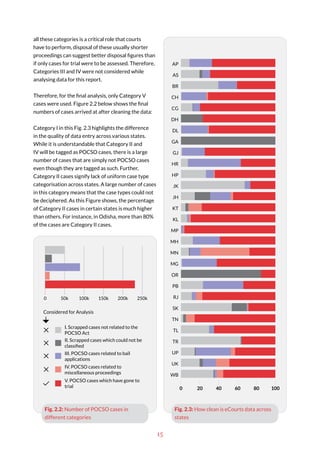
  • 19.
    3 this end, Articles1911 and 3412 of CRC mandated comprehensive state action and international collaboration to prevent child sexual abuse and exploitation. The Optional Protocol13 to the CRC on the sale of children, child prostitution and child pornography was adopted on 25 May 2000. 2000 United Nations Convention against Transnational Organized Crime14 On 15 November 2000, the United Nations Convention against Transnational Organized Crime was adopted by the UNGA as the main international instrument in the fight against transnational organized crime. The Protocol to Prevent, Suppress and Punish Trafficking in Persons Especially Women and Children,15 also adopted on the same date, supplements the Convention. 11 Convention on Rights of the Child, art 19 (adopted 20 November 1989, entered into force 2 September 1990) 1557 UNTS 3. 12 Convention on Rights of the Child, art 34 (adopted 20 November 1989, entered into force 2 September 1990) 1557 UNTS 3. 13 Optional Protocol to the Convention on the Rights of the Child on the Sale of Children, Child Prostitution and Child Pornography (adopted 25 May 2000, entered into force 18 January 2002) UNGA Res 54/263. 14 United Nations Convention against Transnational Organized Crime (adopted 15 November 2000, entered into force 25 December 2003) UNGA Res 55/25. 15 Protocol to Prevent, Suppress and Punish Trafficking in Persons Especially Women and Children, supplementing the United Nations Convention against Transnational Organized Crime (adopted 15 November 2000, entered into force 25 December 2003) UNGA Res 55/25. 16 South Asian Association for Regional Cooperation Convention on Prevention and Combating Trafficking in Women and Children against Prostitution 2002. 17 As per ¶25 of the General Comment 13, “Sexual abuse and exploitation. Sexual abuse and exploitation includes: (a) The inducement or coercion of a child to engage in any unlawful or psychologically harmful sexual activity;* (b) The use of children in commercial sexual exploitation; and (c) The use of children in audio or visual images of child sexual abuse; (d) Child prostitution, sexual slavery, sexual exploitation in travel and tourism, trafficking (within and between countries) and sale of children for sexual purposes and forced marriage. Many children experience sexual victimization which is not accompanied by physical force or restraint but which is nonetheless psychologically intrusive, exploitive and traumatic.” *“Sexual abuse comprises any sexual activities imposed by an adult on a child, against which the child is entitled to protection by criminal law. Sexual activities are also considered as abuse when committed against a child by another child, if the child offender is significantly older than the child victim or uses power, threat or other means of pressure. Sexual activities between children are not considered as sexual abuse if the children are older than the age limit defined by the State party for consensual sexual activities.” 18 UN Committee on Rights of the Child, ‘General Comment 13 – The Right of Child to Freedom from all forms of Violence’ UN Doc CRC/C/GC/13. 2002 Convention on Prevention and Combating Trafficking in Women and Children for Prostitution In 2002, South Asian Association for Regional Cooperation (SAARC) adopted the Convention on Prevention and Combating Trafficking in Women and Children for Prostitution16 to undertake collective measures against all forms of child and adolescent sexual violence. 2011 General Comment 13—The Right of the Child to Freedom from All Forms of Violence The obligation of countries under CRC, to prevent child sexual abuse, was further strengthened by the General Comment 13 published by the Committee on the Rights of the Child—the right of the child to freedom from all forms of violence. In General Comment 13, the Committee clarified the definition of sexual abuse and exploitation,17 and identified the measures that shall be adopted by the governments to address this concern.18
  • 20.
    4 II Development of aframework against child sexual abuse in India Cognisant of the importance of children in our society, the Constitution of India has incorporated several provisions to further their rights and eliminate all forms of exploitation. Chapter III of the Constitution, dedicated to Fundamental Rights, includes provisions to allow special measures for children, overarching the right to equality.19 A recent amendment has also included a provision for free and compulsory education to all children between 6 to 14 years under the Chapter III of the Constitution.20 The Chapter also includes dedicated Articles to prohibit the trafficking of humans and the employment of children in factories.21 The Constitution has further directed the government to endeavour to provide early childhood care and improve public health.22 Pursuant to this objective, India has also been a signatory to landmark international instruments on child rights and against child sexual abuse, such as the Convention on the Rights of the Child (CRC – date of accession – 11 December 1992), Optional Protocol to the Convention on the Rights of the Child on the Sale of Children, Child Prostitution and Child Pornography (CRC-OP-SC),23 and the SAARC Convention on Prevention and Combating Trafficking in Women and Children for Prostitution (signed by India on 5 January 2002). However, despite these strong constitutional and international law frameworks towards strengthening child rights, India lacked any dedicated provision against child sexual abuse till 2012. Even after independence, the criminal law failed to recognise sexual assault and exploitation of children as 19 Constitution of India 1950, art 15 (3). 20 Constitution of India 1950, art 21A introduced by the Constitution (Eighty-sixth Amendment) Act 2002. 21 Constitution of India 1950, art 23 and 24. 22 Constitution of India 1950, art 45 and 47. 23 Ratified by India on 16 August 2005. 24 Pallavi Nautiyal and Arun Mal, ‘Towards Protection of Children against Sexual Abuse: No Child’s Play’ (2010) 3 NUJS L. Rev. 77. 25 Ibid. separate offences and continued to try these cases under the generic provisions for offences affecting the human body and sexual offences. These generic provisions were vastly ill-equipped to address all the instances of sexual exploitation against children.24 While the provision against rape under the Indian Penal Code, 1860, section 375, criminalised sexual offences against women which included penile- vaginal penetration, other forms of aggravated sexual assault did not attract the provision for rape and were tried under the provisions for unnatural offences or assault to woman with intent to outrage her modesty.25 Further, these provisions failed to criminalise the instances of sexual assault and molestation of boys. The offences under IPC, intended to criminalise sexual offences against women, fell short of addressing the complexities, social impact and mental impact of sexual exploitation of children. The nature of the criminal trial under the Code for Criminal Procedure, 1973 did not account for the needs of child witnesses who were victims of sexual offences and the support they need to participate in the criminal justice process.
  • 21.
    5 In State ofPunjab v Major Singh, while addressing the appeal in a child sexual assault case where the accused was charged with section 354 of IPC, assault with the intent to outrage her modesty, the High Court of Punjab acquitted the accused holding that a girl of seven and a half months does not possess womanly modesty, and therefore, the provision does not apply to the case.26 The Supreme Court later reversed this decision.27 Over the years, several deliberations were held and recommendations were made by the Law Commission of India to overcome these shortcomings in the law to address cases related to child sexual abuse: KEY Date Law Commission Report Description 1971 42nd Law Commission Report on Indian Penal Code The report took cognisance of the lack of any provision to address the offence of indecent assault on children and noted the compulsion on the courts to apply ‘restrictive provisions’ like section 354 of IPC for instances of child sexual abuse.28 The report suggested the inclusion of a dedicated provision to penalise the offence of sexual abuse of children of all ages and sex.29 However, the report refrained from recommending the inclusion of the offence for sexual assault on a boy and stated that ‘such lascivious acts on part of women are socially not so evil as to merit a penal provision.’30 26 AIR 1963 Pun 443. 27 AIR 1967 SC 63. 28 Law Commission of India, The Indian Penal Code (Law Com No 42, 1971) ¶16.86. 29 Ibid. 30 Ibid. 31 Law Commission of India, The Indian Penal Code (Law Com No 156, 1997) ¶9.55. 32 Ibid. 33 Ibid. 34 Sakshi v Union of India (1999) 6 SCC 591. 1997 156th Law Commission Report on Indian Penal Code In the 1990s, the international law obligations under CRC catalysed the conversation for special provisions to address child sexual abuse in India. In 1997, the 156th report of the Law Commission recognised these obligations under CRC to protect children from sexual exploitation and abuse.31 However, the report opined that the existing provisions against sexual offences, i.e. offences of ‘rape’, ‘assault against women with intent to outrage their modesty’, and ‘unnatural offences’ were sufficient to address this issue and suggested a minor increase in the punishments under these provisions.32 The report further suggested that provisions related to the offence of hurt and use of criminal force, be applied to address the instances of sexual abuse against boys.33 The recommendations by the 156th fell short of addressing the issues concerning sexual assault and exploitation of children and were criticised by civil society organisations and the judiciary. On 9 August 1999, the Supreme Court, in its order, requested the Law Commission of India to reconsider its opinion based on the submission by a child and women rights organisation Sakshi regarding the application of existing provisions under the IPC to address the instances of child sexual abuse.34 2000 172nd Law Commission Report on Review of Rape Laws In 2000, in the 172nd report, the Law Commission recommended a major amendment to address the
  • 22.
    6 offence of childsexual abuse and exploitation. Key recommendations of the report included 1. An amendment to section 375 of the IPC to include all forms of forced sexual assault under the offence and widen its scope to make the provision gender-neutral.35 2. Amendments to increase the penalty in cases where near relations and persons in positions of trust and authority commit the offence of sexual assault.36 3. The insertion of the offence of unlawful sexual contact which penalised touching any part of the body of an adolescent with sexual intent and inciting, with sexual intent, adolescent persons to touch any part of the body of any person.37 4. The report also suggested changes to evidence and procedural laws to make the court proceedings more appropriate for sexual assault victims and children.38 While the Law Commission focused on strengthening and widening the existing provisions to address the offence of child sexual abuse, parallel efforts were being made to strengthen the framework for child rights in India through a dedicated legislation to penalise such offences. 35 Law Commission of India, Review of Rape Laws (Law Com No 172, 2000) ¶3.1. 36 Ibid. 37 Ibid. 38 Ibid. 39 Fredrick Norouha, ‘A Can of Worms’ Outlook (10 April 1992) <https://www.outlookindia.com/magazine/story/a-can- of-worms/201154> accessed 7 December 2022; See State of Goa v Freddy A. Peats (1992) State of Goa Sessions Case No 24/1992. 40 Goa Children’s Act 2003. 41 Dr. Savita Bhakhry, Children in India and their Rights (National Human Rights Commission, 2005) 37. 42 LS Deb, 24 July 2001, 13 series, vol XVII, p 204. 43 Oscar Fernandes and others, ‘Two Hundred Fortieth Report on The Protection of Children Against Sexual Offences Bill, 2011’ (Department-Related Parliamentary Standing Committee on Human Resource Development, 21 December 2011) ¶2.1. 44 Ibid. A Need for dedicated legislation for offences against children In the 1990s, the revelation of a child sexual abuse racket in a major tourist hub of India, Goa, shocked the public conscience and brought forth the concern regarding sexual abuse and exploitation of children.39 Concerned with such instances, in 2003, the state government of Goa enacted Goa Children’s Act to promote child rights and children’s development in the state.40 Parallelly, in 2000, the Special Expert Committee formed under the chairpersonship of Justice VR Krishna Iyer and facilitated by the India office of UNICEF presented a draft code for child rights in India, Children’s Code Bill, 2000.41 The draft aimed to incorporate the spirit of CRC into the Indian legislative framework.42 These two initiatives established the basis for dedicated legislation against child sexual abuse. In 2005, the Department of Women and Child Development, in consultation with civil society organisations, prepared the Draft Offences against Children (Protection) Bill, 2005 to address different offences targeted against children, including sexual offences.43 During discussions over this Bill, while some civil society organisations suggested incorporating these provisions under IPC, the Ministry of Home Affairs suggested that there should be separate comprehensive legislation against child abuse.44 This viewpoint was further
  • 23.
    7 strengthened by theStudy of Child Abuse, 2007 report published by the Ministry of Women and Child Development which helped the governments in identifying the gravity of this concern.45 The Study of Child Abuse covered 13 states with a sample size of 12447 children, 2324 young adults and 2449 stakeholders. It looked at different forms of child abuse: Physical Abuse, Sexual Abuse and Emotional Abuse and Girl Child Neglect in five different evidence groups, namely, children in a family environment, children in school, children at work, children on the street and children in institutions.46 The study found that 50.76 per cent of children surveyed reported having faced one or more form of sexual abuse.47 Contrary to the general perception, the overall percentage of boys reporting experiencing sexual abuse was much higher48 than that of girls. This study prompted the government to start taking steps toward creating a sound legal framework to address sexual abuse and sexual exploitation of children. B Enactment of the Protection of Children from Sexual Offences Act, 2012 In January 2010, during the discussions on the Offences against Children (Protection) Bill within the Union Government, an opinion emerged that instead of general legislation addressing different forms of abuse, the Bill should focus on the issue of sexual abuse and exploitation of children.49 Further, it was discussed that other statutes, such as the IPC and the Indian Evidence Act, should be parallelly 45 Dr. Loveleen Kacker and others, ‘Study on Child Abuse’ (Ministry of Women and Child Development, 2007). 46 Ibid. 47 Ibid (Forms of sexual abuse includes sexual assault, making the child fondle private parts, making the child exhibit or exhibiting private body parts and being photographed in the nude). 48 52.94% compared to 47.06% for girls. 75. 49 Oscar Fernandes and others, ‘Two Hundred Fortieth Report on The Protection of Children Against Sexual Offences Bill, 2011’ (Department-Related Parliamentary Standing Committee on Human Resource Development, 21 December 2011) ¶2.3. 50 Ibid. 51 Ibid. 52 Ibid. amended to prevent secondary victimisation and ensure speedy justice to children.50 As a result of these discussions, in September 2010, the Ministry of Women and Child Development, along with other ministries prepared a draft Protection of Children from Sexual Offences Bill, 2010.51 After several rounds of revisions and discussions, the Protection of Children from Sexual Offences Bill was presented in Rajya Sabha on 23 March 2011. This was followed by a series of deliberations in the Parliamentary Standing Committee52 and the discussions in both houses of the Parliament. Ultimately, on 22 May 2012, the POCSO Act was passed in the Parliament and came into force on Children’s Day, 14 November 2012. The Act created a dedicated framework to penalise sexual harassment and sexual abuse of children and provided specific sections to guide different aspects of criminal trial including recording of statements and medical examinations in cases of child sexual abuse. C The movement towards stringent punishments under the POCSO, 2012 The POCSO Act was amended in 2013 and 2018. More recently, in 2019, concerned with rising cases of sexual offences against children and in response to coming to light of certain heinous sexual crimes committed against children, the Ministry of Women and Child Development introduced an amendment to the Act to deter offenders and ensure
  • 24.
    8 safety for children.The amendment increased the minimum punishment for penetrative sexual assault from seven years imprisonment to ten years53 and aggravated penetrative sexual assault from ten years imprisonment to twenty years.54 It has also introduced the punishment of the death penalty for the offence of aggravated penetrative sexual assault.55 In addition to these changes, the amendment Act has also introduced offences for transmitting or propagating pornographic materials involving a child and failing to destroy or report such pornographic materials.56 53 Protection of Children against Sexual Offences (Amendment) Act 2019, s 3. 54 Ibid s 5. 55 Section 6(1) of the POCSO 2019. 56 Ibid s 8.
  • 25.
    9 Chapter II Studying POCSO Methodologyand Challenges Legal data on sexual crimes against children in India is largely compiled by different actors in the Indian justice delivery system. This data however, is fragmented across a plethora of locations, management systems and record-keeping systems. As a case involving child sexual abuse moves through the system, from when it first gets reported to when it is finally disposed of by the court, multiple institutions begin recording information. These institutions range from police stations, private and government hospitals, district Child Welfare Committees, Child Care Institutions (shelter homes), and judicial institutions such as courts and Juvenile Justice Boards. Other monitoring departments and agencies such as the National and State Commissions for Protection of Child Rights, the state department and central Ministry of Women and Child Development and the National Crimes Records Bureau also record aggregate statistics at their end. Since the exact stage at which the data is being recorded differs across these fora, aggregate statistics on filing and pendency maintained by these institutions are bound to vary. While examining how each of these institutions have dealt with POCSO cases is worthy of investigation and critical to how the Act has been implemented, availability of granular data continues to be a challenge.
  • 26.
    10 I Objective In November, 2022,it will be 10 years since the POCSO Act came into force. 10 years is a reasonable time period to adjudge how a legislation has been functioning and how far it is from achieving its stated objectives. To this end, the primary objective of this study is to assess the implementation of the POCSO Act since it came into being by analysing case laws, policy interventions and case metadata collected from eCourts. This study is aimed at evaluating whether the POCSO Act has achieved the purpose for which it was enacted, i.e., expeditious disposal of cases in a child-friendly justice delivery system. Since the Special Courts set up under the POCSO Act perform a critical role in the achievement of the above purpose, this study is centred around data on POCSO courts scraped from the eCourts website.57 Some of the key questions that this study aims to answer are: 1. Has the POCSO Act achieved its goal of creating a child-friendly justice delivery system? 2. If not, what have been some of the major challenges to the effective implementation of the POCSO Act in India? 3. Since 2012, how has the higher judiciary interpreted certain key provisions of the POCSO Act and any inconsistency between the POCSO Act and other legislations? 4. Have Special POCSO Courts (courts so designated under the POCSO Act) managed to 57 The eCourts Mission Mode Project, is a Pan-India Project, monitored and funded by the Department of Justice, Ministry of Law and Justice, Government of India for District Courts across the country. It was conceptualised on the basis of the “National Policy and Action Plan for Implementation of Information and Communication Technology (ICT) in the Indian Judiciary – 2005” submitted by eCommittee, Supreme Court of India with a vision to transform the Indian Judiciary through Information and Communications Technology enablement of Courts. 58 Bharti Ali and Urmi Chudgar, Unpacking Judicial Data to Track Implementation of the POCSO Act in Assam, Delhi & Haryana (HAQ: Centre for Child Rights and CivicDataLab 2021) <https://justicehub.in/dataset/5467514c- 1714-483d-8b82-2fb3984a0cf9/resource/9377bdfc-b723-4617-a74c-9ae508ebe3f3/download/> accessed 29 June 2022; Vaidehi Misra and Satishwar Kedas, ‘The Delhi Court Roster Review: A Step towards Judicial Performance Evaluations’ (2021) Vidhi Centre for Legal Policy <https://vidhilegalpolicy.in/wp-content/ uploads/2021/02/180221_DHC_upload-ready.pdf> accessed 29 June 2022; DAKSH, ‘Deciphering Judicial Data: DAKSH’s Database’ (2020) <https://www.dakshindia.org/wp-content/uploads/2020/08/Case-categorization- paper-FINAL.pdf> accessed 29 June 2022. complete POCSO trials within the statutorily prescribed period of one year? How much time do different stages in a POCSO trial take? What percentage of POCSO cases actually end in acquittal and conviction? What are the most frequently used provisions of the POCSO Act? 5. How have different states and districts fared on different parameters to evaluate the implementation of the Act? While it was possible to answer some of these questions by analysing landmark judgment passed by the higher judiciary, looking at policy interventions by the government and various government agencies, and interviewing stakeholders working on the ground, some of these questions could only be answered with data obtained from the courts. For this purpose, data available on eCourts was used for this study. The next section explains why specifically eCourts data was chosen for this study. II Why this study uses eCourts POCSO data Information available on the eCourts website is expansive and allows for both granular and aggregate data analysis. However, over the years many problems in collecting and using data from eCourts have been identified.58 These studies also put forth a compelling case for an increased access to information not just for research purposes but also to inform the system itself of its performance and to provide the private sector impetus to innovate
  • 27.
    11 solutions using detaileddata.59 While there have been attempts to bridge the data availability gap60 and publish data sets used for empirical research61 online, the efforts are few and far between. Lack of accessibility to reliable and complete judicial data continues to be a pressing problem. For legal researchers, how courts are performing to implement a relatively new special law that directly affects the rights of one of the most vulnerable sections of society, i.e., children, is an important question that deserves answering. Though judicial data related to POCSO cases has been analysed in a number of different studies, due to the difficulties associated with collecting this data, studies have remained limited to specific cities and states only. For instance, studies have focused on Andhra Pradesh,62 Maharashtra,63 Delhi,64 Karnataka,65 Haryana66 and Assam.67 This study is a first of its 59 Prashant Reddy T and others, ‘Open Courts in the Digital Age: A Prescription for an Open Data Policy’ (2019) Vidhi Centre for Legal Policy <https://vidhilegalpolicy.in/wp-content/uploads/2019/11/OpenCourts_digital16dec.pdf> accessed 29 June 2022; Sushant Sinha, ‘Indian Kanoon - The Genesis and The Legal Thirst’ (2011) Cornell University Law School <https://blog.law.cornell.edu/voxpop/2011/04/22/indian-kanoon-the-genesis-and-the-legal-thirst/> accessed 29 June 2022. 60 Justice, Access and Lowering Delays in India, ‘Judicial Vacancies in India’ (JALDI data portal, Vidhi Centre for Legal Policy 2019) <https://data.vidhilegalpolicy.in/dashboard/judicial_vacancy/index.html> accessed 29 June 2022. 61 Justice hub <https://justicehub.in/dataset?publisher_name=CivicDataLab> accessed 29 June 2022. 62 Centre for Child and the Law, National Law School of India University, Study on the Working of Special Courts Under the POCSO Act, 2012 in Andhra Pradesh (28 November, 2017) <https://ccl.nls.ac.in/publications/reports/> accessed 12 September 2022. 63 Pravin Patkar and Pooja Kandula, ‘4 Years Since POCSO: Unfolding of the POCSO Act in the State of Maharashtra’ (2016) Aarambh India <http://aarambhindia.org/wp-content/uploads/2018/05/DigitalAarambh_4-Years-Since- POCSO.pdf> accessed 29 June 2022; Centre for Child and the Law, National Law School of India University, Study on the Working of Special Courts Under the POCSO Act, 2012 in Maharashtra (7 September 2017) <https://ccl.nls.ac.in/ publications/reports/> accessed 12 September 2022. 64 Bharti Ali, Maharukh Adenwalla and Sangeeta Punekar, Implementation of the POCSO Act: Goals, Gaps and Challenges: Study of cases in Special Courts in Delhi & Mumbai (2012 - 2015) (HAQ: Centre for Child Rights and FACSE 2017) <www.haqcrc.org/publication/implementation-pocso-act/> accessed 29 June 2022; Centre for Child and the Law, National Law School of India University, Report of Study on the Working of Special Courts Under the POCSO Act, 2012 in Delhi (29 January 2016) <https://ccl.nls.ac.in/publications/reports/> accessed 12 September 2022. 65 Centre for Child and the Law, National Law School of India University, Study on the Working of Special Courts Under the POCSO Act, 2012 in Karnataka (8 August 2017) <https://ccl.nls.ac.in/publications/reports/> accessed 12 September 2022. 66 Bharti Ali and Urmi Chudgar, Unpacking Judicial Data to Track Implementation of the POCSO Act in Assam, Delhi & Haryana (HAQ: Centre for Child Rights and CivicDataLab 2021) <https://justicehub.in/dataset/5467514c-1714- 483d-8b82-2fb3984a0cf9/resource/9377bdfc-b723-4617-a74c-9ae508ebe3f3/download/> accessed 29 June 2022. 67 Bharti Ali and Urmi Chudgar, Unpacking Judicial Data to Track Implementation of the POCSO Act in Assam, Delhi & Haryana (HAQ: Centre for Child Rights and CivicDataLab 2021) <https://justicehub.in/dataset/5467514c-1714- 483d-8b82-2fb3984a0cf9/resource/9377bdfc-b723-4617-a74c-9ae508ebe3f3/download/> accessed 29 June 2022; Centre for Child and the Law, National Law School of India University, Study on the Working of Special Courts Under the POCSO Act, 2012 in Assam (13 February 2017) <https://ccl.nls.ac.in/publications/reports/> accessed 12 September 2022. kind in terms of the sheer volume of eCourts data analysed and is by far the largest study of eCourts data pertaining to the POCSO Act. III Scope For the purpose of this study, eCourts data from 486 districts spanning 28 states and Union Territories has been collected and analysed for the period 2012 to February, 2021. Secondary data in the form of judicial decisions and policy interventions from across the country has also been analysed with 30-06-2022 being the cut-off date for these two aspects.
  • 28.
    12 IV Methodology A Analysis of caselaw To understand how courts, particularly the higher judiciary, have interpreted the provisions of the POCSO Act in order to improve its implementation, an extensive study of judgments has been undertaken. The literature review and interviews with stakeholders in the child protection system helped the researchers arrive at a list of important issues that have a bearing on the creation of a child-friendly justice delivery system. Thereafter, case-laws were studied to understand the judiciary’s stance on the issues identified. B Analysis of policy interventions While courts play a crucial role in the implementation of the POCSO Act, there are plenty of institutions in the child protection system that are required to work together to make the system work for children. In this context, Rules and guidelines framed by various government departments (especially the Central Ministry and State Departments of Women and Child Development and the State Police Departments) become important. Statutory bodies like the National and State Commission for Protection of Child Rights (NCPCR and SCPCRs) have also taken steps to make the enforcement of the POCSO Act more child-friendly. These interventions have been collated by surveying the websites of the NCPCR and SCPCRs and using keyword search on Google search to identify policy interventions for specific issues. C Interviews In order to supplement the information gathered through secondary research and to understand how the POCSO Act is being implemented on the ground, the researchers conducted structured interviews with multiple stakeholders in the child protection system. Questionnaires were prepared and circulated to the interviewees beforehand and the interviews were conducted online. Questions ranged from asking the stakeholders about their role in the child protection system, the challenges faced, the kind of training received and their suggestions for improving the system. Questions were also tailored in order to get a holistic understanding of the child protection system and understand the problems it is grappling with. Information gathered through these interviews is used at different points in the report to supplement the findings from other sources. Some of the suggestions for improvement feature in the recommendations chapter of this report. D Judgment Analysis The dataset for this study comprised nearly 4,00,000 cases, out of which about 1,20,000 cases were disposed of. Since it was not possible to read all the judgments, a small sample was read and analysed to obtain deeper insights into the outcomes of POCSO cases. Not all disposed cases in eCourts have PDFs of the judgments attached to them. For this analysis, 20 judgment/final order PDFs from disposed cases (for which these were available) from each state were randomly sampled. The judgments were read after dropping cases where the documents were not intelligible or where they were in languages unfamiliar to the researchers. As a result of this exercise, a total of 138 judgments that were written in English and Hindi were read and analysed. The following table shows the number of judgments analysed from each state.
  • 29.
    13 E Data Analysis 1. Datacollection The eCourts website allows a user to search its database by identifying a specific legislation. By using this feature, data was specifically downloaded for cases where the associated legislation had been identified as POCSO. In total, 399664 cases had been tagged with POCSO as the parent legislation during the period between November, 2012 and February, 2021. This system of data collection has some limitations. Most notably, in the unfortunate event that data entry operators failed to tag a POCSO case with the legislation, such a case would be omitted from our dataset. If, however, the tag is misspelt or mistyped, we are able to include the case. While one would assume that the name of a legislation would be uniform throughout all district court websites, 688 variants of the legislation’s name were found. For instance, apart from the expected variants such as POCSO and Protection of Children from Sexual Offences Act, 2012, the name of the legislation had also been identified as “POSCO”, “prohibition of sexual abuse”, “protection of child rights”, etc. A variety of methods, both manual and automatic, were used to identify the relevant variations of the Act name. First, a keyword list including words like ‘child’, ‘sexual’, ‘POCSO’, etc was made. The first keyword - ‘child’, introduces a list of false positives since it would filter variations of other Acts like Child Labour (Prohibition and Regulation) Act, 1986. In order to clean this list, negative keywords like ‘labour’ were introduced. Consequently, Act names which had the keywords from the initial list but did not include the word ‘labour’ were removed. Using the positive and negative keyword lists, a collection of Act names was arrived at, which served as the basis for the data scraping. The list was manually perused to identify other misspellings which might have been missed. While going through the eCourts websites for different districts and manually looking into the Act names, additional variations were manually added to the final list of all versions of the POCSO Act name. In situations where a case had been classified under multiple legislations such as the POCSO Act and the Scheduled Caste and Scheduled Tribe (Prevention of Atrocities) Act, 1989, the case continued to be included within the present dataset. Using this method, data was collected from 486 district courts. 12 7 11 5 3 4 2 2 3 4 6 4 7 8 4 6 7 4 5 6 9 1 4 6 8 138 Assam Andhra Pradesh Bihar Chandigarh Dadra & Nagar Haveli Delhi Gujarat Haryana Himachal Pradesh Jharkhand Kerala Madhya Pradesh Maharashtra Manipur Meghalaya Odisha Punjab Rajasthan Sikkim Tamil Nadu Telangana Tripura Uttar Pradesh Uttarakhand West Bengal Total Fig. 2.1: Number of judgments analysed per state
  • 30.
    14 2. Data cleaning Theextracted data was not immediately usable because a preliminary glance at the data revealed several concerning irregularities. A significant number of cases (on the basis of their case type) seemed completely unrelated to the POCSO Act. To determine if the cases extracted were in fact cases related to the POCSO Act, verification based on case categorisation was done. The verification was aimed at determining if the ‘case type’ did indeed pertain to the POCSO Act. The following process was followed in order to clean the data: Different Excel sheets were created for all the states with the district names, the case type name and the count for how frequently a particular case type occurred in that district. From these, only ‘case types’ explicitly pertaining to cases under the POCSO Act were retained. Therefore, where the case type mentioned some variation of the POCSO Act or was a Sessions Case,68 the decision to include them in the dataset was fairly obvious. Since the case types used across the country are very diverse, when there was confusion about whether a particular case type corresponds to a POCSO case or not, the researchers spoke with advocates from the respective jurisdictions to identify what a particular case type meant and used that information in order to include or exclude certain case types. For instance, it was found that the case type ‘Spl Case’ in Maharashtra would refer to a special legislation like the POCSO Act and was thus included. Similarly, ‘S.C.C.’ refers to Summary Criminal Cases and since POCSO cases cannot be summarily tried, these entries were excluded. For jurisdictions that the researchers could not identify practising lawyers for, a sampling exercise was undertaken for a set of 10 random cases corresponding to a particular case type and district. The researchers looked at the designation of the 68 The Protection of Children from Sexual Offences Act 2012, s 28. A Court of Session is designated as a Special Court to try the offences under the Act. 69 Some examples of such case types are: CMC, U.i. Case, Vio.Misc.case, J.g.r, and 1 C.c. judges in these cases as well as perused the orders passed in order to determine if the case type was indeed one related to the POCSO Act. For example, ‘Misc Case’ and ‘Police Case PS’ were categories of cases before the Chief Metropolitan Magistrate and the orders showed that the cases did not relate to the POCSO Act. Therefore, these cases were excluded from the dataset. Despite following this approach, there were some case types (such as ‘Review Case’, ‘Complaint Case (summon Trial)’, ‘U.i - U.I CASES’, ‘3CCC’ etc.) that could not be categorised. These cases did not have an identifiable case category (either because the case type column was blank or because it could not be categorised by the researchers due to lack of information (such as many categories in Odisha69 )). These rows were put in Category II and excluded from the dataset. Further, case types such as ‘Negotiable Instruments Act’, ‘Civil Suit’, ‘Public Premises Case’, ‘Traffic Cases’ (that were clearly not related to the POCSO Act) were removed from the dataset. These cases were identified as Category I. While it is possible that a data entry operator might have misclassified a POCSO case as a Negotiable Instruments case, a case-by-case assessment of all the possibly misclassified cases was not feasible given the large volume of the dataset. Therefore, it was assumed that these cases were not POCSO cases. The results of this exercise found that around 12.7% of cases (i.e., 50737 cases) extracted from the eCourts website (with POCSO as the corollary legislation) could not, with certainty, be classified as cases filed under the POCSO Act. While the rest of the cases were related to the POCSO Act, they included within their ambit all kinds of cases (such as those concerning bail proceedings (Category III), other miscellaneous proceedings (Category IV) and cases that have gone through or are going through trial). While disposing
  • 31.
    15 all these categoriesis a critical role that courts have to perform, disposal of these usually shorter proceedings can suggest better disposal figures than if only cases for trial were to be assessed. Therefore, Categories III and IV were not considered while analysing data for this report. Therefore, for the final analysis, only Category V cases were used. Figure 2.2 below shows the final numbers of cases arrived at after cleaning the data: Category I in this Fig. 2.3 highlights the difference in the quality of data entry across various states. While it is understandable that Category II and IV will be tagged as POCSO cases, there is a large number of cases that are simply not POCSO cases even though they are tagged as such. Further, Category II cases signify lack of uniform case type categorisation across states. A large number of cases in this category means that the case types could not be deciphered. As this Figure shows, the percentage of Category II cases in certain states is much higher than others. For instance, in Odisha, more than 80% of the cases are Category II cases. 0 50k 100k 150k 200k 250k Considered for Analysis I. Scrapped cases not related to the POCSO Act II. Scrapped cases which could not be classified III. POCSO cases related to bail applications IV. POCSO cases related to miscellaneous proceedings V. POCSO cases which have gone to trial Fig. 2.3: How clean is eCourts data across states Fig. 2.2: Number of POCSO cases in different categories 0 20 40 60 80 100 WB UK UP TR TL TN SK RJ PB OR MG MN MH MP KL KT JH JK HP HR GJ GA DL DH CG CH BR AS AP
  • 32.
    16 IV Challenges of dealingwith data A Missing districts Out of 68870 district courts in India, 202 district courts do not form a part of the dataset for this study. This is because the data was collected from eCourts using the ‘Act name’ option and certain variations of the POCSO Act (found in some districts) might have been missed. Since there were many ways the Act name of POCSO is recorded, a list of possible variations was created (explained in detail in the Data Collection section of this Chapter) in order to identify the relevant variations of the Act name. Using the list of possible variations, a list of districts and courts where the case data was scraped from was arrived at. It is important to note that if a variation of the Act name that was being used in a particular district was not identified by the above-mentioned exercise, the consequence would be missing all the cases from that particular district. For instance, if the Act name was mis-recorded as something other than the list of variations used by the researchers, that would lead to the researchers missing all the cases from that district. Apart from the above, another reason for missing districts is that sometimes, due to an error, the API (Application Programming Interface) returned ‘null’. In order to not miss cases due to this error, the same URL was scraped three times at irregular intervals. If it returned ‘null’ in all three instances, it was assumed that we had no data from there. However, this is a potential step where some cases (and potentially districts) would have been missed out. Fig. 2.4 shows the districts that have been considered for analysis for this study. The districts in red have been covered for the purpose of this 70 District Courts Portal (e-Committee, Supreme Court of India) <https://ecommitteesci.gov.in/service/district-courts- portal/#:~:text=Information%20pertaining%20to%20each%20District,to%20688%20District%20Court%20 websites> accessed 29 June 2022. 71 In India, Union Territories are areas administered by the President through an Administrator appointed by her. study while the ones in grey are districts that the researchers do not have data for. B Missing states in interstate comparisons The availability of district-level identifiers for the cases enabled the research team to make comparisons for different parts of India. The lack of coverage for all districts and all years however, required the research team to draw inferences cautiously. To ensure that the data was representative at the level of states, it was decided that when making interstate comparisons, only states for which data was available for at least 70% of the districts would be included. Consequently, visualisations with interstate comparisons contain data for 21 states and Union Territories. States and Union Territories that were excluded are: Dadra and Nagar Haveli at Silvassa, Jammu and Kashmir, Madhya Pradesh, Manipur, Meghalaya, Orissa, and Telangana. For the bulk of the analysis however, the full sample of 486 districts is retained. The researchers recognise that the challenges that different states face are bound to vary and variations in population, both quantitatively and qualitatively, can be a contributing factor to making these challenges more complex. Therefore, for the purpose of analysis, states have been clubbed into three categories: large and mid-sized states (with a population greater than 10 million); small states (with a population less than 10 million); and Union Territories.71 C Minor mismatches in the case numbers The case data has some mistakes in different columns (attributes) due to which they might not have been considered for certain computations
  • 33.
    17 and graphs. Someof the issues which have led the researchers to drop a given case are as follows: Null data or errors in the date format for the date of filing or date of decision: When considering cases and grouping them by filing date or date of disposal, for instance, such cases would be dropped. However, these cases would not be dropped when counting the total number of POCSO cases in a given district, for instance. Pre 2012 filing dates: Some cases categorised as POCSO have filing dates before 2012 i.e., before the enactment of the POCSO legislation. These cases have therefore been dropped from the analysis. Date of decision is prior to date of filing: Consequently, when computing the case length, these cases have a negative length. Since these are only a handful of cases and do not change the mean values of the statistics of interest, these have been deleted from the computations regarding case length. Fig. 2.4: Districts considered for analysis in this study Districts covered by analysis Districts excluded from statewise analysis Districts not included in this study
  • 34.
    18 For the purposeof this study, here are some key figures to take note of: 399664 Total number of cases scraped 486 Total number of district courts covered 28 Total number of states and Union Territories covered 230730 Total number of cases considered for metadata analysis
  • 35.
    19 Chapter III Interpretation ofPOCSO Developments and Issues In the Chapter on legislative history, the researchers have tracked how the POCSO Act came into being and how the legislation itself has evolved with amendments. Before looking at the findings from data, it is important to understand the context that the Act is working in. An important part of understanding this context is to see how legal issues arising from different provisions of the Act have been adjudicated. It is the judiciary that ultimately interprets a law and this role it performs assumes critical importance when a new law is enacted. Often, the enactment of a new legislation brings to fore certain questions that need to be judicially determined to provide greater clarity to the meaning. The objective of this Chapter is to examine how courts (particularly the higher judiciary) have interpreted the legislation while deciding some difficult legal and factual questions. The purpose of this Chapter is not to exhaustively trace the development of jurisprudence pertaining to the POCSO Act but to shed light on the approach adopted by the judiciary with regard to some key issues that have arisen since the Act came into force.
  • 36.
    20 I Definition of a“child” under section 2(1)(d) of the POCSO Act Context In the year 2000, the Juvenile Justice (Care and Protection of Children) Act, 2000 was enacted. This Act defined a ‘juvenile’ or ‘child’ as ‘a person who has not completed eighteenth year of age.’72 Section 2(1)(d) of the POCSO Act, 2012 adopted the same approach while defining a child as ‘any person below the age of eighteen years’. However, an important issue that arose soon after the implementation of the POCSO Act concerned the scope of this definition. Did age as referred to in this provision mean biological age or mental age? This issue becomes important because there are several cases where even though the victims are biologically above the age of 18 years, their mental age73 is below 18. Since the POCSO Act provides greater safeguards for children by prescribing a child-friendly procedure for trial, it can offer greater protection to persons who are mentally challenged or suffer from severe intellectual disability. Thus, it fell to the courts to decide whether a person who has crossed the biological (and not mental) age of 18 years could also be included within the holistic conception of the term ‘child’ under the POCSO Act. Important Judgments In a crucial case74 at the Supreme Court, it was argued by the appellants that the definition of a child should be interpreted to include within its scope the mental age of any person below the age of 18 years or the age determined by the prevalent science pertaining to psychiatry. The case concerned a sexual 72 Juvenile Justice (Care and Protection of Children) Act 2000, s 2(k). 73 ‘Mental Age’, APA Dictionary of Psychology (APA) <https://dictionary.apa.org/mental-age> accessed 16 June 2022. 74 Eera v State (NCT of Delhi) (2017) 15 SCC 133. assault victim whose biological age was 38 years but whose mental age was six because she had been suffering from cerebral palsy since her birth. A division bench of Justice Dipak Misra and Justice Rohinton Fali Nariman held that it would be doing violence both to the intent and language of the Parliament if the word ‘mental’ is read within the definition of a child under the POCSO Act. According to the Apex Court, the legislature never intended to include the concept of mental age while determining the age of a child for the purpose of the POCSO Act and doing so would amount to encroaching upon the function of the legislature. The court observed that judges could not assume a ‘creative constructionist personality’ when the provision in question was clear and unambiguous. Present Position of Law Therefore, the current position of law is to consider merely the biological age of the victim to determine whether they fall within the definition of a child under section 2(1)(d) of the POCSO Act. II Placing reliance on the sole testimony of the victim to convict Context Like other sexual crimes, in POCSO cases too, the possibility of having eyewitnesses is extremely rare. Usually, the child victim is also the sole witness to the crime. In such cases, an important issue that arises is whether courts can rely on the sole testimony of the child victim in order to convict the accused. Since victims in POCSO cases can be very young children, and since evidence is often recorded after
  • 37.
    21 a considerable lapseof time,75 there can be minor inconsistencies in the statement of the victims. Therefore, courts have to carefully balance the victim’s right to justice with the accused’s right to a fair trial. The law in India does not debar the testimony of any witness on account of age. According to Section 118 of the Indian Evidence Act, 1872 all persons shall be competent to testify unless the court considers that they cannot understand the questions put to them, or give rational answers to those questions, by reason of tender age, extreme old age, disease, whether of body or mind, or any other cause of the same kind. Thus, the qualifying criteria is not the age of the child but rather his abilities to understand questions and form rational answers. However, every testimony has two facets— admissibility and credibility, and while child witnesses are competent witnesses, their evidence has historically been taken with a pinch of salt by the judiciary. The Privy Council in Mohamed Sugal Esa v The King76 opined that it is “a sound rule in practice not to act on the uncorroborated evidence of a child. But this is a rule of prudence and not of law.” Over the years, courts have moved away from this understanding and have accepted that the testimony of a child witness is not inherently untrustworthy. A catena of judgments has held that if the testimony of the child is consistent and inspires confidence, then a conviction can be based on it without the need for corroboration.77 However, a question arose as to 75 Bharti Ali, Maharukh Adenwalla and Sangeeta Punekar, Implementation of the POCSO Act: Goals, Gaps and Challenges: Study of cases in Special Courts in Delhi & Mumbai (2012 - 2015) (HAQ: Centre for Child Rights and FACSE 2017) 95 <www.haqcrc.org/publication/implementation-pocso-act/> accessed 17 June 2022. A study of the Special Court orders in Delhi showed that in only about 11% of the cases is the child’s evidence recorded within the period of 30 days from the date of cognizance. The courts also do not record the reason for delay in recording the child’s testimony as mandated under Section 35(1) of the POCSO Act 76 AIR 1946 PC 3. 77 Dattu Ramrao Sakhare and Others v. State of Maharashtra (1997) 5 SCC 341; In State of U.P. v. Krishna Master & Ors., AIR 2010 SC 3071. State of Madhya Pradesh v. Ramesh & Anr., 2011 (3) Scale 619; Tahal Singh v. Punjab AIR 1979 SC 1347. 78 Ganesan v State (2020) 10 SCC 573. 79 The Protection of Children from Sexual Offences Act 2012, s 8. 80 Janardan Pandurang Kapse v State of Maharashtra, Criminal Appeal No. 838 of 2019 (Bom H.C.) (unreported). whether conviction under the POCSO Act can be based on the sole testimony of a child victim. Important Judgments When the question of whether reliance can be placed on the sole testimony of a child victim came before the Apex Court, it held78 that considering the object and purpose of the POCSO Act, when the evidence of the prosecutrix is reliable and trustworthy, conviction will stand, even though another prosecution witness has turned hostile. In this case, the accused had been sentenced to rigorous imprisonment of three years and fined Rs. 1 lakh under section 879 of the POCSO Act by the trial court. The High Court upheld the conviction but modified the order of compensation. The accused appealed to the Supreme Court and one of the grounds of appeal was that the mother of the victim (a prosecution witness) had turned hostile and the conviction was based on the sole testimony of the victim. The Supreme Court rejected the appeal. Despite the Supreme Court’s decision, in cases where the child victim is extremely young, courts have displayed more caution while relying on their testimony. In a case80 involving a child victim aged five years, the Bombay High Court remarked that a child witness is amenable to tutoring and inducement and is often prone to telling imaginative and exaggerated stories. According to the court, child witnesses, by reason of their tender age, are pliable witnesses and hence their evidence needs to be scrutinised with extreme care and caution.
  • 38.
    22 A different approachwas adopted by the Madras High Court in a case81 involving an 11-year-old child victim. The defence had argued that no independent witness had been examined by the trial court to corroborate the evidence of the child victim. However, the High Court acknowledged that the nature of the case was such that one could not expect an eye witness or independent witness. The court found no reason to disbelieve the cogent, consistent and trustworthy evidence of the sole witness. In another case where there were some inconsistencies in the statements made by the victim, the Calcutta High Court held that the victim is the best judge of the incident and even if there are minor discrepancies in the evidence of the victim, such discrepancies cannot be held to be material contradictions that affect the credibility of the witness.82 Present Position of Law Therefore, as the law currently stands, conviction in POCSO cases can be based upon the sole testimony of the child victim as long as the victim’s evidence is reliable. III Marital rape of a minor wife and the conflict between IPC and POCSO Act Context Since the introduction of the POCSO Act, an inconsistency emerged between the provisions of the POCSO Act and the Indian Penal Code, 1860 (the IPC). While the POCSO Act criminalised sexual intercourse with a woman less than 18 years of age, 81 K. Ruban v State, Criminal Appeal No. 253 of 2021 (Mad H.C.) (22 October 2021) (unreported). 82 Prabir Bhuian v State of West Bengal, 2021 SCC OnLine Cal 3063. 83 Pravin Patkar and Pooja Kandula, ‘4 Years Since POCSO: Unfolding of the POCSO Act in the State of Maharashtra’ (2016) Aarambh India <http://aarambhindia.org/wp-content/uploads/2018/05/DigitalAarambh_4-Years-Since- POCSO.pdf> accessed 29 June 2022. 84 Independent Thought v Union of India (2017) 10 SCC 800. Exception 2 to Section 375 of the IPC carved out an exception in cases where the ‘wife’ was more than 15 years of age. Consequently, sexual intercourse by a man with his wife who was more than 15 years of age, was not rape. This was problematic because the acts falling in this exempted category would still fall within the scope of the POCSO Act. The question therefore was whether the ‘husband’ in such cases could be tried under the provisions of the POCSO Act. A 2018 report by Aarambh India Initiative83 on the implementation of POCSO in Maharashtra shows that when there are conflicting provisions in different laws, the police are often confused about the procedures to be followed. With the police being more familiar with the IPC than POCSO, this anomaly, even if an academic one, could have been potentially dangerous. Though Section 42A of the POCSO Act was very clear regarding the fact that the Act had an overriding effect in case of inconsistency with other laws, the anomaly, albeit an academic one, was disconcerting enough to merit an authoritative pronouncement by the Supreme Court of India. Important Judgments This controversy was settled by the Supreme Court in a landmark judgment in 2017.84 The issue before the apex court in this case was whether sexual intercourse between a man and his wife being a girl between 15 and 18 years of age is rape. The court read down Exception 2 to Section 375 of the IPC which carved out an exception for such cases. To harmonise the system of laws relating to children, the court required Exception 2 to Section 375 to be meaningfully read as: ‘Sexual intercourse or sexual acts by a man with his own wife, the wife not being under eighteen years of age, is not rape.’
  • 39.
    23 The court heldthat the Exception carved out in the IPC creates an unnecessary and artificial distinction between a married girl child and an unmarried girl child. This artificial distinction, it held, is arbitrary and discriminatory and is definitely not in the best interest of the girl child. The court found that the Exception was directly in conflict with the Preamble of the POCSO Act. Referring to Section 42A85 of the POCSO Act, the court held that the provisions of the POCSO Act will override the provisions of any other law (including the IPC) to the extent of any inconsistency. Referring to the age of consent, the court observed that the age of consent for sexual intercourse is definitively 18 years and under no circumstance can a child below 18 years of age give consent, express or implied, for sexual intercourse.86 It recognised that statutes concerning the rights of children are special laws concerning a special subject of legislation and the provisions of such subject-specific legislations must prevail and take precedence over the provisions of a general law such as the IPC.87 This position of law, as laid down by the Supreme Court, was applied by Madhya Pradesh High Court in Ajay Jatav v State of Madhya Pradesh88 wherein it held that physical relationship with a minor is rape since age of the minor ‘wife’ under Exception 2 of Section 375 has to be read as 18 years. Present Position of Law Therefore, as the law currently stands, sexual intercourse by a man with his ‘wife’ who is below 18 85 The Protection of Children from Sexual Offences Act 2012, s 42A: The provisions of this Act shall be in addition to and not in derogation of the provisions of any other law for the time being in force and, in case of any inconsistency, the provisions of this Act shall have overriding effect on the provisions of any such law to the extent of the inconsistency. 86 Independent Thought v Union of India (2017) 10 SCC 800, ¶77. 87 Ibid. 88 2021 SCC OnLine MP 1776. 89 Laasya Shekhar, ‘Naming and shaming victims for ratings: What ails the Tamil media in reporting on rape and crime?’ Newslaundary (1 October 2021) <www.newslaundry.com/2021/10/01/naming-and-shaming-victims-for-ratings- what-ails-the-tamil-media-in-reporting-on-rape-and-crime> accessed 17 June 22. 90 Varsha Rani, ‘Disclosing the Identity of Rape Victims & Survivors: What Does Indian Law Say?’ The Quint (16 September 2021) <https://www.thequint.com/neon/gender/indian-laws-on-disclosing-rape-survivors-victims- identity#read-more> accessed 17 June 2022. years of age would amount to an offence under the POCSO Act as well as rape under the IPC. IV Disclosure of identity of child in POCSO cases Context Section 23(2) of the POCSO Act prescribes the procedure to be followed by the media while reporting cases falling within the ambit of the Act. It provides that no reports in any media shall disclose the identity of a child including the name, address, photograph, family details, school, neighbourhood or any other particulars which may lead to disclosure of identity of the child. Further, Section 24(5) of the Act makes it the duty of the concerned police officer to ensure that the identity of the child is protected from the public media. Additionally, section 33(7) provides that the Special Court shall ensure that the identity of the child is not disclosed at any time during the course of investigation or trial. Finally, section 37 makes a provision for in camera trials in POCSO cases though the presence of the parents of the child or any other person in whom the child has trust or confidence is permitted. The purpose of these provisions is to prevent further traumatisation of the child victim. Despite this provision, there have been numerous instances when the identity of child victims has been revealed by the media89 or public figures.90 Further, sometimes courts themselves disclose the identity of a child
  • 40.
    24 by revealing thenames of the victims or their relatives in their judgments.91 Studies by CCL- NLSIU in five States of India have revealed that, in an overwhelming number of cases, Special Courts have disclosed the identity of the victims in their judgments. In Assam,92 the identity of the victim was disclosed by either naming her or her family members in 77.32% cases. In Maharashtra,93 86% judgments revealed the identity of the victim and in Andhra Pradesh, an alarming 96% of judgments compromised the identity of the victim. In small villages and tightly knit communities, where everyone tends to know everyone else, even the disclosure of the name of the relatives is sufficient to identify the victim. Important Judgments Soon after the POCSO Act came into force in 2012, the Delhi High Court passed an order94 approving guidelines for media reporting on children framed by a Committee95 constituted by it. However, these guidelines were not followed (as can be seen from the instances mentioned above). To protect the interests of child victims, the Supreme Court stepped in and pronounced a landmark ruling on the issue. In its judgment in the case of Nipun Saxena v Union of India,96 among other things, the Apex Court dealt with the issue of protection of the identity of child victims of sexual abuse. Taking note of the provisions in Sections 24(5), 33(7) and 37 of the POCSO Act, the apex court held that the disclosure of the identity of a child can only be permitted by the Special Court if it is in the best interest of the child and for no other reason. The 91 ‘Madras HC asks POCSO courts not to reveal identity of victims’ The New Indian Express (16 April 2022) <https:// www.newindianexpress.com/states/tamil-nadu/2022/apr/16/madras-hcasks-pocso-courts-not-to-reveal-identity- of-victims-2442536.html> accessed 17 June 2022. 92 Centre for Child and the Law, National Law School of India University, Implementation of the POCSO Act, 2012 by Special Courts: Challenges and Issues (National Printing Press, Bengaluru, February 2018). 93 Ibid. 94 AK Asthana v Union of India, W.P.(C) No. 7871 of 2012 (Del H.C.) (unreported). 95 Comprising of Juvenile Justice Board, Union of India, Government of NCT of Delhi, NGOs working for the welfare of children, media, Press Council of India, child rights activists, and the National Commission for Protection of Child Rights. 96 Nipun Saxena v Union of India (2019) 2 SCC 703. 97 Ibid. court also held that disclosure of a child’s name to make the child a symbol of protest would not ordinarily be considered to be in the best interest of the child. However, the court made it clear that it was neither feasible, nor desirable to define what could be considered in the “interest of the child”. Noting that it was the intention of the legislature that the identity of the victim child should not be directly or indirectly disclosed, the court also elaborated on how the media should report on cases pertaining to child sexual abuse.97 The court issued instructions to be followed by the media and the authorities while dealing with such cases. Nipun Saxena v Union of India Guidelines For the Media—The media should: 1. not sensationalise the case; 2. refrain from talking to the victim to prevent further trauma to the child; 3. not disclose any material that might lead to disclosure of the child’s identity For the Police—The police should: 1. not put FIRs relating to offences under Sections 376, 376A, 376AB, 376B, 376C, 376D, 376DA, 376DB or 376E of IPC and offences under the POCSO Act in the public domain. 2. keep all the documents in which the name of the victim is disclosed, as far as possible, in a sealed cover and replace these documents by identical documents after removing the name of the victim in
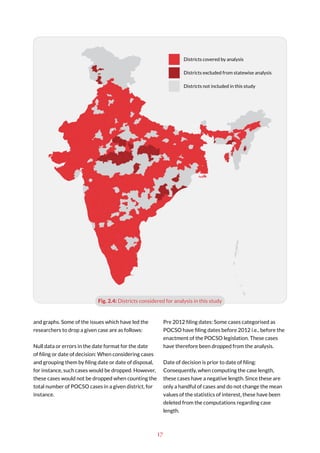
  • 41.
    25 all records likelyto be scrutinised in the public domain. For other authorities—all the authorities to which the name of the victim is disclosed by the investigating agency or the court shall: 1. keep the name and identity of the victim secret and not disclose it in any manner except in the report which should only be sent in a sealed cover to the investigating agency or the court. For the general public—No person shall: 1. print or publish in print, electronic, social media, etc. the name of the victim or even in a remote manner disclose any facts which can lead to the victim being identified and which should make her identity known to the public at large. In a recent judgment,98 the Bombay High Court remarked that despite issuance of these guidelines, the print and electronic media continue to report on these offences in such a manner that the identity of the victim is established directly or indirectly. It also issued additional directions for protecting the identity of the victim during trial, including while framing of charge, recording evidence, and recording the statement of the accused under Section 313 of the CrPC.99 The Calcutta High Court has also issued detailed instructions for the protection of victims’ identity in two significant cases. In Bijoy @ Guddu Das v State of West Bengal,100 it directed that any particulars that may reveal such identity shall not be disclosed in the judgment delivered by the Special 98 Sangita w/o Yeshwant Tanpure v State of Maharashtra, Criminal PIL No. 1 of 2016 (Bom H.C.) (unreported). 99 Criminal PIL No. 1 of 2016 (Bom H.C.) (unreported), ¶16. 100 CRA 663 of 2016. 101 CRA (DB) 29 of 2022. 102 2022 SCC OnLine SC 337. 103 No police officer shall investigate a non-cognizable case without the order of a Magistrate having power to try such case or commit the case for trial. Court unless such disclosure of identity was in the interest of the child. Recently, in Prafulla Mura v State of West Bengal,101 the court directed that pleadings and affidavits containing the victim’s name must be kept in sealed covers and only redacted copies would be released in the public domain. However, an important question concerning the interpretation of Section 23 of POCSO Act is pending before the Supreme Court. In Gangadhar Narayan Nayak v State of Karnataka,102 the issue before the Apex Court was whether Section 155(2)103 of the CrPC applies to the investigation of an offence under Section 23. The case resulted in a split verdict with Justice Indira Banerjee holding that disclosure of identity of the victim under the POCSO Act is a cognizable offence and Justice J.K. Maheshwari concluding that it is not. The matter has been placed before the Chief Justice in order to be placed before an appropriate bench. Present Position of Law Strict guidelines have been put in place by the Apex Court to ensure that the identity of a victim child is not disclosed to the public. However, the question of whether the offence under Section 23 is cognisable or not remains to be answered.
  • 42.
    26 V Applicability of themandatory reporting provision Context Section 19104 of the POCSO Act makes a provision for mandatory reporting of acts that are crimes under the POCSO Act. The provision makes it mandatory for any person who has apprehension that an offence under this Act is likely to be committed or has knowledge that such an offence has been committed to report the offence to the local police or the Special Juvenile Police Unit. This provision has been the subject of much criticism with studies finding that it makes it difficult for children to seek support for fear of registration of a police case.105 Victims of sexual abuse or their families may hesitate to approach medical professionals, including gynaecologists and psychiatrists, for fear of being drawn into a criminal case, thereby negatively impacting their right to health and medical care.106 Apart from this, mandatory reporting also has serious implications for individuals under 18 who are involved in consensual sexual relationships.107 104 S 19(1) Notwithstanding anything contained in the Code of Criminal Procedure, 1973 (2 of1974) any person (including the child), who has apprehension that an offence under this Act is likely to be committed or has knowledge that such an offence has been committed, he shall provide such information to— (a) the Special Juvenile Police Unit; or (b) the local police. 105 Bharti Ali, Maharukh Adenwalla and Sangeeta Punekar, Implementation of the POCSO Act: Goals, Gaps and Challenges: Study of cases in Special Courts in Delhi & Mumbai (2012 - 2015) (HAQ: Centre for Child Rights and FACSE 2017) 39 <https://www.haqcrc.org/publication/implementation-pocso-act/> accessed 17 June 2022. 106 Centre for Reproductive Rights, Legal Barriers to Accessing Safe Abortion Services in India: A Fact Finding Study (National Law School of India University, Bangalore, 2021) < https://reproductiverights.org/wp-content/ uploads/2021/08/Legal-Barriers-to-Accessing-Safe-Abortion-Services-in-India_Final-for-upload.pdf > accessed on 30 September 2022; Alok Prasanna Kumar, ‘Mandatory Reporting under POCSO’ Economic and Political Weekly (17 September 2022) < https://www.epw.in/journal/2022/38/law-and-society/mandatory-reporting-under-pocso. html > accessed on 30 September 2022. 107 Centre for Reproductive Rights, Legal Barriers to Accessing Safe Abortion Services in India: A Fact Finding Study (National Law School of India University, Bangalore, 2021) < https://reproductiverights.org/wp-content/ uploads/2021/08/Legal-Barriers-to-Accessing-Safe-Abortion-Services-in-India_Final-for-upload.pdf > accessed on 30 September 2022. 108 Ibid. 109 Bharti Ali, Maharukh Adenwalla and Sangeeta Punekar, Implementation of the POCSO Act: Goals, Gaps and Challenges: Study of cases in Special Courts in Delhi & Mumbai (2012 - 2015) (HAQ: Centre for Child Rights and FACSE 2017) 77 <https://www.haqcrc.org/publication/implementation-pocso-act/> accessed 17 June 2022. 110 Tessy Joseph v State of Kerala (2018) 18 SCC 292. Medical professionals and child rights activists have often raised the concern that it hinders adolescents’ access to safe and legal sexual and reproductive services, including legal abortions and contraceptives.108 Further, in cases where a case is mandatorily reported against the wish of the victim, there is a greater chance of the unwilling victim turning hostile during prosecution.109 Apart from the issues indicated above, some concerns have arisen about the applicability of the mandatory reporting provision. For instance, does ‘knowledge’ under this provision require a person to actively gain that knowledge or does the obligation to mandatorily report an offence under the Act only mean that if something comes to one’s knowledge, they are supposed to report it? Another issue is whether persons charged with failure to mandatorily report a case can be tried jointly with the person accused of actually committing the sexual offence in that case. Important Judgments Some clarity was provided on the scope of Section 19 by the Supreme Court in a case110 which dealt with the interpretation of Section 19(1) of the POCSO Act. In this case, the Supreme Court quashed the proceedings against a gynaecologist, a
  • 43.
    27 paediatrician and ahospital administrator for failing to mandatorily report rape of a victim child who gave birth in the hospital that they worked in. The victim child was brought to the hospital and immediately went into labour. The child’s age as per the hospital records was entered as 18 years even though she was a minor. The entire case set up against the appellants was on the basis that when the victim was brought to the hospital her age was recorded as 18 years. On that basis, the appellants could have gathered that at the time of conception she was less than 18 years and was, thus, a minor. Therefore, the argument was that the appellants ought to have taken due care to find how the victim became pregnant. The court held that fastening criminal liability on the basis of the aforesaid allegation was too far- fetched.111 It went on to add that the expression used in the POCSO Act is “knowledge” which means that some information received by such a person gives him/her knowledge about the commission of the crime. There is no obligation on this person to investigate and gather knowledge.112 Thus, the court clarified the scope of the mandatory reporting requirement under the Act. Another important question that arises when it comes to mandatory reporting is the stage at which a person should be tried for failure to report. The question whether a person should be tried for failure to report only after the main offence has been proved has seen a divergence of views from different High Courts. The Chhattisgarh High Court has held113 that in order to sustain a prosecution for mandatory reporting, it must first be proved beyond reasonable doubt that the primary offence of sexual assault was committed, and thus a simultaneous prosecution with the abuser would be a violation of the due process of law. It went on to say that the prosecuting agency should be circumspect in initiating prosecution under Section 21(2) of the 111 Ibid. 112 Ibid. 113 Kamal Prasad Patade v State of Chhattisgarh 2016 SCC OnLine Chh 719. 114 Balasaheb v State of Maharashtra 2017 SCC OnLine Bom 1772. POCSO Act against the head of an institution who is entitled to a reasonable time to find out the correct facts through an enquiry at the institutional level before reporting the case to the police. However, the Bombay High Court in Balasaheb Suryakant Yashwantrao Mane v State of Maharashtra114 rejected this reasoning and held that such an interpretation would defeat the object of enactment of these provisions and that the person failing to report should be tried jointly with the abuser as they were different offences committed in the course of the same transaction. A judicial determination of this issue is required by the Supreme Court to ensure some consistency in the interpretation of Section 19 by the High Courts. Present Position of Law Therefore, the current position of law on the issue of mandatory reporting is that there is no obligation on a person to investigate and gather knowledge with respect to the commission of an offence under the POCSO Act. However, with respect to whether the primary accused (accused of committing the sexual offence) and a person accused of flouting the mandatory reporting requirement can be tried together, there is a divergence in the views of different High Courts. This uncertainty needs to be addressed through a judicial pronouncement from the Supreme Court. VI Interpretation of ‘sexual assault’ under the POCSO Act Context The provisions of the POCSO Act as to what constitutes sexual assault under Section 7 have been the subject of much deliberation. This is because there is some uncertainty as to the specificity
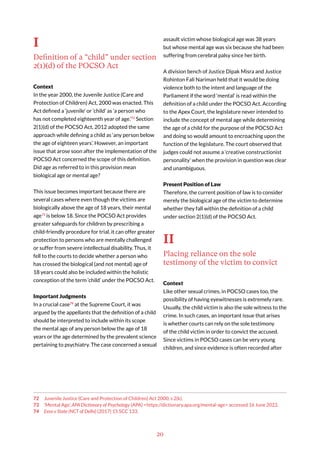
  • 44.
    28 of provisions applicableto different facts and circumstances in certain cases. The Kerala115 and Himachal Pradesh116 High Courts have held that ‘touch’ or ‘physical contact’ through the clothes of the victim would still amount to ‘sexual assault’ under Section 7 of the POCSO Act and does not, in any way, reduce the gravity of the nature of offence. However, the Bombay High Court took a diametrically opposite view in a controversial decision. In Satish Ragde v. State of Maharashtra,117 the Bombay High Court held that the act of pressing the breast of a child aged 12 years without removing her top will not fall within the definition of sexual assault under Section 7118 of the POCSO Act and instead upheld his conviction under Section 354 of the IPC, 1860. The court reasoned that Section 7 requires direct physical contact (skin to skin contact with sexual intent) and since that was absent in the present case, the accused could not be convicted under POCSO. In a similar case,119 the Bombay High Court held that acts of holding the hands of the prosecutrix or unzipping the pant of a child did not fit the definition of sexual assault under Section 7. This started a debate on whether skin to skin contact between the victim and the accused was necessary in order to constitute the offence. Important Judgments These judgments created a furore and were set aside120 by the Supreme Court on the ground that the main ingredient of the offence of sexual assault under Section 7 was ‘sexual intent’ and not ‘skin to skin’ contact. The court observed, ‘The very object of enacting the POCSO Act is to protect the children from sexual abuse, and if such a narrow 115 Geetha v State of Kerala, Criminal MC No. 1237 of 2020 (Ker H.C.) (4 May 2020) (unreported). 116 Jagar Singh v State of Himachal Pradesh, Criminal Miscellaneous Petition No. 1112 of 2014 (H.P. H.C.) (24 September 2014) (unreported). 117 Satish v State of Maharashtra, 2021 SCC OnLine Bom 72. 118 Whoever, with sexual intent touches the vagina, penis, anus or breast of the child or makes the child touch the vagina, penis, anus or breast of such person or any other person, or does any other act with sexual intent which involves physical contact without penetration is said to commit sexual assault. 119 Libnus v State of Maharashtra, Criminal Appeal No. 445 of 2020 (Bom H.C.) (15 January 2021) (unreported). 120 Attorney General for India v Satish (2021) 4 SCC 712. 121 Ravi v State, Criminal Appeal No. 657 of 2017 (SC) (3 October 2019) (unreported). 122 Nurai Sk. @ Nurul Sk. v State of West Bengal, Criminal Appeal No. 45 of 2019 (Cal H.C.) (unreported). 123 Sri Sanju Tanti v State of Tripura, Criminal Appeal No. 19 of 2020 (Tri H.C.) (unreported). interpretation is accepted, it would lead to a very detrimental situation, frustrating the very object of the Act’. Different High Courts have had differing interpretations on the scope of Section 7 when it involved instances where the accused had held the victim’s hand. The Delhi High Court held121 that the accused holding the hand of the victim with sexual intent and involving physical contact would fall within the scope of Section 7. However, the Calcutta High Court has concluded122 that an act of dragging a minor girl’s scarf, pulling her hand and proposing marriage does not come within the purview of sexual assault or sexual harassment under the POCSO Act. Further, the Tripura High Court has gone on to hold123 that touching the hands of a minor without any intention to molest will not attract charges of sexual assault under the POCSO Act. The High Court allowed the appeal of the accused against the order of the trial court on the ground that prosecution witnesses, including the victim, had not ‘specifically stated’ that there was any intention of the accused to molest the victim. Present Position of Law Therefore, as the law currently stands, ‘sexual intent’ and not ‘skin to skin contact’ constitutes the ‘touch’ required for conviction under Section 7 of the POCSO Act. The outcome of cases under Section 7 now hinges on whether sexual intent while touching is proved or not.
  • 45.
    29 VII Applicability of thePOCSO Act to ‘consensual’ relationships between minors Context The age of consent in India is intertwined with the law surrounding child marriages. Until 2012, the age of consent as per Section 375 of the IPC was 16 years.124 By defining a child as ‘any person below the age of eighteen years’,125 the POCSO Act made any sexual activity involving a child an offence under the Act. However, this provision was inconsistent with the IPC, 1860 which pegged the age of consent at 16 years. This inconsistency was resolved with the enactment of the Criminal Law Amendment Act, 2013,126 which raised the age of consent from 16 to 18 years.127 This meant that any sexual activity involving individuals who were below the age of 18 years, irrespective of their consent, would amount to ‘statutory rape’ as per section 375 of the Indian Penal Code, 1860.128 This has resulted in one of the most controversial aspects of the POCSO Act. By rendering teenagers incapable of giving consent to sexual relationships, consensual ‘romantic relationships’ between teenagers often get criminalised. The seriousness of this issue has not escaped judicial attention. In Arhant Janardan Sunatkari v State of Maharashtra,129 the Bombay High Court observed that incidents of 124 Amita Pitre & Lakshmi Lingam, ‘Age of consent: challenges and contradictions of sexual violence laws in India’ (2020) 29 Sexual and Reproductive Health Matters. 125 The Protection of Children from Sexual Offences Act 2012, s 2(d). 126 The Criminal Law (Amendment) Act 2013. 127 When this Bill was first introduced in the Lok Sabha, the age of consent was stated to be 16, but due to protests from certain campaign groups, it was changed to 18 at the time of introducing it in the Rajya Sabha. 128 Indian Penal Code 1860, s 375. 129 Arhant Janardan Sunatkari v State of Maharashtra, 2021 SCC OnLine Bom 136. 130 Swagata Raha, ‘Report of Study on the working of Special Courts under the POCSO Act, 2012 in Delhi’ (2016) Centre for Child and the Law <https://ccl.nls.ac.in/wp-content/uploads/2017/01/specialcourtPOSCOAct2012.pdf> accessed 17 June 2022. 131 Centre for Child and the Law, National Law School of India University, Implementation of the POCSO Act, 2012 by Special Courts: Challenges and Issues (National Printing Press, Bengaluru, February 2018). 132 Ibid. 133 Ibid. consensual sex between minors have been a grey area under the law as a minor’s consent is not valid in the eyes of law. Various studies suggest that many cases filed under the Act pertain to consenting minors. For instance, a study conducted in Delhi found that 28% of the complaints reported between January, 2013 and September, 2015 were between individuals between the age group of 16-18 years.130 90% of these cases resulted in acquittal because the adolescent girl failed to testify against her sexual partner. A report by CCL-NLSIU consolidating findings regarding the implementation of the POCSO Act in five states found that the percentages of POCSO cases involving consensual relationships were 5% in the case of Karnataka, 15% in Assam, 20% in Maharashtra and approximately 21% in Andhra Pradesh.131 While the numbers may seem small, there is no denying the fact that this prevents minors from safely exhibiting and exploring their sexuality.132 The report also notes that most of the ‘romantic cases’ were filed by the family of the victim and not the victim herself, thus giving rise to the assumption that these provisions were being misused by families of adolescents to thwart relationships that they did not approve of.133 A study of rape trials in a Fast Track Court (FTC) in Lucknow found that 50% of the rape trials observed for a period of eight weeks between April, 2015 and May, 2015 were related to consensual relationships where parents opposing
  • 46.
    30 the relationship hadfiled cases for their adolescent daughter.134 Important Judgments Courts have often strictly interpreted135 the POCSO Act by holding that the consent of a minor has no value in the eyes of the law. However, over the years, they are beginning to recognise the draconian interpretations of the POCSO Act and tracing back its intent to protect innocent children from sexual offenses as opposed to a tool of abuse of the process of law to compel a person to get out of a consensual relationship or get into a ‘compromise marriage’. For instance, the Calcutta High Court136 while recognising that the consent of a minor is not a good consent in law, interpreted the term ‘penetration’ in the POCSO Act to mean a positive, unilateral act on the part of the accused and not sexual unions between two persons out of their own volition. Courts have also recognised the problems of imposing rigorous punishments prescribed under the POCSO Act137 and the need for creating legal awareness given the grey area pertaining to consensual relationships.138 The Madras High Court has provided the most definitive to what the position of law on the subject should be. In 2019,139 it recommended that the definition of ‘child’ under Section 2(d) of the POCSO Act should be 16 and not 18 years and consensual relationships after the age of 16 years should be excluded from rigorous punishments under the Act. Drawing from the 134 Neetika Vishwanath, ‘The Shifting Shape of the Rape Discourse’ (2018) 25(1) Indian Journal of Gender Studies <https://doi.org/10.1177%2F0971521517738447> accessed on 17 June 2022. 135 Peer Mohammad Ghotu Mohd. Ismail v State of Maharashtra, Criminal Appeal No. 491 of 2021 (Bom H.C.) (unreported); Rahul P.R. v State of Kerala, Criminal Miscellaneous No. 5890 of 2020 (Ker H. C.) 136 Ranjit Rajbanshi v State of W.B., 2021 SCC OnLine Cal 2470. 137 Vikramsinh Champaksinh Parmar v State of Gujarat, R/Special Criminal Application Number 765 of 2020 (Guj H.C.) (unreported). 138 Arhant Janardan Sunatkari v State of Maharashtra, 2021 SCC OnLine Bom 136; Flavia Agnes, ‘Controversy over Age of Consent’ (2013) 48 EPW 10. 139 Sabari v Inspector of Police, 2019 (3) MLJ Crl 110. 140 Criminal Code of Canada 1985, s 150.1(2.1) 141 Vijayalakshmi v State, 2021 SCC OnLine Mad 317. 142 Meera Emanual, ‘POCSO Act not intended to penalise adolescents or teenagers in romantic relationships: Madras High Court’ Bar and Bench (29 January 2021) <https://www.barandbench.com/news/litigation/pocso-act-not- intended-cover-adolescents-teenagers-romantic-relationships-madras-high-court> accessed 20 July 2021; Mahak Tanwar and Rohan Wadhwa, ‘Revisiting The Age Of Consent In India’ Live Law (30 May 2021) <https:// www.livelaw.in/columns/article-21-indian-constitution-pocso-act-2012-section-375-indian-penal-code- 174909?infinitescroll=1> accessed 20 July 2021. rationale of a Canadian law140 it recommended a suitable amendment to the effect that the age of the offender ought not to be more than five years or so than the age of the victim girl (who should be 16 years or older). In another case, a petition was filed by the alleged victim under Section 482 of the Code of Criminal Procedure, 1973, to quash the proceedings in a POCSO case pending before the trial court. The minor victim and the accused had eloped leading to a registration of the case against the boy. While quashing the criminal proceedings, the court recognised that a law to protect and render justice to victims and survivors of child abuse can also become a tool in the hands of certain sections of the society to abuse the process of law. The Madras High Court furthered its views in 2021,141 where it held that consensual teenage relationships are a part of biosocial dynamics and therefore ‘painting a criminal colour to this aspect would only serve counter-productively’ and also that ‘punishing an adolescent boy who enters into a relationship with a minor girl by treating him as an offender, was never the objective of the POCSO Act.’142 The Court thereby quashed proceedings under Section 482 of the CrPC, 1973, Section 366 of the IPC, 1860 and Section 6 of the POCSO Act, 2012.
  • 47.
    31 When dealing withbail applications of accused persons, High Courts have considered the aspect of consent. In Smti. Ephina Khonglah v State of Meghalaya,143 the Meghalaya High Court held that even though the consent of a minor has no legal validity, one cannot lose sight of the matter while a plea for bail is being considered by the court.144 While dealing with a case involving a ‘consensual’ relationship, the Delhi High Court remarked that the police’s filing of cases under the POCSO Act at the behest of the girl’s family who opposed the relationship is an unfortunate practice.145 Present position of law Even as one bench of the Madras High Court was hailed for its progressive implementation of POCSO, another Bench of the same court, in Maruthupandi v State,146 favoured a more literal interpretation of the Act and held that penalty under POCSO will be attracted irrespective of whether the relationship was consensual or not. This uncertainty can only be resolved if the Supreme Court gives a ruling on the matter or if the Parliament introduces an appropriate amendment. Till then sexual acts between minors will continue to be criminalised and any decision given will be contingent on the how a particular bench decides to interpret the law. The above discussion shows that while some controversies surrounding the interpretation of various provisions of the POCSO Act that have arisen since 2012 have been settled by judicial pronouncements, many others remain. Even within each individual issue, while certain elements have acquired some form of legal certainty, there are certain questions that still need to be settled. It is possible that some of these questions will eventually be answered by the courts. However, for a few others, legislative intervention, in the form of amendments to the law, is necessary. The last 143 B.A. No. 14 of 2021 (Meg H.C.) (unreported). 144 In Dharmander Singh v State, B.A. No. 1559 of 2020 (Del H.C.) (unreported). The Delhi High Court granted bail to the accused while taking into consideration the possibility of a reciprocal physical relationship between the accused and the minor victim. 145 Pradhuman v State, B.A. No. 2380 of 2021 (Del H.C.) (unreported). 146 CRL.A [MD] No. 209 of 2017. chapter of this report lists some recommendations in this regard.
  • 48.
    Chapter IV Examining POCSOin Action 147 Constitution of India 1950, arts 15(3), 21A, 24, 39(e), 39(f) and 45. 148 Juvenile Justice (Care and Protection of Children) Act, 2015. The Juvenile Justice Act lays down the framework for how the system should deal with children in need of care and protection as well as children who come into conflict with the law. It deals with offences committed by minors, care and protection of vulnerable children by providing for their basic needs, and rehabilitation in the best interests of children. 149 Hanif Ur Rahman v State of Bihar, Criminal Writ Jurisdiction Case No. 160 of 2021 (Pat H.C.) (unreported). Actors, Processes and Challenges The previous chapters map the legislative history of the POCSO Act and some of the jurisprudential questions that have arisen so far. The goal of this chapter is to understand the process that a POCSO case goes through in the criminal justice system and what are some of the challenges that arise in these different stages. While this report is primarily aimed at understanding how the judiciary has implemented the POCSO Act, it is important to remember that there are a multitude of actors who influence implementation and hence, the responsibility for success or failure of POCSO is not to be placed solely at the judiciary’s doorstep. The child protection system in India is a complex one. While the Indian Constitution,147 the Indian Penal Code (IPC), 1860, and the Code of Criminal Procedure (CrPC), 1973, the Commissions for Protection of Child Rights Act, 2005, all contain provisions that affect the rights of children, the system primarily lies at the cross-section of two key legislations—the Juvenile Justice (Care and Protection of Children) Act, 2015148 and the POCSO Act, 2012. The year 2022 marks ten years since the POCSO Act came into effect in India. However, the implementation of the Act has faced several challenges along the way, some of which have worsened over the years. The need for better implementation of the POCSO Act has been voiced by several High Courts149 as well as the Supreme Court. This chapter examines some of the key challenges to the implementation of the POCSO Act that the researchers identified through stakeholder interviews and secondary research. It is divided into three parts, each corresponding to the three major stages in a POCSO case identified by the researchers: pre-trial, trial and post-trial. Each part contains an overview of the processes and challenges specific to each stage. Two challenges, however, have been dealt with separately since they pertain to all the three stages: inadequate awareness about the POCSO Act (within the general public as well as actors within the criminal justice system) and the lack of training for various stakeholders involved in the implementation of the POCSO Act.
  • 49.
    33 I Pre Trial A What happensduring this stage Reporting: offence under POCSO Act may be reported to a. SJPU or local police (s. 19 POCSO Act and s.154 CrPC); b. or child helplines (Rule 4(2) POCSO Rules); by any person (including the child). Filing of First Information Report (FIR): Report is written down, read over to the informant and entered in a book by the police unit (s. 19 POCSO Act). FIR is filed and a copy is given to the informant (s. 154 CrPC). Overview of Stages and Challenges Pre trial Across Stages Trial Post trial • Delay in investigation and filing of chargesheet • Non-appointment of Support Persons for victims • Lack of Special Courts in all districts • Lack of Special Public Prosecutors for Special Courts • Non-compliance with the timelines prescribed by the Act • Inadequate awareness about the POCSO Act • Inadequate training of various stakeholders • Inadequate provision of compensation to the victims
  • 50.
    34 Recording of victim’sstatement: Ideally recorded by a woman police officer, not below the rank of sub-inspector and without uniform, in presence of a person the child trusts at the residence of the child or at a place where he usually resides or at the place of his choice (s. 24 POCSO Act and s. 161 CrPC). Statement under s. 164 of the CrPC shall be recorded by a Magistrate (s. 25 POCSO Act and s. 164 CrPC). Translators, interpreters and special educators are employed as and when required (s. 26 POCSO Act). Medical examination of the victim: The child must be taken to the nearest hospital or shelter home within 24 hours (s. 19(5) POCSO Act and Rule 4(3) (b) POCSO Rules). Victim is examined by a registered medical practitioner (woman doctor in case of girl victim) (s. 27 POCSO Act and s. 164-A CrPC), who should send a report to the police within 24 hours (Rule 6(5) POCSO Rules). Forensic samples collected must be forwarded to FSL at the earliest (Rule 4(3)(d) POCSO Rules). Production of victim before CWC: Police to report matter to CWC and Special Court within 24 hours (Section 19(6) POCSO Act). Assignment of Support Person to victim by CWC: On its assessment, CWC may assign a support person to assist the victim throughout all stages of investigation and trial (Rule 4(8) POCSO Rules). Investigation and collection of evidence: Investigation is conducted by the police to collect evidence which includes spot investigation (s. 157 CrPC), search and seizure (ss. 165 and 102 CrPC), and examination of accused and witnesses (s. 161 CrPC).
  • 51.
    35 Arrest of accused:Accused is arrested and produced before the Magistrate without unnecessary delay and within a maximum period of 24 hours from arrest (ss. 41 and 76 CrPC). Medical examination of accused: Medical examination of accused is conducted and forensic samples received therein sent to FSL (s. 53-A CrPC). Filing of chargesheet: On completion of investigation, a chargesheet is filed before Special Court within 90 days (s. 173 CrPC). Hospitals/Doctors Magistrates Child Care Institutions Child Welfare Committees Special Juvenile Police Units Police Informant Victim Stakeholders involved at this stage
  • 52.
    36 B Challenges at thePre Trial Stage a. Delay in investigation and filing of chargesheet Context As readers will see in Chapter V, the pendency of POCSO cases is very high. One of the primary reasons for this high pendency150 is the slow pace of investigation by the police and the delay in depositing samples with the Forensic Science Laboratories. The tables below show the time taken by the police for completion of investigation and for depositing samples with Forensic Science Laboratories (FSLs) as per data recorded in a Supreme Court order.151 It is evident from Fig 4.1 that investigation is completed in less than 60 days only in 35% of 150 Ramya Kannan, ‘Activists press for speedy resolution of POCSO cases’ The Hindu (20 August 2021) <https://www. thehindu.com/news/national/tamil-nadu/activists-press-for-speedy-resolution-of-pocso-cases/article36009297. ece> accessed 20 June 2022. 151 In Re, Alarming Rise in the Number of Reported Child Rape Incidents (2020) 7 SCC 108. Report submitted by Surinder S. Rathi, Registrar, Supreme Court of India. The report was filed in compliance to the order of the Supreme Court dated 01-10-2019 <https://main.sci.gov.in/supremecourt/2019/24308/24308_2019_14_1_17281_Order_01- Oct-2019.pdf> accessed on 30 September 2022. POCSO cases. For 36% of the cases, it takes more than six months just to complete the investigation. If investigation itself takes as long, the possibility Media Accused Legal Aid Authorities Victim’s Lawyer Support Person Juvenile Justice Boards Forensic Science Laboratories Fig. 4.1: Time taken during investigation stage Within 30 days 31-60 days 61-180 days 181-365 days More than one year 0 20 40 60 80 100 Time taken by police for completion of investigation Time taken by police for depositing samples with FSLs
  • 53.
    37 of the trialconcluding within one year of the date when cognizance is taken152 becomes extremely low. Further, it is concerning that in 49% of the cases, it has taken the police anywhere between 31 days to greater than one year to deposit samples with FSLs. Delay can also be attributed to the time taken by FSLs to prepare reports. There is often acute delay in submitting of reports by FSLs and courts have frequently taken them to task for its negative impact on the proceedings. An examination of 100 district court orders by Times of India revealed that some of the proceedings had been held up for more than five years solely on account of the unavailability of FSL reports.153 Officials have often cited the reason of lack of manpower for this, resulting in a prioritisation of newer cases over older ones.154 NCRB data from 2020 shows that out of the 137552 cases of crimes against children, investigation was completed for only 79297 cases, while 58186 (42%) cases were still pending investigation by the end of the year.155 A report on the state of policing and law and order in Delhi by Praja found that a total of 14378 cases of crime against children were to be investigated in Delhi as of December, 2020 out of which 56% cases were pending for investigation at 152 The Protection of Children from Sexual Offences Act 2012, s 35(2). 153 Usha Das, ‘Courting trouble…how endless wait for forensic reports is delaying justice,’ Times of India (13 December, 2021) <https://timesofindia.indiatimes.com/city/delhi/courting-trouble-how-endless-wait-for-forensic-reports-is- delaying-justice/articleshow/88244533.cms> last accessed 30 September 2022. 154 Ibid. 155 National Crime Records Bureau, ‘Crime in India 2020: Statistics,’ Vol. 1, Pg. 325 (Ministry of Home Affairs, 2020) <https://ncrb.gov.in/sites/default/files/CII%202020%20Volume%201.pdf> accessed 30 September 2022. 156 Praja, ‘State of Policing and Law & Order in Delhi November 2021’ (2021) Praja and IC Centre for Governance <https://justicehub.in/dataset/ddae969e-4278-4383-8c0f-f21b2eb29007/resource/3da4a36d-9c68-45c7-a5e1- 3d91597a1dea/download/report-on-state-of-policing-and-law-and-order-in-delhi-2021.pdf> accessed 20 June 2022. 157 Delhi Commission for Protection of Child Rights, ‘Intervention Undertaken by the POCSO Division recently’ DCPCR (29 May 2021) <https://dcpcr.delhi.gov.in/interventions-undertaken-pocso-division-recently> accessed 20 June 2022. 158 Pravin Patkar and Pooja Kandula, ‘4 Years Since POCSO: Unfolding of the POCSO Act in the State of Maharashtra’ (2016) Aarambh India 231 <http://aarambhindia.org/wp-content/uploads/2018/05/DigitalAarambh_4-Years-Since- POCSO.pdf> accessed 23 June 2022. 159 Amit Anand Choudhary, ‘SC Concerned over 46% Vacancies in Forensic Labs, Seeks Explanation from Centre, States’ Times of India (New Delhi, 24 November 2018) <https://timesofindia.indiatimes.com/india/sc-concerned- over-46-vacancies-in-fsl-seeks-explanation-from-centre-states/articleshow/66774857.cms> accessed 23 June 2022; Team Herald, ‘HC pulls up director for failing to make FSL fully operational’ Herald (Panjim, 25 September 2021) <https://www.heraldgoa.in/Goa/HC-pulls-up-director-for-failing-to-make-FSL-fully-operational/180456> accessed 23 June 2022. the end of the year. Out of the cases investigated, chargesheet was filed in only 2284 cases.156 It must be noted that the figure of 14378 cases includes all crimes against children and not just offences under the POCSO Act. Therefore, delay in investigation is a trend not just in POCSO cases but across all crimes against children. The Delhi Commission for Protection of Child Rights (DCPCR) closely monitored the stages of investigation where delays occur and sought quarterly reports from the FSL, Government of Delhi to monitor if forensic examinations were being completed on time. The DCPCR observed that while investigation was completed within three months in nearly 50% of POCSO cases, the delay occurred on part of the police in collecting these reports and filing chargesheets.157 This showcases the lack of priority accorded to POCSO cases by the police. A study in Maharashtra found that because the DNA and forensic labs are located only in some of the metropolises like Mumbai, samples under POCSO Act from across the state are sent there causing serious delay in receiving reports, leading to delay in filing of the chargesheet.158 In addition to these problems, there is a lack of adequate experts,159
  • 54.
    38 expertise160 and infrastructure161 in FSLsand in some cases, there is a lack of FSLs altogether. Therefore, apart from addressing the issue of delays162 where FSLs exist, there is a more urgent need to increase the number of and capacity at FSLs to ensure proper investigation. Interventions Seeing the dismal state of affairs, the Supreme Court directed the Chief Secretaries of all states to ensure that in all POCSO cases, the forensic science laboratories in their states send back reports promptly and without any delay.163 Further, the order directed the Director General of Police or the officer of equivalent rank of the States to constitute a Special Task Force to ensure that the investigation is properly conducted and witnesses are produced on the dates fixed before the trial courts.164 In a judgment passed in September 2020, the Kerala High Court, among other things, directed the state government to take immediate steps to fill vacancies 160 Sohini Chowdhary, ‘Forensic Science Labs need more personnel, more expertise: Supreme Court expresses concerns about delays in FSL reports’ Live Law (24 March 2022) <https://www.livelaw.in/top-stories/supreme-court-forensic- science-laboratories-personnels-expertise-heera-gold-exim-scam-194931?infinitescroll=1> accessed 23 June 2022. 161 The New Indian Express, ‘Delay by FSL affecting justice, says HC’ The New Indian Express (Bengaluru 11 February 2021) <https://www.newindianexpress.com/states/karnataka/2021/feb/11/delay-by-fsl-affecting-justice-says- hc-2262430.html> accessed 23 June 2022. The Karnataka High Court observed that the sorry state of the State FSL and the state government’s failure to provide proper facility for the FSL is affecting the criminal justice system and fundamental rights of the accused. The court directed the Home Secretary to file an affidavit detailing the filling of vacant posts in the FSL, making them operative, timeline for analysis of samples/articles sent to FSL, providing modern equipment to FSL and establishing modern regional labs or mobile labs for analysis of blood samples, etc. 162 Usha Das, ‘Delhi: Courting trouble… how endless wait for forensic reports is delaying justice’ The Times of India (New Delhi 13 December 2021) <https://timesofindia.indiatimes.com/city/delhi/courting-trouble-how-endless-wait-for- forensic-reports-is-delaying-justice/articleshow/88244533.cms> accessed 23 June 2022. 163 In Re: Alarming Rise in the Number of Reported Child Rape Incidents, (2020) 7 SCC 87. 164 Alakh Alok Srivastava v Union of India, (2018) 17 SCC 291. 165 Abhishek K.A @ Bhanu v. State of Kerala, Criminal Appeal No. 1087 of 2019 (Ker H.C.) (Unreported). 166 TNN, ‘Special police task force to speed up action in POCSO cases’ Times of India (23 March 2019) <https:// timesofindia.indiatimes.com/city/trichy/special-police-task-forces-to-speed-up-action-in-pocso-cases/ articleshow/68530111.cms> accessed 30 September and Mohit Kumar Gupta, ‘Is it alive only on paper – Special Task Force/Committee (POCSO) of Delhi Police Constituted as per Alakh Alok Srivastava Judgement’ Live law (1 April 2021) <https://www.livelaw.in/law-firms/articles/special-task-forcecommittee-pocso-delhi-police-alakh-alok- srivastava-judgement-172007> accessed on 30 September 2022. 167 Team MP, ‘LG directs cops to expedite investigation of POCSO cases,’ Millennium Post (31 may 2018) <http://www. millenniumpost.in/delhi/lg-directs-cops-to-expedite-investigation-of-pocso-cases-302337?infinitescroll=1> accessed on 30 September 2022. 168 S. Vijay Kumar, ‘Police adapt SOP to expedite probe in POCSO cases,’ The Hindu (7 December 2021) <https://www. thehindu.com/news/national/tamil-nadu/police-adopt-sop-to-expedite-probe-in-pocso-cases/article37875874. ece> accessed on 30 September 2022. in the FSLs in the state of Kerala to ensure that shortage of manpower in these laboratories does not hamper investigations and trials of POCSO cases.165 In accordance with the directions given by courts, Delhi and Trichy police have established Special Task Forces to ensure timely and proper investigation of POCSO cases.166 The Delhi Police have also taken further steps like designating Assistant Commissioner of Police or Sub-Divisional Police Officer as nodal officers for monitoring investigations and alerting the Joint Commissioner of Police (Range) and Special Commissioner of Police (Law and Order) in case investigation is not completed within 20 days.167 More recently, the Chennai Police, in collaboration with the Tamil Nadu Judicial Academy, have devised a Standard Operating Procedure for expeditious investigation of cases under POCSO.168 In December 2021, the Police Chief of the state of Kerala directed that investigating officers in the state will have the absolute right in filing the
  • 55.
    39 chargesheet, without waitingfor approval from their senior officers.169 Senior officers were directed to ensure the charge-sheets in POCSO cases are filed within 60 days.170 Directions were also issued to all district police chiefs to hold special monthly meetings to evaluate the progress in POCSO cases.171 An online analytic tool for police called ‘Investigation Tracking System for Sexual Offences’ was launched by the Ministry of Home Affairs in 2019 to monitor and track time-bound investigation on sexual assault cases.172 Present scenario In its judgment in Abhishek. K.A. @ Bhanu (mentioned above), the Kerala High Court lamented the poor implementation of the POCSO Act and issued detailed guidelines to protect the children involved in POCSO cases from the risk of secondary victimisation and to make justice delivery under the statute effective and meaningful.173 Despite these interventions by the higher judiciary, there continue to be instances174 where the accused are released on bail due to the failure of the police to file chargesheets in time. 169 G Sajith Kumar, ‘No need to wait for nod from higher-ups to file chargesheets in POCSO cases’ Mathrubhumi (11 December 2021) <https://english.mathrubhumi.com/news/kerala/pocso-cases-kerala-1.6260201> accessed 20 June 2022. 170 Ibid. 171 Ibid. 172 Press Information Bureau, ‘Sexual Cases under POCSO’ Press Information Bureau (06 December 2020) <https://pib. gov.in/Pressreleaseshare.aspx?PRID=1595252> accessed 20 June 2022. 173 Abhishek K.A @ Bhanu v State of Kerala, Criminal Appeal No. 1087 of 2019 (Ker H.C.) (Unreported). 174 The Arunachal Times, ‘Police’s failure to file chargesheets under POCSO Act leads to release of several accused’ The Arunachal Times (23 November 2021) <https://arunachaltimes.in/index.php/2021/11/23/polices-failure-to-file- chargesheets-under-pocso-act-leads-to-release-of-several-accused/> accessed 20 June 2022. 175 Protection of Children from Sexual Offences Rules, 2020, r 5(6). Provided that nothing in these rules shall prevent the child and child’s parents or guardian or other person in whom the child has trust and confidence from seeking the assistance of any person or organisation for proceedings under the Act. 176 For details about the legal responsibilities of a support person, see Protection of Children from Sexual Offences Rules, 2020, r 4(15). 177 Anuroopa Giliyal, Anjali Shivanand and Aneesha Johny, ‘Study on the Working of Special Courts under the POCSO Act, 2012 in Karnataka’ (2017) Centre For Child And The Law, National Law School Of India University <https://ccl. nls.ac.in/wp-content/uploads/2017/01/posco2012karnataka.pdf> accessed 17 June 2022. 178 Pravin Patkar and Pooja Kandula, ‘4 Years Since POCSO: Unfolding of the POCSO Act in the State of Maharashtra’ (2016) Aarambh India 20 <http://aarambhindia.org/wp-content/uploads/2018/05/DigitalAarambh_4-Years-Since- POCSO.pdf> accessed 20 June 2022. b. Non-appointment of Support Persons for victims Context A support person may be a person or organisation working in the field of child rights or child protection, or an official of a children’s home or shelter home having custody of the child, or a person employed by the District Child Protection Unit (DCPU).175 They can play a crucial role in handholding the victim through interactions with the legal system. Support persons liaise with various agencies and update families with important information in addition to responsibilities listed under the law.176 These include providing information relating to available services, compensation, judicial procedures, and potential outcomes. In addition, they also help with school admissions, moving houses etc. which are not strictly their responsibility under the Act.177 However, a study conducted in Maharashtra after four years of the implementation of the POCSO Act found that 94% of Child Welfare Committees were unaware of the provision of appointing a support person as per the POCSO Rules.178 It further found that not a single DCPU that was a part of the study
  • 56.
    40 was aware ofthe provisions under which they could be appointed as support persons under the POCSO Rules.179 A study examining the implementation of the POCSO Act in Delhi and Mumbai found that though the numbers regarding awarding of compensation under the POCSO Act were very low, these numbers increased when a support person /organisation was involved in the cases.180 However, support persons are not being appointed in most POCSO cases. The Supreme Court has noted that in 96% of POCSO cases, a support person was not provided to the victim.181 Interventions Despite the crucial role that support persons play in ensuring that the child protection system actually helps the child, targeted interventions to increase the quantity and quality of support provided have been limited. In a 2020 judgment, the Supreme Court has ruled that while drawing up the panel of support persons for a district, care should be taken to appoint persons who are dedicated to the cause of child rights and apart from academic qualifications, are oriented towards child rights and sensitive to the needs of children.182 To what extent this judgment is being followed by CWCs is difficult to ascertain in the absence of an empirical study. Present scenario In March 2022, “The Handbook for Support Persons 2021 – Assisting Child Victims of Sexual Violence”183 was released by UNICEF, and child rights NGOs Enfold Proactive Health Trust and Prerna, to help support persons understand their 179 Ibid. 180 Bharti Ali, Maharukh Adenwalla and Sangeeta Punekar, Implementation of the POCSO Act: Goals, Gaps and Challenges: Study of cases in Special Courts in Delhi & Mumbai (2012 - 2015) (HAQ: Centre for Child Rights and FACSE 2017) 123 <www.haqcrc.org/publication/implementation-pocso-act/> accessed 17 June 2022. 181 In Re, Alarming Rise in the Number of Reported Child Rape Incidents (2020) 7 SCC 108. 182 In Re, Alarming Rise in the Number of Reported Child Rape Incidents (2020) 7 SCC 87. 183 Enfold Trust, ‘Handbook for Support Persons’ (2021) Enfold Trust and Prerna <http://enfoldindia.org/wp-content/ uploads/2022/03/Handbook-for-Support-Persons-2021-Released-on-10_3_2022.pdf> accessed 20 June 2022. 184 The News Minute, ‘Handbook on support persons’ role in child sexual abuse cases released’ The News Minute (11 March 2022) <https://www.thenewsminute.com/article/handbook-support-persons-role-child-sexual-abuse-cases- released-161827> accessed 20 June 2022. 185 Government of Rajasthan, ‘Notification 28.01.2021’ <http://www.crc-hcmripa.in/wp-content/uploads/knowledge_ hub/Bal-Mitre-Yojna-2020.pdf> accessed on 30 September 2022. roles and responsibilities with respect to the POCSO Act, the child victim, the authorities, agencies, and other stakeholders.184 Such initiatives that will build capacity of support persons and enable them to provide effective support to victims in POCSO cases are the need of the hour. The Rajasthan government has introduced a scheme with respect to support persons, called the Bal Mitra Yojana. The scheme delineates the role of the support persons, the procedures for their appointment and removal, their remuneration, and the process of filing complaints against them.185 Schemes like this can go a long way in ensuring that support persons are appointed in POCSO cases.
  • 57.
    41 II 186 The Protectionof Children from Sexual Offences Act 2012, ss 35 and 35(2). A trial in a POCSO case is conducted in camera (s. 37 POCSO Act) and should, as far as possible, be disposed of by the Special Court within a period of one year from the date of taking cognizance of the offence (s. 35(2) POCSO Act). Trial A What happens during this stage186 Cognizance by Special Court: The Special Court takes cognizance of the offence (s.33(1) POCSO Act and s. 193 CrPC) Issuance of warrants: Special Court issues a warrant for the appearance of the accused (s. 204 CrPC). Supply of documents to the accused: The following documents are supplied (s. 207 CrPC): a. Police report; b. Copy of FIR; c. Record of statements of victim and witnesses; and d. Other relevant documents. Framing of charges/Discharge: After hearing submissions from both prosecution and defence, if the Special Court finds sufficient grounds to prosecute, charges are framed (s. 228 CrPC), otherwise the accused is discharged (s. 227 CrPC).
  • 58.
    42 Plea by theaccused: If accused pleads ‘guilty’ to the charges, the accused gets convicted (s. 229 CrPC). If the accused pleads ‘not guilty’, the Special Court proceeds with evidence for prosecution. Prosecution evidence including victim’s testimony: Testimony of the victim (s. 231 CrPC) is recorded. During examination-in-chief, Special Public Prosecutor and the defence counsel are required to communicate questions to be put to the child to the Special Court which shall in turn put those questions to the child (s. 33(2) POCSO Act). Evidence of the child shall be recorded within 30 days of Special Court taking cognizance of the offence and reasons for delay, if any, shall be recorded by the Special Court (s. 35(1) POCSO Act). During examination, the court must ensure a child- friendly atmosphere. No direct, aggressive, or defamatory questions can be put to the child (s. 33 POCSO Act). Child should not be exposed to the accused in any manner (s. 36 POCSO Act). Special educators, translators, and legal aid services are provided wherever required (ss. 38, 39, and 40 of POCSO Act). Victim can be examined at a place other than the court as well (s. 37 POCSO Act and s. 284 CrPC). Examination of accused: Special Court examines the accused (s. 313 CrPC). Acquittal: at this stage, if the Judge considers that there is no evidence that the accused committed the offence, the Judge shall record an order of acquittal (s. 232 CrPC).
  • 59.
    43 Defence evidence: Ifthe accused is not acquitted under s. 232 CrPC, he is called upon to enter on his defence and adduce any evidence in support thereof (s. 233 CrPC). Arguments: The Prosecutor shall sum up his case and the accused or his pleader shall be entitled to reply (s. 234 CrPC). Pronouncement of judgment: Judgment of conviction or acquittal is pronounced after oral submissions from both sides (s. 235 CrPC). Hearing on sentence (if convicted): If an accused is convicted, a sentence of imprisonment and/or fine is passed by Special Court after giving accused an opportunity to be heard (s. 235(2) CrPC). Order on compensation: Compensation, both final and interim, may be awarded to the victim irrespective of whether the trial results in conviction, acquittal, or discharge (s. 33 POCSO Act, Rules 9 and 10 of POCSO Rules and 357-A of CrPC).
  • 60.
    44 B Challenges at theTrial Stage a. Lack of Special Courts in all districts Context Section 28 of the POCSO Act provides that for the purposes of providing a speedy trial, the State Government shall, in consultation with the Chief Justice of the High Court, by notification in the Official Gazette, designate for each district, a Court of Session to be a Special Court to try the offences under the POCSO Act. 187 Alakh Alok Srivastava v Union of India (2018) 17 SCC 291. Since POCSO cases involving child victims are highly sensitive, it was hoped that Special Courts would not only provide a speedy trial, but a child-friendly atmosphere for the victims. However, even after the enactment of the POCSO Act and its coming into force in 2012, designation of Special Courts (as mandated by the Act) did not happen at the expected pace. States were lagging behind in designating these courts causing the Supreme Court to intervene. Interventions In 2018, Alakh Alok Srivastava v Union of India,187 the Supreme Court issued certain directions so that the legislative intent and the purpose of the POCSO Act are actually fructified at the ground level. It directed Child Care Institutions District Legal Service Authorities Media Support Person Juvenile Justice Boards Lawyers (Victim, Defence) Special Public Prosecutors Court Staff POCSO Special Court Judge POCSO Special Court Judge Accused Victim High Courts Stakeholders involved at this stage
  • 61.
    45 that Special Courts,as conceived under the POCSO Act, be established, if not already done. Further, High Courts were ordered to ensure that cases registered under the POCSO Act are tried and disposed of by Special Courts and the presiding officers of these courts are sensitised in the matters of child protection and psychological response. Despite this judgment, Special Courts were not designated in all districts. Expressing shock at the existing state of affairs, in 2019, the Supreme Court directed the Central and State governments to take steps for creation or assignment of dedicated courts to try POCSO cases on top priority.188 Taking note of the various issues with the implementation of the POCSO Act, the Supreme Court directed that within 60 days of its order, the Central and State governments should set up exclusive/designated POCSO courts in all districts if there were more than a 100 POCSO cases in the concerned district.189 This deadline for setting up these exclusive courts was later extended to March 1, 2020.190 Further, the Apex Court also ordered191 that in districts having more than 300 POCSO cases pending, at least two exclusive POCSO Courts shall be set up. The Apex Court directed that these courts would not try any other offence except those under the POCSO Act.192 It said that such courts would be set up under a Central scheme and be funded by the Central government.193 This fund would not only take 188 In Re: Alarming Rise in the Number of Reported Child Rape Incidents (2020) 7 SCC 87, at 108. 189 Ibid. 190 Ibid. 191 Ibid. 192 Ibid. 193 Ibid. 194 Ibid. 195 Add as a footnote in the Annexure: The Supreme Court issued special instructions for the states of Uttar Pradesh and West Bengal, the state of affairs in which the court termed “deplorable”. The court laid down the following criteria for these two states: One exclusive POCSO Court in districts with upto 300 POCSO cases pending; two exclusive POCSO Courts in districts with 301 to 600 POCSO cases pending; three exclusive POCSO Courts in districts with 601 to 1000 POCSO cases pending; and four exclusive POCSO Courts in districts with 1000 or more POCSO cases pending. 196 In Re: Alarming Rise in the Number of Reported Child Rape Incidents (2020) 7 SCC 112. 197 Department of Justice, ‘Fast track Special Courts (FTSCs)’ <https://doj.gov.in/fast-track-special-court- ftscs/#:~:text=1572.86%20Cr.-,with%20Rs.,than%201%2C02%2C000%20pending%20cases> accessed on 30 September 2022. care of the appointment of the Presiding Officer, but also the appointments of support persons, Special Public Prosecutors, court staff and infrastructure (including creation of child-friendly environment and vulnerable witnesses’ deposition rooms).194 Annexure 1195 is based on this order196 and shows for each state, the number of total districts in that state, the number of districts with greater than 100 POCSO cases and the number of Special Courts sanctioned by the Central Government. It is clear from this Figure that there is a huge disparity between different states as far as the sanctioning of Special POCSO Courts is concerned. For instance, while the required number of courts has been sanctioned for Andhra Pradesh, states like Madhya Pradesh are grossly underserved. This is when some states like Rajasthan have sanctioned Special Courts in excess of the required number. It must be noted that this is only the sanctioned strength and the researchers cannot be certain about how many Special Courts may have actually been set up with the required judges, personnel and infrastructure. Present scenario Despite these orders, POCSO courts have not been designated in all districts in the country. As of 2022, 408 POCSO courts have been set up in 28 States as part of the Government’s Fast Track Special Court’s Scheme.197 Though Section 28 of the Act merely provides for the designation of Special Courts and not setting up, the government has set up exclusive
  • 62.
    46 courts for POCSOcases in view of the high pendency figures. b. Lack of Special Public Prosecutors for Special Courts Context Setting up Special Courts and appointing trained judges by themselves cannot ensure effective implementation of the Act. Ultimately judges depend on the capability of the Special Public Prosecutors (‘SPP’s) who have to assist the court by presenting the State’s case and evidence before it. Section 32(1) of the POCSO Act provides that the State Government shall, by notification in the Official Gazette, appoint an SPP for every Special Court for conducting cases only under the provisions of this Act.198 However, according to a study of POCSO courts in Maharashtra, only 42% courts had a designated SPP assigned to attend to cases under the POCSO Act.199 A study by CCL-NLSIU found that even when SPPs were designated, they were not working exclusively on POCSO cases, thus compromising the quality of assistance rendered to victims.200 In the four States of Andhra Pradesh, 198 The Protection of Children from Sexual Offences Act 2012, ss 32(2), 32(1) and 32 (3); Criminal Procedure Code, 1973 s 2(u). Section 32(2) provides that a person shall be eligible to be appointed as a Special Public Prosecutor under section 32(1) only if he had been in practice for not less than seven years as an advocate. Section 32(3) lays down that every person appointed as a Special Public Prosecutor under this section shall be deemed to be a Public Prosecutor within the meaning of section 2(u) of the CrPC, 1973 and provisions of the CrPC shall have effect accordingly. 199 Pravin Patkar and Pooja Kandula, ‘4 Years Since POCSO: Unfolding of the POCSO Act in the State of Maharashtra’ (2016) Aarambh India 85 <http://aarambhindia.org/wp-content/uploads/2018/05/DigitalAarambh_4-Years-Since- POCSO.pdf> accessed 20 June 2022. 200 CCL-NLSIU’s Studies revealed that existing PPs or Additional PPs were specified as PPs in Andhra Pradesh, Assam, Delhi, and Maharashtra (pg. 3) In Maharashtra, by a notification dated 22 March 2013, all Public Prosecutors/ Additional Public Prosecutors appointed under Section 24(3), Code of Criminal Procedure (Cr.PC), were specified as Special Public Prosecutors for conducting cases in the Special Court designated under the POCSO Act (Karnataka report, Pg. 15) 201 Ibid. 202 Hannah M Varghese, ‘Abject Incompetence of Prosecution: Kerala High Court initiates Suo Moto Case to probe appointment of Prosecutors’ Live Law (23 September 2021) <https://www.livelaw.in/news-updates/kerala-high-suo- motu-cognizance-on-incompetence-of-prosecutors-182322> accessed 23 June 2022. 203 In Re: Alarming Rise in the Number of Reported Child Rape Incidents (2020) 7 SCC 130. 204 Giti Pratap, ‘Abject incompetence of prosecution: Kerala High Court initiates suo motu case to deal with appointment of Public Prosecutors’ Bar and Bench (27 September 2021) <https://www.barandbench.com/ news/litigation/abject-incompetence-of-prosecution-kerala-high-court-initiates-suo-motu-case-to-deal-with- appointment-of-public-prosecutors> accessed 20 June 2022. 205 In Re: Alarming Rise in the Number of Reported Child Rape Incidents (2020) 7 SCC 87. Assam, Delhi, and Maharashtra, existing PPs and Additional PPs were simply designated as SPPs through a notification.201 The issue however is not just the lack of dedicated SPPs. The quality of assistance from the prosecutors has also come under severe criticism.202 Interventions Even when Special Public Prosecutors were being appointed, it was noticed that they were also required to handle non-POCSO cases. It took the Supreme Court to reiterate that the language of Section 32 of the POCSO Act leaves no doubt that a Special Public Prosecutor under the Act should not deal with other cases.203 Last year, taking note of the ‘abject incompetence’ displayed by the prosecution in a POCSO case, the Kerala High Court initiated a suo moto case to address the issue of appointment of public prosecutors.204 Owing to the sensitive nature of POCSO cases, the Supreme Court has said that while appointing Special Public Prosecutors for a district, care should be taken to appoint persons who are dedicated to the cause of child rights and apart from academic qualifications, are oriented towards child rights and sensitive to the needs of children.205
  • 63.
    47 Present scenario In February,2020, the Prosecution Department in the state of Tamil Nadu announced the appointment of 16 Special Public Prosecutors to handle offences relating to the POCSO Act in 16 special courts across the State.206 A writ petition207 seeking appointment of Additional Public Prosecutors (APPs) for Fast Track Special Courts (including POCSO courts) is currently pending before the Delhi High Court. Noting that the ‘laudable’ objective of creating fast track courts was being hampered due to inaction by the state government in creating the requisite number of posts of APPs, the High Court observed that expeditious disposal of rape and POCSO cases was the need of the hour.208 Therefore, states are at different levels in terms of ensuring adequacy in terms of number and quality of prosecutors dealing with POCSO cases. Intervention by the Supreme Court to direct all state governments to do the needful in a time bound manner may be necessary. c. Non-compliance with the timelines prescribed by the Act Context According to Section 35 of the POCSO Act, the evidence of a child shall be recorded within a period of 30 days of the Special Court taking cognizance of the offence and reasons for delay, if any, shall be recorded by the Special Court. This provision further states that the Special Court shall complete the trial, 206 The Hindu, ‘Special public prosecutors appointed for POCSO cases’ The Hindu (20 February 2020) <https://www. thehindu.com/news/cities/chennai/special-public-prosecutors-appointed-for-pocso-cases/article30865287.ece> accessed 20 June 2022. 207 Delhi Prosecutors Welfare Association v Government of NCT of Delhi, W.P.(C) no. 2181 of 2021 (Del H.C.) (Unreported). 208 Ibid. 209 Bharti Ali, Maharukh Adenwalla and Sangeeta Punekar, Implementation of the POCSO Act: Goals, Gaps and Challenges: Study of cases in Special Courts in Delhi & Mumbai (2012 - 2015) (HAQ: Centre for Child Rights and FACSE 2017) 95 <www.haqcrc.org/publication/implementation-pocso-act/> accessed 17 June 2022. 210 Ibid. 211 Ibid. 212 Centre for Child and the Law, National Law School of India University, ‘Study on the Working of Special Courts under the POCSO Act, 2012 in Karnataka’ (2017) Centre for Child and the Law, National Law School of India University, 29 <https://ccl.nls.ac.in/wp-content/uploads/2017/01/posco2012karnataka.pdf> accessed 17 June 2022. 213 Ibid. 214 Centre for Child and the Law, National Law School of India University, Implementation of the POCSO Act, 2012 by Special Courts: Challenges and Issues (National Printing Press, Bengaluru, February 2018). as far as possible, within a period of one year from the date of taking cognizance of the offence. However, this provision is followed in its breach in a large majority of POCSO cases. A study of Special Court orders in Delhi showed that in only about 11% of the cases is the child’s evidence recorded within the period of 30 days from the date of cognizance.209 The courts also do not record the reason for delay in recording the child’s testimony as mandated under Section 35(1) of the POCSO Act.210 Further, out of 946 cases for which delay in completion of trial was computed, delay was observed in 682 cases from Delhi and Mumbai (72%).211 Another study found that except for two (4%) out of 55 cases, the time gap between the FIR and date of evidence of the child was above six months. In 33 cases (60%), the time gap was between one year and two years and 17(31%) cases within 7- 12 months.212 The study also found that a majority of cases (45 out of 62) were disposed of after completion of one year but within two years.213 As per a CCL-NLSIU study, in Maharashtra and Assam only 37% and 29% of POCSO cases respectively were disposed of within a year, while in Karnataka as many as 72% cases took more than one year to be disposed of.214 One of the repercussions of delay in disposal could be that, as years go on, the victims, who are often young children, might forget key details of the case. Long drawn proceedings may
  • 64.
    48 also require thevictim to give testimony years after the occurrence which can result in re-traumatization of the victim and disrupt their healing process. As a result, children and their families may prefer to not pursue the case. For instance, the CCL study found that in Assam, the rate of children turning hostile rose with the increasing gap between the lodging of the FIR and the recording of the evidence.215 A more recent study216 of POCSO cases in Delhi, Assam and Haryana calculated the case age data for all pending and disposed cases in the period 2012 to 23 April, 2020. It showed that 19.86% of disposed cases and 33.39% of pending cases were more than two years old (from the date of registration at CIS).217 It found that out of the cases registered in a particular year, only 15% to 25% are being disposed of in the same year as the year of registration.218 The Supreme Court’s order in In Re, Alarming Rise in the Number of Reported Child Rape Incidents219 records that 63% of POCSO cases remain pending for more than one year. Fig 4.2 shows pendency how long POCSO cases have remained pending for across the country. According to NCRB data however, 94.7% cases from the total POCSO cases pending trial at the beginning of 2020 still remained pending at the end of the year.220 Chapter V of this report shows how long it takes courts to dispose of POCSO cases. By looking at the age of cases, it proves that disposal of a large proportion of POCSO cases takes much longer than a year. 215 Ibid. 216 Bharti Ali and Urmi Chudgar, Unpacking Judicial Data to Track Implementation of the POCSO Act in Assam, Delhi & Haryana (HAQ: Centre for Child Rights and CivicDataLab 2021) <https://justicehub.in/dataset/5467514c-1714- 483d-8b82-2fb3984a0cf9/resource/9377bdfc-b723-4617-a74c-9ae508ebe3f3/download/> accessed 17 June 2022. 217 Ibid. 218 ibid. 219 In Re: Alarming Rise in the Number of Reported Child Rape Incidents (2020) 7 SCC 108. 220 National Crime Records Bureau, ‘Crime in India 2020: Statistics,’ Vol. 1, Pg. 341 (Ministry of Home Affairs, 2020) <https://ncrb.gov.in/sites/default/files/CII%202020%20Volume%201.pdf> accessed 30 September 2022. 221 Alakh Alok Srivastava v Union of India (2018) 17 SCC 291. 222 Ibid. 223 Omkar Gokhale, ‘POCSO courts should examine victims in expeditious manner: HC’ The Indian Express (8 February 2022) <https://indianexpress.com/article/cities/mumbai/pocso-courts-should-examine-victims-in-expeditious- manner-hc-7763133/> accessed 20 June 2022. Interventions In Alakh Alok Srivastava v Union of India,221 the Supreme Court ordered that instructions be issued to the Special Courts to fast track POCSO cases by not granting unnecessary adjournments and thus completing the trial in a time ­bound manner or within the specific time frame prescribed under the POCSO Act. It also requested the Chief Justices of the High Courts to constitute a Committee of three Judges to regulate and monitor the progress of the trials under the POCSO Act.222 Early this year, the Bombay High Court reiterated that the Special Courts should complete the examination of minor victims as expeditiously as possible, so that the victims do not forget the incident due to passage of time, giving advantage to the accused.223 In view of the fact that there had been no progress in the trial, the High Court ordered Fig. 4.2: Pendency of POCSO cases Less than a year 1-2 years 2-3 years 3-4 years More than 4 years 0 20 40 60 80 100 POCSO cases pending for
  • 65.
    49 the sessions judgeto file a report within two weeks to explain the delay in the conclusion of the trial and why the victim had not been examined till date.224 Present scenario As Chapter V will show, the situation has not changed much since the Supreme Court orders and POCSO cases still take a long time to be disposed of. 224 Atul Gorekhnath Ambale v State of Maharashtra, Criminal Bail Application No. 3242 of 2019 (Bom H.C.) (Unreported).
  • 66.
    50 III Post Trial A What happensduring this stage Sanctioning of compensation to victim: Compensation awarded to victim is to be paid by the State government, from the Victim Compensation Fund or any other such fund, within a period of 30 days from the receipt of order (Rule 9 POCSO Rules and s. 357-A CrPC). Special Courts are also empowered to order compensation. Disbursement of compensation to victim: If a portion of the fine is directed to be paid to the victim, then after the lapse of period of appeal, the CWC coordinates with DLSA to ensure its receipt by the victim (s. 357 CrPC and Rule 10 POCSO Rules). CWC is also responsible to take steps, such as opening of bank accounts, to ensure that the compensation amount is received by the child (Rule 10 POCSO Rules). Stakeholders involved at this stage National/State Commission for Protection of Child Rights Child Welfare Committees District Legal Service Authorities Victim & Guardian State/Central Governments Special Court
  • 67.
    51 B Challenges at thePost Trial Stage a. Inadequate compensation to the victims Context The payment of compensation to victims under the POCSO Act is a complex issue because there is often a lack of clarity on procedures for disbursing the compensation, especially in cases where the child has no family support, or resides in a childcare institution without parental support, or there is apprehension that the compensation so awarded may be misused.225 Powers to direct payment of compensation to victims arise from various provisions under the POCSO Act, 2012 and the POCSO Rules, 2020 as well as the CrPC. In the POCSO Act, Section 33(8) empowers the Special Courts to direct payment of compensation in addition to punishment, for physical or mental trauma caused to the child, or for immediate rehabilitation. Rule 9 of the POCSO Rules, 2020 details out the mechanism of when and how compensation can be granted in POCSO cases and the relevant factors that can be taken into consideration while determining the amount of compensation to be paid. Under the CrPC, the powers arise from Sections 357 and 357A. Under Section 357(1)(b), a court can direct that the whole or part of the fine imposed as part of a sentence, if recovered, be paid towards compensation for any loss or injury caused by the 225 Bharti Ali and Urmi Chudgar, Unpacking Judicial Data to Track Implementation of the POCSO Act in Assam, Delhi & Haryana (HAQ: Centre for Child Rights and CivicDataLab 2021) 122 <https://justicehub.in/dataset/5467514c- 1714-483d-8b82-2fb3984a0cf9/resource/9377bdfc-b723-4617-a74c-9ae508ebe3f3/download/> accessed 17 June 2022. 226 Assam Victim Compensation Scheme 2012, cl 4(3). 227 Andhra Pradesh Victim Compensation Scheme 2015, cl 5(d). 228 Neha Joshi, ‘POCSO case: Mumbai Court directs return of compensation after victim turns hostile mid-trial’ Bar and Bench (18 October 2021) <https://www.barandbench.com/news/litigation/pocso-case-mumbai-court-directs- return-of-compensation-after-victim-turns-hostile-mid-trial> accessed 20 June 2022. 229 State of Maharashtra v Vicky Vinod Gajabe & Others, Special Case Child Protection No. 258 of 2016 (City Civil & Sessions Court, Borivali Div). 230 Bharti Ali, Maharukh Adenwalla and Sangeeta Punekar, Implementation of the POCSO Act: Goals, Gaps and Challenges: Study of cases in Special Courts in Delhi & Mumbai (2012 - 2015) (HAQ: Centre for Child Rights and FACSE 2017) 129 <www.haqcrc.org/publication/implementation-pocso-act/> accessed 17 June 2022. offence, if such compensation could be recoverable in a Civil Court. Therefore, this section can be attracted only in the cases where the accused was convicted. Rule 9(4), POCSO Rules, 2020 states that the compensation awarded should be paid from the Victim Compensation Fund or any other government scheme for compensating and rehabilitating victims under section 357A of the CrPC or any other law for the time being in force, or, where such fund or scheme does not exist, by the State Government. Another important issue that arises when dealing with compensation is that the Victim Compensation Schemes of several States and Union Territories (like Assam226 and Andhra Pradesh227 ) require the victim to cooperate with the police and the prosecution during investigation and trial to be eligible for grant of compensation. Even though the POCSO Act and Rules do not link the payment of compensation to the child’s testimony in court, there are instances228 where return of compensation (if paid) is ordered by the trial court because the victim turned hostile mid-trial.229 No specific judicial ruling from the higher judiciary has so far resolved this conflict. A judicial determination on this issue is crucial because there can be various reasons for a victim turning hostile, including but not limited to threats and social pressure. A study analysing POCSO cases in Delhi found that information regarding victim compensation was not a part of most judgments or sentencing orders or daily orders. Further, none of the daily orders mentioned award of interim compensation.230 Another study in Karnataka found that
  • 68.
    52 compensation orders havenot been passed in Karnataka under the POCSO Act.231 A report by CCL-NLSIU that analysed POCSO judgments from five states found that compensation was generally awarded in only 5 to 10% of cases. In both Andhra Pradesh and Karnataka compensation was given232 in just approximately 3% of cases, and in Delhi and Maharashtra it was given in 5% and 9% cases respectively.233 Assam was the only exception with about 22% judgments directing compensation to the victims.234 In none of the judgments, except one judgment from Assam Special Court, was there a reference to interim compensation.235 Interventions In Nipun Saxena v Union of India,236 the Supreme Court directed that the Special Court, upon receipt of information as to commission of any offence under the Act by registration of FIR, shall on his own or on the application of the victim make an enquiry as to the immediate needs of the child for relief or rehabilitation and pass appropriate order for interim compensation. It was further held that if the court declines to grant interim or final compensation it shall record its reasons for not doing so. Finally, the Apex Court made it abundantly clear that the Special Court must mandatorily take up and consider each POCSO case for the aspect of compensation. This does not mean that compensation must be granted in every case, but the adjudication on compensation 231 Anuroopa Giliyal, Anjali Shivanand and Aneesha Johny, ‘Study on the Working of Special Courts under the POCSO Act, 2012 in Karnataka’ (2017) Centre for Child and the Law, National Law School of India University 25 <https://ccl. nls.ac.in/wp-content/uploads/2017/01/posco2012karnataka.pdf> accessed 17 June 2022. 232 Centre for Child and the Law, National Law School of India University, Implementation of the POCSO Act, 2012 by Special Courts: Challenges and Issues (National Printing Press, Bengaluru, February 2018). 233 Ibid. 234 Ibid. 235 Ibid. 236 Nipun Saxena v Union of India (2019) 2 SCC 703, ¶37. 237 National Legal Services Authority ‘NALSA’s Compensation Scheme for Women Victims/Survivors of Sexual Assault/ other Crimes - 2018’ NALSA (2018) <https://nalsa.gov.in/services/victim-compensation/nalsa-s-compensation- scheme-for-women-victims-survivors-of-sexual-assault-other-crimes---2018> accessed 20 June 2022. 238 Central Victim Compensation Fund Guidelines 2016. 239 In Re, Alarming Rise in the number of reported child rape incidents, Suo Moto (Criminal) No. 1 of 2019 (SC) (Unreported). 240 As of 22 June 2022. 241 Bharti Ali and Urmi Chudgar, Unpacking Judicial Data to Track Implementation of the POCSO Act in Assam, Delhi & Haryana (HAQ: Centre for Child Rights and CivicDataLab 2021) 201 <https://justicehub.in/dataset/5467514c- 1714-483d-8b82-2fb3984a0cf9/resource/9377bdfc-b723-4617-a74c-9ae508ebe3f3/download/> accessed 17 June 2022. must be there in every case. Further, the court said that the NALSA’s Compensation Scheme237 should function as a guideline to the Special Court for the award of compensation to victims of child sexual abuse under Rule 7 until the Rules were finalised by the Central Government. In addition to the Central Victim Compensation Fund Scheme,238 most states and union territories have framed their Victim Compensation Schemes for POCSO victims. In March, 2020, the Supreme Court had observed that on the next date of hearing, it will consider the issue of framing a national scheme for payment of compensation to victims of offences under the POCSO Act. For this purpose, it had requested the Joint Secretary of the Ministry of Women and Child Development, Government of India to remain present in Court to assist it with regard to the formulation of scheme for payment of compensation to the victims.239 However, the matter has not been heard on merits since then.240 Present scenario A more recent study of POCSO cases in Delhi, Assam and Haryana found that while final compensation may still find a mention in the sentence order, interim compensation finds no mention in any orders of the Special Courts.241 CCL-NLSIU’s study of Special Courts in Delhi found that the courts often deferred
  • 69.
    53 the decision todetermine interim compensation until after the victim’s testimony to deter the victims from turning hostile.242 In some cases, the amount of compensation to be provided under the state scheme was left to be determined by the DLSA, although the POCSO Act and Rules require the Special Courts to determine the quantum, while the role of the DLSA is limited to disbursement.243 In one case, the Special Court had explicitly limited the right of the victim to apply for further compensation in direct contravention of Rule 7(6) of the POCSO Rules.244 According to the figure available in a Supreme Court order, both final and interim compensation are only provided in 1% of cases.245 This figure is abysmal given the physical and mental trauma that victims of child sexual abuse go through and the resources that may be required for their treatment and rehabilitation. 242 Centre for Child and the Law, National Law School of India University, Report of Study on the Working of Special Courts Under the POCSO Act, 2012 in Delhi (29 January 2016) <https://ccl.nls.ac.in/publications/reports/> accessed 12 September 2022. 243 Bharti Ali and Urmi Chudgar, Unpacking Judicial Data to Track Implementation of the POCSO Act in Assam, Delhi & Haryana (HAQ: Centre for Child Rights and CivicDataLab 2021) 200 <https://justicehub.in/dataset/5467514c- 1714-483d-8b82-2fb3984a0cf9/resource/9377bdfc-b723-4617-a74c-9ae508ebe3f3/download/> accessed 17 June 2022. 244 Ibid. 245 In Re: Alarming Rise in the Number of Reported Child Rape Incidents (2020) 7 SCC 108. 246 A body under the Union Ministry of Women and Children Development. 247 National Institute of Public Cooperation and Child Development, ‘Booklets for School Children to Generate Awareness on Child Sexual Abuse (CSA)’ NIPCCD <Booklets for School Children to Generate Awareness on Child Sexual Abuse (CSA)> accessed 20 June 2022. 248 The Times of India, ‘Bhadram to spread awareness on child rights’ The Times of India (Thiruvananthapuram, 30 December 2018) <https://timesofindia.indiatimes.com/city/thiruvananthapuram/bhadram-to-spread-awareness- on-child-rights/articleshow/67305226.cms> accessed 20 June 2022. 249 The Times of India, ‘Campaign to create awareness on child sexual abuse catches the bus’ The Times of India (20 August, 2014) <https://timesofindia.indiatimes.com/city/trichy/campaign-to-create-awareness-on-child-sexual- abuse-catches-the-bus/articleshow/40438086.cms> accessed 20 June 2022. 250 The Hindu, ‘Awareness campaign on POCSO Act launched’ The Hindu (16 November 2016) <https://www.thehindu. com/news/national/andhra-pradesh/Awareness-campaign-on-POCSO-Act-launched/article16643405.ece> accessed 20 June 2022. IV Inadequate awareness about the POCSO Act Context For any new law, awareness about its existence and its content, specifically amongst the target audience, are basic requirements to ensure that the law actually achieves its objectives. In recognition of this, Section 43 in the Act provides that the Central Government and every State Government, shall take all measures to ensure that the provisions of the POCSO Act are given wide publicity through media including the television, radio and the print media at regular intervals to make the general public, children as well as their parents and guardians, aware of the provisions of this Act. Interventions In order to promote awareness on child sexual abuse among children, the National Institute of Public Cooperation and Child Development246 has prepared a set of booklets.247 Awareness programmes have been undertaken by state governments248 in collaboration with the local police249 and NGOs.250 Additionally, several Information Education
  • 70.
    54 Communication (IEC) materialson POCSO have been designed and published by various Civil Society Organizations like Arpan, Tulir, Antakshari Foundation and Kailash Satyarthi Foundation.251 In order to push the government to perform its duty under the POCSO Act, the Supreme Court specifically directed the Ministry of Women and Child Development to screen a short clip for spreading awareness on child sexual abuse in movie halls and broadcast it on television channels at regular intervals.252 The court also asked the Department to prominently display child helpline numbers to increase awareness about these helplines.253 Present scenario Despite these efforts, a 2020 study on Child Sexual Abuse Awareness and Attitudes by World Vision India found that only 35% children and 32.13% caregivers were aware about the POCSO Act. The awareness varied across urban, rural and tribal areas with tribal areas being the least aware.254 In an order passed in June 2022, the Kerala High Court remarked that the educational machinery of the state had fallen woefully short in imparting the required awareness to young children about the heinous crimes covered under the POCSO Act.255 Even though the court was dealing with a bail application, it used its powers under Article 226 of the Constitution to suo moto implead the state 251 By the Women and Child Development Department <https://wcdhry.gov.in/iec-material-pocso-jj-act/> - interactive, engaging materials like games and colourful booklets. One of the few child-centric materials; Antakshari Foundation <https://www.antaksharifoundation.org/knowledge-hub/iec-material/>; Kailash Satyarthi Children’s Foundation <https://satyarthi.org.in/brochures/>; Arpan <https://www.arpan.org.in/children-and-adolescents/> IEC materials for both adults and children; Tulir - Centre for the Prevention and Healing of Child Sexual Abuse (CPHCSA) <https:// www.tulir.org/downloads.htm> also has audiobooks. 252 In Re: Alarming Rise in the Number of Reported Child Rape Incidents (2020) 7 SCC 87. 253 Ibid. 254 World Vision India, ‘A Study on Child Sexual Abuse Awareness and Attitudes’ WVI, <https://www.lifenews.co.in/ assets/front/pdf/CSA%20Launch%20PPT%20Final%20Updated%20-wsj%20today.pdf> accessed 20 June 2022; The News Minute, ‘POCSO Act: Only 13.7% TN children aware, Bihar has almost nil awareness’ The News Minute (15 September 2020) <https://www.thenewsminute.com/article/pocso-act-only-137-tn-children-aware-bihar-has- almost-nil-awareness-133077> accessed 20 June 2022. 255 Hannah M Varghese, ‘Teens Engage In Sex Unmindful Of Drastic Consequences Under POCSO Act: Kerala High Court Calls For Awareness In School’ LiveLaw (9 June 2022) <https://www.livelaw.in/news-updates/teenage-sex- consensual-pocso-act-rape-kerala-high-court-201240> accessed 20 June 2022. 256 Anoop v State, Bail Application No. 3273 of 2022 (Ker H.C.) (unreported). government, Central Board of Secondary Education and, the Kerala State Legal Services Authority as parties with the aim of paving the way for better awareness on the POCSO Act in schools in Kerala.256 It noted that punishing the offender was only one of the purposes of the POCSO Act, prevention being the other and in order to prevent offences under the POCSO Act, awareness amongst children was essential. It becomes evident from this discussion that while attempts at spreading awareness about the POCSO Act have been made, there is still a long way to go. V Inadequate training of various stakeholders Context An examination of the roles played by the plethora of actors in the child protection system reveals the complexities involved in effectively addressing child sexual abuse in the country. Figure 4.3 maps some of the key interactions between stakeholders in a typical POCSO case. While this diagram is not comprehensive, it does show the complexity of the processes involved in a POCSO case and some of the major points of interaction between various stakeholders.
  • 71.
    55 The purpose ofthis chart is to show the myriad ways in which stakeholders interact with each other. Since the child protection system involves stakeholders interacting with each other fairly frequently, in addition to understanding their own roles and responsibilities within the system, they also need to appreciate the roles performed by the others. Training is crucial to ensure that the system functions smoothly and ensures justice for the child victims. Section 43 of the POCSO Act says that the officers of the Central Government and the State Governments and other concerned persons (including police Fig. 4.3: Examples of interactions between stakeholders in the child protection system collecting samples to send to FSLs taking victim and accused for medical examination sending samples for testing receiving report from FSL to prepare chargesheet producing victim before CWC appointment of support person sending child in need of support and protection DCPO is secretary to CWC in some states DCPU persons also act as support persons if accused is minor recording victims statement, giving evidence representing the victim provides compensation to the victim providing support to the victim during trial DCPU Govt. Hospitals FSLs Police POCSO Special Court Prosecutors District Legal Service Authority CWCs Support Persons Child Care Institutions Juvenile Justice Boards
  • 72.
    56 officers) shall beimparted periodic training on the matters relating to the implementation of the provisions of the Act. Though training is currently taking place, it is deemed inadequate by those receiving it. Different stakeholders interviewed by us highlighted the issues with the current system of training. It might be useful to first take note of these problems before trying to come up with any solutions to the issues. The table below shows the various stakeholders interviewed and the shortcomings in the training they received (as identified by them). KEY Stakeholder • Training provided by 1. Lacunae Private medical practitioners (usually the first point of contact for child victims) • No structured training provided. 1. No mandatory training provided to enable them to handle cases of child sexual abuse effectively. Government doctors • No structured training provided. 1. Not comprehensive—only very basic instructions are given about sample collection. 2. No specific training for dealing with child sexual abuse cases. 3. Absence of sensitivity training. 4. No continuing training at regular intervals to keep them updated with the latest developments. Juvenile Justice Board (JJB) members • State Department of Women and Child Development • State Police Department 257 Venkatachalam v Inspector of Police, Crimnal Appeal No. 113 of 2021 (Mad H.C.) (Unreported); Venkatachalam v Inspector of Police, Criminal Miscellaneous Petition No.r 2925 of 2021 (Mad H.C.) (Unreported). 258 Renold Mike Tyson v State, Criminal Appeal No. 93 of 2020 (Mad H.C.) (Unreported); Nupur Thapliyal, ‘Madras Hihg Court directs judicial academy to impart training to special judge, IO, prosecutors dealing with POCSO cases’ Live Law (3 July 2021) <https://www.livelaw.in/news-updates/madras-high-court-judicial-academy-training-to-special- judge-prosecutor-pocso-cases-176787> accessed 23 June 2022. 259 American Counseling Association, ‘Vicarious Trauma’ (Fact Sheet #9) <https://www.counseling.org/docs/trauma- disaster/fact-sheet-9---vicarious-trauma.pdf?sfvrsn=2> accessed 20 June 2022. • State Judicial Academy 1. Not of practical use to address day to day challenges faced. Judges • State Judicial Academy 1. Time given for training is very short. 2. Legalistic approach with little focus on sensitisation training. Special Public Prosecutors • Institute of Correctional Administration • State Judicial Academy 1. Not held at periodic intervals to enable them to stay abreast of the latest developments in law. Interventions Courts have taken note of this lack of training for key stakeholders like courts and public prosecutors. The Madras High Court in Venkatachalam v. Inspector of Police257 observed that in many cases, the Special Judges who deal with cases under POCSO Act, do not properly understand the scope and object of the POCSO Act. It ordered that before posting any Sessions Judge to the Special Court which deals with the cases under POCSO Act, they have to necessarily be sensitised and trained through the Tamil Nadu State Judicial Academy. In a subsequent judgment,258 the Madras High Court directed the State Judicial Academy to impart training to stakeholders (specifically, the Investigating Officers, Special Public Prosecutors and, Special Judges) dealing with cases under the POCSO Act. Interviews with POCSO judges have thrown light on the mental health issues that judges face due to lack of special training to deal with POCSO cases which often expose them to gruesome details. There is now serious thinking about ‘vicarious trauma’259 affecting
  • 73.
    57 judges260 and prosecutors261 involved inheinous crimes such as rape and child sexual abuse.262 Judicial academies must be adequately equipped to impart suitable training263 for judges and prosecutors to have the skills to handle these cases. The Supreme Court has also emphasised that Special Public Prosecutors need to understand the psychology of children and empathise with them. Explaining the role of Special Public Prosecutors in POCSO cases, the Apex Court said that they need to know how to bring out the truth from children who are victims of sexual abuse and have to undergo the trauma again while recounting the traumatic experience. The court acknowledged that the job assigned to the Public Prosecutor for POCSO cases is a very onerous one which must be carried out with great care and sensitivity.264 Therefore, the court recognised not only the need to have exclusive Public Prosecutors but the need to develop a training programme where these Special Public Prosecutors are trained to deal with issues which will arise in their courts, including legal, psychological, health and other related issues. Keeping in view these factors, the Supreme Court directed all the States to take steps to appoint exclusive Public Prosecutors in all POCSO courts and requested the Chief Justices of all High Courts to ensure that in the Judicial Academy of the State, special programmes are developed so that these Special Public Prosecutors attached to POCSO Courts are imparted training not only in law but also in child psychology, child behaviour, health issues etc. The Supreme Court also requested the Director of the National Judicial Academy to ensure that a 260 Debora Wood Smith, ‘Secondary and Vicarious Trauma Among Judges and Court Personnel’ (National Center for State Courts 2017) <https://ncsc.contentdm.oclc.org/digital/api/collection/hr/id/171/page/0/inline/hr_171_0> accessed 20 June 2022. 261 Amy Russel, ‘Vicarious Trauma in Child Sexual Abuse Prosecutors’ (2010) 2(6) Center Piece <https://www. zeroabuseproject.org/wp-content/uploads/2019/02/39255836-centerpiece-vol-2-issue-6.pdf> accessed 20 June 2022. 262 Peter G Jaffe and others, ‘Vicarious Trauma in Judges: the Personal Challenge of Dispensing Justice’ (2009) 54(4) Juvenile and Family Court Journal <https://onlinelibrary.wiley.com/doi/abs/10.1111/j.1755-6988.2003.tb00083.x> accessed 20 June 2022. 263 Office for Victims of Crime, ‘The Vicarious Trauma Toolkit’ (OVC, U.S. Department of Justice) <https://ovc.ojp.gov/ program/vtt/introduction> accessed 20 June 2022. 264 In Re: Alarming Rise in the Number of Reported Child Rape Incidents (2020) 7 SCC 130. 265 Ibid. training programme is developed in the National Judicial Academy to train master trainers who can then work in the Judicial Academies in each State.265 Present scenario Despite these interventions, not a lot has changed on the ground. In most of the stakeholder consultations undertaken for the purpose of this study, the lack of proper training for different stakeholders in the child protection system was emphasised. How this lack of proper training can be dealt with is discussed in Chapter VI of this report. The objective of this Chapter was to shed light on some of the challenges that have hindered the effective implementation of the POCSO Act across the country. What is evident from the above discussion is that there is no one single challenge impeding the realisation of the goals of the POCSO Act. There is a need for holistic reform in order to build a system that actually works for child victims of sexual abuse. The next Chapter contains the analysis of POCSO case data collected from eCourts. Based on the implementation challenges identified above and the findings in Chapter V, recommendations on what needs to be done to ensure that the POCSO Act achieves its aim of providing victims a child-friendly justice delivery system can be found in Chapter VI.
  • 74.
    Chapter V Data Analysis Whilethe previous chapters have dealt with the legislative history of the POCSO Act, some important jurisprudential questions that have emerged in the last 10 years and the implementation of the Act (gleaned through judgments and policy interventions), the focus of this chapter is data collected through eCourts. The challenges pertaining to eCourts data have been discussed in detail in the chapter on methodology. This chapter is the heart of this report as it analyses eCourts related data from 486 districts and 230730 cases across the country. The analysis ranges from looking at the overall reporting of POCSO cases on eCourts to examining disposal data. This chapter also studies the time spent in different stages of a POCSO trial based on data available in the hearings table on eCourts. An attempt has also been made to understand how frequently different provisions of the POCSO Act have been used over the years. Each of these analysis posed a different set of challenges that have been mentioned along with the findings.
  • 75.
    59 I Overview A Reporting of POCSOcases on eCourts 1 The heat map in Fig. 5.1 shows the reporting of POCSO cases in different states (representing 437 districts) between 2013 and 2020. It is important to bear in mind that reporting of cases on eCourts is different from incidence of these cases in the country (data on which is extremely difficult to capture since child sexual abuse cases often go unreported) and reporting of POCSO cases to the police (data that is captured by the NCRB in its Crime in India report). Further, not all districts might upload data regularly and in a timely manner. Therefore, this analysis only reflects the number of POCSO cases reported on eCourts and may not necessarily reflect the exact situation on the ground. However, to answer the question of how courts are implementing the POCSO Act throughout the country, reliance on eCourts data (despite its many limitations) becomes necessary. For the purpose of this section, reporting should be understood to mean reporting of cases on eCourts. Reporting on eCourts is calculated by dividing the total number of POCSO cases available on eCourts for a particular state by the population of that state. The figures thus arrived at provide insights about the number of cases per 100,000 population in a given state as reported on eCourts. Population data for districts has been obtained from the 2011 Census.266 States have been divided into three categories—large and mid-sized states (that have a population greater than 10 million); small sized states (that have a population less than 10 million); and union territories. 266 For districts that came into existence after the 2011 Census, data has been taken from official websites of the districts. In Fig. 5.1, the darker the colour of each rectangle corresponding to a year, the higher is the reporting of POCSO cases on eCourts in that state. It is clear from this Figure that the reporting of POCSO cases on eCourts has varied starkly across states and between years. States like Chhattisgarh, Haryana, Kerala, Sikkim, Chandigarh and the NCT of Delhi seem to have a much higher reporting of POCSO cases when compared to the other states that form part of the analysis. Delhi has the highest reporting in the country with the figure reaching 13.539 per 100,000 population in 2018. Higher reporting on eCourts means that cases of sexual offences against children in such states are higher than the rest. This can be driven by a variety of factors. For instance, greater awareness of the law could lead to greater reporting in some states, which can lead to a higher number of cases observed. However, this Figure can be used as an indicator of the varying burden of POCSO cases on law enforcement agencies and courts. Therefore, policy interventions to improve the functioning of the Act have to be tailored to meet the specific capacity constraints faced by a state and a one size fits all approach is best avoided.
  • 76.
    60 2 0 1 2 2 0 1 3 2 0 1 4 2 0 1 5 2 0 1 6 2 0 1 7 2 0 1 8 2 0 1 9 2 0 2 0 Andhra Pradesh Assam Bihar Chhattisgarh Gujarat Haryana Jharkhand Karnataka Kerala Maharashtra Punjab Rajasthan Tamil Nadu UttarPradesh Uttarakhand West Bengal Himachal Pradesh Sikkim Tripura Chandigarh NCT of Delhi 0 2 4 6 8 10 12 Large & Mid Sized States Small States Union Territories Reporting on eCourts per 100,000 population Filing Year Fig. 5.1: Reporting of POCSO cases on eCourts by state and filing year
  • 77.
    61 2 While Fig. 5.1presents a comparison of the reporting of POCSO cases on eCourts across the states over a period of time, Fig. 5.2 provides more granular information about overall reporting of POCSO cases at the district level. It also takes into account an additional 49 districts that could not be included in the previous analysis.267 In order to ensure that 8 districts with extremely high reporting (greater than 100 per 100,000 population) do not overshadow the remaining districts, these have been highlighted below. Therefore, 472 out of the 486 districts studied are represented in the choropleth. The choropleth map in Fig. 5.2 thus shows the number of cases filed per district for the period between November, 2012 (when the POCSO Act came into force) and February, 2021 (the cut-off point for data collection). This map depicts the district level variation in the reporting of POCSO cases on eCourts. Thus, reporting varies greatly from one district to another even within a state. For instance, in Assam, reporting of POCSO cases ranges from 0.53 cases per 100,000 population in Barpeta to 40.73 cases per 100,000 population in Morigaon. In Himachal Pradesh, the range is even starker with 0.91 cases per 100,000 population in Kullu and 90.35 cases per 100,000 population in Kinnaur. Annexure 2 shows the exact number of cases and the reporting for each of the districts studied. Given the huge variation even within states, it becomes clear that certain districts require greater attention from policymakers. 267 49 districts were excluded from the previous analysis because the researchers did not have data for more than 70% of the districts in those states and comparing those states (in the absence of most of the districts) would not have painted an accurate picture.
  • 78.
    62 Fig. 5.2: District-wisereporting of POCSO cases on eCourts
  • 79.
    63 3 While Fig. 5.2provides an overall picture of the reporting of POCSO cases on eCourts in 472 districts, Fig. 5.3 shows the 15 districts that have the highest reporting of POCSO cases. Districts have been ranked based on the total number of POCSO cases reported on eCourts in a district between November, 2012 and February, 2021, when adjusted for the population of that district. In this Figure, the size of the red dot depicts the magnitude of reporting of POCSO cases, the red number shows the reporting of POCSO cases on eCourts per 100,000 population and the number in blue shows the total number of cases reported from that district during the period of this study. As this Figure shows, with 510.19 cases per 100,000 population, Namchi (Sikkim) has the highest reporting of POCSO cases out of the 486 districts studied. Though the overall number of cases in Namchi is relatively low (223 cases), since it also has a very small population, when adjusted for population, the number becomes extremely high. New Delhi (Delhi) is ranked second with a reporting of 354.92 POCSO cases per 100,000 population. 14 out of 15 districts in this Figure all have reported greater than 90 cases per 100,000 population. Raisen (Madhya Pradesh) is quite close though, with 89.44 reported cases per 100,000 population.
  • 80.
    64 3. Central Delhi 182.37 •1062 6. Bhopal Madhya Pradesh 109.78 • 2603 8. Kottayam Kerala 100.58 • 1986 10. Ernakulam Kerala 98.37 • 3229 12. Ujjain Madhya Pradesh 93.11 • 1850 13. Sagar Madhya Pradesh 93.09 • 2214 15. Raisen Madhya Pradesh 89.44 • 1191 2. New Delhi Delhi 354.92 • 504 14. Kinnaur Himachal Pradesh 90.35 • 76 9. Hamirpur Uttar Pradesh 99.34 • 1097 1. Namchi Sikkim 510.19 • 223 5. West Garo Hills Meghalaya 114.17 • 195 7. Kawardha Chhattisgarh 107.94 • 576 11. Adilabad Telangana 94.64 • 671 4. Medak Telangana 148.55 • 1140 Key District State Reporting on eCourts • Total Cases 500.0 250.0 100.0 Reporting on eCourts per 100,000 population Fig. 5.3: Districts with the highest reporting of POCSO cases on eCourts
  • 81.
    65 B Pendency and disposalanalysis 1 Fig. 5.4 shows the total case numbers across all the districts studied between 2013 and 2020. In this Figure, the y axis represents the total number of cases while the x axis represents the year at the end of which these figures were obtained. The line graph above the bar graph shows the percentage of pending cases out of the total cases year on year. The pending cases for a given year are POCSO cases that were pending as of 31 December of that year while the disposed cases are cases that were disposed between 1 January and 31 December of that year. Since the dataset for this research only had data for two months for both 2012 and 2021, those two years have been removed from this Figure. Figure 5.4 provides insights into the total number of POCSO cases between 2013 and 2020, and also the breakdown of these cases between pendency and disposal. As far as the total number of cases is concerned, the cases rose steadily between 2013 and 2020. Breaking down the total number of cases in terms of pending and disposed cases shows that the number of pending cases has consistently increased since 2013. The sharp increase (24863 cases) in the number of pending cases in 2020 could be attributed to the fact that the district judiciary did not function at its usual capacity during the COVID-19 induced lockdowns, leading to poor disposal. An analysis of the number of disposed cases also illustrates the impact of the COVID-19 pandemic. While the number of cases disposed was on the increase between 2013 and 2019, between 2019 and 2020, the number of cases disposed fell sharply from 28471 in 2019 to 19658 in 2020. To the extent that the pandemic’s impact is dampening as the courts begin functioning at their usual capacity, the number of disposals can be expected to rise. Fig. 5.4: Total, pending and disposed cases across years 0 30000 60000 90000 120000 150000 2020 2019 2018 2017 2016 2015 2014 2013 60% 80% 100% Disposed Pending Proportion of pending cases Number of cases
  • 82.
    66 2 Fig. 5.5 throwslight on the total number of reported POCSO cases across states for the period of study (November, 2012 - February, 2021) and also shows how many of these are pending and disposed. Percentage of cases pending is also shown in the Figure. Fig. 5.5 clearly shows the wide variation in the total number of POCSO cases reported on eCourts across states. The total number of such cases varies between 39635 in Uttar Pradesh to 249 cases in Tripura. With a little over 32000 cases, Maharashtra reports the second highest number of POCSO cases on eCourts. Further, even though Delhi is relatively much smaller in size and population than the other states that report more cases than it, it has the sixth highest reporting of POCSO cases out of the states and Union Territories studied. As far as pending and disposed cases are concerned, a case in the dataset was considered pending if there was a null entry in the date of decision column as on 24 February, 2021. Cases were then grouped by the state where they originated and the number of pending and disposed cases was counted. The percentage of cases disposed of varies from 20.58% in Himachal Pradesh to 80.2% in Tamil Nadu. Uttar Pradesh has the highest pendency with more than three-fourths (77.77%) of the total cases pending. This means that in Uttar Pradesh, of all the cases that were filed between 2012 and 2021, as of 24 February, 2021, less than one-fourth were actually disposed of. Delhi is also similarly placed with 2821 out of 10838 cases disposed of. In Maharashtra (the only other state with a comparable reporting of POCSO cases as that of Uttar Pradesh), the percentage of disposed cases is significantly higher (at 39.77%). However, these few states do not represent the bulk of the states studied. The picture in other states is quite different. At 80.2%, Tamil Nadu has the highest disposal percentage out of the states studied. Kerala, Rajasthan, and Sikkim have all disposed of more than 70% of the cases filed since the POCSO Act came into force. States like Chandigarh, Andhra Pradesh, Tripura, Chhattisgarh, Punjab, Uttarakhand and Jharkhand have all disposed of more than 60% of the cases filed till the cut-off date for data collection. The data thus highlights the variation between how POCSO cases are handled across different states and helps us identify states that are most in need of policy interventions.
  • 83.
    67 0 5000 1000015000 20000 25000 30000 35000 40000 CH DL TR SK HP UK AS AP JH PB BR TN HR WB KT CG RJ KL GJ MH UP Large & Mid Sized States Small States Union Territories Pendency % Number of cases Disposed Pending 77.7 60.2 51.5 24.3 24.9 35.0 45.5 74.6 41.4 19.7 67.6 36.0 38.6 33.5 50.5 37.3 79.4 28.9 34.5 73.9 30.1 Fig. 5.5: Total, pending and disposed cases across states
  • 84.
    68 3 The previous twofigures provide insights about pending and disposed cases across states and across years. Fig. 5.6 shows 15 districts with the lowest disposal rates out of the 486 districts studied. It is important to note that the disposal percentage in this Figure is calculated based on the data available on eCourts. Apart from a slow rate of disposal, an important factor that could be responsible for a lower disposal percentage for a district is a lack of regular updated information about cases from certain districts on eCourts. However, even if that is the case and the updated status of cases is not being regularly updated on eCourts, it is a serious issue that needs to be addressed. For Fig. 5.6, the disposal percentage has been arrived at by dividing the total number of disposed cases by the total number of cases filed during the time period ranging from 2013 to 2020 for each district. To avoid bias arising from districts with very low annual filing (which could have less caseload and therefore higher disposals), only districts with greater than 100 average annual filings were considered for this analysis. Figure 5.6 shows that with a disposal percentage of 2.17%, Lucknow (Uttar Pradesh) is the poorest performing district in the country as far as disposals are concerned. Hardoi (Uttar Pradesh) is a close second with disposal percentage of 2.27%. While districts from Uttar Pradesh and West Bengal dominate this list, districts from NCT of Delhi, Maharashtra and Telangana are also part of this ranking. Slow disposals impact the accused who might be incarcerated. They also have a negative impact on the child victim who might be forced to relive the details of a traumatic incident of sexual violence years after the abuse. Further, slow disposals also have a bearing on the outcome of the trial. According to the experts consulted for this report, as more time passes, witnesses might start to forget important details pertaining to the case, particularly Investigating Officers, who might be transferred to another posting during the intervening period. Further, the main purpose of the POCSO Act was creation of a child friendly justice delivery system that provides faster adjudication for offences of child sexual abuse. Such low disposal percentages only go on to show that this goal is far from being realised.
  • 85.
    69 North West Delhi Jalpaiguri West Bengal Bulandshahr UttarPradesh South Delhi Thane Maharashtra Moradabad Uttar Pradesh Sitapur Uttar Pradesh Karimnagar Telangana North Twenty Four Parganas West Bengal Ghaziabad Uttar Pradesh Howrah West Bengal Allahabad Uttar Pradesh Budaun Uttar Pradesh Hardoi Uttar Pradesh Lucknow Uttar Pradesh 0 1000 2000 3000 4000 5000 2.17 2.27 3.02 10.28 10.45 13.03 13.49 18.08 18.11 19.08 20.06 22.00 22.07 22.53 22.87 DISTRICT DISPOSAL % TOTAL CASES DISPOSED TOTAL CASES FILED Number of Cases Fig. 5.6: Districts with lowest disposal rates
  • 86.
    70 II Analysis of DisposedCases A Outcomes of disposed cases 1 One would assume that a “disposal” in a POCSO case would either mean an acquittal or a conviction. However, this presumption is far from the reality. When a case is disposed of, its outcome can be recorded in various ways on eCourts. In this section, disposed POCSO cases have been analysed based on their nature of disposal. The purpose of this analysis is to arrive at a more nuanced understanding of disposals in POCSO cases. In our dataset of roughly 112000 disposed cases, there were 717 unique types of case outcomes ranging from “otherwise” to “FRT Accepted” to “Settled by ADR”. To make sense of this data-set of “disposed” cases, as a starting point, it was necessary to club various terms that could be considered to fall under the same outcome category. A total of 137 outcomes corresponding to 96.7% of cases were categorised into seven categories. These seven categories comprise acquittal (43.44%), conviction (14.03%), transfer (22.76%), disposed (9.84%), allowed (2.48%), dismissal (1.06%) and miscellaneous (3.11%). The remaining 3.28% (corresponding to 580 outcomes) were termed “unclassified” and added as a separate category. The table below provides information on what each of these categories refers to and gives some examples of the outcomes that were clubbed in these categories. KEY Final outcome category (post cleaning) What this category includes Examples of Outcomes clubbed in this category Acquittal Cases where the final outcome of the disposed case is acquittal. discharge; acquittal by compromise; acquitted Conviction Cases where the final outcome of the disposed case is conviction. plead guilty; convicted and fined; judgment by conviction Transfer Cases where the case is transferred from one court to another, mostly to the Special POCSO Court. case committed; made over; transfer cases to other court Disposed Outcomes that do not provide any information about the nature of disposal. This category could include convictions, acquittals and all other categories of outcomes and it does not provide information about what the actual outcome of the case was. judgment; decided; disposed of Allowed Most likely related to bail applications and other miscellaneous applications. allowed; order passed, allowed; allowed otherwise Dismissal Most likely related to bail applications and other miscellaneous applications. reject; dismissed as withdrawn; dismissed Miscellaneous Outcomes that could not be classified due to lack of information. untrace; accused absconded; admission of claim Unclassified Outcomes that corresponded to a small number of cases and were not classified. accepted; filed forever; reinvestigation Fig. 5.7 shows the percentage and actual numbers of disposals of different types.
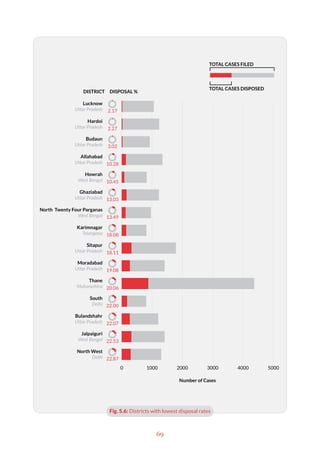
  • 87.
    71 If one onlyfocuses on the categories of “acquittal” and “conviction”, Fig. 5.7 shows us that in the POCSO cases disposed of between 2012 and February, 2021, convictions comprised just about 14% of the cases while acquittals form over 43% of the disposals. This means that for every one conviction, there were three acquittals. More than one-fifth of the cases in this dataset ended in transfers. Since POCSO cases are supposed to be tried by the Special Court set up under Section 28 of the POCSO Act, 2012, a POCSO case that comes before any other court has to be transferred to the Special POCSO Court. Fig. 5.8 shows how the number of transfers has varied over the years. Apart from a small dip between 2016 and 2017, the overall number of transfers has been on an increase. This increase, however, could be attributed to rising number of POCSO cases in general. However, when one looks at how the percentage of transfers as a component of all disposals has varied, a different trend is visible. While the percentage of transfers out of total disposals was only around 8% in 2013, it rose to a little over 19% in 2019 and a startling 42% in 2020. The huge jump in 2020 might be explained as an impact of the COVID-19 pandemic during which Special POCSO Courts may not have been functioning and cases came before other courts which then transferred them to the Special POCSO Courts. Even if one excludes 2020, transfers still comprised more than 15% of the total disposals between 2013 and 2019. This is concerning because precious time is being wasted if the matter has to be transferred from one court to another and unnecessary delay is being caused in the trial process. Transfers are indicative of either administrative mismanagement or wrongful appreciation of facts by the police. Regarding the former, it is concerning that even after a decade of the POCSO Act being in force, cases are being allowed to be filed in the wrong courts. Clear guidelines to enable the police and prosecution to bring POCSO cases directly to the Special Courts could solve this issue. For the latter, there seems to be a legitimate concern regarding identifying the age of the victim. The investigating authorities along with medical experts need to expedite this process, so that precious trial time is not spent in the wrong court. Fig. 5.7: Overall disposal pattern in POCSO cases 0 10k 20k 30k 40k 50k Dismissal Allowed Miscellaneous Unclassified Disposed Conviction Transfer Acquittal 43.44% 22.76% 14.03% 9.84% 3.28% 1.06% 2.48% 3.11% Number of Cases Proportion of Cases Type of disposal
  • 88.
    72 Further, for thecategories “allowed” and “dismissal”, a study of a randomised sample of cases indicated that a majority of them are related to applications filed under the main POCSO case either being allowed or dismissed by the court. Though every effort was made to exclude bail and other miscellaneous applications from the dataset, the researchers are cognisant that some such cases might have crept into the cleaned dataset as well. Given that “allowed” and “dismissed” relate to applications and not the main case, this might be reflective of a deeper problem of inflated disposals. There is a need to have uniform terminologies for disposal types for it to lend itself to any scientific analysis. Fig. 5.8: Transfers over the years 0 2000 4000 6000 8000 10000 2020 2019 2018 2017 2016 2015 2014 2013 2020 2019 2018 2017 2016 2015 2014 2013 Number of Transfers 0 10 20 30 40 50 Proportion of Transfers out of Total Disposals
  • 89.
    73 2. State-wise disposalpatterns According to our study of POCSO case disposal data from 2012 to February, 2021, on an average, it takes 509.78 days for a POCSO case to be disposed of. Fig. 5.9 depicts how this figure has varied across states by throwing light on the disposal patterns in different states. Disposal types have been divided into four categories: conviction, acquittal, transfer and others (comprising disposed, allowed, dismissal, miscellaneous and unclassified categories). The scale on the right side of Fig. 5.9 shows the total number of disposed cases in a particular state while the bars on the left show the proportion constituted by each of the identified categories. This figure suggests that transfers account for a significant proportion of the total cases disposed of by courts, particularly in states like Tamil Nadu (58.64%), Rajasthan (38.99%), Andhra Pradesh (33.51%) and Bihar (29.51%). Fig. 5.9 further shows that acquittals are significantly higher than convictions for all of the states studied. Andhra Pradesh shows a huge disparity between acquittal and conviction figures with 56.15% of the total disposed cases ending in acquittals and only 7.25% convictions. In West Bengal too, acquittals (53.38%) are nearly five times the conviction figures (11.56%). The situation is different in Kerala where the gap between acquittal and conviction is not very high with acquittals constituting 20.5% of the total cases and convictions constituting 16.49%.
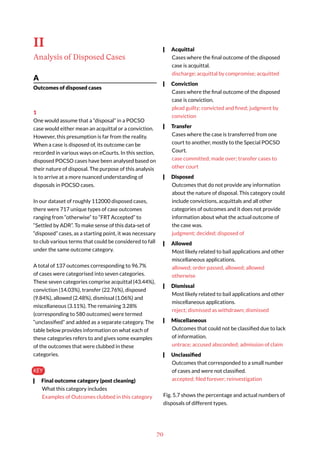
  • 90.
    74 Large & Mid SizedStates Small States Union Territories Proportion of cases Number of cases 0 20 40 60 80 100 CH DL TR HP SK UK BR WB AS JH AP PB HR TN KA CG GJ UP RJ KL MH 0 3000 6000 9000 12000 15000 Acquittal Conviction Transfer Others Fig. 5.9: State-wise disposal patterns in POCSO cases
  • 91.
    75 B Average case lengthby state and year 1 Fig. 5.10 represents the average case length (i.e., the number of days it took to dispose of POCSO cases in a given year) for different states for different years. It shows the average case length of all the POCSO cases that were disposed of in a year. This graph seeks to indicate the average time the case has spent in the court before getting disposed. The colour of the dots connotes a specific year and their size connotes the number of cases disposed of in that year. For states with less than 100 cases in a particular year, the dot has been changed to a symbol to ensure that it is visible in the graph. In 2020, at 1284.33 days, Delhi had the highest average case length out of the states studied. Himachal Pradesh came a close second with average case length in 2020 being 1093.48 days. It is natural that cases disposed in 2013 would have smaller average pendency days as opposed to cases disposed in 2020, given that the Act came into effect only in 2012. However, what is concerning is that the average pendency days of disposed cases is increasing year on year which indicates that the pendency case-load is preventing the court from taking up and disposing newer POCSO cases. This systemic issue extremely delayed cases in POCSO courts should be tackled strategically in order to create capacity for new POCSO cases. It is immediately clear from this graph that the average case length has increased from year to year in many of the states studied (Assam, Chhattisgarh, Gujarat, Karnataka, Tamil Nadu, West Bengal, and Himachal Pradesh). This indicates that most of the cases being disposed are the ones which have been pending in the system for multiple years. The pressure of pending case-load therefore leaves very little time for judges to concentrate on new POCSO cases. In other states, the average case length has fallen in one or two years and then again risen in the subsequent years (Haryana, Maharashtra, Punjab, Rajasthan, Uttarakhand, Uttar Pradesh, Sikkim, Chandigarh, and Delhi). In Kerala, case length has been on an increasing trend since 2017. Andhra Pradesh presents an interesting case study. While the average case length increased from 2012 (122 days) to 2014 (611.2 days), there was a sharp fall in 2015 (130.01 days). From 2016, the average case length continued to steadily increase (reaching 604.99 days in 2020). Bihar has also followed a haphazard pattern with average case length varying from 21.33 days in 2014 to 374.11 days in 2020. In Jharkhand, the average case length rose from 16.51 days in 2014 to 400.77 days in 2019 before declining to 314.49 days in 2020. This is interesting given that 2020 was a pandemic hit year. While average case length provides important insights into the pipeline of justice, an important caveat of this indicator is that it aggregates disposals for all kinds of cases, including transfer cases that might take less time to be disposed of relative to other cases, thereby skewing the dataset in favour of faster disposals.
  • 92.
    76 AP AS BR CG GJ HR JH KA KL MH PB RJ TN UK UP WB HP SK TR CH DL 0 200 400600 800 1000 1200 0 200 400 600 800 1000 1200 Large & Mid-Sized States Small States UTs Average Case Length (in days) 2013 2014 2015 2016 2017 2018 2019 2020 Decision year Fig. 5.10: Average case length by state and year
  • 93.
    77 C Time taken fordisposal 1. Overall time taken for disposal (based on decision year) Fig. 5.11 presents the age composition of disposals based on their decision year (i.e., the year in which a POCSO case was disposed of). It has three parts. The pie chart shows the age of disposed POCSO cases when aggregated. The bar graph shows the year-on-year age of disposed cases while the line graph shows the age of disposed cases in terms of proportion of the total disposal in a particular year. Each stacked bar above a decision year shows how many cases were disposed in that year and what the age of these disposed cases was at the time of disposal. The age is represented by four different colours corresponding to four age categories: yellow for cases that were disposed of in less than one year, pink for cases that were disposed of in one to two years, red for cases that took two to three years to be disposed of, and purple for cases that were disposed of in greater than three years. This Figure only studies cases that were decided between 2016 and 2020. This is because in this analysis, the cases are grouped by the date of decision. If the graph was started from, for instance, 2013, then the cohort of cases in consideration would be the cases filed in 2012 (since the Act came into force in November, 2012) and disposed till 31 December 2013. All these cases would fall into the ‘less than one year’ category and the graph would be misleading if it were to be interpreted as the courts becoming very efficient. For this reason, this analysis only considers cases which have had at least three years’ time to be disposed of. While the bars above the decision year show the actual number of cases disposed of in a particular year, the line graph below the decision year shows what proportion of cases disposed in a particular year were disposed of between the different time periods represented by the different colours. The pie chart in the above Figure shows that nearly 90% of POCSO cases are disposed of in less than three years, with over 47% of these being disposed of in less than one year. Of the 22625 cases that were disposed of in the year 2018, 45.63% of the cases were disposed of in less than one year, 29.67% took one to two years, 13.54% took two to three years and 11.16% took more than three years to be disposed of. It is evident from this Figure that the proportion of cases disposed of in less than one year has gradually decreased. Thus, while over 60% of the cases disposed of in 2016 were disposed of in less than a year, this figure decreased to 42.07% for cases disposed of in 2018. Further, the share of cases disposed of in greater than three years seems to have increased overtime. Of the cases disposed in 2016, only 1.2% were disposed of in more than three years. However, for cases disposed of in 2020 this figure was at 19.66%. One of the explanations for such a small percentage of cases taking more than three years to be disposed of in 2016 could be that a lot of cases filed till 31 December, 2016 might not have been disposed of till 31 December, 2021. This becomes evident in a comparison of the filing and disposal data. Out of the 59742 cases filed till 31 December, 2016, only 28.96% had been disposed of till 31 December, 2016. Thus, over 70% of the cases filed till 2016 (i.e., between 2012 and 2016) had not been disposed of till the end of 2016. This seems to suggest that over the years, courts have become more inefficient in disposal of POCSO cases. Since this Figure includes all kinds of disposals, in order to understand how long courts take to dispose of POCSO cases that end in acquittal or conviction, the researchers have further analysed the age composition of these two categories of cases in the next section.
  • 94.
    78 Less than 1year 1 to 2 years 2 to 3 years More than 3 years 0 5000 10000 15000 20000 25000 30000 2016 2017 2020 2019 2018 0 10 20 30 40 50 60 70 80 Proportion of cases Number of Cases 47.69% 26.93% 13.45% 11.93% Fig. 5.11: Overall time taken for disposal in POCSO cases (based on decision year)
  • 95.
    79 2. Time takenfor disposal in acquittal and conviction cases by year (based on decision year) Fig. 5.11 shows the overall age profile of disposed POCSO cases for cases disposed of between 2016 and 2020. Figs. 5.12 and 5.13 do a similar analysis for cases that ended in acquittal and conviction. These figures have three parts. The pie chart shows the age of acquittal or conviction cases (as the case may be) when aggregated. The bar graph shows the year-on- year age of acquittal or conviction cases while the line graph shows the age of acquittal or conviction cases in terms of proportion of the total acquittal or conviction cases in a particular year. Different colours in the bars represent different age categories for disposed cases. The reason for choosing 2016 as the first year for analysis has been discussed in the previous section. Since the researchers only had data for two months of 2021, it has not been included in this Figure. In order to arrive at the number of acquittal and conviction cases for each year, the disposed cases where the disposal type corresponded to acquittal or conviction respectively were grouped by disposal year and the difference between the date of filing (as available on eCourts) and the date of disposal was calculated and the cases were then classified into different age brackets. A comparison of the pie charts in Figs. 5.12 and 5.13 shows that the outcome of the case (in the form of acquittal or conviction) does not have a significant relationship with how long it takes to dispose of POCSO cases. For example, for cases ending both in acquittal and conviction, the percentage of cases disposed in less than three years is similar (around 85%). Similarly, around 14% of the cases ending in acquittal and conviction take more than three years to be disposed of. Thus, this study does not find any significant impact of the outcome of a case on its length (calculated in terms of date of filing and date of disposal). 268 Centre for Child and the Law, National Law School of India University, Implementation of the POCSO Act, 2012 by Special Courts: Challenges and Issues (National Printing Press, Bengaluru, February 2018). This finding is different from previous studies on the POCSO Act and from what experts opined during the stakeholder interviews. Studies undertaken by the CCL-NLSIU in different states found that acquittals were higher in cases disposed within a year as compared to convictions and that the time taken to dispose a case was higher when it resulted in a conviction. Further, according to these studies, disposal time is lower in cases that end in acquittals because the court dispenses with the examination of formal witnesses when the victim turns hostile or does not support the prosecution.268 Experts interviewed also suggested that cases which end in conviction take longer than cases where there is acquittal. Further, these Figures suggest that over the years, there has been a rise in the proportion of cases ending in conviction that take more than three years to be disposed of. For instance, while only 1.75% of the cases (that ended in conviction) disposed of in 2016 were aged more than three years at the time of disposal, the percentage of such cases in 2020 was 30.92%. This suggests that the courts are taking more time to dispose of POCSO cases with every passing year.
  • 96.
    80 Less than 1year 1 to 2 years 2 to 3 years More than 3 years 0 3000 6000 9000 12000 15000 0 10 20 30 40 50 60 0 10 20 30 40 50 60 0 1000 2000 3000 4000 5000 ACQUITTALS CONVICTIONS Proportion of cases Proportion of cases 2016 2017 2018 2019 2020 2016 2017 2018 2019 2020 Number of Cases Number of Cases 40.71% 34.84% 33.78% 16.27% 15.10% 29.92% 16.02% 13.35% Fig. 5.12: Time taken for disposal in acquittal cases by year (based on decision year) Fig. 5.13: Time taken for disposal in conviction cases by year (based on decision year)
  • 97.
    81 3. Time takenfor disposal in conviction and acquittal cases in different states Another way of looking at data pertaining to acquittal and conviction is to study how the mean length of these cases varies across states. As Fig. 5.14 shows, the mean case length in cases of acquittal varies between 179.62 days in Chandigarh to 1027.52 days in Himachal Pradesh. For cases that end in conviction, the mean case length ranges from 311.72 days in Chandigarh to 1373.2 days in Delhi. Further, apart from Sikkim, Kerala and West Bengal, for all the states studied, the time taken for conviction is longer than the time taken for acquittal. This means that courts spend more time in hearing cases that ultimately end in conviction as compared to cases that end in acquittal. Additionally, data shows that Chandigarh and West Bengal are the only states where convictions are taking place (on average) within the statutorily prescribed period of one year with states like Karnataka, Uttar Pradesh, Maharashtra, Gujarat, Bihar, Himachal Pradesh and Delhi, all taking over two years for disposing of cases that end in conviction. Fig. 5.14: Time taken for disposal in conviction and acquittal cases in different states 400 200 400 600 800 1000 600 800 1000 1200 1400 DL HP MH KL UP KA AP AS TN PB HR TR CG CH WB SK RJ UK JH BR GJ Mean convicted case length Mean acquitted case length 1000 5000 10000 Number of cases Large & Medium Sized States Small States Union Territories
  • 98.
    82 III Analysis of stagesin a POCSO case A case goes through many stages during the process of trial before the courts. For instance, a case can be listed for framing of the charge, for charge, for prosecution evidence, or for arguments. Fig. 4.__ in Chapter IV discusses the stages in a POCSO trial in detail. Ideally, a uniform and well-organised dataset would be able to classify all cases for the above categories based on the information provided in the hearings table269 for each case (available on eCourts). However, that is far from reality. Since the terms used for the purpose of hearing are discretionary, with no pan-India uniform key or standardised nomenclature, the terminology used for the purpose of hearing across courts, districts and states varies greatly. As a result, for the dataset of almost 230000 total cases (out of which about 112000 are disposed cases), about 2729 (2340 for disposed cases) unique names have been provided for purposes of hearing. The high number only reflects that the names used differ significantly. The procedure continues to be regulated by the CrPC and the POCSO Act and, barring a few minor administrative practices, will be uniform throughout the country. The 2729 unique names of purposes are repeated multiple times in the hearings table for different cases. There was a total of 5245484 hearings corresponding to the over 112000 cases. Since it was not feasible to study the entire dataset, nearly 84.5% of the total hearings and about 87% of the total hearings for disposed cases were categorised. The details of the process adopted for classification of the purposes of hearing into various categories can be found in Annexure 3. After the process of standardisation, purpose of hearing was divided into 11 categories: Evidence; Charge; Service/ Appearance; Arguments; Hearing; Disposal/ Judgment; Adjourned; For trial; Preliminary Hearing; Miscellaneous and Other. 269 The hearings table provides the purpose of hearing for every hearing for each individual case. For this section, only disposed cases have been analysed. This is because only disposed cases would have gone through the entire process of trial before being disposed of and would be capable of providing information on all the intervening stages between cognizance and disposal of a case and the average case length. A Average number of days and hearings a POCSO case takes for disposal across states Fig. 5.15 shows the average number of days (average case length) and the average number of hearings it takes for a POCSO case to be disposed of in different states. The average case length in POCSO cases in a particular state is computed by dividing the sum total of the case lengths of all the disposed cases by the total number of disposed cases. The average number of hearings is arrived at by computing the total number of hearings of disposed cases in the state and dividing that by the total number of disposed cases in that state. The average number of hearings is depicted on the x axis whereas the average case length is depicted on the y axis. As this Figure shows, the average case length varies between 877.96 days in Himachal Pradesh to 215.43 days in Chandigarh. Sikkim (360.95 days), Punjab (312.91 days) and Haryana (309.03 days) also have average case lengths less than 365 days (the period prescribed under the POCSO Act for completion of trial). Further, the average number of hearings till disposal varies between 11.12 hearings in the state of Kerala to 31.41 hearings in Gujarat. Greater number of hearings means that the court is spending more resources on a case. Further, a smaller number of hearings does not automatically mean that cases are being disposed of faster. As is visible in the case of Kerala, where the average number of hearings is 11.12 hearings, the average case length is 587.97
  • 99.
    83 days. This indicatesthat the time period between consecutive hearings might be really long in the state, which itself is a cause of concern, especially for victims. States which have a shorter case length take an average number of hearings (16-20 hearings) for disposal. For instance, Chandigarh, which has the shortest case length among the states studied, takes 19.53 hearings for disposal of POCSO cases. Similarly, Tripura (with an average case length of 367.6 days) takes an average of 16.01 hearings to dispose of a POCSO case. Fig. 5.15: Average case length and hearings for disposal in a POCSO case across states 12.5 15.0 17.5 20.0 22.5 25.0 27.5 30.0 200 300 400 500 600 700 800 900 AP UP TN RJ PB MH KL UK JH KA HR GJ CG BR AS WB SK TR HP DL CH Average Number of Hearings Average Case Length Large & Medium Sized States Small States Union Territories
  • 100.
    84 B Time taken bydifferent stages in a POCSO trial 1. Average number of days taken by each stage Fig. 5.16 shows the average number of days each stage in a POCSO trial takes. In order to arrive at the average for each stage, the total number of days spent on each stage was divided by the total number of disposed cases. The average number of days for each stage is depicted on the y axis and the proportion of the total number of days taken by each stage is represented on the x axis. It is clearly visible from this Figure that a large proportion of the total number of days spent in disposed POCSO cases are spent on the stage of evidence. On an average, 183.41 days are spent on the evidence stage in a typical POCSO case. The second largest number of days (68.21 days) is spent on the charge stage, which takes about 10% of the number of days spent in a POCSO trial. The least number of days (3.11 days on average) are spent on judgment/disposal. On average, over 40% of the total number of days in a POCSO case are spent just on the evidence stage of evidence. Fig. 5.16: Average number of days taken by each stage in a POCSO trial Evidence Other Charge Service/Appearance Arguments Hearing Disposed/Judgment Miscellaneous Adjourned For Trial Preliminary hearing Stage of Trial 0 20 40 60 80 100 0 50 100 150 200 Proportion of Days Average number of Days
  • 101.
    85 2. Average numberof hearings taken by each stage Fig. 5.17 shows the average number of hearings each stage in a POCSO trial takes. In order to arrive at the average for each stage, the total number of hearings spent on each stage was divided by the total number of disposed cases. The average number of hearings for each stage is depicted on the y axis and the proportion of the total number of hearings taken by each stage is represented on the x axis. It is evident from this figure that even when looked at through the lens of the number of hearings, it is the evidence stage that the greatest number of hearings in a POCSO case are spent on. On an average, 9.21 hearings are spent on the evidence stage with over 40% of the total number of hearings in disposed cases being taken up by this stage. The least number of hearings are spent on the stage of preliminary hearing (0.25 hearings). The stages of Charge and Service/Appearance take about 11% of the total hearings in a POCSO case. This data reveals that if POCSO trials are to be completed expeditiously (one of the primary purposes of the POCSO Act), the evidence stage needs to be expedited. It is the most crucial stage in a trial and it is understandable that it would take more time than the other stages. With over 40% of the total number of days and hearings spent on POCSO trials being spent on this stage, it becomes crucial to find ways in which processes can be more streamlined to reduce the time taken to complete this stage. One possible solution could be to record certain expert testimonies through video conferencing. A hybrid approach with some parts of the evidence being recorded through the use of technology could help in reducing the time spent at this stage. There is a need for better training for the deposition of Investigating Officers and examination and cross examination by Special Public Prosecutors. Other actors in the trial process need better training to expedite the evidence stage. For instance, the support person needs to be adequately trained to support the child witness/victim during examination. Fig. 5.17: Average number of hearings taken by each stage in a POCSO trial Evidence Other Charge Service/Appearance Arguments Hearing Disposed/Judgment Miscellaneous Adjourned For Trial Preliminary hearing Stage of Trial 0 20 40 60 80 100 Proportion of Hearings Average number of Hearings 0 2 4 6 8 10
  • 102.
    86 C Comparison of timespent for evidence stage across states The above analysis makes it abundantly clear that a large part of the time spent (both in the number of days and the number of hearings) in a POCSO trial is spent at the stage of evidence. The following analysis is aimed at understanding what proportion of time is spent on the evidence stage across different states. 1. Days spent for evidence stage Fig. 5.18 throws light on the number of days spent on the stage of evidence across different states. The average number of days was calculated by dividing the total number of days spent in evidence hearings in disposed cases in a given state by the total number of disposed cases in that state. The proportion of days spent at the evidence stage was calculated by dividing the total number of days spent in the evidence stage by the sum of case lengths of all disposed cases in that state. The x axis represents the proportion of total days spent on the evidence stage while the y axis shows the average number of days spent on this stage. Delhi spends an extremely high amount of time on the evidence stage with 593.03 days on average being spent on evidence. This constitutes 73.89% of the total number of days spent on average on a POCSO case in Delhi. In Haryana, which spends relatively lesser number of days in the evidence stage (254.29 days), the proportion of time spent on the evidence stage is quite high (82.97%). Then there are states like Chandigarh, Tripura, Andhra Pradesh and Kerala which seem to spend a negligible amount of time (less than 10%) on the evidence stage. However, more than reflecting the ground reality, this seems to be an anomaly that has arisen because of the way the purpose of hearing appears in eCourts for these states. Fig. 5.18: Average number of days spent for evidence stage across states Average number of days spent on evidence per case Proportion of days in evidence hearings 0 20 40 60 80 0 100 200 300 400 500 600 AP AS BR CG CH DL GJ HP HR JH KA KL MH PB RJ SK TN TR UK UP WB Large & Medium Sized States Small States Union Territories
  • 103.
    87 2. Hearings spentfor evidence stage Fig. 5.19 shows the number of hearings spent on the stage of evidence as well as the proportion of total hearings these constitute across different states. The average number of hearings per case was computed by dividing the sum of the number of evidence hearings in disposed cases in a state by the total number of disposed cases in that state. The proportion of evidence hearings was computed by dividing the total number of evidence hearings in all disposed cases in the state by the total number of hearings for disposed cases in that state. The x axis represents the proportion of total hearings spent on the evidence stage while the y axis shows the average number of hearings out of the total days spent on this stage. Sikkim holds the greatest number of hearings (19.42 hearings) for evidence in all the states studied with evidence hearings constituting 69.54% of the total proportion of all the hearings. Thus, in Sikkim, nearly 70% of the time spent in a POCSO case is spent on the evidence stage. Chandigarh, Tripura, Andhra Pradesh and Kerala also stand out as anomalies with less than two evidence hearings per case. As discussed above, this could be due to the manner in which the purpose of hearing is entered on eCourts and not because these states actually spend less than two hearings on evidence. At 71.59%, Punjab spends the highest proportion of its total hearings on the evidence stage holding an average of 13.73 hearings for evidence per case. Haryana is a close second spending 70.56% of its total hearings on the stage of evidence while holding an average of 12 evidence hearings per case. One would assume that the proportion of days and the proportion of hearings spent on the evidence stage should be somewhat similar, if not exactly the same because if a court is spending a large number of days listening to evidence, the number of hearings would also increase. While this holds true for a large number of states like Punjab, Sikkim, Gujarat and Rajasthan, looking at the two figures together shows that a large amount of time (denoted by the number of days) spent on evidence does not automatically mean a greater number of evidence hearings in all states. For instance, though Delhi spends 593.03 days on the evidence stages, the average number of evidence hearings in Delhi is just 9.79 per case. This implies that there are long gaps between consecutive evidence hearings. This becomes clearer when we look at the proportion of days and hearings spent on evidence. Even though Delhi spends 73.89% of the days spent on a POCSO case on just the evidence stage, in terms of hearings, it only spends 52.28% of the total hearings on evidence. This means that there are fewer evidence hearings even though a large number of days are being spent on the evidence stage in Delhi. This can have an adverse impact on the child victims who have to wait for long periods of time between hearings for their case to be heard by the court. The child victim might be re-traumatised by the process of the trial by having to recount the details of the sexual offence committed while giving evidence to the court. They are also prevented from moving on with their lives when trials are delayed for years.
  • 104.
    88 Fig. 5.19: Averagenumber of hearings spent for evidence stage across states 0 10 20 30 40 50 60 70 0.0 2.5 5.0 7.5 10.0 12.5 15.0 17.5 20.0 PB HR SK CG RJ GJ DL JH UK UP BR MH AS WB HP KA TN CH AP TR KL Average number of evidence hearings per case Proportion of hearings in evidence hearings Large & Medium Sized States Small States Union Territories
  • 105.
    89 IV Analysis of theuse of various provisions of the POCSO Act and the IPC A Most frequently used provisions of the POCSO Act Fig. 5.20 shows the aggregate usage of different sets of POCSO provisions over the time period of the study. While this Figure can give us an idea about what provisions of the POCSO Act are more frequently used than the others, it does not represent all the cases that form a part of the dataset for this study. This is because not all cases on eCourts have proper and complete information about the Sections of the Acts applied. In order to arrive at the aggregate percentages, the main sections defining offences under the Act were grouped together such that the substantive provision defining an offence and the provision providing for punishment for the same offence would form one category. Thus, Section 3 (which defines penetrative sexual assault) and Section 4 (which provides the punishment for penetrative sexual assault) form one pie in the chart. From this Figure, it is evident that over 56% of all the POCSO cases that we were able to analyse to arrive at this Figure correspond to the offences of penetrative sexual assault (31.18%) and aggravated penetrative sexual assault (25.59%), which have the most stringent punishments under the Act. Though these are not conviction figures, it is concerning that a majority of cases under the POCSO Act are being filed for such serious acts of sexual violence against children. While this aggregate data gives a bird’s eye view of the use of different provisions of the POCSO Act, it is also useful to see how these provisions have been applied over the years. Fig. 5.21 shows the frequency of occurrence of certain provisions of the POCSO Act in different years. This Figure has been arrived at by disaggregating the data in Fig. 5.20 according to different years. The x axis contains the Section numbers corresponding to the POCSO Act and while there are two y axes. The y axis above the x axis shows the total number of cases filed in a particular year while the y axis below the x axis shows the proportion of cases constituted by a specific year. The years are represented by different colours. 2012 has been excluded since the Act came into force in November 2012 and very few cases were filed in 2012 and 2021 has been excluded since the researchers only had data for two months of this year. The Figure shows that offences falling under the five categories identified are increasing year on year. However, this does not necessarily lead to the conclusion that more sexual crimes against children are occurring. Since sexual offences involving children are generally underreported, this increase in the number of cases could be due to increased reporting as awareness about the POCSO Act is increasing. It is important to note that even though 2020 was a pandemic affected year where a large part of the year was spent in lockdowns, the number of POCSO cases entering the court system continued to increase for all identified categories except sexual Fig. 5.20: Most frequently used provisions of the POCSO Act 15.33% 3.40% 24.48% 25.59% 31.18% 3 & 4 : Penetrative Sexual Assault 5 & 6 : Aggravated Penetrative Sexual Assault 7 & 8 : Sexual Assault 9 & 10 : Aggravated Sexual Assault 11 & 12 : Sexual Harassment
  • 106.
    90 0 10000 20000 30000 40000 50000 2 0 1 3 2 0 1 4 2 0 1 5 2 0 1 6 2 0 1 7 2 0 1 8 2 0 1 9 2 0 2 0 3 & 45 & 6 7 & 8 9 & 10 11 & 12 POCSO PROVISION Number of Cases Proportion of cases 0% 5% 10% 15% 20% 25% 30% Fig. 5.21: Frequency of use of POCSO Act provisions over the years
  • 107.
    91 harassment (which sawa small dip from 4839 cases in 2019 to 4732 cases in 2020). Fig. 5.22 sheds light on the percentage of acquittals and convictions across the five offences identified. The purpose of this analysis was to understand if and how acquittal and conviction percentages vary across offences. The x axis in this Figure contains the Section numbers and there are two y axes. The y axis in the upper half of this Figure shows the total number of cases for a particular offence and the y axis in the lower half of this Figure represents the percentage constituted by acquittal and conviction 270 Others includes all disposal types except the ones that have been categorised by the researchers as corresponding to acquittal and conviction. (represented by two different colours). Since the purpose of Fig. 5.22 was to understand the percentage of acquittals and convictions, this Figure does not include other270 types of disposals that form a substantial portion of total disposals. Fig. 5.22 shows that there is no significant variation between acquittal and conviction percentages for different offences with convictions varying between 21 and 26% for cases of penetrative sexual assault and aggravated sexual assault respectively. However, convictions are lowest in cases of sexual harassment (18.16%). Fig. 5.22: Acquittal and conviction in different offences under the POCSO Act 0 5000 10000 15000 Acquittal Conviction 3 & 4 5 & 6 7 & 8 9 & 10 11 & 12 0 20 40 60 80 100 Proportion of cases Number of Cases POCSO PROVISION
  • 108.
    92 B Usage of IPCand POCSO provisions with each other Fig. 5.23 depicts how IPC and POCSO provisions are used with each other. Each square in the Figure represents information about a collection of cases citing the Act and Sections represented as labels on the respective column and row. For instance, the square on the lower left corner represents the collection of cases citing both the IPC 506 and POCSO Sections 3, 4. The larger dotted squares indicate whether the Acts considered are only POCSO or POCSO and IPC or only IPC. The colour of each of the small squares is proportional to the number of such selected cases, so it is darker if the caseload is larger. Further, the squares on the diagonal indicate the volume of cases corresponding to a specific set of provisions. For instance, the first square at the top of the diagonal indicates the volume of cases corresponding to Sections 3, 4 of the POCSO Act. Similarly, the last square at the bottom of the diagonal represents the total volume of cases that mention Section 506 of the IPC (that are categorised as POCSO cases on eCourts). Only the lower half of the figure is filled out since the upper half would represent the same data and would be redundant. The set of cases represented by the square need not exclusively cite the Acts and Sections in the row and column labels. For instance, if a case is counted as falling under Sections 3, 4 of the POCSO Act in this Figure, it should not be taken to mean that no other provision of the POCSO Act or the IPC was applied to it. There might be cases where multiple sets of provisions mentioned in this Figure might have been applied to a single case, leading to some overcounting. 271 Section 354 - Assault or criminal force to woman with intent to outrage her modesty; Section 363 - Punishment for kidnapping.; Section 366 - Kidnapping, abducting or inducing woman to compel her marriage, etc.; Section 376 - Punishment for rape.; and Section 506 - Punishment for criminal intimidation. 272 Shruthi Ramakrishnan, ‘Changing the age of consent,’ The Hindu (5 September 2022) <https://www.thehindu.com/ opinion/op-ed/changing-the-age-of-consent/article65849243.ece> accessed 30 September 2022. The five271 IPC provisions used in this Figure were chosen because they were the most frequently applied IPC provisions in POCSO cases. It is evident from Fig. 5.23 that Section 376 of the IPC frequently co-occurs with Sections 3, 4 of the POCSO Act and almost as frequently with POCSO Sections 5, 6 but far less frequently with Sections 9, 10 of the POCSO Act. Further, Section 376 of the IPC also co-occurs frequently with Sections 363 and 366 of the IPC (in POCSO cases). The exact numbers of these co-occurrences can be found in Annexure 4 of this report. The use of Sections 376 and 366 together in such a large number of cases could point to their use to deal with cases of ‘romantic relationships’ where parents file cases when their daughter elopes with someone of her choice. An analysis by Enfold Proactive Health Trust of 1,715 ‘romantic’ cases under the POCSO Act decided between 2016-2020 by Special Courts in Assam, Maharashtra, and West Bengal revealed that such cases constituted 24.3% of the total cases decided by the courts.272 Analysis of 138 judgments undertaken for this study also deals with the issue of ‘romantic’ relationships and has been discussed in the next section.
  • 109.
    93 Fig. 5.23: Usageof IPC and POCSO provisions with each other POCSO 3 & 4 POCSO 5 & 6 POCSO 7 & 8 POCSO 9 & 10 POCSO 11 & 12 IPC 354 IPC 363 IPC 366 IPC 376 IPC 506 POCSO 3 & 4 POCSO 5 & 6 POCSO 7 & 8 POCSO 9 & 10 POCSO 11 & 12 IPC 354 IPC 363 IPC 366 IPC 376 IPC 506 1 0 0 0 0 2 0 0 0 0 3 0 0 0 0 4 0 0 0 0 5 0 0 0 0 6 0 0 0 0 POCSO + IPC POCSO + POCSO IPC + IPC Number of Cases
  • 110.
    94 V Analysis of POCSOjudgments from eCourts While the above analyses provide a broad overview of the conduct of cases concerning sexual assault against children, this section deep dives into the judgments delivered by the courts in POCSO cases in order to identify trends concerning the implementation of the Act. For the purpose of this analysis, 138 judgments concerning sexual assault against children were studied and analysed. Based on this analysis, the section offers insights into the cases filed under the POCSO Act. A Age of the victim and the accused The age of the victim and the accused is crucial to understanding the nature of the underlying crime and the policy interventions required to address the same. An analysis of the random sample of 138 judgments offered insights for this data point. Though 10 judgments per state were collated, judgments in languages unfamiliar to the researchers were not analysed. Fig. 5.24 shows the age profile of the victims and accused in POCSO cases as obtained from the judgments in individual cases. Age in this Figure corresponds to the age of the victim and the accused at the time of the commission of the offence. While the judgments did not identify the age for 70 victims, among others, 41 victims were between 15 and 18 years of age. Whereas 26 victims were between 10 and 15 years old. As highlighted in the Figure above, most of the cases reported under the POCSO Act refer to sexual offences against adolescent children. Fig. 5.25 provides the analysis of the age of the accused as identified in the judgments studied. Fig. 5.25 highlights that the age of the accused in POCSO cases is often between 19 to 35 years. While most of the judgments were silent in reference to the age of the accused, among the rest, 33 (22%) of the accused were between 19 to 35 years of age. As per the analysis, 9 of the accused persons studied were between 35 to 45 years of age while the other 10 were more than 45 years old. While this analysis provides an overview of the profiles of the victims and the accused, a deeper victimological and criminological analysis of these crimes is required to identify key policy interventions. Fig. 5.24: Age of the victim in POCSO cases Fig. 5.25: Age of the accused in POCSO cases Unknown Under 10 Between 10 & 15 Between 15 & 18 Above 18 Unknown Between 15 & 18 Between 19 & 25 Between 25 & 35 Between 35 & 45 Above 45 Age of the Victim Age of the Accused 47.94% 63.69% 0.68% 11.64% 10.95% 6.16% 6.84% 5.47% 17.80% 28.08% 0.68%
  • 111.
    95 B Relationship between thevictim and the accused The relationship between the victim and the accused was another key statistic explored under the analysis of judgments concerning the POCSO Act, 2012. As per the data published by the NCRB, in 96% of the cases filed under the POCSO Act, 2012, the accused was a person known to the child victim.273 The analysis of judgments for this study offers a similar result. Fig. 5.26 shows the relationship between the accused and the victim, as gleaned from the judgments analysed. Fig. 5.26 shows that while in 44 per cent of the cases, the judgments did not identify the relationship between the victim and the accused, only in about 6% of the cases, the accused was unknown to the victim. Further, in 18% of the cases, the judgment identified a prior romantic relationship between the victim and the accused. As per the data published by NCRB in 2021, in 48.66% of cases concerning the sexual assault of a child, the accused is either a friend or a romantic partner of the victim.274 Though any form of sexual relationship with a person below 18 years is a crime, courts have considered the romantic relationship between the victim and the accused to quash the FIR or to reduce the punishment.275 The analysis of the judgments highlights a similar trend. The study of 19 judgments where there was a prior romantic relationship between the accused and the victim highlights that in 17 of such cases, the accused was acquitted by the court. Fig. 5.27 presents this analysis. One of the reasons for such a high acquittal rate can be the lack of judicial discretion under the POCSO 273 National Crimes Records Bureau, ‘Crime in India 2020’ (2021) 354 <https://ncrb.gov.in/sites/default/files/CII%20 2020%20Volume%201.pdf> accessed 26 July 2022. 274 Ibid. 275 Express News Service, ‘Bombay HC quashes POCSO case as victim, now above 18, and accused decide to marry each other’ (Indian Express, 6 June 2022) <https://indianexpress.com/article/cities/mumbai/bombay-hc-quashes- pocso-case-as-victim-now-above-18-and-accused-decide-to-marry-each-other-7956076/> accessed 26 July 2022. 276 Andrew Ashworth, Sentencing and Criminal Justice (Cambridge University Press 2012), See Preeti Pratishruti Dash, ‘Rape adjudication in India in the aftermath of Criminal Law Amendment Act, 2013: findings from trial courts of Delhi’ Indian Law Review. 277 Ibid. Act, 2012. Numerous studies have found that mandatory minimum sentences often result in a drop in conviction rates.276 In cases where the judges and the prosecution think that the mandatory minimum sentence is unduly harsh, they tend to divert the cases from such provisions.277 While this analysis provides a window into the nature of judgments in the cases concerning the sexual abuse of a child, there is a need to analyse such data for a bigger database and understand the effect of mandatory minimum provisions and the relationship between the victim and the accused on the outcome of the case.
  • 112.
    96 Fig. 5.26: Relationshipbetween the victim and the accused Fig. 5.27: Decision in cases of ‘romantic’ relationships Cannot be ascertained Known Person Romantic Relationship Stranger Person in the position of power Family Acquitted Convicted Relationship between the victim and accused Decision in cases where there was a prior romantic relation- ship between the victim and the accused 44.44% 17 2 22.96% 17.77% 5.92% 5.18% 3.70%
  • 113.
    97 Chapter VI Recommendations The primarygoal of any child protection system should be to create a just system that meets the specific needs of the children that come in contact with it. Such a system would not only prevent violence against children but ensure when violence does occur, children get effective redressal. However, as the previous Chapters show, that there is a long way to go in order to make this goal a reality. The purpose of this study is not to point fingers at stakeholders, administrators or the judiciary but to understand the problems that afflict the child protection system and identify ways in which the system can be further improved. The following sections list some reform ideas. The researchers have identified the steps that need to be taken, why such reforms are necessary and which stakeholders are best positioned to execute and implement these recommendations. Recommendations have been divided into separate sections based on the underlying issues. These recommendations are borne out of data analysis and inputs from experts in the field and are based on the researchers’ understanding and inputs gathered from experts over the course of the last year. Therefore, the recommendations are much wider in scope than the issues highlighted in the previous sections. Wherever possible, linkages have been drawn between the previous sections and the recommendations.
  • 114.
    98 I Increasing awareness aboutthe POCSO Act Include age-appropriate information about POCSO in school curriculum, including information on helplines like Childline.278 • To ensure that a comprehensive and holistic approach to sexuality education (including information about sexual offences) is introduced for young children in a suitable manner. • To inform children about the mechanisms available to them for reporting sexual offences committed against them or their peers. 1. Department of School Education & Literacy, Union Ministry of Education 2. State Education Departments 3. School Education Boards like CBSE, State Education Boards etc. Impart POCSO awareness training to school staff. Include POCSO in the curriculum of students undergoing teaching courses like B.Ed, M.Ed etc.279 • Educators are often the first point of contact for a child victim and should be able to respond according to the law, in the child’s best interest. • To ensure that educators are aware of their duties under the POCSO Act. 1. State Education Departments 2. School Education Boards 278 See Chapter IV. 279 Ibid. 280 See Chapter III. 281 See Chapter IV. II Legislative changes to make the Act more effective Reduce the age of consent from 18 to 16 years with adequate safeguards.280 • To prevent the criminalisation of ‘romantic’ consensual relationships between adolescents. • To ensure that the Act achieves its intended objective of protecting children who are actually victims of sexual offences. 1. Parliament III Policy recommendations Hold public consultations with domain experts before making any substantive amendments to the Act. • To ensure that the law reflects social realities and is representative of expert opinion on important issues and is not amended to only assuage public opinion. 1. Parliament Stipulate a time limit for consideration of disbursement of interim compensation to the victim.281 Key What needs to be done • Why it should be done 1. Who needs to act
  • 115.
    99 • To ensurethat victims receive immediate relief in emergency situations. 1. Parliament 2. State Governments 3. Supreme Court IV Making POCSO Courts functional Establish Vulnerable Witness Deposition Centres, with appropriate infrastructure, in all POCSO courts in accordance with the Supreme Court judgment in State of Maharashtra v Bandu @ Daulat282 and Smruti Tukaram Badade v State of Maharashtra.283 • To provide a safe environment for recording the testimony of child victims of sexual abuse and other ‘vulnerable’ witnesses. • To prevent re-traumatisation of victims. 1. Supreme Court 2. High Courts 3. Ministry of Law and Justice Appoint adequately trained Special Public Prosecutors exclusively for POCSO courts where they have not been appointed. Progress for this can be monitored by respective High Courts. 284 • To reduce delay in POCSO trials resulting from over-burdened public prosecutors. • To ensure proper representation of victims of child sexual abuse. 1. State Governments 2. High Courts 282 State of Maharashtra v Bandu @ Daulat, SLP(CRL.) No. 2172 of 2014. 283 Miscellaneous Application No 1852 of 2019 in Criminal Appeal No 1101 of 2019. 284 See Chapter IV. 285 See Chapter IV. 286 See Chapter IV. Employ a ‘hybrid’ approach for recording of evidence wherein the evidence of certain witnesses like doctors, forensic experts etc. can be recorded virtually. • To prevent delay in POCSO trials, particularly during the evidence stage, caused by unavailability of expert witnesses. 1. High Courts 2. POCSO Courts Ensure the appointment and continuous presence of support persons in every pre-trial and trial stage.285 • To ensure that they can act as the conduit of information between the criminal justice system and the victim and provide much needed support to child victims. 1. Child Welfare Committees 2. State Women and Child Welfare Departments 3. Special POCSO Courts, Magistrates and JJBs. Create mechanisms to enable judges and prosecutors to have the required skill set to deal with the ‘vicarious trauma’ they experience when dealing with cases of heinous sexual offences committed against children. Provide counselling support to judges and prosecutors showing symptoms of ‘secondary traumatisation’.286 • To allow judges and prosecutors to cope better with the specific nature of the cases they deal with. • To enable judges to perform their duties efficiently without the nature of their work affecting their mental health. 1. Supreme Court
  • 116.
    100 2. High Courts 3.State Judicial Academies 4. State Law/Prosecution Departments Specifically train judges to write operational compensation orders.287 • To allow for timely and effective disbursement of compensation to victims. 1. State Judicial Academies V Capacity building at all levels Conduct periodic integrated capacity building programmes for stakeholders with a focus on sensitivity training.288 • To enhance coordination between different stakeholders. • To impart practical skills that address real-life, on-ground problems. • To ensure that the stakeholders stay abreast of the latest developments in the law. 1. State Women and Child Development Departments 2. State Judicial Academies 3. State Institutes of Public Administration 4. State Police Training Academies 287 See Chapter IV. Order must specify the quantum of compensation along with the specific sections of CrPC or POCSO Act under which it is granted. It should also lay down guidelines for the process of compensation disbursement. Every order, whether granting or rejecting applications, must mention reasons for the same. 288 See Chapter IV. 289 See Chapter II. 290 See Chapter II. 291 Deepika Kinhal and others, ‘National Judicial Policy: A Concept Note’ (2022) JALDI, Vidhi Centre for Legal Policy 16 <https://vidhilegalpolicy.in/wp-content/uploads/2022/02/National-Judicial-Policy-Report-by-Vidhi-Centre-for- Legal-Policy.pdf> accessed 5 July 2022. VI Increasing accuracy and uniformity in eCourts data Introduce a standardised drop-down menu for inputting information pertaining to the name of the legislation, case type,289 court complex, police station etc. • To allow for data to be easily transferred between courts and interoperable between platforms and applications and reduce errors at the time of data entry. 1. Ministry of Home Affairs (for Crime and Criminal Tracking Network and Systems) 2. eCommittee of the Supreme Court 3. National Informatics Centre (MeitY) Standardise Act names to make it easier to get accurate data using the Act name feature of eCourts.290 There could potentially be a database of Act names and Sections of the Acts which populate a dropdown list which is accessible to data entry operators. • To help identify best practices for the purpose of introducing standard operating procedures (SOPs) for streamlining291 the data entry process for e-courts data. These best practices and SOPs can then be included in the training curriculum for data entry operators. • To put an end to the current practice of manual entry of Acts applicable to a case by data entry operators because it leads to far too many
  • 117.
    101 variations in howthe applicable Act is recorded and makes any kind of exact analysis using Act name virtually impossible. For instance, Section numbers are sometimes added to the Act name leading to a proliferation of entries for the same Act. 1. eCommittee of the Supreme Court 2. National Informatics Centre (MeitY) 3. Computer Committees of different High Courts Add interpretable entries in the Hearings Table. If not for all cases, a large majority have pre- defined stages of the case which are applicable to the hearings and hence can be easily recorded. The purpose and outcome of the hearing must be mentioned. For instance, if the hearing was held to hear the evidence of the victim, then whether it was an effective hearing or whether it was adjourned. • To make the Hearings Table a source of key information pertaining to cases, particularly pending cases. Currently, the hearing table includes purpose and dates but, in practice, the purpose recorded is non-informative. 1. eCommittee of the Supreme Court 2. National Informatics Centre (MeitY) Provide clear and usable information pertaining to outcomes of cases. In relevant cases, it would be ideal to have more detailed information about the outcomes compensation, sentence etc. • To ensure that outcomes are recorded through a well-defined schema and provide useful information to litigants and researchers. 1. eCommittee of the Supreme Court 2. National Informatics Centre (MeitY) Add information regarding appeals (where applicable). One potential addition is a simple marker (Boolean to suggest a Yes or a No) to existing district cases to indicate appeals. • To allow litigants a mechanism to track the appeal from a district court judgment to the higher courts. 1. eCommittee of the Supreme Court 2. National Informatics Centre (MeitY) Provide information pertaining to date of filing of FIR, chargesheet, date of cognizance by court and date of disposal (if disposed) on eCourts. • To make key case information accessible to litigants. 1. eCommittee of the Supreme Court 2. National Informatics Centre (MeitY) Provide information pertaining to names of judges in addition to the designation of judges (the current practice). Provide unique IDs to judges. • To increase transparency and increase access to key information. • To incentivise all the district courts to clearly list the sitting judges so researchers can study their workloads, how many judges a case gets transferred to before disposal and such other trends. • To avoid ambiguity resulting in cases of common names. 1. eCommittee of the Supreme Court 2. National Informatics Centre (MeitY)
  • 118.
    102 VII Miscellaneous Set up moreFSLs while improving the capacity and infrastructure of existing ones.292 • To reduce delay in preparation of reports which leads to delay in investigation, filing of chargesheet and ultimately trial. • To improve the accuracy and quality of reports received. 1. Union and State Governments 2. Directorate of Forensic Science Services It is important to bear in mind that these recommendations are only a starting point in thinking about systemic reform in the child protection ecosystem. Any hope for large scale reform hinges on concerted push by an array of actors that have been identified above. Further, it is important to adopt an evidence-based approach to reforming the system. The various studies cited in this report all present cogent evidence of what is and what is not working within the system. The goal of the present study is to add to this discourse and emphasise the urgency with which reform needs to be undertaken. By identifying the challenges to the effective implementation of the POCSO Act and providing these recommendations to address them, this study hopes to contribute towards the development of a system that works for one the most vulnerable sections of our society— children who have been sexually abused. 292 See Chapter IV.
  • 119.
  • 120.
    104 Annexure 1: Numberof District Courts in States State Number of Districts Number of Districts with >100 cases Number of Special Courts sanctioned by the Central Government Andhra Pradesh 13 8 8 Arunachal Pradesh Very few POCSO cases in the state so no specific directions required. Assam 27 12 Courts of District and Sessions Judges have been declared to be POCSO Courts. There are no exclusive POCSO Courts. Bihar 38 34 30 Delhi No information in the order. No information in the order. 8 Chhattisgarh 23 14 11 Goa No orders are required at this stage. Gujarat 32 23 24 Haryana 22 14 12 Himachal Pradesh No information in the order. No information in the order. 3 Union Territory of Jammu and Kashmir No information in the order. Jharkhand 24 6 8 Karnataka 30 17 (as per the state’s affidavit) and 18 (as per the state High Court’s affidavit) 17 Kerala 14 14 14 Madhya Pradesh 50 38 26 Maharashtra 33 30 30 Manipur No further orders are required at this stage. Meghalaya 11 2 5 Nagaland No further orders are required at this stage. Odisha 30 24 22 Punjab 22 2 2 Rajasthan 35 26 26 Sikkim No orders need be passed at this stage.
  • 121.
    105 State Number ofDistricts Number of Districts with >100 cases Number of Special Courts sanctioned by the Central Government Tamil Nadu 32 24 According to the status report filed by the Union of India, the State has set up 16 exclusive POCSO Courts but have received no communication from the Government for release of funds in terms of the orders passed by this Court. Telangana 10 10 10 Tripura No information in the order. 1 1 Uttarakhand No information in the order. 4 4 Mizoram 11 1 1 Uttar Pradesh 74 74 74 West Bengal 20 19 No information in the order. Union Territories of Chandigarhh, Dadra & Nagar Haveli, Daman & Diu and Puducherry No directions are required to be passed for these union territories at this stage. Union Territory of Andaman & Nicobar No information in the order. 226 pending cases in the entire Union Territory of Andaman & Nicobar No information in the order.
  • 122.
    106 State District Numberof cases Filtered reporting on eCourts per 100k population Uttar Pradesh Hamirpur 1097 99.34 Kerala Ernakulam 3229 98.37 Telangana Adilabad 671 94.64 Madhya Pradesh Ujjain 1850 93.11 Madhya Pradesh Sagar 2214 93.09 Himachal Pradesh Kinnaur 76 90.35 Madhya Pradesh Raisen 1191 89.44 Madhya Pradesh Shahdol 938 87.99 Kerala Pathanamthitta 1035 86.44 Telangana Karimnagar 829 82.43 NCT of Delhi West 1888 82.34 Sikkim East District 35 80.08 Madhya Pradesh Vidisha 1127 77.25 Karnataka Bangalore Rural 757 76.39 Madhya Pradesh Ratlam 1106 76.01 Kerala Idukki 840 75.75 Telangana Nalgonda 1200 74.15 Meghalaya West Jaintia Hills 195 72.13 Madhya Pradesh Rajgarh 1109 71.74 Rajasthan Sawai Madhopur 956 71.58 Chhatisgarh Raigarh 1058 70.82 Rajasthan Churu 1421 69.67 Uttar Pradesh Etah 1221 68.81 Karnataka Bangalore 3262 68.25 Madhya Pradesh Seoni 941 68.23 Madhya Pradesh Tikamgarh 975 67.47 Telangana Warangal (R) 480 66.8 Maharashtra Wardha 840 64.58 Chhatisgarh Balod 824 63.13 Maharashtra Amravati 1810 62.66 Meghalaya East Khasi Hills 512 61.99 Kerala Thiruvananthapuram 1916 58.04 Sikkim West District 84 57.2 Madhya Pradesh Satna 1269 56.93 Haryana Faridabad 1029 56.86 NCT of Delhi North 1261 56.25 Annexure 2: Number and reporting of POCSO cases on eCourts for all districts studied
  • 123.
    107 State District Numberof cases Filtered reporting on eCourts per 100k population Uttar Pradesh Fatehpur 1460 55.46 Madhya Pradesh Shajapur 830 54.87 Uttar Pradesh Kanshiram Nagar 784 54.57 Maharashtra Nagpur 2532 54.41 Madhya Pradesh Sehore 697 53.15 NCT of Delhi South West 1212 52.86 Jharkhand Lohardaga 244 52.84 Manipur Thoubal 222 52.59 Kerala Kasaragod 685 52.4 Chhatisgarh Bemetra 410 51.52 Chhatisgarh Dhamtari 406 50.76 Madhya Pradesh Shivpuri 870 50.4 Uttar Pradesh Kaushambi 802 50.14 Uttar Pradesh Baghpat 653 50.11 Haryana Gurgaon 756 49.92 Maharashtra Washim 590 49.28 Chhatisgarh Jashpur 416 48.85 Madhya Pradesh Panna 494 48.6 Rajasthan Pali 985 48.34 Maharashtra Yavatmal 1321 47.65 Chhatisgarh Mungeli 334 47.6 Uttar Pradesh Hapur 634 47.38 Uttar Pradesh Mainpuri 851 45.54 Rajasthan Bharatpur 1145 44.93 Chhatisgarh Uttar Bastar Kanker 336 44.86 Kerala Wayanad 356 43.55 Kerala Thrissur 1354 43.38 Chhatisgarh Raipur 1715 42.2 Jharkhand Purbi Singhbhum 379 42.09 Chhatisgarh Kondagaon 243 42.02 Chandigarh Chandigarh 441 41.78 Uttarakhand Dehradun 707 41.67 Uttar Pradesh Sitapur 1850 41.26 Maharashtra Parbhani 757 41.23 NCT of Delhi East 704 41.19 Madhya Pradesh Sidhi 460 40.82 Assam Morigaon 390 40.73 Haryana Kurukshetra 392 40.64 Uttar Pradesh Pratapgarh 1300 40.51 Maharashtra Thane 4464 40.36 Maharashtra Satara 1206 40.15 Madhya Pradesh Singrauli 472 40.06
  • 124.
    108 State District Numberof cases Filtered reporting on eCourts per 100k population Tripura Khowai 131 39.99 Kerala Malappuram 1623 39.46 Uttar Pradesh Chitrakoot 391 39.43 Maharashtra Chandrapur 863 39.15 Jharkhand Pakur 351 38.98 Haryana Ambala 437 38.73 Haryana Jhajjar 371 38.71 Maharashtra Solapur 1671 38.7 Uttarakhand Nainital 369 38.65 Orissa Koraput 529 38.34 Punjab Jalandhar 838 38.2 Kerala Kannur 963 38.17 Madhya Pradesh Rewa 898 37.97 Uttar Pradesh Kushinagar 1343 37.68 Haryana Sonipat 545 37.59 Maharashtra Akola 681 37.54 Haryana Fatehabad 352 37.37 West Bengal Jalpaiguri 1445 37.31 NCT of Delhi North West 1353 37 Gujarat Amreli 559 36.92 Jharkhand Dhanbad 989 36.84 Maharashtra Aurangabad 1357 36.66 Uttar Pradesh Jyotiba Phule Nagar 674 36.63 Maharashtra Buldana 940 36.35 Uttar Pradesh Sant Kabir Nagar 623 36.32 Uttar Pradesh Bulandshahr 1251 35.75 NCT of Delhi South 819 35.72 Gujarat Gandhinagar 496 35.64 Gujarat Ahmadabad 2561 35.5 Kerala Palakkad 976 34.73 Rajasthan Karauli 503 34.49 Rajasthan Alwar 1267 34.48 Assam Chirang 166 34.43 Rajasthan Baran 419 34.27 Haryana Rewari 307 34.1 Maharashtra Sangli 956 33.87 Chhatisgarh Surguja 780 33.05 Uttar Pradesh Mathura 836 32.82 Gujarat Morbi 312 32.49 Uttar Pradesh Farrukhabad 608 32.25 Uttar Pradesh Gautam Buddha Nagar 529 32.1 Chhatisgarh Rajnandgaon 493 32.07
  • 125.
    109 State District Numberof cases Filtered reporting on eCourts per 100k population Gujarat Mahesana 652 32.04 Gujarat Vadodara 1334 32.02 Haryana Rohtak 339 31.94 Uttar Pradesh Shrawasti 356 31.86 Gujarat Surat 1935 31.82 Gujarat Anand 665 31.78 Chhatisgarh Baloda Bazar 411 31.49 Uttar Pradesh Hardoi 1285 31.4 Haryana Sirsa 402 31.04 Rajasthan Jhunjhunun 658 30.79 Gujarat Kachchh 644 30.78 Uttar Pradesh Moradabad 1467 30.74 NCT of Delhi North East 522 30.54 Assam Sivasagar 351 30.49 Maharashtra Osmanabad 505 30.47 Punjab Fazilka 355 30.07 Maharashtra Ahmadnagar 1365 30.05 Maharashtra Gadchiroli 322 30.01 Rajasthan Bikaner 704 29.78 Uttar Pradesh Sambhal 652 29.73 Rajasthan Udaipur 906 29.53 Punjab Mansa 227 29.49 Assam Nalbari 225 29.16 Uttar Pradesh Auraiya 401 29.07 Maharashtra Raigarh 764 29 West Bengal Dakshin Dinajpur 486 28.99 Uttar Pradesh Balrampur 623 28.99 Gujarat Bharuch 448 28.88 Haryana Panchkula 162 28.86 Rajasthan Ganganagar 568 28.84 Himachal Pradesh Solan 167 28.78 Chhatisgarh Bilaspur 766 28.76 Gujarat Panch Mahals 677 28.32 Gujarat Patan 379 28.2 Haryana Jind 376 28.18 Chhatisgarh Dakshin Bastar Dantewada 150 28.11 Rajasthan Sirohi 288 27.79 Orissa Rayagada 268 27.69 Uttar Pradesh Basti 682 27.67 Uttar Pradesh Ghaziabad 1290 27.55 Gujarat Porbandar 160 27.33 Punjab Faridkot 168 27.21
  • 126.
    110 State District Numberof cases Filtered reporting on eCourts per 100k population Dadra & Nagar Haveli Dadra & Nagar Haveli 93 27.06 Uttarakhand Uttarkashi 89 26.96 Haryana Palwal 277 26.57 Orissa Puri 451 26.55 Tamil Nadu Perambalur 150 26.54 Karnataka Ramanagara 287 26.51 Punjab Sahibzada Ajit Singh Nagar 264 26.51 Uttar Pradesh Budaun 969 26.32 Himachal Pradesh Sirmaur 139 26.23 Madhya Pradesh Sheopur 180 26.17 Assam Dibrugarh 346 26.09 Gujarat Chhota Udaipur 277 25.89 Gujarat Kheda 588 25.57 Uttar Pradesh Lalitpur 312 25.54 Tamil Nadu Theni 318 25.52 Maharashtra Jalna 500 25.52 Uttar Pradesh Chandauli 497 25.45 Karnataka Hassan 452 25.44 Gujarat Banas Kantha 793 25.41 Karnataka Chamarajanagar 259 25.37 Karnataka Udupi 298 25.31 Assam Lakhimpur 262 25.14 Maharashtra Kolhapur 973 25.1 Punjab Kapurthala 202 24.78 Jharkhand Ranchi 718 24.64 Maharashtra Bid 910 24.59 Assam Golaghat 260 24.37 Haryana Hisar 422 24.2 Uttar Pradesh Lucknow 1103 24.03 Uttarakhand Champawat 62 23.88 Uttarakhand Hardwar 448 23.7 Assam Darrang 220 23.69 West Bengal Darjiling 436 23.61 Maharashtra Nashik 1439 23.56 Uttar Pradesh Allahabad 1402 23.55 Assam Karbi Anglong 224 23.42 Uttar Pradesh Ballia 758 23.4 Haryana Kaithal 251 23.36 Andhra Pradesh Guntur 1140 23.32 Jharkhand Palamu 267 23.21 Maharashtra Bhandara 277 23.08 Karnataka Chikmagalur 261 22.94
  • 127.
    111 State District Numberof cases Filtered reporting on eCourts per 100k population Punjab Sangrur 377 22.78 Uttar Pradesh Kanpur Nagar 1038 22.66 Himachal Pradesh Mandi 225 22.51 Jharkhand Kodarma 161 22.48 Kerala Alappuzha 478 22.46 Punjab Ludhiana 782 22.35 Jharkhand Bokaro 458 22.21 Punjab Bathinda 308 22.18 Tamil Nadu Ariyalur 167 22.12 Karnataka Shimoga 385 21.97 Assam Baksa 207 21.79 Gujarat Jamnagar 470 21.76 Uttar Pradesh Bara Banki 709 21.74 Maharashtra Latur 533 21.72 Uttar Pradesh Unnao 674 21.68 Uttar Pradesh Mau 476 21.58 Haryana Panipat 259 21.49 Uttar Pradesh Kanpur Dehat 384 21.38 Karnataka Chikkaballapura 268 21.35 Gujarat Narmada 126 21.35 Karnataka Haveri 340 21.28 Maharashtra Nanded 715 21.27 Uttar Pradesh Jhansi 421 21.06 Chhatisgarh Durg 693 20.72 Gujarat Sabar Kantha 497 20.46 Maharashtra Jalgaon 863 20.4 Gujarat Aravali 208 20.32 Orissa Ganjam 716 20.29 Bihar Bhagalpur 616 20.28 Uttar Pradesh Siddharthnagar 517 20.2 Maharashtra Ratnagiri 325 20.12 Maharashtra Nandurbar 323 19.6 Gujarat Gir Somnath 185 19.54 Tamil Nadu Thoothukkudi 341 19.48 Rajasthan Chittaurgarh 298 19.3 Uttar Pradesh Meerut 652 18.93 Manipur Imphal East 86 18.85 Maharashtra Dhule 384 18.72 Gujarat Rajkot 711 18.69 Uttar Pradesh Varanasi 685 18.63 Karnataka Dakshina Kannada 389 18.62 Assam Cachar 322 18.54
  • 128.
    112 State District Numberof cases Filtered reporting on eCourts per 100k population Gujarat Devbhumi Dwarka 139 18.47 Punjab Hoshiarpur 293 18.47 Punjab Rupnagar 125 18.26 Kerala Kollam 480 18.21 Gujarat Navsari 239 17.97 Jharkhand Gumla 184 17.95 Karnataka Kodagu 99 17.85 Punjab Barnala 106 17.8 West Bengal Haora 855 17.63 Jharkhand Giridih 431 17.62 Uttarakhand Chamoli 69 17.62 Gujarat Valsad 300 17.59 Himachal Pradesh Shimla 143 17.57 Maharashtra Sindhudurg 148 17.42 Assam Kamrup 259 17.07 Chhatisgarh Korba 205 16.99 Rajasthan Jaipur 1117 16.86 Rajasthan Jodhpur 621 16.84 Karnataka Kolar 257 16.73 Karnataka Raichur 319 16.54 Andhra Pradesh West Godavari 645 16.38 Rajasthan Dungarpur 226 16.28 Rajasthan Bundi 180 16.2 Assam Dhubri 314 16.11 Telangana Nizamabad 253 16.1 Karnataka Mysore 483 16.09 West Bengal Nadia 828 16.02 Tamil Nadu Thiruvarur 200 15.82 Assam Sonitpur 300 15.59 Uttarakhand Tehri Garhwal 95 15.35 Tamil Nadu Madurai 466 15.34 Orissa Kalahandi 239 15.16 West Bengal Birbhum 531 15.16 Telangana Mahabubnagar 224 15.07 Punjab Pathankot 94 15.01 Assam Dima Hasao 32 14.95 Andhra Pradesh Sri Potti Sriramulu Nellore 443 14.95 Haryana Yamunanagar 180 14.82 Tamil Nadu Namakkal 253 14.65 Punjab Fatehgarh Sahib 86 14.33 Chhatisgarh Surajpur 113 14.32 Bihar Saharsa 268 14.1
  • 129.
    113 State District Numberof cases Filtered reporting on eCourts per 100k population Assam Tinsukia 187 14.08 Bihar Supaul 309 13.86 Himachal Pradesh Kangra 208 13.77 Karnataka Bijapur 297 13.64 Karnataka Tumkur 364 13.59 Bihar Gaya 595 13.55 Uttar Pradesh Gorakhpur 600 13.51 Punjab Firozpur 270 13.31 Assam Goalpara 134 13.29 Karnataka Davanagere 257 13.21 Rajasthan Pratapgarh 113 13.02 Maharashtra Pune 1225 12.99 Gujarat Tapi 104 12.89 Bihar Nawada 284 12.8 Uttar Pradesh Bahraich 443 12.7 West Bengal South Twenty Four Parganas 1035 12.68 Maharashtra Gondiya 167 12.63 Rajasthan Banswara 227 12.63 Uttar Pradesh Aligarh 463 12.6 Jharkhand Jamtara 98 12.39 Uttarakhand Almora 77 12.37 Tamil Nadu Viluppuram 427 12.35 Bihar Madhubani 550 12.26 Andhra Pradesh Prakasam 412 12.13 Karnataka Uttara Kannada 173 12.04 Karnataka Bidar 205 12.04 Himachal Pradesh Una 62 11.9 Karnataka Bellary 289 11.78 Jharkhand Simdega 70 11.67 Karnataka Gadag 123 11.55 Jharkhand Hazaribagh 199 11.47 Assam Bongaigaon 84 11.37 Uttarakhand Garhwal 78 11.35 Tamil Nadu Tirunelveli 349 11.34 Bihar Aurangabad 287 11.3 Tamil Nadu Kanniyakumari 211 11.28 Rajasthan Jhalawar 158 11.2 Tamil Nadu Virudhunagar 217 11.17 Bihar Purnia 361 11.06 Bihar Siwan 367 11.02 Uttar Pradesh Kannauj 181 10.93 Telangana Khammam 153 10.92
  • 130.
    114 State District Numberof cases Filtered reporting on eCourts per 100k population Uttar Pradesh Mirzapur 271 10.85 Rajasthan Tonk 153 10.76 Tamil Nadu The Nilgiris 79 10.74 Bihar Madhepura 213 10.64 Uttar Pradesh Deoria 330 10.64 Bihar Sitamarhi 360 10.52 Tripura Gomati 46 10.42 Gujarat Dohad 746 10.34 Bihar Vaishali 361 10.33 Tamil Nadu Cuddalore 269 10.32 Bihar Araria 288 10.24 Punjab Moga 101 10.14 Andhra Pradesh Srikakulam 274 10.14 Manipur Bishnupur 24 10.11 West Bengal North Twenty Four Parganas 997 9.96 Tamil Nadu Sivaganga 132 9.86 Uttar Pradesh Azamgarh 455 9.86 Rajasthan Sikar 261 9.75 Tamil Nadu Nagapattinam 156 9.65 Tamil Nadu Dindigul 208 9.63 Haryana Mahendragarh 144 9.57 Tamil Nadu Salem 329 9.45 Chhatisgarh Janjgir-Champa 153 9.45 Uttar Pradesh Saharanpur 305 8.8 Uttar Pradesh Pilibhit 178 8.76 West Bengal Maldah 349 8.75 Tamil Nadu Thiruvallur 325 8.72 Uttar Pradesh Kheri 386 8.69 Tamil Nadu Tiruvannamalai 211 8.56 Andhra Pradesh Anantapur 349 8.55 Andhra Pradesh Vizianagaram 200 8.53 Uttarakhand Bageshwar 22 8.46 Chhatisgarh Mahasamund 86 8.33 Himachal Pradesh Chamba 43 8.28 Assam Karimganj 101 8.22 Gujarat Junagadh 224 8.17 Uttar Pradesh Gonda 280 8.15 Uttar Pradesh Sonbhadra 151 8.11 Bihar Nalanda 232 8.06 Gujarat Surendranagar 141 8.03 Kerala Kozhikode 247 8 Orissa Anugul 101 7.93
  • 131.
    115 State District Numberof cases Filtered reporting on eCourts per 100k population Tamil Nadu Coimbatore 273 7.89 Uttar Pradesh Sant Ravidas Nagar (Bhadohi) 318 7.77 Tamil Nadu Thanjavur 185 7.69 Karnataka Bagalkot 142 7.51 Rajasthan Nagaur 248 7.5 West Bengal Puruliya 217 7.41 Rajasthan Barmer 191 7.34 Jharkhand Sahibganj 84 7.3 Tripura Sipahijula 39 7.19 Tamil Nadu Chennai 332 7.14 Andhra Pradesh Kurnool 283 6.98 Tamil Nadu Pudukkottai 113 6.98 Tamil Nadu Krishnagiri 130 6.92 Karnataka Chitradurga 112 6.75 Andhra Pradesh East Godavari 348 6.75 Jammu & Kashmir Reasi 21 6.67 Uttar Pradesh Ambedkar Nagar 158 6.59 Tamil Nadu Erode 148 6.57 Punjab Tarn Taran 73 6.52 West Bengal Uttar Dinajpur 196 6.52 Uttar Pradesh Jaunpur 289 6.43 Tamil Nadu Kancheepuram 249 6.23 Andhra Pradesh Visakhapatnam 267 6.22 West Bengal Purba Medinipur 304 5.97 Tamil Nadu Dharmapuri 90 5.97 Haryana Bhiwani 97 5.93 Tamil Nadu Ramanathapuram 79 5.84 Tamil Nadu Tiruppur 142 5.73 Uttar Pradesh Muzaffarnagar 233 5.62 Assam Dhemaji 38 5.54 West Bengal Murshidabad 390 5.49 Bihar Lakhisarai 55 5.49 Andhra Pradesh Krishna 245 5.42 Bihar Khagaria 87 5.22 Rajasthan Jaisalmer 35 5.22 Punjab Gurdaspur 117 5.09 Uttar Pradesh Bijnor 184 5 Uttar Pradesh Samli 79 4.94 Manipur Imphal West 24 4.63 Himachal Pradesh Bilaspur 17 4.45 Himachal Pradesh Hamirpur 19 4.18 Jammu & Kashmir Shupiyan 11 4.13
  • 132.
    116 State District Numberof cases Filtered reporting on eCourts per 100k population Jharkhand Saraikela-Kharsawan 43 4.04 Rajasthan Jalor 72 3.94 Bihar Buxar 66 3.87 Bihar Saran 146 3.69 Bihar Katihar 105 3.42 Uttar Pradesh Etawah 48 3.03 Tamil Nadu Karur 32 3.01 Telangana Hydrabad 110 2.79 Gujarat Batod 197 2.73 Bihar Begusarai 75 2.52 Bihar Sheikhpura 16 2.51 Jharkhand Godda 33 2.51 Bihar Pashchim Champaran 73 2.19 Haryana Karnal 33 2.19 Bihar Jehanabad 24 2.13 Jharkhand Dumka 28 2.12 Tripura South Tripura 18 2.05 Punjab Amritsar 51 2.05 Bihar Munger 27 1.97 Jharkhand Deoghar 28 1.88 Tripura North Tripura 12 1.73 Uttarakhand Udham Singh Nagar 28 1.7 West Bengal Barddhaman 128 1.66 Jharkhand Latehar 12 1.65 Bihar Darbhanga 60 1.52 Bihar Bhojpur 40 1.47 Jharkhand Chatra 15 1.44 Bihar Kaimur (Bhabua) 21 1.29 Bihar Kishanganj 21 1.24 Uttarakhand Pithoragarh 6 1.24 West Bengal Bankura 42 1.17 Assam Kokrajhar 10 1.13 Jharkhand Garhwa 15 1.13 West Bengal Hugli 54 1.11 Jammu & Kashmir Kupwara 8 0.92 Himachal Pradesh Kullu 4 0.91 Karnataka Gulbarga 10 0.8 Rajasthan Rajsamand 9 0.78 Andhra Pradesh Kadapa(YSR) 22 0.76 Jharkhand Pashchimi Singhbhum 15 0.65 Tamil Nadu Tiruchirappalli 15 0.55 Assam Barpeta 9 0.53
  • 133.
    117 State District Numberof cases Filtered reporting on eCourts per 100k population Uttar Pradesh Bareilly 23 0.52 Bihar Sheohar 3 0.46 Karnataka Belgaum 19 0.4 Jammu & Kashmir Ganderbal 1 0.34 Jammu & Kashmir Samba 1 0.31 Bihar Muzaffarpur 15 0.31 Bihar Rohtas 6 0.2 Rajasthan Bhilwara 4 0.17 Tripura West Tripura 3 0.17 Bihar Gopalganj 3 0.12 Jammu & Kashmir Baramula 1 0.1 Jammu & Kashmir Jammu 1 0.07 Rajasthan Dhaulpur 1 0.07 Bihar Jamui 1 0.06 Bihar Patna 2 0.03 West bengal Koch Bihar 1 0.02
  • 134.
    118 Annexure 3: Howpurposes of hearing were classified into various categories Name of the purpose of hearing Count Percentage Cumulative Percentage Total number of purposes Revised name of the purpose Evidence 711797 13.57 13.57 5245463 Evidence Charge 407785 7.77 21.34 5245463 Charge Prosecution Evidence 388065 7.4 28.74 5245463 Evidence Appearance 342733 6.53 35.28 5245463 Service/ appearance EVIDENCE OF PROSECUTION 232309 4.43 39.7 5245463 Evidence Matter Relating to Recording of Evidence in Criminal Matter 227968 4.35 44.05 5245463 Evidence EVIDENCE 212254 4.05 48.1 5245463 Evidence Hearing 185199 3.53 51.63 5245463 Hearing(ambiguous) Evidence Part Heard 112538 2.15 53.77 5245463 Evidence Procecution Evidence 71569 1.36 55.14 5245463 Evidence Arguments 67772 1.29 56.43 5245463 Arguments Rest Evidence 60246 1.15 57.58 5245463 Evidence Miscellanceous matters not defined otherwise 54970 1.05 58.63 5245463 Miscellaneous Defence Evidence 46207 0.88 59.51 5245463 Evidence FRAMING OF CHARGE/PLEA 44997 0.86 60.36 5245463 Charge HEARING 44966 0.86 61.22 5245463 Hearing(ambiguous) Disposed 42416 0.81 62.03 5245463 Disposed/ judgment Appereance 40797 0.78 62.81 5245463 Service/ appearance PROCESS TO ACCUSED 40523 0.77 63.58 5245463 Service/ appearance Argument before Charge / Charge 37531 0.72 64.3 5245463 Charge For recording pre- trial statements/ evidence 32894 0.63 64.92 5245463 Evidence Production of Accused 31987 0.61 65.53 5245463 Service/ appearance CONSIDERATION OF CHARGES 26883 0.51 66.05 5245463 Charge
  • 135.
    119 Name of the purposeof hearing Count Percentage Cumulative Percentage Total number of purposes Revised name of the purpose FOR TRIAL 25503 0.49 66.53 5245463 For Trial (ambiguous) Misc./ Appearance 25138 0.48 67.01 5245463 Service/ appearance FRAMING OF CHARGE OR PLEA 24351 0.46 67.48 5245463 Charge Hearing on Charge 23229 0.44 67.92 5245463 Charge FINAL ARGUMENTS 21872 0.42 68.34 5245463 Arguments Appearence 21148 0.4 68.74 5245463 Service/ appearance Order 21056 0.4 69.14 5245463 Miscellaneous For examination of witnesses 21049 0.4 69.54 5245463 Evidence ARGUMENTS 20885 0.4 69.94 5245463 Arguments OPENING UP OF CASE BY PROSECUTION 20692 0.39 70.33 5245463 Evidence Statement U/ sec.313 Cr.P.C. 20075 0.38 70.72 5245463 Evidence SUMMONS 19741 0.38 71.09 5245463 Service/ appearance FRAMING OF CHARGE 19375 0.37 71.46 5245463 Charge DOCUMENTARY EVIDENCE 18907 0.36 71.82 5245463 Evidence Service Pending 18446 0.35 72.17 5245463 Service/ appearance Production 18258 0.35 72.52 5245463 Service/ appearance Prosecution/ Complainant Evidence 17961 0.34 72.86 5245463 Evidence Awaiting Muddemal 16414 0.31 73.18 5245463 Evidence Trial 15900 0.3 73.48 5245463 For Trial (ambiguous) CHARGE 15738 0.3 73.78 5245463 Charge Hearing arguments on Charge 15138 0.29 74.07 5245463 Charge Argument on Exh.____Unready 15128 0.29 74.36 5245463 Arguments Appearance of accused 14998 0.29 74.64 5245463 Service/ appearance JUDGEMENT 14878 0.28 74.93 5245463 Disposed/ judgment SUMMONS - NOTICE 14726 0.28 75.21 5245463 Service/ appearance SCHEDULE 14266 0.27 75.48 5245463 Miscellaneous APPEARANCE OF ACCUSSED 14227 0.27 75.75 5245463 Service/ appearance Charge / Plea Hearing 14198 0.27 76.02 5245463 Charge
  • 136.
    120 Name of the purposeof hearing Count Percentage Cumulative Percentage Total number of purposes Revised name of the purpose Awated for final form / Chargesheet 14013 0.27 76.29 5245463 Charge N.B.W._Unready 13892 0.26 76.55 5245463 Service/ appearance Framing of Charges 13596 0.26 76.81 5245463 Charge Call on 13441 0.26 77.07 5245463 Adjourned Adjourned 13170 0.25 77.32 5245463 Adjourned Awaiting Warrant 13073 0.25 77.57 5245463 Service/ appearance FOR APPEARANCE OF ACCUSED 12492 0.24 77.81 5245463 Service/ appearance Issue Summons 12438 0.24 78.04 5245463 Service/ appearance List of Witness 12239 0.23 78.28 5245463 Evidence Formal Hearing 12082 0.23 78.51 5245463 Preliminary hearing Say / Hearing on Exh____Ready 12004 0.23 78.74 5245463 Preliminary hearing SUMMON 11994 0.23 78.97 5245463 Service/ appearance Evidnce 11981 0.23 79.19 5245463 Evidence Final Hearing / Final Argument Matters 11685 0.22 79.42 5245463 Arguments FURTHER STATEMENT 11633 0.22 79.64 5245463 Evidence Judgement 11433 0.22 79.86 5245463 Disposed/ judgment Final Arguments 11417 0.22 80.07 5245463 Arguments FOR HEARING 11312 0.22 80.29 5245463 Hearing(ambiguous) evidence 11232 0.21 80.5 5245463 Evidence PART HEARD TRIAL 11214 0.21 80.72 5245463 Arguments Judgment 11171 0.21 80.93 5245463 Disposed/ judgment Fixing date of Hearing 10739 0.2 81.14 5245463 Evidence PROCESS TO DELINQUENT 10656 0.2 81.34 5245463 Service/ appearance Issue of Service 10650 0.2 81.54 5245463 Service/ appearance Final Form 10255 0.2 81.74 5245463 Charge FIRST HEARING 10235 0.2 81.93 5245463 Preliminary hearing Framing of Charge/ Plea 10210 0.19 82.13 5245463 Charge N.B.W._Ready 9934 0.19 82.32 5245463 Service/ appearance For framing charge 9546 0.18 82.5 5245463 Charge Summon 9357 0.18 82.68 5245463 Service/ appearance Final arguments 9293 0.18 82.85 5245463 Arguments COPIES TO ACCUSED 9175 0.17 83.03 5245463 Adjourned FOR ARGUMENTS 8902 0.17 83.2 5245463 Arguments FOR ENGAGING ADVOCATE 8713 0.17 83.36 5245463 Adjourned Police Paper 8565 0.16 83.53 5245463 Charge
  • 137.
    121 Name of the purposeof hearing Count Percentage Cumulative Percentage Total number of purposes Revised name of the purpose PROSECUTION EVIDENCE 8241 0.16 83.69 5245463 Evidence Awaiting Summons 8141 0.16 83.84 5245463 Service/ appearance EXAMINATION 8009 0.15 83.99 5245463 Evidence Matter Relaing to Accused Statment 7878 0.15 84.14 5245463 Evidence Statement of Accused 7744 0.15 84.29 5245463 Evidence Framing of Charge/ Plea 7736 0.15 84.44 5245463 Charge Part Heard 7725 0.15 84.59 5245463 Arguments EVIDENCE. 7445 0.14 84.73 5245463 Evidence Argument on Charge 7387 0.14 84.87 5245463 Charge Appearance of Accused 7121 0.14 85 5245463 Service/ appearance Report 7106 0.14 85.14 5245463 Miscellaneous APPEARANCE 7094 0.14 85.28 5245463 Service/ appearance 313 Cr.Pc 7030 0.13 85.41 5245463 Evidence EVIDENCE FOR CHARGE 7005 0.13 85.54 5245463 Charge HBC 6693 0.13 85.67 5245463 Charge Unready Board 6554 0.12 85.8 5245463 Adjourned For Evidence 6522 0.12 85.92 5245463 Evidence Order on Exh 6476 0.12 86.04 5245463 Evidence APPEARANCE OF ACCUSED 6331 0.12 86.16 5245463 Service/ appearance DEFENCE EVIDENCE 6325 0.12 86.28 5245463 Evidence ISSUE BW/NBW 6166 0.12 86.4 5245463 Service/ appearance Further Order 6094 0.12 86.52 5245463 Miscellaneous Plaintiff/Petitioner Evidence 6054 0.12 86.63 5245463 Evidence Further Evidence 6015 0.11 86.75 5245463 Evidence CALL ON 6004 0.11 86.86 5245463 Adjourned Objection/Disposal 6003 0.11 86.98 5245463 Disposed/ judgment Filing of Say on Exh___Unready 5991 0.11 87.09 5245463 Preliminary hearing Cross-examination 5870 0.11 87.2 5245463 Evidence Revoked 5695 0.11 87.31 5245463 Miscellaneous Matter Relating to Recording of Evidence in Civil 5670 0.11 87.42 5245463 Evidence Cross Examination PW 5658 0.11 87.53 5245463 Evidence Remand Extended 5556 0.11 87.63 5245463 Service/ appearance
  • 138.
    122 Name of the purposeof hearing Count Percentage Cumulative Percentage Total number of purposes Revised name of the purpose Hearing Before Charge 5525 0.11 87.74 5245463 Charge F. O. 5510 0.11 87.84 5245463 Preliminary hearing ORDERS 5506 0.1 87.95 5245463 Miscellaneous For further Proceedings 5404 0.1 88.05 5245463 Miscellaneous No sitting notified 5348 0.1 88.15 5245463 Should not be a part of the dataset Copies 5336 0.1 88.26 5245463 Preliminary hearing Argument On Charge 5291 0.1 88.36 5245463 Charge for arguement before charge 5284 0.1 88.46 5245463 Charge FURTHER EVIDENCE 5165 0.1 88.56 5245463 Evidence ACCUSSED STATEMENT u/s 313 CrPC 4998 0.1 88.65 5245463 Evidence Final Argument 4992 0.1 88.75 5245463 Arguments Reply/Say 4930 0.09 88.84 5245463 Arguments First Order 4890 0.09 88.93 5245463 Preliminary hearing RPE 4724 0.09 89.02 5245463 Hearing(ambiguous) IA / EA Pending / CMP Pending / CRP Pending / CMA Pending 4713 0.09 89.11 5245463 Miscellaneous Awating final form / Chargesheet 4668 0.09 89.2 5245463 Charge Examination of accused u/s. 313 Cr.P.C. 4609 0.09 89.29 5245463 Evidence hearing 4476 0.09 89.38 5245463 Hearing(ambiguous) NOTICE 4454 0.08 89.46 5245463 Service/ appearance Prl.Hearing 4423 0.08 89.54 5245463 Preliminary hearing Argument 4356 0.08 89.63 5245463 Arguments Remand 4284 0.08 89.71 5245463 Service/ appearance Awaiting Report 4246 0.08 89.79 5245463 Preliminary hearing HEARING BEFORE CHARGE 4163 0.08 89.87 5245463 Preliminary hearing ARGUMENT 3968 0.08 89.95 5245463 Arguments Compliance 3963 0.08 90.02 5245463 Miscellaneous
  • 139.
    123 Annexure 4: Numbersof co-occurrences of certain IPC and POCSO provisions POCSO 3&4 POCSO 5&6 POCSO 7&8 POCSO 9&10 POCSO 11&12 IPC 354 IPC 363 IPC 366 IPC 376 IPC 506 POCSO 3&4 45046 7142 6540 509 3075 1851 10729 11434 21045 4724 POCSO 5&6 7142 37343 1628 648 1156 1179 10666 11043 20573 5103 POCSO 7&8 6540 1628 35464 946 4430 14703 3656 3427 5419 5798 POCSO 9&10 509 648 946 4938 773 2116 395 334 700 764 POCSO 11&12 3075 1156 4430 773 22209 11482 2714 2299 2483 5027 IPC 354 1851 1179 14703 2116 11482 47058 3248 2130 4759 15347 IPC 363 10729 10666 3656 395 2714 3248 36806 27666 28160 5286 IPC 366 11434 11043 3427 334 2299 2130 27666 37446 27934 4905 IPC 376 21045 20573 5419 700 2483 4759 28160 27934 64432 12753 IPC 506 4724 5103 5798 764 5027 15347 5286 4905 12753 29540
  • 140.
    124 Annexure 5: Abbreviationsof States & Union Territories Abbreviation State AP Andhra Pradesh AR Arunachal Pradesh AS Assam BR Bihar CG Chhattisgarh GA Goa GJ Gujarat HR Haryana HP Himachal Pradesh JK Jammu and Kashmir JH Jharkhand KA Karnataka KL Kerala MP Madhya Pradesh MH Maharashtra MN Manipur ML Meghalaya MZ Mizoram NL Nagaland OR Orissa PB Punjab RJ Rajasthan SK Sikkim TN Tamil Nadu TG Telangana TR Tripura UK Uttarakhand UP Uttar Pradesh WB West Bengal TN Tamil Nadu TR Tripura AN Andaman and Nicobar Islands CH Chandigarh DH Dadra and Nagar Haveli DD Daman and Diu DL Delhi LD Lakshadweep PY Puducherry
  • 141.
    Vidhi interns Yajat Bansal AnkitaKamath Anoushka Singha Aarya Parihar Ranu Tiwari Aditya Hawaldar Chiranth S. Aakash A. P. L. Sundar Ishika Ray Chaudhuri People interviewed Gyanwati Swagata Raha Dr. Bharath Reddy Bharti Ali Nimisha Srivastava Dr. Siddhida Swami Vinod Kumar Upasana Sachdeva Saurab Gusain Aishwarya Sinha Anant Kumar Asthana Urmi Chugdar Vohra Apoorv Anand DE JURE Suhani Garg Pritika Kumar Praharsha Enagandula Neha Dagaonkar Kshitiz Khandelwal Shevani Tewari Bakhita Fung Nayantara Vohra Acknowledgments