1


Promoting & researching adaptive regulation:
   Successes, challenges & possibilities


                                 Allyson Fiona Hadwin
        Stephanie Helm, Lindsay McCardle, Mariel Miller, Elizabeth Webster
                             University of Victoria, BC, Canada


                         Research funded by a SSHRC Standard Research Grant
                                                                              Technology Integration &
University of Victoria                     410-2008-0700
                                                                              Evaluation Research Lab
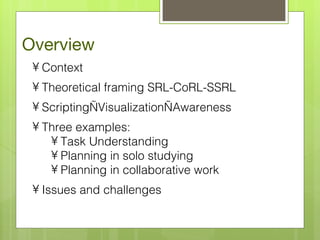
Overview
 • Context
 • Theoretical framing SRL-CoRL-SSRL
 • Scripting—Visualization—Awareness
 • Three examples:
    • Task Understanding
    • Planning in solo studying
    • Planning in collaborative work
 • Issues and challenges
3


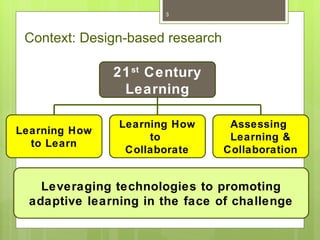
 Context: Design-based research

                  st
               21 Century
                Learning

                Learning How       Assessing
Learning How
                     to            Learning &
  to Learn
                 Collaborate      Collaboration


    Leveraging technologies to promoting
  adaptive learning in the face of challenge
5


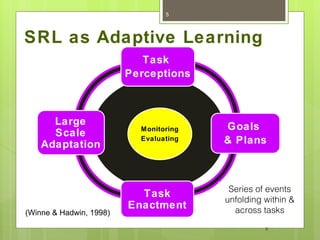
SRL as Adaptive Learning
                            Task
                         Perceptions


      Large                             Goals
                           Monitoring
      Scale              Condistions
                           Evaluating   & Plans
    Adaptation


                                         Series of events
                           Task
                                        unfolding within &
                         Enactment        across tasks
(Winne & Hadwin, 1998)
                                                  5
6


Lisa was studying for a midterm exam in environmental studies. Her professor told students the exam

covers Chapters 5-7, and consists of 35 multiple-choice questions (worth 2 points each) plus 3

short answer questions (worth 10 point each). Lisa’s professor provided a list of testable concepts

covered to date. Lisa looked over the list of concepts and created cue-cards for each one. She wrote

the concept on one side and copied point form explanations on the other side from her notes or

textbook. Over five days, Lisa quizzed herself by reading each concept and trying to remember exactly

what she had written on the other side. When she faltered, she re-read her written points. Lisa

repeated this process until she could make her way faultlessly through every card. “I’m totally ready,”

she thought. When she read the first exam question, she panicked. Although the concepts she studied

were included in questions, they were embedded in problem scenarios or in questions contrasting

several concepts. Lisa received a C+ on her exam. Feeling devastated, she met with her professor. As

they reviewed the exam questions, Lisa realized that when the professor said, “Know these concepts,”

she meant “know how concepts relate to environmental issues and problems”. The professor explained

this is why she had introduced case examples in each lecture and used those issues for

discussion points in each tutorial.
7

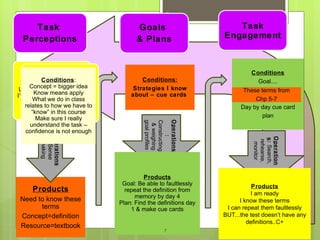
     Task                               Goals                         Task
  Perceptions                           & Plans                    Engagement


                                                                             Conditions
        Conditions:
           Conditions:                    Conditions:                          Goal....
   35 MC; Chapter 5-7
 List Concept = bigger idea
      of testable concepts             Strategies I know                  These terms from
        Know means apply              about – cue cards
I’ve done lots of tests like
       What before in class                                                   Chp 5-7
         this we do
    relates to to study have to
      5 days how we                                                      Day by day cue card
       “know” in this course
         Make sure I really                                                      plan


                                           Operations
                                           goal profiles

                                           Constructing
      understand the task –


                                            & weighing
    confidence is not enough
         Operations


                                                 :


                                                                              Operation
                                                                              s: Search,
                                                                               rehearse,
          : Sense
           making


                                                                                monitor
                                           Products
                                   Goal: Be able to faultlessly               Products
      Products                      repeat the definition from
                                        memory by day 4                      I am ready
 Need to know these                                                      I know these terms
                                  Plan: Find the definitions day
       terms                          1 & make cue cards            I can repeat them faultlessly
 Concept=definition                                                BUT...the test doesn’t have any
                                                                            definitions..C+
 Resource=textbook
                                                   7
9


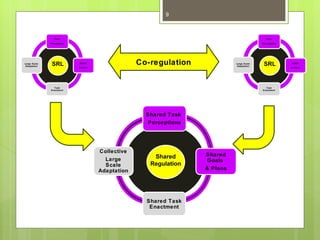
                Task                                                                         Task

              Perceptions                                                                  Perceptions


Large Scale
Adaptation     SRL          Goals

                            & Plans
                                                   Co-regulation             Large Scale
                                                                             Adaptation     SRL          Goals

                                                                                                         & Plans


                Task                                                                         Task
              Enactment                                                                    Enactment


                                                     Shared Task
                                                     Perceptions


                                      Collective
                                                       Shared      Shared
                                        Large                      Goals
                                        Scale         Regulation
                                      Adaptation                   & Plans


                                                     Shared Task
                                                      Enactment
10


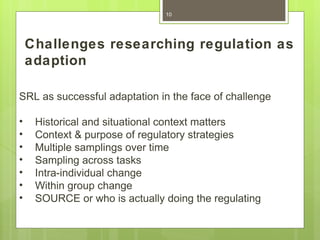
    Challenges researching regulation as
    adaption

SRL as successful adaptation in the face of challenge

•    Historical and situational context matters
•    Context & purpose of regulatory strategies
•    Multiple samplings over time
•    Sampling across tasks
•    Intra-individual change
•    Within group change
•    SOURCE or who is actually doing the regulating
11


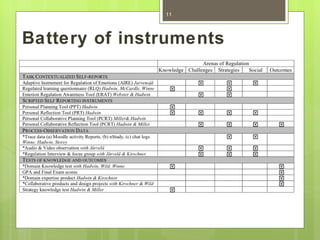
Battery of instruments
PAR-21
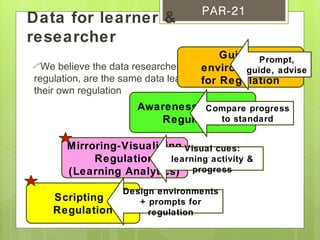
Data for learner &
researcher
                                          Guiding  Prompt,
We believe the data researchers need to study
                                      environments advise
                                                guide,
regulation, are the same data learners need to improve
                                      for Regulation
their own regulation
                         Awareness tools for progress
                                    Compare
                            Regulationto standard

       Mirroring-Visualizing Visual cues:
            Regulation    learning activity &
       (Learning Analytics) progress
                       Design environments
    Scripting             + prompts for
    Regulation              regulation
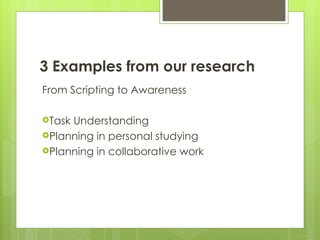
3 Examples from our research
From Scripting to Awareness

TaskUnderstanding
Planning in personal studying
Planning in collaborative work
Example 1:
Task Understanding
Scripting to visualization
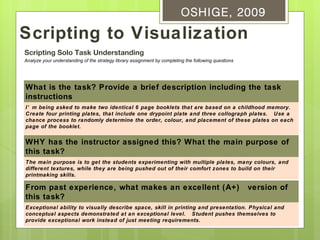
OSHIGE, 2009

Scripting to Visualization
Scripting Solo Task Understanding
Analyze your understanding of the strategy library assignment by completing the following questions


What is the task? Provide a brief description including the task
instructions
I’ m being asked to make two identical 6 page booklets that are based on a childhood memory.
Create four printing plates, that include one drypoint plate and three collograph plates. Use a
chance process to randomly determine the order, colour, and placement of these plates on each
page of the booklet.


WHY has the instructor assigned this? What the main purpose of
this task?
The main purpose is to get the students experimenting with multiple plates, many colours, and
different textures, while they are being pushed out of their comfort zones to build on their
printmaking skills.

From past experience, what makes an excellent (A+)                                                    version of
this task?
Exceptional ability to visually describe space, skill in printing and presentation. Physical and
conceptual aspects demonstrated at an exceptional level. Student pushes themselves to
provide exceptional work instead of just meeting requirements.
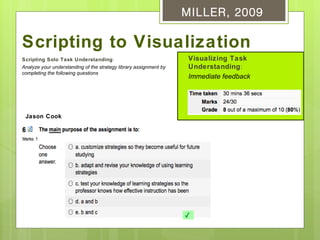
MILLER, 2009

Scripting to Visualization
Scripting Solo Task Understanding:                                  Visualizing Task
Analyze your understanding of the strategy library assignment by    Understanding:
completing the following questions
                                                                    Immediate feedback


 Jason Cook
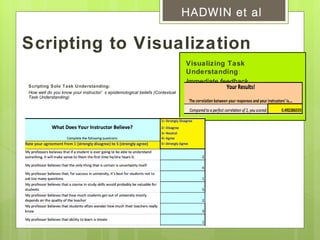
HADWIN et al

Scripting to Visualization
                                                                              Visualizing Task
                                                                              Understanding:
                                                                              Immediate feedback
Scripting Solo Task Understanding:
How well do you know your instructor’ s epistemological beliefs (Contextual
Task Understanding)
Example 2:
Personalized Planning for
studying
From Scripting to awareness
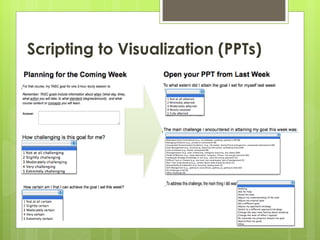
Scripting to Visualization (PPTs)
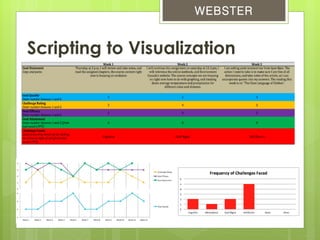
WEBSTER


Scripting to Visualization

     PPT excel
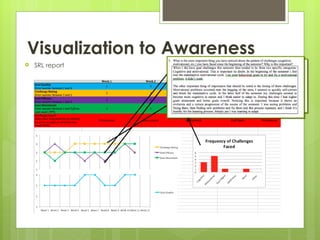
Visualization to Awareness
   SRL report
Example 3:
Collaborative Planning
From scripting to awareness
Scripting to Visualization
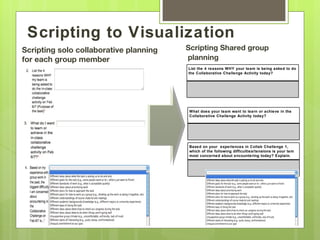
Scripting solo collaborative planning   Scripting Shared group
for each group member                   planning
                                        List the 4 reasons WHY your team is being asked to do
                                        the Collaborative Challenge Activity today?


                                        What does your team want to learn or achieve in the
                                        Collaborative Challenge Activity today?


                                        Based on your experiences in Collab Challenge 1,
                                        which of the following difficulties/tensions is your tem
                                        most concerned about encountering today? Explain.
Scripting to Visualization
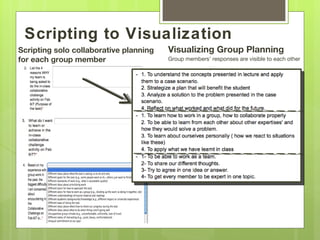
Scripting solo collaborative planning   Visualizing Group Planning
for each group member                   Group members’ responses are visible to each other
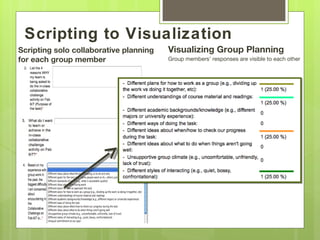
Scripting to Visualization
Scripting solo collaborative planning   Visualizing Group Planning
for each group member                   Group members’ responses are visible to each other
Scripting to Visualization
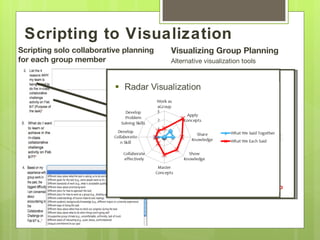
Scripting solo collaborative planning       Visualizing Group Planning
for each group member                       Alternative visualization tools

                              Flow Charts Visualization


                             Green = ideas mentioned by individuals and the group
                             Red = ideas mentioned by individuals but not the group
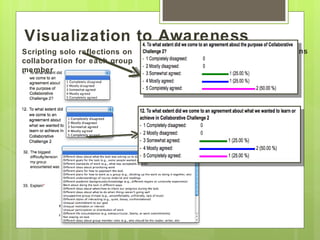
Visualization to Awareness
Scripting solo reflections on   Visualizing collaborative reflections
collaboration for each group    for the group
member
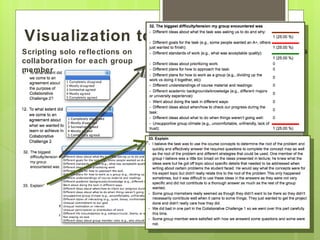
Visualization to Awareness
Scripting solo reflections on   Visualizing collaborative reflections
collaboration for each group    for the group
member
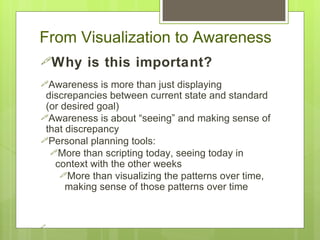
From Visualization to Awareness
Why      is this important?
Awareness    is more than just displaying
 discrepancies between current state and standard
 (or desired goal)
Awareness is about “seeing” and making sense of
 that discrepancy
Personal planning tools:
  More than scripting today, seeing today in
   context with the other weeks
    More than visualizing the patterns over time,
      making sense of those patterns over time



29


                                                      Findings
 In a recent case study of shared planning, most group members reported high
  consensus in their shared plans despite describing different ideas about the
  purpose of the task and different goals for the task in their individual plans
   (Miller & Hadwin, 2012)

                                          Group Member      Task Purpose Consensus

                                          Jay               Completely agreed

                                          Aaron             Completely agreed

                                          Michael           Mostly agreed

                                          Kelsey            Somewhat agreed


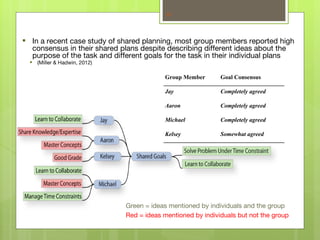
                                 Green = ideas mentioned by individuals and the group
                                 Red = ideas mentioned by individuals but not the group
30


 In a recent case study of shared planning, most group members reported high
  consensus in their shared plans despite describing different ideas about the
  purpose of the task and different goals for the task in their individual plans
   (Miller & Hadwin, 2012)

                                           Group Member      Goal Consensus

                                           Jay               Completely agreed

                                           Aaron             Completely agreed

                                           Michael           Completely agreed

                                           Kelsey            Somewhat agreed


                              Green = ideas mentioned by individuals and the group
                              Red = ideas mentioned by individuals but not the group
Charting future trajectories
   Scripting opportunities to engage metacognitively and
    reflectively in academic work

   Creating opportunities for learners to visualize patterns
    in their challenges, task perceptions, goals, motivation,
    evaluations in relation to past events and tasks (SRL as
    unfolding paterns)

   Scripting awareness of regulation patterns over time and
    tasks

   Leveraging awareness to guide and promote adaptive
    learning



Challenges                   & Opportunities
When does scripting             Scripting   adaptive habits in
 become other regulation?         learning

When   does guiding become      Helping  learners visualize data
 other regulation?                across studying sessions –
                                  breaking maladapative patterns
Who   is doing the regulating
 (learner, computer, other       Adaptive  regulation is a lifelong
 person)?                         learning skill – not just for
                                  academic success
Adapting  in the face of new
 challenges vs. adopting         Shift to view challenges and
 prescribed scripts               errors as necessary
                                  opportunities to learn to regulate


35


For more information:

hadwin@uvic.ca
http://allysonhadwin.wordpress.com/

Promoting & researching adaptive regulation: Successes, challenges & possibilities

  • 1.
    1 Promoting & researchingadaptive regulation: Successes, challenges & possibilities Allyson Fiona Hadwin Stephanie Helm, Lindsay McCardle, Mariel Miller, Elizabeth Webster University of Victoria, BC, Canada Research funded by a SSHRC Standard Research Grant Technology Integration & University of Victoria 410-2008-0700 Evaluation Research Lab
  • 2.
    Overview • Context • Theoretical framing SRL-CoRL-SSRL • Scripting—Visualization—Awareness • Three examples: • Task Understanding • Planning in solo studying • Planning in collaborative work • Issues and challenges
  • 3.
    3 Context: Design-basedresearch st 21 Century Learning Learning How Assessing Learning How to Learning & to Learn Collaborate Collaboration Leveraging technologies to promoting adaptive learning in the face of challenge
  • 4.
    5 SRL as AdaptiveLearning Task Perceptions Large Goals Monitoring Scale Condistions Evaluating & Plans Adaptation Series of events Task unfolding within & Enactment across tasks (Winne & Hadwin, 1998) 5
  • 5.
    6 Lisa was studyingfor a midterm exam in environmental studies. Her professor told students the exam covers Chapters 5-7, and consists of 35 multiple-choice questions (worth 2 points each) plus 3 short answer questions (worth 10 point each). Lisa’s professor provided a list of testable concepts covered to date. Lisa looked over the list of concepts and created cue-cards for each one. She wrote the concept on one side and copied point form explanations on the other side from her notes or textbook. Over five days, Lisa quizzed herself by reading each concept and trying to remember exactly what she had written on the other side. When she faltered, she re-read her written points. Lisa repeated this process until she could make her way faultlessly through every card. “I’m totally ready,” she thought. When she read the first exam question, she panicked. Although the concepts she studied were included in questions, they were embedded in problem scenarios or in questions contrasting several concepts. Lisa received a C+ on her exam. Feeling devastated, she met with her professor. As they reviewed the exam questions, Lisa realized that when the professor said, “Know these concepts,” she meant “know how concepts relate to environmental issues and problems”. The professor explained this is why she had introduced case examples in each lecture and used those issues for discussion points in each tutorial.
  • 6.
    7 Task Goals Task Perceptions & Plans Engagement Conditions Conditions: Conditions: Conditions: Goal.... 35 MC; Chapter 5-7 List Concept = bigger idea of testable concepts Strategies I know These terms from Know means apply about – cue cards I’ve done lots of tests like What before in class Chp 5-7 this we do relates to to study have to 5 days how we Day by day cue card “know” in this course Make sure I really plan Operations goal profiles Constructing understand the task – & weighing confidence is not enough Operations : Operation s: Search, rehearse, : Sense making monitor Products Goal: Be able to faultlessly Products Products repeat the definition from memory by day 4 I am ready Need to know these I know these terms Plan: Find the definitions day terms 1 & make cue cards I can repeat them faultlessly Concept=definition BUT...the test doesn’t have any definitions..C+ Resource=textbook 7
  • 7.
    9 Task Task Perceptions Perceptions Large Scale Adaptation SRL Goals & Plans Co-regulation Large Scale Adaptation SRL Goals & Plans Task Task Enactment Enactment Shared Task Perceptions Collective Shared Shared Large Goals Scale Regulation Adaptation & Plans Shared Task Enactment
  • 8.
    10 Challenges researching regulation as adaption SRL as successful adaptation in the face of challenge • Historical and situational context matters • Context & purpose of regulatory strategies • Multiple samplings over time • Sampling across tasks • Intra-individual change • Within group change • SOURCE or who is actually doing the regulating
  • 9.
  • 10.
    PAR-21 Data for learner& researcher Guiding Prompt, We believe the data researchers need to study environments advise guide, regulation, are the same data learners need to improve for Regulation their own regulation Awareness tools for progress Compare Regulationto standard Mirroring-Visualizing Visual cues: Regulation learning activity & (Learning Analytics) progress Design environments Scripting + prompts for Regulation regulation
  • 11.
    3 Examples fromour research From Scripting to Awareness TaskUnderstanding Planning in personal studying Planning in collaborative work
  • 12.
  • 13.
    OSHIGE, 2009 Scripting toVisualization Scripting Solo Task Understanding Analyze your understanding of the strategy library assignment by completing the following questions What is the task? Provide a brief description including the task instructions I’ m being asked to make two identical 6 page booklets that are based on a childhood memory. Create four printing plates, that include one drypoint plate and three collograph plates. Use a chance process to randomly determine the order, colour, and placement of these plates on each page of the booklet. WHY has the instructor assigned this? What the main purpose of this task? The main purpose is to get the students experimenting with multiple plates, many colours, and different textures, while they are being pushed out of their comfort zones to build on their printmaking skills. From past experience, what makes an excellent (A+) version of this task? Exceptional ability to visually describe space, skill in printing and presentation. Physical and conceptual aspects demonstrated at an exceptional level. Student pushes themselves to provide exceptional work instead of just meeting requirements.
  • 14.
    MILLER, 2009 Scripting toVisualization Scripting Solo Task Understanding: Visualizing Task Analyze your understanding of the strategy library assignment by Understanding: completing the following questions Immediate feedback Jason Cook
  • 15.
    HADWIN et al Scriptingto Visualization Visualizing Task Understanding: Immediate feedback Scripting Solo Task Understanding: How well do you know your instructor’ s epistemological beliefs (Contextual Task Understanding)
  • 16.
    Example 2: Personalized Planningfor studying From Scripting to awareness
  • 17.
  • 18.
  • 19.
  • 20.
  • 21.
    Scripting to Visualization Scriptingsolo collaborative planning Scripting Shared group for each group member planning List the 4 reasons WHY your team is being asked to do the Collaborative Challenge Activity today? What does your team want to learn or achieve in the Collaborative Challenge Activity today? Based on your experiences in Collab Challenge 1, which of the following difficulties/tensions is your tem most concerned about encountering today? Explain.
  • 22.
    Scripting to Visualization Scriptingsolo collaborative planning Visualizing Group Planning for each group member Group members’ responses are visible to each other
  • 23.
    Scripting to Visualization Scriptingsolo collaborative planning Visualizing Group Planning for each group member Group members’ responses are visible to each other
  • 24.
    Scripting to Visualization Scriptingsolo collaborative planning Visualizing Group Planning for each group member Alternative visualization tools Flow Charts Visualization Green = ideas mentioned by individuals and the group Red = ideas mentioned by individuals but not the group
  • 25.
    Visualization to Awareness Scriptingsolo reflections on Visualizing collaborative reflections collaboration for each group for the group member
  • 26.
    Visualization to Awareness Scriptingsolo reflections on Visualizing collaborative reflections collaboration for each group for the group member
  • 27.
    From Visualization toAwareness Why is this important? Awareness is more than just displaying discrepancies between current state and standard (or desired goal) Awareness is about “seeing” and making sense of that discrepancy Personal planning tools: More than scripting today, seeing today in context with the other weeks More than visualizing the patterns over time, making sense of those patterns over time 
  • 28.
    29 Findings  In a recent case study of shared planning, most group members reported high consensus in their shared plans despite describing different ideas about the purpose of the task and different goals for the task in their individual plans  (Miller & Hadwin, 2012) Group Member Task Purpose Consensus Jay Completely agreed Aaron Completely agreed Michael Mostly agreed Kelsey Somewhat agreed Green = ideas mentioned by individuals and the group Red = ideas mentioned by individuals but not the group
  • 29.
    30  In arecent case study of shared planning, most group members reported high consensus in their shared plans despite describing different ideas about the purpose of the task and different goals for the task in their individual plans  (Miller & Hadwin, 2012) Group Member Goal Consensus Jay Completely agreed Aaron Completely agreed Michael Completely agreed Kelsey Somewhat agreed Green = ideas mentioned by individuals and the group Red = ideas mentioned by individuals but not the group
  • 30.
    Charting future trajectories  Scripting opportunities to engage metacognitively and reflectively in academic work  Creating opportunities for learners to visualize patterns in their challenges, task perceptions, goals, motivation, evaluations in relation to past events and tasks (SRL as unfolding paterns)  Scripting awareness of regulation patterns over time and tasks  Leveraging awareness to guide and promote adaptive learning 
  • 31.
    Challenges & Opportunities When does scripting Scripting adaptive habits in become other regulation? learning When does guiding become Helping learners visualize data other regulation? across studying sessions – breaking maladapative patterns Who is doing the regulating (learner, computer, other Adaptive regulation is a lifelong person)? learning skill – not just for academic success Adapting in the face of new challenges vs. adopting Shift to view challenges and prescribed scripts errors as necessary opportunities to learn to regulate 
  • 32.

Editor's Notes

  • #3 Both groups demonstrated fairly good quality of shared plans Both groups included 3 of the 4 task purposes described by the instructor Both groups left out individual ideas about the task purpose that could have contributed more alignment with the instructor Both groups set goals aligned with their perceptions of the task Although goals did not target the full breadth of ideas in their shared task perceptions AND Low performers left out individual’s goals that could have more comprehensively aligned their goals with shared task perceptions.
  • #11 Scripting tools support learners by structuring steps in a workflow. To date, scripting tools have focused on promoting task management and more recently cognitive work or knowledge co-construction (cf., O’Donnell et al., 2005) rather than scripting the regulation of collaborative work. In PAR-21 we examine how scripting tools, including O’Donnell’s (1999) roles and prompts, can support regulation. Visualization or mirroring tools collect, aggregate and reflect information back to learners to boost awareness about how they engage as individuals and as a group (Kreijns, Kirschner, & Jochems, 2002; Soller et al., 2005). However, Martens et al. (2011) found that merely providing learners with visualizations of their motivation scores did not promote motivation regulation because learners missed opportunities to reflect upon and make sense of that feedback. Awareness tools help learners compare current regulatory processes with standards they set out in goals. These tools target (a) group awareness such as knowing who is online, what collaborators are looking at and what they are doing (e.g., Leinonen, Järvelä, & Häkkinen, 2005); and (b) social awareness such as discerning team members’ knowledge and perceptions (Buder & Bodemer, 2008). When information is presented in a way that affords comparisons across team members or across teams, the tools support metacognition (Phielix, Prins, Krischner, et al, 2011). Guiding systems (Soller et al., 2005) use complex computational algorithms that “interpret” data and offer coaching or guidance (Azevedo et al., 2010).
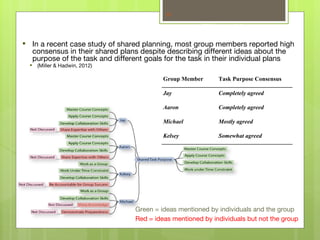
  • #22 Radar Chart \\s Web display of the idea. Red lines are what all the group members said individually (and how many people mentioned the idea (maximum of 4). Blue is what the group said together (maximum of 1). Doesn’t show what happened in the group discussion. Gives some idea of the overlap between individuals and the group, but somewhat misleading because group responses (blue) are out of a maximum of 1. If you take out the group response though, it gives a good visualization of the ideas mentioned by each individual (and how many of them mentioned it). For instance, this one shows that in this group, 3 people said apply concepts individually, and the group also said apply concepts. 2 people individually said master concepts, but the group didn’t, etc.
  • #23 Radar Chart \\s Web display of the idea. Red lines are what all the group members said individually (and how many people mentioned the idea (maximum of 4). Blue is what the group said together (maximum of 1). Doesn’t show what happened in the group discussion. Gives some idea of the overlap between individuals and the group, but somewhat misleading because group responses (blue) are out of a maximum of 1. If you take out the group response though, it gives a good visualization of the ideas mentioned by each individual (and how many of them mentioned it). For instance, this one shows that in this group, 3 people said apply concepts individually, and the group also said apply concepts. 2 people individually said master concepts, but the group didn’t, etc.
  • #24 Radar Chart \\s Web display of the idea. Red lines are what all the group members said individually (and how many people mentioned the idea (maximum of 4). Blue is what the group said together (maximum of 1). Doesn’t show what happened in the group discussion. Gives some idea of the overlap between individuals and the group, but somewhat misleading because group responses (blue) are out of a maximum of 1. If you take out the group response though, it gives a good visualization of the ideas mentioned by each individual (and how many of them mentioned it). For instance, this one shows that in this group, 3 people said apply concepts individually, and the group also said apply concepts. 2 people individually said master concepts, but the group didn’t, etc.
  • #25 Radar Chart \\s Web display of the idea. Red lines are what all the group members said individually (and how many people mentioned the idea (maximum of 4). Blue is what the group said together (maximum of 1). Doesn’t show what happened in the group discussion. Gives some idea of the overlap between individuals and the group, but somewhat misleading because group responses (blue) are out of a maximum of 1. If you take out the group response though, it gives a good visualization of the ideas mentioned by each individual (and how many of them mentioned it). For instance, this one shows that in this group, 3 people said apply concepts individually, and the group also said apply concepts. 2 people individually said master concepts, but the group didn’t, etc.
  • #26 Radar Chart \\s Web display of the idea. Red lines are what all the group members said individually (and how many people mentioned the idea (maximum of 4). Blue is what the group said together (maximum of 1). Doesn’t show what happened in the group discussion. Gives some idea of the overlap between individuals and the group, but somewhat misleading because group responses (blue) are out of a maximum of 1. If you take out the group response though, it gives a good visualization of the ideas mentioned by each individual (and how many of them mentioned it). For instance, this one shows that in this group, 3 people said apply concepts individually, and the group also said apply concepts. 2 people individually said master concepts, but the group didn’t, etc.
  • #27 Radar Chart \\s Web display of the idea. Red lines are what all the group members said individually (and how many people mentioned the idea (maximum of 4). Blue is what the group said together (maximum of 1). Doesn’t show what happened in the group discussion. Gives some idea of the overlap between individuals and the group, but somewhat misleading because group responses (blue) are out of a maximum of 1. If you take out the group response though, it gives a good visualization of the ideas mentioned by each individual (and how many of them mentioned it). For instance, this one shows that in this group, 3 people said apply concepts individually, and the group also said apply concepts. 2 people individually said master concepts, but the group didn’t, etc.
  • #29 Comparatively, nearly all students reported the perception that their group had reached consensus.  
  • #30 Comparatively, nearly all students reported the perception that their group had reached consensus.