Facility Capacity and Location Chapter 5, Part A
Overview Facility Planning Long-Range Capacity Planning Facility Location Wrap-Up: What World-Class Companies Do
Facility Planning HOW MUCH long range capacity is needed WHEN additional capacity is needed WHERE the production facilities should be located WHAT the layout and characteristics of the facilities should be
Facility Planning The capital investment in land, buildings, technology, and machinery is enormous A firm must live with its facility planning decisions for a long time, and these decisions affect: Operating efficiency Economy of scale Ease of scheduling Maintenance costs …  Profitability!
Long-Range Capacity Planning
Steps in the Capacity Planning Process Estimate the capacity of the present facilities. Forecast the long-range future capacity needs. Identify and analyze sources of capacity to meet these needs. Select from among the alternative sources of capacity.
Definitions of Capacity In general,  production capacity  is the maximum production rate of an organization. Capacity can be difficult to quantify due to … Day-to-day uncertainties such as employee absences, equipment breakdowns, and material-delivery delays Products and services differ in production rates (so product mix is a factor) Different interpretations of maximum capacity
Definitions of Capacity The Federal Reserve Board defines  sustainable practical capacity  as the greatest level of output that a plant can maintain … within the framework of a realistic work schedule taking account of normal downtime assuming sufficient availability of inputs to operate the machinery and equipment in place
Measurements of Capacity Output Rate Capacity For a facility having a single product or a few homogeneous products, the unit of measure is straightforward (barrels of beer per month) For a facility having a diverse mix of products, an  aggregate unit of capacity  must be established using a common unit of output (sales dollars per week)
Measurements of Capacity Input Rate Capacity   Commonly used for service operations where output measures are particularly difficult Hospitals use available beds per month Airlines use available seat-miles per month Movie theatres use available seats per month
Measurements of Capacity Capacity Utilization Percentage Relates actual output to output capacity Example:  Actual automobiles produced in a quarter divided by the quarterly automobile production capacity Relates actual input used to input capacity Example:  Actual accountant hours used in a month divided by the monthly account-hours available
Measurements of Capacity Capacity Cushion an additional amount of capacity added onto the expected demand to allow for: greater than expected demand demand during peak demand seasons lower production costs product and volume flexibility improved quality of products and services
Forecasting Capacity Demand  Consider the life of the input (e.g. facility is 10-30 yr) Understand product life cycle as it impacts capacity Anticipate technological developments Anticipate competitors’ actions Forecast the firm’s demand
Other Considerations Resource availability Accuracy of the long-range forecast Capacity cushion Changes in competitive environment
Expansion of Long-Term Capacity Subcontract with other companies Acquire other companies, facilities, or resources Develop sites, construct buildings, buy equipment Expand, update, or modify existing facilities Reactivate standby facilities
Reduction of Long-Term Capacity Sell off existing resources, lay off employees Mothball facilities, transfer employees Develop and phase in new products/services
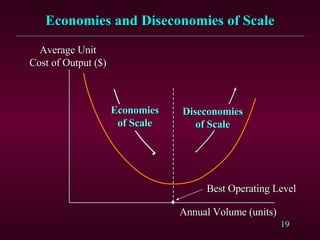
Economies of Scale Best operating level  - least average unit cost Economies of scale  - average cost per unit decreases as the volume increases toward the best operating level Diseconomies of scale  - average cost per unit increases as the volume increases beyond the best operating level
Economies and Diseconomies of Scale Average Unit Cost of Output ($) Annual Volume (units) Best Operating Level Economies of Scale Diseconomies of Scale
Economies of Scale Declining costs result from: Fixed costs being spread over more and more units Longer production runs result in a smaller proportion of labor being allocated to setups Proportionally less material scrap …  and other economies
Diseconomies of Scale Increasing costs result from increased congestion of workers and material, which contributes to: Increasing inefficiency Difficulty in scheduling Damaged goods Reduced morale Increased use of overtime …  and other diseconomies
Two General Approaches  to Expanding Long-Range Capacity All at Once  – build the ultimate facility now and grow into it Incrementally  – build incrementally as capacity demand grows
Two General Approaches  to Expanding Long-Range Capacity All at Once   Little risk of having to turn down business due to inadequate capacity Less interruption of production One large construction project costs less than several smaller projects Due to inflation, construction costs will be higher in the future Most appropriate for mature products with stable demand
Two General Approaches  to Expanding Long-Range Capacity Incrementally   Less risky if forecast needs do not materialize Funds that could be used for other types of investments will not be tied up in excess capacity More appropriate for new products
Subcontractor Networks A viable alternative to larger-capacity facilities is to develop subcontractor and supplier networks. “ Farming out” or outsourcing your capacity needs to your suppliers Developing long-range relationships with suppliers of parts, components, and subassemblies Relying less on backward vertical integration Requiring less capital for production facilities More easily varying capacity during slack or peak demand periods
Outsourcing Service Functions Building maintenance Data processing Delivery Payroll Bookkeeping Customer service Mailroom Benefits administration …  and more
Economies of Scope The ability to produce many product models in one flexible facility more cheaply than in separate facilities Highly flexible and programmable automation allows quick, inexpensive product-to-product changes Economies are created by spreading the automation cost over many products
Analyzing Capacity-Planning Decisions Break-Even Analysis  (Chapter 4 and this chapter) Present-Value Analysis Computer Simulation  (Chapter 9) Waiting Line Analysis (Chapter 9) Linear Programming  (Chapter 8) Decision Tree Analysis  (this chapter)
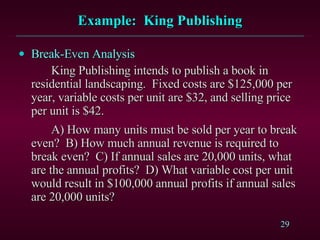
Example:  King Publishing Break-Even Analysis King Publishing intends to publish a book in residential landscaping.  Fixed costs are $125,000 per year, variable costs per unit are $32, and selling price per unit is $42. A) How many units must be sold per year to break even?  B) How much annual revenue is required to break even?  C) If annual sales are 20,000 units, what are the annual profits?  D) What variable cost per unit would result in $100,000 annual profits if annual sales are 20,000 units?
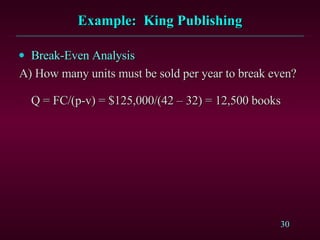
Example:  King Publishing Break-Even Analysis A) How many units must be sold per year to break even? Q = FC/(p-v) = $125,000/(42 – 32) = 12,500 books
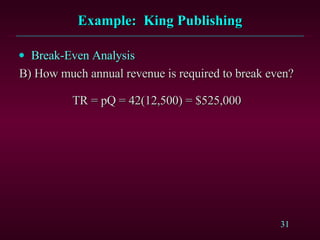
Example:  King Publishing Break-Even Analysis B) How much annual revenue is required to break even?   TR = pQ = 42(12,500) = $525,000
Example:  King Publishing Break-Even Analysis C) If annual sales are 20,000 units, what are the annual  profits?   P = pQ – (FC + vQ)   = 42(20,000) – [125,000 + 32(20,000)]   = 840,000 – 125,000 – 640,000   = $75,000
Example:  King Publishing Break-Even Analysis D) What variable cost per unit would result in $100,000 annual profits if annual sales are 20,000 units?   P = pQ – (FC + vQ)   100,000 = 42(20,000) – [125,000 + v(20,000)]   100,000 = 840,000 – 125,000 – 20,000v   20,000v = 615,000     v = $30.75
Decision Tree Analysis Structures complex multiphase decisions, showing: What decisions must be made What sequence the decisions must occur Interdependence of the decisions Allows objective evaluation of alternatives Incorporates uncertainty Develops expected values
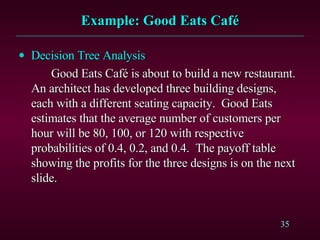
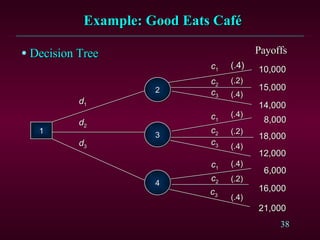
Example: Good Eats Café Decision Tree Analysis   Good Eats Café is about to build a new restaurant.  An architect has developed three building designs, each with a different seating capacity.  Good Eats estimates that the average number of customers per hour will be 80, 100, or 120 with respective probabilities of 0.4, 0.2, and 0.4.  The payoff table showing the profits for the three designs is on the next slide.
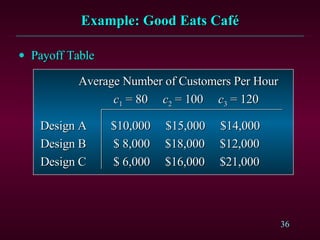
Payoff Table   Average Number of Customers Per Hour   c 1  = 80  c 2  = 100  c 3  = 120   Design A  $10,000  $15,000  $14,000 Design B  $ 8,000  $18,000  $12,000 Design C  $ 6,000  $16,000  $21,000 Example: Good Eats Café
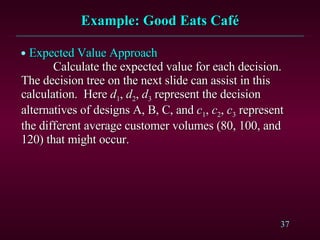
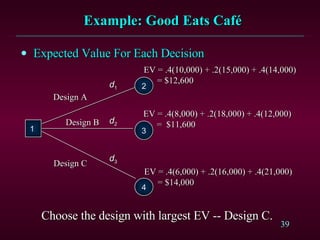
Expected Value Approach Calculate the expected value for each decision.  The decision tree on the next slide can assist in this calculation.  Here  d 1 ,  d 2 ,  d 3  represent the decision alternatives of designs A, B, C, and  c 1 ,  c 2 ,  c 3  represent the different average customer volumes (80, 100, and 120) that might occur. Example: Good Eats Café
Decision Tree Example: Good Eats Café 1 (. 2 ) (. 4 ) (. 4 ) (. 4 ) (. 2 ) (. 4 ) (. 4 ) (. 2 ) (. 4 ) d 1 d 2 d 3 c 1 c 1 c 1 c 2 c 3 c 2 c 2 c 3 c 3 Payoffs 10,000 15,000 14,000 8,000 18,000 12,000 6,000 16,000 21,000 2 3 4
Expected Value For Each Decision   Choose the design with largest EV -- Design C. 3 4 d 1 d 2 d 3 EV = .4(10,000) + .2(15,000) + .4(14,000) = $12,600 EV = .4(8,000) + .2(18,000) + .4(12,000) =  $11,600 EV = .4(6,000) + .2(16,000) + .4(21,000) = $14,000 Design A Design B Design C 2 1   Example: Good Eats Café
Facility Location
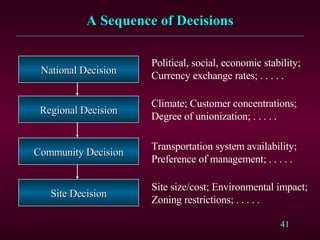
A Sequence of Decisions National Decision Regional Decision Community Decision Site Decision Political, social, economic stability; Currency exchange rates; . . . . . Climate; Customer concentrations; Degree of unionization; . . . . . Transportation system availability; Preference of management; . . . . . Site size/cost; Environmental impact;  Zoning restrictions; . . . . .
Factors Affecting  the Location Decision Economic   Site acquisition, preparation and construction costs Labor costs, skills and availability Utilities costs and availability Transportation costs Taxes
Factors Affecting  the Location Decision Non-economic Labor attitudes and traditions Training and employment services Community’s attitude Schools and churches Recreation and cultural attractions Amount and type of housing available
Facility Types and Their Dominant Locational Factors Mining, Quarrying, and Heavy Manufacturing Near their raw material sources Abundant supply of utilities Land and construction costs are inexpensive Light Manufacturing Availability and cost of labor Warehousing Proximity to transportation facilities Incoming and outgoing transportation costs . . . more
Facility Types and Their Dominant Locational Factors R&D and High-Tech Manufacturing Ability to recruit/retain scientists, engineers, etc. Near companies with similar technology interests Retailing and For-Profit Services Near concentrations of target customers Government and Health/Emergency Services Near concentrations of constituents
Some Reasons the  Facility Location Decision Arises Changes in the market Expansion Contraction Geographic shift Changes in inputs Labor skills and/or costs Materials costs and/or availability Utility costs . . . more
Some Reasons the  Facility Location Decision Arises Changes in the environment Regulations and laws Attitude of the community Changes in technology
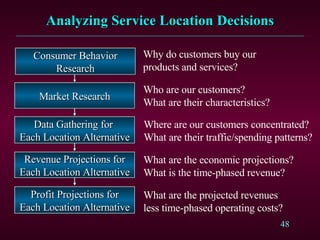
Analyzing Service Location Decisions Consumer Behavior Research Market Research Data Gathering for  Each Location Alternative Revenue Projections for Each Location Alternative Why do customers buy our products and services? Who are our customers? What are their characteristics? What are the economic projections? What is the time-phased revenue? Profit Projections for Each Location Alternative What are the projected revenues less time-phased operating costs? Where are our customers concentrated? What are their traffic/spending patterns?
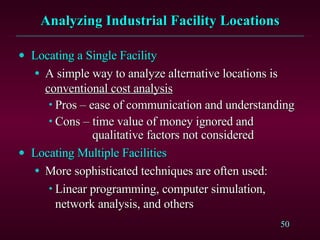
Analyzing Industrial Facility Locations Factors that tend to dominate the industrial-facility location decision are: Transportation costs Labor cost and availability Materials cost and availability Utilities cost
Analyzing Industrial Facility Locations Locating a Single Facility A simple way to analyze alternative locations is  conventional cost analysis Pros – ease of communication and understanding Cons – time value of money ignored and      qualitative factors not considered Locating Multiple Facilities More sophisticated techniques are often used: Linear programming, computer simulation, network analysis, and others
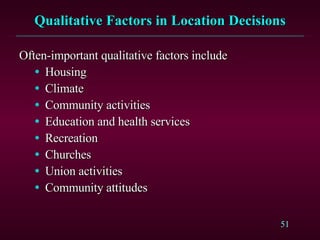
Qualitative Factors in Location Decisions Often-important qualitative factors include Housing Climate Community activities Education and health services Recreation Churches Union activities Community attitudes
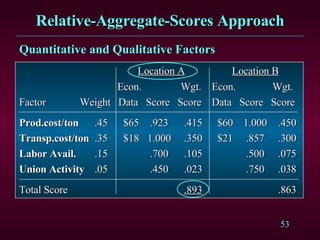
Integrating Qualitative & Quantitative Factors Managers often wrestle with the task of trading off qualitative factors against quantitative ones Methods for systematically displaying the relative advantages and disadvantages, both qualitative and quantitative, of each location alternative have been developed The  relative-aggregate-scores  approach is one such method
Relative-Aggregate-Scores Approach Quantitative and Qualitative Factors   Location A   Location B   Econ.  Wgt.  Econ.   Wgt. Factor   Weight  Data  Score  Score  Data  Score  Score Prod.cost/ton .45 $65 .923 .415 $60 1.000 .450 Transp.cost/ton .35 $18 1.000 .350 $21 .857 .300 Labor Avail. .15 .700 .105 .500 .075 Union Activity .05 .450 .023 .750 .038 Total Score .893 .863
Wrap-Up: World-Class Practice Outstanding long-range business plans Long-range capacity studies Justify investment on how it positions their company to capture market share Facility location decisions involve worldwide search for sites
End of Chapter 5, Part A

lay out

  • 1.
  • 2.
    Facility Capacity andLocation Chapter 5, Part A
  • 3.
    Overview Facility PlanningLong-Range Capacity Planning Facility Location Wrap-Up: What World-Class Companies Do
  • 4.
    Facility Planning HOWMUCH long range capacity is needed WHEN additional capacity is needed WHERE the production facilities should be located WHAT the layout and characteristics of the facilities should be
  • 5.
    Facility Planning Thecapital investment in land, buildings, technology, and machinery is enormous A firm must live with its facility planning decisions for a long time, and these decisions affect: Operating efficiency Economy of scale Ease of scheduling Maintenance costs … Profitability!
  • 6.
  • 7.
    Steps in theCapacity Planning Process Estimate the capacity of the present facilities. Forecast the long-range future capacity needs. Identify and analyze sources of capacity to meet these needs. Select from among the alternative sources of capacity.
  • 8.
    Definitions of CapacityIn general, production capacity is the maximum production rate of an organization. Capacity can be difficult to quantify due to … Day-to-day uncertainties such as employee absences, equipment breakdowns, and material-delivery delays Products and services differ in production rates (so product mix is a factor) Different interpretations of maximum capacity
  • 9.
    Definitions of CapacityThe Federal Reserve Board defines sustainable practical capacity as the greatest level of output that a plant can maintain … within the framework of a realistic work schedule taking account of normal downtime assuming sufficient availability of inputs to operate the machinery and equipment in place
  • 10.
    Measurements of CapacityOutput Rate Capacity For a facility having a single product or a few homogeneous products, the unit of measure is straightforward (barrels of beer per month) For a facility having a diverse mix of products, an aggregate unit of capacity must be established using a common unit of output (sales dollars per week)
  • 11.
    Measurements of CapacityInput Rate Capacity Commonly used for service operations where output measures are particularly difficult Hospitals use available beds per month Airlines use available seat-miles per month Movie theatres use available seats per month
  • 12.
    Measurements of CapacityCapacity Utilization Percentage Relates actual output to output capacity Example: Actual automobiles produced in a quarter divided by the quarterly automobile production capacity Relates actual input used to input capacity Example: Actual accountant hours used in a month divided by the monthly account-hours available
  • 13.
    Measurements of CapacityCapacity Cushion an additional amount of capacity added onto the expected demand to allow for: greater than expected demand demand during peak demand seasons lower production costs product and volume flexibility improved quality of products and services
  • 14.
    Forecasting Capacity Demand Consider the life of the input (e.g. facility is 10-30 yr) Understand product life cycle as it impacts capacity Anticipate technological developments Anticipate competitors’ actions Forecast the firm’s demand
  • 15.
    Other Considerations Resourceavailability Accuracy of the long-range forecast Capacity cushion Changes in competitive environment
  • 16.
    Expansion of Long-TermCapacity Subcontract with other companies Acquire other companies, facilities, or resources Develop sites, construct buildings, buy equipment Expand, update, or modify existing facilities Reactivate standby facilities
  • 17.
    Reduction of Long-TermCapacity Sell off existing resources, lay off employees Mothball facilities, transfer employees Develop and phase in new products/services
  • 18.
    Economies of ScaleBest operating level - least average unit cost Economies of scale - average cost per unit decreases as the volume increases toward the best operating level Diseconomies of scale - average cost per unit increases as the volume increases beyond the best operating level
  • 19.
    Economies and Diseconomiesof Scale Average Unit Cost of Output ($) Annual Volume (units) Best Operating Level Economies of Scale Diseconomies of Scale
  • 20.
    Economies of ScaleDeclining costs result from: Fixed costs being spread over more and more units Longer production runs result in a smaller proportion of labor being allocated to setups Proportionally less material scrap … and other economies
  • 21.
    Diseconomies of ScaleIncreasing costs result from increased congestion of workers and material, which contributes to: Increasing inefficiency Difficulty in scheduling Damaged goods Reduced morale Increased use of overtime … and other diseconomies
  • 22.
    Two General Approaches to Expanding Long-Range Capacity All at Once – build the ultimate facility now and grow into it Incrementally – build incrementally as capacity demand grows
  • 23.
    Two General Approaches to Expanding Long-Range Capacity All at Once Little risk of having to turn down business due to inadequate capacity Less interruption of production One large construction project costs less than several smaller projects Due to inflation, construction costs will be higher in the future Most appropriate for mature products with stable demand
  • 24.
    Two General Approaches to Expanding Long-Range Capacity Incrementally Less risky if forecast needs do not materialize Funds that could be used for other types of investments will not be tied up in excess capacity More appropriate for new products
  • 25.
    Subcontractor Networks Aviable alternative to larger-capacity facilities is to develop subcontractor and supplier networks. “ Farming out” or outsourcing your capacity needs to your suppliers Developing long-range relationships with suppliers of parts, components, and subassemblies Relying less on backward vertical integration Requiring less capital for production facilities More easily varying capacity during slack or peak demand periods
  • 26.
    Outsourcing Service FunctionsBuilding maintenance Data processing Delivery Payroll Bookkeeping Customer service Mailroom Benefits administration … and more
  • 27.
    Economies of ScopeThe ability to produce many product models in one flexible facility more cheaply than in separate facilities Highly flexible and programmable automation allows quick, inexpensive product-to-product changes Economies are created by spreading the automation cost over many products
  • 28.
    Analyzing Capacity-Planning DecisionsBreak-Even Analysis (Chapter 4 and this chapter) Present-Value Analysis Computer Simulation (Chapter 9) Waiting Line Analysis (Chapter 9) Linear Programming (Chapter 8) Decision Tree Analysis (this chapter)
  • 29.
    Example: KingPublishing Break-Even Analysis King Publishing intends to publish a book in residential landscaping. Fixed costs are $125,000 per year, variable costs per unit are $32, and selling price per unit is $42. A) How many units must be sold per year to break even? B) How much annual revenue is required to break even? C) If annual sales are 20,000 units, what are the annual profits? D) What variable cost per unit would result in $100,000 annual profits if annual sales are 20,000 units?
  • 30.
    Example: KingPublishing Break-Even Analysis A) How many units must be sold per year to break even? Q = FC/(p-v) = $125,000/(42 – 32) = 12,500 books
  • 31.
    Example: KingPublishing Break-Even Analysis B) How much annual revenue is required to break even? TR = pQ = 42(12,500) = $525,000
  • 32.
    Example: KingPublishing Break-Even Analysis C) If annual sales are 20,000 units, what are the annual profits? P = pQ – (FC + vQ) = 42(20,000) – [125,000 + 32(20,000)] = 840,000 – 125,000 – 640,000 = $75,000
  • 33.
    Example: KingPublishing Break-Even Analysis D) What variable cost per unit would result in $100,000 annual profits if annual sales are 20,000 units? P = pQ – (FC + vQ) 100,000 = 42(20,000) – [125,000 + v(20,000)] 100,000 = 840,000 – 125,000 – 20,000v 20,000v = 615,000 v = $30.75
  • 34.
    Decision Tree AnalysisStructures complex multiphase decisions, showing: What decisions must be made What sequence the decisions must occur Interdependence of the decisions Allows objective evaluation of alternatives Incorporates uncertainty Develops expected values
  • 35.
    Example: Good EatsCafé Decision Tree Analysis Good Eats Café is about to build a new restaurant. An architect has developed three building designs, each with a different seating capacity. Good Eats estimates that the average number of customers per hour will be 80, 100, or 120 with respective probabilities of 0.4, 0.2, and 0.4. The payoff table showing the profits for the three designs is on the next slide.
  • 36.
    Payoff Table Average Number of Customers Per Hour c 1 = 80 c 2 = 100 c 3 = 120 Design A $10,000 $15,000 $14,000 Design B $ 8,000 $18,000 $12,000 Design C $ 6,000 $16,000 $21,000 Example: Good Eats Café
  • 37.
    Expected Value ApproachCalculate the expected value for each decision. The decision tree on the next slide can assist in this calculation. Here d 1 , d 2 , d 3 represent the decision alternatives of designs A, B, C, and c 1 , c 2 , c 3 represent the different average customer volumes (80, 100, and 120) that might occur. Example: Good Eats Café
  • 38.
    Decision Tree Example:Good Eats Café 1 (. 2 ) (. 4 ) (. 4 ) (. 4 ) (. 2 ) (. 4 ) (. 4 ) (. 2 ) (. 4 ) d 1 d 2 d 3 c 1 c 1 c 1 c 2 c 3 c 2 c 2 c 3 c 3 Payoffs 10,000 15,000 14,000 8,000 18,000 12,000 6,000 16,000 21,000 2 3 4
  • 39.
    Expected Value ForEach Decision Choose the design with largest EV -- Design C. 3 4 d 1 d 2 d 3 EV = .4(10,000) + .2(15,000) + .4(14,000) = $12,600 EV = .4(8,000) + .2(18,000) + .4(12,000) = $11,600 EV = .4(6,000) + .2(16,000) + .4(21,000) = $14,000 Design A Design B Design C 2 1 Example: Good Eats Café
  • 40.
  • 41.
    A Sequence ofDecisions National Decision Regional Decision Community Decision Site Decision Political, social, economic stability; Currency exchange rates; . . . . . Climate; Customer concentrations; Degree of unionization; . . . . . Transportation system availability; Preference of management; . . . . . Site size/cost; Environmental impact; Zoning restrictions; . . . . .
  • 42.
    Factors Affecting the Location Decision Economic Site acquisition, preparation and construction costs Labor costs, skills and availability Utilities costs and availability Transportation costs Taxes
  • 43.
    Factors Affecting the Location Decision Non-economic Labor attitudes and traditions Training and employment services Community’s attitude Schools and churches Recreation and cultural attractions Amount and type of housing available
  • 44.
    Facility Types andTheir Dominant Locational Factors Mining, Quarrying, and Heavy Manufacturing Near their raw material sources Abundant supply of utilities Land and construction costs are inexpensive Light Manufacturing Availability and cost of labor Warehousing Proximity to transportation facilities Incoming and outgoing transportation costs . . . more
  • 45.
    Facility Types andTheir Dominant Locational Factors R&D and High-Tech Manufacturing Ability to recruit/retain scientists, engineers, etc. Near companies with similar technology interests Retailing and For-Profit Services Near concentrations of target customers Government and Health/Emergency Services Near concentrations of constituents
  • 46.
    Some Reasons the Facility Location Decision Arises Changes in the market Expansion Contraction Geographic shift Changes in inputs Labor skills and/or costs Materials costs and/or availability Utility costs . . . more
  • 47.
    Some Reasons the Facility Location Decision Arises Changes in the environment Regulations and laws Attitude of the community Changes in technology
  • 48.
    Analyzing Service LocationDecisions Consumer Behavior Research Market Research Data Gathering for Each Location Alternative Revenue Projections for Each Location Alternative Why do customers buy our products and services? Who are our customers? What are their characteristics? What are the economic projections? What is the time-phased revenue? Profit Projections for Each Location Alternative What are the projected revenues less time-phased operating costs? Where are our customers concentrated? What are their traffic/spending patterns?
  • 49.
    Analyzing Industrial FacilityLocations Factors that tend to dominate the industrial-facility location decision are: Transportation costs Labor cost and availability Materials cost and availability Utilities cost
  • 50.
    Analyzing Industrial FacilityLocations Locating a Single Facility A simple way to analyze alternative locations is conventional cost analysis Pros – ease of communication and understanding Cons – time value of money ignored and qualitative factors not considered Locating Multiple Facilities More sophisticated techniques are often used: Linear programming, computer simulation, network analysis, and others
  • 51.
    Qualitative Factors inLocation Decisions Often-important qualitative factors include Housing Climate Community activities Education and health services Recreation Churches Union activities Community attitudes
  • 52.
    Integrating Qualitative &Quantitative Factors Managers often wrestle with the task of trading off qualitative factors against quantitative ones Methods for systematically displaying the relative advantages and disadvantages, both qualitative and quantitative, of each location alternative have been developed The relative-aggregate-scores approach is one such method
  • 53.
    Relative-Aggregate-Scores Approach Quantitativeand Qualitative Factors Location A Location B Econ. Wgt. Econ. Wgt. Factor Weight Data Score Score Data Score Score Prod.cost/ton .45 $65 .923 .415 $60 1.000 .450 Transp.cost/ton .35 $18 1.000 .350 $21 .857 .300 Labor Avail. .15 .700 .105 .500 .075 Union Activity .05 .450 .023 .750 .038 Total Score .893 .863
  • 54.
    Wrap-Up: World-Class PracticeOutstanding long-range business plans Long-range capacity studies Justify investment on how it positions their company to capture market share Facility location decisions involve worldwide search for sites
  • 55.
    End of Chapter5, Part A