A BOON FOR COMPLICATED AND
INOPERABLE CASES
By:
DR. MRS. MANJUSHREE BOOB
M.D., D.N.B., FICMCH, FICOG
DIPLOMATE OF NATIONAL BOARD.
CONSULTING OBSTETRICIAN GYNAECOLOGIST
INFERTILITY & LAPAROSCOPIC SURGEON
SHUBHAM HOSPITAL BADNERA ROAD, AMRAVATI
REAL LIFE SITUATION
• YOUNG LADY 28 YRS. OLD
• SEVERE MENORRHAGIA REPEATED
• Hb% 5 - 8gm%
• M/4 8 – 10 / 28 – 30 / HOW +++ 6 – 8 Pads WITH
CLOTS.
• O/H  PARA 1 – FTN 2 YRS. ANXIOUS TO HAVE
FURTHER CHILDBEARING.
• P/V / TVS  UTERUS BULKY
• T/T  NOT RESPONDING TO ORAL HORMONES
AND D & C MIRENA INSURTED 4 ur fACT.
CASE STUDY- 2
• 48 YRS OLD.
• SEVERE MENORRHAGIA.
• H/O RENAL TRANSPLANT & ON REGULAR
ANTI PLATELET DRUGS.
• NOT FIT FOR SURGERY.
• MIRENA INSURTED 3 YRS. BACK.
RESULT: GOOD CONTROL FOR BLEEDING
CASE STUDY- 3
• 37 YRS. OLD.
• PARA – 4. ALL C SECTION ALIVE – 2
• H/O HERNIA REPAIR BY PROLENE MESH.
• SEVERE MENORRHAGIA SINCE 2 YRS.
• TVS MULTIPLE FIBROID
• SIZE -- & 2-3 IN NUMBER
• T/T MIRENA.
CASE STUDY- 4
• 4 CASES OF 45 – 48 YRS. OLD.
• PREV 3 C- SECTION.
• SEVERE MENORRHAGIA
• NOT RESPONDING TO DRUGS AND
D & C
• T/T  MIRENA
CASE STUDY- 5
• 32 YRS OLD.
• SEVERE MENORRHAGIA SINCE 2 YRS.
• TVS FIBROID OF SIZE 3 X 3 CM.
INTRAMURAL
• NOT WILLING FOR SURGERY
• PARA 2
• MIRENA INSERTED.
CASE STUDY- 6
• 30 YRS OLD.
• PARA 1 WITH ITP
• SEVERE MENORRHAGIA SINCE 2 YRS.
• MIRENA INSERTED.
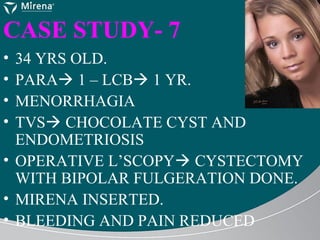
CASE STUDY- 7
• 34 YRS OLD.
• PARA 1 – LCB 1 YR.
• MENORRHAGIA
• TVS CHOCOLATE CYST AND
ENDOMETRIOSIS
• OPERATIVE L’SCOPY CYSTECTOMY
WITH BIPOLAR FULGERATION DONE.
• MIRENA INSERTED.
• BLEEDING AND PAIN REDUCED
CASE STUDY- 8
• 45 YRS OLD FEMALE
• WEIGHING 95 KG.
• SEVERE HT AND DM
• MENORRHAGIA
• D & C DONE
• MIRENA INSERTED.
MIRENA:
BOON FOR COMPLECATED AND
INOPERABLE CASES
CAFETARIA APPROACH
MENORRHAGIA
DUB FIBROID ELSE
ENDOMETRIUM
• ORAL OR INJECTABLE HORMONES
• MIRENA
• THERMA CHOICE
• TCRE
• HYSTERECTOMY
VAGINAL LAPAROTOMY
LAPAROSCOPIC
“ T/T SHOULD BE TAILORMADE TO THE PATIENT
AND HER DISEASE ”
Therapeutic Use of LNG IUS
• Prevention of anemia
• Treatment of menorrhagia / dysmenorrhea
• Alternative to sterilization
• Endometrial protection with ET
• Promising findings:
Treatment of endometriosis / adenomyosis
Endometrial protection with Tamoxifen
Treatment of endometrial hyperplasia
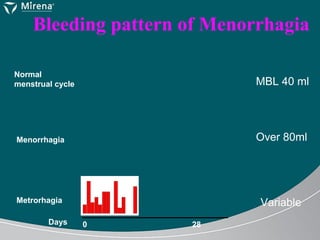
Normal
menstrual cycle
Menorrhagia
Metrorhagia
MBL 40 ml
Over 80ml
Variable
Bleeding pattern of Menorrhagia
280Days
Menstrual Blood Loss before and
after LNG-IUS insertion
0
20
40
60
80
100
Baseline 3 months 6 months 12 months
MBL
(estimated
by PBACs
score)
p<0.0001
p<0.0001
p<0.0001
97
32
22
16
Vera Grigorieva,
Fertil. Steril. 2003
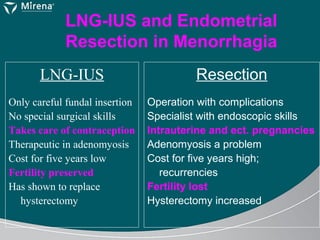
LNG-IUS
Only careful fundal insertion
No special surgical skills
Takes care of contraception
Therapeutic in adenomyosis
Cost for five years low
Fertility preserved
Has shown to replace
hysterectomy
Resection
Operation with complications
Specialist with endoscopic skills
Intrauterine and ect. pregnancies
Adenomyosis a problem
Cost for five years high;
recurrencies
Fertility lost
Hysterectomy increased
LNG-IUS and Endometrial
Resection in Menorrhagia
Summary of LNG-IUS
• LNG-IUS is effective and inexpensive
medication in the treatment of
menorrhagia
MIRENA® in the Symptomatic
Treatment of Endometriosis
Endometrial Hyperplasia, Effect of
MIRENA®
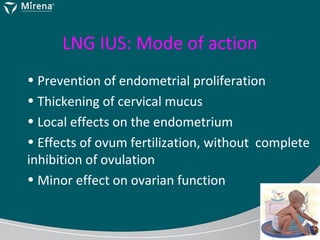
LNG IUS: Mode of action
• Prevention of endometrial proliferation
• Thickening of cervical mucus
• Local effects on the endometrium
• Effects of ovum fertilization, without complete
inhibition of ovulation
• Minor effect on ovarian function
LNG IUS
Bleeding &
spotting days per
month
LNG IUS (n = 1495)
Nova-T (n = 739)
8
6
4
2
0
Meannumberofdays
Months
Meannumberofdays
0
4
8
12
16
0 2 4 6 8 10 12
Bleeding per month in 1st year
Andersson et al., 1994
p < 0.001
Bleeding days per
month
Contraceptive efficacy of LNG IUS
•Overall pregnancy rate: 0.16 per 100 woman-years
•European multicentre study: cumulative gross pregnancy
r ate
- 1-year rate LNG IUS: 0.1%Cu IUD: 1.0%
- 5-year rate LNG IUS: 0.5%Cu IUD: 5.9%
•Risk of ectopic pregnancy: 0.06 per 100 woman-years.
Ectopic rate for women not using any contraception: 0.3-
0.5 per 100 woman-years
What is menorrhagia?
• Menstrual bleeding (bleeding occurring at
normal intervals (21─35 days), but with
– Heavy flow (≥ 80 mL) or
– Duration (≥ 7 days)
• Excessive menstrual blood loss can cause
apprehension, embarrassment and
inconvenience and, over several cycles, may
cause iron deficiency anaemia
Causes of menorrhagia
• Idiopathic
• fibroids
• endometriosis / adenomyosis
• genital infections
• polyps
• hyperplasia
• malignancy
• coagulation or endocrine disorders
• medications
Medical therapy for menorrhagia
• Mirena®
• Progestogens (oral or injectable)
• Tranexamic acid
• Non-steroidal anti-inflammatory agents
• Combined oral contraceptives
• Danazol
• GnRH analogues
74-97%
32-50%
47-54%
20-50%
43%
50%
>90%
Surgical options for
menorrhagia
• Hysterectomy
– Vaginal
– Abdominal
– Laparoscopic
• Endometrial ablation/resection
– Laser
– Thermal balloon
– Microwave
– Transcervical resection of the endometrium (TCRE)
– Fluid instillation
– Cryotherapy
Summary of studies comparing Mirena®
with
endometrial ablation/resection
97% (36 months)
99% (36 months)
19
22
Rauramo et al, 2004
Mirena
TCRE
90% (12 months)
98% (12 months
30
29
Istre and Trolle, 2001
Mirena
TCRE
71% (6 months)
50% (6 months)
25
25
Barrington et al., 2003
Mirena
Thermal balloon
82% (median 20.9 month)
73% (median 8.3 months)
20
35
Henshaw et al., 2002
Mirena
Microwave ablation
Reduction in menstrual
blood loss (duration of
assessment)
NStudy
TCRE; transcervical resection of the endometrium
Mirena lng iucd case discussions

Mirena lng iucd case discussions

  • 1.
    A BOON FORCOMPLICATED AND INOPERABLE CASES By: DR. MRS. MANJUSHREE BOOB M.D., D.N.B., FICMCH, FICOG DIPLOMATE OF NATIONAL BOARD. CONSULTING OBSTETRICIAN GYNAECOLOGIST INFERTILITY & LAPAROSCOPIC SURGEON SHUBHAM HOSPITAL BADNERA ROAD, AMRAVATI
  • 2.
    REAL LIFE SITUATION •YOUNG LADY 28 YRS. OLD • SEVERE MENORRHAGIA REPEATED • Hb% 5 - 8gm% • M/4 8 – 10 / 28 – 30 / HOW +++ 6 – 8 Pads WITH CLOTS. • O/H  PARA 1 – FTN 2 YRS. ANXIOUS TO HAVE FURTHER CHILDBEARING. • P/V / TVS  UTERUS BULKY • T/T  NOT RESPONDING TO ORAL HORMONES AND D & C MIRENA INSURTED 4 ur fACT.
  • 3.
    CASE STUDY- 2 •48 YRS OLD. • SEVERE MENORRHAGIA. • H/O RENAL TRANSPLANT & ON REGULAR ANTI PLATELET DRUGS. • NOT FIT FOR SURGERY. • MIRENA INSURTED 3 YRS. BACK. RESULT: GOOD CONTROL FOR BLEEDING
  • 4.
    CASE STUDY- 3 •37 YRS. OLD. • PARA – 4. ALL C SECTION ALIVE – 2 • H/O HERNIA REPAIR BY PROLENE MESH. • SEVERE MENORRHAGIA SINCE 2 YRS. • TVS MULTIPLE FIBROID • SIZE -- & 2-3 IN NUMBER • T/T MIRENA.
  • 5.
    CASE STUDY- 4 •4 CASES OF 45 – 48 YRS. OLD. • PREV 3 C- SECTION. • SEVERE MENORRHAGIA • NOT RESPONDING TO DRUGS AND D & C • T/T  MIRENA
  • 6.
    CASE STUDY- 5 •32 YRS OLD. • SEVERE MENORRHAGIA SINCE 2 YRS. • TVS FIBROID OF SIZE 3 X 3 CM. INTRAMURAL • NOT WILLING FOR SURGERY • PARA 2 • MIRENA INSERTED.
  • 7.
    CASE STUDY- 6 •30 YRS OLD. • PARA 1 WITH ITP • SEVERE MENORRHAGIA SINCE 2 YRS. • MIRENA INSERTED.
  • 8.
    CASE STUDY- 7 •34 YRS OLD. • PARA 1 – LCB 1 YR. • MENORRHAGIA • TVS CHOCOLATE CYST AND ENDOMETRIOSIS • OPERATIVE L’SCOPY CYSTECTOMY WITH BIPOLAR FULGERATION DONE. • MIRENA INSERTED. • BLEEDING AND PAIN REDUCED
  • 9.
    CASE STUDY- 8 •45 YRS OLD FEMALE • WEIGHING 95 KG. • SEVERE HT AND DM • MENORRHAGIA • D & C DONE • MIRENA INSERTED.
  • 10.
    MIRENA: BOON FOR COMPLECATEDAND INOPERABLE CASES CAFETARIA APPROACH MENORRHAGIA DUB FIBROID ELSE ENDOMETRIUM • ORAL OR INJECTABLE HORMONES • MIRENA • THERMA CHOICE • TCRE • HYSTERECTOMY VAGINAL LAPAROTOMY LAPAROSCOPIC “ T/T SHOULD BE TAILORMADE TO THE PATIENT AND HER DISEASE ”
  • 11.
    Therapeutic Use ofLNG IUS • Prevention of anemia • Treatment of menorrhagia / dysmenorrhea • Alternative to sterilization • Endometrial protection with ET • Promising findings: Treatment of endometriosis / adenomyosis Endometrial protection with Tamoxifen Treatment of endometrial hyperplasia
  • 12.
    Normal menstrual cycle Menorrhagia Metrorhagia MBL 40ml Over 80ml Variable Bleeding pattern of Menorrhagia 280Days
  • 13.
    Menstrual Blood Lossbefore and after LNG-IUS insertion 0 20 40 60 80 100 Baseline 3 months 6 months 12 months MBL (estimated by PBACs score) p<0.0001 p<0.0001 p<0.0001 97 32 22 16 Vera Grigorieva, Fertil. Steril. 2003
  • 14.
    LNG-IUS Only careful fundalinsertion No special surgical skills Takes care of contraception Therapeutic in adenomyosis Cost for five years low Fertility preserved Has shown to replace hysterectomy Resection Operation with complications Specialist with endoscopic skills Intrauterine and ect. pregnancies Adenomyosis a problem Cost for five years high; recurrencies Fertility lost Hysterectomy increased LNG-IUS and Endometrial Resection in Menorrhagia
  • 15.
    Summary of LNG-IUS •LNG-IUS is effective and inexpensive medication in the treatment of menorrhagia
  • 16.
    MIRENA® in theSymptomatic Treatment of Endometriosis
  • 17.
  • 18.
    LNG IUS: Modeof action • Prevention of endometrial proliferation • Thickening of cervical mucus • Local effects on the endometrium • Effects of ovum fertilization, without complete inhibition of ovulation • Minor effect on ovarian function
  • 19.
  • 20.
    Bleeding & spotting daysper month LNG IUS (n = 1495) Nova-T (n = 739) 8 6 4 2 0 Meannumberofdays Months Meannumberofdays 0 4 8 12 16 0 2 4 6 8 10 12 Bleeding per month in 1st year Andersson et al., 1994 p < 0.001 Bleeding days per month
  • 21.
    Contraceptive efficacy ofLNG IUS •Overall pregnancy rate: 0.16 per 100 woman-years •European multicentre study: cumulative gross pregnancy r ate - 1-year rate LNG IUS: 0.1%Cu IUD: 1.0% - 5-year rate LNG IUS: 0.5%Cu IUD: 5.9% •Risk of ectopic pregnancy: 0.06 per 100 woman-years. Ectopic rate for women not using any contraception: 0.3- 0.5 per 100 woman-years
  • 23.
    What is menorrhagia? •Menstrual bleeding (bleeding occurring at normal intervals (21─35 days), but with – Heavy flow (≥ 80 mL) or – Duration (≥ 7 days) • Excessive menstrual blood loss can cause apprehension, embarrassment and inconvenience and, over several cycles, may cause iron deficiency anaemia
  • 24.
    Causes of menorrhagia •Idiopathic • fibroids • endometriosis / adenomyosis • genital infections • polyps • hyperplasia • malignancy • coagulation or endocrine disorders • medications
  • 25.
    Medical therapy formenorrhagia • Mirena® • Progestogens (oral or injectable) • Tranexamic acid • Non-steroidal anti-inflammatory agents • Combined oral contraceptives • Danazol • GnRH analogues 74-97% 32-50% 47-54% 20-50% 43% 50% >90%
  • 26.
    Surgical options for menorrhagia •Hysterectomy – Vaginal – Abdominal – Laparoscopic • Endometrial ablation/resection – Laser – Thermal balloon – Microwave – Transcervical resection of the endometrium (TCRE) – Fluid instillation – Cryotherapy
  • 27.
    Summary of studiescomparing Mirena® with endometrial ablation/resection 97% (36 months) 99% (36 months) 19 22 Rauramo et al, 2004 Mirena TCRE 90% (12 months) 98% (12 months 30 29 Istre and Trolle, 2001 Mirena TCRE 71% (6 months) 50% (6 months) 25 25 Barrington et al., 2003 Mirena Thermal balloon 82% (median 20.9 month) 73% (median 8.3 months) 20 35 Henshaw et al., 2002 Mirena Microwave ablation Reduction in menstrual blood loss (duration of assessment) NStudy TCRE; transcervical resection of the endometrium

Editor's Notes

  • #28 Similar results have been reported in other studies for LNG IUS and a variety of endometrial ablation/resection methods [1-4]. Overall, these result suggest that LNG IUS is a good alternative to endometrial ablation/resection. Importantly, LNG IUS does not compromise future fertility, unlike the endometrial ablation/resection methods. References Istre P, Trolle B. Treatment of menorrhagia with the levonorgestrel intrauterine system versus endometrial resection. Fertil Steril 2001; 76: 304-9 Kittelsen N, Istre O. A randomised study comparing levonorgestrel-releasing intrauterine system (LNG IUS) and transcervical resection of the endometrium in the treatment of menorrhagia: preliminary results. Gynaecol Endoscopy 1998; 7: 61-5 Henshaw R, Coyle C, Low S, et al. A retrospective cohort study comparing microwave endometrial ablation with levonorgestrel-releasing intrauterine device in the management of heavy menstrual bleeding. Aust NZ J Obstet Gynaecol 2002; 42: 205-9 Barrington JW, Angamuthu S, Arunkalaivanan AS, et al. Comparison between the levonorgestrel intrauterine system (LNG-IUS) and thermal balloon ablation in the treatment of menorrhagia. Eur J Obstet Gynecol Reprod Biol 2003; 108: 72-4