WelComeWelCome
“ DR. MANJUSHREE BOOB”
M.B.B.S. M.D. D.N.B. F.I.C.M.C.H.
DIPLOMATE OF NATIONAL BOARDS
CONSULTANT OBSTETRICIAN
GYNAECOLOGIST
AND INFERTILITY EXPERT
“SHUBHAM HOSPITAL”
BADNERA ROAD
AMRAVATI
By,…By,…
IMPROVING ENDOMETRIAL RECEPTIVITYIMPROVING ENDOMETRIAL RECEPTIVITY
WILL IT CHANGE IVF SUCCESSWILL IT CHANGE IVF SUCCESS
INTRODUCTION
1) Definition of Endometrial Receptivity
2) Fertilization
3) Window of Receptivity
4) Formation of Decidua :
I)Nk Cells – Like
a) CD – 56 – Bright
b) CD – 16
c) CD – 3
i) Formation of –
a)Phosphoethanolamine [PE]
b) Phosphoserine [PS]
c) Cardiolipin
For SYNCYTILIZATION which is important for foetal survival
THE IMPLANTATION PROCESS
ENDOMETRIUM AT IMPLANTATION
1) Apposition
2) Adhesion
3) Invasion
1) HISTOLOGICAL CHANGES :
a) Formation of Pinpodes
b) Decrease in cell polarity and tight junction
between cell.
ENDOMETRIUM AT IMPLANTATION
C) INVASION – PROTEOLYTIC ENZYMES
• Serineproteases
• Metalloproteases
• Collagenases
1) BIOCHEMICAL & MOLECULAR CHANGES-
a)APPOSITION –> Chemokinase
1) IL8 – Interlukin 8
2) MCPI – Monocyte chemo attractant protein-1
3) RANTES – Regulated on activation, T- Cell expressed and secreted
CHEMOKINES – DIRECT EMBRYO TOWARDS ITS SPECIFIC SITE OF
IMPLANTATION.
b) ADHESIONS – CYTOKINES ARE RESPONSIBLE, Eg..
• LIF
• IC-I Systems
• HBGF
• INTEGRINS
• HOXA – 10
IMMUNOLOGICAL ASPECT OF IMPLANTATIONIMMUNOLOGICAL ASPECT OF IMPLANTATION
1) Increase no of Leukocytes, T-cell, mcrophages and
large Granular Lymphocyte [LGL] is seen in
endometrium, believed to play a role in Implantation
and maintainance of Pregnancy.
2) Combination α4 & B3 integrins subunits are seen in
secretary endometrium
B3 is reliable marker in opening
“WINDOW OF IMPLANTATION”
ENDOMETRIAL VASCULAR CHANGES
1) The lowest impedonce to blood flow is seen in implantation
phase – Increase Vascularity – increase endometrial and stromal
growth which permitts expression & efficient distribution of
biochemical markers in endometrium for implantation .
ENDOMETRIAL RECEPTIVITYENDOMETRIAL RECEPTIVITY
ASSESSING ER –
1) Test to assess Endometrial change
a) Endometrial Histology
b) TV - USG & Doppler
c) Harmonal levels.
2) Evaluation of Marker’s of Embryo – Endometrial dialogue
Natural conception cycle - Implantation rate is 30%
IVF CYCLE - 12 - 20%
ENDOMETRIAL HISTOLOGY
1) By Electron Microscopy
2) Timings – Late luteal phase
3) Pitfalls – a) Reflects only regional variation in endometrium but whole
morphology is not seen
b) Cannot be done in routine IVF cycle.
4) Study – STUDY OF PINPODES BY SEM i.e.. – (Scanning electron
microscopy)
Its important for oocyte donation or frozen embryo transfer cycle.
There is corelation between apical projection seen on LEM [Light electron
Microscopy] with pinpodes as visualised in SEM which incrcases the
effectivity of routine Embreyo Transfer.
ULTRASOUND – TVS is simple non-invasive modality which is most
commonly used to assess ER.
1) Endometrial thickness < 7mm- Poor endometrium
> 15mm- Poor endometrium
1) Endometrial volume < 2.5ml- Poor response
2) Echogenicity -
1. Endometrium is hypoechoic in proliferative phase
2. As thickness increase - Triple or multilayered endometrium.
3. Secretary phase - Isoechoic / hyperechoic
DOPPLER – MID LUTEL PHASE
Uterine perfusion is maximum.
• Uterine Artery flow (p1) P1 < 3 – Increased pregnancy rate in IVF Cycle.
• Sub- endometrial Blood Flow – Presence of pulsatile SE blood flow signifies Increased
Implantation rate
ULTRASOUND AND DOPPELER – TO EVALUATE ER
Endometrium is divided in 4 Zones
Good Vascularity in zone 3/4th /EE
in relation to uterine lumen
suggest good ER.
Controversial result in evaluating ER & PR in luteal phase in
terms of pregnancy.
ENDOMETRIAL ZONES
ESTROGEN AND PROGESTERON RECEPTOR’S=>
PRACTICAL EVALUATION OF ER
1) 2 Endometrial Biopsies:-
a)1st
EB :-
During “Window Of Receptivity” to look at factors for
apposition and adhesions
SEE For :- Pin podes, mucin integrim, trophonin EGF, HB-
EGF, CSF-1, LIF,IL-1b Calcitonin, Hoxa-10, Cox-2
b) 2nd
EB:-
In late secretary phase to look for event of invasion.
Screen for- TGF-B, IGF BPI, TIMP, Fibronectin Laminin.
2 ) IMMUNOLOGICAL TEST:-
Like APA, ACA, PT, APTT. is
A must for repeated failure in IVF cycle or Cases of BOH.
TREAMENT TO IMPROVE ER
Use of Aspirin, Heparin and I.V. immunologlobulin
have increased pregnancy rate. With Aspirin and
Heparin failure, use of IVIG has still better success
rate.
ASPIRIN-
Dose of 80 mg OD is given preconceptionely and
continued during pregnancy.
Mode Of Action:-
It is anti-prostaglandin and antiprostacycline
effects, inhibits platelet adhesion and aggregation
which increases foetomaternal circulation.
TREATMENT [contd]
B) HEPARIN -
In APA +ve cases-5000 IU of low molecular weight heparin is
given twice daily.
Mode Of Action-
It Repels autoantibodies from phospholipid molecules& thus
sheild trophoblast , which facilitates syncytialization and promotes
proper interaction with decidua.
C) IV IMMUNOGLOBULIN [IVIG]-
APA +ve cases IVIG Should be given 7 day prior to ET and
should be repeated in 4-6 weeks time . Very useful in autoimmune
hypothyroidism.
D) Sildenafil-
Improves vasular supply to Endometrium giving
good result in few centers.
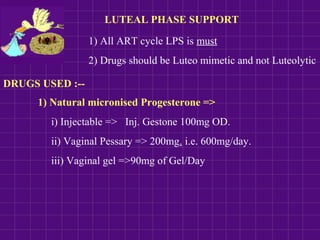
LUTEAL PHASE SUPPORT
1) All ART cycle LPS is must
2) Drugs should be Luteo mimetic and not Luteolytic
DRUGS USED :--
1) Natural micronised Progesterone =>
i) Injectable => Inj. Gestone 100mg OD.
ii) Vaginal Pessary => 200mg. i.e. 600mg/day.
iii) Vaginal gel =>90mg of Gel/Day
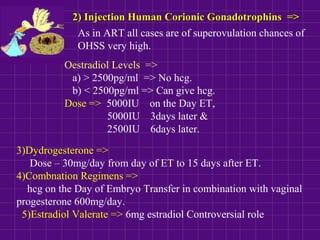
2) Injection Human Corionic Gonadotrophins =>2) Injection Human Corionic Gonadotrophins =>
As in ART all cases are of superovulation chances of
OHSS very high.
Oestradiol Levels =>
a) > 2500pg/ml => No hcg.
b) < 2500pg/ml => Can give hcg.
Dose => 5000IU on the Day ET,
5000IU 3days later &
2500IU 6days later.
3)Dydrogesterone =>
Dose – 30mg/day from day of ET to 15 days after ET.
4)Combnation Regimens =>
hcg on the Day of Embryo Transfer in combination with vaginal
progesterone 600mg/day.
5)Estradiol Valerate => 6mg estradiol Controversial role
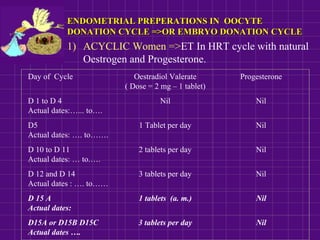
ENDOMETRIAL PREPERATIONS IN OOCYTEENDOMETRIAL PREPERATIONS IN OOCYTE
DONATION CYCLE =>OR EMBRYO DONATION CYCLEDONATION CYCLE =>OR EMBRYO DONATION CYCLE
1) ACYCLIC Women =>ET In HRT cycle with natural
Oestrogen and Progesterone.
Day of Cycle Oestradiol Valerate
( Dose = 2 mg – 1 tablet)
Progesterone
D 1 to D 4
Actual dates:…... to….
Nil Nil
D5
Actual dates: …. to…….
1 Tablet per day Nil
D 10 to D 11
Actual dates: … to.….
2 tablets per day Nil
D 12 and D 14
Actual dates : …. to……
3 tablets per day Nil
D 15 A
Actual dates:
1 tablets (a. m.) Nil
D15A or D15B D15C
Actual dates ….
3 tablets per day Nil
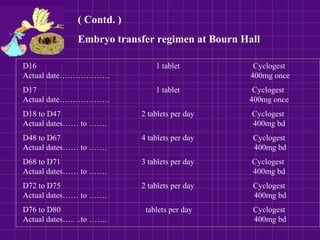
D16
Actual date……………….
1 tablet Cyclogest
400mg once
D17
Actual date……………….
1 tablet Cyclogest
400mg once
D18 to D47
Actual dates…… to …….
2 tablets per day Cyclogest
400mg bd
D48 to D67
Actual dates…… to …….
4 tablets per day Cyclogest
400mg bd
D68 to D71
Actual dates…… to …….
3 tablets per day Cyclogest
400mg bd
D72 to D75
Actual dates…… to …….
2 tablets per day Cyclogest
400mg bd
D76 to D80
Actual dates….. ..to …….
tablets per day Cyclogest
400mg bd
( Contd. )
Embryo transfer regimen at Bourn Hall
CYCLIC Women =>
1)Natural cycle - as in routine IVF cycle.
2)HRT Cycle.
In the pursuit of optimizing outcome with assisted reproduction,
the clinician has profound responsibility to make every attempt
to enhance the environment for implantation.
THIS WILL PROMOTE NOBLE OBJECTIVE OF
ENHANCING THE SUCCESS RATE OF IVF.
INDEBTED AND THANKFULL
TO ONE AND ALL
FOR
PATIENT LISTENING

Improving endometrial receptivity f

  • 1.
  • 2.
    “ DR. MANJUSHREEBOOB” M.B.B.S. M.D. D.N.B. F.I.C.M.C.H. DIPLOMATE OF NATIONAL BOARDS CONSULTANT OBSTETRICIAN GYNAECOLOGIST AND INFERTILITY EXPERT “SHUBHAM HOSPITAL” BADNERA ROAD AMRAVATI By,…By,… IMPROVING ENDOMETRIAL RECEPTIVITYIMPROVING ENDOMETRIAL RECEPTIVITY WILL IT CHANGE IVF SUCCESSWILL IT CHANGE IVF SUCCESS
  • 3.
    INTRODUCTION 1) Definition ofEndometrial Receptivity 2) Fertilization 3) Window of Receptivity 4) Formation of Decidua : I)Nk Cells – Like a) CD – 56 – Bright b) CD – 16 c) CD – 3 i) Formation of – a)Phosphoethanolamine [PE] b) Phosphoserine [PS] c) Cardiolipin For SYNCYTILIZATION which is important for foetal survival
  • 4.
    THE IMPLANTATION PROCESS ENDOMETRIUMAT IMPLANTATION 1) Apposition 2) Adhesion 3) Invasion 1) HISTOLOGICAL CHANGES : a) Formation of Pinpodes b) Decrease in cell polarity and tight junction between cell.
  • 5.
    ENDOMETRIUM AT IMPLANTATION C)INVASION – PROTEOLYTIC ENZYMES • Serineproteases • Metalloproteases • Collagenases 1) BIOCHEMICAL & MOLECULAR CHANGES- a)APPOSITION –> Chemokinase 1) IL8 – Interlukin 8 2) MCPI – Monocyte chemo attractant protein-1 3) RANTES – Regulated on activation, T- Cell expressed and secreted CHEMOKINES – DIRECT EMBRYO TOWARDS ITS SPECIFIC SITE OF IMPLANTATION. b) ADHESIONS – CYTOKINES ARE RESPONSIBLE, Eg.. • LIF • IC-I Systems • HBGF • INTEGRINS • HOXA – 10
  • 6.
    IMMUNOLOGICAL ASPECT OFIMPLANTATIONIMMUNOLOGICAL ASPECT OF IMPLANTATION 1) Increase no of Leukocytes, T-cell, mcrophages and large Granular Lymphocyte [LGL] is seen in endometrium, believed to play a role in Implantation and maintainance of Pregnancy. 2) Combination α4 & B3 integrins subunits are seen in secretary endometrium B3 is reliable marker in opening “WINDOW OF IMPLANTATION” ENDOMETRIAL VASCULAR CHANGES 1) The lowest impedonce to blood flow is seen in implantation phase – Increase Vascularity – increase endometrial and stromal growth which permitts expression & efficient distribution of biochemical markers in endometrium for implantation .
  • 7.
    ENDOMETRIAL RECEPTIVITYENDOMETRIAL RECEPTIVITY ASSESSINGER – 1) Test to assess Endometrial change a) Endometrial Histology b) TV - USG & Doppler c) Harmonal levels. 2) Evaluation of Marker’s of Embryo – Endometrial dialogue Natural conception cycle - Implantation rate is 30% IVF CYCLE - 12 - 20%
  • 8.
    ENDOMETRIAL HISTOLOGY 1) ByElectron Microscopy 2) Timings – Late luteal phase 3) Pitfalls – a) Reflects only regional variation in endometrium but whole morphology is not seen b) Cannot be done in routine IVF cycle. 4) Study – STUDY OF PINPODES BY SEM i.e.. – (Scanning electron microscopy) Its important for oocyte donation or frozen embryo transfer cycle. There is corelation between apical projection seen on LEM [Light electron Microscopy] with pinpodes as visualised in SEM which incrcases the effectivity of routine Embreyo Transfer.
  • 9.
    ULTRASOUND – TVSis simple non-invasive modality which is most commonly used to assess ER. 1) Endometrial thickness < 7mm- Poor endometrium > 15mm- Poor endometrium 1) Endometrial volume < 2.5ml- Poor response 2) Echogenicity - 1. Endometrium is hypoechoic in proliferative phase 2. As thickness increase - Triple or multilayered endometrium. 3. Secretary phase - Isoechoic / hyperechoic DOPPLER – MID LUTEL PHASE Uterine perfusion is maximum. • Uterine Artery flow (p1) P1 < 3 – Increased pregnancy rate in IVF Cycle. • Sub- endometrial Blood Flow – Presence of pulsatile SE blood flow signifies Increased Implantation rate ULTRASOUND AND DOPPELER – TO EVALUATE ER
  • 10.
    Endometrium is dividedin 4 Zones Good Vascularity in zone 3/4th /EE in relation to uterine lumen suggest good ER. Controversial result in evaluating ER & PR in luteal phase in terms of pregnancy. ENDOMETRIAL ZONES ESTROGEN AND PROGESTERON RECEPTOR’S=>
  • 11.
    PRACTICAL EVALUATION OFER 1) 2 Endometrial Biopsies:- a)1st EB :- During “Window Of Receptivity” to look at factors for apposition and adhesions SEE For :- Pin podes, mucin integrim, trophonin EGF, HB- EGF, CSF-1, LIF,IL-1b Calcitonin, Hoxa-10, Cox-2 b) 2nd EB:- In late secretary phase to look for event of invasion. Screen for- TGF-B, IGF BPI, TIMP, Fibronectin Laminin. 2 ) IMMUNOLOGICAL TEST:- Like APA, ACA, PT, APTT. is A must for repeated failure in IVF cycle or Cases of BOH.
  • 12.
    TREAMENT TO IMPROVEER Use of Aspirin, Heparin and I.V. immunologlobulin have increased pregnancy rate. With Aspirin and Heparin failure, use of IVIG has still better success rate. ASPIRIN- Dose of 80 mg OD is given preconceptionely and continued during pregnancy. Mode Of Action:- It is anti-prostaglandin and antiprostacycline effects, inhibits platelet adhesion and aggregation which increases foetomaternal circulation.
  • 13.
    TREATMENT [contd] B) HEPARIN- In APA +ve cases-5000 IU of low molecular weight heparin is given twice daily. Mode Of Action- It Repels autoantibodies from phospholipid molecules& thus sheild trophoblast , which facilitates syncytialization and promotes proper interaction with decidua. C) IV IMMUNOGLOBULIN [IVIG]- APA +ve cases IVIG Should be given 7 day prior to ET and should be repeated in 4-6 weeks time . Very useful in autoimmune hypothyroidism. D) Sildenafil- Improves vasular supply to Endometrium giving good result in few centers.
  • 14.
    LUTEAL PHASE SUPPORT 1)All ART cycle LPS is must 2) Drugs should be Luteo mimetic and not Luteolytic DRUGS USED :-- 1) Natural micronised Progesterone => i) Injectable => Inj. Gestone 100mg OD. ii) Vaginal Pessary => 200mg. i.e. 600mg/day. iii) Vaginal gel =>90mg of Gel/Day
  • 15.
    2) Injection HumanCorionic Gonadotrophins =>2) Injection Human Corionic Gonadotrophins => As in ART all cases are of superovulation chances of OHSS very high. Oestradiol Levels => a) > 2500pg/ml => No hcg. b) < 2500pg/ml => Can give hcg. Dose => 5000IU on the Day ET, 5000IU 3days later & 2500IU 6days later. 3)Dydrogesterone => Dose – 30mg/day from day of ET to 15 days after ET. 4)Combnation Regimens => hcg on the Day of Embryo Transfer in combination with vaginal progesterone 600mg/day. 5)Estradiol Valerate => 6mg estradiol Controversial role
  • 16.
    ENDOMETRIAL PREPERATIONS INOOCYTEENDOMETRIAL PREPERATIONS IN OOCYTE DONATION CYCLE =>OR EMBRYO DONATION CYCLEDONATION CYCLE =>OR EMBRYO DONATION CYCLE 1) ACYCLIC Women =>ET In HRT cycle with natural Oestrogen and Progesterone. Day of Cycle Oestradiol Valerate ( Dose = 2 mg – 1 tablet) Progesterone D 1 to D 4 Actual dates:…... to…. Nil Nil D5 Actual dates: …. to……. 1 Tablet per day Nil D 10 to D 11 Actual dates: … to.…. 2 tablets per day Nil D 12 and D 14 Actual dates : …. to…… 3 tablets per day Nil D 15 A Actual dates: 1 tablets (a. m.) Nil D15A or D15B D15C Actual dates …. 3 tablets per day Nil
  • 17.
    D16 Actual date………………. 1 tabletCyclogest 400mg once D17 Actual date………………. 1 tablet Cyclogest 400mg once D18 to D47 Actual dates…… to ……. 2 tablets per day Cyclogest 400mg bd D48 to D67 Actual dates…… to ……. 4 tablets per day Cyclogest 400mg bd D68 to D71 Actual dates…… to ……. 3 tablets per day Cyclogest 400mg bd D72 to D75 Actual dates…… to ……. 2 tablets per day Cyclogest 400mg bd D76 to D80 Actual dates….. ..to ……. tablets per day Cyclogest 400mg bd ( Contd. ) Embryo transfer regimen at Bourn Hall
  • 18.
    CYCLIC Women => 1)Naturalcycle - as in routine IVF cycle. 2)HRT Cycle.
  • 19.
    In the pursuitof optimizing outcome with assisted reproduction, the clinician has profound responsibility to make every attempt to enhance the environment for implantation. THIS WILL PROMOTE NOBLE OBJECTIVE OF ENHANCING THE SUCCESS RATE OF IVF.
  • 20.
    INDEBTED AND THANKFULL TOONE AND ALL FOR PATIENT LISTENING