Part	
  1:	
  	
  Se*ng	
  the	
  Scene	
  
-­‐	
  About	
  Organisa/ons	
  
-­‐ 	
  Partnership	
  	
  
-­‐ 	
  KaTu	
  Honey	
  Project	
  
-­‐	
  Design	
  Programme	
  	
  Structure	


Part	
  2:	
  	
  Crea1ve	
  Process	
  
-­‐	
  Naming	
  
-­‐ 	
  Consumer	
  	
  
-­‐ 	
  Inspira/on	
  
-­‐ 	
  Survey	
  
-­‐ 	
  Artwork	
  and	
  Rollout	


Part	
  3:	
  Growth	
  
-­‐	
  Local	
  Market	
  
-­‐	
  Interna/onal	
  Market	
  	
  
-­‐	
  Summary	
  &	
  Key	
  Tips	


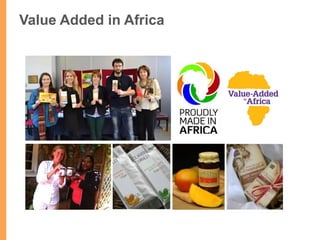
Value Added in Africa


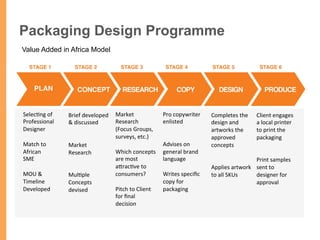
Packaging Design Programme
Selec/ng	
  of	
  
Professional	
  
Designer	


Match	
  to	
  
African	
  
SME	


MOU	
  &	
  
Timeline	
  
Developed	
  
Brief	
  developed	
  
&	
  discussed	


Market	
  
Research	


Mul/ple	
  
Concepts	
  
devised	


Market	
  
Research	
  
(Focus	
  Groups,	
  
surveys,	
  etc.)	


Which	
  concepts	
  
are	
  most	
  
aTrac/ve	
  to	
  
consumers?	


Pitch	
  to	
  Client	
  
for	
  final	
  
decision	


Pro	
  copywriter	
  
enlisted	


Advises	
  on	
  
general	
  brand	
  
language	


Writes	
  specific	
  
copy	
  for	
  
packaging	
  	
  
Completes	
  the	
  
design	
  and	
  
artworks	
  the	
  
approved	
  
concepts	


Applies	
  artwork	
  
to	
  all	
  SKUs	


Client	
  engages	
  
a	
  local	
  printer	
  
to	
  print	
  the	
  
packaging	


Print	
  samples	
  
sent	
  to	
  
designer	
  for	
  
approval	
  
Value Added in Africa Model
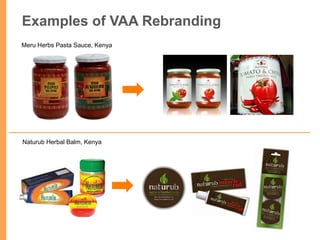
Examples of VAA Rebranding	
  
Meru Herbs Pasta Sauce, Kenya
Naturub Herbal Balm, Kenya
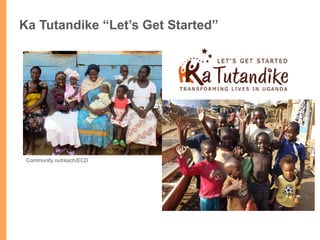
Ka Tutandike “Let’s Get Started”
Community outreach/ECD 	
  
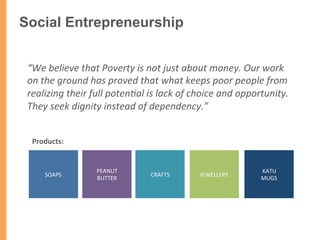
“We	
  believe	
  that	
  Poverty	
  is	
  not	
  just	
  about	
  money.	
  Our	
  work	
  
on	
  the	
  ground	
  has	
  proved	
  that	
  what	
  keeps	
  poor	
  people	
  from	
  
realizing	
  their	
  full	
  poten>al	
  is	
  lack	
  of	
  choice	
  and	
  opportunity.	
  
They	
  seek	
  dignity	
  instead	
  of	
  dependency.”	
  
Social Entrepreneurship
SOAPS	
  
PEANUT	
  
BUTTER	
  
CRAFTS	
   JEWELLERY	
  
KATU	
  
MUGS	
  
Products:	


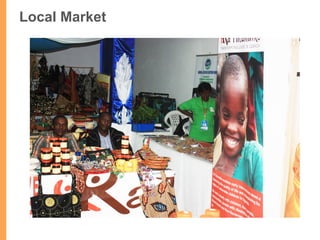
Local Market
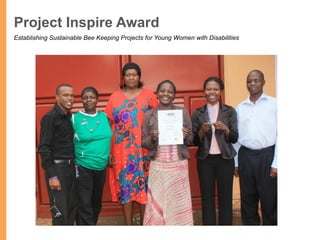
Establishing Sustainable Bee Keeping Projects for Young Women with Disabilities
Project Inspire Award
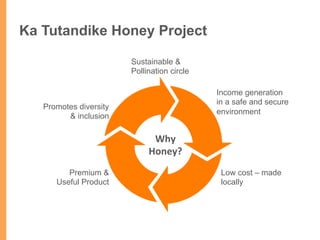
Ka Tutandike Honey Project
Sustainable &
Pollination circle
Premium &
Useful Product
Income generation
in a safe and secure
environment
Low cost – made
locally
Why	
  
Honey?	


Promotes diversity
& inclusion
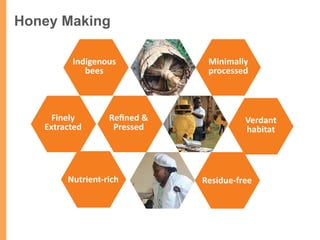
Honey Making
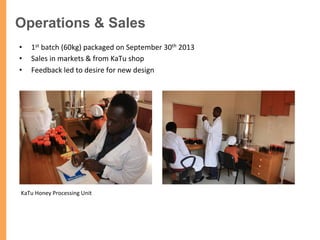
Operations & Sales
•  1st	
  batch	
  (60kg)	
  packaged	
  on	
  September	
  30th	
  2013	
  
•  Sales	
  in	
  markets	
  &	
  from	
  KaTu	
  shop	


•  Feedback	
  led	
  to	
  desire	
  for	
  new	
  design	
  
KaTu	
  Honey	
  Processing	
  Unit	
  
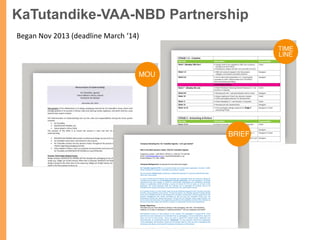
KaTutandike-VAA-NBD Partnership
Began	
  Nov	
  2013	
  (deadline	
  March	
  ‘14)	
  
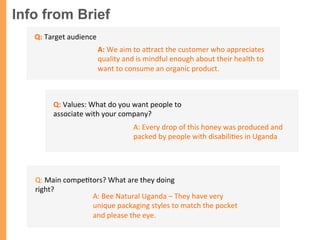
Info from Brief
Q:	
  Target	
  audience	
  
A:	
  We	
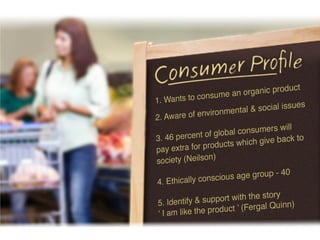
  aim	
  to	
  aTract	
  the	
  customer	
  who	
  appreciates	
  
quality	
  and	
  is	
  mindful	
  enough	
  about	
  their	
  health	
  to	
  
want	
  to	
  consume	
  an	
  organic	
  product.	
  
Q:	
  Values:	
  What	
  do	
  you	
  want	
  people	
  to	
  
associate	
  with	
  your	
  company?	
  
A:	
  Every	
  drop	
  of	
  this	
  honey	
  was	
  produced	
  and	
  
packed	
  by	
  people	
  with	
  disabili/es	
  in	
  Uganda	
  
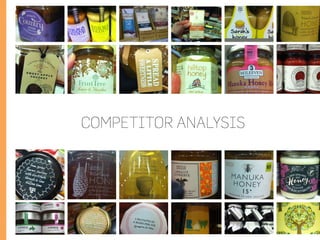
Q:	
  Main	
  compe/tors?	
  What	
  are	
  they	
  doing	
  
right?	
  	
  
A:	
  Bee	
  Natural	
  Uganda	
  –	
  They	
  have	
  very	
  
unique	
  packaging	
  styles	
  to	
  match	
  the	
  pocket	
  
and	
  please	
  the	
  eye.	


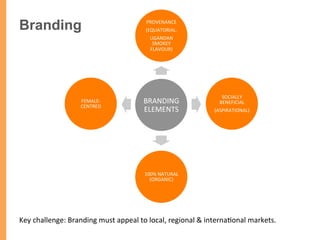
Branding
BRANDING	
  
ELEMENTS	
  
PROVENANCE	
  
(EQUATORIAL.	
  
UGANDAN	
  
SMOKEY	
  
FLAVOUR)	
  
SOCIALLY	
  
BENEFICIAL	
  
(ASPIRATIONAL)	
  
100%	
  NATURAL	
  
(ORGANIC)	
  
FEMALE-­‐
CENTRED	
  
Key	
  challenge:	
  Branding	
  must	
  appeal	
  to	
  local,	
  regional	
  &	
  interna/onal	
  markets.	
  
 
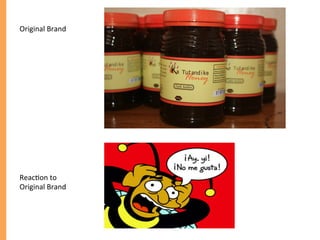
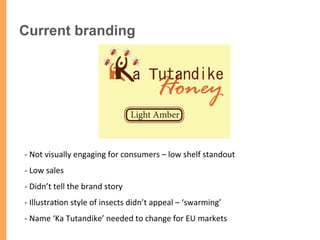
Original	
  Brand	
  
Reac/on	
  to	
  
Original	
  Brand	
  
-­‐	
  Not	
  visually	
  engaging	
  for	
  consumers	
  –	
  low	
  shelf	
  standout	
  
-­‐	
  Low	
  sales	
  
-­‐	
  Didn’t	
  tell	
  the	
  brand	
  story	
  
-­‐	
  Illustra/on	
  style	
  of	
  insects	
  didn’t	
  appeal	
  –	
  ‘swarming’	
  	
  
-­‐	
  Name	
  ‘Ka	
  Tutandike’	
  needed	
  to	
  change	
  for	
  EU	
  markets	


Current branding
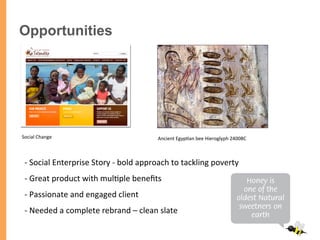
-­‐ 	
  Social	
  Enterprise	
  Story	
  -­‐	
  bold	
  approach	
  to	
  tackling	
  poverty	
  
-­‐ 	
  Great	
  product	
  with	
  mul/ple	
  benefits	
  	
  
-­‐ 	
  Passionate	
  and	
  engaged	
  client	
  
-­‐ 	
  Needed	
  a	
  complete	
  rebrand	
  –	
  clean	
  slate	
  
Opportunities
Ancient	
  Egyp/an	
  bee	
  Hieroglyph	
  2400BC	
  Social	
  Change	
  
Out	
  of	
  25	
  names	
  in	
  total,	
  9	
  names	
  were	
  shortlisted:	


Assessment	
  Criteria	
  
1.	
  Pronouncibility	
  (local/Interna/onal)	
  
2.	
  Sound	
  symbolism	


3.	
  Emo/onal	
  bonding	
  power	
  	
  
4.	
  Memorability	
  	
  
5.	
  Fit	
  to	
  concept	


6.	
  Nega/ve/posi/ve	
  associa/ons	
  	
  
Shortlist	
  Names	
  
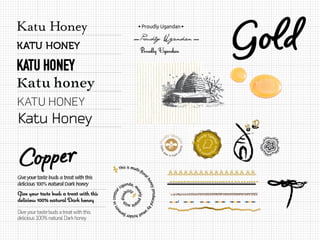
Katu	
  Honey	
  
Simply	
  Honey	
  
Equator	
  Honey	
  
A	
  Good	
  Start	
  Honey	
  
My	
  LiTle	
  Hive	
  
Honey	
  Haven	
  
Ugandan	
  Sisters	
  
Honey	
  Mammas	
  
Muzinga	
  Honey	
  
Bench.mark	
  [bench-­‐mahrk]	
  
noun	


“Benchmarking	
  is	
  the	
  process	
  of	
  studying	
  a	
  
par/cular	
  func/on	
  or	
  aTribute	
  of	
  a	
  compe/tor	
  for	
  
the	
  purpose	
  of	
  making	
  their	
  level	
  of	
  excellence	
  your	
  
minimum	
  level	
  of	
  excellence.”	


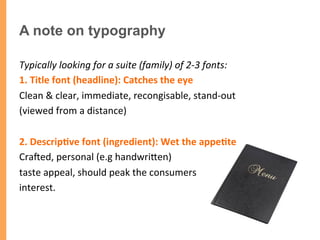
A note on typography
Typically	
  looking	
  for	
  a	
  suite	
  (family)	
  of	
  2-­‐3	
  fonts:	
  
1.	
  Title	
  font	
  (headline):	
  Catches	
  the	
  eye	


Clean	
  &	
  clear,	
  immediate,	
  recongisable,	
  stand-­‐out	


(viewed	
  from	
  a	
  distance)	


2.	
  Descrip1ve	
  font	
  (ingredient):	
  Wet	
  the	
  appe1te	
  	
  
Craped,	
  personal	
  (e.g	
  handwriTen)	
  	
  
taste	
  appeal,	
  should	
  peak	
  the	
  consumers	
  	
  
interest.	
  
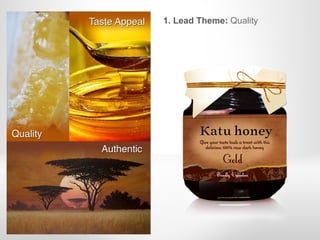
1. Lead Theme: Quality
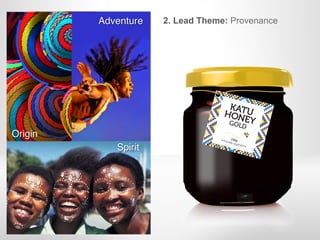
2. Lead Theme: Provenance
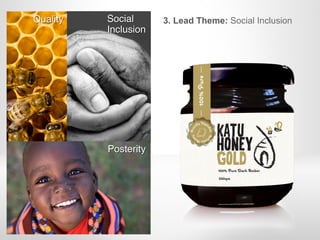
3. Lead Theme: Social Inclusion
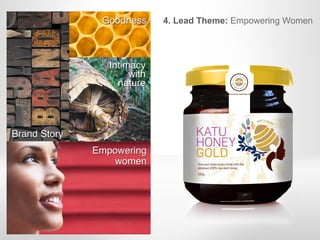
4. Lead Theme: Empowering Women
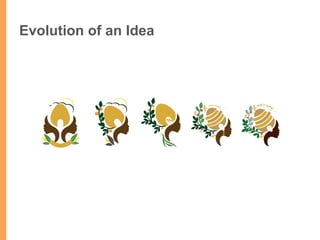
Evolution of an Idea
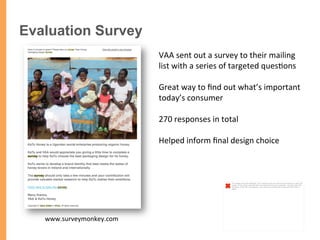
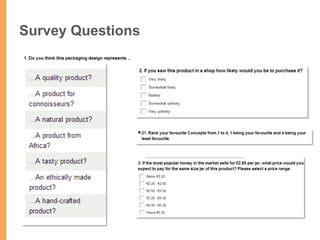
Evaluation Survey
VAA	
  sent	
  out	
  a	
  survey	
  to	
  their	
  mailing	
  
list	
  with	
  a	
  series	
  of	
  targeted	
  ques/ons	


Great	
  way	
  to	
  find	
  out	
  what’s	
  important	
  
today’s	
  consumer	


270	
  responses	
  in	
  total	
  
Helped	
  inform	
  final	
  design	
  choice	


www.surveymonkey.com	
  
The image cannot be displayed. Your computer may not have enough memory to open the
image, or the image may have been corrupted. Restart your computer, and then open the
file again. If the red x still appears, you may have to delete the image and then insert it
again.
Survey Questions
“The	
  design	
  is	
  tasteful,	
  important	
  if	
  you	
  are	
  trying	
  to	
  convey	
  a	
  good	
  
tas/ng	
  product”	
  
“Gives	
  me	
  the	
  feeling	
  I’m	
  buying	
  a	
  high	
  end	
  product”	
  
“Looks	
  Authen/c	
  and	
  African”	
  
“Because	
  there	
  is	
  a	
  strong	
  connec/on	
  with	
  the	
  packaging,	
  I	
  would	
  be	
  likely	
  to	
  
remember	
  “oh	
  this	
  is	
  the	
  honey	
  produced	
  by	
  women	
  in	
  Uganda	
  and	
  it	
  would	
  	
  
encourage	
  a	
  repeat	
  purchase”	
  
“Would	
  like	
  to	
  have	
  it	
  on	
  my	
  kitchen	
  shelf”	
  
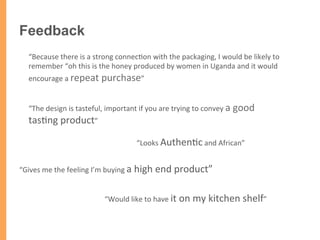
Feedback
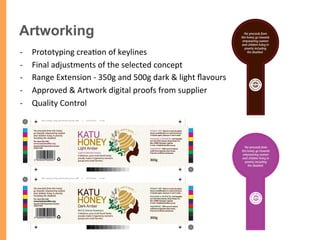
Artworking
-­‐  Prototyping	
  crea/on	
  of	
  keylines	
  
-­‐  Final	
  adjustments	
  of	
  the	
  selected	
  concept	
  
-­‐  Range	
  Extension	
  -­‐	
  350g	
  and	
  500g	
  dark	
  &	
  light	
  flavours	
  
-­‐  Approved	
  &	
  Artwork	
  digital	
  proofs	
  from	
  supplier	
  
-­‐  Quality	
  Control	
  
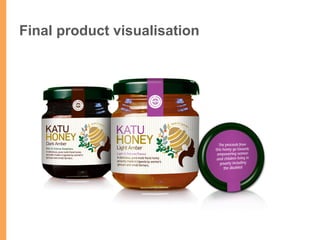
Final product visualisation
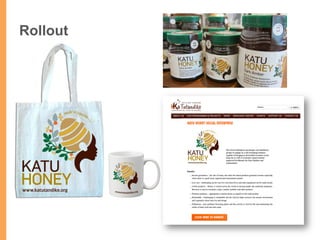
Rollout
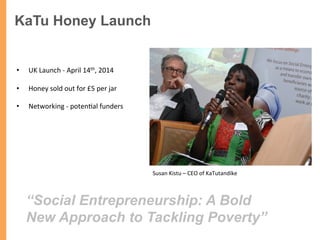
KaTu Honey Launch
	
  
•  UK	
  Launch	
  -­‐	
  April	
  14th,	
  2014	
  
•  Honey	
  sold	
  out	
  for	
  £5	
  per	
  jar	
  
•  Networking	
  -­‐	
  poten/al	
  funders	
  
Susan	
  Kistu	
  –	
  CEO	
  of	
  KaTutandike	
  
“Social Entrepreneurship: A Bold
New Approach to Tackling Poverty”	
  
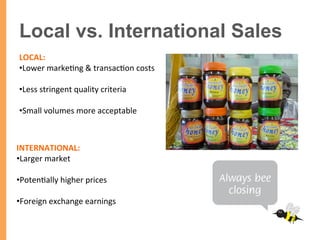
Local vs. International Sales
LOCAL:	
  	
  
• Lower	
  marke/ng	
  &	
  transac/on	
  costs	
  
• Less	
  stringent	
  quality	
  criteria	
  	
  
• Small	
  volumes	
  more	
  acceptable	


INTERNATIONAL:	
  	
  
• Larger	
  market	
  
• Poten/ally	
  higher	
  prices	
  
• Foreign	
  exchange	
  earnings	


Routes to Local Market:
Main	
  Opportuni1es	
  
• Local/Regional	
  Demand	
  
• ‘Buy	
  Local’	
  Sen/ment	


• 	
  Unexploited	
  Market	
  for	
  other	
  Bee	
  
Products	
  
Main	
  Challenges	
  
• Under-­‐developed	
  imports	
  sub-­‐sector	
  
• Cer/fica/ons	
  (US	
  18,	
  UNBS)	
  
• Cheap	
  Foreign	
  Brands	
  
• Scale	
  
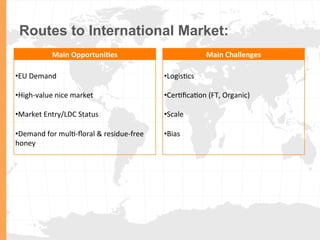
Routes to International Market:
Main	
  Opportuni1es	
  
• EU	
  Demand	


• High-­‐value	
  nice	
  market	


• Market	
  Entry/LDC	
  Status	


• Demand	
  for	
  mul/-­‐floral	
  &	
  residue-­‐free	
  
honey	
  
Main	
  Challenges	


• Logis/cs	


• Cer/fica/on	
  (FT,	
  Organic)	


• Scale	


• Bias	


Summary
1.  Develop	
  a	
  compelling	
  brand	
  story	
  
2.	
  Openly	
  engage	
  in	
  the	
  design	
  process	
  –	
  it	
  should	
  be	
  
enjoyable!	


3.	
  Test	
  the	
  product	
  with	
  the	
  market	
  prior	
  to	
  launch	
  
(survey)	


4.	
  Hire	
  a	
  copywriter	


5.	
  Develop	
  strong	
  working	
  rela/onships/friendships	


6.	
  Brief,	
  brief	
  &	
  more	
  brief!	


7.	
  Market	
  w/	
  broad	
  brushstrokes	
  (convey	
  the	
  sen/ment,	
  
Laura Macaulay, Navigate By Design on her work for Ka Tutandike at Outstanding By Design

Laura Macaulay, Navigate By Design on her work for Ka Tutandike at Outstanding By Design

  • 2.
    Part  1:    Se*ng  the  Scene   -­‐  About  Organisa/ons   -­‐   Partnership     -­‐   KaTu  Honey  Project   -­‐  Design  Programme    Structure       Part  2:    Crea1ve  Process   -­‐  Naming   -­‐   Consumer     -­‐   Inspira/on   -­‐   Survey   -­‐   Artwork  and  Rollout       Part  3:  Growth   -­‐  Local  Market   -­‐  Interna/onal  Market     -­‐  Summary  &  Key  Tips      
  • 3.
    Value Added inAfrica    
  • 4.
    Packaging Design Programme Selec/ng  of   Professional   Designer     Match  to   African   SME       MOU  &   Timeline   Developed   Brief  developed   &  discussed       Market   Research         Mul/ple   Concepts   devised             Market   Research   (Focus  Groups,   surveys,  etc.)     Which  concepts   are  most   aTrac/ve  to   consumers?     Pitch  to  Client   for  final   decision     Pro  copywriter   enlisted       Advises  on   general  brand   language       Writes  specific   copy  for   packaging     Completes  the   design  and   artworks  the   approved   concepts       Applies  artwork   to  all  SKUs       Client  engages   a  local  printer   to  print  the   packaging       Print  samples   sent  to   designer  for   approval   Value Added in Africa Model
  • 5.
    Examples of VAARebranding   Meru Herbs Pasta Sauce, Kenya Naturub Herbal Balm, Kenya
  • 6.
    Ka Tutandike “Let’sGet Started” Community outreach/ECD  
  • 7.
    “We  believe  that  Poverty  is  not  just  about  money.  Our  work   on  the  ground  has  proved  that  what  keeps  poor  people  from   realizing  their  full  poten>al  is  lack  of  choice  and  opportunity.   They  seek  dignity  instead  of  dependency.”   Social Entrepreneurship SOAPS   PEANUT   BUTTER   CRAFTS   JEWELLERY   KATU   MUGS   Products:    
  • 8.
  • 9.
    Establishing Sustainable BeeKeeping Projects for Young Women with Disabilities Project Inspire Award
  • 10.
    Ka Tutandike HoneyProject Sustainable & Pollination circle Premium & Useful Product Income generation in a safe and secure environment Low cost – made locally Why   Honey?     Promotes diversity & inclusion
  • 11.
  • 12.
    Operations & Sales • 1st  batch  (60kg)  packaged  on  September  30th  2013   •  Sales  in  markets  &  from  KaTu  shop                                         •  Feedback  led  to  desire  for  new  design   KaTu  Honey  Processing  Unit  
  • 13.
    KaTutandike-VAA-NBD Partnership Began  Nov  2013  (deadline  March  ‘14)  
  • 14.
    Info from Brief Q:  Target  audience   A:  We  aim  to  aTract  the  customer  who  appreciates   quality  and  is  mindful  enough  about  their  health  to   want  to  consume  an  organic  product.   Q:  Values:  What  do  you  want  people  to   associate  with  your  company?   A:  Every  drop  of  this  honey  was  produced  and   packed  by  people  with  disabili/es  in  Uganda   Q:  Main  compe/tors?  What  are  they  doing   right?     A:  Bee  Natural  Uganda  –  They  have  very   unique  packaging  styles  to  match  the  pocket   and  please  the  eye.      
  • 15.
    Branding BRANDING   ELEMENTS   PROVENANCE   (EQUATORIAL.   UGANDAN   SMOKEY   FLAVOUR)   SOCIALLY   BENEFICIAL   (ASPIRATIONAL)   100%  NATURAL   (ORGANIC)   FEMALE-­‐ CENTRED   Key  challenge:  Branding  must  appeal  to  local,  regional  &  interna/onal  markets.  
  • 17.
      Original  Brand   Reac/on  to   Original  Brand  
  • 18.
    -­‐  Not  visually  engaging  for  consumers  –  low  shelf  standout   -­‐  Low  sales   -­‐  Didn’t  tell  the  brand  story   -­‐  Illustra/on  style  of  insects  didn’t  appeal  –  ‘swarming’     -­‐  Name  ‘Ka  Tutandike’  needed  to  change  for  EU  markets     Current branding
  • 19.
    -­‐   Social  Enterprise  Story  -­‐  bold  approach  to  tackling  poverty   -­‐   Great  product  with  mul/ple  benefits     -­‐   Passionate  and  engaged  client   -­‐   Needed  a  complete  rebrand  –  clean  slate   Opportunities Ancient  Egyp/an  bee  Hieroglyph  2400BC  Social  Change  
  • 20.
    Out  of  25  names  in  total,  9  names  were  shortlisted:       Assessment  Criteria   1.  Pronouncibility  (local/Interna/onal)   2.  Sound  symbolism       3.  Emo/onal  bonding  power     4.  Memorability     5.  Fit  to  concept       6.  Nega/ve/posi/ve  associa/ons     Shortlist  Names   Katu  Honey   Simply  Honey   Equator  Honey   A  Good  Start  Honey   My  LiTle  Hive   Honey  Haven   Ugandan  Sisters   Honey  Mammas   Muzinga  Honey  
  • 23.
    Bench.mark  [bench-­‐mahrk]   noun     “Benchmarking  is  the  process  of  studying  a   par/cular  func/on  or  aTribute  of  a  compe/tor  for   the  purpose  of  making  their  level  of  excellence  your   minimum  level  of  excellence.”    
  • 26.
    A note ontypography Typically  looking  for  a  suite  (family)  of  2-­‐3  fonts:   1.  Title  font  (headline):  Catches  the  eye       Clean  &  clear,  immediate,  recongisable,  stand-­‐out       (viewed  from  a  distance)     2.  Descrip1ve  font  (ingredient):  Wet  the  appe1te     Craped,  personal  (e.g  handwriTen)     taste  appeal,  should  peak  the  consumers     interest.  
  • 29.
  • 30.
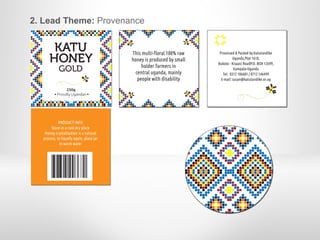
    2. Lead Theme:Provenance
  • 32.
    2. Lead Theme:Provenance
  • 33.
    3. Lead Theme:Social Inclusion
  • 34.
    4. Lead Theme:Empowering Women
  • 35.
  • 36.
    Evaluation Survey VAA  sent  out  a  survey  to  their  mailing   list  with  a  series  of  targeted  ques/ons       Great  way  to  find  out  what’s  important   today’s  consumer     270  responses  in  total   Helped  inform  final  design  choice     www.surveymonkey.com   The image cannot be displayed. Your computer may not have enough memory to open the image, or the image may have been corrupted. Restart your computer, and then open the file again. If the red x still appears, you may have to delete the image and then insert it again.
  • 37.
  • 38.
    “The  design  is  tasteful,  important  if  you  are  trying  to  convey  a  good   tas/ng  product”   “Gives  me  the  feeling  I’m  buying  a  high  end  product”   “Looks  Authen/c  and  African”   “Because  there  is  a  strong  connec/on  with  the  packaging,  I  would  be  likely  to   remember  “oh  this  is  the  honey  produced  by  women  in  Uganda  and  it  would     encourage  a  repeat  purchase”   “Would  like  to  have  it  on  my  kitchen  shelf”   Feedback
  • 39.
    Artworking -­‐  Prototyping  crea/on  of  keylines   -­‐  Final  adjustments  of  the  selected  concept   -­‐  Range  Extension  -­‐  350g  and  500g  dark  &  light  flavours   -­‐  Approved  &  Artwork  digital  proofs  from  supplier   -­‐  Quality  Control  
  • 40.
  • 41.
  • 43.
    KaTu Honey Launch   •  UK  Launch  -­‐  April  14th,  2014   •  Honey  sold  out  for  £5  per  jar   •  Networking  -­‐  poten/al  funders   Susan  Kistu  –  CEO  of  KaTutandike   “Social Entrepreneurship: A Bold New Approach to Tackling Poverty”  
  • 44.
    Local vs. InternationalSales LOCAL:     • Lower  marke/ng  &  transac/on  costs   • Less  stringent  quality  criteria     • Small  volumes  more  acceptable     INTERNATIONAL:     • Larger  market   • Poten/ally  higher  prices   • Foreign  exchange  earnings    
  • 45.
    Routes to LocalMarket: Main  Opportuni1es   • Local/Regional  Demand   • ‘Buy  Local’  Sen/ment     •   Unexploited  Market  for  other  Bee   Products   Main  Challenges   • Under-­‐developed  imports  sub-­‐sector   • Cer/fica/ons  (US  18,  UNBS)   • Cheap  Foreign  Brands   • Scale  
  • 46.
    Routes to InternationalMarket: Main  Opportuni1es   • EU  Demand     • High-­‐value  nice  market     • Market  Entry/LDC  Status     • Demand  for  mul/-­‐floral  &  residue-­‐free   honey   Main  Challenges     • Logis/cs     • Cer/fica/on  (FT,  Organic)     • Scale     • Bias          
  • 47.
    Summary 1.  Develop  a  compelling  brand  story   2.  Openly  engage  in  the  design  process  –  it  should  be   enjoyable!     3.  Test  the  product  with  the  market  prior  to  launch   (survey)     4.  Hire  a  copywriter       5.  Develop  strong  working  rela/onships/friendships     6.  Brief,  brief  &  more  brief!     7.  Market  w/  broad  brushstrokes  (convey  the  sen/ment,