TATA STARBUCKS COFFEE
INDIA
By, Arjun Singh
Division B
Roll no. 18
Batch 2013-15
SIMS, pune
1
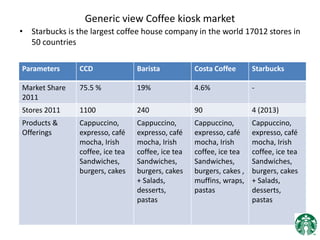
Generic view Coffee kiosk market
• Starbucks is the largest coffee house company in the world 17012 stores in
50 countries
Parameters CCD Barista Costa Coffee Starbucks
Market Share
2011
75.5 % 19% 4.6% -
Stores 2011 1100 240 90 4 (2013)
Products &
Offerings
Cappuccino,
expresso, café
mocha, Irish
coffee, ice tea
Sandwiches,
burgers, cakes
Cappuccino,
expresso, café
mocha, Irish
coffee, ice tea
Sandwiches,
burgers, cakes
+ Salads,
desserts,
pastas
Cappuccino,
expresso, café
mocha, Irish
coffee, ice tea
Sandwiches,
burgers, cakes ,
muffins, wraps,
pastas
Cappuccino,
expresso, café
mocha, Irish
coffee, ice tea
Sandwiches,
burgers, cakes
+ Salads,
desserts,
pastas
2
Indian Coffee market Analysis
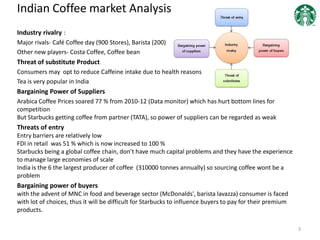
Industry rivalry :
Major rivals- Café Coffee day (900 Stores), Barista (200)
Other new players- Costa Coffee, Coffee bean
Threat of substitute Product
Consumers may opt to reduce Caffeine intake due to health reasons
Tea is very popular in India
Bargaining Power of Suppliers
Arabica Coffee Prices soared 77 % from 2010-12 (Data monitor) which has hurt bottom lines for
competition
But Starbucks getting coffee from partner (TATA), so power of suppliers can be regarded as weak
Threats of entry
Entry barriers are relatively low
FDI in retail was 51 % which is now increased to 100 %
Starbucks being a global coffee chain, don’t have much capital problems and they have the experience
to manage large economies of scale
India is the 6 the largest producer of coffee (310000 tonnes annually) so sourcing coffee wont be a
problem
Bargaining power of buyers
with the advent of MNC in food and beverage sector (McDonalds', barista lavazza) consumer is faced
with lot of choices, thus it will be difficult for Starbucks to influence buyers to pay for their premium
products.
3
Comparative analysis
Target market segmentation
The marketing strategy will focus on targeting both groups – College and university
students aged (18-25) in the short term and working professionals (25-40) in the
medium to long run
Starbucks to focus on Premium and high end customers mostly working professionals
and students
 Economic factors
Indian economy will grow an estimated 6.5 % this year , fastest among developing Asian
economies excluding China (Source : Bloomberg )
The personal disposable income per Capita in India has doubled between 2001-2010
(By Deloite )
 Legal factors
FDI limit raised to 100 % for foreign retailers selling a
single brand
Joint venture (50-50) Between TATA and Starbucks
 Socio Cultural factors
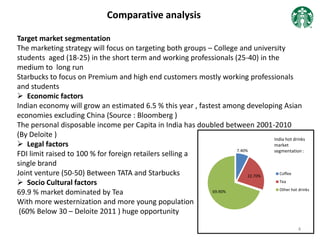
69.9 % market dominated by Tea
With more westernization and more young population
(60% Below 30 – Deloite 2011 ) huge opportunity
7.40%
22.70%
69.90%
Coffee
Tea
Other hot drinks
India hot drinks
market
segmentation :
4
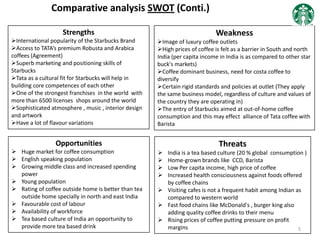
Strengths
International popularity of the Starbucks Brand
Access to TATA’s premium Robusta and Arabica
coffees (Agreement)
Superb marketing and positioning skills of
Starbucks
Tata as a cultural fit for Starbucks will help in
building core competences of each other
One of the strongest franchises in the world with
more than 6500 licenses shops around the world
Sophisticated atmosphere , music , interior design
and artwork
Have a lot of flavour variations
Weakness
Image of luxury coffee outlets
High prices of coffee is felt as a barrier in South and north
India (per capita income in India is as compared to other star
buck's markets)
Coffee dominant business, need for costa coffee to
diversify
Certain rigid standards and policies at outlet (They apply
the same business model, regardless of culture and values of
the country they are operating in)
The entry of Starbucks aimed at out-of-home coffee
consumption and this may effect alliance of Tata coffee with
Barista
Opportunities
 Huge market for coffee consumption
 English speaking population
 Growing middle class and increased spending
power
 Young population
 Rating of coffee outside home is better than tea
outside home specially in north and east India
 Favourable cost of labour
 Availability of workforce
 Tea based culture of India an opportunity to
provide more tea based drink
Threats
 India is a tea based culture (20 % global consumption )
 Home-grown brands like CCD, Barista
 Low Per capita income, high price of coffee
 Increased health consciousness against foods offered
by coffee chains
 Visiting cafes is not a frequent habit among Indian as
compared to western world
 Fast food chains like McDonald's , burger king also
adding quality coffee drinks to their menu
 Rising prices of coffee putting pressure on profit
margins
Comparative analysis SWOT (Conti.)
5
Business overview & strategy
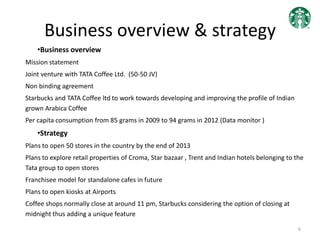
•Business overview
Mission statement
Joint venture with TATA Coffee Ltd. (50-50 JV)
Non binding agreement
Starbucks and TATA Coffee ltd to work towards developing and improving the profile of Indian
grown Arabica Coffee
Per capita consumption from 85 grams in 2009 to 94 grams in 2012 (Data monitor )
•Strategy
Plans to open 50 stores in the country by the end of 2013
Plans to explore retail properties of Croma, Star bazaar , Trent and Indian hotels belonging to the
Tata group to open stores
Franchisee model for standalone cafes in future
Plans to open kiosks at Airports
Coffee shops normally close at around 11 pm, Starbucks considering the option of closing at
midnight thus adding a unique feature
6
Conclusion
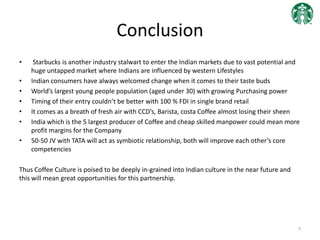
• Starbucks is another industry stalwart to enter the Indian markets due to vast potential and
huge untapped market where Indians are influenced by western Lifestyles
• Indian consumers have always welcomed change when it comes to their taste buds
• World’s largest young people population (aged under 30) with growing Purchasing power
• Timing of their entry couldn’t be better with 100 % FDI in single brand retail
• It comes as a breath of fresh air with CCD’s, Barista, costa Coffee almost losing their sheen
• India which is the 5 largest producer of Coffee and cheap skilled manpower could mean more
profit margins for the Company
• 50-50 JV with TATA will act as symbiotic relationship, both will improve each other’s core
competencies
Thus Coffee Culture is poised to be deeply in-grained into Indian culture in the near future and
this will mean great opportunities for this partnership.
7

Tata Starbucks India

  • 1.
    TATA STARBUCKS COFFEE INDIA By,Arjun Singh Division B Roll no. 18 Batch 2013-15 SIMS, pune 1
  • 2.
    Generic view Coffeekiosk market • Starbucks is the largest coffee house company in the world 17012 stores in 50 countries Parameters CCD Barista Costa Coffee Starbucks Market Share 2011 75.5 % 19% 4.6% - Stores 2011 1100 240 90 4 (2013) Products & Offerings Cappuccino, expresso, café mocha, Irish coffee, ice tea Sandwiches, burgers, cakes Cappuccino, expresso, café mocha, Irish coffee, ice tea Sandwiches, burgers, cakes + Salads, desserts, pastas Cappuccino, expresso, café mocha, Irish coffee, ice tea Sandwiches, burgers, cakes , muffins, wraps, pastas Cappuccino, expresso, café mocha, Irish coffee, ice tea Sandwiches, burgers, cakes + Salads, desserts, pastas 2
  • 3.
    Indian Coffee marketAnalysis Industry rivalry : Major rivals- Café Coffee day (900 Stores), Barista (200) Other new players- Costa Coffee, Coffee bean Threat of substitute Product Consumers may opt to reduce Caffeine intake due to health reasons Tea is very popular in India Bargaining Power of Suppliers Arabica Coffee Prices soared 77 % from 2010-12 (Data monitor) which has hurt bottom lines for competition But Starbucks getting coffee from partner (TATA), so power of suppliers can be regarded as weak Threats of entry Entry barriers are relatively low FDI in retail was 51 % which is now increased to 100 % Starbucks being a global coffee chain, don’t have much capital problems and they have the experience to manage large economies of scale India is the 6 the largest producer of coffee (310000 tonnes annually) so sourcing coffee wont be a problem Bargaining power of buyers with the advent of MNC in food and beverage sector (McDonalds', barista lavazza) consumer is faced with lot of choices, thus it will be difficult for Starbucks to influence buyers to pay for their premium products. 3
  • 4.
    Comparative analysis Target marketsegmentation The marketing strategy will focus on targeting both groups – College and university students aged (18-25) in the short term and working professionals (25-40) in the medium to long run Starbucks to focus on Premium and high end customers mostly working professionals and students  Economic factors Indian economy will grow an estimated 6.5 % this year , fastest among developing Asian economies excluding China (Source : Bloomberg ) The personal disposable income per Capita in India has doubled between 2001-2010 (By Deloite )  Legal factors FDI limit raised to 100 % for foreign retailers selling a single brand Joint venture (50-50) Between TATA and Starbucks  Socio Cultural factors 69.9 % market dominated by Tea With more westernization and more young population (60% Below 30 – Deloite 2011 ) huge opportunity 7.40% 22.70% 69.90% Coffee Tea Other hot drinks India hot drinks market segmentation : 4
  • 5.
    Strengths International popularity ofthe Starbucks Brand Access to TATA’s premium Robusta and Arabica coffees (Agreement) Superb marketing and positioning skills of Starbucks Tata as a cultural fit for Starbucks will help in building core competences of each other One of the strongest franchises in the world with more than 6500 licenses shops around the world Sophisticated atmosphere , music , interior design and artwork Have a lot of flavour variations Weakness Image of luxury coffee outlets High prices of coffee is felt as a barrier in South and north India (per capita income in India is as compared to other star buck's markets) Coffee dominant business, need for costa coffee to diversify Certain rigid standards and policies at outlet (They apply the same business model, regardless of culture and values of the country they are operating in) The entry of Starbucks aimed at out-of-home coffee consumption and this may effect alliance of Tata coffee with Barista Opportunities  Huge market for coffee consumption  English speaking population  Growing middle class and increased spending power  Young population  Rating of coffee outside home is better than tea outside home specially in north and east India  Favourable cost of labour  Availability of workforce  Tea based culture of India an opportunity to provide more tea based drink Threats  India is a tea based culture (20 % global consumption )  Home-grown brands like CCD, Barista  Low Per capita income, high price of coffee  Increased health consciousness against foods offered by coffee chains  Visiting cafes is not a frequent habit among Indian as compared to western world  Fast food chains like McDonald's , burger king also adding quality coffee drinks to their menu  Rising prices of coffee putting pressure on profit margins Comparative analysis SWOT (Conti.) 5
  • 6.
    Business overview &strategy •Business overview Mission statement Joint venture with TATA Coffee Ltd. (50-50 JV) Non binding agreement Starbucks and TATA Coffee ltd to work towards developing and improving the profile of Indian grown Arabica Coffee Per capita consumption from 85 grams in 2009 to 94 grams in 2012 (Data monitor ) •Strategy Plans to open 50 stores in the country by the end of 2013 Plans to explore retail properties of Croma, Star bazaar , Trent and Indian hotels belonging to the Tata group to open stores Franchisee model for standalone cafes in future Plans to open kiosks at Airports Coffee shops normally close at around 11 pm, Starbucks considering the option of closing at midnight thus adding a unique feature 6
  • 7.
    Conclusion • Starbucks isanother industry stalwart to enter the Indian markets due to vast potential and huge untapped market where Indians are influenced by western Lifestyles • Indian consumers have always welcomed change when it comes to their taste buds • World’s largest young people population (aged under 30) with growing Purchasing power • Timing of their entry couldn’t be better with 100 % FDI in single brand retail • It comes as a breath of fresh air with CCD’s, Barista, costa Coffee almost losing their sheen • India which is the 5 largest producer of Coffee and cheap skilled manpower could mean more profit margins for the Company • 50-50 JV with TATA will act as symbiotic relationship, both will improve each other’s core competencies Thus Coffee Culture is poised to be deeply in-grained into Indian culture in the near future and this will mean great opportunities for this partnership. 7