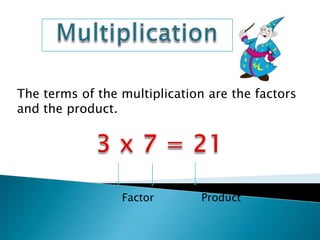
The terms of the multiplication are the factors
and the product.

Factor

Product
Properties of the multiplication
Associative property:
When three or more numbers are multiplied, the product is the
same regardless of the grouping of the factors.

Conmutative property:
When two numbers are multiplied together, the product is the
same regardless of the order of the multiplicands.
Distributive property:
The sum of two numbers times a third number is equal to the
sum of each addend times the third number.

Identity property:
The product of any number and one is that number.
Multiples of a number
The multiples of a number are all the products that we get
when we multiply the number times each natural number.
Example:

The bus to Cali leaves the bus station every 3 hours. The first
bus leaves at 6:00 am. Let´s find the multiples of 3 in order to
know what are the hours in which the bus leaves the station.
M3: {0,3,6,9,…………..18,21,24}

The bus leaves the bus station at:
6:00 am
9:00 am
12:00 pm
3:00 pm
6:00 pm
9:00 pm

Multiples of 3: {0,3,6,9,12,15,18,21}
Multiplication by one digit
In order to multiply a number by one digit factor we first
multiply , the ones, then the tens, the hundreds and so
on.
Let´s multiply 403 x 2.

First step
403
x
2

6

Second step
Ones

x

403
2

06

tens
Third step
403
x
2

1,094

Hundreds
Multiplication by two digits
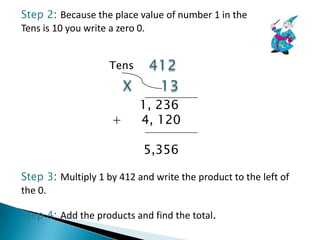
In order to multiply a 2 digit factor, we multiply the number by the
ones, then by the tens and finally we add the products
Let´s multiply 412 x 13.
Step 1 : multiply the number in the ones place which is 3 by 412.

Ones

1,236
Step 2: Because the place value of number 1 in the
Tens is 10 you write a zero 0.
Tens

+

1, 236
4, 120
5,356

Step 3: Multiply 1 by 412 and write the product to the left of
the 0.
Step 4: Add the products and find the total.
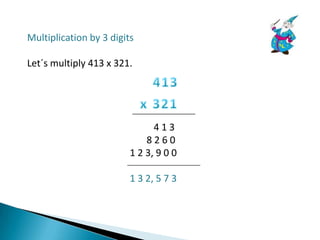
Multiplication by 3 digits
Let´s multiply 413 x 321.

413
8260
1 2 3, 9 0 0
1 3 2, 5 7 3
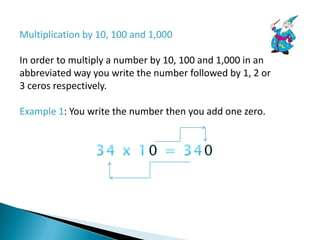
Multiplication by 10, 100 and 1,000
In order to multiply a number by 10, 100 and 1,000 in an
abbreviated way you write the number followed by 1, 2 or
3 ceros respectively.
Example 1: You write the number then you add one zero.
Example 2: To multiply by 100 you write the number and
you add two zeros (0 0).

Example 3: To multiply by 1,000 you write the number
and you add three zeros (0 0 0).

Multiplication lesson

  • 1.
    The terms ofthe multiplication are the factors and the product. Factor Product
  • 3.
    Properties of themultiplication Associative property: When three or more numbers are multiplied, the product is the same regardless of the grouping of the factors. Conmutative property: When two numbers are multiplied together, the product is the same regardless of the order of the multiplicands.
  • 4.
    Distributive property: The sumof two numbers times a third number is equal to the sum of each addend times the third number. Identity property: The product of any number and one is that number.
  • 5.
    Multiples of anumber The multiples of a number are all the products that we get when we multiply the number times each natural number. Example: The bus to Cali leaves the bus station every 3 hours. The first bus leaves at 6:00 am. Let´s find the multiples of 3 in order to know what are the hours in which the bus leaves the station.
  • 6.
    M3: {0,3,6,9,…………..18,21,24} The busleaves the bus station at: 6:00 am 9:00 am 12:00 pm 3:00 pm 6:00 pm 9:00 pm Multiples of 3: {0,3,6,9,12,15,18,21}
  • 7.
    Multiplication by onedigit In order to multiply a number by one digit factor we first multiply , the ones, then the tens, the hundreds and so on. Let´s multiply 403 x 2. First step 403 x 2 6 Second step Ones x 403 2 06 tens
  • 8.
  • 9.
    Multiplication by twodigits In order to multiply a 2 digit factor, we multiply the number by the ones, then by the tens and finally we add the products Let´s multiply 412 x 13. Step 1 : multiply the number in the ones place which is 3 by 412. Ones 1,236
  • 10.
    Step 2: Becausethe place value of number 1 in the Tens is 10 you write a zero 0. Tens + 1, 236 4, 120 5,356 Step 3: Multiply 1 by 412 and write the product to the left of the 0. Step 4: Add the products and find the total.
  • 11.
    Multiplication by 3digits Let´s multiply 413 x 321. 413 8260 1 2 3, 9 0 0 1 3 2, 5 7 3
  • 12.
    Multiplication by 10,100 and 1,000 In order to multiply a number by 10, 100 and 1,000 in an abbreviated way you write the number followed by 1, 2 or 3 ceros respectively. Example 1: You write the number then you add one zero.
  • 13.
    Example 2: Tomultiply by 100 you write the number and you add two zeros (0 0). Example 3: To multiply by 1,000 you write the number and you add three zeros (0 0 0).