TOPIC : LATHE -TAPER TURNING AND
FACING
NAME: SAYAN GHOSH
INTRODUCTION
 Lathe is a machine which removes the metal from a piece
of work to the required shape and size.
 It works on the principle of a rotating workpiece and a
fixed cutting tool.
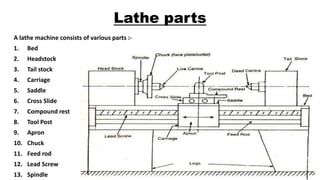
Lathe parts
A lathe machine consists of various parts :-
1. Bed
2. Headstock
3. Tail stock
4. Carriage
5. Saddle
6. Cross Slide
7. Compound rest
8. Tool Post
9. Apron
10. Chuck
11. Feed rod
12. Lead Screw
13. Spindle
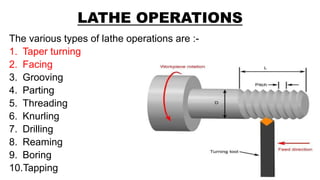
LATHE OPERATIONS
The various types of lathe operations are :-
1. Taper turning
2. Facing
3. Grooving
4. Parting
5. Threading
6. Knurling
7. Drilling
8. Reaming
9. Boring
10.Tapping
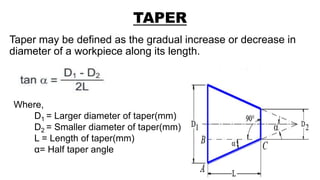
TAPER
Taper may be defined as the gradual increase or decrease in
diameter of a workpiece along its length.
Where,
D1 = Larger diameter of taper(mm)
D2 = Smaller diameter of taper(mm)
L = Length of taper(mm)
α= Half taper angle
TAPER
 Tapers are classified as inch tapers or metric tapers based on their
measuring units.
 Metric tapers are measured in millimeters per meter of length; for
example, a 1:20 taper has a 1-mm diameter change in 20mm of
length.
 Taper is necessary to
 Ensure self alignment.
 For quick fixing and releasing.
 For easy assembly and dismantle of parts.
 For transmitting drive in the assembled parts.
 Tapers are used in
 Drill shanks
 Drill sockets
 Drill sleeves
 Drill chuck
 Live centre
 Dead centre
TAPER TURNING OPERATIONS
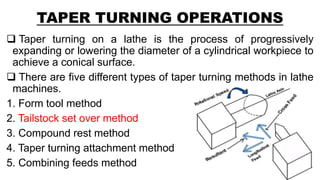
 Taper turning on a lathe is the process of progressively
expanding or lowering the diameter of a cylindrical workpiece to
achieve a conical surface.
 There are five different types of taper turning methods in lathe
machines.
1. Form tool method
2. Tailstock set over method
3. Compound rest method
4. Taper turning attachment method
5. Combining feeds method
TAILSTOCK SET OVER METHOD
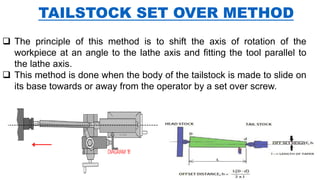
 The principle of this method is to shift the axis of rotation of the
workpiece at an angle to the lathe axis and fitting the tool parallel to
the lathe axis.
 This method is done when the body of the tailstock is made to slide on
its base towards or away from the operator by a set over screw.
ADVANTAGES AND DISADVANTAGES
ADVANTAGES
Power feed can be given
Good surface finish can be
obtained
Maximum length of the taper can
be produced
External threads on taper portion
can be produced
Duplicate tapers can be
produced
DISADVANTAGES
Only external taper can be turned
Accurate setting of the offset is
difficult
Taper turning is possible when work
is held between centres only
Damages to the centre drilled holes
of the work
The alignment of the lathe centres
will be disturbed
Steep tapers cannot be turned
FACING OPERATION
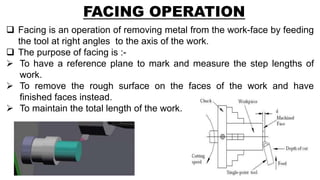
 Facing is an operation of removing metal from the work-face by feeding
the tool at right angles to the axis of the work.
 The purpose of facing is :-
 To have a reference plane to mark and measure the step lengths of
work.
 To remove the rough surface on the faces of the work and have
finished faces instead.
 To maintain the total length of the work.
CONCLUSION
Taper is the gradual increase or decrease in diameter
of a workpiece along its length.
Taper turning is done to provide a conical shape in the
metal.
Facing is done to provide a flat surface form which to
take accurate measurements.
Lathe is called mother of all machines as all kind of
operations can be performed here.
THANK YOU

lathe taper-turning and facing.pptx

  • 1.
    TOPIC : LATHE-TAPER TURNING AND FACING NAME: SAYAN GHOSH
  • 2.
    INTRODUCTION  Lathe isa machine which removes the metal from a piece of work to the required shape and size.  It works on the principle of a rotating workpiece and a fixed cutting tool.
  • 3.
    Lathe parts A lathemachine consists of various parts :- 1. Bed 2. Headstock 3. Tail stock 4. Carriage 5. Saddle 6. Cross Slide 7. Compound rest 8. Tool Post 9. Apron 10. Chuck 11. Feed rod 12. Lead Screw 13. Spindle
  • 4.
    LATHE OPERATIONS The varioustypes of lathe operations are :- 1. Taper turning 2. Facing 3. Grooving 4. Parting 5. Threading 6. Knurling 7. Drilling 8. Reaming 9. Boring 10.Tapping
  • 5.
    TAPER Taper may bedefined as the gradual increase or decrease in diameter of a workpiece along its length. Where, D1 = Larger diameter of taper(mm) D2 = Smaller diameter of taper(mm) L = Length of taper(mm) α= Half taper angle
  • 6.
    TAPER  Tapers areclassified as inch tapers or metric tapers based on their measuring units.  Metric tapers are measured in millimeters per meter of length; for example, a 1:20 taper has a 1-mm diameter change in 20mm of length.  Taper is necessary to  Ensure self alignment.  For quick fixing and releasing.  For easy assembly and dismantle of parts.  For transmitting drive in the assembled parts.  Tapers are used in  Drill shanks  Drill sockets  Drill sleeves  Drill chuck  Live centre  Dead centre
  • 7.
    TAPER TURNING OPERATIONS Taper turning on a lathe is the process of progressively expanding or lowering the diameter of a cylindrical workpiece to achieve a conical surface.  There are five different types of taper turning methods in lathe machines. 1. Form tool method 2. Tailstock set over method 3. Compound rest method 4. Taper turning attachment method 5. Combining feeds method
  • 8.
    TAILSTOCK SET OVERMETHOD  The principle of this method is to shift the axis of rotation of the workpiece at an angle to the lathe axis and fitting the tool parallel to the lathe axis.  This method is done when the body of the tailstock is made to slide on its base towards or away from the operator by a set over screw.
  • 9.
    ADVANTAGES AND DISADVANTAGES ADVANTAGES Powerfeed can be given Good surface finish can be obtained Maximum length of the taper can be produced External threads on taper portion can be produced Duplicate tapers can be produced DISADVANTAGES Only external taper can be turned Accurate setting of the offset is difficult Taper turning is possible when work is held between centres only Damages to the centre drilled holes of the work The alignment of the lathe centres will be disturbed Steep tapers cannot be turned
  • 10.
    FACING OPERATION  Facingis an operation of removing metal from the work-face by feeding the tool at right angles to the axis of the work.  The purpose of facing is :-  To have a reference plane to mark and measure the step lengths of work.  To remove the rough surface on the faces of the work and have finished faces instead.  To maintain the total length of the work.
  • 11.
    CONCLUSION Taper is thegradual increase or decrease in diameter of a workpiece along its length. Taper turning is done to provide a conical shape in the metal. Facing is done to provide a flat surface form which to take accurate measurements. Lathe is called mother of all machines as all kind of operations can be performed here.
  • 12.