Latest Trends in Opto Electronic
Devices and Communication
By:
Dr. Mayank Pandey
Assistant Professor
Department of Physics and Electronics.
Kristu Jayanti College (Autonomous), Bangalore
Evolution of Technology
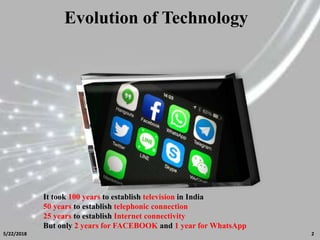
It took 100 years to establish television in India
50 years to establish telephonic connection
25 years to establish Internet connectivity
But only 2 years for FACEBOOK and 1 year for WhatsApp
5/22/2018 2
• 1880 – Alexander Graham Bell
• 1930 – Patents on tubing
• 1950 – Patent for two-layer glass wave-guide
• 1960 – Laser first used as light source
• 1965 – High loss of light discovered
• 1970s–Refining of manufacturing process
• 1980s –OF technology becomes backbone of long
distance telephone networks in NA.
Evolution of Optical Fiber
5/22/2018 3
What is Optical Fiber?
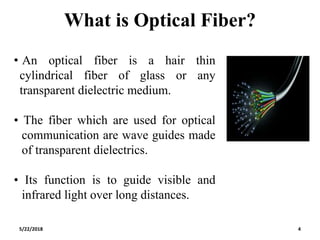
• An optical fiber is a hair thin
cylindrical fiber of glass or any
transparent dielectric medium.
• The fiber which are used for optical
communication are wave guides made
of transparent dielectrics.
• Its function is to guide visible and
infrared light over long distances.
5/22/2018 4
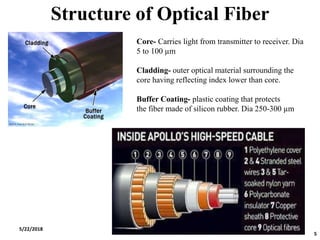
Structure of Optical Fiber
Core- Carries light from transmitter to receiver. Dia
5 to 100 µm
Cladding- outer optical material surrounding the
core having reflecting index lower than core.
Buffer Coating- plastic coating that protects
the fiber made of silicon rubber. Dia 250-300 µm
5/22/2018
5
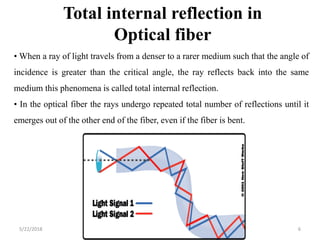
Total internal reflection in
Optical fiber
• When a ray of light travels from a denser to a rarer medium such that the angle of
incidence is greater than the critical angle, the ray reflects back into the same
medium this phenomena is called total internal reflection.
• In the optical fiber the rays undergo repeated total number of reflections until it
emerges out of the other end of the fiber, even if the fiber is bent.
5/22/2018 6
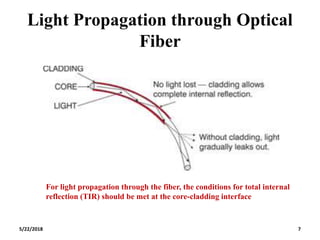
Light Propagation through Optical
Fiber
5/22/2018 7
For light propagation through the fiber, the conditions for total internal
reflection (TIR) should be met at the core-cladding interface
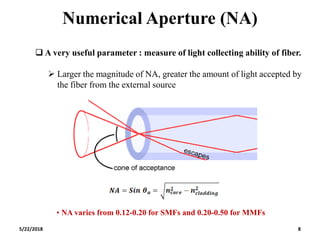
Numerical Aperture (NA)
5/22/2018 8
 A very useful parameter : measure of light collecting ability of fiber.
 Larger the magnitude of NA, greater the amount of light accepted by
the fiber from the external source
• NA varies from 0.12-0.20 for SMFs and 0.20-0.50 for MMFs
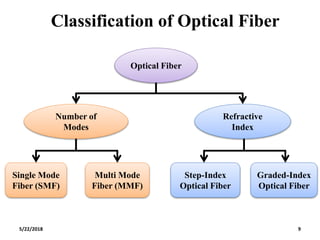
Classification of Optical Fiber
Optical Fiber
Number of
Modes
Refractive
Index
Single Mode
Fiber (SMF)
Multi Mode
Fiber (MMF)
Step-Index
Optical Fiber
Graded-Index
Optical Fiber
5/22/2018 9
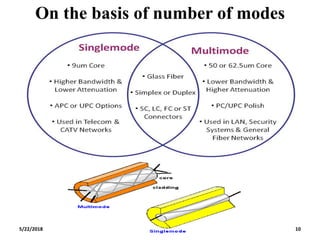
On the basis of number of modes
5/22/2018 10
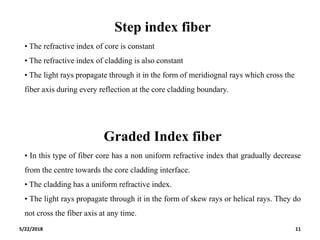
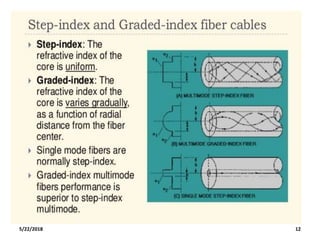
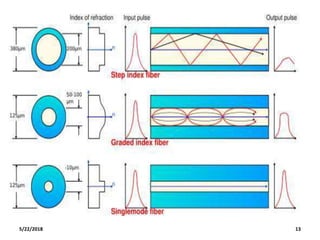
Step index fiber
• The refractive index of core is constant
• The refractive index of cladding is also constant
• The light rays propagate through it in the form of meridiognal rays which cross the
fiber axis during every reflection at the core cladding boundary.
Graded Index fiber
• In this type of fiber core has a non uniform refractive index that gradually decrease
from the centre towards the core cladding interface.
• The cladding has a uniform refractive index.
• The light rays propagate through it in the form of skew rays or helical rays. They do
not cross the fiber axis at any time.
5/22/2018 11
5/22/2018 12
5/22/2018 13
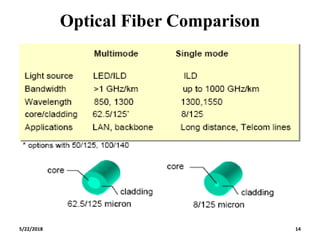
Optical Fiber Comparison
5/22/2018 14
5/22/2018 15
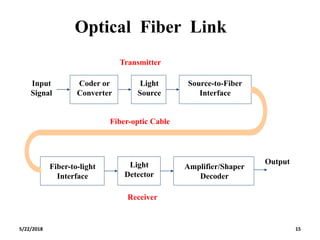
Optical Fiber Link
Output
Input
Signal
Coder or
Converter
Light
Source
Source-to-Fiber
Interface
Fiber-to-light
Interface
Light
Detector
Amplifier/Shaper
Decoder
Fiber-optic Cable
Transmitter
Receiver
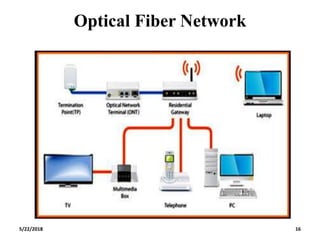
Optical Fiber Network
5/22/2018 16
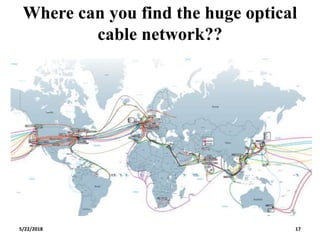
Where can you find the huge optical
cable network??
5/22/2018 17
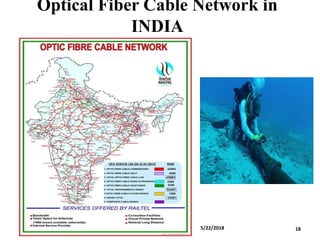
Optical Fiber Cable Network in
INDIA
5/22/2018 18
Differentiates the Size of the
Network held by a Company.
There are three tiers which differentiates the size of the network held by a company.
Tier-1 :- These are the companies which have a global network connecting so many
cables around the world. They will be able to provide access to any destination on
the internet without paying fee to others. They usually access the network of other
tier-1 companies without paying any fee. This network acts as the backbone of the
internet.
Tier-2 :- These are companies which have a regional networks and are usually
connected to one or more tier-1 networks. They have to pay a fee to access the tier-
1 company's network.
Tier-3 :- These are the Internet Service Providers(ISPs) from whom we buy our
broadband connections. They are the last tier, connecting the internet to the end
users.
5/22/2018 19
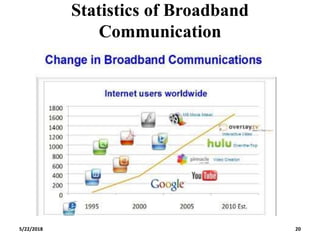
Statistics of Broadband
Communication
5/22/2018 20
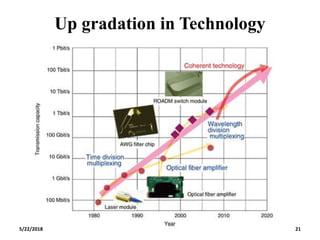
Up gradation in Technology
5/22/2018 21
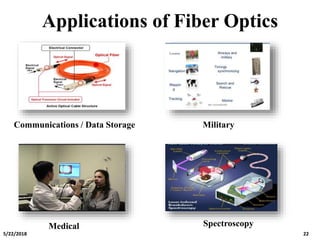
Applications of Fiber Optics
Communications / Data Storage Military
Medical Spectroscopy
5/22/2018 22
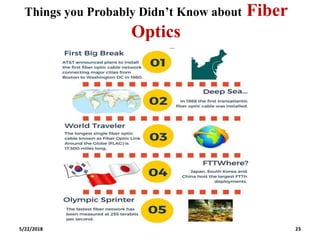
Things you Probably Didn’t Know about Fiber
Optics
5/22/2018 23
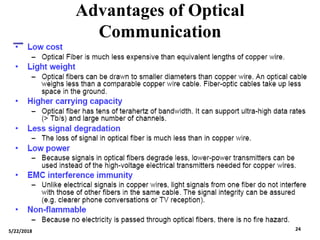
Advantages of Optical
Communication
5/22/2018 24
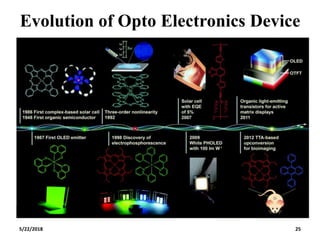
Evolution of Opto Electronics Device
5/22/2018 25
5/22/2018 26
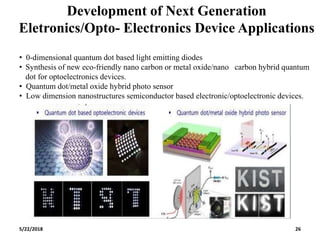
Development of Next Generation
Eletronics/Opto- Electronics Device Applications
• 0-dimensional quantum dot based light emitting diodes
• Synthesis of new eco-friendly nano carbon or metal oxide/nano carbon hybrid quantum
dot for optoelectronics devices.
• Quantum dot/metal oxide hybrid photo sensor
• Low dimension nanostructures semiconductor based electronic/optoelectronic devices.
5/22/2018 27
Conclusion
5/22/2018 28
To make accurate measurements using optical fiber,
the following conditions are required;
• Use a light source that is stable in time and in respect to the temperature.
• Verify that the connections, the fibers and the receiving cell are perfectly
clean .
• Use a reference link between the laser source and the element under test.
• To make several measurements with the same light injection conditions, the
reference fiber must not be disconnected during the measurement period.
THANK YU
5/22/2018 29

Latest trends in optoelectronics device and communication

  • 1.
    Latest Trends inOpto Electronic Devices and Communication By: Dr. Mayank Pandey Assistant Professor Department of Physics and Electronics. Kristu Jayanti College (Autonomous), Bangalore
  • 2.
    Evolution of Technology Ittook 100 years to establish television in India 50 years to establish telephonic connection 25 years to establish Internet connectivity But only 2 years for FACEBOOK and 1 year for WhatsApp 5/22/2018 2
  • 3.
    • 1880 –Alexander Graham Bell • 1930 – Patents on tubing • 1950 – Patent for two-layer glass wave-guide • 1960 – Laser first used as light source • 1965 – High loss of light discovered • 1970s–Refining of manufacturing process • 1980s –OF technology becomes backbone of long distance telephone networks in NA. Evolution of Optical Fiber 5/22/2018 3
  • 4.
    What is OpticalFiber? • An optical fiber is a hair thin cylindrical fiber of glass or any transparent dielectric medium. • The fiber which are used for optical communication are wave guides made of transparent dielectrics. • Its function is to guide visible and infrared light over long distances. 5/22/2018 4
  • 5.
    Structure of OpticalFiber Core- Carries light from transmitter to receiver. Dia 5 to 100 µm Cladding- outer optical material surrounding the core having reflecting index lower than core. Buffer Coating- plastic coating that protects the fiber made of silicon rubber. Dia 250-300 µm 5/22/2018 5
  • 6.
    Total internal reflectionin Optical fiber • When a ray of light travels from a denser to a rarer medium such that the angle of incidence is greater than the critical angle, the ray reflects back into the same medium this phenomena is called total internal reflection. • In the optical fiber the rays undergo repeated total number of reflections until it emerges out of the other end of the fiber, even if the fiber is bent. 5/22/2018 6
  • 7.
    Light Propagation throughOptical Fiber 5/22/2018 7 For light propagation through the fiber, the conditions for total internal reflection (TIR) should be met at the core-cladding interface
  • 8.
    Numerical Aperture (NA) 5/22/20188  A very useful parameter : measure of light collecting ability of fiber.  Larger the magnitude of NA, greater the amount of light accepted by the fiber from the external source • NA varies from 0.12-0.20 for SMFs and 0.20-0.50 for MMFs
  • 9.
    Classification of OpticalFiber Optical Fiber Number of Modes Refractive Index Single Mode Fiber (SMF) Multi Mode Fiber (MMF) Step-Index Optical Fiber Graded-Index Optical Fiber 5/22/2018 9
  • 10.
    On the basisof number of modes 5/22/2018 10
  • 11.
    Step index fiber •The refractive index of core is constant • The refractive index of cladding is also constant • The light rays propagate through it in the form of meridiognal rays which cross the fiber axis during every reflection at the core cladding boundary. Graded Index fiber • In this type of fiber core has a non uniform refractive index that gradually decrease from the centre towards the core cladding interface. • The cladding has a uniform refractive index. • The light rays propagate through it in the form of skew rays or helical rays. They do not cross the fiber axis at any time. 5/22/2018 11
  • 12.
  • 13.
  • 14.
  • 15.
    5/22/2018 15 Optical FiberLink Output Input Signal Coder or Converter Light Source Source-to-Fiber Interface Fiber-to-light Interface Light Detector Amplifier/Shaper Decoder Fiber-optic Cable Transmitter Receiver
  • 16.
  • 17.
    Where can youfind the huge optical cable network?? 5/22/2018 17
  • 18.
    Optical Fiber CableNetwork in INDIA 5/22/2018 18
  • 19.
    Differentiates the Sizeof the Network held by a Company. There are three tiers which differentiates the size of the network held by a company. Tier-1 :- These are the companies which have a global network connecting so many cables around the world. They will be able to provide access to any destination on the internet without paying fee to others. They usually access the network of other tier-1 companies without paying any fee. This network acts as the backbone of the internet. Tier-2 :- These are companies which have a regional networks and are usually connected to one or more tier-1 networks. They have to pay a fee to access the tier- 1 company's network. Tier-3 :- These are the Internet Service Providers(ISPs) from whom we buy our broadband connections. They are the last tier, connecting the internet to the end users. 5/22/2018 19
  • 20.
  • 21.
    Up gradation inTechnology 5/22/2018 21
  • 22.
    Applications of FiberOptics Communications / Data Storage Military Medical Spectroscopy 5/22/2018 22
  • 23.
    Things you ProbablyDidn’t Know about Fiber Optics 5/22/2018 23
  • 24.
  • 25.
    Evolution of OptoElectronics Device 5/22/2018 25
  • 26.
    5/22/2018 26 Development ofNext Generation Eletronics/Opto- Electronics Device Applications • 0-dimensional quantum dot based light emitting diodes • Synthesis of new eco-friendly nano carbon or metal oxide/nano carbon hybrid quantum dot for optoelectronics devices. • Quantum dot/metal oxide hybrid photo sensor • Low dimension nanostructures semiconductor based electronic/optoelectronic devices.
  • 27.
  • 28.
    Conclusion 5/22/2018 28 To makeaccurate measurements using optical fiber, the following conditions are required; • Use a light source that is stable in time and in respect to the temperature. • Verify that the connections, the fibers and the receiving cell are perfectly clean . • Use a reference link between the laser source and the element under test. • To make several measurements with the same light injection conditions, the reference fiber must not be disconnected during the measurement period.
  • 29.