Lateral Sinus Thrombosis
A Complication of CSOM
Overview
• 6% of all Intracranial complications of CSOM
• In CSOM direcrt spread through bone erosion
and thrombophlebitic spread through
emissary veins
• In ASOM spread is mainly through emissary
veins
Anatomy
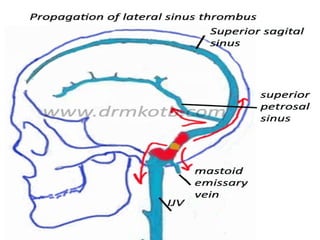
• Formed by the confluence of the superior
petrosal and transverse sinuses
• Becomes internal jugular vein at its exit from
foramen jugulare
Spread
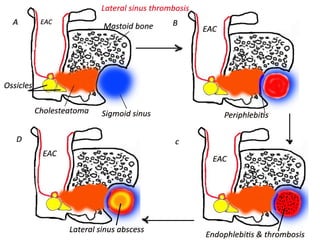
• Directly through bone erosion due to
granulation and cholesteatoma
• Thrombophlebitis of the mastoid emissary
veins
– Griesinger’s Sign
– Erythema, edema and tenderness over mastoid area
Pathophysiology
• Perisinus abscess  penetrates dura  reaches
intima  mural thrombus forms due to intimal
damage, hypercoagulation and blood flow in sinus
• Bacteria & thrombus  platelet aggregtion  fibrin
formation  mural clot  necrosis of clot 
intramural abscess
• Clot propagates  occlusion of vessel lumen &
infected emboli given off in circulation  metastatic
abscesses  septicemia
Presentation
• Varies according to stage
Presentation Contd.
• Despite antibiotics may present as
– Fever with periodic chills
– Picket fence due to periodic release of steptococci in blood from
septic thrombus
– Headache
– Due to raised ICP caused by interrupted cortical venous circulation
 Papilledema
– Otorrhoea
– Refractory to antibiotic therapy
– Neck Pain
– Extension of thrombophlebitis to jugular bulb and internal jugular
vein  IJV palpated as a tender cord in neck
Presentation Cont.
– Neck rigidity
– Due to meningeal irritation. Torticollis may also be seen due to
guarding of the neck muscles
– Nausea, vomiting
– Due to raised ICP and bacteremia
– Altered mental state and focal neurologic signs
– If brain abscess
– Vertigo and nystagmus
– Involvement of labyrinth
– Seizures
– Temporal lobe involvement
– Lethargy
Presentation Cont.
• Jugular Foramen Syndrome-Vernet’s Syndrome
- Dysphonia/hoarseness
- Soft palate dropping
- deviation of the uvula towards the normal side
- dysphagia
- loss of sensory function from the posterior 1/3 of the
tongue
- decrease in the parotid gland secretion
- loss of gag reflex
- Sternocleidomastoid and trapezius muscles paresis
Presentation Cont.
• Jugular Foramen Syndrome-Vernet’s Syndrome
– 9th
, 10th
& 11th
and sometimes 12th
nerve paralysis due to
pressure of clot in jugular bulb
– Symptoms
» pain in or behind ear due to irritation of the auricular
branches of the 9th
and 10th
nerves
» headache due to irritation of the meningeal branch of vagus
» hoarseness due to paralysis of the laryngeal nerves
» dysphagia (diffiuclty to swallow) due to paralysis of the
pharyngomotor fibres
» honers syndrome ( ptosis of upper eyelid, pupillary
constriction) due to interruption of sympathetic internal
caortid plexus
» wasting of affected side of tongue and deviation of the
protruded tongue to the affected side due to infranuclear
paralysis of 12th
nerve
Presentation Cont.
» deviation of the uvula away form the affected side due to
unopposed action of levator palatini
» sensory loss in oroharynx on the affected side
» inabllity to adduct the vocal cords to the midline
» weakness and wasting of sternocleidomastoid and
treapezius due to involvement of 11th
nerve
sympathetic signs may be absent if accessory nerve
unaffected
– Recovery depends on collateral circulation and
recanalization of the sinus
– Surgical intervention not required usually
– Decompression and removal of clot if necessary
Presentation Cont.
• Otitic Hydrocephalus
– Due to interrupted cortical venous circulation
obstruction in CSF flow leads to ventricular
dilatation
– One or both lateral sinuses may be found
thrombosed
– S&S of raised ICP`
Clinical Examination
• Anaemia & emaciation
• Griesingers’s sign
• Positive Tobey – Ayer’s Test
• Positive Crow – Beck’s Test
• Tenderness along IJV
• Enlarged jugular nodes
• Torticollis
• Positive Kernig’s Sign
• Positive Brudzinski’s Sign
Bacteriology
• Acute
– Hemolytic stretpococci
– Pneumococci
– Staphylococci
• Chronic
– Bacillus Proteus
– Pseudomonas Pyocyaneus
– E.coli
– Bacteroides
– Staphylococci
Labs
• Polys on CBC
• CSF examination ICP only
• C/S of ear swab
• C/S of pus material from sinus if available
Imaging
• CT with contrast  Delta Sign
• Gadolinium enhanced MRI  Delta Sign
– MRI is the investigation of choice & is done in
combination with CT
• Serial MRV in combination with MRI to see
clot propagation and resolution
Treatment
• Medical + Surgical  Combo
• Medical
– I/V antibiotics
– Anti coagulants only if clot in superior sagittal
sinus or ICP persists despite medical
management
Treatment Contd.
• Surgical
• Mastoidectomy + removal of clot from sinus
– ASOM
– Cortical + removal of sinus plate
– CSOM + Cholesteatoma
– Radical
– Refractory Septicemia
– IJV ligation to stop emboli being thrown into circulation
Follow up
• Post op antibiotics for 2-3 weeks
• Post op MRI & MRV
Complications
• Mostly ipsilateral
• At times contralateral due to hematogenous
spread
Prognosis
• Mortality has decreased to less than 10% due
to availability of effective medical and surgical
treatment
Name No. Drains to / Becomes
Inferior Sagittal Sinus 1 Straight sinus
Superior Sagittal Sinus 1 Becomes right transverse sinus or confluence of
sinuses
Straight Sinus 1 Becomes left transverse sinus or confluence of
sinuses
Occipital Sinus 1 Confluence of sinuses
Confluence Of Sinuses 1 Right and left transverse sinuses
Sphenoparietal Sinuses 2 Cavernous sinuses
Intercavernous Sinuses 2 Cavernous sinuses
Cavernous Sinuses 2 Superior and inferior petrosal sinuses
Superior & Inferior Petrosal
Sinuses
2/2 Transverse sinuses
Transverse Sinuses 2 Sigmoid sinusees
Sigmoid Sinuses 2 Jugular bulb  IJV

Lateral sinus thrombosis

  • 1.
    Lateral Sinus Thrombosis AComplication of CSOM
  • 2.
    Overview • 6% ofall Intracranial complications of CSOM • In CSOM direcrt spread through bone erosion and thrombophlebitic spread through emissary veins • In ASOM spread is mainly through emissary veins
  • 3.
    Anatomy • Formed bythe confluence of the superior petrosal and transverse sinuses • Becomes internal jugular vein at its exit from foramen jugulare
  • 6.
    Spread • Directly throughbone erosion due to granulation and cholesteatoma • Thrombophlebitis of the mastoid emissary veins – Griesinger’s Sign – Erythema, edema and tenderness over mastoid area
  • 9.
    Pathophysiology • Perisinus abscess penetrates dura  reaches intima  mural thrombus forms due to intimal damage, hypercoagulation and blood flow in sinus • Bacteria & thrombus  platelet aggregtion  fibrin formation  mural clot  necrosis of clot  intramural abscess • Clot propagates  occlusion of vessel lumen & infected emboli given off in circulation  metastatic abscesses  septicemia
  • 11.
  • 14.
    Presentation Contd. • Despiteantibiotics may present as – Fever with periodic chills – Picket fence due to periodic release of steptococci in blood from septic thrombus – Headache – Due to raised ICP caused by interrupted cortical venous circulation  Papilledema – Otorrhoea – Refractory to antibiotic therapy – Neck Pain – Extension of thrombophlebitis to jugular bulb and internal jugular vein  IJV palpated as a tender cord in neck
  • 15.
    Presentation Cont. – Neckrigidity – Due to meningeal irritation. Torticollis may also be seen due to guarding of the neck muscles – Nausea, vomiting – Due to raised ICP and bacteremia – Altered mental state and focal neurologic signs – If brain abscess – Vertigo and nystagmus – Involvement of labyrinth – Seizures – Temporal lobe involvement – Lethargy
  • 16.
    Presentation Cont. • JugularForamen Syndrome-Vernet’s Syndrome - Dysphonia/hoarseness - Soft palate dropping - deviation of the uvula towards the normal side - dysphagia - loss of sensory function from the posterior 1/3 of the tongue - decrease in the parotid gland secretion - loss of gag reflex - Sternocleidomastoid and trapezius muscles paresis
  • 17.
    Presentation Cont. • JugularForamen Syndrome-Vernet’s Syndrome – 9th , 10th & 11th and sometimes 12th nerve paralysis due to pressure of clot in jugular bulb – Symptoms » pain in or behind ear due to irritation of the auricular branches of the 9th and 10th nerves » headache due to irritation of the meningeal branch of vagus » hoarseness due to paralysis of the laryngeal nerves » dysphagia (diffiuclty to swallow) due to paralysis of the pharyngomotor fibres » honers syndrome ( ptosis of upper eyelid, pupillary constriction) due to interruption of sympathetic internal caortid plexus » wasting of affected side of tongue and deviation of the protruded tongue to the affected side due to infranuclear paralysis of 12th nerve
  • 18.
    Presentation Cont. » deviationof the uvula away form the affected side due to unopposed action of levator palatini » sensory loss in oroharynx on the affected side » inabllity to adduct the vocal cords to the midline » weakness and wasting of sternocleidomastoid and treapezius due to involvement of 11th nerve sympathetic signs may be absent if accessory nerve unaffected – Recovery depends on collateral circulation and recanalization of the sinus – Surgical intervention not required usually – Decompression and removal of clot if necessary
  • 20.
    Presentation Cont. • OtiticHydrocephalus – Due to interrupted cortical venous circulation obstruction in CSF flow leads to ventricular dilatation – One or both lateral sinuses may be found thrombosed – S&S of raised ICP`
  • 21.
    Clinical Examination • Anaemia& emaciation • Griesingers’s sign • Positive Tobey – Ayer’s Test • Positive Crow – Beck’s Test • Tenderness along IJV • Enlarged jugular nodes • Torticollis • Positive Kernig’s Sign • Positive Brudzinski’s Sign
  • 23.
    Bacteriology • Acute – Hemolyticstretpococci – Pneumococci – Staphylococci • Chronic – Bacillus Proteus – Pseudomonas Pyocyaneus – E.coli – Bacteroides – Staphylococci
  • 24.
    Labs • Polys onCBC • CSF examination ICP only • C/S of ear swab • C/S of pus material from sinus if available
  • 25.
    Imaging • CT withcontrast  Delta Sign • Gadolinium enhanced MRI  Delta Sign – MRI is the investigation of choice & is done in combination with CT • Serial MRV in combination with MRI to see clot propagation and resolution
  • 26.
    Treatment • Medical +Surgical  Combo • Medical – I/V antibiotics – Anti coagulants only if clot in superior sagittal sinus or ICP persists despite medical management
  • 27.
    Treatment Contd. • Surgical •Mastoidectomy + removal of clot from sinus – ASOM – Cortical + removal of sinus plate – CSOM + Cholesteatoma – Radical – Refractory Septicemia – IJV ligation to stop emboli being thrown into circulation
  • 28.
    Follow up • Postop antibiotics for 2-3 weeks • Post op MRI & MRV
  • 29.
    Complications • Mostly ipsilateral •At times contralateral due to hematogenous spread
  • 30.
    Prognosis • Mortality hasdecreased to less than 10% due to availability of effective medical and surgical treatment
  • 34.
    Name No. Drainsto / Becomes Inferior Sagittal Sinus 1 Straight sinus Superior Sagittal Sinus 1 Becomes right transverse sinus or confluence of sinuses Straight Sinus 1 Becomes left transverse sinus or confluence of sinuses Occipital Sinus 1 Confluence of sinuses Confluence Of Sinuses 1 Right and left transverse sinuses Sphenoparietal Sinuses 2 Cavernous sinuses Intercavernous Sinuses 2 Cavernous sinuses Cavernous Sinuses 2 Superior and inferior petrosal sinuses Superior & Inferior Petrosal Sinuses 2/2 Transverse sinuses Transverse Sinuses 2 Sigmoid sinusees Sigmoid Sinuses 2 Jugular bulb  IJV