LASER SCANNING TECHNOLOGY IN CIVIL ENGINEERING
CONSTRUCTION PROJECTS
Presented By
SURYA C.D
ME Construction Management
1
CONTENTS
 Objectives 3
 Scope 4
 What is Laser Scanning ? 5
 Why is Laser Scanning ? 10
 Major applications in Civil Engineering 11
Case Study 19
 Disadvantages 24
 Conclusion 25
References 26
2Date:30/1/2011
SLIDE NUMBER
OBJECTIVES
 To reveal the applications of Laser Scanning Technology in Civil
Engineering construction Projects
 To reveal the benefits of using Laser Scanning technology in
construction field
To show the simple working of Laser Scanner.
3
Date: 25-06-2016
SCOPE
 Used mainly for 3D modeling, dam monitoring etc.
 Used in construction manufacturing plants, airports ,hospitals
bridges etc.
Increases speed and accuracy of plans, elevations, profiles, and
volume and area calculations.
Valuable tool for reduction of construction costs
Ensure fast & accurate data whenever required.
425-06-2016
What is Laser Scanner ?
LASER
SCANNER
Laser Unit
Rotating Unit
Control And
Recording
Unit
Ranging
Unit
5
25-06-2016
 Detailed 3D positioning of a structure can be made.
 Provide full FOV (Full field of view)
 Advanced timing technology
 Accurate enough up to 2 mm resolution
 Long range up to about 300 m with good reflective surfaces.
 Cannot be easily set up over a known point (heavy)
Characteristics
6
25-06-2016
Scanner Specifications
Speed-5000 points per second
360 degree field of view
Weighs-13 Kg to 15 Kg
340mm deep & 270 mm wide
Requires electric power to operate.
7
25-06-2016
Basic Concept
825-06-2016
Date:30/1/2011
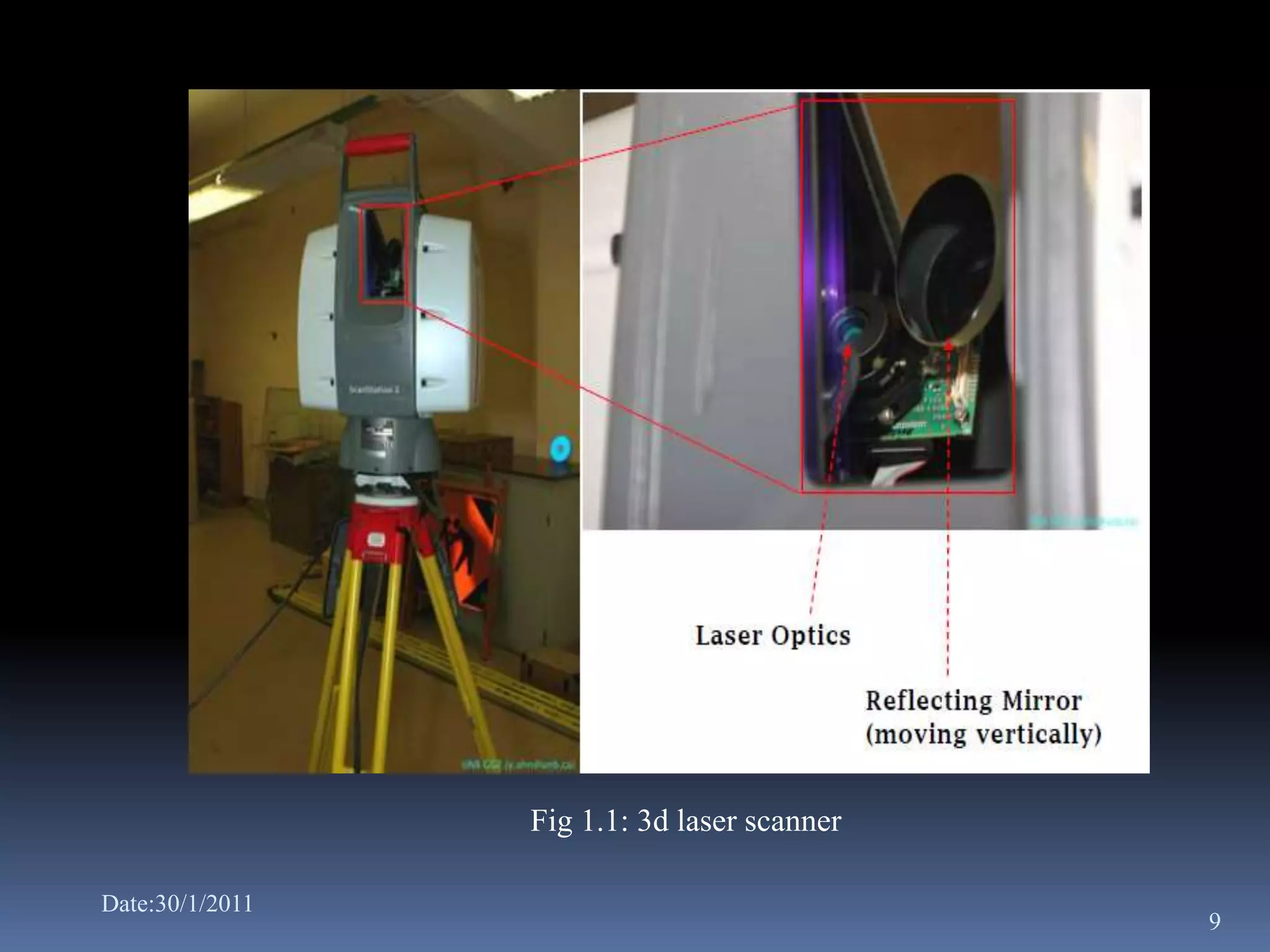
Fig 1.1: 3d laser scanner
9
Date:30/1/2011
Why Laser scanning ?
Higher project costs
Missed schedules
Operations & maintenance inefficiencies
and problems
Safety problems
10
Date:30/1/2011
Applications
11
Date:30/1/2011
3D modeling
• Data Acquisition
• Data processing
• Modeling
Steps Involved:-
12Date:30/1/2011
STEP 1: Target the structure
13
Date:30/1/2011
Fig. 3.1 Targeting bridge
STEP 2 : Point Clouding
14
Date:30/1/2011
Fig.3.2 Point clouding
STEP 3 : Modeling / Meshing
15
25-06-2016 Fig. 3.3 Mesh model
LST for Railway And track Survey
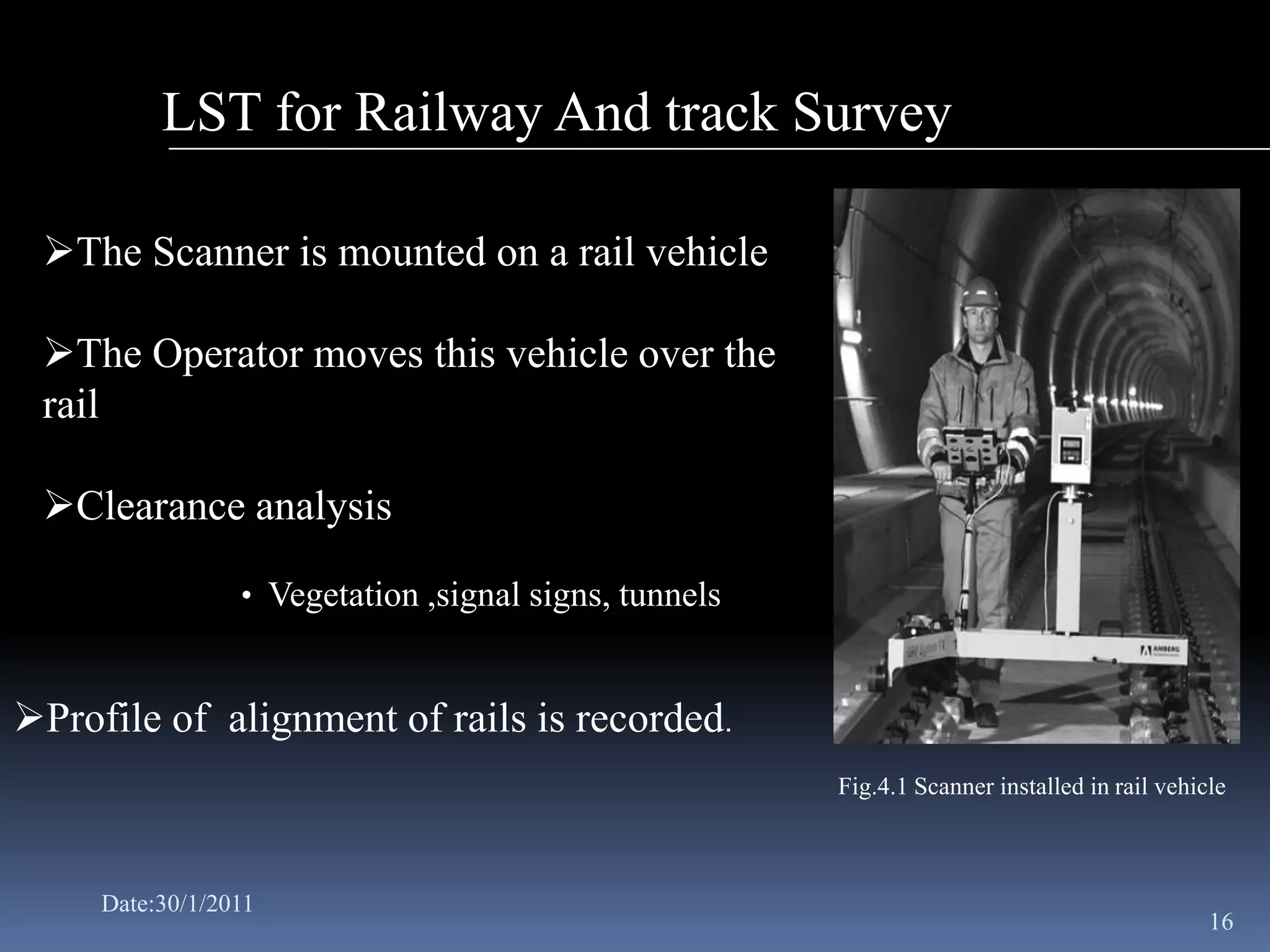
The Scanner is mounted on a rail vehicle
The Operator moves this vehicle over the
rail
Clearance analysis
• Vegetation ,signal signs, tunnels
Profile of alignment of rails is recorded.
16
Date:30/1/2011
Fig.4.1 Scanner installed in rail vehicle
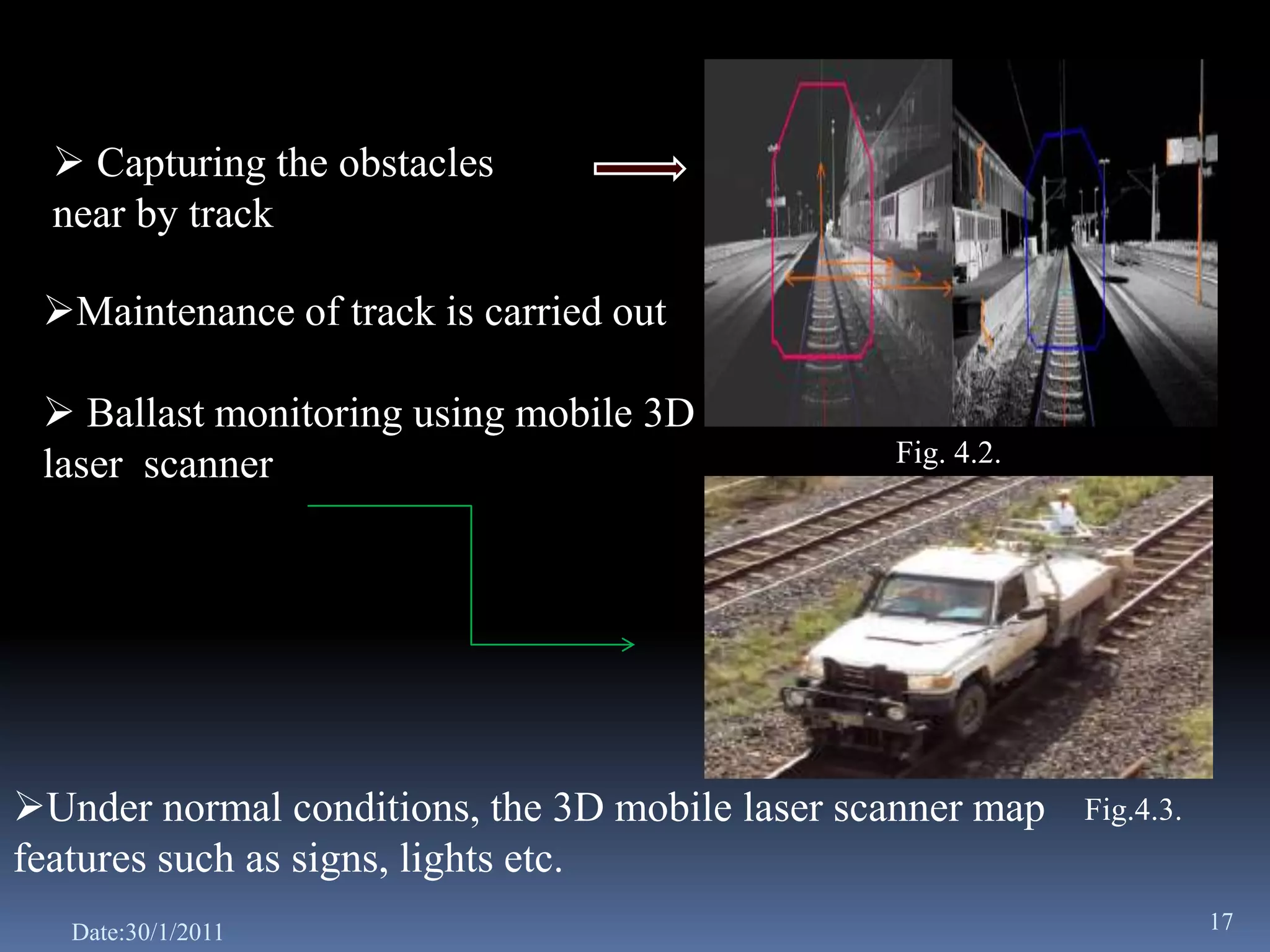
 Capturing the obstacles
near by track
Maintenance of track is carried out
 Ballast monitoring using mobile 3D
laser scanner
Under normal conditions, the 3D mobile laser scanner map
features such as signs, lights etc.
17Date:30/1/2011
Fig. 4.2.
Fig.4.3.
LST for Dam Monitoring
Monitoring –evaluating the structural safety of dams
Surface displacements are important quantities to be
determined
18Date:30/1/2011
19
Date:30/1/2011
Case study
Alto ceira is dam situated in portugal
Crack surveying and mapping -- major problems of dam
Cracks wider than 2 or 3mm are to be surveyed.
 The main challenge in dam monitoring – resolution of
images rather than metric quality
 3stations have been set up for the scanner
Perspective view of the dam is obtained
20
Date:30/1/2011
 Processing and modeling is done by meshing
 Orto images were created
21
Date:30/1/2011
 Vectorization using CAD software
 Association of CAD and DBMS
 Accurate model of dam with cracks is obtained and can be
then analyzed
22
Date:30/1/2011
Other applications
Deformation monitoring
Distance measurement
Determine building maintenance requirements
Helps in determination of earthwork quantities
Used to measure bridge camber
23
Date:30/1/2011
When scanning outside, vegetation such as trees pose a major
obstacle
Power stability is an issue for continuous usage.
Weather must be considered for outside scan.
Major Disadvantages
24
Date:30/1/2011
Conclusion
Possibilities of laser scanning in civil engineering is limitless
Reliable technology
Gives high fidelity data
Enable Precise and accurate 3D model of any structure
25
Date:30/1/2011
26
References
[1] Jocea Andreea Florinas,”3D spatial data acquisition and modeling of
Anghel saligney monument using terrestrial laser scanning” Vol
2(15),2012,pp.2-5
[2] A Bernini’s, “Terrestrial laser scanning-civil engineering applications” Vol
XXXVIII, Part 5,2010
[3] Pedro Arias and Higino Gonzalez, “Novel method to determine laser scanner
accuracy for applications in civil engineering “Vol XLII,No. 1,2012
[4] Arias, J Armesto, M solla “ Terrestrial laser scanning and non parametric
methods in masonry arches inspection” Vol XXXVIII,2010
[5] WIKIPEDIA,http//www.wikipedia.com//
Date:30/1/2011
27

Laser scanning technology in civil engg

  • 1.
    LASER SCANNING TECHNOLOGYIN CIVIL ENGINEERING CONSTRUCTION PROJECTS Presented By SURYA C.D ME Construction Management 1
  • 2.
    CONTENTS  Objectives 3 Scope 4  What is Laser Scanning ? 5  Why is Laser Scanning ? 10  Major applications in Civil Engineering 11 Case Study 19  Disadvantages 24  Conclusion 25 References 26 2Date:30/1/2011 SLIDE NUMBER
  • 3.
    OBJECTIVES  To revealthe applications of Laser Scanning Technology in Civil Engineering construction Projects  To reveal the benefits of using Laser Scanning technology in construction field To show the simple working of Laser Scanner. 3 Date: 25-06-2016
  • 4.
    SCOPE  Used mainlyfor 3D modeling, dam monitoring etc.  Used in construction manufacturing plants, airports ,hospitals bridges etc. Increases speed and accuracy of plans, elevations, profiles, and volume and area calculations. Valuable tool for reduction of construction costs Ensure fast & accurate data whenever required. 425-06-2016
  • 5.
    What is LaserScanner ? LASER SCANNER Laser Unit Rotating Unit Control And Recording Unit Ranging Unit 5 25-06-2016
  • 6.
     Detailed 3Dpositioning of a structure can be made.  Provide full FOV (Full field of view)  Advanced timing technology  Accurate enough up to 2 mm resolution  Long range up to about 300 m with good reflective surfaces.  Cannot be easily set up over a known point (heavy) Characteristics 6 25-06-2016
  • 7.
    Scanner Specifications Speed-5000 pointsper second 360 degree field of view Weighs-13 Kg to 15 Kg 340mm deep & 270 mm wide Requires electric power to operate. 7 25-06-2016
  • 8.
  • 9.
    Fig 1.1: 3dlaser scanner 9 Date:30/1/2011
  • 10.
    Why Laser scanning? Higher project costs Missed schedules Operations & maintenance inefficiencies and problems Safety problems 10 Date:30/1/2011
  • 11.
  • 12.
    3D modeling • DataAcquisition • Data processing • Modeling Steps Involved:- 12Date:30/1/2011
  • 13.
    STEP 1: Targetthe structure 13 Date:30/1/2011 Fig. 3.1 Targeting bridge
  • 14.
    STEP 2 :Point Clouding 14 Date:30/1/2011 Fig.3.2 Point clouding
  • 15.
    STEP 3 :Modeling / Meshing 15 25-06-2016 Fig. 3.3 Mesh model
  • 16.
    LST for RailwayAnd track Survey The Scanner is mounted on a rail vehicle The Operator moves this vehicle over the rail Clearance analysis • Vegetation ,signal signs, tunnels Profile of alignment of rails is recorded. 16 Date:30/1/2011 Fig.4.1 Scanner installed in rail vehicle
  • 17.
     Capturing theobstacles near by track Maintenance of track is carried out  Ballast monitoring using mobile 3D laser scanner Under normal conditions, the 3D mobile laser scanner map features such as signs, lights etc. 17Date:30/1/2011 Fig. 4.2. Fig.4.3.
  • 18.
    LST for DamMonitoring Monitoring –evaluating the structural safety of dams Surface displacements are important quantities to be determined 18Date:30/1/2011
  • 19.
    19 Date:30/1/2011 Case study Alto ceirais dam situated in portugal Crack surveying and mapping -- major problems of dam Cracks wider than 2 or 3mm are to be surveyed.  The main challenge in dam monitoring – resolution of images rather than metric quality
  • 20.
     3stations havebeen set up for the scanner Perspective view of the dam is obtained 20 Date:30/1/2011
  • 21.
     Processing andmodeling is done by meshing  Orto images were created 21 Date:30/1/2011
  • 22.
     Vectorization usingCAD software  Association of CAD and DBMS  Accurate model of dam with cracks is obtained and can be then analyzed 22 Date:30/1/2011
  • 23.
    Other applications Deformation monitoring Distancemeasurement Determine building maintenance requirements Helps in determination of earthwork quantities Used to measure bridge camber 23 Date:30/1/2011
  • 24.
    When scanning outside,vegetation such as trees pose a major obstacle Power stability is an issue for continuous usage. Weather must be considered for outside scan. Major Disadvantages 24 Date:30/1/2011
  • 25.
    Conclusion Possibilities of laserscanning in civil engineering is limitless Reliable technology Gives high fidelity data Enable Precise and accurate 3D model of any structure 25 Date:30/1/2011
  • 26.
    26 References [1] Jocea AndreeaFlorinas,”3D spatial data acquisition and modeling of Anghel saligney monument using terrestrial laser scanning” Vol 2(15),2012,pp.2-5 [2] A Bernini’s, “Terrestrial laser scanning-civil engineering applications” Vol XXXVIII, Part 5,2010 [3] Pedro Arias and Higino Gonzalez, “Novel method to determine laser scanner accuracy for applications in civil engineering “Vol XLII,No. 1,2012 [4] Arias, J Armesto, M solla “ Terrestrial laser scanning and non parametric methods in masonry arches inspection” Vol XXXVIII,2010 [5] WIKIPEDIA,http//www.wikipedia.com// Date:30/1/2011
  • 27.