AUTOMATION IN CIVIL
ENGINEERING
TABLE OF CONTENTS
▪ Introduction
▪ Necessity of Automation in the Construction
▪ Economy of Indian Construction
▪ Areas of Automation in Construction
▪ Advantages and Disadvantages
▪ Conclusion
INTRODUCTION
Automation is the technology by which a process or procedure is
performed with minimum human assistance.
 It has been achieved by various means including mechanical,
pneumatic, hydraulic, electrical, electronic and computer devices.
Automation is developed in situations when there is repeated and
regular work.
The scope of Automation in Construction is broad, encompassing all
stages of construction from planning to dismantling of strucutre.
NECESSITY OF AUTOMATION
▪ In developing countries like India, the construction industries need
automation technologies for faster completion of works such as roads,
tunnels, and bridge construction, earthwork, etc.
▪ The construction industry being labor intensive requires more numbers
of skilled labor, good quality of work, and increase in productivity etc.
The problems associated with construction work such as decreasing
quality of work, labor shortages, and safety of labor and working
condition of projects makes serious trouble in construction, where as
automation has the potential to improve the quality, safety, and
productivity in the construction industry.
▪ At times construction work is conducted under dangerous sites such as
like undermines, tunnels, cassions, bridges and high rise buildings and
etc. thus in such machinery is required.
▪ Automated machinery is necessary when availability of skilled worker is
least.
▪ And also required when work is to be completed in shorter period with
great efficiency and quality.
AREAS OF AUTOMATION IN CIVIL ENGINEERING
In modern world every field is some what automated, but Some of the
areas of civil engineering in which automation Is intensively developed are
▪ Automation in Surveying process
▪ Automation in Designing process
▪ Automation in construction process
Automation In Surveying Field
▪ In current construction practices, the use of surveying processes is an
essential procedure that can be per-formed with automation and
robotics technologies if the appropriate tools can be integrated. Various
regular surveying processes, such as point layout and soil and pavement
deformation monitoring, distance measuring can benefit from
innovative hardware development, like Total stations, laser scanner,
tachometry, drones and etc.
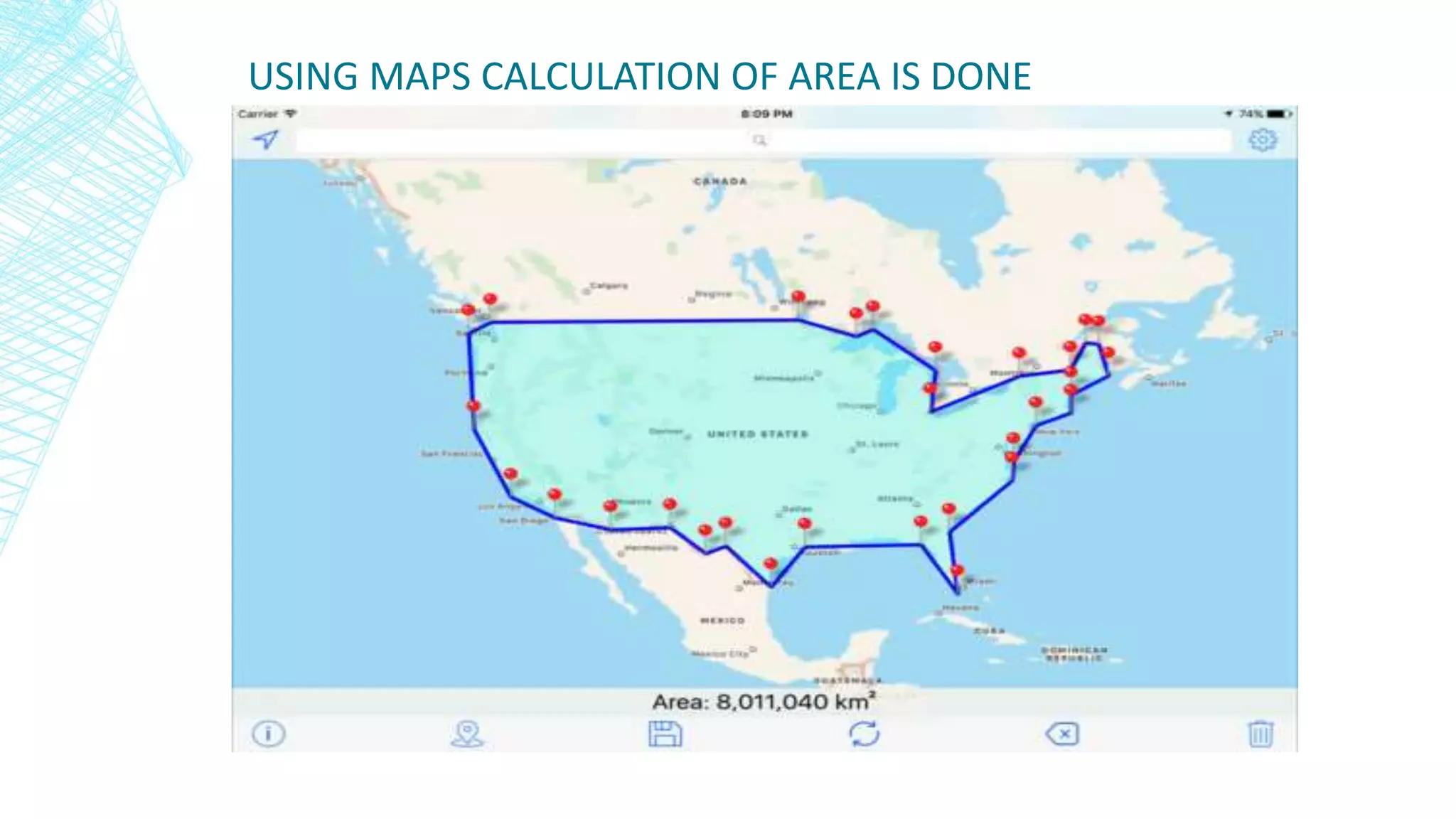
▪ In case of calculating distances and areas of large area satellite Maps
are used for grater precise.
▪ And also intensive development in computer aided programs such like
AUTOCAD is seen in industry.
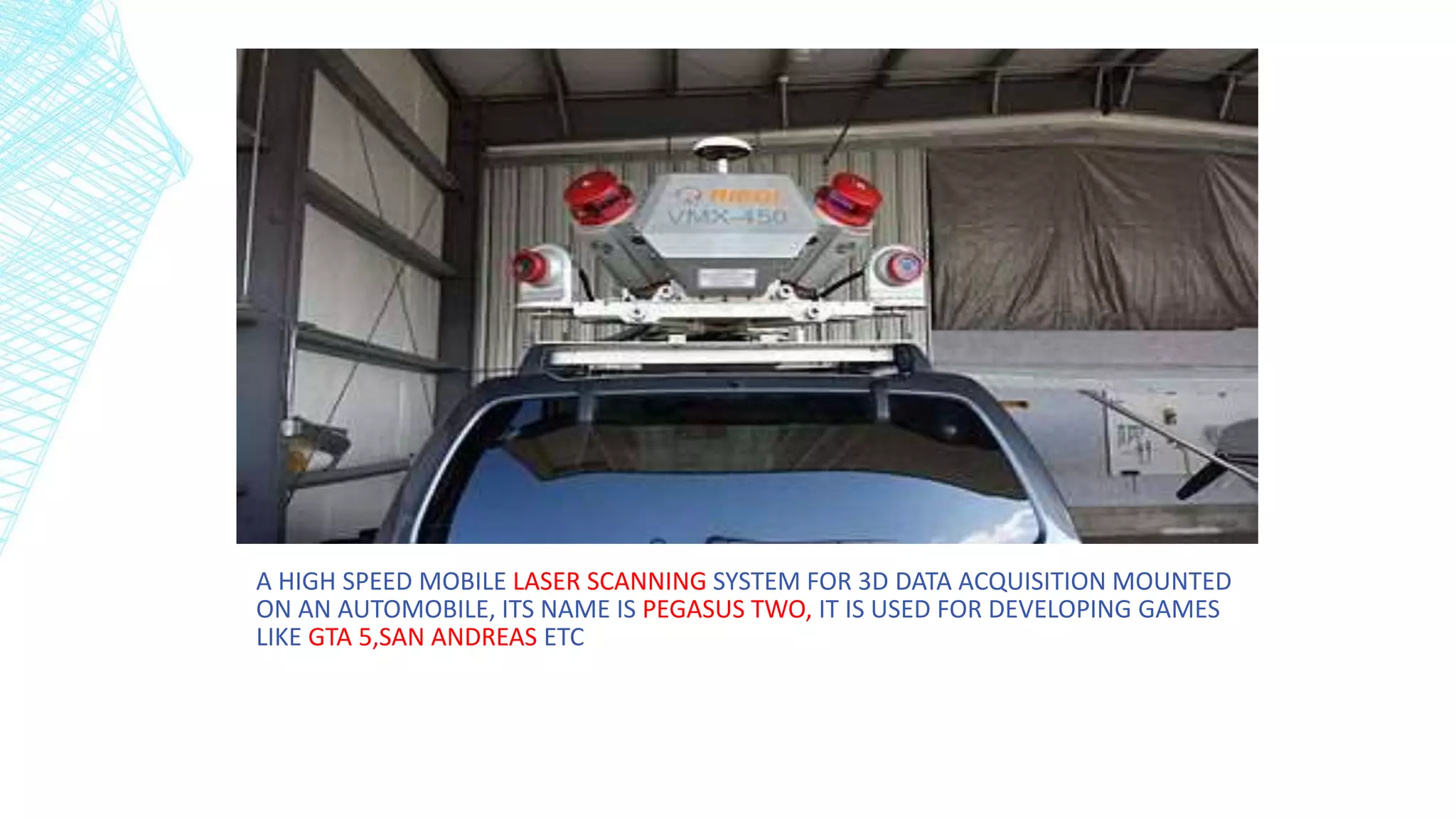
A HIGH SPEED MOBILE LASER SCANNING SYSTEM FOR 3D DATA ACQUISITION MOUNTED
ON AN AUTOMOBILE, ITS NAME IS PEGASUS TWO, IT IS USED FOR DEVELOPING GAMES
LIKE GTA 5,SAN ANDREAS ETC
USING MAPS CALCULATION OF AREA IS DONE
CONSTRUCTION AUTOMATION
▪ Construction automated equipment's such as like crane, excavators
reduce most of the laborious work and increase the output value in just
shot period of time.
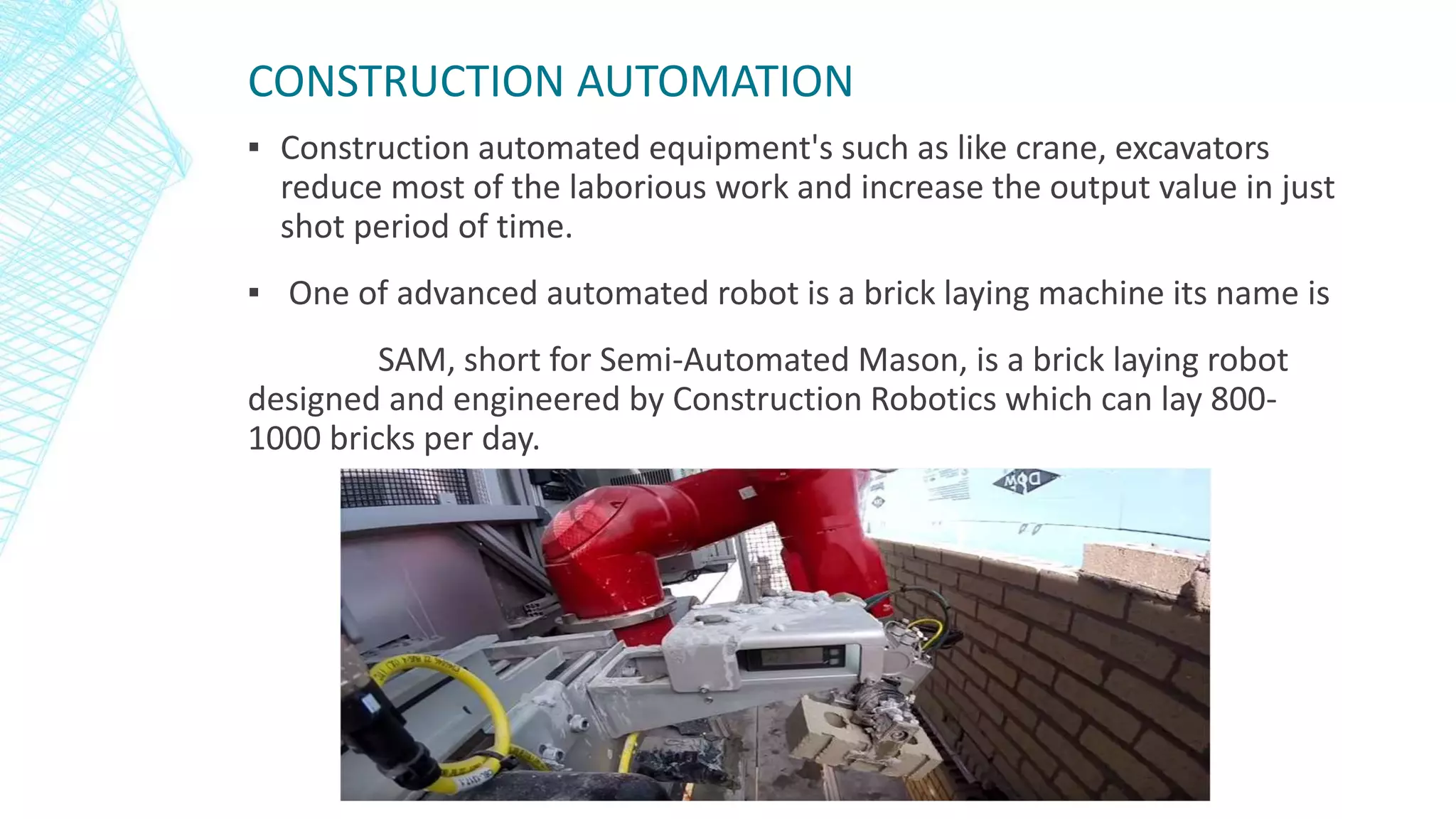
▪ One of advanced automated robot is a brick laying machine its name is
SAM, short for Semi-Automated Mason, is a brick laying robot
designed and engineered by Construction Robotics which can lay 800-
1000 bricks per day.
AUTOMATION IN DESIGNING
▪ Design processes use intellectual rather than physical skills and these
have been far harder to automate until the invention of the digital
computer. As much engineering design comprises of mathematical
modelling, and the computer is highly efficient at executing
mathematical calculations, this phenomenon leads to software's like
STAAD , ETABS, SAP 2000, Revit and etc,
▪ Until now this field is semi automated but may not be in future
▪ Construction design can be broken down into various functions, most of
which are ideally suited to computerization. Technical design usually
starts with a conceptual phase where real-world problems are analyzed
and idealized. This is a high-level skill, based on experience and
although some software tools can assist, such as those based on
artificial intelligence, this phase is not well suited to computerization.
When the real-world problem is broken down into discreet elements
that can be modelled: analysis, design, drawing, detailing, scheduling
and even planning, can be computerized. Once these processes are in
an electronic form, partial automation has been achieved. When the
software passes the output from one phase to another, full automation
has arrived.
THE PROBLEMS ASSOCIATED WITH DESIGN
AUTOMATION
▪ The problems associated with computerized design, come from the
potential for unanticipated or unrecognized consequences, this give
errors some of which have led to catastrophic failure.
▪ Sometimes computer generated errors come from deficiencies in the
modelling process, or a lack of understanding of the limitations of the
software, rather than the actual computation or errors in the software
itself.
▪ And Many organizations have recognized this and have published
guidelines for the safer use of computers in engineering calculations.
These usually recommend a systematic approach to computer analysis
that breaks the process into a numbers of stages, each with its own
verification and validation procedures(Manual checks).
ADVANTAGES
• Uniform quality with higher accuracy can achieved.
• Replacing human operators in tasks that involve hard physical or
monotonous work.
• Replacing humans in tasks performed in dangerous environments such
as those with heights, over a river etc.
• Making tasks that are beyond human capabilities easier.
• Increasing productivity and work efficiency with reduced costs.
DISADVANTAGES
▪ Reduction in employment and job opportunities.
▪ The automation of a new product or the construction of a new plant
requires a huge initial investment compared to the unit cost of the
product.
▪ A skilled maintenance department is often required to service and
maintain the automation system in proper working order.
▪ Unseen errors can cause severe loss in projects.
THANK YOU

Automation in civil engineering , TECH

  • 1.
  • 2.
    TABLE OF CONTENTS ▪Introduction ▪ Necessity of Automation in the Construction ▪ Economy of Indian Construction ▪ Areas of Automation in Construction ▪ Advantages and Disadvantages ▪ Conclusion
  • 3.
    INTRODUCTION Automation is thetechnology by which a process or procedure is performed with minimum human assistance.  It has been achieved by various means including mechanical, pneumatic, hydraulic, electrical, electronic and computer devices. Automation is developed in situations when there is repeated and regular work. The scope of Automation in Construction is broad, encompassing all stages of construction from planning to dismantling of strucutre.
  • 4.
    NECESSITY OF AUTOMATION ▪In developing countries like India, the construction industries need automation technologies for faster completion of works such as roads, tunnels, and bridge construction, earthwork, etc. ▪ The construction industry being labor intensive requires more numbers of skilled labor, good quality of work, and increase in productivity etc. The problems associated with construction work such as decreasing quality of work, labor shortages, and safety of labor and working condition of projects makes serious trouble in construction, where as automation has the potential to improve the quality, safety, and productivity in the construction industry.
  • 5.
    ▪ At timesconstruction work is conducted under dangerous sites such as like undermines, tunnels, cassions, bridges and high rise buildings and etc. thus in such machinery is required. ▪ Automated machinery is necessary when availability of skilled worker is least. ▪ And also required when work is to be completed in shorter period with great efficiency and quality.
  • 6.
    AREAS OF AUTOMATIONIN CIVIL ENGINEERING In modern world every field is some what automated, but Some of the areas of civil engineering in which automation Is intensively developed are ▪ Automation in Surveying process ▪ Automation in Designing process ▪ Automation in construction process
  • 7.
    Automation In SurveyingField ▪ In current construction practices, the use of surveying processes is an essential procedure that can be per-formed with automation and robotics technologies if the appropriate tools can be integrated. Various regular surveying processes, such as point layout and soil and pavement deformation monitoring, distance measuring can benefit from innovative hardware development, like Total stations, laser scanner, tachometry, drones and etc. ▪ In case of calculating distances and areas of large area satellite Maps are used for grater precise. ▪ And also intensive development in computer aided programs such like AUTOCAD is seen in industry.
  • 8.
    A HIGH SPEEDMOBILE LASER SCANNING SYSTEM FOR 3D DATA ACQUISITION MOUNTED ON AN AUTOMOBILE, ITS NAME IS PEGASUS TWO, IT IS USED FOR DEVELOPING GAMES LIKE GTA 5,SAN ANDREAS ETC
  • 9.
    USING MAPS CALCULATIONOF AREA IS DONE
  • 10.
    CONSTRUCTION AUTOMATION ▪ Constructionautomated equipment's such as like crane, excavators reduce most of the laborious work and increase the output value in just shot period of time. ▪ One of advanced automated robot is a brick laying machine its name is SAM, short for Semi-Automated Mason, is a brick laying robot designed and engineered by Construction Robotics which can lay 800- 1000 bricks per day.
  • 11.
    AUTOMATION IN DESIGNING ▪Design processes use intellectual rather than physical skills and these have been far harder to automate until the invention of the digital computer. As much engineering design comprises of mathematical modelling, and the computer is highly efficient at executing mathematical calculations, this phenomenon leads to software's like STAAD , ETABS, SAP 2000, Revit and etc, ▪ Until now this field is semi automated but may not be in future ▪ Construction design can be broken down into various functions, most of which are ideally suited to computerization. Technical design usually starts with a conceptual phase where real-world problems are analyzed and idealized. This is a high-level skill, based on experience and although some software tools can assist, such as those based on artificial intelligence, this phase is not well suited to computerization. When the real-world problem is broken down into discreet elements that can be modelled: analysis, design, drawing, detailing, scheduling and even planning, can be computerized. Once these processes are in an electronic form, partial automation has been achieved. When the software passes the output from one phase to another, full automation has arrived.
  • 12.
    THE PROBLEMS ASSOCIATEDWITH DESIGN AUTOMATION ▪ The problems associated with computerized design, come from the potential for unanticipated or unrecognized consequences, this give errors some of which have led to catastrophic failure. ▪ Sometimes computer generated errors come from deficiencies in the modelling process, or a lack of understanding of the limitations of the software, rather than the actual computation or errors in the software itself. ▪ And Many organizations have recognized this and have published guidelines for the safer use of computers in engineering calculations. These usually recommend a systematic approach to computer analysis that breaks the process into a numbers of stages, each with its own verification and validation procedures(Manual checks).
  • 13.
    ADVANTAGES • Uniform qualitywith higher accuracy can achieved. • Replacing human operators in tasks that involve hard physical or monotonous work. • Replacing humans in tasks performed in dangerous environments such as those with heights, over a river etc. • Making tasks that are beyond human capabilities easier. • Increasing productivity and work efficiency with reduced costs.
  • 14.
    DISADVANTAGES ▪ Reduction inemployment and job opportunities. ▪ The automation of a new product or the construction of a new plant requires a huge initial investment compared to the unit cost of the product. ▪ A skilled maintenance department is often required to service and maintain the automation system in proper working order. ▪ Unseen errors can cause severe loss in projects.
  • 15.