 LARYNGEAL TRAUMA
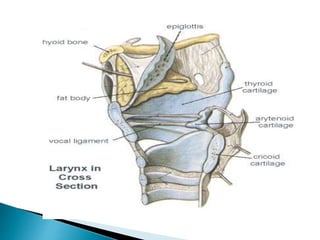
 Larynx is a well protected structure in the
neck
 Functions: airway ,tracheobronchial
protection & phonation
 Skeletal framework : hyoid,thyroid,cricoid
 Divided into supraglottis.glottis,subglottis
 Supraglottis –soft tissue
 Glottis-relies on external
support,cricoarytenoid jt mobility and
neuromuscular coordinaton
 Subglottis - cricoid
 Laryngeal trauma is rare < 1 % of all traumas
 Incidence is low < 1 / 30,000 ER visits
 Males > females
 Older persons more predisposed to communited
fractures attributed to calcification
Associated injuries
 Intracranial : 13%
 Cervical spine fracture : 8%
 Oesophageal injury : 3%
BLUNT INJURIES : CLOTHESLINE
CRUSHING
HANGING
STRANGULATION
PENETRATING INJURIES
INHALATIONAL/INGESTION INJURIES
IATROGENIC INJURIES
 ANTERIOR BLUNT
INJURIES: Mc in
motor vehicle
accidents
 During deceleration
driver is thrust
forward with neck
hyperextended:
without the
protection of
mandible, larynx
can strike wheel/
dashboard :
compressed
 Clothesline injury : rider of vehicle : motorcycle
or snowmobile: encounter a fixed horizontal
object at neck, clotheline at neck, there is large
amount of energy against small surface
causing separation of cricoid from larynx or
the trachea
 Strangulation : initially abrasion of skin
 12 - 24 hrs later edema of larynx leading to
airway compromise
 Penetrating injuries : gunshot or knife injuries
 Gunshots at close range impart intense
energy and are usually fatal
 Long range : damage may be minimal
 High velocity weapons : surrounding tissue
damage is significant, wide debridement
advisable

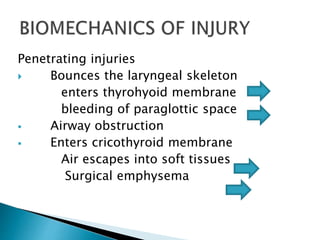
Penetrating injuries
 Bounces the laryngeal skeleton
enters thyrohyoid membrane
bleeding of paraglottic space
 Airway obstruction
 Enters cricothyroid membrane
Air escapes into soft tissues
Surgical emphysema
Hyoid bone :
 May be fractured
 Can cause mild discomfort or painful
swallowing
 Rarely can lead to formation of bursa at the
fractured ends which can be treated by
excision
Thyroid cartilage & arytenoids
 Commonly fractured due to the prominence
of the thyroid cartilage in the neck
 This injury depends on degree of calcification
of the cartilage
 Minimal injury – no fracture
 If pushed backwards over cervical
spine,thyroid ala is splayed apart to a more
obtuse angle
 This can lead to pre-epiglottic space bleeding
& posterior displacement of epiglottis
 Calcified thyroid cartilage gets shattered
resulting in communited fracture
Cricoid cartilage
 Invariably associated with thyroid fractures
 Anterior part of the cricoid mostly fractured
Cricotracheal seperation
 Final soft tissue injury,usually results in death at
the roadside
 Cricotracheal membrane is sheared off
 Several tracheal rings may be damaged
 Larynx pulled upwards & trachea is pushed to the
retrosternal area
Inhalational injuries
 Hot air/smoke/steam: glottis reflexely closes:
limits the amount of thermal injury by stopping
inhalation : injury supraglottic larynx.
 Ass with burns in othr parts of the body
 Initial erythema & blackish sputum
 Marked oedema
 Early airway management : marked edema of
injured mucosa with loss of airway : inability to
intubate
Ingestion injuries
 Mucosal burns
 Direct damage due to ingestion / regurgitation
 Alkali worse than acids
Iatrogenic injuries
 Intubation : Mucosal laceration / crico
arytenoid dislocation / injury to
lingual,hypoglossal , superior laryngeal ,
recurrent laryngeal nerve (neuropraxia)
 Prolonged intubation
 Tracheostomy : Injury to cricoid / recurrent
laryngeal nerve
 Diagnosis
Symptoms : Change in voice ,Difficulty in
breathing,Dysphonia,Dyspaghia,Pain,Cough
Hemoptysis
 Stridor : b/l vc palsy/ surpaglottic/ glottic /
subglottic edema
 Skin : contusions, abrasions
 open fractures
 laryngocutaneous fistula
 Palpation : Crepitance
 tenderness : significant injury
 Cervical spine should always be palpated
 EXAMINATION
 Incases of cricotracheal separation the
airway may be maintained via a cutaneous
laceration tat connects the trachea: no
attempt should be made to cover or
compress or manipulate the wound : until
surgeon ready for airway establishment
 Subtle form of laryngeal dysfunction is
aspiration: immobitly of vocal cords
 Any penetrating injury should be examined for
entry and exit wounds
 Open wounds should not be explored with
instruments, should not be probed
 Endolaryngeal anatomy examined : fibreoptic in
case of non intubated pts, very careful
 Look for hematomas, movement of arytenoids or
presence of any exposed cartilage
Plain x-ray of cervical spine :
 To exclude hyoid bone fracture & concurrent
cervical spine fracture
Chest x-ray
 To rule out mediastinal emphysema /
puenomothorax
CT SCAN
 Mainly for pts who can do well without any
surgical intervention
 Pts requiring a open surgical repair or with
exposed cartilage : does give much input
 nonivasive
 Spiral ct scan- mainstay of post traumatic
laryngeal injury
 Quick (< 20secs)
 Can produce two dimensional ,reconstructed
images
 Detects mucosal oedema,fracture of
thyroid,disruption of cricoaryteniod/cricothyroid
joint,assessment of c-spine
CT reserved for for
patients in whom
laryngeal injury is
supected from either
history or physical
examination without any
indications for surgery.
Noninvasive
confirmation of laryngeal
injury without need for
GA or laryngoscopy.
Presence of massive
edema or hematoma :
direct laryngoscopy not
helpful: CT provides
input.
Direct laryngoscopy
 Done under GA
 Look for 1) large mucosal laceration 2)
exposed cartilage 3)laceration on the free
edge of the vocal cords 4)vocal cord
immobility 5)dislocated arytenoids 6)
displaced fractures 6) other neck injuries
GROUP SYMPTOMS SIGNS MANAGEMENT
Group I Minor airway
symptoms
Minimal hematoma
Small laceration
No fractures
Observation
Humidified air
Head end elevation
+/- Steroids
Group II Airway compromise Oedema/hematoma
Minor mucosal disruption
No cartilage exposure
Direct laryngoscopy
Oesophagoscopy
+/- Tracheostomy
+/- steroids
Group III Airway compromise Oedema
Mucosal tears
 Exposed cartilage
Vocal cord immobility
Tracheostomy
Direct laryngoscopy
Oesophagoscopy
Exploration/repair
No stent needed
Group IV Airway compromise Massive oedema
Significant mucosal tear
Exposed cartilage
Vocal cord immobility
Tracheostomy
Direct laryngoscopy
Oesophagoscopy
Exploration/repair
Stent required
 Securing the airway-
 Tracheostomy
 Endotracheal intubation-indicated only when
mucosa is intact,minimal laryngeal fracture
 Endotracheal intubation may further damage the
larynx
 Paediatric pt –airway secured with rigid
bronchoscopy,tracheostomy performed over
bronchoscope
 Follwing intubation/ trach : direct laryngoscopy to
assess the extent of damage: hematomas,
exposed cartilage, lacerations, movement of vocal
cords
Conservative management
 Group I & II
 Clinical observation for 48hrs
 Head end elevation 30 degree
 Voice rest –minimize edema
 Humidified air-prevents crust formation &
improves ciliary function
 Corticosteroids
 Antibiotics
 Antireflux medication
 Surgical management
 All injuries involving the anterior commisure
 Exposed cartilage
 Multiple or displaced fracture of thyroid
cartilage
 Multiple fractures of cricoid cartilage causing
1. Vocal fold paralysis
2. Airway compromise to require intubation or
trach
3. Injury to neck requiring exploration
 Open surgical exploration & repair
 Exploration within 24hrs –maximizes airway
& phonation results
 Hemostasis
 Evacuation of hematoma
 Reconstruction of the laryngeal framework
 Coverage of de-epithelialized surfaces
 Group II to IV required surgical intervention
 Subplatysmal apron flap elevated till the
hyoid bone
 Laryngeal skeleton is exposed from the
hyoid to sternal notch
 Midline thyrotomy
◦ May use a vertical fracture (2 to 3mm of midline)
 Nondisplaced fractures
◦ Suture outer perichondrium
◦ Primary closure with nonabsorbable suture / wires
 Mucosal lacerations
◦ Meticulously repaired using fine absorbable sutures
◦ Knots outside the laryngeal lumen (prevent
granulation)
 Displace fractures of
the cartilages are
reduced
◦ Stabilized using stainless
steel wires,
nonabsorbable suture or
miniplates.
◦ Small fragments of
cartilage with no intact
perichondrium are
removed to prevent
perichondritis.
 Anterior commissure-
suspend the anterior
true vocal cords to
the outer
perichondrium
of the thyroid
cartilage
 Close the thyrotomy
◦ Nonabsorbable suture,
wires or miniplates
 Anterior glottic injuries :
 Seen in vertical thyroid cartilage #
 Ass with vocal fold laceration
 Endolarynx approached through midline
thyrotomy or thru thyroid #
 Anterior commisure divided in midline
 Mucosal laceration closed
 Anterior free edges of false and true vocal
cords sutured thru the anterior thyroid
perichondrium
 Keel used to reconstruct the anterior comm
 Endolaryngeal stenting (group IV )
◦ Disruption of the anterior commissure
◦ Massive mucosal injuries
◦ Comminuted fractures of the laryngeal skeleton
◦ Cases wher architecture of larynx not maintained by
open fixation
 Uses :
◦ Stability and prevent endolaryngeal adhesions
◦ Maintains the scaphoid shape of anterior
commissure,essential for vocalization
◦ Support to laryngeal framework : movement :
phonation/ swallowing
Types of stents
Endotracheal portex tube-
 Most easily available
 3.5cm long,upper end closed with sutures to
prevent aspiration
 Smooth clamps are placed to approximate true &
false vocal cords
Finger cots filled with gelfoam /gauze
 Stent should be placed such that it extends from
false vocal cords to first tracheal ring
 Stent secured by monofilament sutures through the
laryngeal ventricle and cricothyroid membrane and
tied to skin buttons.
 Removed in a period of 10 to 14 days to prevent
mucosal damage
 Antibiotics – 5 to 7 days
 Antireflux – proton pump inhibitors routinely used
to prevent reflux which can cause mucosal damage
& scarring.
 Avoid nasogastric tubes as it erodes the postcricoid
mucosa
 Head end elevation
 Early ambulation
 Tracheostomy care
 Removal of stents in 2 weeks followed by
decannulation
 Follow up-1yr for assessment of true vocal cord
function & to monitor development of subglottic
stenosis
 Formation of profuse granulation tissue ; can be
debulked endoscopically
 Vocal cord immobility due to
• RLN injury- unilateral paralysis wait & watch for 6
months.Medializtion procedure considered if no
voice return is noted
• Bilateral paralysis-arytenoidectomy / cordotomy
 Subglottic /Tracheal stenois
 Common in clothesline
injuries., ligamentous inj
 Cricotracheal separation is
usually associated with
cricoid fractures and
avulsion of the mucosa
from the anterior surface
of the posterior cricoid
plate.
 high chance of
asphyxiation and
mortality.
 Cricotracheal separation is
highly associated with
recurrent laryngeal nerve
injury.
 Immediate onset aphonia, hemoptysis,
respiratory distress, cervical subcutaneous
emphysema
 Open neck wound : distal stump : intubated
 No neck wound : emergency tracheostomy
 Repair : within 24hrs
 Primary re-
anastamosis from
posterior to anterior
 Intact cricoid :only the
mucous membrane
needs to be repaired.
 If cricoid is fractured:
◦ internal fixation of
the cricoid cartilage
done.
 If > 2cm of tracheal
loss : larynx mobilized
 Complications-
granulations, laryngeal
and tracheal stenosis,
glottic web

 Incidence : 4-13% : adults, 0.5 -61% in
neonates
 Mc cause : prolonged intubation
• Endotracheal intubation injuries
1. Laryngeal mucosa
2. Soft tissues
3. Perichondrium
4. Cartilage
• most injuries : superficial irritation / minor
ulceration : heal quickly
• More severe injuries : edema, granulation
tissue / ulcerations
Epithelial erosion and ulceration
Ischemic necrosis
Mucosal injury
Mucosal ischemia Capillary perfusion pressure
Cartilage necrosis
Perichondritis
After 96hrs
Stromal necrosis
Minor epithelial erosion :
primary epithelialization
Extensive ulceration
secondary intention healing
with granulation tissue
Granuloma
Contracted scar tissue
 Endotracheal tube
lies in the posterior
larynx :
 Applies pressure on
3 sites
1. Arytenoids : vocal
process: medial
surface
2. Posterior glottic
mucosa in the
interarytenoid
region
3. Cricoid cartilage
• Physical trauma :
difficult/ repeated
intubations
• Duration of inutbation
:
1. 7 days : adults
2. Infants : longer
3. Neonates : weeks
• State of larynx
• Movement of tube :
coughing, swallowing,
bucking during
anesthesia,
transmitted ventilator
movement
Mucociliray mechanism :
reduced :
1. Presence of tube
2. Stasis of secretions
3. Trauma from
suctioning
4. Bacterial
contamination
Gastroesophageal reflux :
chemical irritation :
increased local injury
Nasogastric tube
 Tube characteristics
 Tube sizing
 Max : 8 mm in
males and 7mm in
females : inner dia
 Upto 8yrs :
uncuffed tube
 Cuff pressure 8cm
of H2O2
 Patient factors
◦ Poor tissue
perfusion (i.e.
sepsis, organ
failure, etc)
◦ LPR
◦ Abnormal larynx
◦ Wound healing,
keloid
 ENDOSCOPIC ASSESMENT
 Nature of degree of trauma assessed by direct
laryngoscopy and endoscopy
 Assesment : 7 days : adultys, children after 1 -2
weeks, infants when attempted extubation
unsuccesful
 Continued intubation
1. Edema in vocal cords
2. Surface mucosal ulceration
3. Minor granulation tissue at vocal process
4. Absence of deep ulceration and perichondritis
Intubation injuries heal quickly without treatment
 Severe injuries : deep ulceration :
tracheostomy
 Continued intubation > 7 days :
tracheostomy
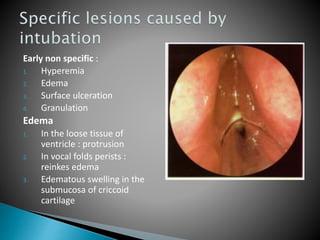
Early non specific :
1. Hyperemia
2. Edema
3. Surface ulceration
4. Granulation
Edema
1. In the loose tissue of
ventricle : protrusion
2. In vocal folds perists :
reinkes edema
3. Edematous swelling in the
submucosa of criccoid
cartilage
 Granulation tissue: at
the sites of ulceration
by tube pressure on
mucosa,
perichondrium/
cartilage
 Formed within 48hrs
 Spontaneous resolution
: after tube removal
 Incomplete resolution :
intubation granuloma
nodules
interarytenoid
adhesions
 Ulceration
 Caused by pressure necrosis of the tube
 Sites :
1. medial surface of aytenoids
2. Anterior surface of lamina of thyroid
cartilage
3. Cricoarytenoid joints
 Superficial ulcerations : epithelialization
 Deep : scar tissue formation : stenosis
 Misc injuries
 Laceration
 Bleeding into vocal cords
 Arytenoid dislocation
 Perforation
 Cricoid ulceration: sinus/ fistula : both NG
tube and ET tube presence
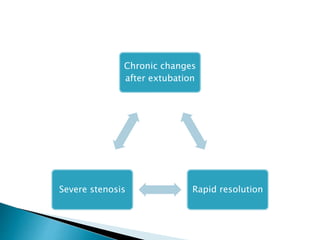
Chronic changes
after extubation
Rapid resolutionSevere stenosis
 Intubation granulomas
 Healing incomplete :
perichondritis persists :
granulation tissue
remains localised :
granuloma
 U/L, can be B/L
 Yellow red goblular
mass, pedunculated at
vocal process and medial
surface of arytenoid
 Can develop upto 8wks
aftr extubation
 50% resolve
spontaneously
 Co2 laser excision
1. Less removal: proliferation and recurrence
2. Excessive removal : exposure of
perichondrium and recurrence
b/l granulations on vocal
process fall together adhere
and heal to one another
If not removed
Mature
Interarytenoid bands
 Vocal cords tethered together, abduction
is limited : airway obstruction
 Misdiagnosed as b/l vocal cord paralysis
Partial or complete cicatricial narrowing
of endolarynx
 Establishing diagnosis
◦ Laryngeal stenosis
 Noisy breathing
 Stridor
 Phases: inspiratory, expiratory, biphasic
 Wheezing
 Recurrent : precepitating factors and aggravating factors
 Infection, exercise
 History of emergency intubation
 Suggest higher possibility of intubation trauma due to
repetition, stylet use and higher friction
 Duration of mechanical ventilation (2-5/7: 0-2%, 5-10/7: 5-
10%, >10/7: 12-14%)2,3, cuff pressure (laryngeal
microcirculation critical P 30mmHg) 1
 Tracheostomy (site, type of incision, tube biomechanics)4
 Acute organophosphate poisoning: primary reason of
intubation contributes to laryngotracheal stenosis
 Dysphagia, change in quality of voice
◦ Infective (Tuberculosis of the larynx)
 Prolonged history of fever, unintentional weight loss,
cough, hemoptysis, change in quality of voice, neck
swelling.
 Contact with tuberculosis patients
◦ Immune mediated (Sarcoidosis, Rheumatoid
arthritis, Pemphigus)
 Onset and progression is usually gradual
 Related symptoms: joint pain and deformity, skin
lesions,
◦ Vocal fold immobility
 Change in quality of voice
 Aspiration symptoms
CAUSE RESULT
External laryngotracheal trauma Penetrating injury
Blunt injury
Internal laryngotracheal trauma Endotracheal intubation
Post tracheostomy
Post radiotherapy
Chemical,thermal burns
Infection TB,Scleroma,fungal histoplasmosis
Chronic inflammatory disease Sarcoidosis
Collagen vascular diseases Wegener’s granulomatosis
Relapsing polychondritis
Neoplastic disease Benign : squamous
papillomas,chondromas
Malignant : squamous cell
ca,lymphoma,sarcoma
External trauma
Disruption of
cartilagenous
framework
Hematoma and
mucosal
laceration
Resorption of
hematoma
Cartilage loss
Extensive
deposition of
collagen
Scar contraction
stenosis
Intubation trauma
Ischemic necrosis
of mucosa because
of ET tube
Mucosal ulceration Perichondritis
Cartilage
resorption
Healing with
secondary
intention
Submucosal
fibrosis
Scar contraction
 Cotton-Myer
◦ Based on relative
reduction
of subglottic cross-
sectional area
◦ Good for mature, firm,
circumferential lesions
◦ Does not take into
account
extension to other
subsites or
length of stenosis
 Posterior glottic stenosis : Bogdasarian & olson
classification
 Type I : interarytenoid adhesion
 Type II : posterior commisure stenosis with
scarring in interarytenoid plane & post cricoid
lamina
 Type III :posterior commisure stenosis with
unilateral cricoarytenoid ankylosis
 Type IV : posterior commisure stenosis with
bilateral cricoarytenoid jt ankylosis
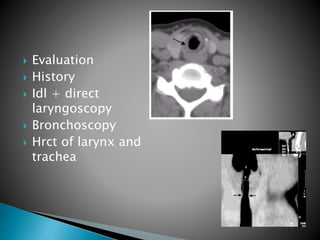
 Evaluation
 History
 Idl + direct
laryngoscopy
 Bronchoscopy
 Hrct of larynx and
trachea
 Timing of repair initial management and
airway establishment : evaluation of degree of
laryngeal injury
 Acute stenosis : open repair within first two
weeks of injury
 Chronic stenosis : repair elective
 Open repair : increasing airway obstruction
requiring trach
 Cervical emphysema
 Exposed cartilage
 Extensive mucosal laceration
 Evidence of #/ dislocation
 Endoscopic repair
 Acute stenosis secondary to granulation
tissue after extubation
 Mc used : CO2 laser
 Adv of CO2 : delayed formation and
maturation of collagen : allows time for
reepithelialization before scar tissue
formation
 Minimal deep tissue injury
 Precise control of hemostasis : preservation
of mucosa
 Goal : to establish satisfactory airway,phonation &
glottis closure
 Assessment of stenosis :location,vocal fold
impairement,degree of functional impairement
 Management protocol :
 Re-establishment of stuctural
support;grafts/cartilage
 Preservation of mucosa
 Judicious use of antibiotics,stents,skin
grafts,cartilage & bone grafts to reduce granuloma
formation & scarring
 For repair : cartilage / bone grafts
 Acute injuries : stabilization of fractures
 Chronic : for structural support, luminal
augmentation
 Grafts :
1. Rib : mc used
2. Iliac crest : mc used
3. Hyoid
4. Epiglottis
5. Thyroid
6. Auricular
7. Septal cartilage
 Uses : to
approximate
epidermal grafts
and immobilize it
 Support for
cartilage and bone
grafts
 Separate opposing
surfaces
 Maintain lumen in a
recontructed area
 1-3 wks : mucosal
healing
 6-8 wks : to
maintain laryngeal
skeleton in position
 Upto 14months :
cartilagenous
framework
deficient,
maturation of scar
contracture
 Composed of
teflon, cigar
shaped
 Designed for
laryngeal
reconstuction in
children
 Less irritation
 Granulation tissue
may form in the
base of epiglottis
 Made of Silicon
 Long central lumen & smaller lumen
projecting from side at 90 degree/75 degree
 Used in laryngotracheal reconstruction in
stenosis
 Can be left in place for > 12months
 Advantage : pt can speak with T –tube
 Disadvantage : more prone for crusting ( can
be prevented by blocking the side lumen&
proper suctioning)
Montgomery tube
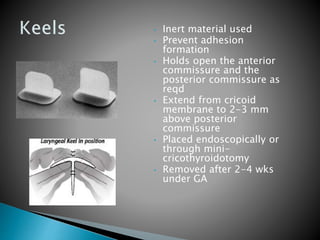
• Inert material used
• Prevent adhesion
formation
• Holds open the anterior
commissure and the
posterior commissure as
reqd
• Extend from cricoid
membrane to 2-3 mm
above posterior
commissure
• Placed endoscopically or
through mini-
cricothyroidotomy
• Removed after 2-4 wks
under GA
 Supraglottic stenosis
 Adhesions of epiglotttis to the
hypopharyngeal walls : division of adhesion
along long axis; submucosal excision of scar
and primary mucosal closure
 Horizontal web : vertical incision : scar
excised
 External laryngeal trauma : thyroid cartilage #
and mucosal disruption
 Endolaryngeal truama : intubation or surgical
removal of mucosa : anterior edges : two
opposing raw edges heal together : web
 Management : endoscopic resection / MLS
excision with laser
 Keel placed
 Keel :
 Should be inert material
 Length should be sufficient to extend from the
cricothyroid membrane atleast 2-3mm above
the anterior comissure
 Anterior edge of keel should make 120 degree
angle
 The posterior wing should lie at the vocal
processes and should not touch the posterior
commisure
 Removed after 2-4weeks
 External approach :
 If extends > 5mm into subglottis
 Ass with laryngeal inlet stenosis
 Endoscopic approach failed
 Et intubation/ cricothyroid joint arthritis
 Endoscopic repair : type I and II : simple
division of web + finger cot stents for 2
weeks/ with laser
 With arytenoid fixation : external approach
 if b/l arytenoid fixation : removal of least
mobile arytenoid, denuded surfaces covered
with mucosal flaps , skin and mucosal grafts
 Stenting for 2-3 weeks
 Type IV : endoscopic laser arytenoidectomy
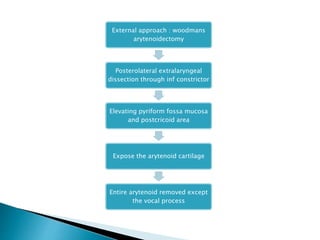
External approach : woodmans
arytenoidectomy
Posterolateral extralaryngeal
dissection through inf constrictor
Elevating pyriform fossa mucosa
and postcricoid area
Expose the arytenoid cartilage
Entire arytenoid removed except
the vocal process
 95% of cases of SGS
 90% due to long-term or prior intubation
◦ Duration of intubation
◦ ETT size
◦ Number of intubations
◦ Traumatic intubations
◦ Movement of the ETT
◦ Infection
Cartilaginous Stenosis
 Cricoid cartilage
deformity
◦ Normal shape
 Small for infant's size
◦ Abnormal shape
 Large anterior lamina
 Oval (elliptic shape)
 Large posterior lamina
 Generalized thickening
 Submucous (occult) cleft
 Other congenital cricoid
stenosis
◦ Trapped first tracheal
ring
Soft-Tissue
Stenosis
 Submucosal
fibrosis
 Submucosal
gland hyperplasia
 Granulation
tissue
 I. Endoscopic
◦ Dilation
◦ Laser
 II. Open procedure
◦ Expansion procedure (with trach and stent or SS-
LTR)
 Laryngotracheoplasty
 Laryngotracheal reconstruction
 Grade III and IV stenoses require and open
procedure
 Anterior Cricoid Split (ACS)
 Posterior Cricoid Split (PCS)
 Combined ACS and PCS
 Four quadrant cricoid cartilage division
 Described in 1980 as an alternative to
tracheotomy in the management of acquired
SGS in premature infants
 Safe and effective (67-70% extubation rate)
◦ If stenosis isolated & moderate grade
◦ No other anatomic abnormalities prohibiting
decannulation
◦ Pulmonary reserve must be adequate
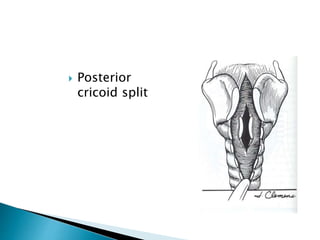
 Posterior
cricoid split
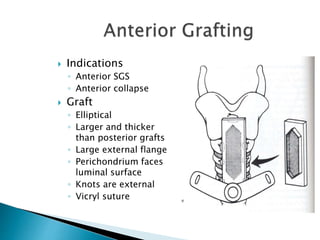
 Indications
◦ Anterior SGS
◦ Anterior collapse
 Graft
◦ Elliptical
◦ Larger and thicker
than posterior grafts
◦ Large external flange
◦ Perichondrium faces
luminal surface
◦ Knots are external
◦ Vicryl suture
 Indications
◦ Posterior SGS
◦ Glottic extension
 Try to avoid
complete
laryngofissure
 Graft
◦ Elliptical
◦ Thinner than anterior
graft
◦ Width
 .05 to 1.00 mm/yr of
age up to 1 cm
(Cotton, 1999)
 Pts with possible perforation : gastrograffin
swallow/ barium swallow
 Best detected by combination of
esophagoscopy and esophagram in
symptomatic patients.
 Close wounds in watertight 2 layer
fashion.
 After mucosal repair, muscle flap may be
interposed, minimises the risk of TE Fistula
 Small pharyngeal lesions above arytenoids
can be treated with NPO and observation 5-
7 days
 All patients should be NPO for 5-7 days.
 Missed tears represent most of delayed
injuries : mediastinits
 Neck exploration for patients who have air in
soft tissues of neck
 During neck exploration. NG tube can be
pulled up to the level of the neck and
methyelene blue infused to localise.
 caused by severe hyperextension during
acceleration/deceleration motor injuries.
 Signs: Hemiplegia, quadriplegia, CN deficits,
change of sensorium, Horner’s syndrome
(disturbance of stellate ganglion), neurogenic
shock
 Evaluation: clinical examination and imaging –
AP and lateral cervical radiography plain films
and CT scan.
 Management: Neurosurgery should be consulted
for any surgical intervention. From the ENT
standpoint, stability of cervical spine to be
established.
Laryngeal trauma

Laryngeal trauma

  • 1.
  • 2.
     Larynx isa well protected structure in the neck  Functions: airway ,tracheobronchial protection & phonation  Skeletal framework : hyoid,thyroid,cricoid  Divided into supraglottis.glottis,subglottis  Supraglottis –soft tissue  Glottis-relies on external support,cricoarytenoid jt mobility and neuromuscular coordinaton  Subglottis - cricoid
  • 4.
     Laryngeal traumais rare < 1 % of all traumas  Incidence is low < 1 / 30,000 ER visits  Males > females  Older persons more predisposed to communited fractures attributed to calcification Associated injuries  Intracranial : 13%  Cervical spine fracture : 8%  Oesophageal injury : 3%
  • 5.
    BLUNT INJURIES :CLOTHESLINE CRUSHING HANGING STRANGULATION PENETRATING INJURIES INHALATIONAL/INGESTION INJURIES IATROGENIC INJURIES
  • 6.
     ANTERIOR BLUNT INJURIES:Mc in motor vehicle accidents  During deceleration driver is thrust forward with neck hyperextended: without the protection of mandible, larynx can strike wheel/ dashboard : compressed
  • 7.
     Clothesline injury: rider of vehicle : motorcycle or snowmobile: encounter a fixed horizontal object at neck, clotheline at neck, there is large amount of energy against small surface causing separation of cricoid from larynx or the trachea  Strangulation : initially abrasion of skin  12 - 24 hrs later edema of larynx leading to airway compromise
  • 8.
     Penetrating injuries: gunshot or knife injuries  Gunshots at close range impart intense energy and are usually fatal  Long range : damage may be minimal  High velocity weapons : surrounding tissue damage is significant, wide debridement advisable 
  • 10.
    Penetrating injuries  Bouncesthe laryngeal skeleton enters thyrohyoid membrane bleeding of paraglottic space  Airway obstruction  Enters cricothyroid membrane Air escapes into soft tissues Surgical emphysema
  • 11.
    Hyoid bone : May be fractured  Can cause mild discomfort or painful swallowing  Rarely can lead to formation of bursa at the fractured ends which can be treated by excision
  • 12.
    Thyroid cartilage &arytenoids  Commonly fractured due to the prominence of the thyroid cartilage in the neck  This injury depends on degree of calcification of the cartilage  Minimal injury – no fracture  If pushed backwards over cervical spine,thyroid ala is splayed apart to a more obtuse angle
  • 13.
     This canlead to pre-epiglottic space bleeding & posterior displacement of epiglottis  Calcified thyroid cartilage gets shattered resulting in communited fracture
  • 15.
    Cricoid cartilage  Invariablyassociated with thyroid fractures  Anterior part of the cricoid mostly fractured Cricotracheal seperation  Final soft tissue injury,usually results in death at the roadside  Cricotracheal membrane is sheared off  Several tracheal rings may be damaged  Larynx pulled upwards & trachea is pushed to the retrosternal area
  • 16.
    Inhalational injuries  Hotair/smoke/steam: glottis reflexely closes: limits the amount of thermal injury by stopping inhalation : injury supraglottic larynx.  Ass with burns in othr parts of the body  Initial erythema & blackish sputum  Marked oedema  Early airway management : marked edema of injured mucosa with loss of airway : inability to intubate Ingestion injuries  Mucosal burns  Direct damage due to ingestion / regurgitation  Alkali worse than acids
  • 17.
    Iatrogenic injuries  Intubation: Mucosal laceration / crico arytenoid dislocation / injury to lingual,hypoglossal , superior laryngeal , recurrent laryngeal nerve (neuropraxia)  Prolonged intubation  Tracheostomy : Injury to cricoid / recurrent laryngeal nerve
  • 18.
     Diagnosis Symptoms :Change in voice ,Difficulty in breathing,Dysphonia,Dyspaghia,Pain,Cough Hemoptysis  Stridor : b/l vc palsy/ surpaglottic/ glottic / subglottic edema  Skin : contusions, abrasions  open fractures  laryngocutaneous fistula  Palpation : Crepitance  tenderness : significant injury  Cervical spine should always be palpated
  • 20.
     EXAMINATION  Incasesof cricotracheal separation the airway may be maintained via a cutaneous laceration tat connects the trachea: no attempt should be made to cover or compress or manipulate the wound : until surgeon ready for airway establishment  Subtle form of laryngeal dysfunction is aspiration: immobitly of vocal cords
  • 21.
     Any penetratinginjury should be examined for entry and exit wounds  Open wounds should not be explored with instruments, should not be probed  Endolaryngeal anatomy examined : fibreoptic in case of non intubated pts, very careful  Look for hematomas, movement of arytenoids or presence of any exposed cartilage
  • 22.
    Plain x-ray ofcervical spine :  To exclude hyoid bone fracture & concurrent cervical spine fracture Chest x-ray  To rule out mediastinal emphysema / puenomothorax
  • 23.
    CT SCAN  Mainlyfor pts who can do well without any surgical intervention  Pts requiring a open surgical repair or with exposed cartilage : does give much input  nonivasive  Spiral ct scan- mainstay of post traumatic laryngeal injury  Quick (< 20secs)  Can produce two dimensional ,reconstructed images  Detects mucosal oedema,fracture of thyroid,disruption of cricoaryteniod/cricothyroid joint,assessment of c-spine
  • 24.
    CT reserved forfor patients in whom laryngeal injury is supected from either history or physical examination without any indications for surgery. Noninvasive confirmation of laryngeal injury without need for GA or laryngoscopy. Presence of massive edema or hematoma : direct laryngoscopy not helpful: CT provides input.
  • 25.
    Direct laryngoscopy  Doneunder GA  Look for 1) large mucosal laceration 2) exposed cartilage 3)laceration on the free edge of the vocal cords 4)vocal cord immobility 5)dislocated arytenoids 6) displaced fractures 6) other neck injuries
  • 27.
    GROUP SYMPTOMS SIGNSMANAGEMENT Group I Minor airway symptoms Minimal hematoma Small laceration No fractures Observation Humidified air Head end elevation +/- Steroids Group II Airway compromise Oedema/hematoma Minor mucosal disruption No cartilage exposure Direct laryngoscopy Oesophagoscopy +/- Tracheostomy +/- steroids Group III Airway compromise Oedema Mucosal tears  Exposed cartilage Vocal cord immobility Tracheostomy Direct laryngoscopy Oesophagoscopy Exploration/repair No stent needed Group IV Airway compromise Massive oedema Significant mucosal tear Exposed cartilage Vocal cord immobility Tracheostomy Direct laryngoscopy Oesophagoscopy Exploration/repair Stent required
  • 28.
     Securing theairway-  Tracheostomy  Endotracheal intubation-indicated only when mucosa is intact,minimal laryngeal fracture  Endotracheal intubation may further damage the larynx  Paediatric pt –airway secured with rigid bronchoscopy,tracheostomy performed over bronchoscope  Follwing intubation/ trach : direct laryngoscopy to assess the extent of damage: hematomas, exposed cartilage, lacerations, movement of vocal cords
  • 29.
    Conservative management  GroupI & II  Clinical observation for 48hrs  Head end elevation 30 degree  Voice rest –minimize edema  Humidified air-prevents crust formation & improves ciliary function  Corticosteroids  Antibiotics  Antireflux medication
  • 30.
     Surgical management All injuries involving the anterior commisure  Exposed cartilage  Multiple or displaced fracture of thyroid cartilage  Multiple fractures of cricoid cartilage causing 1. Vocal fold paralysis 2. Airway compromise to require intubation or trach 3. Injury to neck requiring exploration
  • 31.
     Open surgicalexploration & repair  Exploration within 24hrs –maximizes airway & phonation results  Hemostasis  Evacuation of hematoma  Reconstruction of the laryngeal framework  Coverage of de-epithelialized surfaces  Group II to IV required surgical intervention
  • 32.
     Subplatysmal apronflap elevated till the hyoid bone  Laryngeal skeleton is exposed from the hyoid to sternal notch  Midline thyrotomy ◦ May use a vertical fracture (2 to 3mm of midline)  Nondisplaced fractures ◦ Suture outer perichondrium ◦ Primary closure with nonabsorbable suture / wires  Mucosal lacerations ◦ Meticulously repaired using fine absorbable sutures ◦ Knots outside the laryngeal lumen (prevent granulation)
  • 33.
     Displace fracturesof the cartilages are reduced ◦ Stabilized using stainless steel wires, nonabsorbable suture or miniplates. ◦ Small fragments of cartilage with no intact perichondrium are removed to prevent perichondritis.  Anterior commissure- suspend the anterior true vocal cords to the outer perichondrium of the thyroid cartilage  Close the thyrotomy ◦ Nonabsorbable suture, wires or miniplates
  • 35.
     Anterior glotticinjuries :  Seen in vertical thyroid cartilage #  Ass with vocal fold laceration  Endolarynx approached through midline thyrotomy or thru thyroid #  Anterior commisure divided in midline  Mucosal laceration closed  Anterior free edges of false and true vocal cords sutured thru the anterior thyroid perichondrium  Keel used to reconstruct the anterior comm
  • 36.
     Endolaryngeal stenting(group IV ) ◦ Disruption of the anterior commissure ◦ Massive mucosal injuries ◦ Comminuted fractures of the laryngeal skeleton ◦ Cases wher architecture of larynx not maintained by open fixation  Uses : ◦ Stability and prevent endolaryngeal adhesions ◦ Maintains the scaphoid shape of anterior commissure,essential for vocalization ◦ Support to laryngeal framework : movement : phonation/ swallowing
  • 37.
    Types of stents Endotrachealportex tube-  Most easily available  3.5cm long,upper end closed with sutures to prevent aspiration  Smooth clamps are placed to approximate true & false vocal cords Finger cots filled with gelfoam /gauze
  • 39.
     Stent shouldbe placed such that it extends from false vocal cords to first tracheal ring  Stent secured by monofilament sutures through the laryngeal ventricle and cricothyroid membrane and tied to skin buttons.  Removed in a period of 10 to 14 days to prevent mucosal damage
  • 40.
     Antibiotics –5 to 7 days  Antireflux – proton pump inhibitors routinely used to prevent reflux which can cause mucosal damage & scarring.  Avoid nasogastric tubes as it erodes the postcricoid mucosa  Head end elevation  Early ambulation  Tracheostomy care  Removal of stents in 2 weeks followed by decannulation  Follow up-1yr for assessment of true vocal cord function & to monitor development of subglottic stenosis
  • 41.
     Formation ofprofuse granulation tissue ; can be debulked endoscopically  Vocal cord immobility due to • RLN injury- unilateral paralysis wait & watch for 6 months.Medializtion procedure considered if no voice return is noted • Bilateral paralysis-arytenoidectomy / cordotomy  Subglottic /Tracheal stenois
  • 42.
     Common inclothesline injuries., ligamentous inj  Cricotracheal separation is usually associated with cricoid fractures and avulsion of the mucosa from the anterior surface of the posterior cricoid plate.  high chance of asphyxiation and mortality.  Cricotracheal separation is highly associated with recurrent laryngeal nerve injury.
  • 43.
     Immediate onsetaphonia, hemoptysis, respiratory distress, cervical subcutaneous emphysema  Open neck wound : distal stump : intubated  No neck wound : emergency tracheostomy  Repair : within 24hrs
  • 44.
     Primary re- anastamosisfrom posterior to anterior  Intact cricoid :only the mucous membrane needs to be repaired.  If cricoid is fractured: ◦ internal fixation of the cricoid cartilage done.  If > 2cm of tracheal loss : larynx mobilized  Complications- granulations, laryngeal and tracheal stenosis, glottic web 
  • 45.
     Incidence :4-13% : adults, 0.5 -61% in neonates  Mc cause : prolonged intubation
  • 46.
    • Endotracheal intubationinjuries 1. Laryngeal mucosa 2. Soft tissues 3. Perichondrium 4. Cartilage • most injuries : superficial irritation / minor ulceration : heal quickly • More severe injuries : edema, granulation tissue / ulcerations
  • 47.
    Epithelial erosion andulceration Ischemic necrosis Mucosal injury Mucosal ischemia Capillary perfusion pressure
  • 48.
  • 49.
    Minor epithelial erosion: primary epithelialization Extensive ulceration secondary intention healing with granulation tissue Granuloma Contracted scar tissue
  • 50.
     Endotracheal tube liesin the posterior larynx :  Applies pressure on 3 sites 1. Arytenoids : vocal process: medial surface 2. Posterior glottic mucosa in the interarytenoid region 3. Cricoid cartilage
  • 51.
    • Physical trauma: difficult/ repeated intubations • Duration of inutbation : 1. 7 days : adults 2. Infants : longer 3. Neonates : weeks • State of larynx • Movement of tube : coughing, swallowing, bucking during anesthesia, transmitted ventilator movement Mucociliray mechanism : reduced : 1. Presence of tube 2. Stasis of secretions 3. Trauma from suctioning 4. Bacterial contamination Gastroesophageal reflux : chemical irritation : increased local injury Nasogastric tube
  • 52.
     Tube characteristics Tube sizing  Max : 8 mm in males and 7mm in females : inner dia  Upto 8yrs : uncuffed tube  Cuff pressure 8cm of H2O2  Patient factors ◦ Poor tissue perfusion (i.e. sepsis, organ failure, etc) ◦ LPR ◦ Abnormal larynx ◦ Wound healing, keloid
  • 53.
     ENDOSCOPIC ASSESMENT Nature of degree of trauma assessed by direct laryngoscopy and endoscopy  Assesment : 7 days : adultys, children after 1 -2 weeks, infants when attempted extubation unsuccesful  Continued intubation 1. Edema in vocal cords 2. Surface mucosal ulceration 3. Minor granulation tissue at vocal process 4. Absence of deep ulceration and perichondritis Intubation injuries heal quickly without treatment
  • 54.
     Severe injuries: deep ulceration : tracheostomy  Continued intubation > 7 days : tracheostomy
  • 55.
    Early non specific: 1. Hyperemia 2. Edema 3. Surface ulceration 4. Granulation Edema 1. In the loose tissue of ventricle : protrusion 2. In vocal folds perists : reinkes edema 3. Edematous swelling in the submucosa of criccoid cartilage
  • 56.
     Granulation tissue:at the sites of ulceration by tube pressure on mucosa, perichondrium/ cartilage  Formed within 48hrs  Spontaneous resolution : after tube removal  Incomplete resolution : intubation granuloma nodules interarytenoid adhesions
  • 57.
     Ulceration  Causedby pressure necrosis of the tube  Sites : 1. medial surface of aytenoids 2. Anterior surface of lamina of thyroid cartilage 3. Cricoarytenoid joints  Superficial ulcerations : epithelialization  Deep : scar tissue formation : stenosis
  • 58.
     Misc injuries Laceration  Bleeding into vocal cords  Arytenoid dislocation  Perforation  Cricoid ulceration: sinus/ fistula : both NG tube and ET tube presence
  • 59.
    Chronic changes after extubation RapidresolutionSevere stenosis
  • 60.
     Intubation granulomas Healing incomplete : perichondritis persists : granulation tissue remains localised : granuloma  U/L, can be B/L  Yellow red goblular mass, pedunculated at vocal process and medial surface of arytenoid  Can develop upto 8wks aftr extubation  50% resolve spontaneously
  • 61.
     Co2 laserexcision 1. Less removal: proliferation and recurrence 2. Excessive removal : exposure of perichondrium and recurrence
  • 62.
    b/l granulations onvocal process fall together adhere and heal to one another If not removed Mature Interarytenoid bands
  • 63.
     Vocal cordstethered together, abduction is limited : airway obstruction  Misdiagnosed as b/l vocal cord paralysis
  • 64.
    Partial or completecicatricial narrowing of endolarynx
  • 65.
     Establishing diagnosis ◦Laryngeal stenosis  Noisy breathing  Stridor  Phases: inspiratory, expiratory, biphasic  Wheezing  Recurrent : precepitating factors and aggravating factors  Infection, exercise  History of emergency intubation  Suggest higher possibility of intubation trauma due to repetition, stylet use and higher friction  Duration of mechanical ventilation (2-5/7: 0-2%, 5-10/7: 5- 10%, >10/7: 12-14%)2,3, cuff pressure (laryngeal microcirculation critical P 30mmHg) 1  Tracheostomy (site, type of incision, tube biomechanics)4  Acute organophosphate poisoning: primary reason of intubation contributes to laryngotracheal stenosis  Dysphagia, change in quality of voice
  • 66.
    ◦ Infective (Tuberculosisof the larynx)  Prolonged history of fever, unintentional weight loss, cough, hemoptysis, change in quality of voice, neck swelling.  Contact with tuberculosis patients ◦ Immune mediated (Sarcoidosis, Rheumatoid arthritis, Pemphigus)  Onset and progression is usually gradual  Related symptoms: joint pain and deformity, skin lesions, ◦ Vocal fold immobility  Change in quality of voice  Aspiration symptoms
  • 67.
    CAUSE RESULT External laryngotrachealtrauma Penetrating injury Blunt injury Internal laryngotracheal trauma Endotracheal intubation Post tracheostomy Post radiotherapy Chemical,thermal burns Infection TB,Scleroma,fungal histoplasmosis Chronic inflammatory disease Sarcoidosis Collagen vascular diseases Wegener’s granulomatosis Relapsing polychondritis Neoplastic disease Benign : squamous papillomas,chondromas Malignant : squamous cell ca,lymphoma,sarcoma
  • 68.
    External trauma Disruption of cartilagenous framework Hematomaand mucosal laceration Resorption of hematoma Cartilage loss Extensive deposition of collagen Scar contraction stenosis
  • 69.
    Intubation trauma Ischemic necrosis ofmucosa because of ET tube Mucosal ulceration Perichondritis Cartilage resorption Healing with secondary intention Submucosal fibrosis Scar contraction
  • 71.
     Cotton-Myer ◦ Basedon relative reduction of subglottic cross- sectional area ◦ Good for mature, firm, circumferential lesions ◦ Does not take into account extension to other subsites or length of stenosis
  • 73.
     Posterior glotticstenosis : Bogdasarian & olson classification  Type I : interarytenoid adhesion  Type II : posterior commisure stenosis with scarring in interarytenoid plane & post cricoid lamina  Type III :posterior commisure stenosis with unilateral cricoarytenoid ankylosis  Type IV : posterior commisure stenosis with bilateral cricoarytenoid jt ankylosis
  • 75.
     Evaluation  History Idl + direct laryngoscopy  Bronchoscopy  Hrct of larynx and trachea
  • 76.
     Timing ofrepair initial management and airway establishment : evaluation of degree of laryngeal injury  Acute stenosis : open repair within first two weeks of injury  Chronic stenosis : repair elective
  • 77.
     Open repair: increasing airway obstruction requiring trach  Cervical emphysema  Exposed cartilage  Extensive mucosal laceration  Evidence of #/ dislocation
  • 78.
     Endoscopic repair Acute stenosis secondary to granulation tissue after extubation  Mc used : CO2 laser  Adv of CO2 : delayed formation and maturation of collagen : allows time for reepithelialization before scar tissue formation  Minimal deep tissue injury  Precise control of hemostasis : preservation of mucosa
  • 79.
     Goal :to establish satisfactory airway,phonation & glottis closure  Assessment of stenosis :location,vocal fold impairement,degree of functional impairement  Management protocol :  Re-establishment of stuctural support;grafts/cartilage  Preservation of mucosa  Judicious use of antibiotics,stents,skin grafts,cartilage & bone grafts to reduce granuloma formation & scarring
  • 80.
     For repair: cartilage / bone grafts  Acute injuries : stabilization of fractures  Chronic : for structural support, luminal augmentation  Grafts : 1. Rib : mc used 2. Iliac crest : mc used 3. Hyoid 4. Epiglottis 5. Thyroid 6. Auricular 7. Septal cartilage
  • 81.
     Uses :to approximate epidermal grafts and immobilize it  Support for cartilage and bone grafts  Separate opposing surfaces  Maintain lumen in a recontructed area  1-3 wks : mucosal healing  6-8 wks : to maintain laryngeal skeleton in position  Upto 14months : cartilagenous framework deficient, maturation of scar contracture
  • 82.
     Composed of teflon,cigar shaped  Designed for laryngeal reconstuction in children  Less irritation  Granulation tissue may form in the base of epiglottis
  • 83.
     Made ofSilicon  Long central lumen & smaller lumen projecting from side at 90 degree/75 degree  Used in laryngotracheal reconstruction in stenosis  Can be left in place for > 12months  Advantage : pt can speak with T –tube  Disadvantage : more prone for crusting ( can be prevented by blocking the side lumen& proper suctioning)
  • 84.
  • 85.
    • Inert materialused • Prevent adhesion formation • Holds open the anterior commissure and the posterior commissure as reqd • Extend from cricoid membrane to 2-3 mm above posterior commissure • Placed endoscopically or through mini- cricothyroidotomy • Removed after 2-4 wks under GA
  • 86.
     Supraglottic stenosis Adhesions of epiglotttis to the hypopharyngeal walls : division of adhesion along long axis; submucosal excision of scar and primary mucosal closure  Horizontal web : vertical incision : scar excised
  • 87.
     External laryngealtrauma : thyroid cartilage # and mucosal disruption  Endolaryngeal truama : intubation or surgical removal of mucosa : anterior edges : two opposing raw edges heal together : web  Management : endoscopic resection / MLS excision with laser  Keel placed
  • 88.
     Keel : Should be inert material  Length should be sufficient to extend from the cricothyroid membrane atleast 2-3mm above the anterior comissure  Anterior edge of keel should make 120 degree angle  The posterior wing should lie at the vocal processes and should not touch the posterior commisure  Removed after 2-4weeks
  • 89.
     External approach:  If extends > 5mm into subglottis  Ass with laryngeal inlet stenosis  Endoscopic approach failed
  • 90.
     Et intubation/cricothyroid joint arthritis  Endoscopic repair : type I and II : simple division of web + finger cot stents for 2 weeks/ with laser  With arytenoid fixation : external approach  if b/l arytenoid fixation : removal of least mobile arytenoid, denuded surfaces covered with mucosal flaps , skin and mucosal grafts  Stenting for 2-3 weeks  Type IV : endoscopic laser arytenoidectomy
  • 91.
    External approach :woodmans arytenoidectomy Posterolateral extralaryngeal dissection through inf constrictor Elevating pyriform fossa mucosa and postcricoid area Expose the arytenoid cartilage Entire arytenoid removed except the vocal process
  • 92.
     95% ofcases of SGS  90% due to long-term or prior intubation ◦ Duration of intubation ◦ ETT size ◦ Number of intubations ◦ Traumatic intubations ◦ Movement of the ETT ◦ Infection
  • 93.
    Cartilaginous Stenosis  Cricoidcartilage deformity ◦ Normal shape  Small for infant's size ◦ Abnormal shape  Large anterior lamina  Oval (elliptic shape)  Large posterior lamina  Generalized thickening  Submucous (occult) cleft  Other congenital cricoid stenosis ◦ Trapped first tracheal ring Soft-Tissue Stenosis  Submucosal fibrosis  Submucosal gland hyperplasia  Granulation tissue
  • 94.
     I. Endoscopic ◦Dilation ◦ Laser  II. Open procedure ◦ Expansion procedure (with trach and stent or SS- LTR)  Laryngotracheoplasty  Laryngotracheal reconstruction
  • 96.
     Grade IIIand IV stenoses require and open procedure
  • 97.
     Anterior CricoidSplit (ACS)  Posterior Cricoid Split (PCS)  Combined ACS and PCS  Four quadrant cricoid cartilage division
  • 98.
     Described in1980 as an alternative to tracheotomy in the management of acquired SGS in premature infants  Safe and effective (67-70% extubation rate) ◦ If stenosis isolated & moderate grade ◦ No other anatomic abnormalities prohibiting decannulation ◦ Pulmonary reserve must be adequate
  • 100.
  • 101.
     Indications ◦ AnteriorSGS ◦ Anterior collapse  Graft ◦ Elliptical ◦ Larger and thicker than posterior grafts ◦ Large external flange ◦ Perichondrium faces luminal surface ◦ Knots are external ◦ Vicryl suture
  • 102.
     Indications ◦ PosteriorSGS ◦ Glottic extension  Try to avoid complete laryngofissure  Graft ◦ Elliptical ◦ Thinner than anterior graft ◦ Width  .05 to 1.00 mm/yr of age up to 1 cm (Cotton, 1999)
  • 103.
     Pts withpossible perforation : gastrograffin swallow/ barium swallow  Best detected by combination of esophagoscopy and esophagram in symptomatic patients.  Close wounds in watertight 2 layer fashion.  After mucosal repair, muscle flap may be interposed, minimises the risk of TE Fistula  Small pharyngeal lesions above arytenoids can be treated with NPO and observation 5- 7 days  All patients should be NPO for 5-7 days.
  • 104.
     Missed tearsrepresent most of delayed injuries : mediastinits  Neck exploration for patients who have air in soft tissues of neck  During neck exploration. NG tube can be pulled up to the level of the neck and methyelene blue infused to localise.
  • 105.
     caused bysevere hyperextension during acceleration/deceleration motor injuries.  Signs: Hemiplegia, quadriplegia, CN deficits, change of sensorium, Horner’s syndrome (disturbance of stellate ganglion), neurogenic shock  Evaluation: clinical examination and imaging – AP and lateral cervical radiography plain films and CT scan.  Management: Neurosurgery should be consulted for any surgical intervention. From the ENT standpoint, stability of cervical spine to be established.