Can Threatened Languages Be Saved 2nd Edition Joshua A Fishman
Can Threatened Languages Be Saved 2nd Edition Joshua A Fishman
Can Threatened Languages Be Saved 2nd Edition Joshua A Fishman
Can Threatened Languages Be Saved 2nd Edition Joshua A Fishman
Can Threatened Languages Be Saved 2nd Edition Joshua A Fishman
1.
Can Threatened LanguagesBe Saved 2nd Edition
Joshua A Fishman download
https://ebookbell.com/product/can-threatened-languages-be-
saved-2nd-edition-joshua-a-fishman-2327614
Explore and download more ebooks at ebookbell.com
2.
Here are somerecommended products that we believe you will be
interested in. You can click the link to download.
Can Threatened Languages Be Saved Joshua A Fishman Editor
https://ebookbell.com/product/can-threatened-languages-be-saved-
joshua-a-fishman-editor-51814388
Conflicts Of Interest In Science How Corporatefunded Academic Research
Can Threaten Public Health Krimsky
https://ebookbell.com/product/conflicts-of-interest-in-science-how-
corporatefunded-academic-research-can-threaten-public-health-
krimsky-11652478
Outsourcing Sovereignty Why Privatization Of Government Functions
Threatens Democracy And What We Can Do About It Paul R Verkuil Verkuil
https://ebookbell.com/product/outsourcing-sovereignty-why-
privatization-of-government-functions-threatens-democracy-and-what-we-
can-do-about-it-paul-r-verkuil-verkuil-23394514
Money How The Destruction Of The Dollar Threatens The Global Economy
And What We Can Do About It Forbes
https://ebookbell.com/product/money-how-the-destruction-of-the-dollar-
threatens-the-global-economy-and-what-we-can-do-about-it-
forbes-55284728
3.
Americas Ticking BankruptcyBomb How The Looming Debt Crisis Threatens
The American Dream And How We Can Turn The Tide Before Its Too Late
Peter Ferrara
https://ebookbell.com/product/americas-ticking-bankruptcy-bomb-how-
the-looming-debt-crisis-threatens-the-american-dream-and-how-we-can-
turn-the-tide-before-its-too-late-peter-ferrara-49005610
Changing Planet Changing Health How The Climate Crisis Threatens Our
Health And What We Can Do About It Paul R Epstein Dan Ferber
https://ebookbell.com/product/changing-planet-changing-health-how-the-
climate-crisis-threatens-our-health-and-what-we-can-do-about-it-paul-
r-epstein-dan-ferber-51816366
Changing Planet Changing Health How The Climate Crisis Threatens Our
Health And What We Can Do About It First Edition First Printing Paul R
Epstein Md
https://ebookbell.com/product/changing-planet-changing-health-how-the-
climate-crisis-threatens-our-health-and-what-we-can-do-about-it-first-
edition-first-printing-paul-r-epstein-md-4182604
We Are Arrested Can Dndar
https://ebookbell.com/product/we-are-arrested-can-dndar-44887606
Can I Have Babies Too Sexuality And Relationships Education For
Children From Infancy Up To Age 11 Sanderijn Van Der Doef
https://ebookbell.com/product/can-i-have-babies-too-sexuality-and-
relationships-education-for-children-from-infancy-up-to-
age-11-sanderijn-van-der-doef-46082718
6.
MULTILINGUAL MATTERS 116
SeriesEditor: John Edwards
Can Threatened
Languages Be Saved?
Reversing Language Shift, Revisited:
A 21st Century Perspective
Edited by
Joshua A. Fishman
MULTILINGUAL MATTERS LTD
Clevedon • Buffalo • Toronto • Sydney
In memory of
CharlesA. Ferguson
1921–1998
thanks to whom sociolinguistics became
both an intellectual and a moral quest
10.
Contents
Contributors . .. . . . . . . . . . . . . . . . . . . . . . . . . . . . . . . vii
Preface . . . . . . . . . . . . . . . . . . . . . . . . . . . . . . . . . . . . . xii
1 Why is it so Hard to Save a Threatened Language?
J.A. Fishman . . . . . . . . . . . . . . . . . . . . . . . . . . . . . . . . 1
The Americas
2 Reversing Navajo Language Shift, Revisited
T. Lee and D. McLaughlin . . . . . . . . . . . . . . . . . . . . . . . . 23
3 How Threatened is the Spanish of New York Puerto Ricans?
O. García, J.L. Morín and K. Rivera . . . . . . . . . . . . . . . . . . . 44
4 A Decade in the Life of a Two-in-One Language
J.A. Fishman. . . . . . . . . . . . . . . . . . . . . . . . . . . . . . . . 74
5 Reversing Language Shift in Quebec
R.Y. Bourhis . . . . . . . . . . . . . . . . . . . . . . . . . . . . . . . 101
6 Otomí Language Shift and Some Recent Efforts to Reverse It
Y. Lastra . . . . . . . . . . . . . . . . . . . . . . . . . . . . . . . . . 142
7 Reversing Quechua Language Shift in South America
N.H. Hornberger and K.A. King . . . . . . . . . . . . . . . . . . . . 166
Europe
8 Irish Language Production and Reproduction 1981–1996
P.Ó Riagáin . . . . . . . . . . . . . . . . . . . . . . . . . . . . . . . 195
9 A Frisian Update of Reversing Language Shift
D. Gorter. . . . . . . . . . . . . . . . . . . . . . . . . . . . . . . . . 215
10 Reversing Language Shift: The Case of Basque
M.-J. Azurmendi, E. Bachoc and F. Zabaleta . . . . . . . . . . . . . . 234
11 Catalan a Decade Later
M. Strubell. . . . . . . . . . . . . . . . . . . . . . . . . . . . . . . . 260
v
Can Threatened Languages be Saved?
11.
Africa and Asia
12Saving Threatened Languages in Africa: A Case Study of Oko
E. Adegbija. . . . . . . . . . . . . . . . . . . . . . . . . . . . . . . . 284
13 Andamanese: Biological Challenge for Language Reversal
E. Annamalai and V. Gnanasundaram . . . . . . . . . . . . . . . . . 309
14 Akor Itak – Our Language, Your Language: Ainu in Japan
J.C. Maher . . . . . . . . . . . . . . . . . . . . . . . . . . . . . . . . 323
15 Hebrew After a Century of RLS Efforts
B. Spolsky and E. Shohamy . . . . . . . . . . . . . . . . . . . . . . . 350
The Pacific
16 Can the Shift from Immigrant Languages be Reversed
in Australia?
M. Clyne . . . . . . . . . . . . . . . . . . . . . . . . . . . . . . . . . 364
17 Is the Extinction of Australia’s Indigenous Languages
Inevitable?
J. Lo Bianco and M. Rhydwen . . . . . . . . . . . . . . . . . . . . . . 391
18 RLS in Aotearoa/New Zealand 1989–1999
R. Benton and N. Benton . . . . . . . . . . . . . . . . . . . . . . . . 423
Conclusions
19 From Theory to Practice (and Vice Versa)
J.A. Fishman . . . . . . . . . . . . . . . . . . . . . . . . . . . . . . . 451
Index . . . . . . . . . . . . . . . . . . . . . . . . . . . . . . . . . . . . . 484
vi Can Threatened Languages be Saved?
12.
The Contributors
Professor EfurosibinaAdegbija teaches at the Department of Modern Eu-
ropean Languages, University of Ilorin, Nigeria. His major interests are
sociolinguistics, pragmatics and applied linguistics, especially in a natural
ESL context. His current research interest is language attidudes. He is the
author of Language Attitudes in Sub-Saharan Africa: A Sociolinguistic Over-
view (Multilingual Matters) and he has published several journal articles on
that topic. His present focus is on language and attitude change.
E. Annamalai, Director Emeritus, Central Institute of Indian Languages,
works in the areas of language planning, language education, language
contact and grammar. He has designed and guided research on the indig-
enous languages of India for their codification and use in education. He
has been a Visiting Professor in Tokyo, Leiden and Melbourne. His recent
publications include Adjectival Clauses in Tamil (Tokyo, 1996) and Man-
aging Multilingualism: Languages Planning and Use in India (New Delhi,
2000).
Maria-Josi Azurmendi is Professor in the Department of Social Psychol-
ogy, University of the Basque Country (Donostia/San Sebastian, in Spain).
She is a specialist in sociolinguistics, psycholinguistic and social psychol-
ogy and language, applied mainy to the Basque language. Her most recent
book is Psicosociolingüstica (Bilbao, 1999).
Erramun Bachoc has been Associate Professor in the Department of
Psychopedagogy of Language, Univerity of the Basque Country (Donostia/
San Sebastian, in Spain). Currently, he is the president of the Basque Cul-
tural Institute, for promoting the revival of the Basque language in
Iparralde (Baiona/Bayonne, in France.
Nena Eslao Benton has been resident in New Zealand since 1971, after
starting her research career as an urban anthropologist in the Philippines,
specializing in family and kinship networks. She was involved in the plan-
ning and execution of the sociolinguistic survey of Maori language use
carried out by the New Zealand Council for Educational Research in the
1970s, and directed an internship programme to train Maori students in all
vii
13.
viii Can ThreatenedLanguages be Saved?
aspects of research, from planning and field work to publication. This led
on to pioneering research on the recognition of prior learning in higher ed-
ucation. Her involvement in Maori language revitalization efforts has
continued, most recently as a consultant to the NZ Government’s Maori
Development Education Commission.
Richard Benton is currently Director of the James Henare Maori Research
Centre at the University of Auckland, New Zealand, and Associate Direc-
tor of Te Matahauariki Institute at the School of Law of the University of
Waikato. He first became involved in efforts to secure an acceptance of the
Maori language as an essential part of New Zealand’s national life as a stu-
dent in the late 1950s. Since then he has studied, written about and lectured
on language policy, revitalization of minority languages and related sub-
jects in the Pacific, Southeast Asia, Europe and North America.
Professor Richard Y. Bourhis was educated in French and English schools
in Montreal and then obtained a BSc in Psychology at McGill University
and a PhD in social psychology at the University of Bristol, England. He
taught social psychology at McMaster University in Ontario and then at the
University of Quebec, Montreal where he is now full Professor. He has
published extensively in English and French on topics such as cross-
cultural communication, discrimination and intergroup relations, accul-
turation and language planning.
Michael Clyne, who holds a PhD from Monash University, is currently
Professorial Fellow in Linguistics at the University of Melbourne and was
previously Professor of Linguistics and Director of the Language and Soci-
ety Centre at that university. His research interests are multilingualism/
language contact, sociolinguistics, inter-cultural communication, and sec-
ond language acquisition.
Joshua A. Fishman, PhD (Columbia University, 1953: Social Psychology);
Ped.D. (Hon.) (Yeshiva University, 1978); D. Litt. (Hon.) (Vrije Universiteit
Brussel, 1986). Distinguished University Research Professor, Social Sci-
ences, Yeshiva University. 1966–, Emeritus, 1988, and Visiting Professor,
Linguistics and Education, Stanford University, 1992–; Visiting Professor
of Education, New York University, 1999–; Long Island University 2000–.
Fellow at Centers for Advanced Study: Center for Advanced Study in the
Behavioral Sciences, Stanford, California (1963–1964), Institute for
Advanced Projects, East–West Center, Honolulu, Hawaii (1969–1969),
Institute for Advanced Study, Princeton, N.J. (1975–1976), Netherlands
Institute for Advanced Study, Wasenaar, Netherlands (1982–1983), Israel
Institute for Advanced Study, Jerusalem (1983). Specialises in the
14.
sociolinguistics of minoritylanguages, small languages and small lan-
guage communities, particularly in connection with their language
planning processes and reversing language shift.
Ofelia García is Dean of the School of Education at the Brooklyn Campus
of Long Island University. She has published extensively on bilingual edu-
cation, the education of language minorities, especially Latinos,
bilingualism, sociology of language and US Spanish. A Fulbright Scholar
and Spencer Fellow, she is the editor of Educators for Urban Minorities. In
1997 she co-edited, with Joshua A. Fishman, The Multilingual Apple: Lan-
guages in New York City (Mouton de Gruyter).
V. Gnanasundaram is Deputy Director of the Central Institute of Indian
Languages. He has prepared learning/teaching materials and trained
teachers for the minority languages of India. He coordinated the Insti-
tute’s project to record India’s endangered languages.
Durk Gorter studied sociology and sociolinguistics in Groningen, Amster-
dam and Santa Barbara (USA). Since 1979 he has been a researcher in the
sociology of language at the Fryske Akademy in Ljouwert/Leeuwarden,
and a part-time Professor of Frisian at the University of Amsterdam. He has
been involved in studies of the Frisian language situation and European
minority languages on which he has published a number of books and arti-
cles. He is currently working on a book about language surveys in
Friesland and he also does comparative work on the education of European
minoritylanguagesintheframeworkofthe Mercator-EducationNetwork.
Nancy H. Hornberger is Professor of Education and Director of Educa-
tional Linguistics at the University of Pennsylvania Graduate School of
Education. She specializes in sociolinguistics, educational anthropology,
language planning and biliteracy. Recent publications include Indigenous
Literacies in the Americas (Mouton, 1996).
Kendall A. King is Assistant Professor of Multilingual Multicultural Studies
at New York University where she teaches courses in sociolinguistics and bi-
lingual education. Her recent publications include Language Revitalization
Processes and Prospects (Multilingual Matters, 2001).
Yolanda Lastra is Professor and Researcher at the Instituto de Investi-
gaciones Antropológicas of the Universidad Nacional Autónoma de
México. She has written on Nahuatl and Otomí dialectology and is author
of Sociolingüística para hispanoamericanos: una introducción and El otomí de
The Contributors ix
15.
Ixtenco. She iscurrently engaged in ethnohistorical and linguistic research
on the Otomí.
Tiffany S. Lee holds a PhD in Sociology of Education, Stanford Univer-
sity. Dr Lee has research and professional interests involving the
educational issues of Native Americans related to language, culture and
community. She currently teaches in the Community-based Education
Program at Santa Fe Indian School. Her goals are to continue research
and service in academic programs serving Native American students.
Joseph Lo Bianco is the author of Australia’s first National Policy on Lan-
guages and Director and Founder of Language Australia: The National
Languages and Literacy Institute of Australia. He is Professor of Education
at the University of Melbourne. Recent publications include: Australian
Literacies (with P. Freebody, 1997) and Striving for the Third Place: Inter-
cultural Competence Through Language Education (with C. Crozet and T.
Liddicoat).
Daniel McLaughlin has worked for twenty-three years in American In-
dian education as a teacher, principal, program director, university
professor, researcher and teacher educator. He received a PhD in Educa-
tion and Anthropology from the University of New Mexico in 1987. He is
the author of When Literacy Empowers: Navajo Language in Print (1992, Uni-
versity of New Mexico Press) and co-editor of Naming Silenced Lives:
Personal Narratives and Processes of School Change (1993, Routledge). For the
past six years, he has been a Program Specialist for Dini College’s Dini
Teacher Education Program.
John Maher is Professor of Linguistics at the International Christian Uni-
versity, Tokyo. He is author/editor of several books in English and
Japanese: Linguistic Theory for Language Teaching (1993), Diversity in Japanese
Culture and Language (1994), Multilingual Japan (1995), Introducing Chomsky
(1996). He served as interpreter for the Ainu delegation to the UN, Geneva.
A forthcoming work is Ainu: A Grammatical Sketch (Lincom Europa). His re-
search interests include the languages of Japan, politics and language,
Chomsky’s philosophy of language, Freud and linguistic theory.
José Luís Morín is Assistant Professor at John Jay College of Criminal Jus-
tice in the Puerto Rican Studies Department. He has published on issues
involving international law, indigenous peoples’ rights, human rights and
civil rights law, Latin America and Latino communities in the United
States.
x Can Threatened Languages be Saved?
16.
Pádraig Ó Riagáinis Research Professor at the Linguistics Institute of Ire-
land. His research interests are in sociology of language and language
planning, particularly with regard to Irish and minority languages in Eu-
rope. He has been a consultant advisor in these fields to the Irish
Government, the Council of Europe and the European Union. Recent pub-
lications include Language Policy and Social Reproduction: Ireland 1893–1993
(Oxford Univerity Press, 1997).
Mari Rhydwen is a freelance writer and researcher. She did her doctoral re-
search on Kriol literacy, subsequently worked on language loss and has
taught at several Australian universities. She is the listowner for the endan-
gered-languages list and was one of the founders of Terralingua. She is now
sailing the world on her yacht (White Cloud) still teaching, researching and
writing wherever she goes.
Klaudia M. Rivera is Associate Professor at the Brooklyn Campus of Long
Island University. Dr Rivera’s work addresses issues of literacy, language,
gender and culture and their relationship to power and equality. Her most
recent publication, entitled Popular Research and Social Transformation: A
Community-basedApproachtoCriticalPedagogy,appearedinTesolQuarterly.
Elana Shohamy is Directory of the Program in Language Education at Tel
Aviv University. She is currently conducting research on the academic
achievement of immigrant pupils and on the language of signs. Co-author
of the 1999 Languages of Israel, her Power of Tests: A Critical Perspective on the
Use and Consequences of Language Tests will appear in 2001.
Bernard Spolsky has been Professor in the Department of English at Bar-
Ilan University since 1980. His most recent books are Sociolinguistics (1999),
The Languages of Israel: Policy, Ideology and Practice (1999; with Elana
Shohamy) andConciseEncyclopediaofEducationalLinguistics (edited,1999).
Miquel Strubell read Psychology and Physiology at the University of Ox-
ford, and holds an MSc in the Psychology of Education from the University
of London. He worked for the Government of Catalonia in the Language
Policy directorate (1980–1999) and is now Deputy Director of the Depart-
ment of the Humanities and Philology of the Open University of Catalonia,
Europe’s first fully telematic university.
Francisca Zabaleta has been director of sociolinguistic research on the
Basque language in the Autonomous Government of Navarre (in Spain).
Currently she is Associate Professor in the Department of Social Psychol-
ogy, Public University of Navarre (Iruqa/Pamplona, in Spain).
The Contributors xi
17.
Preface
Reversing Language Shift:The Best of
Times, The Worst of Times
JOSHUA A. FISHMAN
I am acutely aware of how different the ‘spirit of the times’ is today, insofar
as Reversing Language Shift (RSL) is concerned, in comparison to a decade
ago when my first volume on this topic was completed and appeared
(1990–1991). At that time it was an unformulated and an unnamed field on
the one hand, and one that corresponded to the major interests of very few
academics, notwithstanding its centrality for minority language advocates
worldwide. Indeed, one reviewer laughed at the very thought that threat-
ened languages could be saved from extinction. Today, efforts along such
lines not only constitute a frequent topic of interest in the mainstream lay
media but it is also no longer unusual to see sessions devoted to such efforts
at academic conferences on all continents,1
to receive organisational
updates, e-mail postings and press releases on various aspects of this topic2
and to hear of governmental, inter-governmental and international agency
efforts in connection with it.3
Books by several different authors are now
beginning to be published focusing entirely on threatened languages4
and
newsletters as well as websites devoted to language-threats and their
amelioration5
are not only no longer an oddity but a full enumeration of
those now available is urgently needed since no individual is able to keep
tabs on them all.
As one of the pioneers in this area of study and endeavour, it is
extremely gratifying to me to feel that I may have contributed to the devel-
opment of this field, both practically and theoretically, and, even more so,
to be able to revisit it a decade later and to discover how it is faring and how
my original ideas have held up or need to be scrapped, revised or supple-
mented. I can remember when my course in sociolinguistics/sociology of
language (University of Pennsylvania, spring 1960) was the only such
course in the USA. My courses on reversing language shift (Stanford
University, winters 1995–1999) may also have had that distinction. May
they bear as much fruit as did their precursor in 1960, and do so in the short
run too, rather than only in the long.
xii
Can Threatened Languages be Saved?
18.
Notwithstanding all ofthe above welcome expressions of international
and interdisciplinary concern, interest and involvement in the fate of
threatened languages, a noticeably under-represented focus is that of
applied directions, priorities and emphases. Actually, what seems to be
most needed is a theoretically grounded thrust, derived from familiarity
with a large number of cases of efforts on behalf of threatened languages in
all parts of the world (therefore including experiences of developed, now
developing and still little developed contexts) that can distill-out and
propose generally applicable ameliorative principles which will, of course,
still require local fine-tuning in light of particularly unique experiences,
beliefs and circumstances. It has been my hope during the past decade that
I may have proposed some constituents of such a theory-based applied
thrust. The present volume represents an attempt to see whether and to
what extent that is so in the eyes of other scholars as well.
Such a volume is both an opportunity to test consensus as well as an
opportunity to air dissent. Just as any single-authored volume inevitably
overestimates the degree of coherence and confirmation vis-à-vis the
author’s views, any multi-authored volume is likely to reveal a reverse
imbalance, over-representing differences and disconfirmations relative to
the views of that same particular author’s approach. Both types of volumes
are sorely needed if this area of specialisation is to continue to grow
productively, as has happened with other areas that I have contributed to
or even initiated during the past four decades, e.g. language maintenance
and language shift, language and ethnic identity, language and nation-
alism, language planning and the sociology of bilingual education. These
several fields represent a true reflection of my life rather than just of my
professional interests. Accordingly, attention to reversing language shift
among threatened languages is not only a logical but a personally fulfilling
addition to and summation of the original quintet.
But, as my mother (a devoted and successful language activist in her
own right) was fond of saying ‘Ven s’iz shoyn gut, iz den gut?’ (Even when
things are going well, are they really going well?) New dangers have
increasingly appeared on the horizons of threatened languages. Whereas
heretofore their dangers derived from the superior armed might, wealth
and numbers of their immediate neighbours or specific conquerors from
afar, today’s dangers are more ubiquitous. Today, the worldwide process
of globalisation of the economy, communication and entertainment media,
not to mention modernisation-based consumerism as a way of life have
threatened to sweep away everything locally authentic and different that
may stand in their way. As a result, even former ‘RLS success stories’ have
encountered new and increased threats (often coupled with the post-
Preface xiii
19.
nationalist fatigue thatcomes after winning endless battles without ever
winning the war), and even hitherto unthreatened languages have begun
to realise that they too are not really masters of their own homes and
futures. Thus, all in all, RLS is still very far from entering a messianic age
and must often run faster and faster if it is even to end up relatively in the
same place as before. Nevertheless, the reader will find a few modest
successes in the pages that follow as well as several more sophisticated
empirical analyses, more advanced theoretical perspectives and more
elegant practical suggestions. As in many other areas of modern life, RLS
progress is revealed as taking three steps forward and two steps back; and
while its progress is slow its woes and fears are numerous and it can
hardly be said to be ‘out of the woods’ by any stretch of the imagination.
But, like the war against cancer, the struggle against language-in-culture
decimation still goes on with little likelihood of early and clear triumph.
Indeed, it constitutes a veritable ode to the human spirit and to its
endlessly fascinating capacity for creating working solutions out of
complex ethnolinguistic repertoires (combining the old with the new, the
authentic with the imported, and one language with another for function-
ally distinct purposes).
As always, my wife Gella has contributed in very major ways to my
thought and productivity via endless technical assistance and constant
discussion of ‘what works and what doesn’t’. My gratitude to her knows no
bounds for she has also provided me with whatever semblance of after-
work ‘normality’ an academic can hope to attain. I am also thankful and
indebted to research librarians (particularly John Rawlings), the interli-
brary loan division (particularly Sonia Moss) and colleagues in linguistics
and applied linguistics (particularly John Baugh, Kenji Hakuta, Amado
Padilla, John Rickford and Guadalupe Valdes), all at Stanford University,
where this work was begun, stimulated through teaching and helped along
in various ways both large and small by superb secretarial/technical
support (particularly Gina Wein, Michelle Murray and Elayne Weissler).
In addition, I am truly grateful to two colleagues at Yeshiva University
(with which I have been associated in various capacities since 1960),
Charles Swencionis, Chair of the Health Psychology Program, and
Lawrence Siegel, Dean of the Ferkauf Graduate School of Psychology, for
accommodating my bi-coastal schedule, thereby enabling me to continue
teaching Test Construction and Medical Anthropology at that school on the
Albert Einstein College of Medicine Campus in the Bronx. These courses
provide me with two perspectives that have both methodologically and
theoretically supplied me with novel and, therefore, all the more valuable
perspectives on my sociolinguistic preoccupations. Finally, I am extremely
xiv Can Threatened Languages be Saved?
20.
grateful to MarkAlter, Chair of the Department of Teaching and Learning,
and Miriam Eisenstein Ebsworth, Director of Doctoral Programs in Multi-
lingual Multicultural Studies, both at New York University; Ofelia Garcia,
Dean of the School of Education at Long Island University; and Ricardo
Otheguy of the Linguistics Department at the CUNY Graduate Center for
attaching me to their respective sociolinguistic programmes so that my
contact with the field could continue to be nourished during those parts of
the year that I spend in New York.
Although he departed this world for a better one in 1998, it is mostly of
my friend and colleague Charles A. Ferguson that I will always be
reminded, whether in connection with Stanford or with matters
sociolinguistic more generally, equally so insofar as his intellect, his kind-
ness and his spiritual sensitivity are concerned, and to whose blessed
memory this volume is affectionately dedicated.
January 2000
Ferkauf Graduate School of Psychology,
Albert Einstein College of Medicine Campus,
Yeshiva University, Bronx, NY 10461
Notes
1. A few recent examples, of the dozens that could be listed here, are: Congreso
Nacional de Linguistica (Monterey, Mexico), October 1999; International Confer-
ence on Minority Languages (Bilbao, Spain), December 1999; Second International
Conference on Language Policy (Ramat Gan, Israel), December 1999.
2. Some examples of this kind are the SSILA Bulletin of the Society for the Study of
the Indigenous Languages of the Americas <ssila@oregon.uoregon.edu>; the
Nat-Lang list at <NAT-LANG@tamvm1.tamu.ed> focusing on aboriginal peo-
ples; Ogmios, the publication of the Foundation for Endangered Languages
(UK; also see its website, listed below); Langscapes, the newsletter of
Terralingua: Partnership for Linguistic and Biological Diversity (contact
<afallenb@wvi.com> and see website listing below); El Pregonero, the news-
letter of the Asosiasion para la Konservasion i Promosion de la Kultura Djudeo-
espanyola.
3. See, e.g. Contact Bulletin of the European Bureau for Lesser Used Languages
(also note its website, below); Euskararen Berripapera of the Department of Cul-
ture of the Basque Government (e-mail contact <M-Meaurio@ej-gv.es>); the
newsletter of the Frisian Academy (in Frisian), Ut de Smidte, obtainable by con-
tacting <fa@fa.knaw.nl>, etc.
4. For starters, see, e.g. Maffi, Luisa (ed.) 1999 Language, Knowledge and the Environ-
ment: The Interdependence of Cultural and Biological Diversity. Washington, DC,
Smithsonian Institute Press; Hertzfeld, Anita and Yolanda Lastra (eds) 1999 Las
causas sociales de la desaparicio’n y del mantenimento de las lenguas en las naciones de
América. Hermosilla (Sonora), Unison; an entire issue of Practicing Anthropology
(1999, 21, No. 2) devoted explicitly to Reversing Language Shift; Nettle, Daniel
Preface xv
21.
and Suzzanne Romaine,2000 Vanishing Voices: The Extinction of the World’s Lan-
guages, New York, Oxford University Press; Grenoble, Lenore and Lindsay J.
Whaley, 1998. Endangered Languages: Language Loss and Community Response.
Cambridge, Cambridge University Press. Two older publications, one contempo-
rary with and the other slightly after my own 1991 volume (Reversing Language
Shift: Theoretical and Empirical Foundations of Assistance to Threatened Languages,
Clevedon, Multilingual Matters), that contributed in major ways to attracting
linguistic attention to threatened languages were: Robins, Robert H. and
Eugenius Uhlenbeck, 1991 Endangered Languages, New York, Oxford University
Press, and Michael Krauss (1992) The world’s languages in crisis, Language 68,
4–10. Since 1992 additional titles have appeared with increased frequency, both
as books and as articles in linguistic and in sociolinguistic book-series and jour-
nals.
5. For example, note Merkblatt: Documentation of Endangered Languages at
http://www.volkswagen-stiftung.de/merkblat/merkdocu.html; the Linguis-
tic Society of America’s Committee on Endangered Languages and their
Protection (LSA/CELP) sponsors the site http://www.ipola.org/endan-
gered/index.html; Terralingua’s website is http://www.terralingua.org;
Asturian, an Iberian too often overlooked, can be accessed at http://
www.asturies.com/asturiana; The (British) Foundation for Endangered Lan-
guages sponsors www.ogmios.org; The European Bureau for Lesser Used
Languages’ website is http://www.eblul.org. Even an almost extinct language,
Livonian, has a website: geocities.com/tuksnesis/livonia/livonia.html, not to
mention several of the languages reviewed in this volume, e.g. Yiddish: http://
www2.trincoll.edu/~mendele/ and Aboriginal languages of Australia:
http://www.dnathan.com/VL/austlang.htm. The number of websites de-
voted to this general area of interest is growing very rapidly.
xvi Can Threatened Languages be Saved?
22.
Chapter 1
Why isit so Hard to Save a
Threatened Language?
(A Perspective on the Cases that Follow)
J.A. FISHMAN
The recent well-justified alarm that many thousands of languages (a very
high proportion indeed of all those now in existence) are dying and that
thousands more are destined to die out during the first half of this century,
important though it is, is not the immediate issue which this book seeks to
address. Prognostications foretelling disaster are not enough. What the
smaller and weaker languages (and peoples and cultures) of the world
need are not generalised predictions of dire and even terminal illnesses but,
rather, the development of therapeutic undertandings and approaches that
can be adjusted so as to tackle essentially the same illness in patient after
patient. However, just as the illnesses that have infected so many of the
world’s languages constitute a very recognisable syndrome that yet varies
in kind and in degree from one infected language to another, so the diag-
noses and cures that are required, fundamentally related though they may
well be, must also vary, depending on the facts in each case. Fortunately, a
start was made in that very direction as the previous century drew to a
close. Fittingly, that start did not call itself a ‘theory of the life and death of
languages,’ nor an account of ‘why all languages – even English itself –
must die sooner or later.’ Instead, it called itself Reversing Language Shift:
Theoretical and Empirical Foundations of Assistance to Threatened Languages
(Fishman, 1991).
The approach, which this volume attempts to re-examine, refine, and
revise, considers language illnesses and even language death per se, as just
examples of varying degrees of severity of hitherto uncontrolled (largely
because misunderstood) changes in the number and kinds of social func-
tions for which particular languages are utilised at particular historical
junctures. Such functional changes come as a result of contacts with neigh-
bouring languages (including the cultures and resources of the neighbours
that utilise these languages and that advocate, foster and even require them
1
Can Threatened Languages be Saved?
23.
for specific functions).Thus, any theory and practice of assistance to threat-
ened languages – whether the threat be a threat to their very lives, on the
one hand, or a much less serious functional threat, on the other hand – must
begin with a model of the functional diversification of languages. If
analysts can appropriately identify the functions that are endangered as a
result of the impact of stronger languages and cultures on weaker ones,
then it may become easier to recommend which therapeutic steps must be
undertaken in order to counteract any injurious impact that occurs. The
purpose of our analyses must be to understand, limit and rectify the soci-
etal loss of functionality in the weaker language when two languages
interact and compete for the same functions within the same ethnocultural
community and to differentiate between life-threatening and non-life-
threatening losses. The study and practice of ‘reversing language shift’
(RLS) is thus not only descriptive but also prescriptive in functional terms.
It does not merely use language-related adjectives (‘prestigious’, ‘stand-
ardised’, ‘positively viewed’), which are of course, almost endless in
number,inconjunctionwiththe healthoflanguages,butitusessubstantive
functional designations and seeks to determine whether the number or
power of the community members discharging these functions in a partic-
ular language is rising or falling. The analysis of languages in competition,
in terms of the societal functions that are involved, contested, lost or gained
in such interlanguage competition and the degree of ‘cruciality’ of these
functions for the future longevity of given languages, is what the study of
‘reversing language shift’ seeks to become, in both theoretical and practical
terms.
A Specific Culturally Related Language is not the same as
Language in General
The Western world has had a love affair with its own languages for over
two centuries. Because of this love affair (the seeds of which the power and
prestige of the West has also sown throughout much, if not most, of the
world), it is easy to overstate the importance of language in human social
and cultural affairs. Language is not the only important consideration in
connection with the lives of peoples and nations, communities and regions.
There are also demographic, economic, geographic and yet other essen-
tially co-occurring sociolinguistic factors that must be considered in the
study of the determinants and consequences of the sociocultural priorities,
values and behaviours of human collectivities. But because language is
such a central ingredient in most of the foregoing, and because of the love
affair with language mentioned earlier, language (specifically, a society’s
2 Can Threatened Languages be Saved?
24.
perceived ‘own’ language)has been elevated to the stature of a prime
consideration in the life of most human collectivities. In other words, we
have made language into something even more important than it might
otherwise have been in any case. Having done so, we are now doubly
obliged to consider sympathetically what many human collectivities do
when they perceive their own language to be threatened and why some
protective and restorative actions are more successful than others. It does
not help for doctors to tell depressed patients that they have no reason to be
depressed. Similarly, it is not helpful for social scientists to tell a
sociocultural collectivity that there are more important things to worry
about than the maintenance of their own seemingly ailing language. The
concern for certain ailments may appear to outsiders to be overblown, but
they are usually by no means groundless or specious or inconsequential.
This is so not only because social problems believed to be true tend to
generate real social consequences, but because the true involvement of
language in human culture and cultural identity is, when all is said and
done, quite amazing. Collective worry about such an important factor in all
human cultures and cultural identities must be taken seriously, because
not to do so would have very serious and deleterious social consequences,
both objectively and perspectively speaking.
Specific languages are related to specific cultures and to their attendant
cultural identities at the level of doing, at the level of knowing and at the
level of being.
Such a huge part of every ethnoculture is linguistically expressed that it
is not wrong to say that most ethnocultural behaviours would be impos-
sible without their expression via the particular language with which these
behaviours have been traditionally associated. Education (in content and
in practice), the legal system (its abstract prohibitions and concrete
enforcements), the religious beliefs and observances, the self-govern-
mental operations, the literature (spoken and/or written), the folklore, the
philosophy of morals and ethics, the medical code of illnesses and diseases,
not to mention the total round of interpersonal interactions (childhood
socialisation, establishment of friendship and kinship ties, greetings, jokes,
songs, benedictions, maladictions, etc.) are not only linguistically
expressed but they are normally enacted, at any given time, via the specific
language with which these activities grew up, have been identified and
have been intergenerationally associated. It is the specificity of the
linguistic bond of most cultural doings that makes the very notion of a
‘translated culture’ so inauthentic and even abhorrent to most
ethnocultural aggregates. The fact that some few ethnocultures and
cultural identities have been able to ‘survive’ translation is neither here nor
Why is it so Hard to Save a Threatened Language? 3
25.
there. In translationthey are not the same as they were in their original (i.e.
most of the associated features itemised above have changed and some
have been literally ‘lost in translation’). Every sociocultural collectivity
interested in doing so has the right to strive for its own perceived authen-
ticity via the language of its own preference. To claim that social meanings
can remain the same when a different language, coming from a different
ethnocultural point of origin, is employed, is to misinterpret the dynamics
and symbols of ‘insiders’ to any culture. Translations may do for ‘outsid-
ers’. We all read translations of Hebrew, Greek and Latin, not to mention
Sanskrit and other classical texts, but we cannot pretend, thereby, to be
enacting the very same culture and cultural identity of the original authors
and audiences of those texts. ‘Insiders’, in particular, may well want more
than a translated culture and identity, particularly if what they conceive of
as the‘realthing’canstillbe protectedandintergenerationallytransmitted.
But note how many of the overt ‘doings’ of ethnocultural membership
are related to specific ethnocultural ‘knowings’. Ethnocognitions go
beyond the usual general association between language and cognition. The
cultural colour system, the illness terminology, the kinship terminology,
the body-part terminology, the very number system that is employed, the
pronoun system (are there or aren’t there formal and informal pronouns
and if so, how many levels of different degrees of formality are required by
the traditionally associated language?), whether verbs and adjectives
recognise gender or whether such recognition can be avoided or obscured;
these all represent specific ethnolinguistic interpretations of reality. As
such, they are at any period in cultural time an indication of what particular
cultures know only through their specific and traditionally associated
languages. Through social change and social learning experiences these
‘knowings’ can be overridden or overturned, supplemented or modified,
discarded or forgotten, but it is certainly not justified to say that the
resulting ‘remainder’ is ‘the same culture’ as that which existed ‘originally’.
Cultural knowings constitute a huge portion of the sum total of cultural
identity and human collectivities may well be justified in seeking to main-
tain and strengthen the very ‘knowings’ in terms of which they recognise
themselves, the uniqueness of their culture and their intergenerational
identification with one another.
Just as ‘knowings’ are somewhat more linguistically abstract than
‘doings’, so the ‘being’ aspect of the link between a specific language and
ethnocultural identity/membership is more abstract (some might say
‘mystic’) than is the ‘knowing’ link thereto. ‘Being’ is the very
intergenerational link itself, the corporeal link between generations via
which a particular ‘essence’ is believed to be passed on. Ethnocultures
4 Can Threatened Languages be Saved?
26.
consist, perspectivally, ofgenetically continuous human populations, and
just as such populations are phenotypically defined (they often believe
they can recognise each other on sight, even when others cannot do so), so,
too, they often believe that their specific languages are part and parcel of
this ‘essential’ bodily inheritance that one generation passes on to the next.
Child development research has revealed that children begin to learn the
phonology and the syntax of their prospective ‘mother tongue’ when they
are still in the womb. Many ethnocultures have always supposed that this
was so and since the culturally specific language issues forth from what is
perceived as a culturally specific body-type and genetic pool, it is not
uncommon to view the language as being yet another tangible contributor
to authentic ethnocultural membership. To abandon the language may be
viewed as an abandonment not only of the traditional doings and
knowings, but as an abandonment of personal ancestral kin and cultural
ancestral heroes per se. Similarly, guaranteeing or fostering the specific
language’s acquisition and use is often viewed as fostering one’s own
personal (in addition to the culture’s) triumph over death and obliteration
via living on in one’s own children and grandchildren. Life and death
imagery is pervasive in ethnolinguistic consciousness the world over
(Fishman, 1997).
This is a mystic belief to which many are attracted on occasion. We all
want to believe in life everlasting. The culturally specific language is often
the vehicle and the beneficiary of such mystic beliefs. Wherever they are
emphasised to the exclusion of the other two (more open-ended) dimen-
sions mentioned above, they can come to be racist beliefs (and, therefore,
harmful to those defined as ‘outsiders’). However, more usually, the
‘being’ aspect involves nothing more than a further strong link between the
culturally traditional specific language and personal responsibility (as well
as personal reward) for the continuity of the language and ethnicity link.
Ethnicity itself is a kinship-based myth (a myth because it is more impor-
tant to believe it than that it be literally true) and the language of the
intergenerational ethnolinguistic continuity experience is, therefore, likely
to share in this kinship-based assumption (which is, fundamentally, a
‘being’ assumption).
From all of the above, it should be clear that a traditionally associated
language is more than just a tool of communication for its culture. Such a
language can mean much more to its ethnoculture than just languages in
general or than the language capacity with which all humans are endowed.
Such a language is often viewed as a very specific gift, a marker of identity
and a specific responsibility vis-à-vis future generations.
Why is it so Hard to Save a Threatened Language? 5
27.
Why Organising onBehalf of Reversing Language Shift is not
Anti-modern
‘Globalisation is the wave of the future’, more than one recent news-
paper headline (not to mention the received popular wisdom) has
announced, and, to some extent, this is so. But globalisation is both a
constructive and a destructive phenomenon, both a unifying and a divisive
one, and it is definitely not a culturally neutral or impartial one. In our day
and age, it is definitely the globalisation of pan-Western culture (and pop-
consumer culture in particular) that is the motor of language shift. And
since America-dominated globalisation has become the major economic,
technological and cultural thrust of worldwide modernisation and Wester-
nisation, efforts to safeguard threatened languages (and, therefore, inevi-
tably, contextually weaker languages) must oppose the very strongest
processes and powers that the world knows today. That, in a word, is
exactly why it is so hard to save threatened languages.
But it is even harder than that. The necessarily unequal competition
between the weak and the strong, the few and the many, the poor and the
rich, would be bad enough. The case of threatened languages (which is just
our short-cut way of referring to threatened cultures and cultural identi-
ties) is rendered even more difficult by the fact that not only is the ‘enemy’
not recognised, but he/she is even persona grata within the very gates of the
beleagureed defenders (‘We have met the enemy, and he is us!’, as the
cartoon character Pogo pointed out more than a generation ago). As the 18
cases that constitute the bulk of this book amply indicate, most RLSers are
not by any means aiming at a ‘return to the golden past’, when the interac-
tion between peoples was minimal and, therefore, when local differences
could be easily maintained. On the contrary; they generally aim at nothing
more than to achieve greater self-regulation over the processes of
sociocultural change which globalisation fosters. They want to be able to
tame globalisation somewhat, to counterbalance it with more of their own
language-and-culture institutions, processes and outcomes. They would
like to ‘call more of their own cultural shots’, so to speak, and to make sure
that globalisation’s unification of the market (both in production and in
consumption) is counterbalanced to a larger extent by an even greater
emphasis on differential cultural values, skills, attitudes and beliefs that
stem from and reinforce their own identity. Indeed, most RLSers do not
even ‘go the whole way’ and do not aspire to independent statehood (the
usual modern mechanism of establishing, maintaining and regulating
cultural boundaries). They are committed to pursuing the goals of
strengthening their own particular threatened language, culture and iden-
6 Can Threatened Languages be Saved?
28.
tity via peacefulpolitical persuasion, advocacy of democratic cultural
autonomy and self-initiated efforts to foster their own intergenerational
continuity.
This is a difficult position to take and even a more difficult position to
defend. In a sense, most RLSers are determined not only to fight an unequal
struggle (even an unequal two-front struggle, if we count the struggle
against the contextually stronger immediate neighbour as a separate
struggle than the one against globalisation more generally), but to do so
with one hand tied behind their backs. That is to say, not only is
globalisation/modernisation as a whole not rejected, but an internal soci-
etal re-allocation of languages to functions is pursued that will also be
partially acceptive of the culturally stronger Big Brother language. Though
being themselves dominated, RLSers nevertheless do not generally strive
at being hegemonic dominators. What most RLSers in this day and age seek
is a reasonable compromise with respect to both struggles, so that they can
gain the autonomy they need with respect to fostering their own language-
imbedded cultural identities, while engaging in the worldwide encounter
with modernisation via controlled interaction with neighbours both near
and far. The charges of provincialism, intrapunitivism and Luddism that
are sometimes hurled at RLSers by their opponents are totally unjustified.
Not only that, but these very same opponents of RLS make sure that their
own language is recognised and protected by the EU and by international
trade, mass-media and fiscal conventions. Furthermore, the opponents of
RLS, within their very own political borders, also face many of the same
cultural identity dangers that so alarm RLSers, and, in partnership with
RLSers, could perhaps mitigate those dangers better than they now do.
Unfortunately, such partnerships of the strong with the weak, amounting
as they do to power-sharing with the hitherto dominated, are generally few
and far between. The absence of such partnerships is an indication of the
provincialism of the strong, a ‘dog in the manger’ type of phenomenon that
is much more dangerous than the self-protection of the weak.
Even were such power-sharing to be attained more commonly, the
implicit ‘open sesame’ for co-admission to mainstream language and iden-
tity that such partnerships imply, would still continue to make it exceed-
ingly hard to strengthen functionally threatened languages with any
degree of success. This is due to the fact that a peaceful partnership with
stronger neighbours also inevitably increases interaction with them and
runs the risk of fostering dependency based interaction for the weaker
party. The intrusion of outside authorities into the implementation of inti-
mate, spontaneous, everyday life (an intrusion which strikes – as we will
soon see – at the very heart of RLS) is a great danger for RLS. Indeed, it is as
Why is it so Hard to Save a Threatened Language? 7
29.
much a riskas is the more general intrusion of globalisation (masked
Americanisation) into local/regional economic, educational and recre-
ational pursuits as an outcome of large-scale ‘partnerships’ of any kind. All
in all, therefore, RLS is a difficult and risky operation and requires a very
fine sense of balance, an extremely delicate sense of boundary definition, of
functional analysis (as to shared functions and exclusively dominated
functions) and a constant recognition of priorities, such that the right thing
to do is the right thing only if it is done at the right time and in the right
sequence with other things. Such a combination of delicacy and stubborn-
ness, of sensitivity and of priorities, is extremely difficult to achieve. This is
why it is so hard to strengthen threatened languages. It is hard precisely
because most advocates of RLS are not really adamantly against
globalisation and national integration of any and all kinds. Furthermore,
being against globalisation wouldn’t make it any easier for their cause
either, as is amply witnessed by the difficulties that even many major
powers have with respect to holding globalisation at bay in their own
larger and stronger language-and-culture arenas.
Most RLSers are not primordialists. They generally don’t believe, as did
Herder and other romantics of the 18th and 19th centuries, that their
language is God-given and that it would be both futile and immoral to
abandon that which is fated and eternal. They are constructivists through
and through. They believe that the fate of their beloved language depends
on the success of efforts that came before them as well as on the efforts that
they themselves undertake on its behalf. In this respect they are rational
and modern beings. Although their regard for and their stewardship of
their cultural patrimony may strike others as ‘romantic’ or as supra-
rational, RLSers are far from being fuzzy-minded fanatics. They do have
ideals and strong convictions, like many of the ‘mainliners’, which define
and delimit their goals and their devotions, sacrifices and efforts. More-
over, they are men and women who undertake to alter reality by dint of
their own efforts and not by virtue of relying on their faith alone. People
who feel strongly, protectively, responsibly about their cultural identity,
can be as constructivist and as rational as are the other constructivists with
whom they differ! Indeed, RLSers may be said to be activated by such
totally modern convictions as cultural democracy, the rights of popula-
tions to define their own identities and priorities, and the rights of minori-
ties to march to a different drummer in an increasingly connected,
materialistic and power-centred world that often appears to be willing to
put globalisation above all else. RLSers believe that globalisation has
undoubted benefits, but that when these benefits are pursued at the
expense of their own cultural identity (at the same time that the main-
8 Can Threatened Languages be Saved?
30.
stream is strongenough not to lose its identity to the same degree or at the
same rate), this expense is then an altogether unjustified and uncalled-for
sacrifice and comes at a cost that they will not agree to (Fishman, 1999).
However, it is very difficult to resist selectively and partially both state and
global integration, which is exactly what is called for, and that, again, is
why it is ultimately so hard to strengthen a weaker language on a perma-
nent basis.
How can Functions be both Differentiated and Shared in
Furtherance of RLS Purposes?
A recurring cultural reality of all RLS efforts is the ethnolinguistic omni-
presence of a Big Brother. He is either literally co-present in the living-space
of the threatened language (as when two culturally different populations,
also differing markedly in power, live intermixed one with the other), or
when RLSers and their ethnolinguistically mainstreamed kin (whose
greater power derives from their mainstream connections and support)
live residentially intermixed one with the other, or when both of the above
scenarios obtain. It is also a recurring ethnolinguistic reality that the
speakers of the threatened language are mostly bilingual, almost always
speaking (and often also reading and writing) the mainstream language as
well as (or even better than and in preference to) ‘their own’. Finally, it is
also clear that this co-territoriality and the primarily uni-directional bilin-
gualism that it fosters is likely to persist indefinitely into the future. The
mainstream language yields too many advantages for RLSers and their
supporters for them ever to give it up entirely, no matter how much danger
it portends for their own threatened language. Indeed, they must learn to
use it skilfully – as well as the media and other tools linked to it – and to do
so to their own advantage rather than disadvantage.
While RSL-efforts may be focused on those co-ethnics (‘kinfolk’) who
have partially or completely given up the threatened language, RLSers
believe that it is the threatened language that those ‘kinsmen’ must
(re)acquire, rather than that the mainstream language must be suppressed,
whether among themselves, among their ‘kinfolk’ or among ‘non-kinfolk’.
Finally, it is commonly understood that the threatened language yields too
few material or other-than-kinship advantages (in comparison to those
yielded by the the mainstream language) for any significant number of
mainstream individuals to acquire anything more than a smattering of
convivial pleasantries or ‘emergency phrases’ in the threatened language.
Threatened languages are destined to live with this problem (either forever
or for a long, long time to come). The only way to escape from this problem
Why is it so Hard to Save a Threatened Language? 9
31.
of sharing languagefunctions with another language (indeed, with the
very language or languages that are causing the threatened status to begin
with) is to establish fairly complete interactional or political boundariesvis-
à-vis Big Brother. If the latter is not an available option (it is certainly not an
immediately available option for the overwhelming majority of all threat-
ened languages), and even the bulk of those ethnopolitical communities
that have established such ‘independence’ still commonly indicate that
they too experience many of the same threats that threatened languages
experience, then another more symbiotic arrangement (a manageable
arrangement, not a completely triumphant solution) must be sought.
There are many societal functions of language, but, to make things
simpler for purposes of initial discussion, let us first divide them into two
clusters, P and n-P. P functions are those that are more powerful (employ-
ment, higher education, mass media, government, etc.). If the threatened
language1
aspires to discharge these functions, we will write its abbrevia-
tion (Th) above a line intended to differentiate them from the n-P functions
(family, friendship neighbourhood, community and, possibly, some type
of community-controlled pre-school or elementary education). The nota-
tion
P Th
——— : ———,
n-P Th
therefore implies that both power and non-power functions are discharged
in the threatened language. Many threatened languages aspire to this ulti-
mate state of affairs, distant though it may be from their current functional
situation. Currently, their situation may be more like the following:
P n-Th
——— : ———,
n-P Th
where n-Th stands for the constantly present non-threatened (mainstream)
language. RLSers rarely aspire to remove completely n-Th from all of its P
functions. A more realistic and, certainly initially, more feasible goal would
be to try to share some of the P functions, e.g. secondary education or local
employment with n-Th. That would be represented as follows:
P n-Th/Th
——— : ———.
n-P Th
10 Can Threatened Languages be Saved?
32.
More complicated situationsare not uncommon, e.g. when both the P
and the n-P functions have to be shared with Big Brother, either because so
few members of the threatened ethnocultural group still really master their
Th language, or, alternatively, because so much of their n-P interaction is
with members of the n-Th ethnocultural group and the latter very uncom-
monly speak Th.
A common formulation of the reversing language shift task is to set as a
goal the elevation of Th from n-P to P functions. The other problem, that of
more exclusive Th control of the n-P functions, is less commonly recog-
nised. The two problems are, as we will soon see, intimately linked,
however. If Th is not successfully (intergenerationally) maintained at the n-
P level (and mother tongue transmission is an informal, spontaneous, inti-
mate n-P function), it will then have no mother tongue speakers within one
generationwhocanuseitforn-P functions.Inthatcase,itcanstill discharge
certain P functions, but they will have to be acquired anew generation after
generation via exposure to a P institution that is under Th-control. Such
institutions, like all P institutions, are typically under great n-Th influence,
pressure or regulation. Thus, the loss of crucial intergenerational Th-
related n-P functions and the difficulty of substituting for them a few insti-
tutionally based (rather than intergenerationally transmitted) Th-related P
functions, is another reason why it is so difficult to save a threatened
language.
Yet a further reason has to do with the functional compartmentalisation
(i.e. the functional non-generalisability) of P vs n-P languages. A glance at
the formulas above reveals two kinds of lines: the horizontal ones and the
slanted ones. These lines pertain to the extent to which languages can be
functionally compartmentalised (i.e. restricted to their established func-
tions) as distinct from the extent to which they tend dynamically to over-
flow their functional boundaries. From the perspective of RLS, Th
languages tend, at best, to become compartmentalised (i.e. functionally
fixed), whereas n-Th languages tend to break out of any pre-existing func-
tional compartmentalisation and to spread into new functions, both above
and below the horizontal power divider. P languages are more commonly
n-Th than Th and, because of their lesser compartmentalisability, they tend
to threaten the n-P languages with which they are contextually associated.
Thus, any complementary allocation of languages to functions tends to
become unstable if this allocation runs counter to the major power differen-
tials between the languages involved.
It is not enough, therefore, for a speech community to collectively decide
on distinctive and complementary functions for the Th and n-Th languages
which it utilises (hoping thereby to give the Th language a secure func-
Why is it so Hard to Save a Threatened Language? 11
33.
tional niche). Anysuch division is the easy part of RLS efforts. The hard
part is making the division ‘stick’. RLS requires making constant and
repeated efforts not only to elevate the power-status of the Th language,
but also making concerted efforts – efforts of will and efforts in terms of
allocated resources – to reinforce recurringly the compartmentalisation of
the n-Th language, so as to keep the latter from constantly generalising to
new functions, whether above or below the horizontal power divide. The
constant vigilance and insistence required by the n-P community of Th
language users in order to compartmentalise continually and successfully
the n-Th language of the P community is so substantial and unattainable
that it also constitutes a reason why it is so difficult to strengthen threat-
ened languages. Successful RLS requires those language communities who
have less resources to do more in many respects than those language
communities who have more resources. This represents a tremendous
effort of will (conviction, commitment, dedication and ever-readiness to
innovate and to find and commit new resources). RLS is hard and often
discouraging work and we must not wonder that it so rarely succeeds
quickly or sufficiently. But RLSers are a hardy breed and they do not take
‘no’ for an answer (certainly not for a definitive answer).
The surrounding larger context of social change must always be exam-
ined and exploited by RLSers in order to find possible new resources and
opportunities. n-Th languages also develop problems: they can come to be
viewed as bullies; they can come to be identified as politically incorrect and
even ‘gross’. Anti-’Ugly American’-sentiments, and growing opposition to
‘Coca-Colonisation’ and ‘MacDonaldisation’ on the one hand, and the
renewed attractiveness of ‘environmental protection and diversification’,
‘smaller is better’ and the growth of ‘Gemeinschaft over Gesellschaft’
ethnic revival sentiments, on the other hand, are all relatively new changes
in the ethnolinguistic climate of modern, interactive societies. These latter
developments have tended to give RLSers new arguments and tactics. The
adoption of international conventions on behalf of ‘lesser used languages’
and the need to pass scrutiny vis-à-vis ‘linguistic human rights’ for all states
that wish to join the European Union, Nato or the European Commission,
have also introduced a new ‘atmosphere affect’ vis-à-vis RLS. While it
should be noted that none of the above extra-local developments can
substitute for astute ‘on the ground’ functional allocations and
prioritisations, nor for constantly sensitive and disciplined local control of
compartmentalisation, taken together they do imply that a new spirit of the
times may be taking shape. This spirit may not only encourage threatened
languages to fend for themselves more successfully, but it may even
encourage the non-threatened languages to help them do so.
12 Can Threatened Languages be Saved?
34.
So, how canfunctions both be separated and shared in furtherance of
RLS purposes? The answer is ‘with difficulty’. Nevertheless, there have
been a few successes along these lines, not to mention a few lessons to be
learned from these successes as well as from the failures that recent history
has so amply recorded.
Principles and Stages of RLS
It is relatively easy to reconstruct historically, describe and analyse cases
of RLS, one at a time. It is also easy to prescribe ‘fixes’ that cannot really be
undertaken. It is relatively vacuous to suggest that the speakers of threat-
ened languages should be ‘larger in number’, should establish ‘more and
stronger language supporting institutions’ or should ‘provide their
language with more status’. It is of no help to tell a patient that he should
attain health by getting better, or that he should get better by being
healthier. These are redundant and non-operational bits of advice. If such
advice could be followed, the patient would not be sick to begin with and
the languages to which the advice is addressed would not be threatened.
But it is not merely the case that such advice is impractical or non-opera-
tional. It is also non-theoretical insofar as it posits no priorities, establishes
no sequences or linkages between events and provides no differential
weights to the factors being highlighted, nor any explanation why other
factors are being ignored (e.g. geographic, economic, linguistic, political,
and so on).
It is one of the ‘sad but true’ facts of life that the resources available to
threatened languages are often quite meagre and constantly fewer than
those available to their Big Brother rivals and competitors. As a result, not
only must resources be used sparingly but they must be used tellingly, i.e.
in connection with gaining or securing functions that are both crucial and
defendable. Threatened languages often have no outside support of any oper-
ational significance to fall back upon. Even if there are promises of assistance
from outside the ranks of their own community of speakers and activists,
these promises necessarily come at a price. If they are withdrawn, at the
decision of the outside supporters, they can leave behind a void and a sense
of defeat and betrayal which is worse than the initial threat that such assis-
tance had initially promised to assuage. Thus, an initial policy decision that
may be warranted is not to accept (or, at least, not to depend upon) outside
support and to undertake only the most crucial efforts that can be inde-
pendently conducted and maintained.
There are two key words in the above formulation: ‘independent’ and
‘crucial’. ‘Independent’ has already been discussed. ‘Crucial’ implies an
Why is it so Hard to Save a Threatened Language? 13
35.
ability to identifythe function(s) that can be regained at any particular time
(something that the ‘demography-institutions-status’ blunderbuss does
not do), as well as to link any other functions that are already operative to
the crucial one(s) by means of a feedback system. The purpose of the feed-
back system is to overcome the tendency of Th language functions to
become compartmentalised. Home-neighborhood-community intimacy
functions in threatened languages are not necessarily assisted via mass-
media programmes in such languages. Not only are mass-media efforts in
threatened languages few and far between (and infinitely weaker than
those associated with the Big Brother rival), but even the few that do obtain
are often not consciously and conscientiously linked to reinforcing home or
school language functions. Similarly, school language efforts are often not
linked to home-family-neighbourhood-community functions. Threatened
languages cannot afford functionally diffuse or free-floating efforts. Or, to
put it another way, threatened languages must establish both (1)a priority of
functions, and (2) a priority of linkages between functions in order to derive the
maximal benefit from their relatively weak resource base and unfavour-
able resource competitive setting.
A very commonly adopted functional goal of threatened languages is to
offer education in which those languages can operate as sole or, at least, as
co-media. If the same threatened languages are not first acquired as ethnic
mother tongues at home, before children arrive at school, and if, in addi-
tion, they are not used out of school, after school and even after schooling as
a whole is over, then the school has a much more difficult task on its hands.
Its pupils always arrive already speaking another mother tongue rather
than the threatened language on behalf of which the school has ostensibly
been established. If the school cannot influence the parent body (actual or
potential) also to learn and constantly to activate intimately the threatened
language, then the school itself becomes one link in an established
intergenerational sequence of teaching the threatened language as a
second language (ThLSL) and on keeping it as a second language at least
for another generation. Furthermore, if there are no efforts undertaken to
teach adults of child-bearing age the threatened language as an active
ThLSL, then parents whose period of compulsory schooling is far behind
them (far enough behind them so that they may well have forgotten the
ThLSL lessons that they themselves may have received in school during
there own childhood days) will not be able to transmit that language as a
mother tongue to their children so that these children, in turn, can bring it
with them to school as a first language.
Clearly, therefore, if the school is not to become merely a ThLSL institu-
tion, it must be preceded by (or at least accompanied by) adult language
14 Can Threatened Languages be Saved?
36.
learning of thethreatened language as a second language, by instruction in
parenting via ThLSL, and then by substantial child acquisition of it as a first
language (ThLFiL) even before the pupils-to-be show up at school. If the latter
scenario is really to obtain, then a revitalised home-family-neighbourhood-
community function must become rewarding and satisfying, even before
parents have children and much before those children are sent off to school.
But, at the same time, post- and out-of-school functions for the threatened
language must also be increasingly assured for adolescents and young
adults (e.g. clubs, sports teams, study groups, hobby groups, etc.), other-
wise these young post-schoolers will have no further use for their threat-
ened language until their own pre-parental period, by which time they
may well have to relearn it. It is infinitely easier to socialise children into an
environmentally utilised language (no matter how small that environment
may be in relative terms) than into one that remains unutilised outside of
the easily compartmentalised school-experience.
Thus, optimally, even efforts to achieve school functions for a threat-
ened language need to be conceptualised and activated or implemented in
a linkage system that starts with those adult functions and institutions that
are prior to and preparatory for schooling for children. This linkage system
must be one that continues on to adolescent and young adult functions after
and following upon schooling for children. The functions (1) ‘ThLSL for
adults of child-bearing-age’; (2) ‘erstwhile ThLSL becoming ThLFiL of
family-home-neighborhood-community life’; (3) ‘schooling in a ThLFiL’;
and, finally (4) ‘post-school adolescent and young adult activities in
ThLFiL’ are thus logically, naturally and functionally linked. It is the
linkage that enables the threatened language to become a first language of a
new generation and that enables the school for children to be more than
constantly (intergenerationally) a second language teaching institution.
Were this linkage to come apart, then the school would again lapse into
being only a SL institution and the threatened language would become
compartmentalised there, having neither backward nor forward linkages.
The latter, indeed, is exactly what has occurred in many threatened
language schooling efforts and has resulted in disappointment and disillu-
sionment, with schools and with RLS efforts as a whole. Note, that the
above scenario is not merely one which claims the importance of certain
institutions, but one which links them sequentially, some efforts coming
slightly beyond the stage of schooling and some coming slightly before the
stage of socialisation into intimacy and informality for a new generation. In
the same fashion, RLS-dedicated teachers must be linked to each other (for
sharing teaching materials, curricular ideas and for desktop publishing)
via the most modern media that can be under their own regulatory
Why is it so Hard to Save a Threatened Language? 15
37.
management (e.g. e-mail,websites) and they must become skilled at using
such media for RLS purposes, both in connection with in-school and out-
of-school Xish language exposure and activities.
A similar scenario would obtain if schooling in the threatened language
is not considered to be the crucial initial target-function (some cultures do
not consider their traditionally associated ethnic mother tongue to be suit-
able for formal literacy based education, but, prefer a classical language or
a lingua franca for that function or functional cluster). But inter-
generational mother-tongue transmission is still considered crucial in
many of these very same cases. Accordingly, every functional goal must
also be tackled in terms of the functions that precede it (‘it’ being the target
function per se) and in terms of the subsequent functions that can reward
and reinforce it. In each instance, however, the issues of sufficiency of
resources, of independent self-reliance, of priorities and of forward and
backward (feedback) sequencing must be carefully worked through.
RLSers are initially relatively few in number and poor in means. But they
are the hard-core of the self-sacrificing activists on behalf of the threatened
language. They will be the first to re-acquire it in early adulthood as a fluent
second language (by means of establishing adult learning centres, both for
language fluency and for adult socialisation, activisation and outreach or
community building purposes), they will be the first to establish informal
home-family-neighbourhood communities, and they will found schools
for their children whom they will raise as the first ThLFiL speakers in
infancy and childhood. If their resources are not enough for full dayschools
in lieu of compulsory education, they will found pre-school-schools, after-
school-schools and, possibly, even other literacy related socialising institu-
tions that are not under the direct control of the Big Brother authorities and
that can, therefore, enable activists to concentrate their efforts exactly as
RLSers determine and prefer.
The theory adumbrated here will be spelled out with local examples in
several of the chapters that follow, and will be ignored, criticised and
substituted for in other chapters. This volume constitutes an unforced
attempt to compare the above general RLS theory with others, as well as
with local descriptivisms and with ad hocisms that masquerade as theories.
RLS theory does not posit any evolutionary, inescapable or obligatory
sequence of functional stages: it merely posits that there must be strategic
support or linkage stages, both anticipatory to and subsequent to any
crucial target function. These strategic support functions must be part of
the RLS plan and must be sequenced in terms of their priorities, their prepa-
ratory and reinforcing capacities, the abilities and resources needed in
order to initiate, attain or salvage these goals when and if outside support is
16 Can Threatened Languages be Saved?
38.
not forthcoming oris forthcoming at too great a price vis-à-vis the convic-
tions and the independent action prerogatives of the RLS movement. At all
times the RLS plan keeps in mind the cost of aiming too high (at power
functions), when such functions are the hardest to seize and to retain. To
attempt to do so when the supporting prior intimacy functions have not yet
been attained and solidified, is to build institutions without foundations, as
well as institutions that must constantly be revitalised anew (and as SL
institutions to boot) from the ground up, generation after generation,
rather than instituting any self-priming intergenerational momentum.
Furthermore, RLS movements must realise from the very outset of their
ideological clarification that ethnolinguistic authenticity and identity must
be associated not only with Xish versions of modern Yish-dominated pop-
culture and consumerism (which can be pursued in any language,
including both the local Big Brother and English) but, even more impor-
tantly, with a continuing ethnohumanistic, ethnoreligious and ethno-
cultural constellation of beliefs, behaviours and attitudes. Only such a
constellation will ultimately provide a rationale going beyond the econo-
mies of scale inherent in the materialist view of those who have essentially
concluded that ‘if you can’t beat them, join them’. It is only the conviction
that one’s own-language-in-culture is crucially different and, therefore,
worth sacrificing for (‘vive la difference!’) that makes RLS worthwhile,
even though in the great majority of cases it means embarking on a care-
fully multilingual and multicultural existence for the foreseeable future.
Although this may be considered a defeat by some RLSers, there is also
good reason to consider it an honourable, enriching and constructive solu-
tion to the multiple ethnocultural identities which most modern human
societies and individuals are increasingly destined to enact as an inevitible
consequence of the complexity of ongoing globalisation.
Nevertheless, even this is a compromise position and a difficult goal to
reach. It is beset by many differences of opinion, both among activists and
academic specialists, and in conjunction with the negotiation of priorities
and of linkages (forward and backward) between the crucial target func-
tions and the functions that come before and afterwards. These analytic,
theoretical and practical differences of opinion underline once more why it
is so hard to save a threatened language, even for those who agree that
saving such a language is both desirable and possible.
RLS and Civil Nationalism
The RLS ethos is still very much a child of the age of ethnonationalism.
Although this age has not yet played itself out (not even in Europe, not to
Why is it so Hard to Save a Threatened Language? 17
39.
mention in theinfinitely more diverse regions of Africa and Asia), it has
pretty much run its course in the view of influential intellectuals in most
European polities (Fishman, 1972). In those settings gravitating toward
post-national EU-EC-Nato-OSCE membership, there is often a distinct
weariness with the incessant efforts of ethnolinguistic minorities to
preserve their own identities, regardless of whether such efforts are accom-
panied by the aspiration for independent statehood. RLS efforts that were
once met with encouragement, being viewed as expressions of further
democratisation (i.e. the spread of democracy from the political to the
cultural or intercultural arena), are now more often met by disenchant-
ment and opposition. Indeed, such efforts are often criticised as being ‘too
little and too late’ by some, and as being ‘disturbers of the peace’ and
‘expressions of provincialism and contraproductive balkanisation’ by
others.
In truth, movements for ethnolinguistic liberation, reunification and
democracy have faced both types of opposition since the very beginning of
the 19th century. However, both the criticism of disenchantment and the
criticism of opposition have taken on a number of somewhat new surface
manifestations since the ethnic revivals of the mid-1960s. The criticism of
disenchantment, a type of criticism coming from individuals and groups
that might have been counted upon to support the RLS efforts of the
ethnolinguistic groups to which they themselves admittedly belong, stems
from disappointment with the purportedly minimalist settlements that
have been attained and accepted by groups that once advocated
maximalist or apparently more extreme solutions. ‘We thought the
struggle for the language was part of a struggle for political independence,
rather than just an amicable detente with the state’ is a complaint that is
often heard from many of those who are no longer as active for RLS as they
once were. This disenchantment frequently sees the accommodations that
have been reached or that are still being pursued with the Big Brother as a
trap, or as a cul-de-sac from which the RLS movement cannot emerge
whole, much less victorious.
Those who subscribe to this disenchantment are possessed by a malaise,
if not a sense of doom or foreboding, believing that the cultural democracy
or even cultural autonomy concessions that have been attained (and,
purportedly, prematurely settled for) will ultimately (if not sooner) either
be withdrawn outright by the Big Brother, or that they will inevitably
simply be attrited by the silent weight of the preponderant numbers,
resources and dynamism associated with the less compartmentalisable
language of greater power. The disenchantment of maximalists robs many
RLS movements of much of the valuable intellectual and motivational
18 Can Threatened Languages be Saved?
40.
leadership that theyonce enjoyed and that they so obviously still need. In
some cases, the maximalists form splinter groups of their own and in other
cases they merely remain passively separated from the main body of the
RLS effort. In either case they represent a loss to what might otherwise be a
more united and, therefore, more successful joint effort.
Are they right? In some cases they may be, if the main movement has
really seriously miscalculated how much further (toward how many addi-
tional concessions) the Big Brother might have been pushed, if pushing had
continued longer and less agreeably. In other cases they are wrong, but
their very existence serves as a warning to the Big Brother that a more trou-
blesome and less easily appeasable opposition is in the offing and that if
working arrangements are not arrived at and maintained with the ‘Good
Cop’, then a less tractable ‘Bad Cop’ will have to be faced. I have yet to meet
a threatened language community that does not evince differences of
opinion, of tactics and of ultimately underlying objectives along such lines.
Nevertheless, the so called ‘extremists’ or ‘maximalists’ who believe that
possibilities for the crystallisation of new nation-states are definitely not
over and done with in the post-nationalist world (at least not for their
ethnolinguistic aggregate) and, indeed, that the ‘RLS bandwagon’ will ‘go
further if it is pushed harder and less accommodatingly’, are markedly
fewer and weaker in most parts of the globe as the 21st century begins, than
they were during many other recent periods of history. The belated
dismantling of the Soviet Union may tend to mask this phenomenon, but
neither the pent-up grievances nor the long- and short-term deprivations
that marked that setting and its underlying Herderian ethos and adminis-
trative framework, are readily encountered elsewhere. This does not mean
that current ethnocultural grievances are weaker or that those who aspire
to redress them are fewer. Rather, it means that those who are disenchanted
with the readiness of RLS movements to compromise in multilin-
gual–multicultural directions are generally outnumbered by those who
view independent statist solutions to their ethnolinguistic grievances as no
longer providing either the guarantees or the gratifications that were
formerly attributed to such solutions.
At the other end of the oppositional continuum are the often far more
numerous non-believers in RLS efforts as a whole (and most particularly
when these movements are in their own backyards). These may be either
right-wing defenders of the state or intellectual defenders of post-state
regionalism or internationalism. Frequently, some of the former will
masquerade as subscribing to the latter view, recognising its greater
fashionability (particularly in many university circles). To the long-estab-
lished charges of ‘disturbers of the peace’, ‘destroyers of civility’ and
Why is it so Hard to Save a Threatened Language? 19
41.
‘defenders of parochialism(‘archaic tribalism’, ‘outdated separatism’, etc.),
they now point to the increased promise of supra-state entities such as the
European Union. If currently well-established states are increasingly
anomalous in the face of the growing internationalism of commerce,
governmental practices, technology, fashions and tastes, what reasonable
defence can there be, anti-RLSers ask, for the recrudescence of substate
provincialism, isolationism and ethnocentrism?
The worldwide growth in the migrations of peoples out of their coun-
tries and regions of origin and into countries and regions of greater afflu-
ence and better-established democratic traditions has also provided anti-
RLSers with a new bow to their quiver. Many formerly prototypic nation-
states (e.g. Germany, Sweden, Spain, Netherlands, etc.) are now well along
on the path to becoming state-nations, as a result of their vastly greater
numbers of immigrants, migrants and refugees from afar, differing widely
in race, ethnicity and religion from those of the mainstream. These
newcomers, like immigrants almost everywhere, have only a very tenuous
claim on (or expectation of) long-term ethnocultural and ethnolinguistic
self-maintenance, whether with or without mainstream support. They will
almost inevitably become incorporated into the mainstream, given suffi-
cient socioeconomic mobility and ethnocultural permeability, within
roughly two or three generations. At that point, German writers of Turkish
extractions will be no greater oddity than are American writers of Hispanic
extraction. Thus, instead of forming new pockets of parochialism, immi-
grant-identities will more readily flow – by dint of mutual acceptance – in
the direction of the greater advantages associated with mainstream
ethnolinguistic identity. That being the case, the mainstreamers argue,
there is no good reason why locally indigenous ethnocultural groups
should do otherwise and not join the inevitable wave of the supra-ethnic
future.
Obviously, RLSers are under attack from both defenders of the existing
states (and their languages and ethnic identities) and defenders of the
increasingly growing supra-states (and their growing supra-state
languages and identities). In both cases, however, the existing states have
managed to safeguard their own prerogatives (the EU now has 11 official
languages, all of them being state languages, and may well yet have more –
if only as a means of assuring France that French will always be protected
against a confrontation with English and English alone). And in both cases
the true complexities – and complexity accommodating potentials – of
human identities are being seriously underestimated and reduced to the
level of pauperisation. There will always be sub-state ethnocultural identi-
ties within the identity repertoires of humankind, along with gender, reli-
20 Can Threatened Languages be Saved?
42.
gious, occupational, political,recreational and yet more and more special-
interest and special-experience identities. The human capacity to juggle,
combine and implement these identities should not be underestimated, for
to do so is to impoverish the human experience itself. There will be no post-
ethnic humanity, any more than there will be a post-religious one, or a post-
gender one, or a post-language one, although local-language-and-local-
ethnic-identity may well have to take its place in a much larger total reper-
toire of identities (given the new large scale identities that are becoming
more pervasive) than was the case before. Clearly, until the genuine
complexity potential of humankind is better understood and appreciated,
there may be additional difficulties in providing assistance to threatened
languages. The growing threat to the world’s smaller languages is real,
therefore, and has already been clarified, bemoaned and regretted, all to
very limited effect. The criticism from below and the criticism from above
directed at RLS make the provision of real assistance to threatened
languages all the harder.
Summary
Why is it so hard to strengthen threatened languages? Because (1) the
loss of a traditionally associated ethnocultural language is commonly the
result of many long-ongoing departures from the traditional culture,
thereby robbing that culture of most of its erstwhile and potential
defenders and establishing a rival identity that does not require (although
it may still claim to admire) the traditionally associated language; (2)
organising on behalf of a traditionally associated but weakened language is
competitively depicted and regarded as social mobility contraindicated,
parochial and anti-modern; (3) in order to defend a threatened language
some of its functions must be both differentiated from and shared with its
stronger competitor – a tactically difficult allocation to arrive at and to
maintain; (4) any functions to be regained by the threatened language must
be simultaneously reinforced both from ‘below’ and from ‘above’ in terms
of power considerations; and (5) the opposition to RLS is both statist and
supra-statist, thereby labelling RLS efforts as simultaneously disruptive of
local civility and of higher-order international advantage. Nevertheless,
RLS can attain strategic functional allocations without descending into
either sedition or parochialism, neither of which is in its own best interests.
Only RLS efforts give voice to intimate lower-order identities that, albeit
hard to defend from the biased point of view of incorporative modernity,
are also harmful (both to the individual and to society) to deny.
Why is it so Hard to Save a Threatened Language? 21
43.
We now turnto a dozen and a half cases of efforts on all continents to attain
a variety of RLS goals. These cases deserve special attention because they
provide clues and lessons for all RLS-efforts, operating under a variety of
circumstances, on how to attain greater and more certain (even if usually
only partial) successes, as well as on how best to avoid the partial failures
that most of these efforts only incompletely escape. The examination and
confrontation of a wide variety of separate cases is the basis upon which
more effective theory and practice of RLS must ultimately be based.
Notes
1. The notational system X and Y (used since 1991 and now quite widely adopted)
to designate diads of co-territorial threatened (X) and contextually unthreat-
ened or less threatened (Y) languages, will be re-introduced in the chapters that
follow, depending on the extent to which individual authors find them useful.
The final (summary) chapter uses this older notational system entirely.
References
Fishman, Joshua A. (1972) Language and Nationalism; Two Integrative Essays. Rowley:
Newbury House; also, reprinted in its entirety in his (1989) Language and Ethnic-
ity in Minority Sociolinguistic Perspective. Clevedon: Multilingual Matters.
Fishman, Joshua A. (1991) Reversing Language Shift; Theoretical and Empirical Founda-
tions of Assistance to Threatened Languages. Clevedon: Multilingual Matters.
Fishman, Joshua A. (1997) In Praise of the Beloved Language: A Comparative View of
Positive Ethnolinguistic Consciousness. Berlin, Mouton de Gruyter.
Fishman, Joshua A. (1999) Handbook of Language and Ethnic Identity. New York, Ox-
ford University Press.
Haugen, Einar (1953) The Norwegian Language in America, 2 vols. Philadelphia: Uni-
versity of Pennsylvania Press. Reprinted as one volume: 1969. Bloomington:
Indiana University Press.
22 Can Threatened Languages be Saved?
44.
Chapter 2
Reversing NavajoLanguage Shift,
Revisited
T. LEE and D. McLAUGHLIN
When the words of all people become one, then the world will come to
an end. Our language is holy, and when it is gone, the good in life will
be gone with it. When the old ones said that the world would end with
the disappearance of our language, they meant that the young people
could not hear, understand, and heed the teachings, words of encour-
agement, expressions of love, scoldings, and corrections that were
offered by the parents and elder relatives; nor would they be able to
pray. Without prayers, our lives cannot be good, for without words
there can be no prayers. (F. Alts’iisi, as quoted in Parsons-Yazzie, 1996:
52)
Introduction
We suspect that the elderly individual quoted above sounds all too
familiar to those who, in this age of rapid economic expansion and techno-
logical change, struggle to ensure the survival of the planet’s less presti-
gious, less powerful languages and cultures. For, in the past half-century,
we have begun to become in some meaningful respects one world. Infor-
mation to, from, and about almost anything, from anywhere, is available to
many of us instantly. We readily communicate across daunting distances
and complex cultural and linguistic boundaries.
At the same time, there is no question that the possibilities of our age
come at a steep cost, and that we live in very dangerous times. Our era is
one in which market forces are stronger now than they have ever been; in
the last 20 years, the gaps between the wealthy and the poor have widened
exponentially within the US and across the globe. ‘We have become objects
of a thrilling self-indulgence that has spawned an ecocidal desire endlessly
to consume,’ to quote Peter McLaren (1993: 201). In the process, individu-
als’ cultural-identities and senses of agency have been spread out across
the various landscapes that we inhabit with no common understanding of
23
The Americas
45.
the myriad formsof economic, political, cultural, and linguistic oppression
that we experience, no common vocabulary for naming these forms, and
few collective strategies to contest and transform them (McLaren, 1993).
Of the world’s 3000 to 8000 distinct languages, depending upon how one
counts, only 300 might be considered ‘power languages’ and thus assured,
amazingly, of surviving into the 22nd century. All of the other languages
and peoples rest squarely in the pathway of modes of production that, in
acting on behalf of the most privileged groups, produce widespread
exploitation, marginalisation, urban and industrial pollution, and cultural
and linguistic demise.
One need look no further than to the situation of American Indian
groups to witness the extent of the chaos. Of some 500 aboriginal North
American languages and cultures, fewer than 20 are characterised today by
anything less than impending doom. In Alaska, where two generations ago
there were some 23 native languages, only three are expected to survive the
next decade, and only one is predicted to survive into the next generation
(Krauss, 1992). As for Navajo, which is one of the healthier American indig-
enous languages and cultures by most measures, Diné language and ways
of life are deeply imperiled. The shift from Navajo to English, rationalised
in some quarters by the devil’s own survival-of-the-fittest cultural
Darwinism, as we will explain, is taking place with extraordinary speed.
What we will do in this chapter is describe some of the important
contours of the shift from Navajo to English. Where we appear pessimistic,
perhaps even fatalistic, about the shift, our aim is to bring attention of the
dire threat to Navajo language and culture to the most important audience
for this chapter and indeed for our life-work – Navajo activists, policy-
makers, educators, and community leaders. Where we highlight important
developments that Navajo family members, educators, linguists, and
policy-makers have heroically enacted, our aim is to support such efforts.
All along, we will validate the model for conceptualising language shift,
and for outlining the work that is needed to reverse it, as established by
Joshua Fishman in Reversing Language Shift (1991). From our own experi-
ences in Navajo work and life contexts, specifically, we will validate
Fishman’s Graded Intergenerational Disruption Scale (the GIDS), and reaf-
firm his vital contention that the key to successful language revitalisation
efforts is to focus on the intergenerational transmission of Xish (the imper-
illed language) within family, neighbourhood, and community contexts.
Three sections constitute the heart of our chapter. First, we present snap-
shot analyses of social, economic, political, religious and educational
conditions that shape, and are shaped by, all aspects of language and
culture shift, and efforts to reverse it, within the Navajo Nation as a whole.
24 The Americas
46.
Next, we explainin more detail the present status of Navajo language in
relation to each of the eight stages of the GIDS. We then comment on the
appropriateness of Fishman’s model for conceptualising and working to
effect the reversal of language shift.
Conditions that Undergird the Present Status of Navajo
Language
As recently as a generation ago, nearly all Navajo people spoke Navajo.
Navajo was the unmarked language of oral communication between
Navajos at social gatherings, ceremonies, trading posts, chapter meetings,
and work; in fields, canyons, and school hallways; on playgrounds and
trips to town; and across the generations within nearly all family contexts
(Spolsky & Irvine, 1982). The Navajo language today, however, faces an
uncertain future. The Navajo Nation still has a great number of Navajo
speakers, but it also has a large and growing number of non-Navajo-
speaking tribal members. More than half of the tribe is under the age of 24;
fewer and fewer children grow up as native speakers of their ancestral
language. This section describes present-day conditions that frame the
shifting dynamics of Navajo people’s language use.
Land base
The Navajo Nation has the largest land base of any Native American
tribe in the United States. It consists of some 25,000 square miles that span
three western US states: Arizona, New Mexico and Utah. According to the
1990 United States census figures, the total number of Navajos living in the
US was 219,198. The number of Navajos living within the Navajo Nation
was 148,983. In 1993, it was estimated that the population within the
Navajo Nation had grown to 154,962. While the Navajos’ landmass is vast,
the population density is small. The number of persons per square mile is
only six (Rodgers, 1993).
Travel from one end of the Navajo Nation to the other requires an eight-
hour drive. Across this distance exist hundreds of small reservation
communities, which in turn fit within a matrix of chapters (110 local polit-
ical units in number) that make up the Navajo Nation as a whole. Every
four years, the members of each chapter elect a local president, vice-presi-
dent, secretary, treasurer, manager, and grazing committee chair. Simi-
larly, each chapter elects a representative that sits on the Navajo Nation
tribal council in the nation’s capital at Window Rock. All 110 chapters are
organised by the Bureau of Indian Affairs into five administrative agencies.
Within each agency are one or two towns, at which are clustered tribal and
Reversing Navajo Language Shift 25
47.
federal governmental offices,BIA boarding schools, public school districts
that serve from three to 5000 students. In addition, the towns have super-
markets and mini-mall shopping facilities, Indian Health Service hospitals,
and housing compounds that are connected to the schools and medical
facilities, or managed by the tribe and funded by federal low-income
housing programmes.
Most houses on the reservation resemble mainstream dwellings,
although they tend to be small and clustered at family camps, which in turn
are widely separated from one another, sometimes by distances of many
miles. Families have hooghans (traditional Navajo homes) for ceremonial
purposes or as second dwellings. People in isolated areas also have main-
stream houses, but many live in hooghans. Most housing units lack
plumbing and kitchen facilities and are heated by wood. Many families
haul water from the local chapter or community school and chop wood to
heat their homes. In the past 20 years, there has been a slow but steady
increase of housing developments built by the federal government’s
Department of Housing and Urban Development. These developments
often include 30 or more single family units situated in rows of quarter-acre
lots. The housing units relocate Navajo families into homes with electricity
and running water, and thus make readily available satellite and cable tele-
vision, within an island-like context very different from the widely sepa-
rated family camps of rural reservation areas.
Subsistence
Forty-nine percent of all Navajo income derives from wages and sala-
ries, 23% from general assistance, and 14% from social security. The
proportion of unemployed persons nationwide is 28%; the percentage of
unemployed and under- or temporarily employed individuals in many
Navajo communities is much higher, sometimes as high as 85%
(McLaughlin, 1992). Average wage and salary income was $19,720 in 1990;
there were significantly lower averages for general assistance and social
security: $3,543 and $4,831, respectively. The proportion of the total popu-
lation that lives below the federal government’s poverty line is 56%; many
of these persons are elderly (Rodgers, 1993).
Given limited wealth and job opportunities, a primary focus for many
Navajo families is simply to subsist. At the same time, subsistence occupa-
tions that were once prevalent and distant from mainstream influence,
such as sheep-herding, livestock-raising, and farming, are rapidly dimin-
ishing. With population growth and depletion of the land through over-
grazing, subsistence occupations no longer support Navajo families as
widely as they did as recently as one generation ago. Based on recent
26 The Americas
48.
census data, jobsthat most Navajo people hold today are wage-earning
and are located both in the fast-growing towns within each of the reserva-
tion agencies and in urban areas off the reservation.
Religious beliefs
Navajo people engage widely in traditional Navajo religious practices,
as well as in Mormonism, the Native American Church, and the many vari-
eties of Christianity. Many Navajos participate in two or more religions,
usually a combination of traditional Navajo religion and the Native Amer-
ican Church, or traditional Navajo religion and a local Christian church.
Navajo is spoken more in traditional Navajo ceremonies and in Native
American Church meetings than it is in Christian affiliated services,
although some Christian churches incorporate Navajo through Bible
reading or in sermons.
Traditional religious practices are contexts where Navajo language has
high status relative to English in that prayers and songs, and the powers
that they invoke, must be called forth entirely in Navajo. Non-Navajo
speaking patients and participants are told by Navajo-speaking relatives
what to do. If a non-speaker is the patient and is required to pray in Navajo,
a Navajo-speaking relative may ‘sit-in’ on the patient’s behalf to pray in
Navajo. At Native American Church prayer meetings, many of the songs
and prayers are in Navajo; functional talk, however, tends to take place in
Navajo and English, depending on the language abilities of the participants
(Holm, 1995). For many Navajos, traditional religious practices constitute
settings where Navajo speakers continue to use their ancestral language.
The proportion of youth that participate in traditional religious activities,
however, is unknown. Observations of and conversations with youth lead
one to believe that they participate less in traditional religious activities
than the generation that preceded them.
Education
According to the most recent available statistics, 24% of the Navajo
population have graduated from high school, 10% have attended some
college courses, and only 2% have earned a bachelor’s degree. Despite
these relatively low figures, Navajo children’s attendance at school is now
nearly universal. Approximately 60,000 Navajo children attend some 240
K-12 schools both on and adjacent to the Navajo Nation. Four thousand
preschoolers attend approximately 160 Head Start programmes. More-
over, the numbers of young persons in schools are growing: indeed, the
median age for members of the Navajo tribe is presently 22 (Rodgers, 1993).
Reversing Navajo Language Shift 27
49.
According to 1990US census figures, the Navajo Nation is the fastest-
growing language minority group in the country.
Language demographics
In the 1990 census, most Navajo families reported that an ‘American
Indian language’ was used in the home (107,665 of 130,520). However,
many families also indicated that English was the only language spoken
(22,855). By all accounts, the number of households where English is the
only language spoken is growing. Still, Navajos are better off in compar-
ison to other Native groups when it comes to use of a Native language in
the home. For Navajos, 78% of children ages 5 to 17 speak both English and
‘another language’, presumably Navajo, in their homes (Reddy, 1993). One
major problem with this data, though, is that proficiency levels of either
languages spoken in the home are not reported.
Cause for alarm
The above socioeconomic and cultural-political conditions are cause for
alarm insofar as the stability of the Navajo language is concerned. In the
course of surveying the language abilities of Navajo children in the late
1960s, a study determined that families’ access to paved roads, which at
that time were far fewer in number than they are today, correlated directly
to the young persons’ speaking abilities. That is, the more access that the
child and the family had to paved roads and all that they led to, the more
apt the child and family were to speak English. Conversely, the more
remote and isolated the family was from the many influences of the
English-speaking world, the more apt the family members were to speak
only Navajo (Spolsky, 1970).
The Navajo Nation today is a fundamentally different place from what it
was 30 years ago. Only the most isolated and remote communities remain
unconnected to the reservation highway system. Telephones, cell phones,
electricity, cable and satellite television, and solar-powered 12-volt elec-
tricity systems that support radio, television, VCRs, the internet, and the
like, are all widely available. Trading posts, which used to serve as infor-
mation hubs in the communicative economies of reservation communities,
have been replaced by 7–11 convenience stores owned by off-reservation,
non-Navajo, English-dominant interests. Navajos’ intermarriage with
non-Navajos has increased dramatically.
Simply put, the Navajo Nation is no longer isolated from the rest of the
world. There is little question in the minds of many Navajo language activ-
ists that these aspects of modern living, while representative of progress
and helpful in many other respects, are intimately and cumulatively
28 The Americas
50.
connected to thesocial fact of less and less Navajo. This is especially the
case among Navajo youth and all of which renders the fine-grained anal-
ysis of the Navajo situation vis-à-vis Fishman’s Graded Intergenerational
Disruption Scale so vital.
Navajo Language in Terms of the GIDS
The present section analyses the vitality of the Navajo language specifi-
cally in terms of each of the eight stages of Fishman’s Graded Inter-
generational Disruption Scale (GIDS). As is described in each of the
chapters of this book, the GIDS posits a stage-by-stage continuum of
disruptions to a language’s existence and continuity. The further the stage
number from Stage 1, the greater the disruption and threat to the prospects
for the language being passed on from one generation to the next. Fishman
reported that Stage 6 on the GIDS, involving the intergenerational trans-
mission of the heritage language from adult to child within home, neigh-
bourhood, and community contexts, is an especially crucial period for
reversing language shift. As we describe below, the Navajo Nation is expe-
riencing significant change regarding language use in these critical
contexts.
Stage 8: Reassembling the languages and/or acquiring them on
an individual basis during adulthood
Fishman reported in Reversing Language Shift that the Navajo language is
not ‘so far gone’ that it needs to be reassembled as a linguistic system. This
characterisation is still accurate. There are a great number of Navajo
speakers, even if the majority of speakers are adults and smaller percent-
ages of children acquire Navajo as their first language. A standardised,
widely accepted orthography developed by Robert Young and William
Morgan has been in place since the 1930s (Young, 1992). Dictionaries and
numerous learning materials document oral and written Navajo and
promote its acquisition. Schools and curriculum centres have developed
materials for teaching Navajo language at elementary and secondary
levels. Since the mid-1980s, Diné College, the institution of higher educa-
tion of the Navajo Nation, has had in place eight 300- and 400-level courses
in Navajo language and linguistics; more than 600 Navajos have taken all
eight courses (Slate, forthcoming). Navajo language is nowhere near GIDS
Stage 8 some 10 years after Fishman first described the scale. Yet, given the
sharp decrease in Navajo youths’ abilities to speak Navajo, the language is
decidedly more imperiled than it was a decade ago.
Reversing Navajo Language Shift 29
51.
Stage 7: Themaintenance of a vibrant and natural adult Xish-
speaking society
Fishman wrote in 1991 that interactions in adult community life among
Navajos take place primarily in Navajo, especially with neighbours and in local
community activities. This characterisation is still true. Since most Navajo
adults are bilingual, social context for the most part determines the choice of
language. The majority of Navajo speakers today who choose to speak Navajo
language most or all of the time are adults who are 30 years of age and older.
Traditional Navajo religious ceremonies and local chapter meetings are
contexts in which Navajo language is still widely used among adults.
Although the Native American Church is largely a pan-Indian religion, as
we have described, on the Navajo reservation it is also a context where
Navajo language is widely used. However, English is becoming more
predominant among bilingual Navajos in other contexts. In Navajo tribal
governance activities, other than at local chapter meetings, there is notice-
ably more English spoken among adults both in addition to and in lieu of
Navajo (Holm, 1995). English is predominant in tribal committee meetings,
judiciary proceedings, tribal council meetings, and everyday activities of
tribal employees.
An important factor that is operative in the choice of language involves
the boarding school experiences of older adults, now in their fifties and
sixties, who were removed from their homes and sent to school hundreds
of miles away in the 1950s. Their experiences in English-only submersion
were formative. Many individuals came back home determined to raise
their children as English speakers so that they would not endure the hard-
ships that the Navajo speakers encountered (Batchelder & Markel, 1997).
Others were determined to regain and retain the language and culture that
the boarding schools had aimed to erase (Sells-Dick & McCarty, 1997).
Ten years ago, Fishman stated that the most crucial Navajo-RLS efforts
were not at the Stage 7 level because many Navajos are still speakers of their
native language. However, as fluent Navajo monolingual adults and bilin-
gual adults get older and English monolingual Navajos reach adulthood, the
Navajo language may well move closer to this stage. Consequently, the utili-
sation of Navajo for RLS purposes will become more important.
Stage 6: Creating the intergenerationally continuous Xish-speaking
community via providing and stressing the link to family life,
residential concentration and neighbourhood institutions
Weakening intergenerational transmission of the native language repre-
sents the biggest change to Navajo over the last 10 years. Linkages between
30 The Americas
52.
adults and youthsin home, family, and community contexts through oral
Navajo are increasingly diminishing. As we explain in the next section, it is
at this stage that revitalisation efforts need to be concentrated, and to which
all subsequent stages must also contribute, to prevent further erosion of the
Navajo language.
Several recent studies have examined the level of Navajo spoken among
Navajo people: all indicate a trend toward the rapidly decreasing use of
Navajo among young children (Holm, 1993; Parsons-Yazzie, 1996; and
Platero,1992).TheshiftawayfromNavajohasbeenbothdecisiveandswift.In
the late 1960s, Bernard Spolsky (1969) surveyed the language abilities of
Navajo six-year-olds and found 95% to be speakers of Navajo. In addition,
73% were determined to speak Navajo as well as or better than English.
Twenty-threeyearslater,PaulPlatero(1992)evaluatedNavajo-speakingabili-
ties among children at Head Start centres. He found that over half of 682
Navajo children were monolingual speakers of English. More recently,
Wayne Holm (1993) conducted a survey of kindergartners in all the elemen-
tary schools both on and off the reservation with a majority of Navajos and
with some 3300 students in the sample. Less than one-third were rated by
teachers as fluent in Navajo. Half (52%) had limited Navajo-speaking ability,
most (87%) had at least passive knowledge of the language, and a few (13%)
had no knowledge, not even passive knowledge, of Navajo.
In a qualitative study of Navajo language attrition, Evangeline Parsons-
Yazzie (1995 and 1996) identified six reasons invoked by the adult Navajo
speakers to explain why Navajo children do not acquire Navajo:
· English has become the common language among family and friends,
especially when the child is away from the immediate and extended
family.
· Children often spend a great deal of time away from immediate fami-
lies in off-reservation settings where English greatly outweighs
Navajo both in terms of usage and prestige.
· Many Navajo children are culturally ambivalent about Navajo. Inter-
nalising the lack of cultural identification of their parents, these
young persons harbour shame for their own culture and hostility
toward the language. Parsons-Yazzie described how this ambiva-
lence produces language shift at the level of dyad: a monolingual
Navajo-speaking grandmother talks to her grandchild in Navajo, the
child answers in English. Parents of other children in Parsons-
Yazzie’s study explained that their children were ashamed of the
Navajo language because they were afraid that their friends would
laugh at them for attempting to speak it.
Reversing Navajo Language Shift 31
53.
· While theycan speak Navajo, some parents prefer to speak only
Englishinthehometoensure theirchild’sacademicsuccessinschool.
· Some parents do not speak Navajo to children simply because they
did not think that Navajo speaking abilities are important to later
success in life.
· Finally, parents explained the lack of their children’s and grandchil-
dren’s speaking abilities in Navajo as a function of English-only, or
English-primarily, instruction at school. In nearly all cases, academic
success is predicated on skills in speaking, reading, and writing
English. Moreover, the majority of Navajo-speaking employees with
whom many Navajo children have daily contact are bus drivers,
teacher aides, and janitors, whose language skills become associated
in children’s eyes to the lower socioeconomic stations that these
Navajo adults occupy in school hierarchies.
A more recent study sheds light on Navajo language use and attitudes
among Navajo teenagers (Lee, 1999). In a sample of some 200 Navajo
adolescents from five reservation secondary schools, students rated
Navajo and English usage in five contexts which included: (1) how much
students heard adults in their family speak Navajo and English among
other adults; (2) how much adults spoke Navajo and English to the
students; (3) how much the students spoke Navajo and English to
adults; (4) how much students spoke Navajo and English with siblings;
and (5) how much students heard Navajo and English in their commu-
nity. The students rated Navajo language use in the five contexts
according to a scale that read: ‘only Navajo’, ‘mostly Navajo/some
English’, ‘half and half Navajo and English’, ‘mostly English/some
Navajo’, and ‘only English’. In the first context, the students reported to
hear adults in their family speak mostly Navajo and some English. In the
other four contexts, the students reported that equal proportions of
Navajo and English were used. The teenagers still hear and speak much
Navajo, but except for language spoken between adults only, English is
equivalent to the amount of Navajo heard and spoken in their families
and communities.
A comparison between the students early and then later in life showed
differences in some of the categories. There was no change in how often
adult family members spoke Navajo and English over the years, but
students reported to hear increasingly more English than Navajo in
community settings. The students also reported to speak more Navajo to
their siblings and adult family members as they got older. That the teen-
agers inthis samplespokemore Navajoastheygotolder, andintheprocess
32 The Americas
54.
became more consciousof the imperilled status of the language, could
reflect an important emerging trend.
Traditional religious contexts represent the strongest areas of Navajo
reinforcement between adults and youth, precisely because they are where
Navajo has higher status and utility than English. On average, approxi-
mately half of the students surveyed in Lee’s study (1999) reported to
participate in traditional or NAC ceremonies (111 out of 215). Slightly more
than half participated in these religious ceremonies when they were under
age 13 (125 out of 215). There was a slight reduction in how many partici-
pated over time. The students reported to hear either only Navajo or mostly
Navajo in both traditional ceremonies and NAC meetings. The figures give
some indication that Navajo is still widely used in traditional and NAC
religious settings and that a fairly large number of Navajo youth partici-
pate in these ceremonies. The students were at least hearing Navajo
language; we do not know how much they were speaking the language
during ceremonies.
There was a significant difference, however, between the amount of
Navajo and English heard during these ceremonies from the time the
student was under age 13 to their present age (16 and above). The students
heard less Navajo and more English at their present age than when they
were several years younger. This suggests religious contexts that have been
the strongest in Navajo language use are slowly but increasingly being
influenced by the English dominant world.
Stage 5: Literacy via community schools that do not aim at
meeting the compulsory education requirements
Schools utilise four approaches with regard to Navajo language and
literacy instruction: (1) no Navajo; (2) Navajo as a means to learn English;
(3) Navajo-as-supplemental; and (4) Navajo-as-integral (Holm & Holm,
1995). No matter the differences in Navajo language and literacy instruc-
tional approaches, all schools attempt to meet compulsory education
requirements. In other words, there are no ‘literacy via community schools’
that do not aim to meet compulsory education requirements.
Stage 4a: Schools that are under Xish control and that can be
attended in lieu of compulsory education
Of the total number of schools serving Navajo students, fewer than 10%
are under the control of local reservation communities and the Navajo
Nation as a whole. Of this total, only a handful of schools have imple-
mented Navajo-as-integral programmes over the past 30 years. These
schools include: Rough Rock, Ramah, Borrego Pass, Black Mesa, Little
Reversing Navajo Language Shift 33
‘There’s fey[197] folkin our ship, she winna sail for me,
There’s fey folk in our ship, she winna sail [ony].’
VIII
They’ve castin’ black bullets twice six and forty,
And ae the black bullet fell on bonnie Annie.
IX
‘Ye’ll tak me in your arms twa, lo, lift me cannie,
Throw me out owre-board, your ain dear Annie.’
X
He has ta’en her in his arms twa, lo, lifted her cannie,
He has laid her on a bed of down, his ain dear Annie.
XI
‘What can a woman do, love, I’ll do for ye:’
‘Muckle can a woman do, ye canna do for me.’
XII
‘Lay about, steer about, lay our ship cannie,
Do all ye can to save my dear Annie.’
XIII
‘I’ve laid about, steer’d about, laid about cannie,
Our ship’s on a sand-bank, she winna sail [ony]—
57.
XIV
‘Ye’ll take herin your arms twa, lo, lift her cannie,
And throw her out owre-board, your ain dear Annie.’
XV
He has ta’en her in his arms twa, lo, lifted her cannie,
He has thrown her out owre-board, his ain dear Annie.
XVI
[The corse it did float, the ship it did follow]
Until that they came to the high banks o’ Yarrow[198].
XVII
‘O I’d bury my love on the high banks o’ Yarrow,
But the wood it is dear, and the planks they are narrow.’
XVIII
He made his love a coffin o’ the gowd sae yellow,
And buried his bonnie love doun in a sea valley.
FOOTNOTES:
[196] cannie = gently.
[197] fey = destined to die.
[198] Yarrow =? Jarrow.
I
It fell upona Wadensday
Brown Robyn’s men went to sea;
But they saw neither moon nor sun
Nor starlight wi’ their e’e.
II
‘We’ll cast kevels[199] us amang;
See wha the man may be.’—
The kevel fell on Brown Robyn,
The master-man was he.
III
‘It is nae wonder,’ said Brown Robyn,
‘Altho’ I dinna thrive;
[For at hame I murder’d my ain father—
I would he were on live.]
IV
‘But tie me to a plank o’ wude,
And throw me in the sea;
And if I sink, ye may bid me sink,
But if I swim, let be.’
V
They’ve tied him to a plank o’ wude
And thrown him in the sea;
He didna sink tho’ they bade him sink
61.
He didna sink,tho they bade him sink,
He swim’d, and they bade let be.
VI
He hadna been into the sea
An hour but barely three,
Till by it came Our Blessed Ladie
Her dear young son her wi’.
VII
‘Will ye gang to your men again,
Or will ye gang wi’ me?
Will ye gang to the high heavens
Wi’ my dear son and me?’—
VIII
‘I winna gang to my men again,
For they would be fear’d at me;
But I would gang to the high heavens,
Wi’ thy dear son and thee.’
IX
‘It’s for nae honour ye did, Brown Robyn,
It’s for nae gude ye did to me;
But a’ is for your fair confession
You’ve made upon the sea.’
FOOTNOTES:
I
She lean’d herback unto a thorn;
Fine flowers in the valley
And there she has her two babes born,
And the green leaves they grow rarely.
II
She’s ta’en the ribbon frae her hair,
And bound their bodies fast and sair.
III
‘Smile na sae sweet, my bonny babes,
An’ ye smile sae sweet, ye’ll smile me dead.
IV
‘And, O bonny babes, if ye suck sair,
Ye’ll never suck by my side mair.’
V
She’s ta’en out her little penknife
And twinn’d[200] the sweet babes o’ their life.
VI
She’s howket a grave baith deep and wide,
And there she’s buried them side by side.
65.
VII
She’s buried thembaith beneath the brier,
And washed her hands wi’ mony a tear.
VIII
‘O ay, my God, as I look to thee,
My babes be atween my God and me!
IX
‘And ay their smiles wad win me in,
But I am borne down by deadly sin.’
X
She’s cover’d them o’er wi’ a marble stane,
Thinking she wad gang maiden hame.
XI
She lookit out owre her castle wa’
And saw twa naked boys play at the ba’.
XII
‘O bonny boys, gin ye were mine
I wad cleed[201] you in silk and sabelline[202].
XIII
‘O I would dress you in the silk,
66.
O ou dd ess you t e s ,
And wash you ay in morning milk.’—
XIV
‘O mother dear, when we were thine,
You didna prove to us sae kind.
XV
‘O cruel mother, we were thine
And thou made us to wear the twine[203].
XVI
‘But now we’re in the heavens hie,
Fine flowers in the valley
And ye have the pains o’ hell to drie’—
And the green leaves they grow rarely;
Ten thousand times good night and be wi’ thee!
FOOTNOTES:
[200] twinn’d = robbed, deprived.
[201] cleed = clothe.
[202] sabelline = sable.
[203] twine = twine-cloth, shroud.
I
There were twasisters sat in a bour;
Binnorie, O Binnorie!
There cam a knight to be their wooer,
By the bonnie milldams o’ Binnorie.
II
He courted the eldest with glove and ring,
But he lo’ed the youngest abune a’ thing.
III
The eldest she was vexèd sair,
And sair envìed her sister fair.
IV
Upon a morning fair and clear,
She cried upon her sister dear:
V
‘O sister, sister, tak my hand,
And we’ll see our father’s ships to land.’
VI
She’s ta’en her by the lily hand,
And led her down to the river-strand.
69.
VII
The youngest stoodupon a stane,
The eldest cam and push’d her in.
VIII
‘O sister, sister, reach your hand!
And ye sall be heir o’ half my land:
IX
‘O sister, reach me but your glove!
And sweet William sall be your love.’—
X
‘Foul fa’ the hand that I should take;
It twin’d[204] me o’ my warldis make[205].
XI
‘Your cherry cheeks and your yellow hair
Gar’d me gang maiden evermair.’
XII
Sometimes she sank, sometimes she swam,
Until she cam to the miller’s dam.
XIII
Out then cam the miller’s son,
70.
And saw thefair maid soummin’[206] in.
XIV
‘O father, father, draw your dam!
There’s either a mermaid or a milk-white swan.’
XV
The miller hasted and drew his dam,
And there he found a drown’d woman.
XVI
You couldna see her middle sma’,
Her gowden girdle was sae braw.
XVII
You couldna see her lily feet,
Her gowden fringes were sae deep.
XVIII
You couldna see her yellow hair
For the strings o’ pearls was twisted there.
XIX
You couldna see her fingers sma’,
Wi’ diamond rings they were cover’d a’.
XX
71.
And by therecam a harper fine,
That harpit to the king at dine.
XXI
And when he look’d that lady on,
He sigh’d and made a heavy moan.
XXII
He’s made a harp of her breast-bane,
Whose sound wad melt a heart of stane.
XXIII
He’s ta’en three locks o’ her yellow hair,
And wi’ them strung his harp sae rare.
XXIV
He went into her father’s hall,
And there was the court assembled all.
XXV
He laid his harp upon a stane,
And straight it began to play by lane[207].
XXVI
‘O yonder sits my father, the King,
And yonder sits my mother, the Queen;
72.
y y ,Q ;
XXVII
‘And yonder stands my brother Hugh,
And by him my William, sweet and true.’
XXVIII
But the last tune that the harp play’d then—
Binnorie, O Binnorie!
Was, ‘Woe to my sister, false Helèn!’
By the bonnie milldams o’ Binnorie.
FOOTNOTES:
[204] twin’d = robbed, deprived.
[205] my warldis make = my one mate in the world.
[206] soummin’ = swimming.
[207] by lane = alone, of itself.
I
There was aknight and a lady bright
Set trysts[208] amang the broom,
The ane to come at morning ear[209],
The other at afternoon.
II
‘I’ll wager, I’ll wager, I’ll wager wi’ you
Five hundred merks and ten
That a maid shanna gae to the bonny broom
And a maiden return again.’—
III
‘I’ll wager, I’ll wager, I’ll wager wi’ you
Five hundred merks and ten
That a maid shall gae to the bonny green broom
And a maiden return again.’
IV
The may she sat at her mother’s bower door
And aye she made her mane:
‘O whether shou’d I gang to the Broomfield Hill,
Or should I stay at hame?
V
‘For if I do gang to the Broomfield Hill,
A maid I’ll not return;
B t if I sta f ae the B oomfield Hill
75.
But if Istay frae the Broomfield Hill,
My love will ca’ me man-sworn.’
VI
Up then spake an auld witch-wife,
Sat in the bower abune:
‘O ye may gang to the Broomfield Hill,
And yet come maiden hame,
VII
‘For when ye gang to the Broomfield Hill,
Ye’ll find your love asleep,
Wi’ a silver belt above his head,
And a broom-cow[210] at his feet.
VIII
‘Tak’ ye the bloom frae aff the broom,
Strew’t at his head an’ feet,
And aye the thicker that ye do strew,
The sounder he will sleep.
IX
‘Tak’ ye the rings aff your fingers,
Put them in his right hand,
To let him know when he does wake,
His love was at his command.’
X
Lord John has ta’en his milk-white steed
76.
And his hawkwi’ his bells sae bright,
And he’s ridden swift to the Broomfield Hill,
[Was never a baulder] knight.
XI
‘Now rest, now rest, my milk-white steed,
My lady will soon be here,
And I’ll lay my head by this rose sae red,
And the bonny burn sae near.’
XII
She’s pu’d the broom-flower on Hive Hill,
And strew’d on ’s white breast-bane,
And that was to be wittering[211] true
That maiden she had gane.
XIII
‘O where were ye, my milk-white steed,
That I hae coft[212] sae dear,
That wadna watch and waken me
When there was maiden here?’—
XIV
‘I stampèd wi’ my foot, master,
And gar’d my bridle ring,
But no kin’ thing wald waken ye
Till she was past and gane.’—
XV
77.
‘And wae betideye, my gay goss-hawk,
That I hae coft sae dear,
That wadna watch an’ waken me
When my true-love was here.’—
XVI
‘I clappèd wi’ my wings, master,
And aye my bells I rang,
And aye cried, Waken, waken, master,
Before the ladye gang!’—
XVII
‘But haste, but haste, my gude white steed,
To come the maiden till,
Or a’ the birds of the gude greenwood
O’ your flesh shall have their fill!’—
XVIII
‘Ye needna burst your gude white steed
Wi’ racing o’er the howm[213];
Nae bird flies faster thro’ the wood
Than she fled thro’ the broom.’
FOOTNOTES:
[208] trysts = assignations.
[209] ear = early.
[210] broom-cow = branch of broom.
Welcome to ourwebsite – the perfect destination for book lovers and
knowledge seekers. We believe that every book holds a new world,
offering opportunities for learning, discovery, and personal growth.
That’s why we are dedicated to bringing you a diverse collection of
books, ranging from classic literature and specialized publications to
self-development guides and children's books.
More than just a book-buying platform, we strive to be a bridge
connecting you with timeless cultural and intellectual values. With an
elegant, user-friendly interface and a smart search system, you can
quickly find the books that best suit your interests. Additionally,
our special promotions and home delivery services help you save time
and fully enjoy the joy of reading.
Join us on a journey of knowledge exploration, passion nurturing, and
personal growth every day!
ebookbell.com



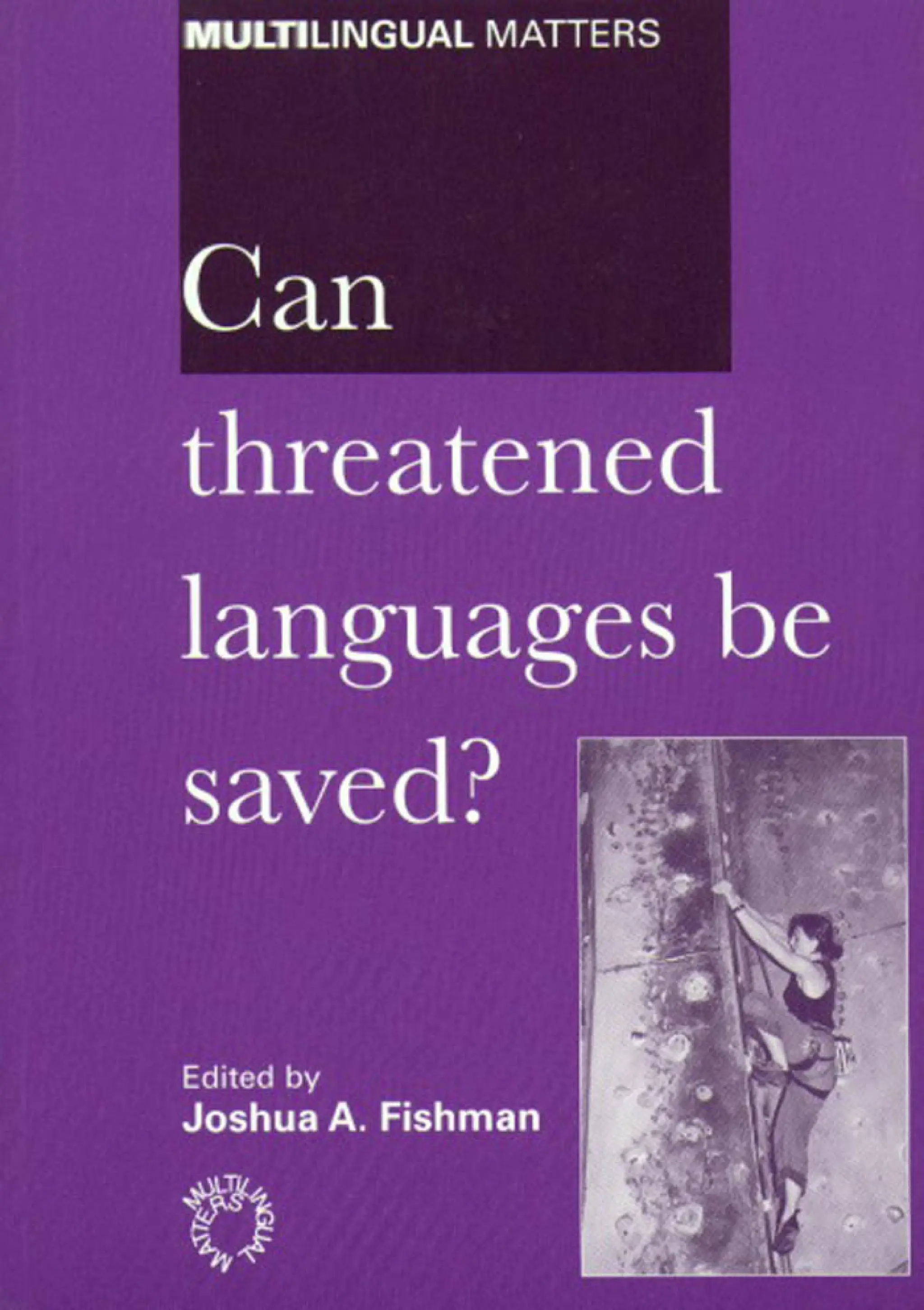


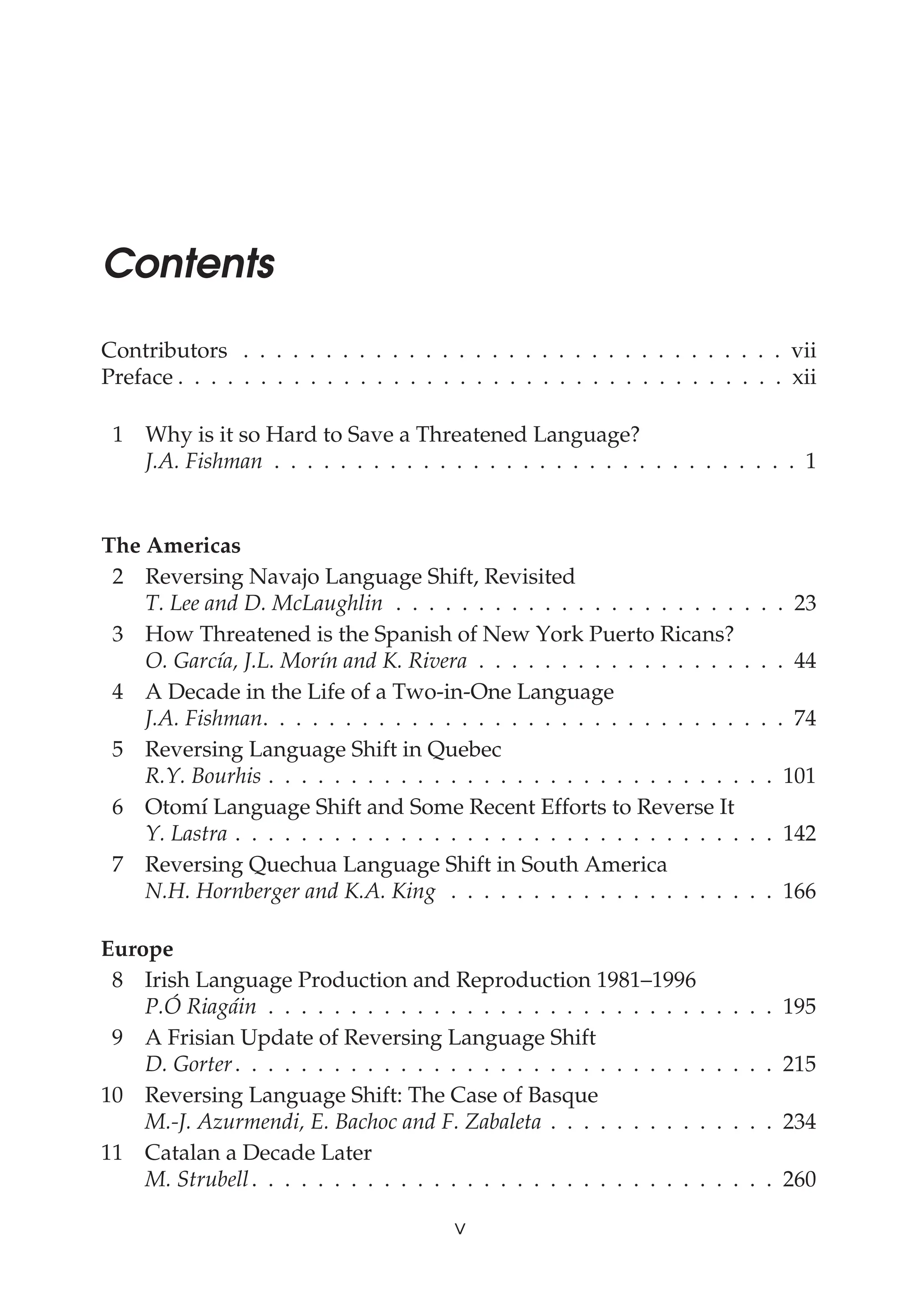














![‘There’s fey[197] folk in our ship, she winna sail for me,
There’s fey folk in our ship, she winna sail [ony].’
VIII
They’ve castin’ black bullets twice six and forty,
And ae the black bullet fell on bonnie Annie.
IX
‘Ye’ll tak me in your arms twa, lo, lift me cannie,
Throw me out owre-board, your ain dear Annie.’
X
He has ta’en her in his arms twa, lo, lifted her cannie,
He has laid her on a bed of down, his ain dear Annie.
XI
‘What can a woman do, love, I’ll do for ye:’
‘Muckle can a woman do, ye canna do for me.’
XII
‘Lay about, steer about, lay our ship cannie,
Do all ye can to save my dear Annie.’
XIII
‘I’ve laid about, steer’d about, laid about cannie,
Our ship’s on a sand-bank, she winna sail [ony]—](https://image.slidesharecdn.com/1163807-250530072351-630b2b3c/75/Can-Threatened-Languages-Be-Saved-2nd-Edition-Joshua-A-Fishman-56-2048.jpg)
![XIV
‘Ye’ll take her in your arms twa, lo, lift her cannie,
And throw her out owre-board, your ain dear Annie.’
XV
He has ta’en her in his arms twa, lo, lifted her cannie,
He has thrown her out owre-board, his ain dear Annie.
XVI
[The corse it did float, the ship it did follow]
Until that they came to the high banks o’ Yarrow[198].
XVII
‘O I’d bury my love on the high banks o’ Yarrow,
But the wood it is dear, and the planks they are narrow.’
XVIII
He made his love a coffin o’ the gowd sae yellow,
And buried his bonnie love doun in a sea valley.
FOOTNOTES:
[196] cannie = gently.
[197] fey = destined to die.
[198] Yarrow =? Jarrow.](https://image.slidesharecdn.com/1163807-250530072351-630b2b3c/75/Can-Threatened-Languages-Be-Saved-2nd-Edition-Joshua-A-Fishman-57-2048.jpg)

![I
It fell upon a Wadensday
Brown Robyn’s men went to sea;
But they saw neither moon nor sun
Nor starlight wi’ their e’e.
II
‘We’ll cast kevels[199] us amang;
See wha the man may be.’—
The kevel fell on Brown Robyn,
The master-man was he.
III
‘It is nae wonder,’ said Brown Robyn,
‘Altho’ I dinna thrive;
[For at hame I murder’d my ain father—
I would he were on live.]
IV
‘But tie me to a plank o’ wude,
And throw me in the sea;
And if I sink, ye may bid me sink,
But if I swim, let be.’
V
They’ve tied him to a plank o’ wude
And thrown him in the sea;
He didna sink tho’ they bade him sink](https://image.slidesharecdn.com/1163807-250530072351-630b2b3c/75/Can-Threatened-Languages-Be-Saved-2nd-Edition-Joshua-A-Fishman-60-2048.jpg)

![[199] kevels = lots.](https://image.slidesharecdn.com/1163807-250530072351-630b2b3c/75/Can-Threatened-Languages-Be-Saved-2nd-Edition-Joshua-A-Fishman-62-2048.jpg)

![I
She lean’d her back unto a thorn;
Fine flowers in the valley
And there she has her two babes born,
And the green leaves they grow rarely.
II
She’s ta’en the ribbon frae her hair,
And bound their bodies fast and sair.
III
‘Smile na sae sweet, my bonny babes,
An’ ye smile sae sweet, ye’ll smile me dead.
IV
‘And, O bonny babes, if ye suck sair,
Ye’ll never suck by my side mair.’
V
She’s ta’en out her little penknife
And twinn’d[200] the sweet babes o’ their life.
VI
She’s howket a grave baith deep and wide,
And there she’s buried them side by side.](https://image.slidesharecdn.com/1163807-250530072351-630b2b3c/75/Can-Threatened-Languages-Be-Saved-2nd-Edition-Joshua-A-Fishman-64-2048.jpg)
![VII
She’s buried them baith beneath the brier,
And washed her hands wi’ mony a tear.
VIII
‘O ay, my God, as I look to thee,
My babes be atween my God and me!
IX
‘And ay their smiles wad win me in,
But I am borne down by deadly sin.’
X
She’s cover’d them o’er wi’ a marble stane,
Thinking she wad gang maiden hame.
XI
She lookit out owre her castle wa’
And saw twa naked boys play at the ba’.
XII
‘O bonny boys, gin ye were mine
I wad cleed[201] you in silk and sabelline[202].
XIII
‘O I would dress you in the silk,](https://image.slidesharecdn.com/1163807-250530072351-630b2b3c/75/Can-Threatened-Languages-Be-Saved-2nd-Edition-Joshua-A-Fishman-65-2048.jpg)
![O ou d d ess you t e s ,
And wash you ay in morning milk.’—
XIV
‘O mother dear, when we were thine,
You didna prove to us sae kind.
XV
‘O cruel mother, we were thine
And thou made us to wear the twine[203].
XVI
‘But now we’re in the heavens hie,
Fine flowers in the valley
And ye have the pains o’ hell to drie’—
And the green leaves they grow rarely;
Ten thousand times good night and be wi’ thee!
FOOTNOTES:
[200] twinn’d = robbed, deprived.
[201] cleed = clothe.
[202] sabelline = sable.
[203] twine = twine-cloth, shroud.](https://image.slidesharecdn.com/1163807-250530072351-630b2b3c/75/Can-Threatened-Languages-Be-Saved-2nd-Edition-Joshua-A-Fishman-66-2048.jpg)
![VII
The youngest stood upon a stane,
The eldest cam and push’d her in.
VIII
‘O sister, sister, reach your hand!
And ye sall be heir o’ half my land:
IX
‘O sister, reach me but your glove!
And sweet William sall be your love.’—
X
‘Foul fa’ the hand that I should take;
It twin’d[204] me o’ my warldis make[205].
XI
‘Your cherry cheeks and your yellow hair
Gar’d me gang maiden evermair.’
XII
Sometimes she sank, sometimes she swam,
Until she cam to the miller’s dam.
XIII
Out then cam the miller’s son,](https://image.slidesharecdn.com/1163807-250530072351-630b2b3c/75/Can-Threatened-Languages-Be-Saved-2nd-Edition-Joshua-A-Fishman-69-2048.jpg)
![And saw the fair maid soummin’[206] in.
XIV
‘O father, father, draw your dam!
There’s either a mermaid or a milk-white swan.’
XV
The miller hasted and drew his dam,
And there he found a drown’d woman.
XVI
You couldna see her middle sma’,
Her gowden girdle was sae braw.
XVII
You couldna see her lily feet,
Her gowden fringes were sae deep.
XVIII
You couldna see her yellow hair
For the strings o’ pearls was twisted there.
XIX
You couldna see her fingers sma’,
Wi’ diamond rings they were cover’d a’.
XX](https://image.slidesharecdn.com/1163807-250530072351-630b2b3c/75/Can-Threatened-Languages-Be-Saved-2nd-Edition-Joshua-A-Fishman-70-2048.jpg)
![And by there cam a harper fine,
That harpit to the king at dine.
XXI
And when he look’d that lady on,
He sigh’d and made a heavy moan.
XXII
He’s made a harp of her breast-bane,
Whose sound wad melt a heart of stane.
XXIII
He’s ta’en three locks o’ her yellow hair,
And wi’ them strung his harp sae rare.
XXIV
He went into her father’s hall,
And there was the court assembled all.
XXV
He laid his harp upon a stane,
And straight it began to play by lane[207].
XXVI
‘O yonder sits my father, the King,
And yonder sits my mother, the Queen;](https://image.slidesharecdn.com/1163807-250530072351-630b2b3c/75/Can-Threatened-Languages-Be-Saved-2nd-Edition-Joshua-A-Fishman-71-2048.jpg)
![y y , Q ;
XXVII
‘And yonder stands my brother Hugh,
And by him my William, sweet and true.’
XXVIII
But the last tune that the harp play’d then—
Binnorie, O Binnorie!
Was, ‘Woe to my sister, false Helèn!’
By the bonnie milldams o’ Binnorie.
FOOTNOTES:
[204] twin’d = robbed, deprived.
[205] my warldis make = my one mate in the world.
[206] soummin’ = swimming.
[207] by lane = alone, of itself.](https://image.slidesharecdn.com/1163807-250530072351-630b2b3c/75/Can-Threatened-Languages-Be-Saved-2nd-Edition-Joshua-A-Fishman-72-2048.jpg)

![I
There was a knight and a lady bright
Set trysts[208] amang the broom,
The ane to come at morning ear[209],
The other at afternoon.
II
‘I’ll wager, I’ll wager, I’ll wager wi’ you
Five hundred merks and ten
That a maid shanna gae to the bonny broom
And a maiden return again.’—
III
‘I’ll wager, I’ll wager, I’ll wager wi’ you
Five hundred merks and ten
That a maid shall gae to the bonny green broom
And a maiden return again.’
IV
The may she sat at her mother’s bower door
And aye she made her mane:
‘O whether shou’d I gang to the Broomfield Hill,
Or should I stay at hame?
V
‘For if I do gang to the Broomfield Hill,
A maid I’ll not return;
B t if I sta f ae the B oomfield Hill](https://image.slidesharecdn.com/1163807-250530072351-630b2b3c/75/Can-Threatened-Languages-Be-Saved-2nd-Edition-Joshua-A-Fishman-74-2048.jpg)
![But if I stay frae the Broomfield Hill,
My love will ca’ me man-sworn.’
VI
Up then spake an auld witch-wife,
Sat in the bower abune:
‘O ye may gang to the Broomfield Hill,
And yet come maiden hame,
VII
‘For when ye gang to the Broomfield Hill,
Ye’ll find your love asleep,
Wi’ a silver belt above his head,
And a broom-cow[210] at his feet.
VIII
‘Tak’ ye the bloom frae aff the broom,
Strew’t at his head an’ feet,
And aye the thicker that ye do strew,
The sounder he will sleep.
IX
‘Tak’ ye the rings aff your fingers,
Put them in his right hand,
To let him know when he does wake,
His love was at his command.’
X
Lord John has ta’en his milk-white steed](https://image.slidesharecdn.com/1163807-250530072351-630b2b3c/75/Can-Threatened-Languages-Be-Saved-2nd-Edition-Joshua-A-Fishman-75-2048.jpg)
![And his hawk wi’ his bells sae bright,
And he’s ridden swift to the Broomfield Hill,
[Was never a baulder] knight.
XI
‘Now rest, now rest, my milk-white steed,
My lady will soon be here,
And I’ll lay my head by this rose sae red,
And the bonny burn sae near.’
XII
She’s pu’d the broom-flower on Hive Hill,
And strew’d on ’s white breast-bane,
And that was to be wittering[211] true
That maiden she had gane.
XIII
‘O where were ye, my milk-white steed,
That I hae coft[212] sae dear,
That wadna watch and waken me
When there was maiden here?’—
XIV
‘I stampèd wi’ my foot, master,
And gar’d my bridle ring,
But no kin’ thing wald waken ye
Till she was past and gane.’—
XV](https://image.slidesharecdn.com/1163807-250530072351-630b2b3c/75/Can-Threatened-Languages-Be-Saved-2nd-Edition-Joshua-A-Fishman-76-2048.jpg)
![‘And wae betide ye, my gay goss-hawk,
That I hae coft sae dear,
That wadna watch an’ waken me
When my true-love was here.’—
XVI
‘I clappèd wi’ my wings, master,
And aye my bells I rang,
And aye cried, Waken, waken, master,
Before the ladye gang!’—
XVII
‘But haste, but haste, my gude white steed,
To come the maiden till,
Or a’ the birds of the gude greenwood
O’ your flesh shall have their fill!’—
XVIII
‘Ye needna burst your gude white steed
Wi’ racing o’er the howm[213];
Nae bird flies faster thro’ the wood
Than she fled thro’ the broom.’
FOOTNOTES:
[208] trysts = assignations.
[209] ear = early.
[210] broom-cow = branch of broom.](https://image.slidesharecdn.com/1163807-250530072351-630b2b3c/75/Can-Threatened-Languages-Be-Saved-2nd-Edition-Joshua-A-Fishman-77-2048.jpg)
![[211] wittering = information, token.
[212] coft = bought.
[213] howm = holm, river-mead.](https://image.slidesharecdn.com/1163807-250530072351-630b2b3c/75/Can-Threatened-Languages-Be-Saved-2nd-Edition-Joshua-A-Fishman-78-2048.jpg)


