California Teachers of English Learners (CTEL)Module ThreeCulture and Inclusionjeffery heil
CTEL InformationThis is the link to the NES site where you can register, get some sample test questions and study guides: http://www.ctel.nesinc.com/
My InformationJeffery HeilEmail: jheil@sdcoe.netWeb: ctelresources.wetpaint.com
Knowledge, Skills, and Abilities (KSAs)See pages 3 – 7Notice that each domain is cross-referenced to a page number in either the participant guide or the CTEL HandbookPage 8 gives the test structure of the first three subtestsPage 9: Rationale for Module 3
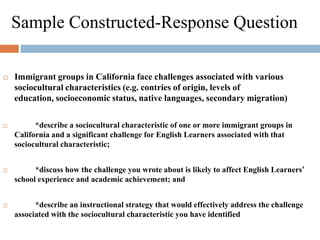
Sample Constructed-Response QuestionImmigrant groups in California face challenges associated with various sociocultural characteristics (e.g. contries of origin, levels of education, socioeconomic status, native languages, secondary migration)	*describe a sociocultural characteristic of one or more immigrant groups in California and a significant challenge for English Learners associated with that sociocultural characteristic;	*discuss how the challenge you wrote about is likely to affect English Learners’ school experience and academic achievement; and	*describe an instructional strategy that would effectively address the challenge associated with the sociocultural characteristic you have identified
Cultural Diversity in California and the United States (KSA - 003)Reading assignment: Ch8 CTEL Handbook
Do We Have the “Will” to Educate All Children?The knowledge and skills to educate all children already exist.  Because we have lived in a historically oppressive society, educational issues tend to be framed as technical issues, which denies their political origin and meaning. . .There are no pedagogical barriers to teaching and learning when willing people are prepared and made available to children. If we embrace a will to excellence, we can deeply restructure education in ways that will enable teachers to release the full potential of all our children								-Asa G. Hilliard
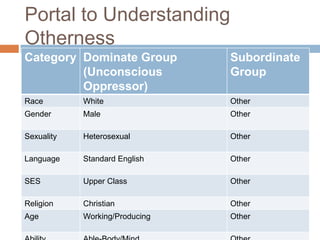
Portal to Understanding Otherness
Cultural Diversity in California and the United StatesComplete the top of page 10 introducing me to an immigrant student in you class or someone you know.EL Voices
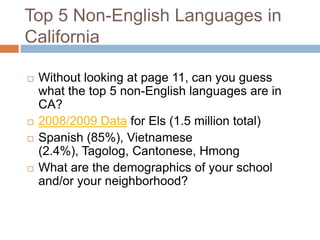
Top 5 Non-English Languages in CaliforniaWithout looking at page 11, can you guess what the top 5 non-English languages are in CA?2008/2009 Data for Els (1.5 million total)Spanish (85%), Vietnamese (2.4%), Tagolog, Cantonese, HmongWhat are the demographics of your school and/or your neighborhood?
Push-Pull Factors Page 13:  Imagine you are going to leave the state of CA.  Discuss at your table, then list some push and pull factors in the empty boxes.See the boxes below to find some push/pull factors for immigrants
The Immigrant ExperiencePage 14:  Rank the problems from 1(easiest) to 10 (hardest)I’ll read to you some answers given by a group of multilingual immigrant parents who had to make these choices.
Immigration and MigrationUsing the CTEL Handbook, Chapter 8 summarize the subtopics listed in your reading.  Pages 15–17.CTEL, CH 8, page 292-297Create a poster with your findings (class size will determine group sizes)
Immigration & Migration:Changing Face of America (292-294)A shift from predominately European American population to one that is substantially non-white (1 out of 3 Americans by 2010)CA is experiencing the initial wave of immigration that will soon impact the USTwo minority groups – immigrants & economically disadvantaged minorities within the US, face similar challenges
Immigration & Migration: Impact of Changing Pop.Poverty plays a large role in the education of America’s youth and hits minority children particularly hard.Large city school populations are overwhelmingly minority. (SD Unified: 75%)The economy of the US in the future will rest more on Asian-Americans & Hispanic-Americans workers than at present.  The education of these populations will become increasingly important
Impact of Changing Pop. ContinuedEven after Brown V. Board of Education, a student who is Black, Latino, or Native American remains much less likely to succeed in school.Many minority students come to school with home languages other than English (1 out of 5 in US; 1 out of 4 in CA).  Districts find themselves scrambling for teachers and staff who speak their languages.
Economic Factors (pg 294)The great disparity in the standard of living attainable in the US compared to that of many underdeveloped countries makes immigration attractive.Immigration policy has corresponded with the cycles of boom and bust in the US economyMost newcomers experience a period of economic hardship.
Political Factors (pg 295)People are pushed to the US because of political instability or political policies unfavorable to them in their home countries.Political conditions within the US affect whether or not immigrants are accepted or denied.
Religious Factors (pg 295)Many of the early English settlers in North American came to found colonies in which they would be free to establish their form of religious domination.Until recently, immigration policies only permitted refugees to be accepted for political rather than religious reasons (Change: current policies permit refugees to be accepted on the basis of religion if the applicant can prove that persecution comes from the government).
Family Unification (pg 295)Immigration has been a male-dominated activity since the early settlement of North America.Once settled, these immigrants seek to bring their family members.
Migration within the US (296)(new)Many immigrants are sponsored by special-interest groups that invite them to reside in their local community.  Some groups find conditions too foreign and make a secondary migration to another part of the US
Immigration Law & Policies (pg 296)Economic cycles in the US have affected immigration policies.  They allow for immigration when workers were needed and restricting it when jobs were scarce.The immigrant preference system emphasizes family ties first, occupation second, and diversity (coming from countries other than from our principle sources) third.
Legal Status (pg 227)Many immigrants are documented–legal residents who have entered the US officially and live under the protection of legal immigration status.  Some of these are refugees.Undocumented immigrants are residents without any documentation, who live in fear of being identified and deported.Undocumented children are legally entitled to public education and their papers cannot be solicited at school when they register.
Resources (pg 297)The Emergency Immigration Education Program (EIEP), (NCLB, Title III, subpart 4) now known as the Refugee Student Assistance Program, provides assistance to school districts whose enrollment is impacted by immigrants.
ISSUES and CHALLENGESPage 18:  We will discuss the issues and challenges faced by culturally and linguistically diverse students. Begin to think about the student whom you introduced to me on page 10.
Primary Language Maintenance and LossPrimary language maintenance - refers to maintaining skills in students’ primary language as they add on new skills in English.Primary language loss - refers to losing their skills in their primary language.  They are replacing the primary language with English.
Phases of AcculturationThese are stages one experiences as he/she acculturates or adapts to the second culture.  They include the honeymoon, culture shock, adaptation, and acceptance phases (we’ll cover in depth later)
Stereotypes and Individual VariationStereotypes – preconceived and oversimplified generalization about a particular ethnic, religious group race or gender.Individual variation – need to consider people as individuals and not categorize them into groups.
Societal and Intragroup ChallengesPrejudice–excessive pride in one’s own heritage, country or culture so that others are viewed negatively.  (regular ballot)Discrimination–actions that limit opportunities of particular groups based on race, gender, language, culture, or social class
Societal and Intragroup ChallengesEconomic Challenges–are a matter of survival and affect all aspects of students’ lives; viewing lower socioeconomic families’ lifestyles and perceived values.Intragroup–recent immigrants versus first generation.
Legal StatusRefugees, Immigrant and Undocumented workers.See page 19 for a full explanation of the difference among the three.
ReflectThink about how these issues and challenges may affect the education of the student you introduced to me on page 10.In the space below, finish your letter by telling me how you could adjust your instructional delivery to address the issues and challenges your student(s) face
Cultural Contact (KSA - 002)CTEL, pg 286
Chanrath Ou QuiteWe have lived through genocide–we’ve lost everything including family members–and when we came to this country from Cambodia we didn’t want again to be victims of our children being torn from us and lost.  We had to give them roots in our community.  It’s time to get rod of the melting pot analogy.  We’re a garden, and a garden of every color.  And to keep a garden healthy you have to have the soil and roots of the plants that are strong.  Our language is our roots.Complete the quickwrite/quickdraw on page 20.
Key VocabularyPage 21:  Refer to the CTEL book, pages 287–288 and take notes on each term.
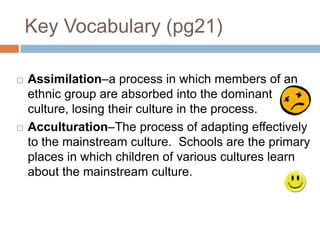
Key Vocabulary (pg21)Assimilation–a process in which members of an ethnic group are absorbed into the dominant culture, losing their culture in the process. Acculturation–The process of adapting effectively to the mainstream culture.  Schools are the primary places in which children of various cultures learn about the mainstream culture.
Key Vocabulary (pg21)Accommodation–a two-way process: members of the mainstream culture change in adapting to a minority culture, the members of which in turn accept some cultural change as they adapt to a mainstream Biculturalism–the ability to function successfully in two cultures.  The process of becoming bicultural is not without stress, especially for students who are expected to internalize dissimilar, perhaps conflicting values.
Key VocabularyHas anyone observed or knows:Someone who is biculturalA teacher with an assimilationist viewSomeone who has acculturatedA teacher who believes in accommodation
Phases of Acculturation(pg 248)Page 22:  Although these phases are primarily about the experiences of an individual who permanently moves to another country or state, anyone who has moved at (large or sometimes small distances) or traveled has some similar experiences (although, probably to a much lesser extent)
“The New Americans”We will be watching the first excerpt from the subtitled video “The New Americans–Supporting Families Module” by Kartemquin FilmsComplete the top of page 23 analyzing Nora & Pedrito’s educational experiences
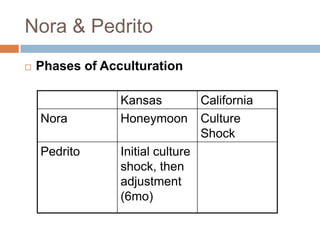
Nora & PedritoPhases of Acculturation
Nora & PedritoFamily dynamicsFamily unification/family firstVentura’s(mom) culture shock in Kansas and then adjustment in CaliforniaMother is the heart of the home
Nora & PedritoStudent Interactions:Pedrito is paired with a student from GuanajuatoNora–worked with adults in Kansas who really cared for her
Nora & PedritoProblem Solving:Immigrant visa issued solved cooperativelyMoving to US, CA, and again if needed.
What Can I do as a Teacher?Learn more about student backgrounds and experiencesTry to figure out where student is in terms of acculturationCheck-in with the students on how they are doing and whether or not they have any questionsSee each child as an individual with individual needs and strengths
What Can I do as a Teacher?Pair up new students with buddies to befriend them and show them the ropes if they are ELsUse strategies for second language acquisitionMake it clear that you expect all students to welcome and support newcomersCreate an inclusive classroom cultureMigrant services for family.Adult Ed-ESL, GED, CBET
Crosscultural Interactions(KSA - 004)CTEL
Sociolinguistic Factors:Getting ready for a test . . .As you listen to the following instructions, count how many idiomatic expressions you can hear. . .
Getting ready for a test . . .Alright kids, put a lid on the talking and button your lips please because I need to remind you of a few things.  If you want to ace the test tomorrow, you’ll really need to hit the books tonight.  Remember when you’re reading the chapters keep your eyes peeled for the key words you’ll come across.  Jot down a few notes before you hit the sack, briefly review them tomorrow and you should be sitting pretty come test time tomorrow.
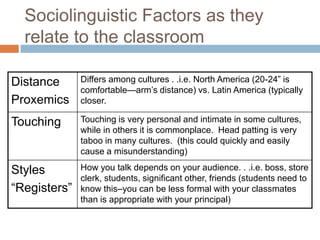
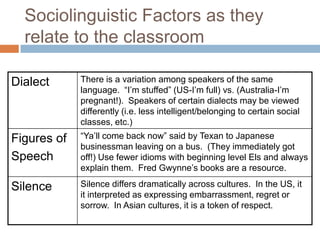
Sociolinguistic Factors(pg 191)Page 24:  There is a social component to linguistic competence that every culture has.  If you have never experienced what it means to learn another culture’s sociolinguistic factor’s, you might not have ever reflected on exactly what they are.
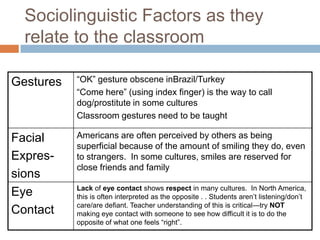
Sociolinguistic Factors as they relate to the classroom
Non-Verbal Communication Activity - Page 26At your tables, complete the nonverbal communication activity.Share out when finished!
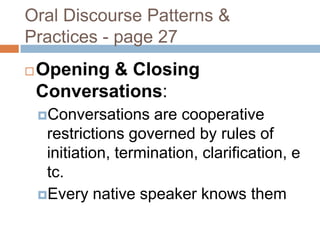
Oral Discourse Patterns & Practices - page 27Opening & Closing Conversations:Conversations are cooperative restrictions governed by rules of initiation, termination, clarification, etc.Every native speaker knows them
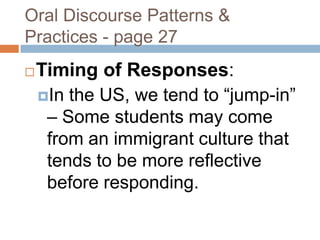
Oral Discourse Patterns & Practices - page 27Timing of Responses:In the US, we tend to “jump-in” – Some students may come from an immigrant culture that tends to be more reflective before responding.
Oral Discourse Patterns & Practices - page 27Turn Taking:Attention getting rules are assimilated to avoid conversational  awkwardnessCulturally oriented sets of rules require finely tuned perceptions.
Oral Discourse Patterns & Practices - page 27Volume of Voice:Voice volume can convey different culture specific meaning that may be different  from classroom culture.
Oral Discourse Patterns & Practices - page 27Use/Role of Silence:Differs across cultures.Can mean embarrassment, criticism, sorrow; can mean personal power; can convey self control and respect See CTEL book pages 304/5
Cultural Thought PatternsPage 28:  Read the excerpts from Robert KaplanSummary:Discourse patterns are different based on language and culture.Thinking patterns are different around the world.  One is not better/worse, just different.The discourse pattern used in Academic English is direct, short, and linear (to the point)
Cultural Thought PatternsExamplesEnglish:  In English the story line would focus on “getting to the point” and the discourse event might sound like, “I need a pair of shoes.  I’m going to the store.  I’ll buy running shoes.”
Cultural Thought PatternsExamplesSemitic:  Semitic languages have been described as taking “two steps forward and one step back” in their discourse structure.  An example may be, “I need shoes; I’ll go to the store.  I need shoes; I should measure my feet.  I need shoes; my old ones are worn out.”  While the storyline advances here, the is clearly a great deal of repetition that would not be found in a similar event in English.
Cultural Thought PatternsExamplesAsian/Native American:  These languages have a circular logic in such a way that discourse is structured around a topic many times without directly stating the topic.  In fact, for speakers of these languages, being too direct is considered to be rude.  An example of this structure is, “In the winter the ground is cold and frozen.  In the summer it is hot and there are sand burrs.  Your feet can get frostbite or burns.  You need shoes.”  This example talks around the subject of needing shoes but not directly to it.
Cultural Thought PatternsExamplesSpanish/Romance:  While these languages, like English, have linear logic, they allow for a great deal of digression that would be considered superfluous in English.  “I need shoes.  I’ll get some running shoes.  You know my sister, she got some running shoes a while ago at J.C. Penney’s.  They gave her blisters but they were cheap.  Maybe we should go to Penney’s to look for shoes.”
Cultural Thought PatternsExamplesRussian:  Has linear logic with some digression.  “I need to buy some good running shoes like Nikes.  I will run on the team.  The team at my school is very good and has won a lot of races and ribbons against teams from all over California.  Good running shoes are important for a team to win, my team all has Nikes, and nobody has sore feet.  I need to buy some Nikes this week so I can be ready to run.”
Cultural Thought PatternsPage 29:  Read the essay from Jo, a 10th grade student who was asked to write about Civil Disobedience.At you tables discuss:His discourse styleHis understanding of the assignmentHow you would grade him and your rationale for doing soJo was given a “D” because he did not discuss Rosa Parks or MLK.
Cultural Thought PatternsRebeca:  Her teacher had her highlight the sections that went together to assist Rebeca in organizing her discourse style to fit American academic style.  First, her teacher had her highlight every place where she talked about her name in one color, about coming from Mexico in another, etc.Rebeca was able to rewrite and feel successful.
Teaching English for Social & Academic CommunicationPage 30Communication Styles: Discuss cultural thought patternsModel Writing (American linear)Color CodingCommunication Strategies:How to ask and answer questions (sentence frames)Cooperative Learning (turn taking, active listening, etc.)
Teaching English for Social & Academic CommunicationConflict Resolution Strategies:Training in negotiation and mediationPositive school climates w/policies and curriculum that support antiracist programs.Valuing language & cultureMultiple Perspectives: Exposing students to differences in world viewsRecognizing multiple points of view [Columbus’ “Discovery, Invasion, or Contact”] (i.e. debate)
Teaching English for Social & Academic CommunicationEthnocentrism & Cultural Relativism:Discussion of how language expresses a message (i.e. using language that creates barriers versus using culturally inclusive language)Explicit modeling
Transmission & Interactive ModesTwo student volunteers to read Teacher A and Teacher B
Contrasting Cultural ValuesInterdependence-FamilyCooperationHierarchy, Rank, StatusFavoritism (Males)FormalityIndirectnessFateIndependence - IndividualCompetitionEgalitarianismFemale RolesInformality DirectnessMastery of One’s own future
Contrasting Cultural ValuesThink of the values as a continuumWhich list is collectivist and which is individualist?In our own classrooms there may be evidence of values from both lists, anywhere along the continuum.
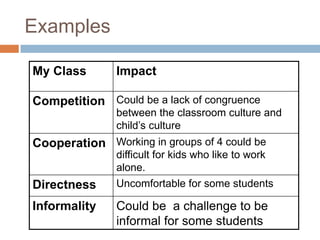
T-Chart - page 33Fill in the t-chart entitled “My Class”. List the values implicit in your class on the right and how each cultural value might impact education.  Share with your table. . .
Examples
Cultural Concepts and Perspectives(KSA - 001)
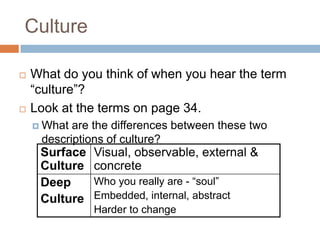
Culture	What do you think of when you hear the term “culture”?Look at the terms on page 34.What are the differences between these two descriptions of culture?
Culture	Look at the terms on page 34.Which elements do we consciously address?How can we more successfully negotiate and acknowledge the deeper elements in our classrooms and curriculum?
Culture Counts“The first premise is that culture is at the heart of all we do in the name of education, whether that is curriculum, instruction, administration, or performance assessment.  Culture refers to a dynamic system of social values, cognitive codes, behavioral standards, worldviews, and beliefs used to give order and meaning to our own lives as well as the lives of others
Culture CountsEven without our being consciously aware of it, culture determines how we think, believe, and behave, and these, in turn, affect how we teach, what we teach, how we relate to children and each other.  Our society’s predominant worldview and cultural norms are so deeply ingrained in how we educate children that we seldom think about the possibility that there may be other different but equally legitimate and effective approaches to teaching and learning.”   		Geneva Gay (2000)
Cultural Treasure Hunt	Page 35.  Complete the Cultural Treasure Hunt at your tables.Page 37.Why address issues of culture in the classroom?Popcorn
We Speak America   (Video)This video explores the complexities of identity, immigration, culture, and language issues faced by parents, young adults, teachers and students.Discuss page 38 at your table, then with the group.
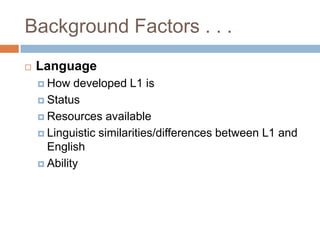
Background Factors . . .LanguageHow developed L1 isStatusResources availableLinguistic similarities/differences between L1 and EnglishAbility
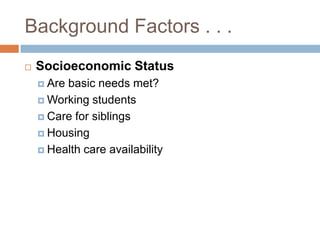
Background Factors . . .Socioeconomic StatusAre basic needs met?Working studentsCare for siblingsHousingHealth care availability
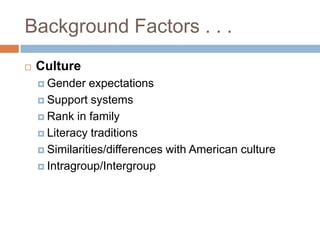
Background Factors . . .CultureGender expectationsSupport systemsRank in familyLiteracy traditionsSimilarities/differences with American cultureIntragroup/Intergroup
Background Factors . . .ExperienceImmigrant/Refugee/Undocumented (voting/citizenship status)TraumaAge when English acquisition began
Background Factors . . .EducationPrior education (Nora from the video)Literacy in L1Print in homeParents’ background and level of educationParental support for education & language acquisition goals
QuickwriteDescribe two background factors that affect ELs.  How does each factor contribute to promoting or impeding learning, language acquisition and school adjustment for English learners?What are the implications of this for your own teaching?
Role of Culture in the Classroom and Schools(KSA - 005)
Drink Cultura - José Antonio BurciagaListen as I read to you an excerpt from the chapter “All Things I learned in School. . .”Can you recall a time when something you learned at school didn’t match what you’d learned or practiced at home?  Share with your table.
What do I know - page 41Jot down your gut level responses regarding students from these cultures on the “What do I know?” . . .How do I know these things?How much of what you know isn’t first-hand knowledge?  How much is from the media?
What do I know - page 41What is your reaction when you hear that tomorrow you are getting a new Korean immigrant student?  What are your expectations?Take the same student to Japan. . .As there is a negative sociopolitical relationship between Japan & Korea, the results are that Korean students usually perform to the level of expectation.
What do I know - page 41Additional examples:  Finnish in Sweden, Kurdish in Turkey, and the French in Vermont
Teaching Styles – CTEL, 307)Glance at the paragraph on teaching style. . .What is your teaching style?How can your own cultural beliefs, attitudes and assumptions affect their management style, teaching style, and interactions with students and parents.Complete page 42. . .
Ways to Find out About. . .Page 43: what are some strategies for finding out about your students’ home cultures and cultural experiences?Using observation, community resources, home visits, interviews, informal conversation and written & oral histories . . .How have you or could you use any of these strategies?
Promoting Culturally Inclusive Learning Environments (KSA - 006)
Ralph Ellison	If you can show me how I can cling to that which is real to me, while teaching me a way into the larger society, then and only then will I drop my defenses and my hostility, and I will sing your praises and help you to make the desert bear fruit.
Promoting Culturally Inclusive Learning Environments  -pg 44Brainstorm alone or with your table. . .Share with the group.
Factors that contribute . . .pg45High ExpectationsFor ALL childrenHigh Level of Respect for Cultural & Linguistic Diversity:Valuing and Validating the primary language and its use.High level of interactions:Cooperative/collaborative group work
Factors that contribute . . .pg45Multicultural PerspectiveInfuse throughout the curriculumUse of proactive approach to cultural conflictOpenly discussing prejudice, discrimination, racism, stereotypes, intergroup relations
Factors that contribute . . .pg45Zero ToleranceFor culturally insensitive behaviorStrong parent/guardian and community involvement:In class and school activities in school organization programs.
Factors that Contribute . . .After taking notes on the factors, come up with one concrete example for one of the factors listed.  Then:Record one good idea on a square on page 46Give One, Get One . . .Mingle and ask for ideas from classmates. . .Page 47:  Quickwrite.  Complete
Culturally Inclusive Curriculum and Instruction(KSA - 008)
3-2-1 . . .  Page 48Fill out the 3-2-1 activityThree titles of multicultural books you have read in your classroomTwo perspectives of involvement of immigrant parents in their child’s educationOne social action you’ve seen your students involved themselves with. . .
Banks: Approaches to Multicultural Curriculum Reform  -page 49  (CTEL – page 325)After discussing Banks’ model, discover where you are as a teacher, a district. . .Page 50.  Complete self-assessmentCould you develop a lesson with a multicultural perspective?Make sure to access the students’ prior knowledge and contextualize the language and content for students.
Family & Community Support(KSA - 007)
Parent VoicesShare your quote with as many people as possible.Listen to Pat Mora’s Nepantla . . .Read through and answer the questions from page 52. (CTEL, page 333)ELAC/DELACDesign a school policy to address one of the questions on page 52.  Include a timeline & share at your tables
So They May Speak - VideoIf Time Permits. . .

Ctel module3 jeff

  • 1.
    California Teachers ofEnglish Learners (CTEL)Module ThreeCulture and Inclusionjeffery heil
  • 2.
    CTEL InformationThis isthe link to the NES site where you can register, get some sample test questions and study guides: http://www.ctel.nesinc.com/
  • 3.
    My InformationJeffery HeilEmail:jheil@sdcoe.netWeb: ctelresources.wetpaint.com
  • 4.
    Knowledge, Skills, andAbilities (KSAs)See pages 3 – 7Notice that each domain is cross-referenced to a page number in either the participant guide or the CTEL HandbookPage 8 gives the test structure of the first three subtestsPage 9: Rationale for Module 3
  • 5.
    Sample Constructed-Response QuestionImmigrantgroups in California face challenges associated with various sociocultural characteristics (e.g. contries of origin, levels of education, socioeconomic status, native languages, secondary migration) *describe a sociocultural characteristic of one or more immigrant groups in California and a significant challenge for English Learners associated with that sociocultural characteristic; *discuss how the challenge you wrote about is likely to affect English Learners’ school experience and academic achievement; and *describe an instructional strategy that would effectively address the challenge associated with the sociocultural characteristic you have identified
  • 6.
    Cultural Diversity inCalifornia and the United States (KSA - 003)Reading assignment: Ch8 CTEL Handbook
  • 7.
    Do We Havethe “Will” to Educate All Children?The knowledge and skills to educate all children already exist. Because we have lived in a historically oppressive society, educational issues tend to be framed as technical issues, which denies their political origin and meaning. . .There are no pedagogical barriers to teaching and learning when willing people are prepared and made available to children. If we embrace a will to excellence, we can deeply restructure education in ways that will enable teachers to release the full potential of all our children -Asa G. Hilliard
  • 8.
  • 9.
    Cultural Diversity inCalifornia and the United StatesComplete the top of page 10 introducing me to an immigrant student in you class or someone you know.EL Voices
  • 10.
    Top 5 Non-EnglishLanguages in CaliforniaWithout looking at page 11, can you guess what the top 5 non-English languages are in CA?2008/2009 Data for Els (1.5 million total)Spanish (85%), Vietnamese (2.4%), Tagolog, Cantonese, HmongWhat are the demographics of your school and/or your neighborhood?
  • 11.
    Push-Pull Factors Page13: Imagine you are going to leave the state of CA. Discuss at your table, then list some push and pull factors in the empty boxes.See the boxes below to find some push/pull factors for immigrants
  • 12.
    The Immigrant ExperiencePage14: Rank the problems from 1(easiest) to 10 (hardest)I’ll read to you some answers given by a group of multilingual immigrant parents who had to make these choices.
  • 13.
    Immigration and MigrationUsingthe CTEL Handbook, Chapter 8 summarize the subtopics listed in your reading. Pages 15–17.CTEL, CH 8, page 292-297Create a poster with your findings (class size will determine group sizes)
  • 14.
    Immigration & Migration:ChangingFace of America (292-294)A shift from predominately European American population to one that is substantially non-white (1 out of 3 Americans by 2010)CA is experiencing the initial wave of immigration that will soon impact the USTwo minority groups – immigrants & economically disadvantaged minorities within the US, face similar challenges
  • 15.
    Immigration & Migration:Impact of Changing Pop.Poverty plays a large role in the education of America’s youth and hits minority children particularly hard.Large city school populations are overwhelmingly minority. (SD Unified: 75%)The economy of the US in the future will rest more on Asian-Americans & Hispanic-Americans workers than at present. The education of these populations will become increasingly important
  • 16.
    Impact of ChangingPop. ContinuedEven after Brown V. Board of Education, a student who is Black, Latino, or Native American remains much less likely to succeed in school.Many minority students come to school with home languages other than English (1 out of 5 in US; 1 out of 4 in CA). Districts find themselves scrambling for teachers and staff who speak their languages.
  • 17.
    Economic Factors (pg294)The great disparity in the standard of living attainable in the US compared to that of many underdeveloped countries makes immigration attractive.Immigration policy has corresponded with the cycles of boom and bust in the US economyMost newcomers experience a period of economic hardship.
  • 18.
    Political Factors (pg295)People are pushed to the US because of political instability or political policies unfavorable to them in their home countries.Political conditions within the US affect whether or not immigrants are accepted or denied.
  • 19.
    Religious Factors (pg295)Many of the early English settlers in North American came to found colonies in which they would be free to establish their form of religious domination.Until recently, immigration policies only permitted refugees to be accepted for political rather than religious reasons (Change: current policies permit refugees to be accepted on the basis of religion if the applicant can prove that persecution comes from the government).
  • 20.
    Family Unification (pg295)Immigration has been a male-dominated activity since the early settlement of North America.Once settled, these immigrants seek to bring their family members.
  • 21.
    Migration within theUS (296)(new)Many immigrants are sponsored by special-interest groups that invite them to reside in their local community. Some groups find conditions too foreign and make a secondary migration to another part of the US
  • 22.
    Immigration Law &Policies (pg 296)Economic cycles in the US have affected immigration policies. They allow for immigration when workers were needed and restricting it when jobs were scarce.The immigrant preference system emphasizes family ties first, occupation second, and diversity (coming from countries other than from our principle sources) third.
  • 23.
    Legal Status (pg227)Many immigrants are documented–legal residents who have entered the US officially and live under the protection of legal immigration status. Some of these are refugees.Undocumented immigrants are residents without any documentation, who live in fear of being identified and deported.Undocumented children are legally entitled to public education and their papers cannot be solicited at school when they register.
  • 24.
    Resources (pg 297)TheEmergency Immigration Education Program (EIEP), (NCLB, Title III, subpart 4) now known as the Refugee Student Assistance Program, provides assistance to school districts whose enrollment is impacted by immigrants.
  • 25.
    ISSUES and CHALLENGESPage18: We will discuss the issues and challenges faced by culturally and linguistically diverse students. Begin to think about the student whom you introduced to me on page 10.
  • 26.
    Primary Language Maintenanceand LossPrimary language maintenance - refers to maintaining skills in students’ primary language as they add on new skills in English.Primary language loss - refers to losing their skills in their primary language. They are replacing the primary language with English.
  • 27.
    Phases of AcculturationTheseare stages one experiences as he/she acculturates or adapts to the second culture. They include the honeymoon, culture shock, adaptation, and acceptance phases (we’ll cover in depth later)
  • 28.
    Stereotypes and IndividualVariationStereotypes – preconceived and oversimplified generalization about a particular ethnic, religious group race or gender.Individual variation – need to consider people as individuals and not categorize them into groups.
  • 29.
    Societal and IntragroupChallengesPrejudice–excessive pride in one’s own heritage, country or culture so that others are viewed negatively. (regular ballot)Discrimination–actions that limit opportunities of particular groups based on race, gender, language, culture, or social class
  • 30.
    Societal and IntragroupChallengesEconomic Challenges–are a matter of survival and affect all aspects of students’ lives; viewing lower socioeconomic families’ lifestyles and perceived values.Intragroup–recent immigrants versus first generation.
  • 31.
    Legal StatusRefugees, Immigrantand Undocumented workers.See page 19 for a full explanation of the difference among the three.
  • 32.
    ReflectThink about howthese issues and challenges may affect the education of the student you introduced to me on page 10.In the space below, finish your letter by telling me how you could adjust your instructional delivery to address the issues and challenges your student(s) face
  • 33.
    Cultural Contact (KSA- 002)CTEL, pg 286
  • 34.
    Chanrath Ou QuiteWehave lived through genocide–we’ve lost everything including family members–and when we came to this country from Cambodia we didn’t want again to be victims of our children being torn from us and lost. We had to give them roots in our community. It’s time to get rod of the melting pot analogy. We’re a garden, and a garden of every color. And to keep a garden healthy you have to have the soil and roots of the plants that are strong. Our language is our roots.Complete the quickwrite/quickdraw on page 20.
  • 35.
    Key VocabularyPage 21: Refer to the CTEL book, pages 287–288 and take notes on each term.
  • 36.
    Key Vocabulary (pg21)Assimilation–aprocess in which members of an ethnic group are absorbed into the dominant culture, losing their culture in the process. Acculturation–The process of adapting effectively to the mainstream culture. Schools are the primary places in which children of various cultures learn about the mainstream culture.
  • 37.
    Key Vocabulary (pg21)Accommodation–atwo-way process: members of the mainstream culture change in adapting to a minority culture, the members of which in turn accept some cultural change as they adapt to a mainstream Biculturalism–the ability to function successfully in two cultures. The process of becoming bicultural is not without stress, especially for students who are expected to internalize dissimilar, perhaps conflicting values.
  • 38.
    Key VocabularyHas anyoneobserved or knows:Someone who is biculturalA teacher with an assimilationist viewSomeone who has acculturatedA teacher who believes in accommodation
  • 39.
    Phases of Acculturation(pg248)Page 22: Although these phases are primarily about the experiences of an individual who permanently moves to another country or state, anyone who has moved at (large or sometimes small distances) or traveled has some similar experiences (although, probably to a much lesser extent)
  • 40.
    “The New Americans”Wewill be watching the first excerpt from the subtitled video “The New Americans–Supporting Families Module” by Kartemquin FilmsComplete the top of page 23 analyzing Nora & Pedrito’s educational experiences
  • 41.
    Nora & PedritoPhasesof Acculturation
  • 42.
    Nora & PedritoFamilydynamicsFamily unification/family firstVentura’s(mom) culture shock in Kansas and then adjustment in CaliforniaMother is the heart of the home
  • 43.
    Nora & PedritoStudentInteractions:Pedrito is paired with a student from GuanajuatoNora–worked with adults in Kansas who really cared for her
  • 44.
    Nora & PedritoProblemSolving:Immigrant visa issued solved cooperativelyMoving to US, CA, and again if needed.
  • 45.
    What Can Ido as a Teacher?Learn more about student backgrounds and experiencesTry to figure out where student is in terms of acculturationCheck-in with the students on how they are doing and whether or not they have any questionsSee each child as an individual with individual needs and strengths
  • 46.
    What Can Ido as a Teacher?Pair up new students with buddies to befriend them and show them the ropes if they are ELsUse strategies for second language acquisitionMake it clear that you expect all students to welcome and support newcomersCreate an inclusive classroom cultureMigrant services for family.Adult Ed-ESL, GED, CBET
  • 47.
  • 48.
    Sociolinguistic Factors:Getting readyfor a test . . .As you listen to the following instructions, count how many idiomatic expressions you can hear. . .
  • 49.
    Getting ready fora test . . .Alright kids, put a lid on the talking and button your lips please because I need to remind you of a few things. If you want to ace the test tomorrow, you’ll really need to hit the books tonight. Remember when you’re reading the chapters keep your eyes peeled for the key words you’ll come across. Jot down a few notes before you hit the sack, briefly review them tomorrow and you should be sitting pretty come test time tomorrow.
  • 50.
    Getting ready fora test . . .Alright kids, put a lid on the talking and button your lips please because I need to remind you of a few things. If you want to ace the test tomorrow, you’ll really need to hit the books tonight. Remember when you’re reading the chapters keep your eyes peeled for the key words you’ll come across. Jot down a few notes before you hit the sack, briefly review them tomorrow and you should be sitting pretty come test time tomorrow.
  • 51.
    Sociolinguistic Factors(pg 191)Page24: There is a social component to linguistic competence that every culture has. If you have never experienced what it means to learn another culture’s sociolinguistic factor’s, you might not have ever reflected on exactly what they are.
  • 52.
    Sociolinguistic Factors asthey relate to the classroom
  • 53.
    Sociolinguistic Factors asthey relate to the classroom
  • 54.
    Sociolinguistic Factors asthey relate to the classroom
  • 55.
    Non-Verbal Communication Activity- Page 26At your tables, complete the nonverbal communication activity.Share out when finished!
  • 56.
    Oral Discourse Patterns& Practices - page 27Opening & Closing Conversations:Conversations are cooperative restrictions governed by rules of initiation, termination, clarification, etc.Every native speaker knows them
  • 57.
    Oral Discourse Patterns& Practices - page 27Timing of Responses:In the US, we tend to “jump-in” – Some students may come from an immigrant culture that tends to be more reflective before responding.
  • 58.
    Oral Discourse Patterns& Practices - page 27Turn Taking:Attention getting rules are assimilated to avoid conversational awkwardnessCulturally oriented sets of rules require finely tuned perceptions.
  • 59.
    Oral Discourse Patterns& Practices - page 27Volume of Voice:Voice volume can convey different culture specific meaning that may be different from classroom culture.
  • 60.
    Oral Discourse Patterns& Practices - page 27Use/Role of Silence:Differs across cultures.Can mean embarrassment, criticism, sorrow; can mean personal power; can convey self control and respect See CTEL book pages 304/5
  • 61.
    Cultural Thought PatternsPage28: Read the excerpts from Robert KaplanSummary:Discourse patterns are different based on language and culture.Thinking patterns are different around the world. One is not better/worse, just different.The discourse pattern used in Academic English is direct, short, and linear (to the point)
  • 62.
    Cultural Thought PatternsExamplesEnglish: In English the story line would focus on “getting to the point” and the discourse event might sound like, “I need a pair of shoes. I’m going to the store. I’ll buy running shoes.”
  • 63.
    Cultural Thought PatternsExamplesSemitic: Semitic languages have been described as taking “two steps forward and one step back” in their discourse structure. An example may be, “I need shoes; I’ll go to the store. I need shoes; I should measure my feet. I need shoes; my old ones are worn out.” While the storyline advances here, the is clearly a great deal of repetition that would not be found in a similar event in English.
  • 64.
    Cultural Thought PatternsExamplesAsian/NativeAmerican: These languages have a circular logic in such a way that discourse is structured around a topic many times without directly stating the topic. In fact, for speakers of these languages, being too direct is considered to be rude. An example of this structure is, “In the winter the ground is cold and frozen. In the summer it is hot and there are sand burrs. Your feet can get frostbite or burns. You need shoes.” This example talks around the subject of needing shoes but not directly to it.
  • 65.
    Cultural Thought PatternsExamplesSpanish/Romance: While these languages, like English, have linear logic, they allow for a great deal of digression that would be considered superfluous in English. “I need shoes. I’ll get some running shoes. You know my sister, she got some running shoes a while ago at J.C. Penney’s. They gave her blisters but they were cheap. Maybe we should go to Penney’s to look for shoes.”
  • 66.
    Cultural Thought PatternsExamplesRussian: Has linear logic with some digression. “I need to buy some good running shoes like Nikes. I will run on the team. The team at my school is very good and has won a lot of races and ribbons against teams from all over California. Good running shoes are important for a team to win, my team all has Nikes, and nobody has sore feet. I need to buy some Nikes this week so I can be ready to run.”
  • 67.
    Cultural Thought PatternsPage29: Read the essay from Jo, a 10th grade student who was asked to write about Civil Disobedience.At you tables discuss:His discourse styleHis understanding of the assignmentHow you would grade him and your rationale for doing soJo was given a “D” because he did not discuss Rosa Parks or MLK.
  • 68.
    Cultural Thought PatternsRebeca: Her teacher had her highlight the sections that went together to assist Rebeca in organizing her discourse style to fit American academic style. First, her teacher had her highlight every place where she talked about her name in one color, about coming from Mexico in another, etc.Rebeca was able to rewrite and feel successful.
  • 69.
    Teaching English forSocial & Academic CommunicationPage 30Communication Styles: Discuss cultural thought patternsModel Writing (American linear)Color CodingCommunication Strategies:How to ask and answer questions (sentence frames)Cooperative Learning (turn taking, active listening, etc.)
  • 70.
    Teaching English forSocial & Academic CommunicationConflict Resolution Strategies:Training in negotiation and mediationPositive school climates w/policies and curriculum that support antiracist programs.Valuing language & cultureMultiple Perspectives: Exposing students to differences in world viewsRecognizing multiple points of view [Columbus’ “Discovery, Invasion, or Contact”] (i.e. debate)
  • 71.
    Teaching English forSocial & Academic CommunicationEthnocentrism & Cultural Relativism:Discussion of how language expresses a message (i.e. using language that creates barriers versus using culturally inclusive language)Explicit modeling
  • 72.
    Transmission & InteractiveModesTwo student volunteers to read Teacher A and Teacher B
  • 73.
    Contrasting Cultural ValuesInterdependence-FamilyCooperationHierarchy,Rank, StatusFavoritism (Males)FormalityIndirectnessFateIndependence - IndividualCompetitionEgalitarianismFemale RolesInformality DirectnessMastery of One’s own future
  • 74.
    Contrasting Cultural ValuesThinkof the values as a continuumWhich list is collectivist and which is individualist?In our own classrooms there may be evidence of values from both lists, anywhere along the continuum.
  • 75.
    T-Chart - page33Fill in the t-chart entitled “My Class”. List the values implicit in your class on the right and how each cultural value might impact education. Share with your table. . .
  • 76.
  • 77.
    Cultural Concepts andPerspectives(KSA - 001)
  • 78.
    Culture What do youthink of when you hear the term “culture”?Look at the terms on page 34.What are the differences between these two descriptions of culture?
  • 79.
    Culture Look at theterms on page 34.Which elements do we consciously address?How can we more successfully negotiate and acknowledge the deeper elements in our classrooms and curriculum?
  • 80.
    Culture Counts“The firstpremise is that culture is at the heart of all we do in the name of education, whether that is curriculum, instruction, administration, or performance assessment. Culture refers to a dynamic system of social values, cognitive codes, behavioral standards, worldviews, and beliefs used to give order and meaning to our own lives as well as the lives of others
  • 81.
    Culture CountsEven withoutour being consciously aware of it, culture determines how we think, believe, and behave, and these, in turn, affect how we teach, what we teach, how we relate to children and each other. Our society’s predominant worldview and cultural norms are so deeply ingrained in how we educate children that we seldom think about the possibility that there may be other different but equally legitimate and effective approaches to teaching and learning.” Geneva Gay (2000)
  • 82.
    Cultural Treasure Hunt Page35. Complete the Cultural Treasure Hunt at your tables.Page 37.Why address issues of culture in the classroom?Popcorn
  • 83.
    We Speak America (Video)This video explores the complexities of identity, immigration, culture, and language issues faced by parents, young adults, teachers and students.Discuss page 38 at your table, then with the group.
  • 84.
    Background Factors .. .LanguageHow developed L1 isStatusResources availableLinguistic similarities/differences between L1 and EnglishAbility
  • 85.
    Background Factors .. .Socioeconomic StatusAre basic needs met?Working studentsCare for siblingsHousingHealth care availability
  • 86.
    Background Factors .. .CultureGender expectationsSupport systemsRank in familyLiteracy traditionsSimilarities/differences with American cultureIntragroup/Intergroup
  • 87.
    Background Factors .. .ExperienceImmigrant/Refugee/Undocumented (voting/citizenship status)TraumaAge when English acquisition began
  • 88.
    Background Factors .. .EducationPrior education (Nora from the video)Literacy in L1Print in homeParents’ background and level of educationParental support for education & language acquisition goals
  • 89.
    QuickwriteDescribe two backgroundfactors that affect ELs. How does each factor contribute to promoting or impeding learning, language acquisition and school adjustment for English learners?What are the implications of this for your own teaching?
  • 90.
    Role of Culturein the Classroom and Schools(KSA - 005)
  • 91.
    Drink Cultura -José Antonio BurciagaListen as I read to you an excerpt from the chapter “All Things I learned in School. . .”Can you recall a time when something you learned at school didn’t match what you’d learned or practiced at home? Share with your table.
  • 92.
    What do Iknow - page 41Jot down your gut level responses regarding students from these cultures on the “What do I know?” . . .How do I know these things?How much of what you know isn’t first-hand knowledge? How much is from the media?
  • 93.
    What do Iknow - page 41What is your reaction when you hear that tomorrow you are getting a new Korean immigrant student? What are your expectations?Take the same student to Japan. . .As there is a negative sociopolitical relationship between Japan & Korea, the results are that Korean students usually perform to the level of expectation.
  • 94.
    What do Iknow - page 41Additional examples: Finnish in Sweden, Kurdish in Turkey, and the French in Vermont
  • 95.
    Teaching Styles –CTEL, 307)Glance at the paragraph on teaching style. . .What is your teaching style?How can your own cultural beliefs, attitudes and assumptions affect their management style, teaching style, and interactions with students and parents.Complete page 42. . .
  • 96.
    Ways to Findout About. . .Page 43: what are some strategies for finding out about your students’ home cultures and cultural experiences?Using observation, community resources, home visits, interviews, informal conversation and written & oral histories . . .How have you or could you use any of these strategies?
  • 97.
    Promoting Culturally InclusiveLearning Environments (KSA - 006)
  • 98.
    Ralph Ellison If youcan show me how I can cling to that which is real to me, while teaching me a way into the larger society, then and only then will I drop my defenses and my hostility, and I will sing your praises and help you to make the desert bear fruit.
  • 99.
    Promoting Culturally InclusiveLearning Environments -pg 44Brainstorm alone or with your table. . .Share with the group.
  • 100.
    Factors that contribute. . .pg45High ExpectationsFor ALL childrenHigh Level of Respect for Cultural & Linguistic Diversity:Valuing and Validating the primary language and its use.High level of interactions:Cooperative/collaborative group work
  • 101.
    Factors that contribute. . .pg45Multicultural PerspectiveInfuse throughout the curriculumUse of proactive approach to cultural conflictOpenly discussing prejudice, discrimination, racism, stereotypes, intergroup relations
  • 102.
    Factors that contribute. . .pg45Zero ToleranceFor culturally insensitive behaviorStrong parent/guardian and community involvement:In class and school activities in school organization programs.
  • 103.
    Factors that Contribute. . .After taking notes on the factors, come up with one concrete example for one of the factors listed. Then:Record one good idea on a square on page 46Give One, Get One . . .Mingle and ask for ideas from classmates. . .Page 47: Quickwrite. Complete
  • 104.
    Culturally Inclusive Curriculumand Instruction(KSA - 008)
  • 105.
    3-2-1 . .. Page 48Fill out the 3-2-1 activityThree titles of multicultural books you have read in your classroomTwo perspectives of involvement of immigrant parents in their child’s educationOne social action you’ve seen your students involved themselves with. . .
  • 106.
    Banks: Approaches toMulticultural Curriculum Reform -page 49 (CTEL – page 325)After discussing Banks’ model, discover where you are as a teacher, a district. . .Page 50. Complete self-assessmentCould you develop a lesson with a multicultural perspective?Make sure to access the students’ prior knowledge and contextualize the language and content for students.
  • 107.
    Family & CommunitySupport(KSA - 007)
  • 108.
    Parent VoicesShare yourquote with as many people as possible.Listen to Pat Mora’s Nepantla . . .Read through and answer the questions from page 52. (CTEL, page 333)ELAC/DELACDesign a school policy to address one of the questions on page 52. Include a timeline & share at your tables
  • 109.
    So They MaySpeak - VideoIf Time Permits. . .