What is
Language?
Introduc)on	
  To	
  Linguis)cs	
  
Adam	
  Szczegielniak	


Learning	
  Goals	
  
• What	
  do	
  we	
  know	
  when	
  we	
  know	
  a	
  language	
  
• Crea)vity	
  in	
  language	
  
• Competence/Performance	
  
• What	
  is	
  Grammar	
  
• Language	
  Universals	
  
• Language	
  Development	
  
• Language	
  and	
  Thought	
  
What is Language?
• The ability to use language, perhaps more
than any other attribute, distinguishes
humans from other animals
• But what does it mean to know a
language?
Linguistic Knowledge
• When you know a language, you can speak (or
sign) and be understood by others who know
that language
• Five-year-olds already know their first
language(s)
• The ability to use a language requires profound
knowledge that most speakers don’t know that
they know
Cant	
  help	
  but	
  use	
  language	
  
• Try	
  to	
  not	
  understand	
  what	
  I	
  am	
  saying	
  
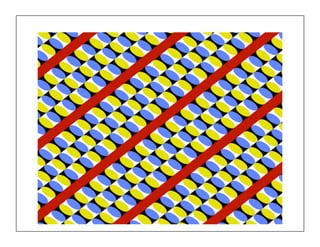
• Just	
  as	
  impossible	
  as	
  trying	
  not	
  to	
  be	
  fooled	
  by	
  op)cal	
  
illusions	
  
• You	
  cannot	
  stop	
  blinking	
  or	
  having	
  peripheral	
  vision	
  
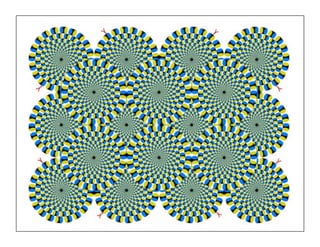
• For	
  example:	
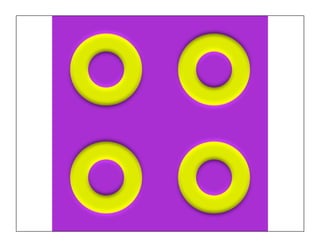
  Rota)ng	
  Snakes	
  –	
  the	
  circular	
  snakes	
  
appear	
  to	
  rotate	
  spontaneously	
  in	
  your	
  peripheral	
  
vision	
  as	
  a	
  result	
  of	
  the	
  peripheral	
  driM	
  illusion.	
  No)ce	
  
how	
  the	
  movement	
  stops	
  when	
  you	
  look	
  directly	
  at	
  a	
  
collec)on	
  of	
  concentric	
  circles.	
  The	
  illusion	
  is	
  probably	
  
caused	
  by	
  unconscious	
  rapid	
  eye	
  movements	
  and	
  
blinking	
  
Knowledge of the Sound System
• When we know a language, we know what
sounds (or signs) are used in the language and
which sounds (or signs) are not
• This also includes knowing how the sounds of
the language can be combined
– Which sounds may start a word
– Which sounds may end a word
– Which sounds may follow each other within a word
Knowledge	
  of	
  sound	
  system	
  
• Knowing	
  the	
  sounds	
  of	
  your	
  language	
  also	
  
involves	
  knowing	
  how	
  your	
  face	
  looks	
  ahwen	
  
you	
  produce	
  them	
  
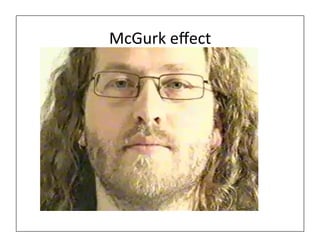
• Mcgurk	
  effect	
  hear	
  da	
  da,	
  but	
  what	
  is	
  
pronounced	
  is	
  ba	
  ba,	
  but	
  lips	
  move	
  to	
  ga	
  ga	
  	
  
McGurk	
  effect	
  	
  
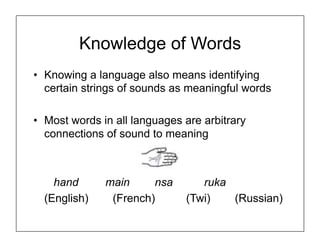
Knowledge of Words
• Knowing a language also means identifying
certain strings of sounds as meaningful words
• Most words in all languages are arbitrary
connections of sound to meaning
hand main nsa ruka
(English) (French) (Twi) (Russian)
History	
  of	
  words	
  
• Knowing	
  a	
  language	
  does	
  not	
  mean	
  we	
  know	
  
its	
  history	
  or	
  the	
  etymology	
  of	
  words.	
  	
  
• Many	
  words	
  of	
  English	
  have	
  a	
  common	
  
ancestor	
  with	
  similar	
  words	
  in	
  other	
  languages	
  
• Languages	
  changes	
  so	
  there	
  will	
  always	
  be	
  
proto-­‐languages	
  
• The	
  structure	
  of	
  protolanguages	
  ‘dies’	
  with	
  its	
  
speakers.	
  	
  
Ancestral Protolanguages
• One way we can tell if languages are genetically related
is if they have a large number of sound correspondences
– Where an English word begins with an f, the corresponding word
in French and Spanish begins with a p:
English /f/ French /p/ Spanish /p/
father père padre
fish poisson pescado
– From these correspondences, we can hypothesize that Indo-
European had a /p/ since more related languages have the /p/
form, and that at some point the /p/ became /f/ in the Germanic
group
– This does not mean that a modern speaker of English has this
knowledge as part of her gramamar
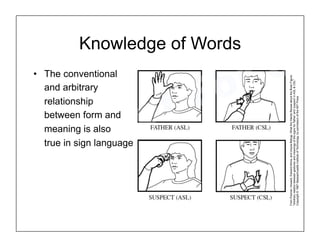
Knowledge of Words
• The conventional
and arbitrary
relationship
between form and
meaning is also
true in sign languages
From
Poizner,
Howard,
Edward
Klima,
and
Ursula
Bellugi.
What
the
Hands
Reveal
about
the
Brain
Figure:
"Arbitrary
relation
between
gestures
and
meanings
of
the
signs
for
'father'
and
'suspect'
in
ASL
&
CSL"
Copyright
©
1987
Massachusetts
Institute
of
Technology,
by
permission
of
the
MIT
Press
Knowledge of Words
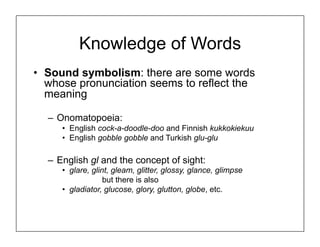
• Sound symbolism: there are some words
whose pronunciation seems to reflect the
meaning
– Onomatopoeia:
• English cock-a-doodle-doo and Finnish kukkokiekuu
• English gobble gobble and Turkish glu-glu
– English gl and the concept of sight:
• glare, glint, gleam, glitter, glossy, glance, glimpse
but there is also
• gladiator, glucose, glory, glutton, globe, etc.
Creativity of Linguistic Knowledge
• Every language has an infinite number of
possible sentences
• Knowing a language enables you to:
– Create a sentence that has never been uttered before
– Understand a sentence that has never been uttered
before
• Most sentences we use are new; very few
sentences are stored in our brains
Knowledge of Sentences and
Nonsentences
• Language is more than a set of words because
words must be ordered in certain ways to create
sentences
• Our knowledge of language allows us to
separate possible sentences from nonsentences
– What he did was climb a tree
– *What he thought was want a sports car
Linguistic Knowledge and Performance
• Knowledge: what we know about a language (linguistic
competence)
– Mostly unconscious knowledge about sounds, structures,
meanings, words, and rules for combining linguistic elements
• Performance: how we use this knowledge in actual
speech production and comprehension
– We can theoretically create an infinitely long sentence, but
physical constraints make this impossible
– In speech we stammer, pause, and produce slips of the tongue
What Is Grammar?
• Grammar = the knowledge speakers have about
the units and rules of their language
– Rules for combining sounds into words, word
formation, making sentences, assigning meaning
– When a sentence is ungrammatical in a linguistic
sense, it means that it breaks the rules of the shared
mental grammar of the language
Descriptive Grammar
• Descriptive grammar: a true model of the
mental grammar of language speakers
– In other words, a descriptive grammar
describes the linguistic rules that people use
when they speak their language
– The point of view of a descriptive grammarian
is that grammars from every language and
dialect are equal
Prescriptive Grammar
• Prescriptive Grammar: attempts to prescribe what rules
of language people should use to speak “properly”
– The view of a prescriptive grammarian is that some grammars
are better than others
• During the Renaissance, a middle class of English
speakers wished to talk like the upper class, so they
started buying handbooks that told them how to speak
“properly”
– Bishop Robert Lowth’s A Short Introduction to English Grammar
with Critical Notes (1762)
Prescriptive Grammar
• Lowth decided that “two negatives makes a
positive,” therefore people should not use
double negatives
– Despite the fact that everybody was already using
double negatives in English (and communication was
just fine)
– Despite the fact that many languages of the world
require the use of double negatives
Dialects	
  
• Prescrip)ve	
  Grammars	
  usually	
  argue	
  for	
  a	
  
standardized	
  dialect.	
  
• Regional	
  forms	
  or	
  forms	
  restricted	
  to	
  group	
  
class	
  are	
  frowned	
  upon	
  
• Dialects	
  have	
  grammars	
  	
  
• Rules	
  are	
  systema)c	
  
The “Standard”
• Standard American English (SAE) is the dominant (or prestige)
dialect in America
– Nobody actually speaks SAE (it’s an idealization), and it is not defined
precisely
• When a standard is the dialect of the wealthy and powerful, people
may be required to speak that dialect in order to get ahead
• Ross (1954) noticed differences in the speech of British upper class
(U) and non-upper class (non-U) speakers
– Non-U speakers wanted to sound U, and U speakers wanted to avoid
non-U speech
– Non-U speakers often hypercorrected, or deviated from the norm
thought to be “proper English”
The “Standard”
• Every dialect is equally expressive, logical, complex, and
systematic
– All dialects represent a set of rules or lexical items in the minds
of speakers, and any value judgments on dialects are social
judgments
• British received pronunciation (RP) omits r in certain
environments and is considered the standard
pronunciation
• In the American northeast, dialects that omit the r are
considered to be “substandard” and the prestige dialect
maintains the r
– What is considered a prestige dialect has a social basis, not a
linguistic one
Dialect - Lexical Differences
• Regional dialects may also differ lexically
– British: lift American: elevator
– British: pants American: underpants
– Boston: tonic Los Angeles: soda
– Los Angeles: freeway
– New York: thruway
– New Jersey: parkway
– England: motorway
Dialect- Phonological
Differences
• There are systematic pronunciation differences
between American and British English
– For example, Americans put stress on the first syllable
of a polysyllabic word, and British speakers put the
stress on the second syllable in words like cigarette,
applicable, formidable, laboratory
– Americans may pronounce the first vowel in data as
[e] or [ei] but vast majority of British speakers would
only use [e]
Dialect - Syntactic Differences
• Appalachian English has several syntactic
differences from Standard English
– Double modals
• You might should go home.
• He might could do it.
– Double objects
• I caught me a fish.
– Progressives
• He came a-runnin’.
Teaching Grammar
• A teaching grammar explicitly states the
rules of a language and is used to learn
another language or dialect.
– Teaching grammars assume the student
already knows one language and then
compares the grammar of the new language
to the one they already know
Language Universals
• Universal Grammar (UG) refers to the universal
properties that all languages share
– Part of a biologically endowed human language
faculty
– The basic blueprint that all languages follow
• It is a major goal of linguistic theory to discover
the nature of UG
The Development of Grammar
• All normal children acquire language relatively quickly
and easily and without instruction
• Children learn the world’s languages in the same way
and pass through the same stages of acquisition
• If children are born with UG, then they can acquire
language so quickly and easily because they already
know the universal properties of language and only need
to learn the specific rules of the language(s) they are
acquiring
Sign Languages: Evidence for
language universals
• Deaf children exposed to sign languages go
through the same stages of language acquisition
as hearing babies
– Deaf children babble with their hands
– Signed languages are organized in the brain just like
spoken languages are
What Is Not (Human) Language
• Some features of human language:
– Discreteness: the ability to combine linguistic units to
make larger units of meaning
– Creativity: the ability to create and understand never-
before-uttered sentences
– Displacement: the ability to talk about things that are
not physically present
• Allows for discussion of past events, abstract ideas, lying,
etc.
What Is Not (Human) Language
• Parrots can mimic words, but their utterances
carry no meaning
• They cannot dissect words into discrete units
– Polly and Molly don’t rhyme for a parrot
• They cannot deduce rules and patterns to create
new utterances
– If the parrot learns “Polly wants a cracker” and “Polly
wants a doughnut” and learns the word “bagel,” the
parrot will not say “Polly wants a bagel”
What Is Not (Human) Language
• Birdcalls convey messages associated with the
immediate environment
• Bird songs are used to stake out territory and attract
mates
– There is no evidence of internal structure in these songs,
although they may vary to express varying degrees of intensity
• Birdcalls and songs are similar to human languages in
that they contain regional dialects, are passed down
from parents to offspring, and can only be acquired
before a certain age
What Is Not (Human) Language
• Honeybees have a communication system that relies on
dance to convey information about the location and
quality of food sources to the rest of the hive
– Round dance: food source is within 20 feet from the hive
– Sickle dance: food source is 20 to 60 feet from the hive
– Tail-wagging dance: food source is more than 60 feet from the
hive
• The number of repetitions of the basic pattern in the tail-wagging
dance indicates the precise distance, with a slower repetition rate
indicating a longer distance
What Is Not (Human) Language
• The bee dances are theoretically able to
create an infinite number of messages
– But, the messages are confined to the subject
of food sources
– If there are any special circumstances
regarding the food source, the bee cannot
convey that information
Can Animals Learn Human
Language?
• Nonhuman primates have communication
systems in the wild to convey information about
the immediate environment and emotional state
(stimulus-response)
• Humans have attempted to teach human
language to other primates
– These nonhuman primates were taught sign
languages because their vocal tracts cannot produce
the sounds of human language
Can Animals Learn Human
Language?
• Washoe
• Koko
• Nim Chimpsky
• Sarah, Lana, Sherman, Austin
• Kanzi
– Researchers concluded that while nonhuman
primates can string two signs together and
show flashes of creativity, their use of
language is nowhere near human linguistic
ability
Language and Thought
• Sapir-Whorf Hypothesis: the theory that the structure of
a language influences how its speakers perceive the
world around them
• Linguistic determinism: the strongest form of the Sapir-
Whorf hypothesis which claims that the language we
speak determines how we perceive the world
– Whorf claimed that the Hopi people do not perceive time in the
same way as speakers of European languages because the
Hopi language does make grammatical distinctions in tense
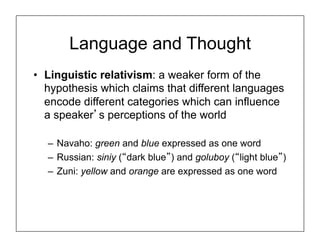
Language and Thought
• Linguistic relativism: a weaker form of the
hypothesis which claims that different languages
encode different categories which can influence
a speaker’s perceptions of the world
– Navaho: green and blue expressed as one word
– Russian: siniy (“dark blue”) and goluboy (“light blue”)
– Zuni: yellow and orange are expressed as one word
Language and Thought
• The strong form of the Sapir-Whorf hypothesis is
clearly false
– We can translate between languages
– We can learn additional languages
– If we don’t have a particular word for a concept, we
can express the concept with a string of words
Language and Thought
• Hopi does have a system for expressing time.
Hopi uses words for days of the week, parts of
the day, etc. to express tense rather than using
word endings like English
• Although languages differ in their color terms,
speakers can perceive differences even if their
language does not have a word to express the
difference
Language and Thought
• Some psychologists have suggested that speakers of
gender-marking languages think about objects as being
gendered
– In Spanish the word “bridge” is masculine (el puente), and
Spanish speakers described a bridge with masculine adjectives
such as big, dangerous, long, strong, and sturdy
– In German, the word “bridge” is feminine (die Brücke) and
German speakers described a bridge with feminine adjectives
such as beautiful, elegant, fragile, pretty, and slender
• This evidence seems to support a weak version of
linguistic relativism

what_is_language.ppt.pdf

  • 1.
    What is Language? Introduc)on  To  Linguis)cs   Adam  Szczegielniak    
  • 2.
    Learning  Goals   •What  do  we  know  when  we  know  a  language   • Crea)vity  in  language   • Competence/Performance   • What  is  Grammar   • Language  Universals   • Language  Development   • Language  and  Thought  
  • 3.
    What is Language? •The ability to use language, perhaps more than any other attribute, distinguishes humans from other animals • But what does it mean to know a language?
  • 4.
    Linguistic Knowledge • Whenyou know a language, you can speak (or sign) and be understood by others who know that language • Five-year-olds already know their first language(s) • The ability to use a language requires profound knowledge that most speakers don’t know that they know
  • 5.
    Cant  help  but  use  language   • Try  to  not  understand  what  I  am  saying   • Just  as  impossible  as  trying  not  to  be  fooled  by  op)cal   illusions   • You  cannot  stop  blinking  or  having  peripheral  vision   • For  example:  Rota)ng  Snakes  –  the  circular  snakes   appear  to  rotate  spontaneously  in  your  peripheral   vision  as  a  result  of  the  peripheral  driM  illusion.  No)ce   how  the  movement  stops  when  you  look  directly  at  a   collec)on  of  concentric  circles.  The  illusion  is  probably   caused  by  unconscious  rapid  eye  movements  and   blinking  
  • 9.
    Knowledge of theSound System • When we know a language, we know what sounds (or signs) are used in the language and which sounds (or signs) are not • This also includes knowing how the sounds of the language can be combined – Which sounds may start a word – Which sounds may end a word – Which sounds may follow each other within a word
  • 10.
    Knowledge  of  sound  system   • Knowing  the  sounds  of  your  language  also   involves  knowing  how  your  face  looks  ahwen   you  produce  them   • Mcgurk  effect  hear  da  da,  but  what  is   pronounced  is  ba  ba,  but  lips  move  to  ga  ga    
  • 11.
  • 12.
    Knowledge of Words •Knowing a language also means identifying certain strings of sounds as meaningful words • Most words in all languages are arbitrary connections of sound to meaning hand main nsa ruka (English) (French) (Twi) (Russian)
  • 13.
    History  of  words   • Knowing  a  language  does  not  mean  we  know   its  history  or  the  etymology  of  words.     • Many  words  of  English  have  a  common   ancestor  with  similar  words  in  other  languages   • Languages  changes  so  there  will  always  be   proto-­‐languages   • The  structure  of  protolanguages  ‘dies’  with  its   speakers.    
  • 14.
    Ancestral Protolanguages • Oneway we can tell if languages are genetically related is if they have a large number of sound correspondences – Where an English word begins with an f, the corresponding word in French and Spanish begins with a p: English /f/ French /p/ Spanish /p/ father père padre fish poisson pescado – From these correspondences, we can hypothesize that Indo- European had a /p/ since more related languages have the /p/ form, and that at some point the /p/ became /f/ in the Germanic group – This does not mean that a modern speaker of English has this knowledge as part of her gramamar
  • 15.
    Knowledge of Words •The conventional and arbitrary relationship between form and meaning is also true in sign languages From Poizner, Howard, Edward Klima, and Ursula Bellugi. What the Hands Reveal about the Brain Figure: "Arbitrary relation between gestures and meanings of the signs for 'father' and 'suspect' in ASL & CSL" Copyright © 1987 Massachusetts Institute of Technology, by permission of the MIT Press
  • 16.
    Knowledge of Words •Sound symbolism: there are some words whose pronunciation seems to reflect the meaning – Onomatopoeia: • English cock-a-doodle-doo and Finnish kukkokiekuu • English gobble gobble and Turkish glu-glu – English gl and the concept of sight: • glare, glint, gleam, glitter, glossy, glance, glimpse but there is also • gladiator, glucose, glory, glutton, globe, etc.
  • 17.
    Creativity of LinguisticKnowledge • Every language has an infinite number of possible sentences • Knowing a language enables you to: – Create a sentence that has never been uttered before – Understand a sentence that has never been uttered before • Most sentences we use are new; very few sentences are stored in our brains
  • 18.
    Knowledge of Sentencesand Nonsentences • Language is more than a set of words because words must be ordered in certain ways to create sentences • Our knowledge of language allows us to separate possible sentences from nonsentences – What he did was climb a tree – *What he thought was want a sports car
  • 19.
    Linguistic Knowledge andPerformance • Knowledge: what we know about a language (linguistic competence) – Mostly unconscious knowledge about sounds, structures, meanings, words, and rules for combining linguistic elements • Performance: how we use this knowledge in actual speech production and comprehension – We can theoretically create an infinitely long sentence, but physical constraints make this impossible – In speech we stammer, pause, and produce slips of the tongue
  • 20.
    What Is Grammar? •Grammar = the knowledge speakers have about the units and rules of their language – Rules for combining sounds into words, word formation, making sentences, assigning meaning – When a sentence is ungrammatical in a linguistic sense, it means that it breaks the rules of the shared mental grammar of the language
  • 21.
    Descriptive Grammar • Descriptivegrammar: a true model of the mental grammar of language speakers – In other words, a descriptive grammar describes the linguistic rules that people use when they speak their language – The point of view of a descriptive grammarian is that grammars from every language and dialect are equal
  • 22.
    Prescriptive Grammar • PrescriptiveGrammar: attempts to prescribe what rules of language people should use to speak “properly” – The view of a prescriptive grammarian is that some grammars are better than others • During the Renaissance, a middle class of English speakers wished to talk like the upper class, so they started buying handbooks that told them how to speak “properly” – Bishop Robert Lowth’s A Short Introduction to English Grammar with Critical Notes (1762)
  • 23.
    Prescriptive Grammar • Lowthdecided that “two negatives makes a positive,” therefore people should not use double negatives – Despite the fact that everybody was already using double negatives in English (and communication was just fine) – Despite the fact that many languages of the world require the use of double negatives
  • 24.
    Dialects   • Prescrip)ve  Grammars  usually  argue  for  a   standardized  dialect.   • Regional  forms  or  forms  restricted  to  group   class  are  frowned  upon   • Dialects  have  grammars     • Rules  are  systema)c  
  • 25.
    The “Standard” • StandardAmerican English (SAE) is the dominant (or prestige) dialect in America – Nobody actually speaks SAE (it’s an idealization), and it is not defined precisely • When a standard is the dialect of the wealthy and powerful, people may be required to speak that dialect in order to get ahead • Ross (1954) noticed differences in the speech of British upper class (U) and non-upper class (non-U) speakers – Non-U speakers wanted to sound U, and U speakers wanted to avoid non-U speech – Non-U speakers often hypercorrected, or deviated from the norm thought to be “proper English”
  • 26.
    The “Standard” • Everydialect is equally expressive, logical, complex, and systematic – All dialects represent a set of rules or lexical items in the minds of speakers, and any value judgments on dialects are social judgments • British received pronunciation (RP) omits r in certain environments and is considered the standard pronunciation • In the American northeast, dialects that omit the r are considered to be “substandard” and the prestige dialect maintains the r – What is considered a prestige dialect has a social basis, not a linguistic one
  • 27.
    Dialect - LexicalDifferences • Regional dialects may also differ lexically – British: lift American: elevator – British: pants American: underpants – Boston: tonic Los Angeles: soda – Los Angeles: freeway – New York: thruway – New Jersey: parkway – England: motorway
  • 28.
    Dialect- Phonological Differences • Thereare systematic pronunciation differences between American and British English – For example, Americans put stress on the first syllable of a polysyllabic word, and British speakers put the stress on the second syllable in words like cigarette, applicable, formidable, laboratory – Americans may pronounce the first vowel in data as [e] or [ei] but vast majority of British speakers would only use [e]
  • 29.
    Dialect - SyntacticDifferences • Appalachian English has several syntactic differences from Standard English – Double modals • You might should go home. • He might could do it. – Double objects • I caught me a fish. – Progressives • He came a-runnin’.
  • 30.
    Teaching Grammar • Ateaching grammar explicitly states the rules of a language and is used to learn another language or dialect. – Teaching grammars assume the student already knows one language and then compares the grammar of the new language to the one they already know
  • 31.
    Language Universals • UniversalGrammar (UG) refers to the universal properties that all languages share – Part of a biologically endowed human language faculty – The basic blueprint that all languages follow • It is a major goal of linguistic theory to discover the nature of UG
  • 32.
    The Development ofGrammar • All normal children acquire language relatively quickly and easily and without instruction • Children learn the world’s languages in the same way and pass through the same stages of acquisition • If children are born with UG, then they can acquire language so quickly and easily because they already know the universal properties of language and only need to learn the specific rules of the language(s) they are acquiring
  • 33.
    Sign Languages: Evidencefor language universals • Deaf children exposed to sign languages go through the same stages of language acquisition as hearing babies – Deaf children babble with their hands – Signed languages are organized in the brain just like spoken languages are
  • 34.
    What Is Not(Human) Language • Some features of human language: – Discreteness: the ability to combine linguistic units to make larger units of meaning – Creativity: the ability to create and understand never- before-uttered sentences – Displacement: the ability to talk about things that are not physically present • Allows for discussion of past events, abstract ideas, lying, etc.
  • 35.
    What Is Not(Human) Language • Parrots can mimic words, but their utterances carry no meaning • They cannot dissect words into discrete units – Polly and Molly don’t rhyme for a parrot • They cannot deduce rules and patterns to create new utterances – If the parrot learns “Polly wants a cracker” and “Polly wants a doughnut” and learns the word “bagel,” the parrot will not say “Polly wants a bagel”
  • 36.
    What Is Not(Human) Language • Birdcalls convey messages associated with the immediate environment • Bird songs are used to stake out territory and attract mates – There is no evidence of internal structure in these songs, although they may vary to express varying degrees of intensity • Birdcalls and songs are similar to human languages in that they contain regional dialects, are passed down from parents to offspring, and can only be acquired before a certain age
  • 37.
    What Is Not(Human) Language • Honeybees have a communication system that relies on dance to convey information about the location and quality of food sources to the rest of the hive – Round dance: food source is within 20 feet from the hive – Sickle dance: food source is 20 to 60 feet from the hive – Tail-wagging dance: food source is more than 60 feet from the hive • The number of repetitions of the basic pattern in the tail-wagging dance indicates the precise distance, with a slower repetition rate indicating a longer distance
  • 38.
    What Is Not(Human) Language • The bee dances are theoretically able to create an infinite number of messages – But, the messages are confined to the subject of food sources – If there are any special circumstances regarding the food source, the bee cannot convey that information
  • 39.
    Can Animals LearnHuman Language? • Nonhuman primates have communication systems in the wild to convey information about the immediate environment and emotional state (stimulus-response) • Humans have attempted to teach human language to other primates – These nonhuman primates were taught sign languages because their vocal tracts cannot produce the sounds of human language
  • 40.
    Can Animals LearnHuman Language? • Washoe • Koko • Nim Chimpsky • Sarah, Lana, Sherman, Austin • Kanzi – Researchers concluded that while nonhuman primates can string two signs together and show flashes of creativity, their use of language is nowhere near human linguistic ability
  • 41.
    Language and Thought •Sapir-Whorf Hypothesis: the theory that the structure of a language influences how its speakers perceive the world around them • Linguistic determinism: the strongest form of the Sapir- Whorf hypothesis which claims that the language we speak determines how we perceive the world – Whorf claimed that the Hopi people do not perceive time in the same way as speakers of European languages because the Hopi language does make grammatical distinctions in tense
  • 42.
    Language and Thought •Linguistic relativism: a weaker form of the hypothesis which claims that different languages encode different categories which can influence a speaker’s perceptions of the world – Navaho: green and blue expressed as one word – Russian: siniy (“dark blue”) and goluboy (“light blue”) – Zuni: yellow and orange are expressed as one word
  • 43.
    Language and Thought •The strong form of the Sapir-Whorf hypothesis is clearly false – We can translate between languages – We can learn additional languages – If we don’t have a particular word for a concept, we can express the concept with a string of words
  • 44.
    Language and Thought •Hopi does have a system for expressing time. Hopi uses words for days of the week, parts of the day, etc. to express tense rather than using word endings like English • Although languages differ in their color terms, speakers can perceive differences even if their language does not have a word to express the difference
  • 45.
    Language and Thought •Some psychologists have suggested that speakers of gender-marking languages think about objects as being gendered – In Spanish the word “bridge” is masculine (el puente), and Spanish speakers described a bridge with masculine adjectives such as big, dangerous, long, strong, and sturdy – In German, the word “bridge” is feminine (die Brücke) and German speakers described a bridge with feminine adjectives such as beautiful, elegant, fragile, pretty, and slender • This evidence seems to support a weak version of linguistic relativism