GROUP NO :3
Koukab Yasmeen
LANGUAGE DEVELOPMENT
•It is the process which children come to understand
and communicate language during early
childhood.
ENVIRONMENT INFLUENCE ON
LANGUAGE
• The interactionist perspective on language Development emphases the
interactions between in nate ability and environmental influences
• These include:
1. Gender
2. Reading habits
3. Temperament
4. Social environment
5. Socio economic status
6. Care giver interaction
LANGUAGE DEVELOPMENT AT
DIFFERENT STAGES
• Language development begins before birth.
• Between birth and three months of age ,most infants acquire the
following abilities:
• Seem to recognize their mother voice.
• Quit down or smile when spoken to.
• Turn toward familiar voices and sounds.
• Cry differently to express different needs.
• Make vowel – like sounds such as “ooh”and “ah”.
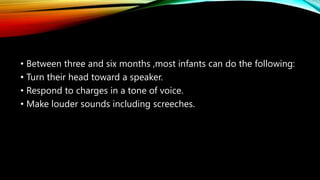
• Between three and six months ,most infants can do the following:
• Turn their head toward a speaker.
• Respond to charges in a tone of voice.
• Make louder sounds including screeches.
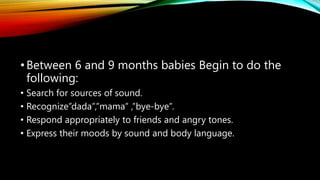
•Between 6 and 9 months babies Begin to do the
following:
• Search for sources of sound.
• Recognize”dada”,”mama” ,”bye-bye”.
• Respond appropriately to friends and angry tones.
• Express their moods by sound and body language.
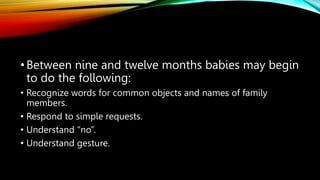
•Between nine and twelve months babies may begin
to do the following:
• Recognize words for common objects and names of family
members.
• Respond to simple requests.
• Understand “no”.
• Understand gesture.
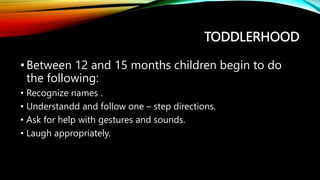
TODDLERHOOD
•Between 12 and 15 months children begin to do
the following:
• Recognize names .
• Understandd and follow one – step directions.
• Ask for help with gestures and sounds.
• Laugh appropriately.
•At 15 to 18 months of age children usually do the
following:
• Use 10 to 20 intelligible words,mostly nouns.
• Put two short words together to form sentences
• Have 2 0 to 25 percent of their speech understood by out siders .
PRESCHOOL
•Three to four years olds usually can do the
following :
• Understand most of what they hear.
• Converse.
• Use pronounce correctly.
• Use three to six – words sentences.
SCHOOL AGE
•At age five most childrens can do the following :
• Follow three consecutive cammands.
• Talk constantly.
• Ask innumerable questions.
• Use generally correct grammar.
DIFFERENCE BETWEEN PRESCHOOL
AND KINDERGARTEN
Preschool
• The preschool is the educational
setting in which the kids of around 2-3
years age are taught the basic concepts
of math, science.
• The preschool is the educational
setting before the formal school,the
students are taught the basic concepts
in a playful manner.
Kindergarten
• The kindergarten is the beginning of the
formal education for the children.The kids
of around 3-5 ages are eligible to join the
kindergarten after cleaning the admission
test.
• The teaching techniques in kindergarten
are quit the same as in the case of the pre
school but the regular classes and more
learning with a formal atmosphere make it
different from the pre school.
Child development language development.pptx

Child development language development.pptx

  • 2.
  • 3.
    LANGUAGE DEVELOPMENT •It isthe process which children come to understand and communicate language during early childhood.
  • 5.
    ENVIRONMENT INFLUENCE ON LANGUAGE •The interactionist perspective on language Development emphases the interactions between in nate ability and environmental influences • These include: 1. Gender 2. Reading habits 3. Temperament 4. Social environment 5. Socio economic status 6. Care giver interaction
  • 6.
    LANGUAGE DEVELOPMENT AT DIFFERENTSTAGES • Language development begins before birth. • Between birth and three months of age ,most infants acquire the following abilities: • Seem to recognize their mother voice. • Quit down or smile when spoken to. • Turn toward familiar voices and sounds. • Cry differently to express different needs. • Make vowel – like sounds such as “ooh”and “ah”.
  • 7.
    • Between threeand six months ,most infants can do the following: • Turn their head toward a speaker. • Respond to charges in a tone of voice. • Make louder sounds including screeches.
  • 8.
    •Between 6 and9 months babies Begin to do the following: • Search for sources of sound. • Recognize”dada”,”mama” ,”bye-bye”. • Respond appropriately to friends and angry tones. • Express their moods by sound and body language.
  • 9.
    •Between nine andtwelve months babies may begin to do the following: • Recognize words for common objects and names of family members. • Respond to simple requests. • Understand “no”. • Understand gesture.
  • 10.
    TODDLERHOOD •Between 12 and15 months children begin to do the following: • Recognize names . • Understandd and follow one – step directions. • Ask for help with gestures and sounds. • Laugh appropriately.
  • 11.
    •At 15 to18 months of age children usually do the following: • Use 10 to 20 intelligible words,mostly nouns. • Put two short words together to form sentences • Have 2 0 to 25 percent of their speech understood by out siders .
  • 12.
    PRESCHOOL •Three to fouryears olds usually can do the following : • Understand most of what they hear. • Converse. • Use pronounce correctly. • Use three to six – words sentences.
  • 13.
    SCHOOL AGE •At agefive most childrens can do the following : • Follow three consecutive cammands. • Talk constantly. • Ask innumerable questions. • Use generally correct grammar.
  • 14.
    DIFFERENCE BETWEEN PRESCHOOL ANDKINDERGARTEN Preschool • The preschool is the educational setting in which the kids of around 2-3 years age are taught the basic concepts of math, science. • The preschool is the educational setting before the formal school,the students are taught the basic concepts in a playful manner. Kindergarten • The kindergarten is the beginning of the formal education for the children.The kids of around 3-5 ages are eligible to join the kindergarten after cleaning the admission test. • The teaching techniques in kindergarten are quit the same as in the case of the pre school but the regular classes and more learning with a formal atmosphere make it different from the pre school.