LANGUAGE DEVELOPMENT
I N I N F A N C Y A N D E A R L Y C H I L D H O O D
B Y A M Y G I L L I S
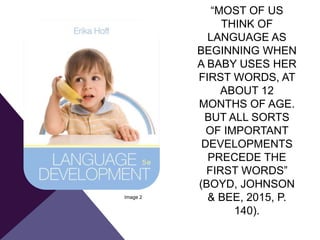
“MOST OF US
THINK OF
LANGUAGE AS
BEGINNING WHEN
A BABY USES HER
FIRST WORDS, AT
ABOUT 12
MONTHS OF AGE.
BUT ALL SORTS
OF IMPORTANT
DEVELOPMENTS
PRECEDE THE
FIRST WORDS”
(BOYD, JOHNSON
& BEE, 2015, P.
140).
Image 2
Behaviourists
 B.F. Skinner
Nativists
 Noam Chomsky
 Claim that infants learn
language through parental
reinforcement of word-like
sounds and correct grammar.
 State that an innate language
processor called the LAD
(language acquisition device)
guides children’s
comprehension and
production of language.
THEORISTS
Image 12
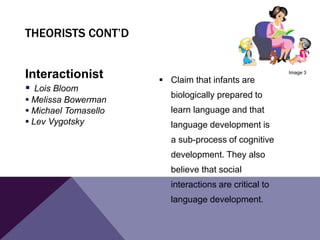
Interactionist
 Lois Bloom
 Melissa Bowerman
 Michael Tomasello
 Lev Vygotsky
 Claim that infants are
biologically prepared to
learn language and that
language development is
a sub-process of cognitive
development. They also
believe that social
interactions are critical to
language development.
THEORISTS CONT’D
Image 3
INFLUENCES ON LANGUAGE DEVELOPMENT
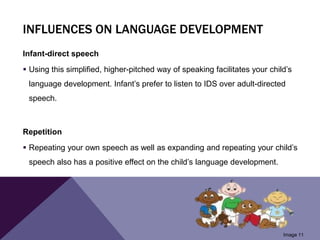
Infant-direct speech
 Using this simplified, higher-pitched way of speaking facilitates your child’s
language development. Infant’s prefer to listen to IDS over adult-directed
speech.
Repetition
 Repeating your own speech as well as expanding and repeating your child’s
speech also has a positive effect on the child’s language development.
Image 11
INFLUENCES ON LANGUAGE DEVELOPMENT CONT’D
Children whose parents:
 Talk to them regularly
 Read to them often
 Use a large vocabulary
Began to:
 Talk sooner
 Develop larger vocabularies
 Use more complex sentences
 Learn to read quicker when they begin school
Image 4
EARLY MILESTONES
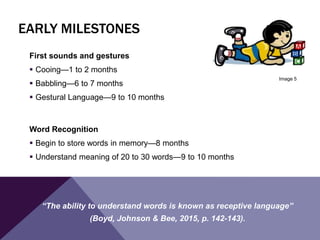
First sounds and gestures
 Cooing—1 to 2 months
 Babbling—6 to 7 months
 Gestural Language—9 to 10 months
Word Recognition
 Begin to store words in memory—8 months
 Understand meaning of 20 to 30 words—9 to 10 months
“The ability to understand words is known as receptive language”
(Boyd, Johnson & Bee, 2015, p. 142-143).
Image 5
FIRST WORDS
 The child’s first word is typically used in the presence of
cues, such as saying “bow-wow” when a dog is present.
 Most children combine a word with a gesture before
combining two words. This combination is called a
holophrase.
 Most first and new words are names for things or people.
 A child’s first word is usually said at approximately 12
months.
Image 6
“The 9 to 10 month-old infant understands far more words
than she can say” (Boyd, Johnson & Bee, 2015, p.145).
FIRST SENTENCES
 Most children began to make their first sentences when
their vocabulary reaches 100 to 200 words—at about 18 to
24 months.
 Typically these sentences are termed telegraphic speech.
• Simple, two to three word sentences.
 The first sentences typically do not follow grammatical
rules.
Image 7
INDIVIDUAL DIFFERENCES
Differences in Rate
 It is recommended that if your child has a severe language developmental delay to seek
professional help.
Differences in Style
 Some children use an expressive style—a style in which high use of personal-social words
are used versus noun-like terms.
 Other children use referential style—a style in which emphasis is on words for naming and
description.
Image 13
“The majority of children who talk late eventually
catch up” (Boyd, Johnson & Bee, 2015, p.145).
DEVELOPMENT ACROSS CULTURES
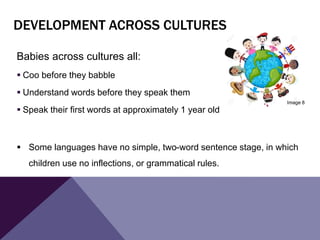
Babies across cultures all:
 Coo before they babble
 Understand words before they speak them
 Speak their first words at approximately 1 year old
 Some languages have no simple, two-word sentence stage, in which
children use no inflections, or grammatical rules.
Image 8
RELEVANCE TO MY
LIFE
This is relevant to my
life because over the
summer I work at a
daycare. Having this
knowledge will allow
me to communicate
better with the
children and plan
activities that will be
within their level of
understanding.
Image 9
RELEVANCE TO MY
LIFE CONT’D
Another reason this is
relevant to my life is
because, in the future, I
hope to be a mother.
Having this information
will allow me to not only
facilitate my child’s
language development
but also to be able to
recognize any language
disabilities they may
have.
Image 14
RELEVANCE TO MY
PROFESSIONAL
LIFE
Following graduation
from the BN program,
my future plans are to
get a job working in
pediatrics.
This information is
relevant because it will
give me the knowledge
on how to
communicate and
build a therapeutic
relationship with my
young patients.
Image 10

Psychology 1170 presentation-final version

  • 1.
    LANGUAGE DEVELOPMENT I NI N F A N C Y A N D E A R L Y C H I L D H O O D B Y A M Y G I L L I S
  • 2.
    “MOST OF US THINKOF LANGUAGE AS BEGINNING WHEN A BABY USES HER FIRST WORDS, AT ABOUT 12 MONTHS OF AGE. BUT ALL SORTS OF IMPORTANT DEVELOPMENTS PRECEDE THE FIRST WORDS” (BOYD, JOHNSON & BEE, 2015, P. 140). Image 2
  • 3.
    Behaviourists  B.F. Skinner Nativists Noam Chomsky  Claim that infants learn language through parental reinforcement of word-like sounds and correct grammar.  State that an innate language processor called the LAD (language acquisition device) guides children’s comprehension and production of language. THEORISTS Image 12
  • 4.
    Interactionist  Lois Bloom Melissa Bowerman  Michael Tomasello  Lev Vygotsky  Claim that infants are biologically prepared to learn language and that language development is a sub-process of cognitive development. They also believe that social interactions are critical to language development. THEORISTS CONT’D Image 3
  • 5.
    INFLUENCES ON LANGUAGEDEVELOPMENT Infant-direct speech  Using this simplified, higher-pitched way of speaking facilitates your child’s language development. Infant’s prefer to listen to IDS over adult-directed speech. Repetition  Repeating your own speech as well as expanding and repeating your child’s speech also has a positive effect on the child’s language development. Image 11
  • 6.
    INFLUENCES ON LANGUAGEDEVELOPMENT CONT’D Children whose parents:  Talk to them regularly  Read to them often  Use a large vocabulary Began to:  Talk sooner  Develop larger vocabularies  Use more complex sentences  Learn to read quicker when they begin school Image 4
  • 7.
    EARLY MILESTONES First soundsand gestures  Cooing—1 to 2 months  Babbling—6 to 7 months  Gestural Language—9 to 10 months Word Recognition  Begin to store words in memory—8 months  Understand meaning of 20 to 30 words—9 to 10 months “The ability to understand words is known as receptive language” (Boyd, Johnson & Bee, 2015, p. 142-143). Image 5
  • 8.
    FIRST WORDS  Thechild’s first word is typically used in the presence of cues, such as saying “bow-wow” when a dog is present.  Most children combine a word with a gesture before combining two words. This combination is called a holophrase.  Most first and new words are names for things or people.  A child’s first word is usually said at approximately 12 months. Image 6 “The 9 to 10 month-old infant understands far more words than she can say” (Boyd, Johnson & Bee, 2015, p.145).
  • 9.
    FIRST SENTENCES  Mostchildren began to make their first sentences when their vocabulary reaches 100 to 200 words—at about 18 to 24 months.  Typically these sentences are termed telegraphic speech. • Simple, two to three word sentences.  The first sentences typically do not follow grammatical rules. Image 7
  • 10.
    INDIVIDUAL DIFFERENCES Differences inRate  It is recommended that if your child has a severe language developmental delay to seek professional help. Differences in Style  Some children use an expressive style—a style in which high use of personal-social words are used versus noun-like terms.  Other children use referential style—a style in which emphasis is on words for naming and description. Image 13 “The majority of children who talk late eventually catch up” (Boyd, Johnson & Bee, 2015, p.145).
  • 11.
    DEVELOPMENT ACROSS CULTURES Babiesacross cultures all:  Coo before they babble  Understand words before they speak them  Speak their first words at approximately 1 year old  Some languages have no simple, two-word sentence stage, in which children use no inflections, or grammatical rules. Image 8
  • 12.
    RELEVANCE TO MY LIFE Thisis relevant to my life because over the summer I work at a daycare. Having this knowledge will allow me to communicate better with the children and plan activities that will be within their level of understanding. Image 9
  • 13.
    RELEVANCE TO MY LIFECONT’D Another reason this is relevant to my life is because, in the future, I hope to be a mother. Having this information will allow me to not only facilitate my child’s language development but also to be able to recognize any language disabilities they may have. Image 14
  • 14.
    RELEVANCE TO MY PROFESSIONAL LIFE Followinggraduation from the BN program, my future plans are to get a job working in pediatrics. This information is relevant because it will give me the knowledge on how to communicate and build a therapeutic relationship with my young patients. Image 10

Editor's Notes

  • #4 -LAD: contains the basic grammatical structure of all human language,
  • #5 -LAD: contains the basic grammatical structure of all human language,
  • #8 Cooing-vowel sounds typically indicating pleasure Babbling-consonant and vowel sounds. Typically infants “play” with these sounds Gestural Language-combination of gestures and sounds
  • #9 Cooing-vowel sounds typically indicating pleasure Babbling-consonant and vowel sounds. Typically infants “play” with these sounds Gestural Language-combination of gestures and sounds