THE DEVELOPMENT OF
LANGUAGE
INFANTS BEGIN MAKING SOUNDS AT BIRTH.
THEY CRY, COO, AND LAUGH…BUT IN THE
FIRST YEAR THEY DON’T REALLY DO MUCH
TALKING
 It could be argued that infants DO communicate with
others, but do not have language
The basic building blocks of language
The unique sounds that can be joined to create words
 The sound of “p” in pin, pet, and pat
 The sound of “b” in bed, bat, and bird
Infants can distinguish many of these sounds,
some of them as early as 1 month after birth
Can discriminate sounds they have never heard
before such as phonemes from a foreign language
PHONEMES
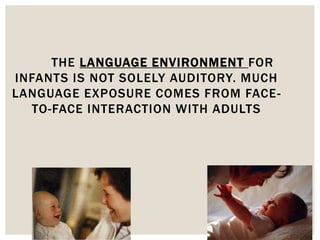
THE LANGUAGE ENVIRONMENT FOR
INFANTS IS NOT SOLELY AUDITORY. MUCH
LANGUAGE EXPOSURE COMES FROM FACE-
TO-FACE INTERACTION WITH ADULTS
 Think on your own…
 In what distinctive way do adults talk to infants? How can
this help infants master the language?
PARENTS AND ADULTS HELP INFANTS
MASTER LANGUAGE SOUNDS BY
TALKING IN A DISTINCTIVE STYLE
 At 2 months, infants begin making sounds that are language-
based
Starts with cooing
 They begin by producing vowel-like sounds, such as “ooooo”
and “ahhhh”
 At 5 to 6 months, infants begin making speech-like sound
that has no meaning
Cooing turns into babbling
SPEECH PRODUCTION
 Prior to producing speech, infants’ vocal tracts are prepared
for speech through crying, sneezing, sighing, burping etc.
 Infants are sensitive to prosody – the characteristic rhythm,
tempo, melody, intonation patterns, etc… with which a
language is spoken
 Babies that are exposed to a language with different patterns
of intonation (such as Japanese and French) reflect their
language’s intonation in their babbling. So, babbling is
influenced by the characteristics of the speech they hear.
POINTS TO PONDER
Babbling is the extended repetition of
certain single syllables, such as “ma-ma-
ma, da-da-da, ba-ba-ba” that begins at 6-
7 months of age.
Babbling is experience-expectant
learning
All babies babble
All babies gesture
The sounds they make are similar no
matter what language their parents
speak
“BABY TALK”
Over the next few months, babbling incorporates
sounds from their native language.
Even untrained listeners can distinguish between
babbling infants who have been raised in
cultures in which French, Arabic, or Cantonese
languages were spoken.
 Many cultures assign important meanings to the sounds babies babble:
 “ma-ma-ma”, “da-da-da” and “pa-pa-pa” are usually taken to apply to
significant people in the infant’s life
“BABBLING”
Infants first recognize words, then they
begin to comprehend words
At about 4 ½ months of age, infants
will listen longer to a tape repeating
their own name than to a tape of
different but similar name
At about 7-8 months of age, infants
readily learn to recognize new words
and remember them for weeks
FIRST WORDS
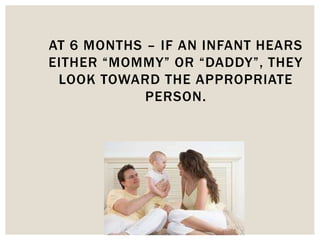
AT 6 MONTHS – IF AN INFANT HEARS
EITHER “MOMMY” OR “DADDY”, THEY
LOOK TOWARD THE APPROPRIATE
PERSON.
 By the age of 2 most children have a vocabulary of a few
hundred words, and by age 6 the vocabulary includes over
10,000 words!
BY THEIR 1ST BIRTHDAY, INFANTS
USUALLY SAY THEIR FIRST WORDS,
USUALLY AN EXTENSION OF BABBLING.
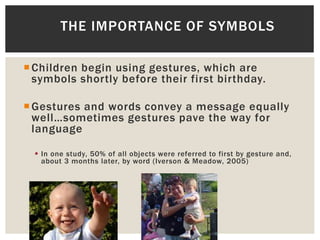
Children begin using gestures, which are
symbols shortly before their first birthday.
Gestures and words convey a message equally
well…sometimes gestures pave the way for
language
 In one study, 50% of all objects were referred to first by gesture and,
about 3 months later, by word (Iverson & Meadow, 2005)
THE IMPORTANCE OF SYMBOLS
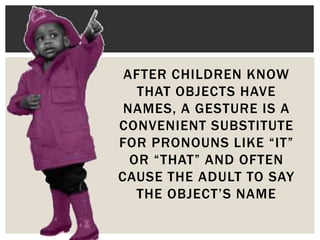
AFTER CHILDREN KNOW
THAT OBJECTS HAVE
NAMES, A GESTURE IS A
CONVENIENT SUBSTITUTE
FOR PRONOUNS LIKE “IT”
OR “THAT” AND OFTEN
CAUSE THE ADULT TO SAY
THE OBJECT’S NAME
Once an infant’s vocabulary
reaches about 50 words it suddenly
begins to build rapidly, at a rate of
50-100+ words per month, mostly
nouns.
This language spurt occurs around
18 months and is sometimes called
the Naming explosion.
NAMES FOR EVERYTHING!
Early productive vocabularies of
children in the US include names for
people, objects, and events from the
child’s everyday life.
Frequent events or routines are also
labeled, such as “up” or “bye-bye”
Nouns predominate the early
productive vocabularies of children
PRODUCTIVE VOCABULARY
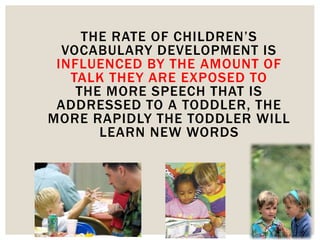
THE RATE OF CHILDREN’S
VOCABULARY DEVELOPMENT IS
INFLUENCED BY THE AMOUNT OF
TALK THEY ARE EXPOSED TO
THE MORE SPEECH THAT IS
ADDRESSED TO A TODDLER, THE
MORE RAPIDLY THE TODDLER WILL
LEARN NEW WORDS
 There are several theories that attempt to explain how we
develop language
THE DEVELOPMENT OF LANGUAGE IN
CHILDREN IS AMAZING, BUT HOW DO
THEY DO IT?
Behaviorist’s believe that all learning is
acquired step-by-step, through associations
and reinforcements
According to this view, the reinforcement of
the quantity and quality of talking to child
affect rate of language development.
When a 6 month-old says, “ma-ma-ma” they
are showered with attention and praise. This
is exactly what the baby wants and will make
the sounds again to get the same rewards.
INFANTS ARE CONDITIONED TO
SPEAK
 Children who are spoken to more and praised
by caregivers tend to develop language
faster.
 Parents are great intuitive teachers- we
name items for infants and praise infants
when they repeat our words.
 For instance, parents typically name each
object when they talk to their child, “Here is
your bottle”, “There is your foot”, “You want
your juice?”
 Parents name the object and speak clearly
and slowly, often using baby talk to capture
the infant’s interest (Gogate et al., 2000).
SAY MA-MA…..
Noam Chomsky believes language is a
product of biology and is too complex to be
mastered so early and easily by
conditioning.
Chomsky noted that children worldwide
learn the rudiments of grammar at
approximately the same age because the
human brain is equipped with a language
device.
 including intonations and structure of language
WHAT DO THE LINGUIST’S SAY?
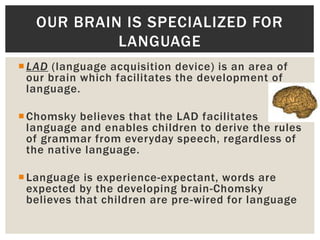
LAD (language acquisition device) is an area of
our brain which facilitates the development of
language.
Chomsky believes that the LAD facilitates
language and enables children to derive the rules
of grammar from everyday speech, regardless of
the native language.
Language is experience-expectant, words are
expected by the developing brain-Chomsky
believes that children are pre-wired for language
OUR BRAIN IS SPECIALIZED FOR
LANGUAGE
SUMMARY
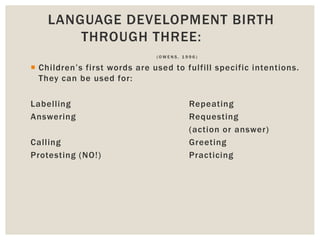
LANGUAGE DEVELOPMENT BIRTH
THROUGH THREE:
( O W E N S , 1 9 9 6 )
 Children’s first words are used to fulfill specific intentions.
They can be used for:
Labelling Repeating
Answering Requesting
(action or answer)
Calling Greeting
Protesting (NO!) Practicing
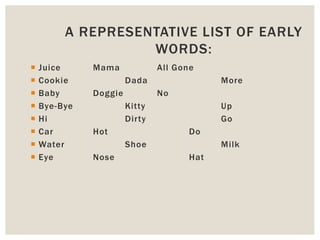
A REPRESENTATIVE LIST OF EARLY
WORDS:
 Juice Mama All Gone
 Cookie Dada More
 Baby Doggie No
 Bye-Bye Kitty Up
 Hi Dirty Go
 Car Hot Do
 Water Shoe Milk
 Eye Nose Hat
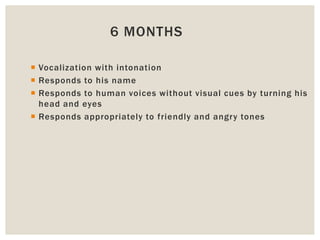
6 MONTHS
 Vocalization with intonation
 Responds to his name
 Responds to human voices without visual cues by turning his
head and eyes
 Responds appropriately to friendly and angry tones
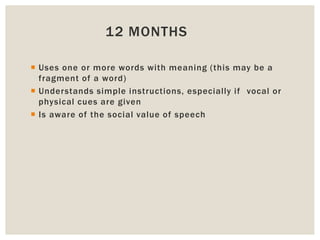
12 MONTHS
 Uses one or more words with meaning (this may be a
fragment of a word)
 Understands simple instructions, especially if vocal or
physical cues are given
 Is aware of the social value of speech
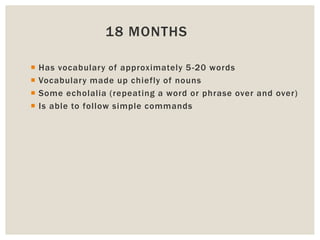
18 MONTHS
 Has vocabulary of approximately 5-20 words
 Vocabulary made up chiefly of nouns
 Some echolalia (repeating a word or phrase over and over)
 Is able to follow simple commands
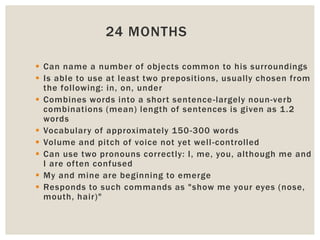
24 MONTHS
 Can name a number of objects common to his surroundings
 Is able to use at least two prepositions, usually chosen from
the following: in, on, under
 Combines words into a short sentence-largely noun-verb
combinations (mean) length of sentences is given as 1.2
words
 Vocabulary of approximately 150-300 words
 Volume and pitch of voice not yet well-controlled
 Can use two pronouns correctly: I, me, you, although me and
I are often confused
 My and mine are beginning to emerge
 Responds to such commands as "show me your eyes (nose,
mouth, hair)"
36 MONTHS
 Use pronouns I, you, me correctly
 Is using some plurals and past tenses
 Knows at least three prepositions, usually in, on, under
 Knows chief parts of body and should be able to indicate these
if not name
 Handles three word sentences easily
 Has in the neighborhood of 900-1000 words
 Verbs begin to predominate
 Understands most simple questions dealing with his
environment and activities
 Relates his experiences so that they can be followed with
reason
 Able to reason out such questions as "what must you do when
you are sleepy, hungry, cool, or thirsty?“
THAT’S ALL FOR TODAY. SEE YOU NEXT
WEEK AS ACTIVE LEARNERS!

The development of language.pptx

  • 1.
  • 2.
    INFANTS BEGIN MAKINGSOUNDS AT BIRTH. THEY CRY, COO, AND LAUGH…BUT IN THE FIRST YEAR THEY DON’T REALLY DO MUCH TALKING  It could be argued that infants DO communicate with others, but do not have language
  • 3.
    The basic buildingblocks of language The unique sounds that can be joined to create words  The sound of “p” in pin, pet, and pat  The sound of “b” in bed, bat, and bird Infants can distinguish many of these sounds, some of them as early as 1 month after birth Can discriminate sounds they have never heard before such as phonemes from a foreign language PHONEMES
  • 4.
    THE LANGUAGE ENVIRONMENTFOR INFANTS IS NOT SOLELY AUDITORY. MUCH LANGUAGE EXPOSURE COMES FROM FACE- TO-FACE INTERACTION WITH ADULTS
  • 5.
     Think onyour own…  In what distinctive way do adults talk to infants? How can this help infants master the language? PARENTS AND ADULTS HELP INFANTS MASTER LANGUAGE SOUNDS BY TALKING IN A DISTINCTIVE STYLE
  • 6.
     At 2months, infants begin making sounds that are language- based Starts with cooing  They begin by producing vowel-like sounds, such as “ooooo” and “ahhhh”  At 5 to 6 months, infants begin making speech-like sound that has no meaning Cooing turns into babbling SPEECH PRODUCTION
  • 7.
     Prior toproducing speech, infants’ vocal tracts are prepared for speech through crying, sneezing, sighing, burping etc.  Infants are sensitive to prosody – the characteristic rhythm, tempo, melody, intonation patterns, etc… with which a language is spoken  Babies that are exposed to a language with different patterns of intonation (such as Japanese and French) reflect their language’s intonation in their babbling. So, babbling is influenced by the characteristics of the speech they hear. POINTS TO PONDER
  • 8.
    Babbling is theextended repetition of certain single syllables, such as “ma-ma- ma, da-da-da, ba-ba-ba” that begins at 6- 7 months of age. Babbling is experience-expectant learning All babies babble All babies gesture The sounds they make are similar no matter what language their parents speak “BABY TALK”
  • 9.
    Over the nextfew months, babbling incorporates sounds from their native language. Even untrained listeners can distinguish between babbling infants who have been raised in cultures in which French, Arabic, or Cantonese languages were spoken.  Many cultures assign important meanings to the sounds babies babble:  “ma-ma-ma”, “da-da-da” and “pa-pa-pa” are usually taken to apply to significant people in the infant’s life “BABBLING”
  • 10.
    Infants first recognizewords, then they begin to comprehend words At about 4 ½ months of age, infants will listen longer to a tape repeating their own name than to a tape of different but similar name At about 7-8 months of age, infants readily learn to recognize new words and remember them for weeks FIRST WORDS
  • 11.
    AT 6 MONTHS– IF AN INFANT HEARS EITHER “MOMMY” OR “DADDY”, THEY LOOK TOWARD THE APPROPRIATE PERSON.
  • 12.
     By theage of 2 most children have a vocabulary of a few hundred words, and by age 6 the vocabulary includes over 10,000 words! BY THEIR 1ST BIRTHDAY, INFANTS USUALLY SAY THEIR FIRST WORDS, USUALLY AN EXTENSION OF BABBLING.
  • 13.
    Children begin usinggestures, which are symbols shortly before their first birthday. Gestures and words convey a message equally well…sometimes gestures pave the way for language  In one study, 50% of all objects were referred to first by gesture and, about 3 months later, by word (Iverson & Meadow, 2005) THE IMPORTANCE OF SYMBOLS
  • 14.
    AFTER CHILDREN KNOW THATOBJECTS HAVE NAMES, A GESTURE IS A CONVENIENT SUBSTITUTE FOR PRONOUNS LIKE “IT” OR “THAT” AND OFTEN CAUSE THE ADULT TO SAY THE OBJECT’S NAME
  • 15.
    Once an infant’svocabulary reaches about 50 words it suddenly begins to build rapidly, at a rate of 50-100+ words per month, mostly nouns. This language spurt occurs around 18 months and is sometimes called the Naming explosion. NAMES FOR EVERYTHING!
  • 16.
    Early productive vocabulariesof children in the US include names for people, objects, and events from the child’s everyday life. Frequent events or routines are also labeled, such as “up” or “bye-bye” Nouns predominate the early productive vocabularies of children PRODUCTIVE VOCABULARY
  • 17.
    THE RATE OFCHILDREN’S VOCABULARY DEVELOPMENT IS INFLUENCED BY THE AMOUNT OF TALK THEY ARE EXPOSED TO THE MORE SPEECH THAT IS ADDRESSED TO A TODDLER, THE MORE RAPIDLY THE TODDLER WILL LEARN NEW WORDS
  • 18.
     There areseveral theories that attempt to explain how we develop language THE DEVELOPMENT OF LANGUAGE IN CHILDREN IS AMAZING, BUT HOW DO THEY DO IT?
  • 19.
    Behaviorist’s believe thatall learning is acquired step-by-step, through associations and reinforcements According to this view, the reinforcement of the quantity and quality of talking to child affect rate of language development. When a 6 month-old says, “ma-ma-ma” they are showered with attention and praise. This is exactly what the baby wants and will make the sounds again to get the same rewards. INFANTS ARE CONDITIONED TO SPEAK
  • 20.
     Children whoare spoken to more and praised by caregivers tend to develop language faster.  Parents are great intuitive teachers- we name items for infants and praise infants when they repeat our words.  For instance, parents typically name each object when they talk to their child, “Here is your bottle”, “There is your foot”, “You want your juice?”  Parents name the object and speak clearly and slowly, often using baby talk to capture the infant’s interest (Gogate et al., 2000). SAY MA-MA…..
  • 21.
    Noam Chomsky believeslanguage is a product of biology and is too complex to be mastered so early and easily by conditioning. Chomsky noted that children worldwide learn the rudiments of grammar at approximately the same age because the human brain is equipped with a language device.  including intonations and structure of language WHAT DO THE LINGUIST’S SAY?
  • 22.
    LAD (language acquisitiondevice) is an area of our brain which facilitates the development of language. Chomsky believes that the LAD facilitates language and enables children to derive the rules of grammar from everyday speech, regardless of the native language. Language is experience-expectant, words are expected by the developing brain-Chomsky believes that children are pre-wired for language OUR BRAIN IS SPECIALIZED FOR LANGUAGE
  • 23.
  • 24.
    LANGUAGE DEVELOPMENT BIRTH THROUGHTHREE: ( O W E N S , 1 9 9 6 )  Children’s first words are used to fulfill specific intentions. They can be used for: Labelling Repeating Answering Requesting (action or answer) Calling Greeting Protesting (NO!) Practicing
  • 25.
    A REPRESENTATIVE LISTOF EARLY WORDS:  Juice Mama All Gone  Cookie Dada More  Baby Doggie No  Bye-Bye Kitty Up  Hi Dirty Go  Car Hot Do  Water Shoe Milk  Eye Nose Hat
  • 26.
    6 MONTHS  Vocalizationwith intonation  Responds to his name  Responds to human voices without visual cues by turning his head and eyes  Responds appropriately to friendly and angry tones
  • 27.
    12 MONTHS  Usesone or more words with meaning (this may be a fragment of a word)  Understands simple instructions, especially if vocal or physical cues are given  Is aware of the social value of speech
  • 28.
    18 MONTHS  Hasvocabulary of approximately 5-20 words  Vocabulary made up chiefly of nouns  Some echolalia (repeating a word or phrase over and over)  Is able to follow simple commands
  • 29.
    24 MONTHS  Canname a number of objects common to his surroundings  Is able to use at least two prepositions, usually chosen from the following: in, on, under  Combines words into a short sentence-largely noun-verb combinations (mean) length of sentences is given as 1.2 words  Vocabulary of approximately 150-300 words  Volume and pitch of voice not yet well-controlled  Can use two pronouns correctly: I, me, you, although me and I are often confused  My and mine are beginning to emerge  Responds to such commands as "show me your eyes (nose, mouth, hair)"
  • 30.
    36 MONTHS  Usepronouns I, you, me correctly  Is using some plurals and past tenses  Knows at least three prepositions, usually in, on, under  Knows chief parts of body and should be able to indicate these if not name  Handles three word sentences easily  Has in the neighborhood of 900-1000 words  Verbs begin to predominate  Understands most simple questions dealing with his environment and activities  Relates his experiences so that they can be followed with reason  Able to reason out such questions as "what must you do when you are sleepy, hungry, cool, or thirsty?“
  • 31.
    THAT’S ALL FORTODAY. SEE YOU NEXT WEEK AS ACTIVE LEARNERS!