Joris de Bres
Australia New Zealand Race Relations
Roundtable,
Canberra, November 2010
Summary
1. Right to language
2. NZHRC projects
 National language policy network
 Māori Language Week
 Sign Language Week
 Samoan Language Week
3. Conclusions
Rights of minorities
“In those states in which
ethnic, religious or
linguistic minorities exist,
persons belonging to such
minorities shall not be
denied the right, in
community with the other
members of their group, to
enjoy their own culture, to
profess and practice their
own religion, or to use
their own language.” Covenant on Civil and Political Rights
Article 27
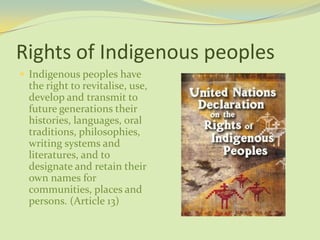
Rights of Indigenous peoples
 Indigenous peoples have
the right to revitalise, use,
develop and transmit to
future generations their
histories, languages, oral
traditions, philosophies,
writing systems and
literatures, and to
designate and retain their
own names for
communities, places and
persons. (Article 13)
Rights of Indigenous peoples
 Indigenous peoples have
the right to establish and
control their educational
systems and institutions
providing education in
their own languages, in a
manner appropriate to
their cultural methods of
teaching and learning.
(Article 14)
Rights of Indigenous peoples
 Indigenous peoples have
the right to the dignity
and diversity of their
cultures, traditions,
histories and aspirations
which shall be
appropriately reflected
in education and public
education (Article 15)
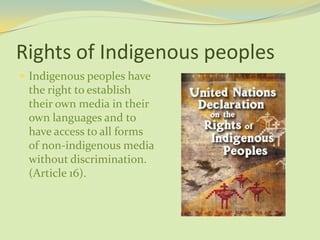
Rights of Indigenous peoples
 Indigenous peoples have
the right to establish
their own media in their
own languages and to
have access to all forms
of non-indigenous media
without discrimination.
(Article 16).
AHRC: Social Justice Report, 2009
 Australian governments
should act to preserve and
promote Indigenous
languages because:
 Evidence shows improved
cognitive functioning in
children who are bilingual
 Minority groups who speak
their languages and
practice their culture,
enjoy better social,
emotional and health
outcomes than groups who
do not
AHRC: Social Justice Report, 2009
 Cultural knowledge has
been proven to assist in the
employment of Indigenous
people in Australia
 There are economic and
social costs associated with
the loss of languages
 Indigenous languages have
intrinsic value to the
people who speak them.
Waitangi Tribunal 2010
“Alongside land, the health
of te reo has been one of
the two great galvanising
issues in Māori protests
over Treaty rights during
the last three decades.
Propelled by a profound
depth of feeling and sense
of purpose, efforts to
safeguard the Māori
language gave great
impetus to the Māori
‘renaissance’ overall.”
WAI 262 pre-publication report
Te Reo Maori
October 2010
NZHRC: Language Policy Statement
Te reo Māori
 New Zealand has a
particular responsibility
under the Treaty of
Waitangi and
international law to
protect and promote te
reo Māori as the
indigenous language of
New Zealand.
NZHRC: Language Policy Statement
Other indigenous languages
 New Zealand also has a
special responsibility to
protect and promote
other languages that are
indigenous to the New
Zealand realm: Vagahau
Niue, Gagana Tokelau,
Cook Island Māori, and
New Zealand Sign
Language.
NZHRC: Language Policy Statement
Other Pacific languages
 New Zealand has a
regional responsibility as
a Pacific nation to
promote and protect
other Pacific languages,
particularly where
significant proportions
of their communities live
in New Zealand.
CERD Committee 2010
The Committee encourages the State party to allocate
adequate resources for the new national approach to
preserve Indigenous languages. It recommends that
the State party, in consultation with Indigenous
communities, hold a national inquiry into the issue of
bilingual education for Indigenous peoples.
CERD Committee 2010
The Committee also recommends that the State party
adopt all necessary measures to preserve native
languages and develop and carry out programmes to
revitalize indigenous languages and bilingual and
intercultural education for Indigenous peoples
respecting cultural identity and history.
CERD Committee 2010
In line with the UNESCO Convention against
Discrimination in Education, to which Australia is a
party, the Committee encourages the State party to
consider providing adequate opportunities for national
minorities to the use and teaching of their own
language.
Language policy network
 National statement on
language policy
 Annual language policy
forum
 Monthly language policy
newsletter
 Promotion of language
projects through the
Diversity Action
Programme
Māori Language Week
 Partnership between
Human Rights
Commission, Ministry of
Māori Development and
Māori Language
Commission
 Focused on gaining
support and recognition
for the language by all
New Zealanders and its
use in the public domain
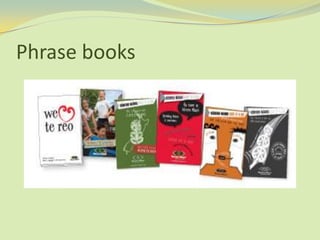
Phrase books
In the public domain
Sign Language Week
 Based on Māori
Language Week model
 Coordinated by Deaf
Aotearoa
 Supported by Human
Rights Commission and
NZ Diversity Action
Programme
Samoan Language Week
 Modelled on Māori
Language Week
 Partnership between
Samoan Teachers
Association, UNESCO
and NZ Human Rights
Commission & others
 Trans-Tasman project
with AHRC, NRL, AFL
Samoan Language Week
 Phrase book
 Media
 Churches
 Schools
 Libraries
 Sports
 Parliament
 Facebook, Youtube
 Language champions
Facebook
 Total fans: 3844
 New Zealand: 2000
 Australia: 800
 United States: 600
 Sydney: 270
 Brisbane: 171
 Melbourne: 140
Churches
Secondary schools
Primary schools
Language champions
Sydney
Sydney
Brisbane
Promotion of language as a human
right
 Resonates with
indigenous and minority
communities
 Affirms their cultural
identity
 Changes public
attitudes
 Builds relationships with
communities
 Supports better social
and economic outcomes
Promotion of language as a human
right
 Incumbent on Australian
and New Zealand human
rights commissions to
promote languages and
cultures indigenous to
Australia, New Zealand
and the Pacific
 Provides opportunities
for trans-Tasman and
Pacific cooperation
Demographics
Māori
 NZ 624,000
 Aus 126,000
 Other 15,000
 Total 765,000
Samoan
 Samoa 220,000
 US 215,000
 NZ 131,000
 Aus 40,000
 Total 606,000
Language and racism
 Attitudes towards indigenous and minority languages
often derive from racist attitudes to indigenous and
minority peoples.
 Changing attitudes towards the use of indigenous
and minority languages has a positive impact on
attitudes to indigenous and minority peoples,
improves race relations and supports social inclusion.

Language and human rights

  • 1.
    Joris de Bres AustraliaNew Zealand Race Relations Roundtable, Canberra, November 2010
  • 2.
    Summary 1. Right tolanguage 2. NZHRC projects  National language policy network  Māori Language Week  Sign Language Week  Samoan Language Week 3. Conclusions
  • 4.
    Rights of minorities “Inthose states in which ethnic, religious or linguistic minorities exist, persons belonging to such minorities shall not be denied the right, in community with the other members of their group, to enjoy their own culture, to profess and practice their own religion, or to use their own language.” Covenant on Civil and Political Rights Article 27
  • 5.
    Rights of Indigenouspeoples  Indigenous peoples have the right to revitalise, use, develop and transmit to future generations their histories, languages, oral traditions, philosophies, writing systems and literatures, and to designate and retain their own names for communities, places and persons. (Article 13)
  • 6.
    Rights of Indigenouspeoples  Indigenous peoples have the right to establish and control their educational systems and institutions providing education in their own languages, in a manner appropriate to their cultural methods of teaching and learning. (Article 14)
  • 7.
    Rights of Indigenouspeoples  Indigenous peoples have the right to the dignity and diversity of their cultures, traditions, histories and aspirations which shall be appropriately reflected in education and public education (Article 15)
  • 8.
    Rights of Indigenouspeoples  Indigenous peoples have the right to establish their own media in their own languages and to have access to all forms of non-indigenous media without discrimination. (Article 16).
  • 9.
    AHRC: Social JusticeReport, 2009  Australian governments should act to preserve and promote Indigenous languages because:  Evidence shows improved cognitive functioning in children who are bilingual  Minority groups who speak their languages and practice their culture, enjoy better social, emotional and health outcomes than groups who do not
  • 10.
    AHRC: Social JusticeReport, 2009  Cultural knowledge has been proven to assist in the employment of Indigenous people in Australia  There are economic and social costs associated with the loss of languages  Indigenous languages have intrinsic value to the people who speak them.
  • 11.
    Waitangi Tribunal 2010 “Alongsideland, the health of te reo has been one of the two great galvanising issues in Māori protests over Treaty rights during the last three decades. Propelled by a profound depth of feeling and sense of purpose, efforts to safeguard the Māori language gave great impetus to the Māori ‘renaissance’ overall.” WAI 262 pre-publication report Te Reo Maori October 2010
  • 12.
    NZHRC: Language PolicyStatement Te reo Māori  New Zealand has a particular responsibility under the Treaty of Waitangi and international law to protect and promote te reo Māori as the indigenous language of New Zealand.
  • 13.
    NZHRC: Language PolicyStatement Other indigenous languages  New Zealand also has a special responsibility to protect and promote other languages that are indigenous to the New Zealand realm: Vagahau Niue, Gagana Tokelau, Cook Island Māori, and New Zealand Sign Language.
  • 14.
    NZHRC: Language PolicyStatement Other Pacific languages  New Zealand has a regional responsibility as a Pacific nation to promote and protect other Pacific languages, particularly where significant proportions of their communities live in New Zealand.
  • 15.
    CERD Committee 2010 TheCommittee encourages the State party to allocate adequate resources for the new national approach to preserve Indigenous languages. It recommends that the State party, in consultation with Indigenous communities, hold a national inquiry into the issue of bilingual education for Indigenous peoples.
  • 16.
    CERD Committee 2010 TheCommittee also recommends that the State party adopt all necessary measures to preserve native languages and develop and carry out programmes to revitalize indigenous languages and bilingual and intercultural education for Indigenous peoples respecting cultural identity and history.
  • 17.
    CERD Committee 2010 Inline with the UNESCO Convention against Discrimination in Education, to which Australia is a party, the Committee encourages the State party to consider providing adequate opportunities for national minorities to the use and teaching of their own language.
  • 19.
    Language policy network National statement on language policy  Annual language policy forum  Monthly language policy newsletter  Promotion of language projects through the Diversity Action Programme
  • 20.
    Māori Language Week Partnership between Human Rights Commission, Ministry of Māori Development and Māori Language Commission  Focused on gaining support and recognition for the language by all New Zealanders and its use in the public domain
  • 21.
  • 22.
  • 23.
    Sign Language Week Based on Māori Language Week model  Coordinated by Deaf Aotearoa  Supported by Human Rights Commission and NZ Diversity Action Programme
  • 24.
    Samoan Language Week Modelled on Māori Language Week  Partnership between Samoan Teachers Association, UNESCO and NZ Human Rights Commission & others  Trans-Tasman project with AHRC, NRL, AFL
  • 25.
    Samoan Language Week Phrase book  Media  Churches  Schools  Libraries  Sports  Parliament  Facebook, Youtube  Language champions
  • 26.
    Facebook  Total fans:3844  New Zealand: 2000  Australia: 800  United States: 600  Sydney: 270  Brisbane: 171  Melbourne: 140
  • 27.
  • 28.
  • 29.
  • 30.
  • 31.
  • 32.
  • 33.
  • 36.
    Promotion of languageas a human right  Resonates with indigenous and minority communities  Affirms their cultural identity  Changes public attitudes  Builds relationships with communities  Supports better social and economic outcomes
  • 37.
    Promotion of languageas a human right  Incumbent on Australian and New Zealand human rights commissions to promote languages and cultures indigenous to Australia, New Zealand and the Pacific  Provides opportunities for trans-Tasman and Pacific cooperation
  • 38.
    Demographics Māori  NZ 624,000 Aus 126,000  Other 15,000  Total 765,000 Samoan  Samoa 220,000  US 215,000  NZ 131,000  Aus 40,000  Total 606,000
  • 39.
    Language and racism Attitudes towards indigenous and minority languages often derive from racist attitudes to indigenous and minority peoples.  Changing attitudes towards the use of indigenous and minority languages has a positive impact on attitudes to indigenous and minority peoples, improves race relations and supports social inclusion.