Facilitating Speech, Language, 
and Communication Skills 
Chapter 16 from The Exceptional Child: Inclusion in Early Childhood 
Education. Allen, K. Eileen and Cowdery, Glynnis E. 2015. Cengage 
Learning.
What Is the Difference? 
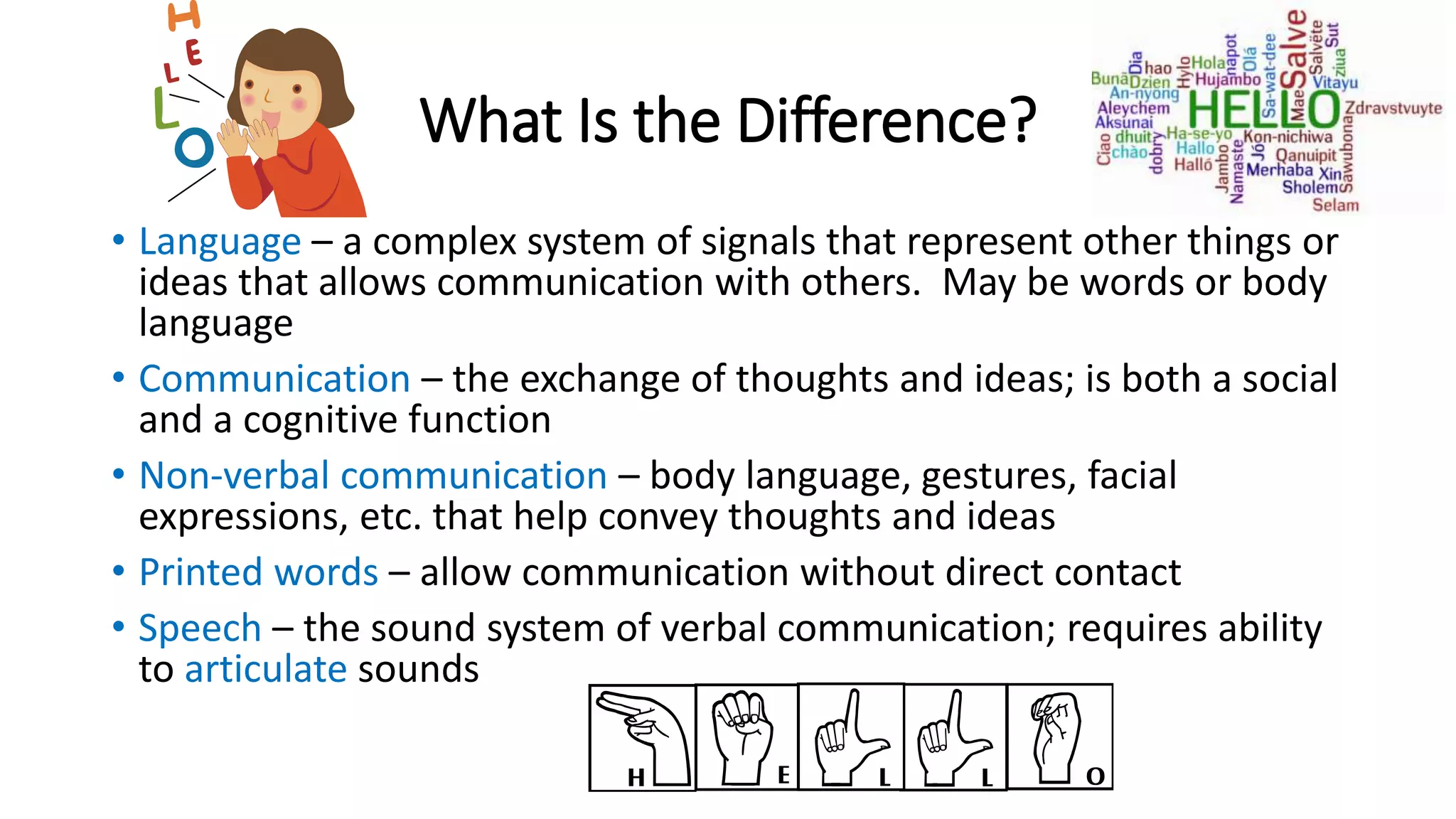
• Language – a complex system of signals that represent other things or 
ideas that allows communication with others. May be words or body 
language 
• Communication – the exchange of thoughts and ideas; is both a social 
and a cognitive function 
• Non-verbal communication – body language, gestures, facial 
expressions, etc. that help convey thoughts and ideas 
• Printed words – allow communication without direct contact 
• Speech – the sound system of verbal communication; requires ability 
to articulate sounds
How Do We Get It? 
• Some language acquisition is the result of imitation and feedback (behaviorist 
theories) 
• ***Language acquisition varies greatly among socioeconomic groups; more 
highly educated mothers speak more to their children 
• There is a direct correlation between language acquisition and academic success. 
• *** Remember: we cannot “spoil” babies if we respond to their needs and 
participate in the healthy, reciprocal relationships that support language, 
cognitive, and social development. 
• Motherese – higher-pitched, simplified language that adults use with babies and 
very young children. 
• Language is part of natural development and maturation 
• High quality experiences and use of language in natural settings supports 
language acquisition.
Predictable and Sequential 
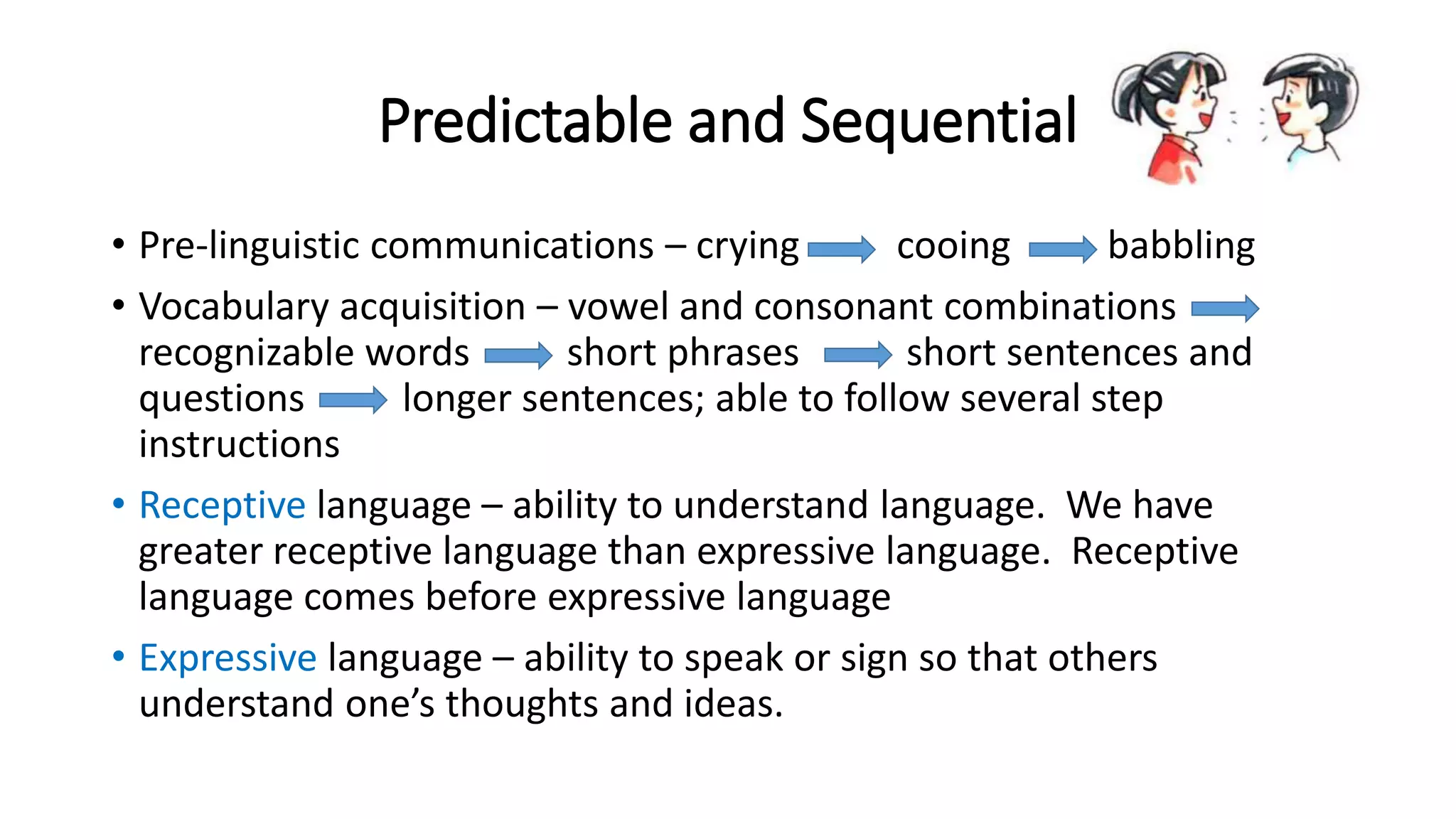
• Pre-linguistic communications – crying cooing babbling 
• Vocabulary acquisition – vowel and consonant combinations 
recognizable words short phrases short sentences and 
questions longer sentences; able to follow several step 
instructions 
• Receptive language – ability to understand language. We have 
greater receptive language than expressive language. Receptive 
language comes before expressive language 
• Expressive language – ability to speak or sign so that others 
understand one’s thoughts and ideas.
Vocabulary and More Sequences 
• Holophrastic speech – using one word to express entire thoughts. Context 
helps with understanding. 
• Telegraphic speech – 2 word sentences; shows that child is learning syntax 
(proper word order) 
• Private speech – children talking to themselves; works to help children 
process information, self- regulate, focus, etc. 
• Language explosion – rapid progression of language learning that occurs 
between 2 and 5 years old 
• Overregularizations or over-generalizations – applying grammar rules to 
the exceptions of grammar rules; i.e. “foots” instead of “feet”, “Daddy 
goed” instead of “Daddy went”
Other Language Systems 
• Alternative language systems may be beneficial for all children, especially 
those with developmental delays. 
• Nonverbal communication – adults can express with words the messages 
children are trying to convey 
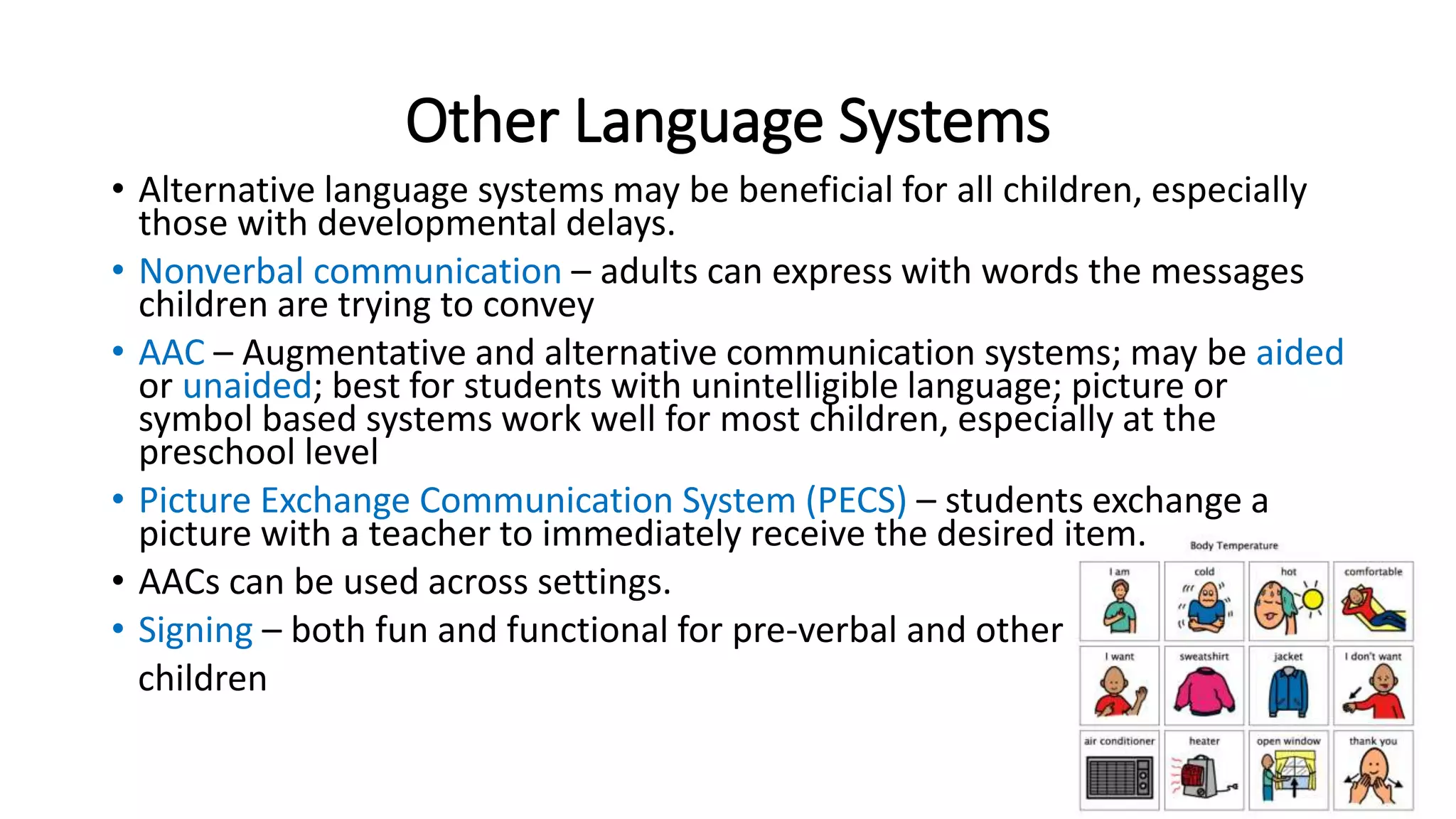
• AAC – Augmentative and alternative communication systems; may be aided 
or unaided; best for students with unintelligible language; picture or 
symbol based systems work well for most children, especially at the 
preschool level 
• Picture Exchange Communication System (PECS) – students exchange a 
picture with a teacher to immediately receive the desired item. 
• AACs can be used across settings. 
• Signing – both fun and functional for pre-verbal and other 
children
Language in Natural Environments 
• Consider the many quality indicators found in the Environment Rating 
Scales. In the ITERS – R, there are 10 pages addressing “Listening and 
Talking” and “Interactions”. In the ECERS-R, there are 10 pages related to 
“Language-Reasoning” and “Interactions”. 
• Children learn language through talking and engaging with materials that 
are worth talking about  
• Adults must be responsive to children’s talk and efforts to engage. 
• Listening is also a communication skill that develops in high quality, natural 
environments. 
• Open-ended questions enhance language learning and cognitive processes 
• Wait-time increases responses
Other Strategies 
• Suggestions for age and developmentally appropriate activities are 
provided on p. 428 in your text. 
• Other strategies for enhancing language development: 
• Choice – 
• Mand-model – 
• Topic continuation – 
• Time-delay – 
• Incidental teaching – 
• Milieu teaching – Caution: accept approximations, avoid pressure, provide 
immediate reinforcement and make exchange desirable for the child
Speech Irregularities 
• Speech irregularities has to do with the physical components of speaking; 
children with various disabilities may have trouble with speech because of 
physical disabilities 
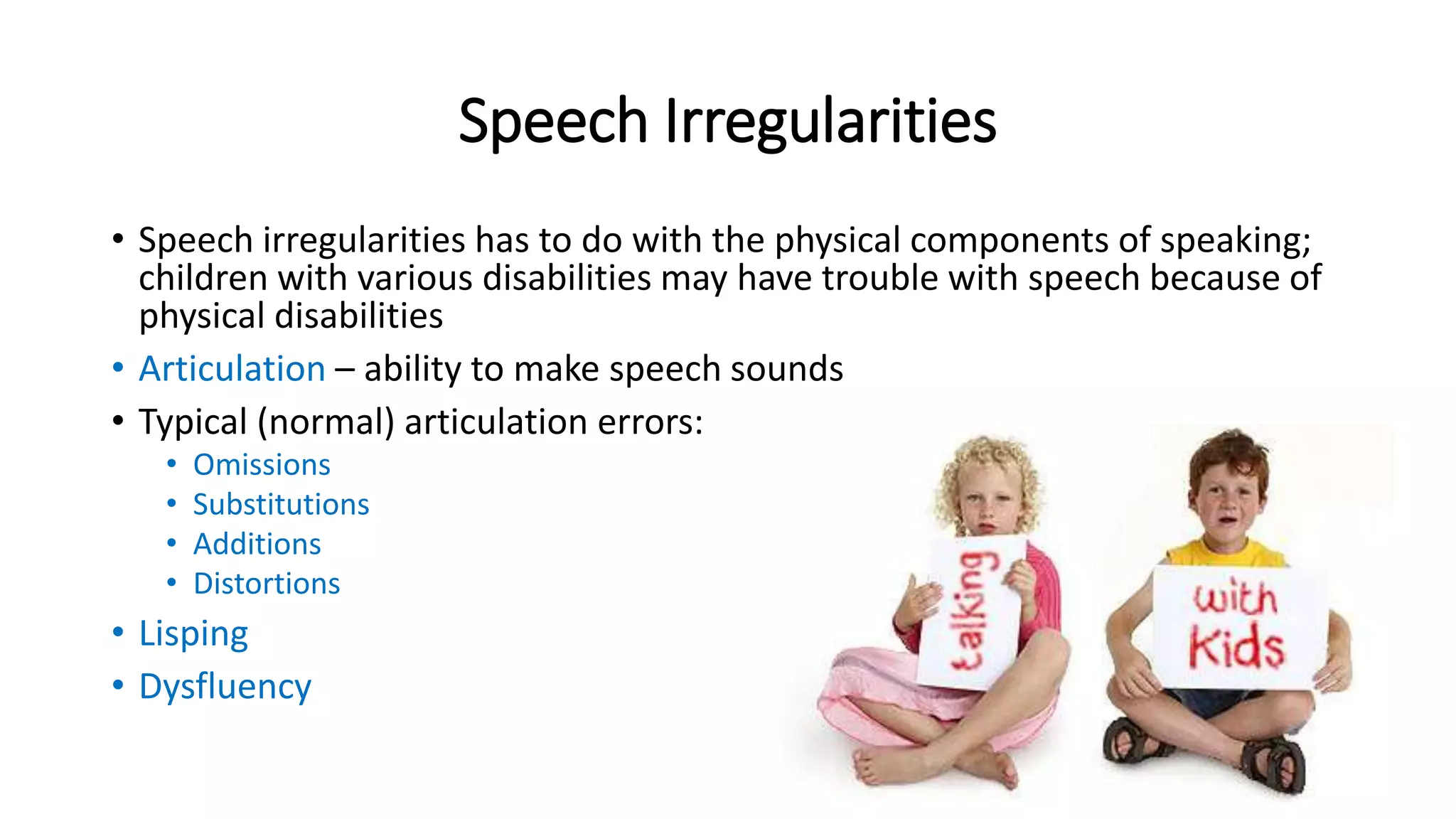
• Articulation – ability to make speech sounds 
• Typical (normal) articulation errors: 
• Omissions 
• Substitutions 
• Additions 
• Distortions 
• Lisping 
• Dysfluency
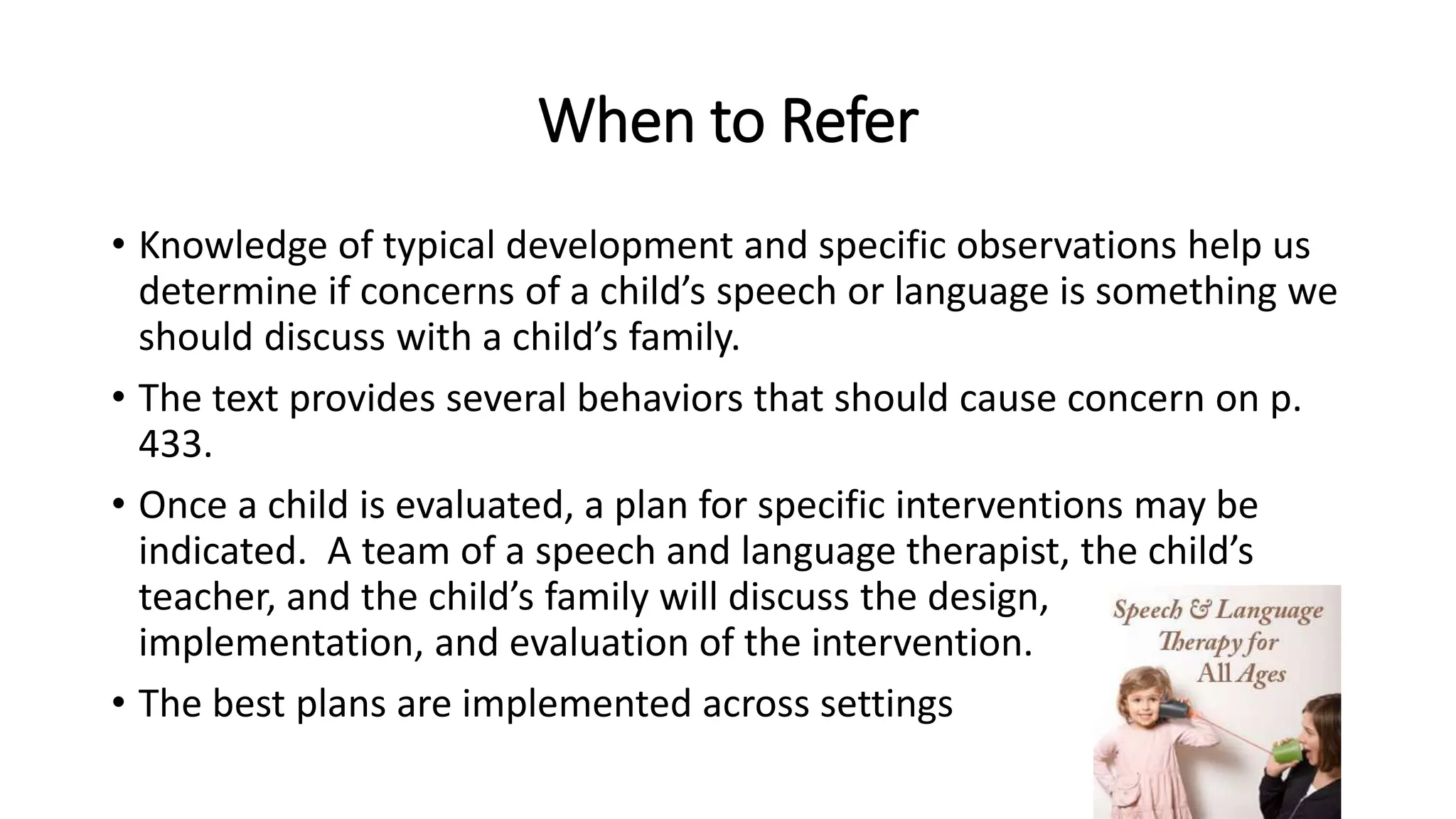
When to Refer 
• Knowledge of typical development and specific observations help us 
determine if concerns of a child’s speech or language is something we 
should discuss with a child’s family. 
• The text provides several behaviors that should cause concern on p. 
433. 
• Once a child is evaluated, a plan for specific interventions may be 
indicated. A team of a speech and language therapist, the child’s 
teacher, and the child’s family will discuss the design, 
implementation, and evaluation of the intervention. 
• The best plans are implemented across settings
English Language Learners 
• Care must be taken to differentiate between speech and/or language 
developmental delays and speech and/or language cultural 
differences 
• Research indicates bilingual education is more effective than total 
immersion programs 
• Total Physical Response (James Asher, 2003) is a naturalistic language 
learning practice that integrates physical and contextual learning
Review 
• Language is a complex developmental process, yet it evolves naturally 
in young children 
• Developmental delays or disabilities may impact speech and/or 
language development 
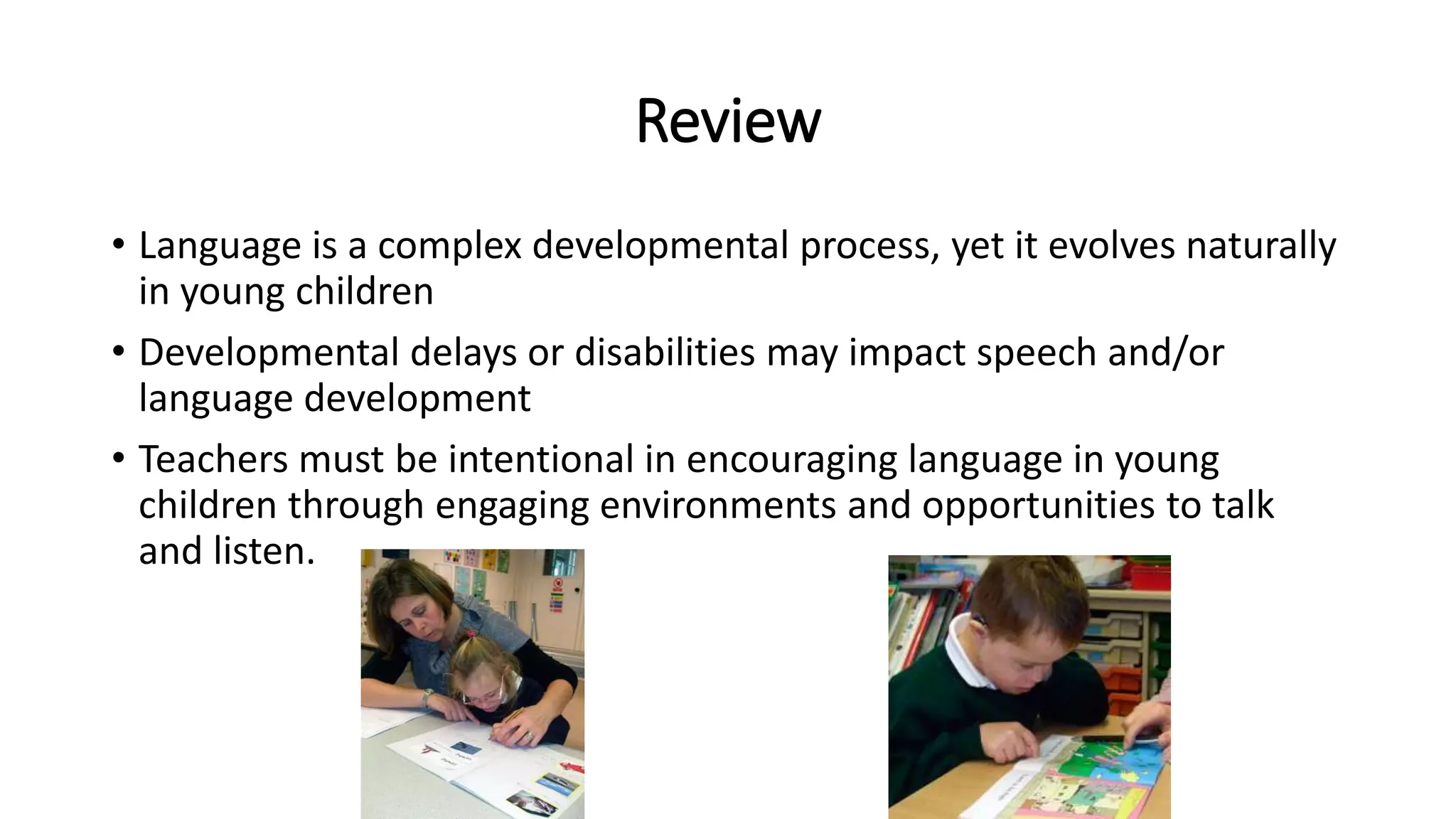
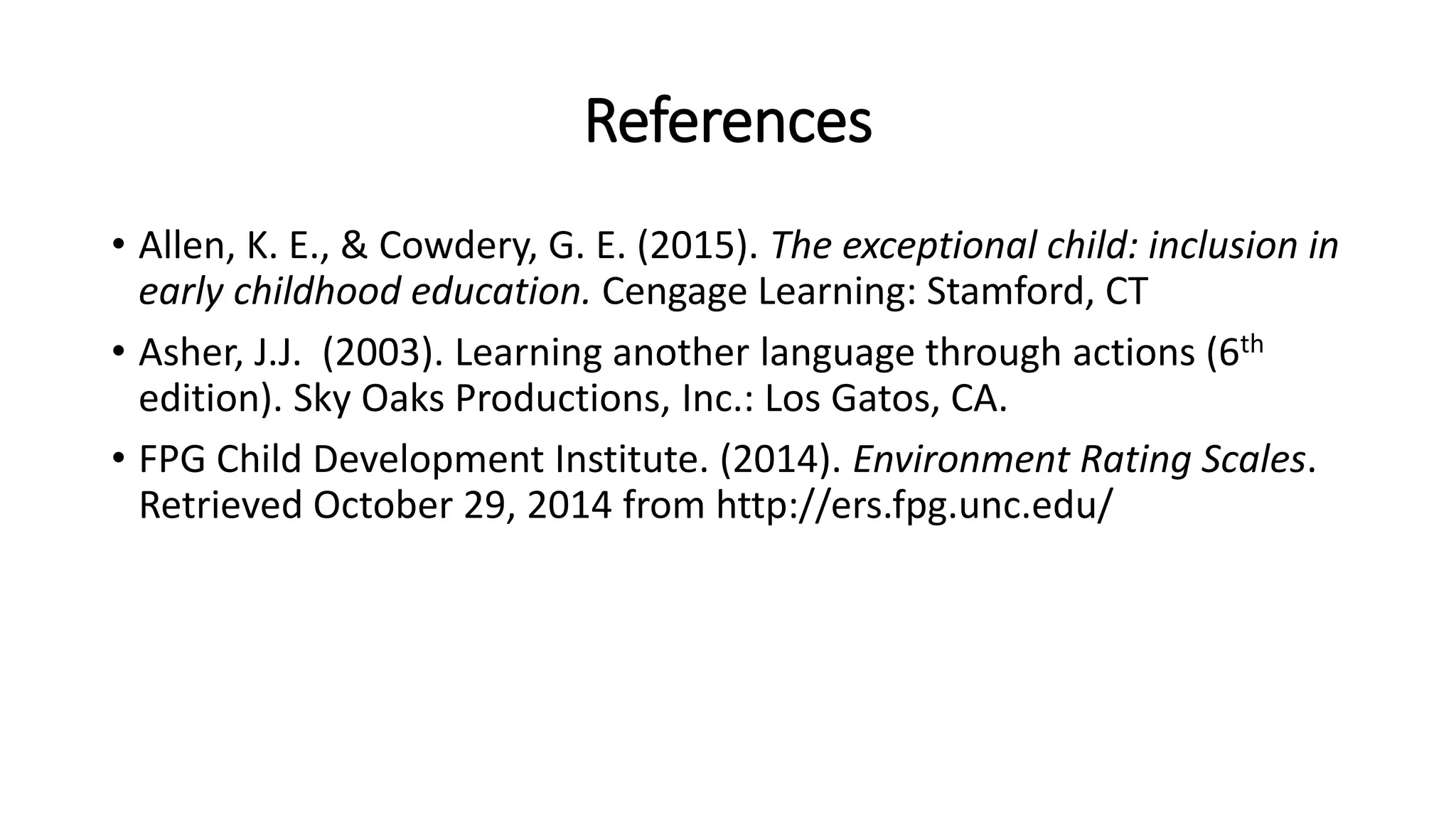
• Teachers must be intentional in encouraging language in young 
children through engaging environments and opportunities to talk 
and listen.
References 
• Allen, K. E., & Cowdery, G. E. (2015). The exceptional child: inclusion in 
early childhood education. Cengage Learning: Stamford, CT 
• Asher, J.J. (2003). Learning another language through actions (6th 
edition). Sky Oaks Productions, Inc.: Los Gatos, CA. 
• FPG Child Development Institute. (2014). Environment Rating Scales. 
Retrieved October 29, 2014 from http://ers.fpg.unc.edu/

Chapter 16 facilitating speech, language, and communication skills

  • 1.
    Facilitating Speech, Language, and Communication Skills Chapter 16 from The Exceptional Child: Inclusion in Early Childhood Education. Allen, K. Eileen and Cowdery, Glynnis E. 2015. Cengage Learning.
  • 2.
    What Is theDifference? • Language – a complex system of signals that represent other things or ideas that allows communication with others. May be words or body language • Communication – the exchange of thoughts and ideas; is both a social and a cognitive function • Non-verbal communication – body language, gestures, facial expressions, etc. that help convey thoughts and ideas • Printed words – allow communication without direct contact • Speech – the sound system of verbal communication; requires ability to articulate sounds
  • 3.
    How Do WeGet It? • Some language acquisition is the result of imitation and feedback (behaviorist theories) • ***Language acquisition varies greatly among socioeconomic groups; more highly educated mothers speak more to their children • There is a direct correlation between language acquisition and academic success. • *** Remember: we cannot “spoil” babies if we respond to their needs and participate in the healthy, reciprocal relationships that support language, cognitive, and social development. • Motherese – higher-pitched, simplified language that adults use with babies and very young children. • Language is part of natural development and maturation • High quality experiences and use of language in natural settings supports language acquisition.
  • 4.
    Predictable and Sequential • Pre-linguistic communications – crying cooing babbling • Vocabulary acquisition – vowel and consonant combinations recognizable words short phrases short sentences and questions longer sentences; able to follow several step instructions • Receptive language – ability to understand language. We have greater receptive language than expressive language. Receptive language comes before expressive language • Expressive language – ability to speak or sign so that others understand one’s thoughts and ideas.
  • 5.
    Vocabulary and MoreSequences • Holophrastic speech – using one word to express entire thoughts. Context helps with understanding. • Telegraphic speech – 2 word sentences; shows that child is learning syntax (proper word order) • Private speech – children talking to themselves; works to help children process information, self- regulate, focus, etc. • Language explosion – rapid progression of language learning that occurs between 2 and 5 years old • Overregularizations or over-generalizations – applying grammar rules to the exceptions of grammar rules; i.e. “foots” instead of “feet”, “Daddy goed” instead of “Daddy went”
  • 6.
    Other Language Systems • Alternative language systems may be beneficial for all children, especially those with developmental delays. • Nonverbal communication – adults can express with words the messages children are trying to convey • AAC – Augmentative and alternative communication systems; may be aided or unaided; best for students with unintelligible language; picture or symbol based systems work well for most children, especially at the preschool level • Picture Exchange Communication System (PECS) – students exchange a picture with a teacher to immediately receive the desired item. • AACs can be used across settings. • Signing – both fun and functional for pre-verbal and other children
  • 7.
    Language in NaturalEnvironments • Consider the many quality indicators found in the Environment Rating Scales. In the ITERS – R, there are 10 pages addressing “Listening and Talking” and “Interactions”. In the ECERS-R, there are 10 pages related to “Language-Reasoning” and “Interactions”. • Children learn language through talking and engaging with materials that are worth talking about  • Adults must be responsive to children’s talk and efforts to engage. • Listening is also a communication skill that develops in high quality, natural environments. • Open-ended questions enhance language learning and cognitive processes • Wait-time increases responses
  • 8.
    Other Strategies •Suggestions for age and developmentally appropriate activities are provided on p. 428 in your text. • Other strategies for enhancing language development: • Choice – • Mand-model – • Topic continuation – • Time-delay – • Incidental teaching – • Milieu teaching – Caution: accept approximations, avoid pressure, provide immediate reinforcement and make exchange desirable for the child
  • 9.
    Speech Irregularities •Speech irregularities has to do with the physical components of speaking; children with various disabilities may have trouble with speech because of physical disabilities • Articulation – ability to make speech sounds • Typical (normal) articulation errors: • Omissions • Substitutions • Additions • Distortions • Lisping • Dysfluency
  • 10.
    When to Refer • Knowledge of typical development and specific observations help us determine if concerns of a child’s speech or language is something we should discuss with a child’s family. • The text provides several behaviors that should cause concern on p. 433. • Once a child is evaluated, a plan for specific interventions may be indicated. A team of a speech and language therapist, the child’s teacher, and the child’s family will discuss the design, implementation, and evaluation of the intervention. • The best plans are implemented across settings
  • 11.
    English Language Learners • Care must be taken to differentiate between speech and/or language developmental delays and speech and/or language cultural differences • Research indicates bilingual education is more effective than total immersion programs • Total Physical Response (James Asher, 2003) is a naturalistic language learning practice that integrates physical and contextual learning
  • 12.
    Review • Languageis a complex developmental process, yet it evolves naturally in young children • Developmental delays or disabilities may impact speech and/or language development • Teachers must be intentional in encouraging language in young children through engaging environments and opportunities to talk and listen.
  • 13.
    References • Allen,K. E., & Cowdery, G. E. (2015). The exceptional child: inclusion in early childhood education. Cengage Learning: Stamford, CT • Asher, J.J. (2003). Learning another language through actions (6th edition). Sky Oaks Productions, Inc.: Los Gatos, CA. • FPG Child Development Institute. (2014). Environment Rating Scales. Retrieved October 29, 2014 from http://ers.fpg.unc.edu/