English course for kids
 To help kids extend their vocabulary
 To develop kids’ speaking and listening skills
 To develop kids’ writing skills
To develop kids’ creative skills
Duration of English course
Time

4 month

3 days of week (Monday, Tuesday, Wednesday)
duration of single lesson 65 minutes (In other month – 90
minutes)

level
age group

biginner

primary
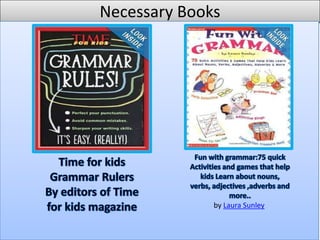
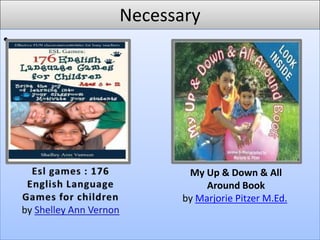
Necessary Books

by Laura Sunley
Necessary
•

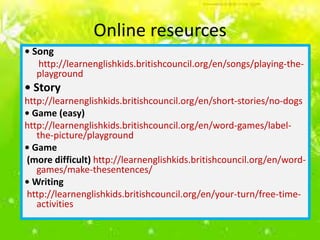
My Up & Down & All
Around Book
by Marjorie Pitzer M.Ed.
Online reseurces
• Song
http://learnenglishkids.britishcouncil.org/en/songs/playing-theplayground

• Story
http://learnenglishkids.britishcouncil.org/en/short-stories/no-dogs
• Game (easy)
http://learnenglishkids.britishcouncil.org/en/word-games/labelthe-picture/playground
• Game
(more difficult) http://learnenglishkids.britishcouncil.org/en/wordgames/make-thesentences/
• Writing
http://learnenglishkids.britishcouncil.org/en/your-turn/free-timeactivities
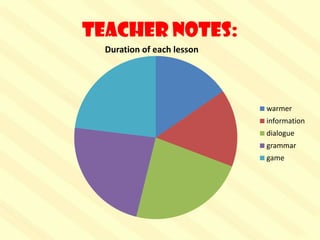
Teacher notes:
Duration of each lesson

warmer

information
dialogue
grammar
game
1 month
1.
2.
3.
4.

Learning with pictures (2 month for Alphabet)
Vacobulary with pictures
Home tasks
Games

• How should be lesson. Teach in context
• Lessons should be planned in accordance with learning goals. Vocabulary and
language should be taught in context. For example, when teaching children foods in
English, it should be within a meal context like breakfast, lunch or dinner, and
should never be a list of items they must study or memorize.
• Playing word games is a good way to help the child to memorize the vocabulary.
• Choose an easy game or a more difficult game depending on the level of your class.
• Game (easy) http://learnenglishkids.britishcouncil.org/en/word-games/label-thepicture/playground
• Song (game)
• Songs are motivating and fun. They are also a very powerful learning method to
help children remember the language they have learned.
2 month
1.
2.
3.
4.

Əlifba
Easy vecabulary
Home tasks
Game ( find the words, puzzle , sing a song and more…)
Phonics helps your child learn to read and spell. Without this
ability, your child cannot be fully literate.

• The sounds and letters of the English alphabet are introduced and practised
in each unit.
• Two letters are usually taught in each unit.
• The children learn the letter name, sound and a simple word that begins
with the letter and sound.
• the complete Alphabet song for additional practice.
• Game (more difficult) http://learnenglishkids.britishcouncil.org/en/wordgames/make-thesentences/ playground-rules
3 month
1.
2.
3.
4.

Easy Grammar (Noun,Adjectives,To be,Pronoun,Present tense,Past simple)
Elementary vocabulary
Home tasks
Game (sing song, story....)

Help them learn new words they might not know, and teach them little
poems or puns to help them enjoy knowing the language more.
Play the rest of the story. Did the children like the story? Ask them if
the dog was happy? Why/ why not?
Songs are motivating and fun. They are also a very powerful learning
method to help children remember the language they have learned.
Help them learn new words they might not know, and teach them little
poems or puns to help them enjoy knowing the language more
4 month

•
•
•
•







skills: integrated skills (listening, speaking, reading, writing)
Once the child has built up their vocabulary, you can teach them phrases. At this point you
can either do both teaching them how to read (can do this also in beginning) and speak or
just speak. Start out with small phrases then go up to step by step.
the child will be able to hold small conversations. It will be best if the child is taught to talk
to you in the language only versus just using the language when needed. This way the child
will not forget it, even if they only talk to you.
Speaking –
Put teams about
Who you are?
What do you do in your spare time?
Where do you spend your summer holiday?
About your family
What is your lovely pet?
What should the teachers know?
•
•
•
•
•
•
•
•

Learn to be patient with the child. Do not be discouraging. It is not good to discourage when teaching.
If the child gets it wrong, smile at them and tell them to try it again.
Do not teach them bad words; kids pick up on the bad words quicker than normal vocabulary.
If the child doesn't want to learn and rather wants to play, do not force them. They will come when
they want.
Time is a necessary thing! You must have lots of it to teach them.
Do not teach them informally in the beginning! They won't be able to take the lessons seriously and
therefore will not learn as well as they would do if you taught them formally.
All children have different learning styles. Some might be similar but most are different. Figure out
their learning style before trying to teach them.
If the child is having a hard time, try to teach them at another time. (or season!)
Do not push your child too hard to learn the language. The reason being is that some kids are just not
cut out or not ready to learn it. If they want to learn it, they'll learn it in the near future.
What should the teachers know?
• Be positive, enthusiastic, supportive, encouraging and creative - the latter is one
thing children respond to best.
• Try to play games with the child to help them learn.
• Always be patient with the child. The child is more likely having a harder time
learning then you are teaching.
• Use everyday objects to teach the kid: cups, spoons, etc...
• Teach the child the formal way to speak. It looks bad when the child is talking to
an adult informally. It also gives the other person respect. And It is cute.
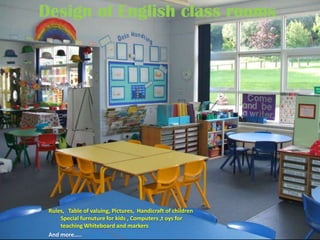
Design of English class rooms

Rules, Table of valuing, Pictures, Handicraft of children
Special furnuture for kids , Computers ,t oys for
teaching Whiteboard and markers
And more…..
English course presentation

English course presentation

  • 1.
  • 2.
     To helpkids extend their vocabulary  To develop kids’ speaking and listening skills  To develop kids’ writing skills To develop kids’ creative skills
  • 3.
    Duration of Englishcourse Time 4 month 3 days of week (Monday, Tuesday, Wednesday) duration of single lesson 65 minutes (In other month – 90 minutes) level age group biginner primary
  • 4.
  • 5.
    Necessary • My Up &Down & All Around Book by Marjorie Pitzer M.Ed.
  • 6.
    Online reseurces • Song http://learnenglishkids.britishcouncil.org/en/songs/playing-theplayground •Story http://learnenglishkids.britishcouncil.org/en/short-stories/no-dogs • Game (easy) http://learnenglishkids.britishcouncil.org/en/word-games/labelthe-picture/playground • Game (more difficult) http://learnenglishkids.britishcouncil.org/en/wordgames/make-thesentences/ • Writing http://learnenglishkids.britishcouncil.org/en/your-turn/free-timeactivities
  • 7.
    Teacher notes: Duration ofeach lesson warmer information dialogue grammar game
  • 8.
    1 month 1. 2. 3. 4. Learning withpictures (2 month for Alphabet) Vacobulary with pictures Home tasks Games • How should be lesson. Teach in context • Lessons should be planned in accordance with learning goals. Vocabulary and language should be taught in context. For example, when teaching children foods in English, it should be within a meal context like breakfast, lunch or dinner, and should never be a list of items they must study or memorize. • Playing word games is a good way to help the child to memorize the vocabulary. • Choose an easy game or a more difficult game depending on the level of your class. • Game (easy) http://learnenglishkids.britishcouncil.org/en/word-games/label-thepicture/playground • Song (game) • Songs are motivating and fun. They are also a very powerful learning method to help children remember the language they have learned.
  • 9.
    2 month 1. 2. 3. 4. Əlifba Easy vecabulary Hometasks Game ( find the words, puzzle , sing a song and more…) Phonics helps your child learn to read and spell. Without this ability, your child cannot be fully literate. • The sounds and letters of the English alphabet are introduced and practised in each unit. • Two letters are usually taught in each unit. • The children learn the letter name, sound and a simple word that begins with the letter and sound. • the complete Alphabet song for additional practice. • Game (more difficult) http://learnenglishkids.britishcouncil.org/en/wordgames/make-thesentences/ playground-rules
  • 10.
    3 month 1. 2. 3. 4. Easy Grammar(Noun,Adjectives,To be,Pronoun,Present tense,Past simple) Elementary vocabulary Home tasks Game (sing song, story....) Help them learn new words they might not know, and teach them little poems or puns to help them enjoy knowing the language more. Play the rest of the story. Did the children like the story? Ask them if the dog was happy? Why/ why not? Songs are motivating and fun. They are also a very powerful learning method to help children remember the language they have learned. Help them learn new words they might not know, and teach them little poems or puns to help them enjoy knowing the language more
  • 11.
    4 month • • • •       skills: integratedskills (listening, speaking, reading, writing) Once the child has built up their vocabulary, you can teach them phrases. At this point you can either do both teaching them how to read (can do this also in beginning) and speak or just speak. Start out with small phrases then go up to step by step. the child will be able to hold small conversations. It will be best if the child is taught to talk to you in the language only versus just using the language when needed. This way the child will not forget it, even if they only talk to you. Speaking – Put teams about Who you are? What do you do in your spare time? Where do you spend your summer holiday? About your family What is your lovely pet?
  • 12.
    What should theteachers know? • • • • • • • • Learn to be patient with the child. Do not be discouraging. It is not good to discourage when teaching. If the child gets it wrong, smile at them and tell them to try it again. Do not teach them bad words; kids pick up on the bad words quicker than normal vocabulary. If the child doesn't want to learn and rather wants to play, do not force them. They will come when they want. Time is a necessary thing! You must have lots of it to teach them. Do not teach them informally in the beginning! They won't be able to take the lessons seriously and therefore will not learn as well as they would do if you taught them formally. All children have different learning styles. Some might be similar but most are different. Figure out their learning style before trying to teach them. If the child is having a hard time, try to teach them at another time. (or season!) Do not push your child too hard to learn the language. The reason being is that some kids are just not cut out or not ready to learn it. If they want to learn it, they'll learn it in the near future.
  • 13.
    What should theteachers know? • Be positive, enthusiastic, supportive, encouraging and creative - the latter is one thing children respond to best. • Try to play games with the child to help them learn. • Always be patient with the child. The child is more likely having a harder time learning then you are teaching. • Use everyday objects to teach the kid: cups, spoons, etc... • Teach the child the formal way to speak. It looks bad when the child is talking to an adult informally. It also gives the other person respect. And It is cute.
  • 14.
    Design of Englishclass rooms Rules, Table of valuing, Pictures, Handicraft of children Special furnuture for kids , Computers ,t oys for teaching Whiteboard and markers And more…..