D4L
Aalborg, Denmark, 19 November 2015
 Crisis, change and context
 Looking at Exclusion
 Inclusion: concept or empowerment?
 Policy to best practice – Global Citizenship
 How wrong can you get? Fukuyama and the
End of History (1992)
 Sociologies of dislocation
 The end of certainty: change or chaos?
 Narratives of insecurity and change
 Motivation: departing/arriving/learning
 European dimensions, global issues
 Globalization – accelerating and pervasive
 Crisis, meltdown and re-structuring post 2008
 Devaluation of the public sphere
 Stratification and inequity
 Labor market transformation
 Rights and inclusion – token or real?
 Access, quality and innovation in education
 Patterns of constant change
 Permanent migration and mobility
 Outsourcing
 Flexible structures and modalities
 Knowledge economy
 Scarcity of traditional jobs
 Ecological pressures
 End of certainty
 End of stable socio-political norms
 Uncertainty, fluid identity and unease
 A world turned upside down
 The poetry of quest – fromYeats to Kavafy
 A deep shiver of guilt – what have we done?
 What have we become?
 The ghosts that will not rest
 End of assumptions about European identity
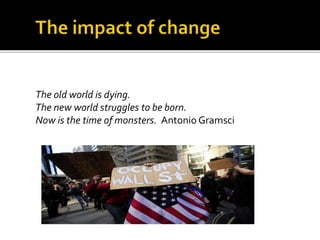
The old world is dying.
The new world struggles to be born.
Now is the time of monsters. Antonio Gramsci
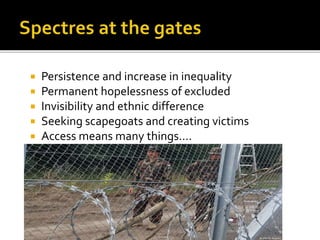
 Persistence and increase in inequality
 Permanent hopelessness of excluded
 Invisibility and ethnic difference
 Seeking scapegoats and creating victims
 Access means many things….
 Decreasing workers’ share in national income
in all countries
 Labor productivity (up 85% since 1980) not
reflected in wages (up 35%)
 Declining social mobility
 Rising income inequality reflected in
declining equality of opportunity
GlobalWage Report 2012/13, ILO
Prof. Miles Corak, Journal of Economic Perspectives 2013
 Mutual interaction or structured exclusion?
 Community values or communal rituals?
 Linkage to realities or past models?
 Shared memories or shared hatreds?
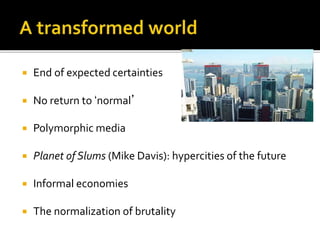
 End of expected certainties
 No return to ‘normal’
 Polymorphic media
 Planet of Slums (Mike Davis): hypercities of the future
 Informal economies
 The normalization of brutality
 Mythology of the ‘normal’
 Defining the mainstream: what have we become?
 Robust probing of social structure required as
preliminary to defining mainstream
 Masking power, relationships and inequity
 Need to avoid cliché and assumptions
 Learners are immersed in and emerging into this
changed constellation – of which the gatekeepers
know little
 Exclusion is much easier to define
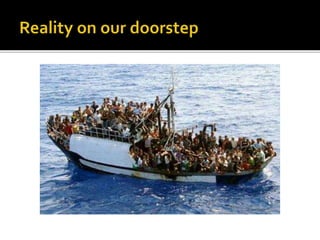
 Tangible evidence of legacy of discrimination
 Pattern of low expectations or invisibility
 Economic, social, cultural dimensions – as
well as educational
 Denial of access to resources
 Unacceptable but often tacit acceptance in
divided or unequal societies
 Barriers (intentional or otherwise)
 Attitudes
 Prejudices
 Stereotypes
 Rejection
 Hostility
 Rigid systems
 Centuries of exclusion in learning systems
 Outright ban – girls, women and disabled
 Exclusion as the norm
 Separate systems: gender, language, religion,
class, ethnic group
 Unequal resources and outcomes
 Fragmentation and disenfranchisement
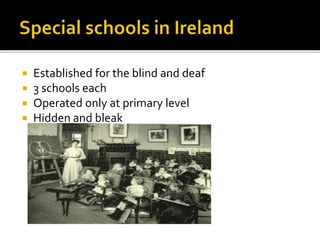
 Established for the blind and deaf
 3 schools each
 Operated only at primary level
 Hidden and bleak
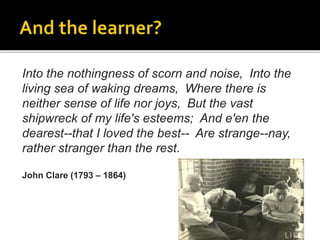
Into the nothingness of scorn and noise, Into the
living sea of waking dreams, Where there is
neither sense of life nor joys, But the vast
shipwreck of my life's esteems; And e'en the
dearest--that I loved the best-- Are strange--nay,
rather stranger than the rest.
John Clare (1793 – 1864)
 Disruptive classroom behaviors
 Absenteeism
 Early school-leaving
 Teacher burnout
 Migration, integration and sustainability
 Literacy, numeracy, basic skills
 Languages
 Quality and governance
DG EAC (2008) European Education andTraining Systems in the Second Decennium of the Lisbon
Strategy, NESSE and ENEE.
 Struggle for recognition
 Gender equality and reproductive
rights
 Religious minorities
 Sexual orientation
 Disability
 Reaction and control – ‘standards’
 Legacies of exclusion are deep and
may re-surface
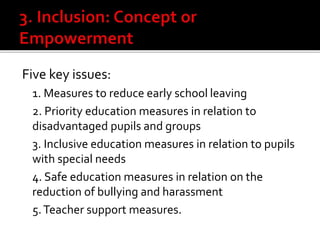
Five key issues:
1. Measures to reduce early school leaving
2. Priority education measures in relation to
disadvantaged pupils and groups
3. Inclusive education measures in relation to pupils
with special needs
4. Safe education measures in relation on the
reduction of bullying and harassment
5.Teacher support measures.
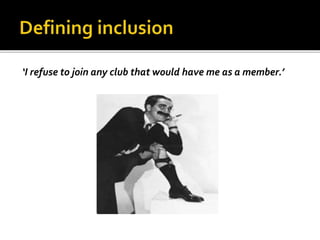
‘I refuse to join any club that would have me as a member.’
Social inclusion can be defined as a number
of affirmative actions undertaken in order
to reverse the social exclusion of individuals
or groups in our society
INCLUSO (EU 7th Framework, 2009)
A multidimensional process of progressive social
rupture, detaching groups and individuals from
social relations and institutions and preventing
them from full participation in the normal,
normatively prescribed activities of the society in
which they live.
H. Silver, Social Exclusion: Comparative Analysis of Europe and Middle East Youth,
Dec. 2007. (Wolfensohn Center for Development, Dubai)
 Not necessarily benign
 Not necessarily desired
 Not necessarily valued
 Inclusion or conformity?
 Exclusion often seen minimally as lack of
access
 Exclusion is a systematic policy of inequality
and denial of rights
 Hugely different implications
 If learning, working and production are controlled
inclusion is at best token, at worst sinister
 At the core of inclusion must be ability to assess
critically and express freely
 Fundamental to inclusion is ability to ask questions
that challenge existing relations
 Inclusion re-examines existing reality while posing
viable alternatives
 Youth and mass unemployment
 Demographics: ageing and life expectancy
 Women and labor market participation
 Immigration, cultural and religious difference
 Disability
 Conflict, stress, anomie
 Urbanization, dissent and democratic deficits
 Positive and proactive decision – policy and
practice
 It is achievable
 Risks: stigmatization and discrimination
 Requires whole-school and community
commitment and support
 Demands resources (personnel and training)
 Demands facilities to UD level throughout
 Designing for diversity
 Support, review, standards
 Inclusion changes both sides – the act of
mainstreaming is to change the mainstream
not the ‘excluded’
 From objects to subjects
 Narratives of adaptation and discovery
 From target group to citizen
 Critical role of teachers
 Inclusion and the dialectic of rights
 Transformational learning and the sociology
of innovation
 Educational systems as networks of actors
who reinforce each other in stable
configurations
 Stable configurations prevent change
 Vested interest acts against innovation and
inclusion - seen as threat
John Henry Newman (1873) The Idea of the University
1. Primary purpose of a University is intellectual and pedagogical
2. Range of teaching within University is universal; it encompasses all
branches of knowledge, and is inconsistent with restrictions of any
kind.
3. The University prepares students by allowing them to learn about
"the ways and principles and maxims" of the world
4.True education requires personal influence of teachers on students.
Clark Kerr (1963) The Uses of the University
1. Modern university is diversified – a multiversity
2. Serves needs of society, economic and cultural
3.Think tank – essential to progress
4. Master Plan for Higher Education (1960) in California
 Contradictory and paradoxical process
 Never greater potential - side by side with
increasing disparities of access
 What we think:
 Citizens
▪ Shared knowledge
▪ Participative engagement
 What we have:
 Consumers
▪ Increasing exclusion
▪ Significant problems with equitable access
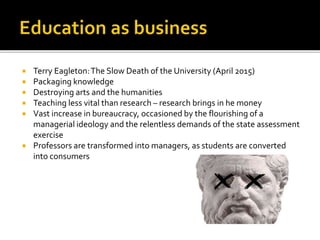
 Terry Eagleton:The Slow Death of the University (April 2015)
 Packaging knowledge
 Destroying arts and the humanities
 Teaching less vital than research – research brings in he money
 Vast increase in bureaucracy, occasioned by the flourishing of a
managerial ideology and the relentless demands of the state assessment
exercise
 Professors are transformed into managers, as students are converted
into consumers
 End of linear models of learning
 Cognitive dissonance: what is needed is not
being provided
 Alienation and anomie in a changing world
 Labor market flux and the loss of autonomy
 Adaptability and innovation as norm, not
exception
 Globalized paradigms/fractured community
 Elephants in the room: power and ownership
Empowerment is the process of increasing the capacity of
individuals or groups to make choices and to transform those
choices into desired actions and outcomes. Central to this
process are actions which both build individual and collective
assets, and improve the efficiency and fairness of the
organizational and institutional context which govern the use
of these assets.
World Bank 2011
41
 Acceleration
 Collaboration and networks
 Collaboration with knowledge production
centers
 Increasing domination by market realities
 Towards competence
 Integrated learning for integrated learners
Education must fully assume its central role in
helping people to forge more just, peaceful,
tolerant and inclusive societies. It must give
people the understanding, skills and values they
need to cooperate in resolving the interconnected
challenges of the 21st century.
United Nations: Global Education First Initiative (2012)
 Membership of a political community
 Belonging and engagement
 Rights and entitlements
 Duties and responsibilities
 Constrained by legacy of nation-state
 Cultural minorities and migrants
 Disputed access
 Shaped by globalizing process
 Greater access to knowledge, information
and values
 Digital media
 Mobility and migration
 Climate change
 International governance bodies
 Accelerated interdependence
 Respect for pluralism and diversity
To enable learners
 To develop a sense of shared destiny through
identification with their social, cultural, and political
environments.
 To become aware of the challenges posed to the
development of their communities through an
understanding of issues related to patterns of social,
economic and environmental change.
 To engage in civic and social action in view of positive
societal participation and/or transformation based on a
sense of individual responsibility towards their
communities.
SobhiTawil (2013)
 Awareness of the wider world and a sense of own role both
as a citizen with rights and responsibilities, and as a
member of the global human community.
 Valuation of the diversity of cultures and of their
languages, arts, religions and philosophies as components
the common heritage of humanity.
 Commitment to sustainable development and sense of
environmental responsibility.
 Commitment to social justice and sense of social
responsibility.
 Willingness to challenge injustice, discrimination,
inequality and exclusion at the local/national and global
level in order to make the world a more just place.
 From oppression to emancipatory learning
 Insights of the excluded - voices of the invisible
 Learning to think – and teach – anew
 Creating benefit for all
 Critical thinking distinct epistemologies of
science and engineering
Science explains what exists; engineering creates what never
existed (Von Karman)
 Disability and learning: from Louis Braille to Ken
Robinson
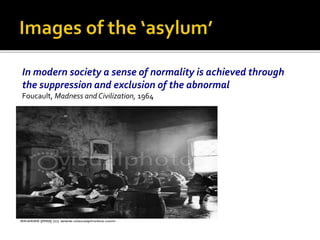
In modern society a sense of normality is achieved through
the suppression and exclusion of the abnormal
Foucault, Madness and Civilization, 1964
 Increased application of new knowledge
 Open and distance learning technologies
facilitating learners and staff competence
 Transformation of traditional teaching role to
mentoring, guiding and facilitation
 Development of network of inclusion best
practice at European level
 Adopting UDL
 Inclusion not as destination but starting point
 Removing barriers - mind and heart
 Avoiding inclusion clichés
 Asserting imagination and creativity
 Limitless potential of the inclusion focus
 Learning for all as foundation for
transformation
 From the core of crisis – new directions or the
abyss?
Dr. Alan Bruce
ULS Dublin
abruce@ulsystems.com
Associate Offices: BARCELONA - HELSINKI - SÃO PAULO - CHICAGO

Inclusion: Mythologies and Opportunities

  • 1.
  • 2.
     Crisis, changeand context  Looking at Exclusion  Inclusion: concept or empowerment?  Policy to best practice – Global Citizenship
  • 3.
     How wrongcan you get? Fukuyama and the End of History (1992)  Sociologies of dislocation  The end of certainty: change or chaos?  Narratives of insecurity and change  Motivation: departing/arriving/learning  European dimensions, global issues
  • 4.
     Globalization –accelerating and pervasive  Crisis, meltdown and re-structuring post 2008  Devaluation of the public sphere  Stratification and inequity  Labor market transformation  Rights and inclusion – token or real?  Access, quality and innovation in education
  • 5.
     Patterns ofconstant change  Permanent migration and mobility  Outsourcing  Flexible structures and modalities  Knowledge economy  Scarcity of traditional jobs  Ecological pressures  End of certainty
  • 6.
     End ofstable socio-political norms  Uncertainty, fluid identity and unease  A world turned upside down  The poetry of quest – fromYeats to Kavafy  A deep shiver of guilt – what have we done?  What have we become?  The ghosts that will not rest  End of assumptions about European identity
  • 7.
    The old worldis dying. The new world struggles to be born. Now is the time of monsters. Antonio Gramsci
  • 8.
     Persistence andincrease in inequality  Permanent hopelessness of excluded  Invisibility and ethnic difference  Seeking scapegoats and creating victims  Access means many things….
  • 9.
     Decreasing workers’share in national income in all countries  Labor productivity (up 85% since 1980) not reflected in wages (up 35%)  Declining social mobility  Rising income inequality reflected in declining equality of opportunity GlobalWage Report 2012/13, ILO Prof. Miles Corak, Journal of Economic Perspectives 2013
  • 10.
     Mutual interactionor structured exclusion?  Community values or communal rituals?  Linkage to realities or past models?  Shared memories or shared hatreds?
  • 11.
     End ofexpected certainties  No return to ‘normal’  Polymorphic media  Planet of Slums (Mike Davis): hypercities of the future  Informal economies  The normalization of brutality
  • 12.
     Mythology ofthe ‘normal’  Defining the mainstream: what have we become?  Robust probing of social structure required as preliminary to defining mainstream  Masking power, relationships and inequity  Need to avoid cliché and assumptions  Learners are immersed in and emerging into this changed constellation – of which the gatekeepers know little
  • 13.
     Exclusion ismuch easier to define  Tangible evidence of legacy of discrimination  Pattern of low expectations or invisibility  Economic, social, cultural dimensions – as well as educational  Denial of access to resources  Unacceptable but often tacit acceptance in divided or unequal societies
  • 14.
     Barriers (intentionalor otherwise)  Attitudes  Prejudices  Stereotypes  Rejection  Hostility  Rigid systems
  • 15.
     Centuries ofexclusion in learning systems  Outright ban – girls, women and disabled  Exclusion as the norm  Separate systems: gender, language, religion, class, ethnic group  Unequal resources and outcomes  Fragmentation and disenfranchisement
  • 16.
     Established forthe blind and deaf  3 schools each  Operated only at primary level  Hidden and bleak
  • 17.
    Into the nothingnessof scorn and noise, Into the living sea of waking dreams, Where there is neither sense of life nor joys, But the vast shipwreck of my life's esteems; And e'en the dearest--that I loved the best-- Are strange--nay, rather stranger than the rest. John Clare (1793 – 1864)
  • 24.
     Disruptive classroombehaviors  Absenteeism  Early school-leaving  Teacher burnout  Migration, integration and sustainability  Literacy, numeracy, basic skills  Languages  Quality and governance DG EAC (2008) European Education andTraining Systems in the Second Decennium of the Lisbon Strategy, NESSE and ENEE.
  • 25.
     Struggle forrecognition  Gender equality and reproductive rights  Religious minorities  Sexual orientation  Disability  Reaction and control – ‘standards’  Legacies of exclusion are deep and may re-surface
  • 26.
    Five key issues: 1.Measures to reduce early school leaving 2. Priority education measures in relation to disadvantaged pupils and groups 3. Inclusive education measures in relation to pupils with special needs 4. Safe education measures in relation on the reduction of bullying and harassment 5.Teacher support measures.
  • 27.
    ‘I refuse tojoin any club that would have me as a member.’
  • 28.
    Social inclusion canbe defined as a number of affirmative actions undertaken in order to reverse the social exclusion of individuals or groups in our society INCLUSO (EU 7th Framework, 2009)
  • 29.
    A multidimensional processof progressive social rupture, detaching groups and individuals from social relations and institutions and preventing them from full participation in the normal, normatively prescribed activities of the society in which they live. H. Silver, Social Exclusion: Comparative Analysis of Europe and Middle East Youth, Dec. 2007. (Wolfensohn Center for Development, Dubai)
  • 30.
     Not necessarilybenign  Not necessarily desired  Not necessarily valued  Inclusion or conformity?  Exclusion often seen minimally as lack of access  Exclusion is a systematic policy of inequality and denial of rights  Hugely different implications
  • 31.
     If learning,working and production are controlled inclusion is at best token, at worst sinister  At the core of inclusion must be ability to assess critically and express freely  Fundamental to inclusion is ability to ask questions that challenge existing relations  Inclusion re-examines existing reality while posing viable alternatives
  • 32.
     Youth andmass unemployment  Demographics: ageing and life expectancy  Women and labor market participation  Immigration, cultural and religious difference  Disability  Conflict, stress, anomie  Urbanization, dissent and democratic deficits
  • 33.
     Positive andproactive decision – policy and practice  It is achievable  Risks: stigmatization and discrimination  Requires whole-school and community commitment and support  Demands resources (personnel and training)  Demands facilities to UD level throughout  Designing for diversity  Support, review, standards
  • 34.
     Inclusion changesboth sides – the act of mainstreaming is to change the mainstream not the ‘excluded’  From objects to subjects  Narratives of adaptation and discovery  From target group to citizen  Critical role of teachers  Inclusion and the dialectic of rights
  • 35.
     Transformational learningand the sociology of innovation  Educational systems as networks of actors who reinforce each other in stable configurations  Stable configurations prevent change  Vested interest acts against innovation and inclusion - seen as threat
  • 37.
    John Henry Newman(1873) The Idea of the University 1. Primary purpose of a University is intellectual and pedagogical 2. Range of teaching within University is universal; it encompasses all branches of knowledge, and is inconsistent with restrictions of any kind. 3. The University prepares students by allowing them to learn about "the ways and principles and maxims" of the world 4.True education requires personal influence of teachers on students. Clark Kerr (1963) The Uses of the University 1. Modern university is diversified – a multiversity 2. Serves needs of society, economic and cultural 3.Think tank – essential to progress 4. Master Plan for Higher Education (1960) in California
  • 38.
     Contradictory andparadoxical process  Never greater potential - side by side with increasing disparities of access  What we think:  Citizens ▪ Shared knowledge ▪ Participative engagement  What we have:  Consumers ▪ Increasing exclusion ▪ Significant problems with equitable access
  • 39.
     Terry Eagleton:TheSlow Death of the University (April 2015)  Packaging knowledge  Destroying arts and the humanities  Teaching less vital than research – research brings in he money  Vast increase in bureaucracy, occasioned by the flourishing of a managerial ideology and the relentless demands of the state assessment exercise  Professors are transformed into managers, as students are converted into consumers
  • 40.
     End oflinear models of learning  Cognitive dissonance: what is needed is not being provided  Alienation and anomie in a changing world  Labor market flux and the loss of autonomy  Adaptability and innovation as norm, not exception  Globalized paradigms/fractured community  Elephants in the room: power and ownership
  • 41.
    Empowerment is theprocess of increasing the capacity of individuals or groups to make choices and to transform those choices into desired actions and outcomes. Central to this process are actions which both build individual and collective assets, and improve the efficiency and fairness of the organizational and institutional context which govern the use of these assets. World Bank 2011 41
  • 42.
     Acceleration  Collaborationand networks  Collaboration with knowledge production centers  Increasing domination by market realities  Towards competence  Integrated learning for integrated learners
  • 43.
    Education must fullyassume its central role in helping people to forge more just, peaceful, tolerant and inclusive societies. It must give people the understanding, skills and values they need to cooperate in resolving the interconnected challenges of the 21st century. United Nations: Global Education First Initiative (2012)
  • 44.
     Membership ofa political community  Belonging and engagement  Rights and entitlements  Duties and responsibilities  Constrained by legacy of nation-state  Cultural minorities and migrants  Disputed access
  • 45.
     Shaped byglobalizing process  Greater access to knowledge, information and values  Digital media  Mobility and migration  Climate change  International governance bodies  Accelerated interdependence  Respect for pluralism and diversity
  • 46.
    To enable learners To develop a sense of shared destiny through identification with their social, cultural, and political environments.  To become aware of the challenges posed to the development of their communities through an understanding of issues related to patterns of social, economic and environmental change.  To engage in civic and social action in view of positive societal participation and/or transformation based on a sense of individual responsibility towards their communities. SobhiTawil (2013)
  • 47.
     Awareness ofthe wider world and a sense of own role both as a citizen with rights and responsibilities, and as a member of the global human community.  Valuation of the diversity of cultures and of their languages, arts, religions and philosophies as components the common heritage of humanity.  Commitment to sustainable development and sense of environmental responsibility.  Commitment to social justice and sense of social responsibility.  Willingness to challenge injustice, discrimination, inequality and exclusion at the local/national and global level in order to make the world a more just place.
  • 48.
     From oppressionto emancipatory learning  Insights of the excluded - voices of the invisible  Learning to think – and teach – anew  Creating benefit for all  Critical thinking distinct epistemologies of science and engineering Science explains what exists; engineering creates what never existed (Von Karman)  Disability and learning: from Louis Braille to Ken Robinson
  • 49.
    In modern societya sense of normality is achieved through the suppression and exclusion of the abnormal Foucault, Madness and Civilization, 1964
  • 50.
     Increased applicationof new knowledge  Open and distance learning technologies facilitating learners and staff competence  Transformation of traditional teaching role to mentoring, guiding and facilitation  Development of network of inclusion best practice at European level  Adopting UDL  Inclusion not as destination but starting point
  • 51.
     Removing barriers- mind and heart  Avoiding inclusion clichés  Asserting imagination and creativity  Limitless potential of the inclusion focus  Learning for all as foundation for transformation  From the core of crisis – new directions or the abyss?
  • 52.
    Dr. Alan Bruce ULSDublin abruce@ulsystems.com Associate Offices: BARCELONA - HELSINKI - SÃO PAULO - CHICAGO