Situated Mobile Language Learning

Marcus Winter
Lyn Pemberton


LLP 511776-LLP-1-2010-1-UK-KA3-KA3MP
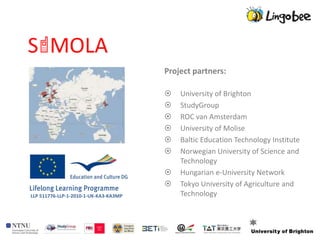
Project partners:

                                          University of Brighton
                                          StudyGroup
                                          ROC van Amsterdam
                                          University of Molise
                                          Baltic Education Technology Institute
                                          Norwegian University of Science and
                                           Technology
                                          Hungarian e-University Network
                                          Tokyo University of Agriculture and
LLP 511776-LLP-1-2010-1-UK-KA3-KA3MP       Technology
Background
European Union:         27 member states
                        23 official languages
                        60+ minority languages
                        ++ migrants from outside the EU

Large-scale programmes to promote linguistic competences and
cultural awareness:     Erasmus          - students
                        Comenius         - teachers
                        Grundvig         - migrants
Background


        classroom                                real life situations

[1] Ex-post evaluation of Erasmus Mundus - Case Studies.
[http://ec.europa.eu/dgs/education_culture/evalreports/education/2009/mundusannex_en.pdf]
[2] 2008 Study on the Impact of Erasmus on European Higher Education: Quality, Openness and Internationalisation
[http://ec.europa.eu/education/erasmus/doc/publ/impact08sum.pdf]
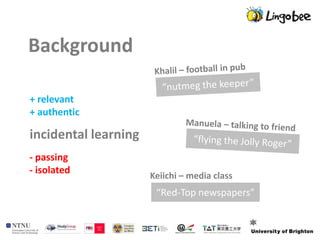
Background

+ relevant
+ authentic

incidental learning
- passing
- isolated
                      Keiichi – media class
                       “Red-Top newspapers”
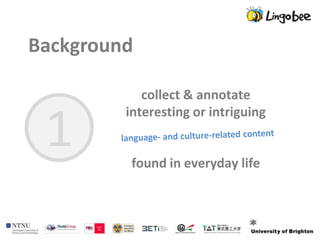
Background

            collect & annotate


 1
         interesting or intriguing


          found in everyday life
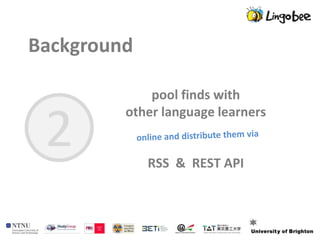
Background

             pool finds with


 2
         other language learners


             RSS & REST API
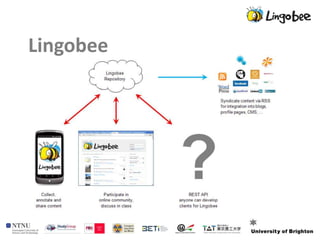
Lingobee
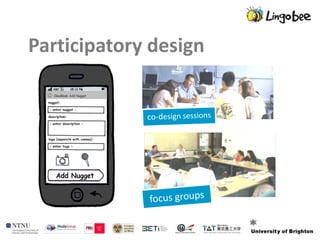
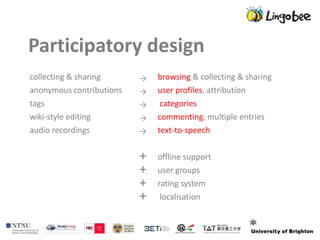
Participatory design
collecting & sharing      →   browsing & collecting & sharing
anonymous contributions   →   user profiles, attribution
tags                      →    categories
wiki-style editing        →   commenting, multiple entries
audio recordings          →   text-to-speech


                          +   offline support
                          +   user groups
                          +   rating system
                          +    localisation
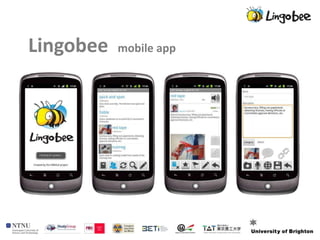
Lingobee   mobile app
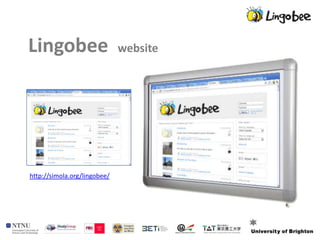
Lingobee                      website


http://simola.org/lingobee/
So far
 most suitable for advanced students
 needs to be super-usable
 phones need to belong to students
 mixed results for social media aspects
 teachers found ways to integrate into classroom
  teaching and combine in- and outside class work
 issues of authoritativeness and misuse
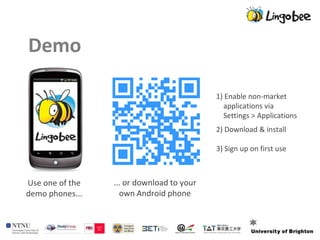
Demo

                                           1) Enable non-market
                                             applications via
                                             Settings > Applications
                                           2) Download & install

                                           3) Sign up on first use


Use one of the   ... or download to your
demo phones...     own Android phone
References
Demouy, V. and A. Kukulska-Hulme.(2010). On the spot: using mobile devices
   for listening and speaking practice on a French language programme.
   Open Learning: The Journal of Open and Distance Learning, 25(3), pp.
   217–232.
Kukulska-Hulme, A. & S. Bull (2009). Theory-based support for mobile
   language learning: noticing and recording. International Journal of
   Interactive Mobile Technologies, 3(2), pp. 12–18.
Pemberton, L., Winter, M. & S. Fallahkhair. (2009). A User Created Content
   Approach to Mobile Knowledge Sharing for Advanced Language Learners.
   Proceedings of mLearn 2009, Orlando, Florida, pp. 184-187.
Pemberton, L., Winter, M. & S. Fallahkhair. 2010. Collaborative Mobile
   Knowledge Sharing for Language Learners. Journal of the Research Center
   for Educational Technology, Vol 6, No 1 (2010)
Thanks
    Questions?
marcus.winter@brighton.ac.uk

lyn.pemberton@brighton.ac.uk

      http://simola.org

Lingobee

  • 1.
    Situated Mobile LanguageLearning Marcus Winter Lyn Pemberton LLP 511776-LLP-1-2010-1-UK-KA3-KA3MP
  • 2.
    Project partners:  University of Brighton  StudyGroup  ROC van Amsterdam  University of Molise  Baltic Education Technology Institute  Norwegian University of Science and Technology  Hungarian e-University Network  Tokyo University of Agriculture and LLP 511776-LLP-1-2010-1-UK-KA3-KA3MP Technology
  • 3.
    Background European Union: 27 member states 23 official languages 60+ minority languages ++ migrants from outside the EU Large-scale programmes to promote linguistic competences and cultural awareness: Erasmus - students Comenius - teachers Grundvig - migrants
  • 4.
    Background classroom real life situations [1] Ex-post evaluation of Erasmus Mundus - Case Studies. [http://ec.europa.eu/dgs/education_culture/evalreports/education/2009/mundusannex_en.pdf] [2] 2008 Study on the Impact of Erasmus on European Higher Education: Quality, Openness and Internationalisation [http://ec.europa.eu/education/erasmus/doc/publ/impact08sum.pdf]
  • 5.
    Background + relevant + authentic incidentallearning - passing - isolated Keiichi – media class “Red-Top newspapers”
  • 6.
    Background collect & annotate 1 interesting or intriguing found in everyday life
  • 7.
    Background pool finds with 2 other language learners RSS & REST API
  • 8.
  • 9.
  • 10.
    Participatory design collecting &sharing → browsing & collecting & sharing anonymous contributions → user profiles, attribution tags → categories wiki-style editing → commenting, multiple entries audio recordings → text-to-speech + offline support + user groups + rating system + localisation
  • 11.
    Lingobee mobile app
  • 12.
    Lingobee website http://simola.org/lingobee/
  • 13.
    So far  mostsuitable for advanced students  needs to be super-usable  phones need to belong to students  mixed results for social media aspects  teachers found ways to integrate into classroom teaching and combine in- and outside class work  issues of authoritativeness and misuse
  • 14.
    Demo 1) Enable non-market applications via Settings > Applications 2) Download & install 3) Sign up on first use Use one of the ... or download to your demo phones... own Android phone
  • 15.
    References Demouy, V. andA. Kukulska-Hulme.(2010). On the spot: using mobile devices for listening and speaking practice on a French language programme. Open Learning: The Journal of Open and Distance Learning, 25(3), pp. 217–232. Kukulska-Hulme, A. & S. Bull (2009). Theory-based support for mobile language learning: noticing and recording. International Journal of Interactive Mobile Technologies, 3(2), pp. 12–18. Pemberton, L., Winter, M. & S. Fallahkhair. (2009). A User Created Content Approach to Mobile Knowledge Sharing for Advanced Language Learners. Proceedings of mLearn 2009, Orlando, Florida, pp. 184-187. Pemberton, L., Winter, M. & S. Fallahkhair. 2010. Collaborative Mobile Knowledge Sharing for Language Learners. Journal of the Research Center for Educational Technology, Vol 6, No 1 (2010)
  • 16.
    Thanks Questions? marcus.winter@brighton.ac.uk lyn.pemberton@brighton.ac.uk http://simola.org