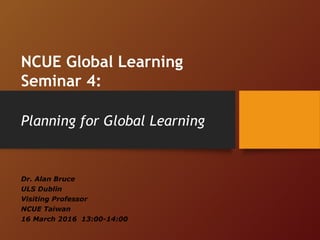
Planning for Global Learning
Dr. Alan Bruce
ULS Dublin
Visiting Professor
NCUE Taiwan
16 March 2016 13:00-14:00
NCUE Global Learning
Seminar 4:
Setting the Scene
Educational change
Impact of socio-economic transformation
New learning needs
Setting priorities
Global learning and mutual benefit
Anticipating the future (OECD
1994)
Future learning and employment needs (Jobs
Study)
•Policy change
•Flexibility
•Entrepreneurship
•Internationalization
•Technology
The future is now…
• Potential provision of universal schooling is
now realized
• Internationalization is the norm
• Technology is pervasive but unevenly
accessible or applied
• ‘Flexibility’: weapon or tool?
• Entrepreneur: leader or false god?
• Policy: shaping or copying?
Defining directions
• Excellence
• Innovation
• Leadership
• System change
• Reform
• ‘The chemistry of widespread improvement’
(Michael Fullan)
Comparative analysis (McKinsey
2010) – 20 countries
Key interventions:
1.Revise curriculum and standards
2.Set appropriate pay for teachers/principals
3.Enhance technical skills for teachers
4.Improve student assessment systems
5.Quality data systems
6.Improve policy and laws
Student demandUNESCO 2009
How do we plan?
• Gathering the evidence
• Gathering the right evidence!
• Analyzing evidence
• Projecting trends
• Demographic data
• Social indicators
• Education relevant information
When do we plan?
• Continuous need for data collection
• Need for regular cycles of planning
• Embedding planning in strategic management
• Planning as a living tool
• Using milestones
What do we plan?
• Resources needed (human and financial)
• Facilities needed
• Capacity needs
• Linkage
• Networking
• Income generation
• Setting targets for everything
• Anticipating change
Why do we plan?
• To be prepared
• To anticipate
• To take advantage
• To maintain motivation
• To flow with needed change
• To target excellence
• To cretae a dynamic organization driven by
quality and innovation
Participation to inclusion
• Impact of universal schooling
• The university revolution – from distance
learning to MOOCs
• Impact of legislation and policy
• Technological revolution only starting
• From psychology to engineering – the altered
environment
• Shaping the mind – struggles with attitudes
Education and Global
Citizenship
To enable learners
•To develop a sense of shared destiny through identification with
their social, cultural, and political environments.
•To become aware of the challenges posed to the development of
their communities through an understanding of issues related to
patterns of social, economic and environmental change.
•To engage in civic and social action in view of positive societal
participation and/or transformation based on a sense of individual
responsibility towards their communities.
Sobhi Tawil (2013)
OER: impact on education
research and policy
• Widened access
• Improved cost-efficiency
• Quality of teaching and learning
• Three impact areas:
• Lifelong Learning
• School Education
• University Education
IPTS Institute for Prospective Technological Studies (Sevilla)
Open Education 2030 (IPTS)
• Communication with Self; Other; World
• Personalized learning management to navigate
to future competencies
• Demonstrated capability and ability in context
of change
• From teaching to facilitation
• Ubiquity; telepresence; interoperability
• Competency based assessment
• Waves of innovation
• Adult learning networks
Age of the MOOC?
• Critical shift in distance and e-learning
• Major impact: scale and impact of online
learning
• Questions remain on pedagogical approaches
• Shift from dedicated structures of past (OUs;
media labs; academic departments) to broader
universal non-expert actors
• Quality, values, standards
• Ownership and control
Supporting learning
• Focus of motivation
• Problem solving focus
• From curriculum to competence
• Content to meaningful action
• From formal teaching to creation of bonds and
links
• Mentoring
• Models of best practice
Embedding learning
• Modeling
• Empathic analysis in transition support
• Social analytics for multidisciplinary work
• Roles and responsibility
• Advanced digital competence/assistive
technologies
• Universal Design
• Comparative research methods
• Independent living/rights based models
Further steps
• Increased application on new knowledge
• Open and distance learning technologies
facilitating learners and staff competence
• Transformation of traditional teaching role to
mentoring, guiding and facilitation
• Development of network of innovative best
practice at international level
Planning for change in global
learning
• Skillbeck Report (2001)
• Challenges and changes are within institutions
• Changes are ubiquitous
• Changes are systemic
• Changes are radical
• Evolving Corporate Universities Forum (Istanbul 2012)
• attract, retain and enhance highly skilled employees
• invest in developing a culture of learning throughout the
organization 
• spread a common culture as engines of strategic change
• ability to promote importance, value and contribution of a learning
culture
• ensure integration of HRM systems and policies with learning
initiatives
• build genuine partnerships with world-class learning institutions
Planning a vision
• Stakeholders in universities are wide-ranging, both internal
and external
• Pressures on corporate and academic worlds are similar, if
different in detail
• Universities to survive must be relevant and visionary
• Universities are now expected:
• To be more outward looking
• To provide leadership and service
• To make efficiency gains
• To maintain standards and quality
• To obtain new and additional revenue sources
Policy opportunities for Global
Learning
• Engaging with diverse communities
• Developing massive outreach to sectors
• Community empowerment
• Outreach, access and validation
• Legislative foundations
• New technologies – mobile telephony
• Shared learning and linkage to other
universities
謝謝
Dr. Alan Bruce
ULS Dublin
abruce@ulsystems.com
Associate Offices: BARCELONA - HELSINKI - SÃO PAULO - CHICAGO

Planning for Global Learning

  • 1.
    Planning for GlobalLearning Dr. Alan Bruce ULS Dublin Visiting Professor NCUE Taiwan 16 March 2016 13:00-14:00 NCUE Global Learning Seminar 4:
  • 2.
    Setting the Scene Educationalchange Impact of socio-economic transformation New learning needs Setting priorities Global learning and mutual benefit
  • 3.
    Anticipating the future(OECD 1994) Future learning and employment needs (Jobs Study) •Policy change •Flexibility •Entrepreneurship •Internationalization •Technology
  • 4.
    The future isnow… • Potential provision of universal schooling is now realized • Internationalization is the norm • Technology is pervasive but unevenly accessible or applied • ‘Flexibility’: weapon or tool? • Entrepreneur: leader or false god? • Policy: shaping or copying?
  • 5.
    Defining directions • Excellence •Innovation • Leadership • System change • Reform • ‘The chemistry of widespread improvement’ (Michael Fullan)
  • 6.
    Comparative analysis (McKinsey 2010)– 20 countries Key interventions: 1.Revise curriculum and standards 2.Set appropriate pay for teachers/principals 3.Enhance technical skills for teachers 4.Improve student assessment systems 5.Quality data systems 6.Improve policy and laws
  • 7.
  • 8.
    How do weplan? • Gathering the evidence • Gathering the right evidence! • Analyzing evidence • Projecting trends • Demographic data • Social indicators • Education relevant information
  • 9.
    When do weplan? • Continuous need for data collection • Need for regular cycles of planning • Embedding planning in strategic management • Planning as a living tool • Using milestones
  • 10.
    What do weplan? • Resources needed (human and financial) • Facilities needed • Capacity needs • Linkage • Networking • Income generation • Setting targets for everything • Anticipating change
  • 11.
    Why do weplan? • To be prepared • To anticipate • To take advantage • To maintain motivation • To flow with needed change • To target excellence • To cretae a dynamic organization driven by quality and innovation
  • 12.
    Participation to inclusion •Impact of universal schooling • The university revolution – from distance learning to MOOCs • Impact of legislation and policy • Technological revolution only starting • From psychology to engineering – the altered environment • Shaping the mind – struggles with attitudes
  • 13.
    Education and Global Citizenship Toenable learners •To develop a sense of shared destiny through identification with their social, cultural, and political environments. •To become aware of the challenges posed to the development of their communities through an understanding of issues related to patterns of social, economic and environmental change. •To engage in civic and social action in view of positive societal participation and/or transformation based on a sense of individual responsibility towards their communities. Sobhi Tawil (2013)
  • 14.
    OER: impact oneducation research and policy • Widened access • Improved cost-efficiency • Quality of teaching and learning • Three impact areas: • Lifelong Learning • School Education • University Education IPTS Institute for Prospective Technological Studies (Sevilla)
  • 15.
    Open Education 2030(IPTS) • Communication with Self; Other; World • Personalized learning management to navigate to future competencies • Demonstrated capability and ability in context of change • From teaching to facilitation • Ubiquity; telepresence; interoperability • Competency based assessment • Waves of innovation • Adult learning networks
  • 16.
    Age of theMOOC? • Critical shift in distance and e-learning • Major impact: scale and impact of online learning • Questions remain on pedagogical approaches • Shift from dedicated structures of past (OUs; media labs; academic departments) to broader universal non-expert actors • Quality, values, standards • Ownership and control
  • 17.
    Supporting learning • Focusof motivation • Problem solving focus • From curriculum to competence • Content to meaningful action • From formal teaching to creation of bonds and links • Mentoring • Models of best practice
  • 18.
    Embedding learning • Modeling •Empathic analysis in transition support • Social analytics for multidisciplinary work • Roles and responsibility • Advanced digital competence/assistive technologies • Universal Design • Comparative research methods • Independent living/rights based models
  • 19.
    Further steps • Increasedapplication on new knowledge • Open and distance learning technologies facilitating learners and staff competence • Transformation of traditional teaching role to mentoring, guiding and facilitation • Development of network of innovative best practice at international level
  • 20.
    Planning for changein global learning • Skillbeck Report (2001) • Challenges and changes are within institutions • Changes are ubiquitous • Changes are systemic • Changes are radical • Evolving Corporate Universities Forum (Istanbul 2012) • attract, retain and enhance highly skilled employees • invest in developing a culture of learning throughout the organization  • spread a common culture as engines of strategic change • ability to promote importance, value and contribution of a learning culture • ensure integration of HRM systems and policies with learning initiatives • build genuine partnerships with world-class learning institutions
  • 21.
    Planning a vision •Stakeholders in universities are wide-ranging, both internal and external • Pressures on corporate and academic worlds are similar, if different in detail • Universities to survive must be relevant and visionary • Universities are now expected: • To be more outward looking • To provide leadership and service • To make efficiency gains • To maintain standards and quality • To obtain new and additional revenue sources
  • 22.
    Policy opportunities forGlobal Learning • Engaging with diverse communities • Developing massive outreach to sectors • Community empowerment • Outreach, access and validation • Legislative foundations • New technologies – mobile telephony • Shared learning and linkage to other universities
  • 23.
    謝謝 Dr. Alan Bruce ULSDublin abruce@ulsystems.com Associate Offices: BARCELONA - HELSINKI - SÃO PAULO - CHICAGO