ACADEMIC WRITING STYLE
© UCT Writing Lab 2015
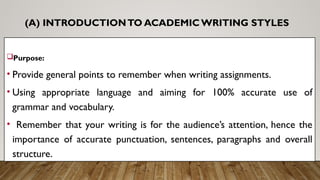
(A) INTRODUCTIONTO ACADEMIC WRITING STYLES
Purpose:
• Provide general points to remember when writing assignments.
• Using appropriate language and aiming for 100% accurate use of
grammar and vocabulary.
• Remember that your writing is for the audience’s attention, hence the
importance of accurate punctuation, sentences, paragraphs and overall
structure.
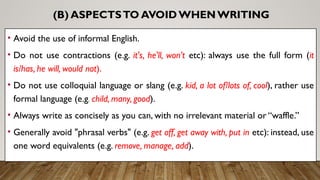
(B) ASPECTSTO AVOID WHENWRITING
• Avoid the use of informal English.
• Do not use contractions (e.g. it's, he'll, won’t etc): always use the full form (it
is/has, he will, would not).
• Do not use colloquial language or slang (e.g. kid, a lot of/lots of, cool), rather use
formal language (e.g. child, many, good).
• Always write as concisely as you can, with no irrelevant material or “waffle.”
• Generally avoid "phrasal verbs" (e.g. get off, get away with, put in etc): instead, use
one word equivalents (e.g. remove, manage, add).
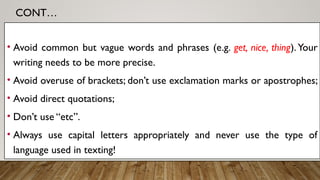
CONT…
• Avoid common but vague words and phrases (e.g. get, nice, thing).Your
writing needs to be more precise.
• Avoid overuse of brackets; don’t use exclamation marks or apostrophes;
• Avoid direct quotations;
• Don’t use “etc”.
• Always use capital letters appropriately and never use the type of
language used in texting!
(C) STRUCTUREYOUR WRITING CAREFULLY
•Make sure you write in complete sentences.
•Divide your writing up into paragraphs.
•Use connecting words and phrases to make your writing
explicit and easy to follow.
•Check your grammar and spelling carefully (Proofread and
Edit)
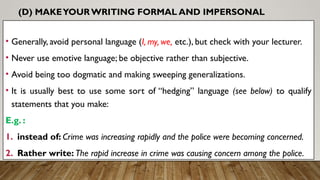
(D) MAKEYOUR WRITING FORMAL AND IMPERSONAL
• Generally, avoid personal language (I, my, we, etc.), but check with your lecturer.
• Never use emotive language; be objective rather than subjective.
• Avoid being too dogmatic and making sweeping generalizations.
• It is usually best to use some sort of “hedging” language (see below) to qualify
statements that you make:
E.g. :
1. instead of: Crime was increasing rapidly and the police were becoming concerned.
2. Rather write: The rapid increase in crime was causing concern among the police.
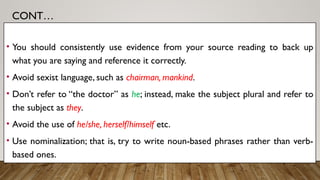
CONT…
• You should consistently use evidence from your source reading to back up
what you are saying and reference it correctly.
• Avoid sexist language, such as chairman, mankind.
• Don’t refer to “the doctor” as he; instead, make the subject plural and refer to
the subject as they.
• Avoid the use of he/she, herself/himself etc.
• Use nominalization; that is, try to write noun-based phrases rather than verb-
based ones.
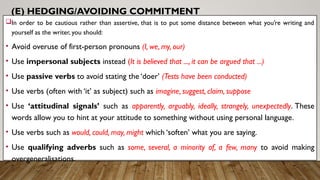
(E) HEDGING/AVOIDING COMMITMENT
In order to be cautious rather than assertive, that is to put some distance between what you’re writing and
yourself as the writer, you should:
• Avoid overuse of first-person pronouns (I, we, my, our)
• Use impersonal subjects instead (It is believed that ..., it can be argued that ...)
• Use passive verbs to avoid stating the ‘doer’ (Tests have been conducted)
• Use verbs (often with ‘it’ as subject) such as imagine, suggest, claim, suppose
• Use ‘attitudinal signals’ such as apparently, arguably, ideally, strangely, unexpectedly. These
words allow you to hint at your attitude to something without using personal language.
• Use verbs such as would, could, may, might which ‘soften’ what you are saying.
• Use qualifying adverbs such as some, several, a minority of, a few, many to avoid making
overgeneralisations.
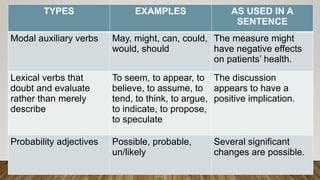
TYPES EXAMPLES AS USED IN A
SENTENCE
Modal auxiliary verbs May, might, can, could,
would, should
The measure might
have negative effects
on patients’ health.
Lexical verbs that
doubt and evaluate
rather than merely
describe
To seem, to appear, to
believe, to assume, to
tend, to think, to argue,
to indicate, to propose,
to speculate
The discussion
appears to have a
positive implication.
Probability adjectives Possible, probable,
un/likely
Several significant
changes are possible.
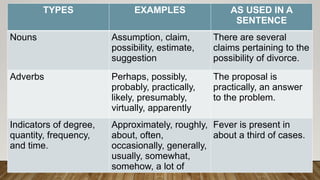
TYPES EXAMPLES AS USED IN A
SENTENCE
Nouns Assumption, claim,
possibility, estimate,
suggestion
There are several
claims pertaining to the
possibility of divorce.
Adverbs Perhaps, possibly,
probably, practically,
likely, presumably,
virtually, apparently
The proposal is
practically, an answer
to the problem.
Indicators of degree,
quantity, frequency,
and time.
Approximately, roughly,
about, often,
occasionally, generally,
usually, somewhat,
somehow, a lot of
Fever is present in
about a third of cases.
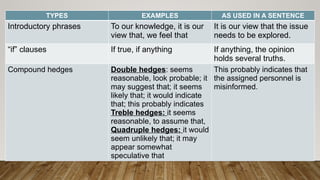
TYPES EXAMPLES AS USED IN A SENTENCE
Introductory phrases To our knowledge, it is our
view that, we feel that
It is our view that the issue
needs to be explored.
“if” clauses If true, if anything If anything, the opinion
holds several truths.
Compound hedges Double hedges: seems
reasonable, look probable; it
may suggest that; it seems
likely that; it would indicate
that; this probably indicates
Treble hedges: it seems
reasonable, to assume that,
Quadruple hedges: it would
seem unlikely that; it may
appear somewhat
speculative that
This probably indicates that
the assigned personnel is
misinformed.
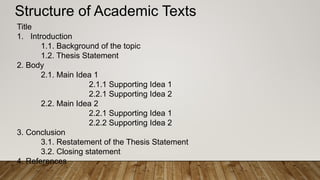
Structure of Academic Texts
Title
1. Introduction
1.1. Background of the topic
1.2. Thesis Statement
2. Body
2.1. Main Idea 1
2.1.1 Supporting Idea 1
2.2.1 Supporting Idea 2
2.2. Main Idea 2
2.2.1 Supporting Idea 1
2.2.2 Supporting Idea 2
3. Conclusion
3.1. Restatement of the Thesis Statement
3.2. Closing statement
4. References
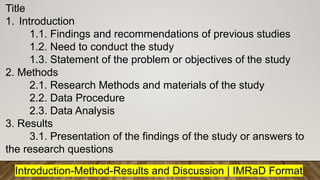
Title
1. Introduction
1.1. Findings and recommendations of previous studies
1.2. Need to conduct the study
1.3. Statement of the problem or objectives of the study
2. Methods
2.1. Research Methods and materials of the study
2.2. Data Procedure
2.3. Data Analysis
3. Results
3.1. Presentation of the findings of the study or answers to
the research questions
Introduction-Method-Results and Discussion | IMRaD Format
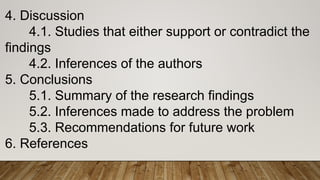
4. Discussion
4.1. Studies that either support or contradict the
findings
4.2. Inferences of the authors
5. Conclusions
5.1. Summary of the research findings
5.2. Inferences made to address the problem
5.3. Recommendations for future work
6. References
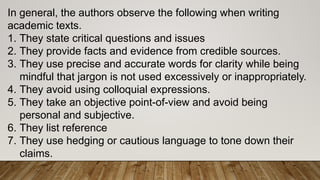
In general, the authors observe the following when writing
academic texts.
1. They state critical questions and issues
2. They provide facts and evidence from credible sources.
3. They use precise and accurate words for clarity while being
mindful that jargon is not used excessively or inappropriately.
4. They avoid using colloquial expressions.
5. They take an objective point-of-view and avoid being
personal and subjective.
6. They list reference
7. They use hedging or cautious language to tone down their
claims.
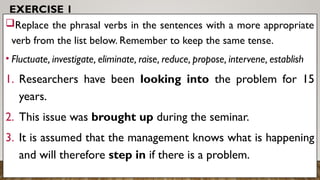
EXERCISE 1
Replace the phrasal verbs in the sentences with a more appropriate
verb from the list below. Remember to keep the same tense.
• Fluctuate, investigate, eliminate, raise, reduce, propose, intervene, establish
1. Researchers have been looking into the problem for 15
years.
2. This issue was brought up during the seminar.
3. It is assumed that the management knows what is happening
and will therefore step in if there is a problem.
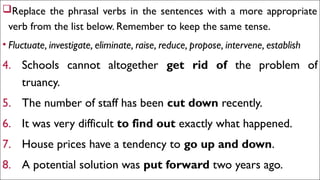
EXERCISE 1
Replace the phrasal verbs in the sentences with a more appropriate
verb from the list below. Remember to keep the same tense.
• Fluctuate, investigate, eliminate, raise, reduce, propose, intervene, establish
4. Schools cannot altogether get rid of the problem of
truancy.
5. The number of staff has been cut down recently.
6. It was very difficult to find out exactly what happened.
7. House prices have a tendency to go up and down.
8. A potential solution was put forward two years ago.
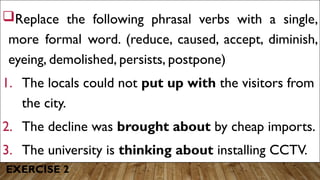
EXERCISE 2
Replace the following phrasal verbs with a single,
more formal word. (reduce, caused, accept, diminish,
eyeing, demolished, persists, postpone)
1. The locals could not put up with the visitors from
the city.
2. The decline was brought about by cheap imports.
3. The university is thinking about installing CCTV.
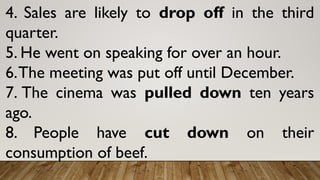
4. Sales are likely to drop off in the third
quarter.
5. He went on speaking for over an hour.
6.The meeting was put off until December.
7. The cinema was pulled down ten years
ago.
8. People have cut down on their
consumption of beef.
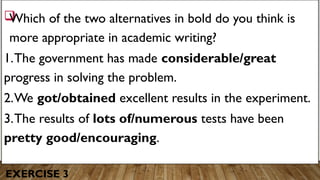
EXERCISE 3

Which of the two alternatives in bold do you think is
more appropriate in academic writing?
1.The government has made considerable/great
progress in solving the problem.
2.We got/obtained excellent results in the experiment.
3.The results of lots of/numerous tests have been
pretty good/encouraging.
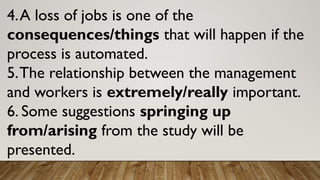
4.A loss of jobs is one of the
consequences/things that will happen if the
process is automated.
5.The relationship between the management
and workers is extremely/really important.
6. Some suggestions springing up
from/arising from the study will be
presented.

2. Lesson 2 - Academic Writing Style.pptx

  • 1.
    ACADEMIC WRITING STYLE ©UCT Writing Lab 2015
  • 2.
    (A) INTRODUCTIONTO ACADEMICWRITING STYLES Purpose: • Provide general points to remember when writing assignments. • Using appropriate language and aiming for 100% accurate use of grammar and vocabulary. • Remember that your writing is for the audience’s attention, hence the importance of accurate punctuation, sentences, paragraphs and overall structure.
  • 3.
    (B) ASPECTSTO AVOIDWHENWRITING • Avoid the use of informal English. • Do not use contractions (e.g. it's, he'll, won’t etc): always use the full form (it is/has, he will, would not). • Do not use colloquial language or slang (e.g. kid, a lot of/lots of, cool), rather use formal language (e.g. child, many, good). • Always write as concisely as you can, with no irrelevant material or “waffle.” • Generally avoid "phrasal verbs" (e.g. get off, get away with, put in etc): instead, use one word equivalents (e.g. remove, manage, add).
  • 4.
    CONT… • Avoid commonbut vague words and phrases (e.g. get, nice, thing).Your writing needs to be more precise. • Avoid overuse of brackets; don’t use exclamation marks or apostrophes; • Avoid direct quotations; • Don’t use “etc”. • Always use capital letters appropriately and never use the type of language used in texting!
  • 5.
    (C) STRUCTUREYOUR WRITINGCAREFULLY •Make sure you write in complete sentences. •Divide your writing up into paragraphs. •Use connecting words and phrases to make your writing explicit and easy to follow. •Check your grammar and spelling carefully (Proofread and Edit)
  • 6.
    (D) MAKEYOUR WRITINGFORMAL AND IMPERSONAL • Generally, avoid personal language (I, my, we, etc.), but check with your lecturer. • Never use emotive language; be objective rather than subjective. • Avoid being too dogmatic and making sweeping generalizations. • It is usually best to use some sort of “hedging” language (see below) to qualify statements that you make: E.g. : 1. instead of: Crime was increasing rapidly and the police were becoming concerned. 2. Rather write: The rapid increase in crime was causing concern among the police.
  • 7.
    CONT… • You shouldconsistently use evidence from your source reading to back up what you are saying and reference it correctly. • Avoid sexist language, such as chairman, mankind. • Don’t refer to “the doctor” as he; instead, make the subject plural and refer to the subject as they. • Avoid the use of he/she, herself/himself etc. • Use nominalization; that is, try to write noun-based phrases rather than verb- based ones.
  • 8.
    (E) HEDGING/AVOIDING COMMITMENT Inorder to be cautious rather than assertive, that is to put some distance between what you’re writing and yourself as the writer, you should: • Avoid overuse of first-person pronouns (I, we, my, our) • Use impersonal subjects instead (It is believed that ..., it can be argued that ...) • Use passive verbs to avoid stating the ‘doer’ (Tests have been conducted) • Use verbs (often with ‘it’ as subject) such as imagine, suggest, claim, suppose • Use ‘attitudinal signals’ such as apparently, arguably, ideally, strangely, unexpectedly. These words allow you to hint at your attitude to something without using personal language. • Use verbs such as would, could, may, might which ‘soften’ what you are saying. • Use qualifying adverbs such as some, several, a minority of, a few, many to avoid making overgeneralisations.
  • 9.
    TYPES EXAMPLES ASUSED IN A SENTENCE Modal auxiliary verbs May, might, can, could, would, should The measure might have negative effects on patients’ health. Lexical verbs that doubt and evaluate rather than merely describe To seem, to appear, to believe, to assume, to tend, to think, to argue, to indicate, to propose, to speculate The discussion appears to have a positive implication. Probability adjectives Possible, probable, un/likely Several significant changes are possible.
  • 10.
    TYPES EXAMPLES ASUSED IN A SENTENCE Nouns Assumption, claim, possibility, estimate, suggestion There are several claims pertaining to the possibility of divorce. Adverbs Perhaps, possibly, probably, practically, likely, presumably, virtually, apparently The proposal is practically, an answer to the problem. Indicators of degree, quantity, frequency, and time. Approximately, roughly, about, often, occasionally, generally, usually, somewhat, somehow, a lot of Fever is present in about a third of cases.
  • 11.
    TYPES EXAMPLES ASUSED IN A SENTENCE Introductory phrases To our knowledge, it is our view that, we feel that It is our view that the issue needs to be explored. “if” clauses If true, if anything If anything, the opinion holds several truths. Compound hedges Double hedges: seems reasonable, look probable; it may suggest that; it seems likely that; it would indicate that; this probably indicates Treble hedges: it seems reasonable, to assume that, Quadruple hedges: it would seem unlikely that; it may appear somewhat speculative that This probably indicates that the assigned personnel is misinformed.
  • 12.
    Structure of AcademicTexts Title 1. Introduction 1.1. Background of the topic 1.2. Thesis Statement 2. Body 2.1. Main Idea 1 2.1.1 Supporting Idea 1 2.2.1 Supporting Idea 2 2.2. Main Idea 2 2.2.1 Supporting Idea 1 2.2.2 Supporting Idea 2 3. Conclusion 3.1. Restatement of the Thesis Statement 3.2. Closing statement 4. References
  • 13.
    Title 1. Introduction 1.1. Findingsand recommendations of previous studies 1.2. Need to conduct the study 1.3. Statement of the problem or objectives of the study 2. Methods 2.1. Research Methods and materials of the study 2.2. Data Procedure 2.3. Data Analysis 3. Results 3.1. Presentation of the findings of the study or answers to the research questions Introduction-Method-Results and Discussion | IMRaD Format
  • 14.
    4. Discussion 4.1. Studiesthat either support or contradict the findings 4.2. Inferences of the authors 5. Conclusions 5.1. Summary of the research findings 5.2. Inferences made to address the problem 5.3. Recommendations for future work 6. References
  • 15.
    In general, theauthors observe the following when writing academic texts. 1. They state critical questions and issues 2. They provide facts and evidence from credible sources. 3. They use precise and accurate words for clarity while being mindful that jargon is not used excessively or inappropriately. 4. They avoid using colloquial expressions. 5. They take an objective point-of-view and avoid being personal and subjective. 6. They list reference 7. They use hedging or cautious language to tone down their claims.
  • 16.
    EXERCISE 1 Replace thephrasal verbs in the sentences with a more appropriate verb from the list below. Remember to keep the same tense. • Fluctuate, investigate, eliminate, raise, reduce, propose, intervene, establish 1. Researchers have been looking into the problem for 15 years. 2. This issue was brought up during the seminar. 3. It is assumed that the management knows what is happening and will therefore step in if there is a problem.
  • 17.
    EXERCISE 1 Replace thephrasal verbs in the sentences with a more appropriate verb from the list below. Remember to keep the same tense. • Fluctuate, investigate, eliminate, raise, reduce, propose, intervene, establish 4. Schools cannot altogether get rid of the problem of truancy. 5. The number of staff has been cut down recently. 6. It was very difficult to find out exactly what happened. 7. House prices have a tendency to go up and down. 8. A potential solution was put forward two years ago.
  • 18.
    EXERCISE 2 Replace thefollowing phrasal verbs with a single, more formal word. (reduce, caused, accept, diminish, eyeing, demolished, persists, postpone) 1. The locals could not put up with the visitors from the city. 2. The decline was brought about by cheap imports. 3. The university is thinking about installing CCTV.
  • 19.
    4. Sales arelikely to drop off in the third quarter. 5. He went on speaking for over an hour. 6.The meeting was put off until December. 7. The cinema was pulled down ten years ago. 8. People have cut down on their consumption of beef.
  • 20.
    EXERCISE 3  Which ofthe two alternatives in bold do you think is more appropriate in academic writing? 1.The government has made considerable/great progress in solving the problem. 2.We got/obtained excellent results in the experiment. 3.The results of lots of/numerous tests have been pretty good/encouraging.
  • 21.
    4.A loss ofjobs is one of the consequences/things that will happen if the process is automated. 5.The relationship between the management and workers is extremely/really important. 6. Some suggestions springing up from/arising from the study will be presented.