SLIDESMANIA.COM
SLIDESMANIA.COM
The Macroecology of Landscape
Ecology
Bio 223: Terrestrial Ecology
Banks-Leite, C., Betts, M. G., Ewers, R. M., Orme, C. D. L., & Pigot, A. L.
(2022).
SLIDESMANIA.COM
SLIDESMANIA.COM
Macroecology
Landscape Ecology concept
Landscape Pattern
Macroecological hypotheses
Overview
SLIDESMANIA.COM
SLIDESMANIA.COM
• Effect traits: an individuals’ behavioural, physiological, and morphological traits that are
associated with the species’ functions in the ecosystem.
• Habitat transformation: refers to all habitat changes, including habitat loss, habitat
fragmentation, and habitat degradation
• Mass effects: process which maintains populations that are not self-sustaining in isolation
through dispersal of individuals from nearby populations.
• Response traits: an individuals’ behavioural, physiological, and morphological traits that
determine the species’ responses to environmental change.
Terminologies
SLIDESMANIA.COM
SLIDESMANIA.COM
Macroecology
A subfield of ecology concerned with large spatial and/or temporal
scales, focusing on using statistical models to identify emergent
properties in species traits (e.g., body size), geographic ranges,
local abundance, and diversity to understand the general
ecological and evolutionary forces that influence these patterns.
SLIDESMANIA.COM
SLIDESMANIA.COM
Landscape Ecology
A subfield of ecology concerned with the reciprocal interactions
between spatial patterns and ecological processes at a range of
spatial scales. The appropriate spatial scale to quantify the
influence of landscape on biodiversity is generally conceptualised
in terms of the particular species, communities, or ecological
processes of interest.
SLIDESMANIA.COM
Causes of Landscape Pattern
� Biotic interactions
competition, herbivory, and
predation-and the role of
keystone species or
ecosystem engineers are
played out on the abiotic
template and influence
species assemblages.
� Abiotic factors
includes climate, which
strongly controls
biogeographic patterns, and
landform, which produces
patterns of physical relief
and soil development
� Disturbance and
succession
� Humans land use
SLIDESMANIA.COM
SLIDESMANIA.COM
SLIDESMANIA.COM
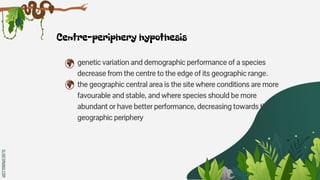
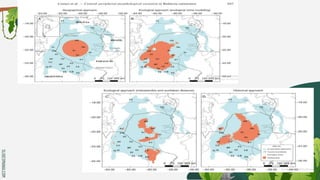
� genetic variation and demographic performance of a species
decrease from the centre to the edge of its geographic range.
� the geographic central area is the site where conditions are more
favourable and stable, and where species should be more
abundant or have better performance, decreasing towards the
geographic periphery
Centre–periphery hypothesis
SLIDESMANIA.COM
SLIDESMANIA.COM
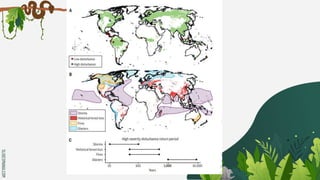
� areas that have experienced disturbance over extended periods of time host
communities that are more resilient to present-day habitat transformation.
� can be explained in two ways: sensitive species in intensively disturbed areas
either have already been driven extinct or have adapted over time to become less
sensitive. If historical disturbances have led species to extinction, it is likely that
species with smaller ranges were the ones that went extinct.
Extinction-filter hypothesis
SLIDESMANIA.COM
SLIDESMANIA.COM
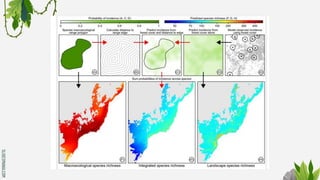
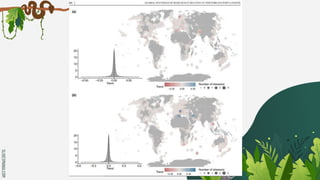
� species’ bioclimatic envelopes dictate large-scale patterns of diversity
� climate suitability, distance to range edge, and habitat transformation are all able
to alter population sizes, fitness, and gene flow in similar ways suggests that the
strength and direction of populations’ and species’ responses to habitat
transformation could be driven by the interaction among natural and
anthropogenic stressors.
Physiological tolerance hypothesis
SLIDESMANIA.COM
SLIDESMANIA.COM
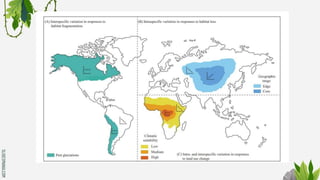
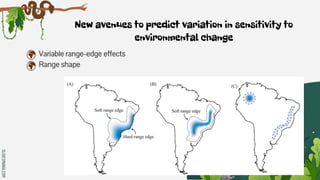
� Variable range-edge effects
� Range shape
New avenues to predict variation in sensitivity to
environmental change
SLIDESMANIA.COM
� Intraspecific variability in functional traits
� Geographic variation in disturbance history
New avenues to predict variation in sensitivity to
environmental change
SLIDESMANIA.COM
SLIDESMANIA.COM
Integrating theories from macroecology into landscape ecology provides
better understanding of the drivers of species loss, ultimately leading to
more reliable accurate determination of patterns and predictions as well
as guidelines of where to best allocate resources for conservation and
restoration.
Conclusion
SLIDESMANIA.COM
References
• Banks-Leite, C., Betts, M. G., Ewers, R. M., Orme, C. D. L., & Pigot, A. L. (2022). The macroecology of landscape
ecology. Trends in Ecology & Evolution.
• Turner, M. G. (2005). Landscape ecology: what is the state of the science?. Annu. Rev. Ecol. Evol. Syst., 36, 319-
344.
• Camps, G. A., Cosacov, A., & Sérsic, A. N. (2021). Centre–periphery approaches based on geography, ecology
and historical climate stability: what explains the variation in morphological traits of Bulnesia sarmientoi?. Annals
of Botany, 127(7), 943-955.
• Betts, M. G., Wolf, C., Pfeifer, M., Banks-Leite, C., Arroyo-Rodríguez, V., Ribeiro, D. B., ... & Ewers, R. M. (2019).
Extinction filters mediate the global effects of habitat fragmentation on animals. Science, 366(6470), 1236-1239.
• Jacob, S., Laurent, E., Haegeman, B., Bertrand, R., Prunier, J. G., Legrand, D., ... & Schtickzelle, N. (2018). Habitat
choice meets thermal specialization: Competition with specialists may drive suboptimal habitat preferences in
generalists. Proceedings of the National Academy of Sciences, 115(47), 11988-11993.
• Capdevila, P., Noviello, N., McRae, L., Freeman, R., & Clements, C. F. (2022). Global patterns of resilience decline
in vertebrate populations. Ecology letters, 25(1), 240-251.
SLIDESMANIA.COM
SLIDESMANIA.COM
Thank you!