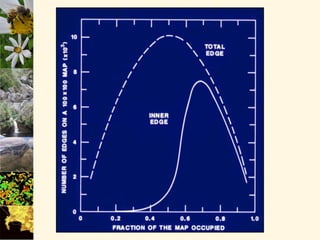
The document discusses several key theories in landscape ecology, including percolation theory, source-sink models, and organism-space interactions. Percolation theory examines how the connectivity of occupied spaces in a landscape affects the movement of species. Source-sink models define certain areas as "sources" that positively contribute to ecological processes or "sinks" that are unhelpful. These concepts can be applied to issues like wildfire spread, disease transmission, and resource usage. Organism-space interaction theories explore how population dynamics depend on landscape characteristics such as habitat size, proximity, and fragmentation.








![[Ostrom, 2009] a general framework for analyzing sustainability of social-e...](https://cdn.slidesharecdn.com/ss_thumbnails/ostrom2009-ageneralframeworkforanalyzingsustainabilityofsocial-ecologicalsystems-211108205623-thumbnail.jpg?width=640&height=640&fit=bounds)


