1
FACULTY OF CIVIL ENGINEERING
Land Use and Environmental Planning
Land Degradation
Lecture:
Dr. Shazwin Binti Mat Taib
Done by
MAZEN ABDO MOHAMMED ALQADI
MKA141077
Land Degradation
1. Introduction
The term land degradation refer to the long term loss of ecosystem function and
productivity caused by disturbances from which the land cannot recover [2]. It is also
defined as the change in the characteristic and quality of soil which adversely affect its
fertility. It is the result of complex inter-relationships between biophysical and socio-
economic issues which affect many people and their land, especially in the tropics and
developing countries [3]. Land degradation can best be understood as a reduction of
soil fertility or a loss of ‘greenness’. Lack of sustainable land management may reduce
soil moisture and organic substance content and cause a loss of nutrients. Eventually,
this may lead to degradation of the soil system and loss of productivity. Over time, this
causes land degradation, which in turn may have negative effects on food security,
particularly when excessive groundwater extraction leads to disruption of water
balance, soil salinity and reduced levels of fresh water [2].
2. Causes of land degradation
According to [4], the causes of land degradation can be divided into natural hazards,
direct causes, and underlying causes. Natural hazards are the conditions of the physical
environment which lead to the existence of a high degradation hazard, for example
steep slopes as a hazard for water erosion. Direct causes are unsuitable land use and
inappropriate land management practices, for example the cultivation of steep slopes
without measures for soil conservation. Underlying causes are the reasons why these
inappropriate types of land use and management are practised; for example, the slopes
may be cultivated because the landless poor need food, and conservation measures not
adopted because these farmers lack security of tenure. However, Mondal [5], reported
that, land is degraded because of the following reason; desertification; deforestation,
overgrazing, agricultural practices such as excessive use of fertilizer and pesticides;
industrialization; salination and urbanization as well as water and wind erosion [4].
2.1 Causes of land degradation in Asia
The causes of land degradation in Asia have been reported by Sivakumar [6], as
the increasing in population, increasing pressure on land, decline in soil and water
resources, decline in natural forests and grasslands, increasing atmospheric carbon and
changing climate, deterioration in living condition for many people.
Asia is the most populated area that has been influenced by desertification in
the world. With the rapid economic development in Asian countries, the rapidly
growing population is placing ever-increasing demands on the land, clearing natural
vegetation and tilling soil without fallow or nutrient replenishment. Hence the area
under land degradation is increasing. And the population increase, the pressure on land
increase as well. Therefore, increasing the demand for agricultural land, food, water
and shelter has put pressure on the land and water resources. This is resulting in
environment degeneration in the region and the trend is intensifying unceasingly.
Moreover, due to the decline in natural vegetation and unsustainable agriculture, the
capacity of soil and water resources to support life has been steadily reduced. In
addition, because of overgrazing and deforestation, natural vegetation cover continues
to decline. Resulting in a huge impact on biodiversity which is declining. Climate
change also has a great impact on land causing it to degrade in the form of droughts and
desertification. With increasing unsustainable use of resources, land degradation leads
to further degradation of land resources, which leads to increased poverty and many
people have to face deteriorating living conditions. About 35% of the arable land in
Asia has been influenced by desertification. Nearly 1.3 billion people or 39% of the
total population in Asian region, are exposed to desertification and the arid conditions
[6].
3. Impact of land degradation
Land-degradation effect agricultural industry. Thus the economic and social
effects of land degradation are felt most by the people involved in agriculture. For
example, in relation to soil, in the short term the economic and social effects may
come from the reduced capacity of the soil to sustain plant growth for crops or
pasture, resulting in reduced yields.
The result of land degradation is small farms, low production per person and
increasing landlessness (land shortage). As a consequence of land shortage is poverty.
Land shortage and poverty lead to non-sustainable land management practices, the
direct causes of degradation. Poor farmers are led to clear forest, cultivate steep slopes
without conservation, overgraze rangelands and make unbalanced fertilizer
applications.
Another important impact of land degradation is threat of food security. As the
world population and land degradation increase, world food security decrease. This
will eventually result in conflict over resources as well as poverty. Figure 1, 2, and 3
shows the effect of land degradation in term of food and water security, poverty and
others.
Figure 1: Relationship between land degradation and conflict risk. (Source: [1])
Figure 2: relationship between land degradation – food and water scarcity – and
conflict risk. (Source: [1])
Figure 3: Relationship between land degradation causes and effects.
4. Case study: Desertification in Sudan
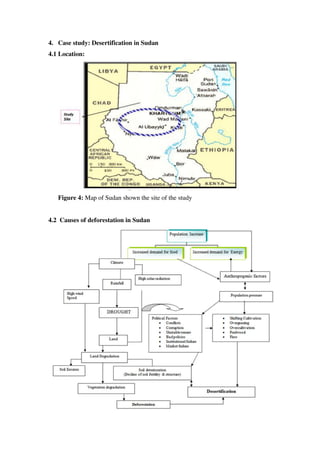
4.1 Location:
Figure 4: Map of Sudan shown the site of the study
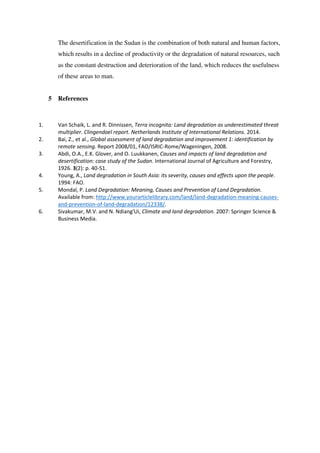
4.2 Causes of deforestation in Sudan
The desertification in the Sudan is the combination of both natural and human factors,
which results in a decline of productivity or the degradation of natural resources, such
as the constant destruction and deterioration of the land, which reduces the usefulness
of these areas to man.
5 References
1. Van Schaik, L. and R. Dinnissen, Terra incognita: Land degradation as underestimated threat
multiplier. Clingendael report. Netherlands Institute of International Relations. 2014.
2. Bai, Z., et al., Global assessment of land degradation and improvement 1: identification by
remote sensing. Report 2008/01, FAO/ISRIC-Rome/Wageningen, 2008.
3. Abdi, O.A., E.K. Glover, and O. Luukkanen, Causes and impacts of land degradation and
desertification: case study of the Sudan. International Journal of Agriculture and Forestry,
1926. 3(2): p. 40-51.
4. Young, A., Land degradation in South Asia: its severity, causes and effects upon the people.
1994: FAO.
5. Mondal, P. Land Degradation: Meaning, Causes and Prevention of Land Degradation.
Available from: http://www.yourarticlelibrary.com/land/land-degradation-meaning-causes-
and-prevention-of-land-degradation/12338/.
6. Sivakumar, M.V. and N. Ndiang'Ui, Climate and land degradation. 2007: Springer Science &
Business Media.

Land degradation

  • 1.
    1 FACULTY OF CIVILENGINEERING Land Use and Environmental Planning Land Degradation Lecture: Dr. Shazwin Binti Mat Taib Done by MAZEN ABDO MOHAMMED ALQADI MKA141077
  • 2.
    Land Degradation 1. Introduction Theterm land degradation refer to the long term loss of ecosystem function and productivity caused by disturbances from which the land cannot recover [2]. It is also defined as the change in the characteristic and quality of soil which adversely affect its fertility. It is the result of complex inter-relationships between biophysical and socio- economic issues which affect many people and their land, especially in the tropics and developing countries [3]. Land degradation can best be understood as a reduction of soil fertility or a loss of ‘greenness’. Lack of sustainable land management may reduce soil moisture and organic substance content and cause a loss of nutrients. Eventually, this may lead to degradation of the soil system and loss of productivity. Over time, this causes land degradation, which in turn may have negative effects on food security, particularly when excessive groundwater extraction leads to disruption of water balance, soil salinity and reduced levels of fresh water [2]. 2. Causes of land degradation According to [4], the causes of land degradation can be divided into natural hazards, direct causes, and underlying causes. Natural hazards are the conditions of the physical environment which lead to the existence of a high degradation hazard, for example steep slopes as a hazard for water erosion. Direct causes are unsuitable land use and inappropriate land management practices, for example the cultivation of steep slopes without measures for soil conservation. Underlying causes are the reasons why these inappropriate types of land use and management are practised; for example, the slopes may be cultivated because the landless poor need food, and conservation measures not
  • 3.
    adopted because thesefarmers lack security of tenure. However, Mondal [5], reported that, land is degraded because of the following reason; desertification; deforestation, overgrazing, agricultural practices such as excessive use of fertilizer and pesticides; industrialization; salination and urbanization as well as water and wind erosion [4]. 2.1 Causes of land degradation in Asia The causes of land degradation in Asia have been reported by Sivakumar [6], as the increasing in population, increasing pressure on land, decline in soil and water resources, decline in natural forests and grasslands, increasing atmospheric carbon and changing climate, deterioration in living condition for many people. Asia is the most populated area that has been influenced by desertification in the world. With the rapid economic development in Asian countries, the rapidly growing population is placing ever-increasing demands on the land, clearing natural vegetation and tilling soil without fallow or nutrient replenishment. Hence the area under land degradation is increasing. And the population increase, the pressure on land increase as well. Therefore, increasing the demand for agricultural land, food, water and shelter has put pressure on the land and water resources. This is resulting in environment degeneration in the region and the trend is intensifying unceasingly. Moreover, due to the decline in natural vegetation and unsustainable agriculture, the capacity of soil and water resources to support life has been steadily reduced. In addition, because of overgrazing and deforestation, natural vegetation cover continues to decline. Resulting in a huge impact on biodiversity which is declining. Climate change also has a great impact on land causing it to degrade in the form of droughts and desertification. With increasing unsustainable use of resources, land degradation leads to further degradation of land resources, which leads to increased poverty and many people have to face deteriorating living conditions. About 35% of the arable land in Asia has been influenced by desertification. Nearly 1.3 billion people or 39% of the total population in Asian region, are exposed to desertification and the arid conditions [6].
  • 4.
    3. Impact ofland degradation Land-degradation effect agricultural industry. Thus the economic and social effects of land degradation are felt most by the people involved in agriculture. For example, in relation to soil, in the short term the economic and social effects may come from the reduced capacity of the soil to sustain plant growth for crops or pasture, resulting in reduced yields. The result of land degradation is small farms, low production per person and increasing landlessness (land shortage). As a consequence of land shortage is poverty. Land shortage and poverty lead to non-sustainable land management practices, the direct causes of degradation. Poor farmers are led to clear forest, cultivate steep slopes without conservation, overgraze rangelands and make unbalanced fertilizer applications. Another important impact of land degradation is threat of food security. As the world population and land degradation increase, world food security decrease. This will eventually result in conflict over resources as well as poverty. Figure 1, 2, and 3 shows the effect of land degradation in term of food and water security, poverty and others. Figure 1: Relationship between land degradation and conflict risk. (Source: [1])
  • 5.
    Figure 2: relationshipbetween land degradation – food and water scarcity – and conflict risk. (Source: [1]) Figure 3: Relationship between land degradation causes and effects.
  • 6.
    4. Case study:Desertification in Sudan 4.1 Location: Figure 4: Map of Sudan shown the site of the study 4.2 Causes of deforestation in Sudan
  • 7.
    The desertification inthe Sudan is the combination of both natural and human factors, which results in a decline of productivity or the degradation of natural resources, such as the constant destruction and deterioration of the land, which reduces the usefulness of these areas to man. 5 References 1. Van Schaik, L. and R. Dinnissen, Terra incognita: Land degradation as underestimated threat multiplier. Clingendael report. Netherlands Institute of International Relations. 2014. 2. Bai, Z., et al., Global assessment of land degradation and improvement 1: identification by remote sensing. Report 2008/01, FAO/ISRIC-Rome/Wageningen, 2008. 3. Abdi, O.A., E.K. Glover, and O. Luukkanen, Causes and impacts of land degradation and desertification: case study of the Sudan. International Journal of Agriculture and Forestry, 1926. 3(2): p. 40-51. 4. Young, A., Land degradation in South Asia: its severity, causes and effects upon the people. 1994: FAO. 5. Mondal, P. Land Degradation: Meaning, Causes and Prevention of Land Degradation. Available from: http://www.yourarticlelibrary.com/land/land-degradation-meaning-causes- and-prevention-of-land-degradation/12338/. 6. Sivakumar, M.V. and N. Ndiang'Ui, Climate and land degradation. 2007: Springer Science & Business Media.