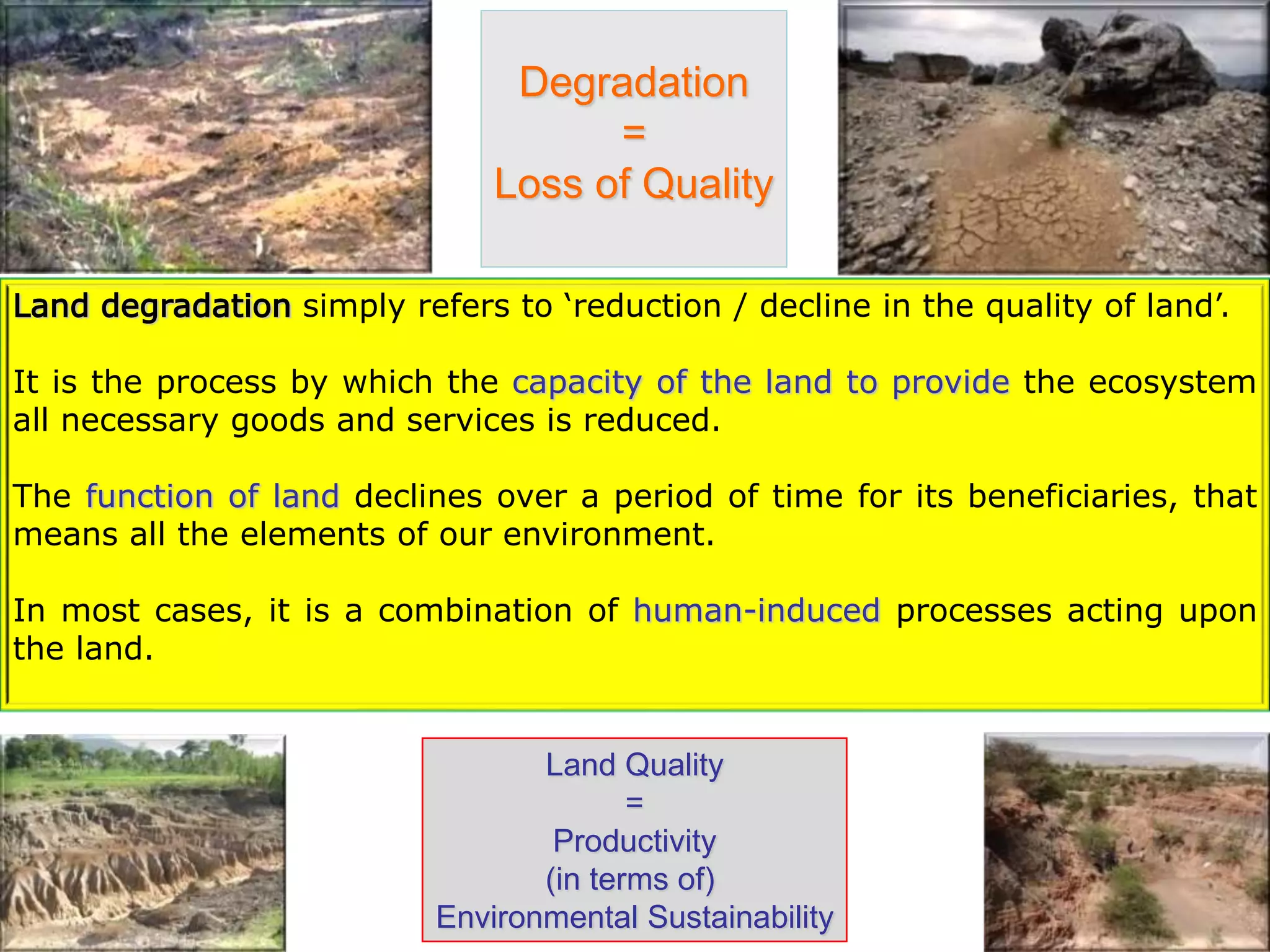
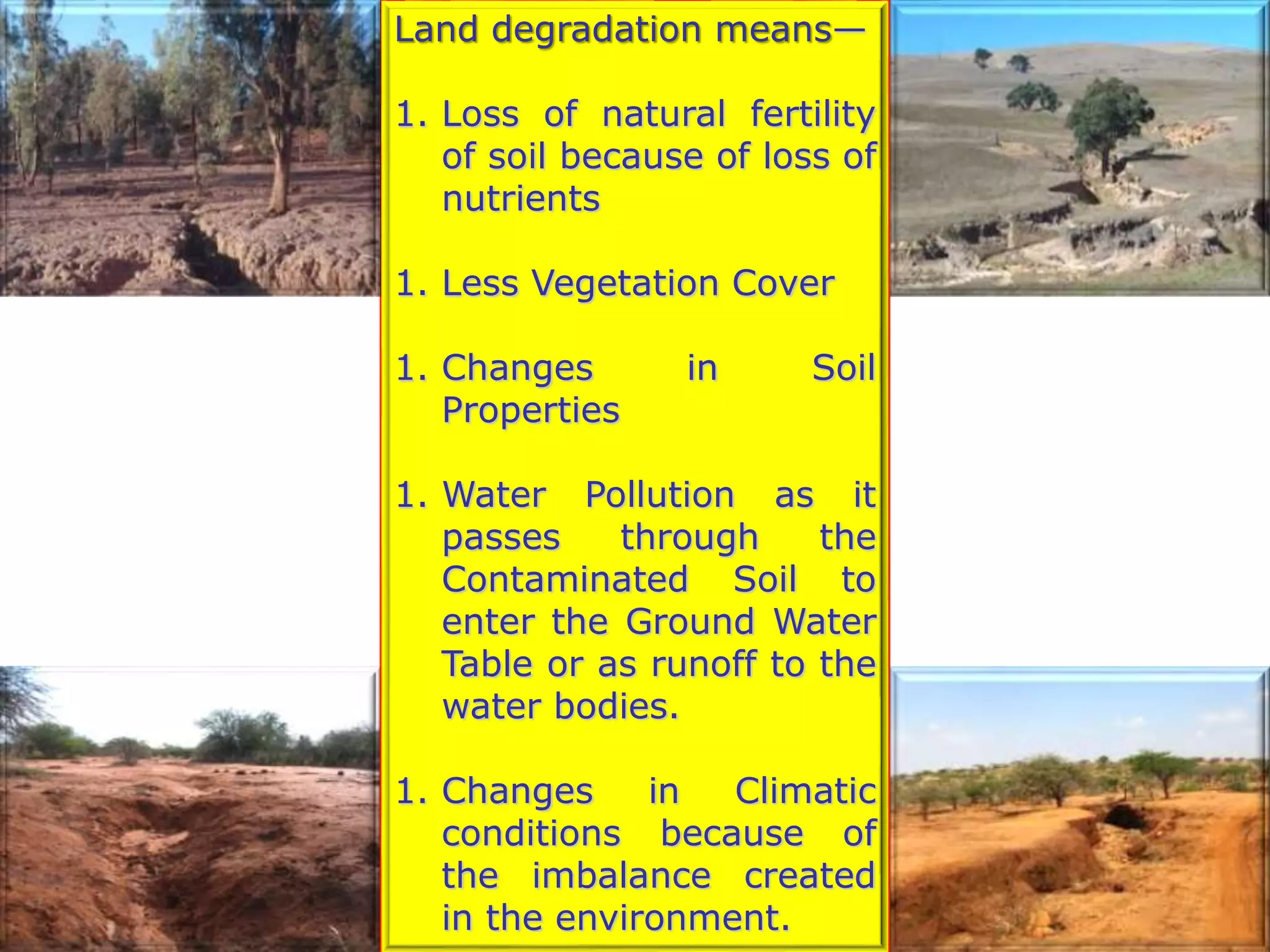
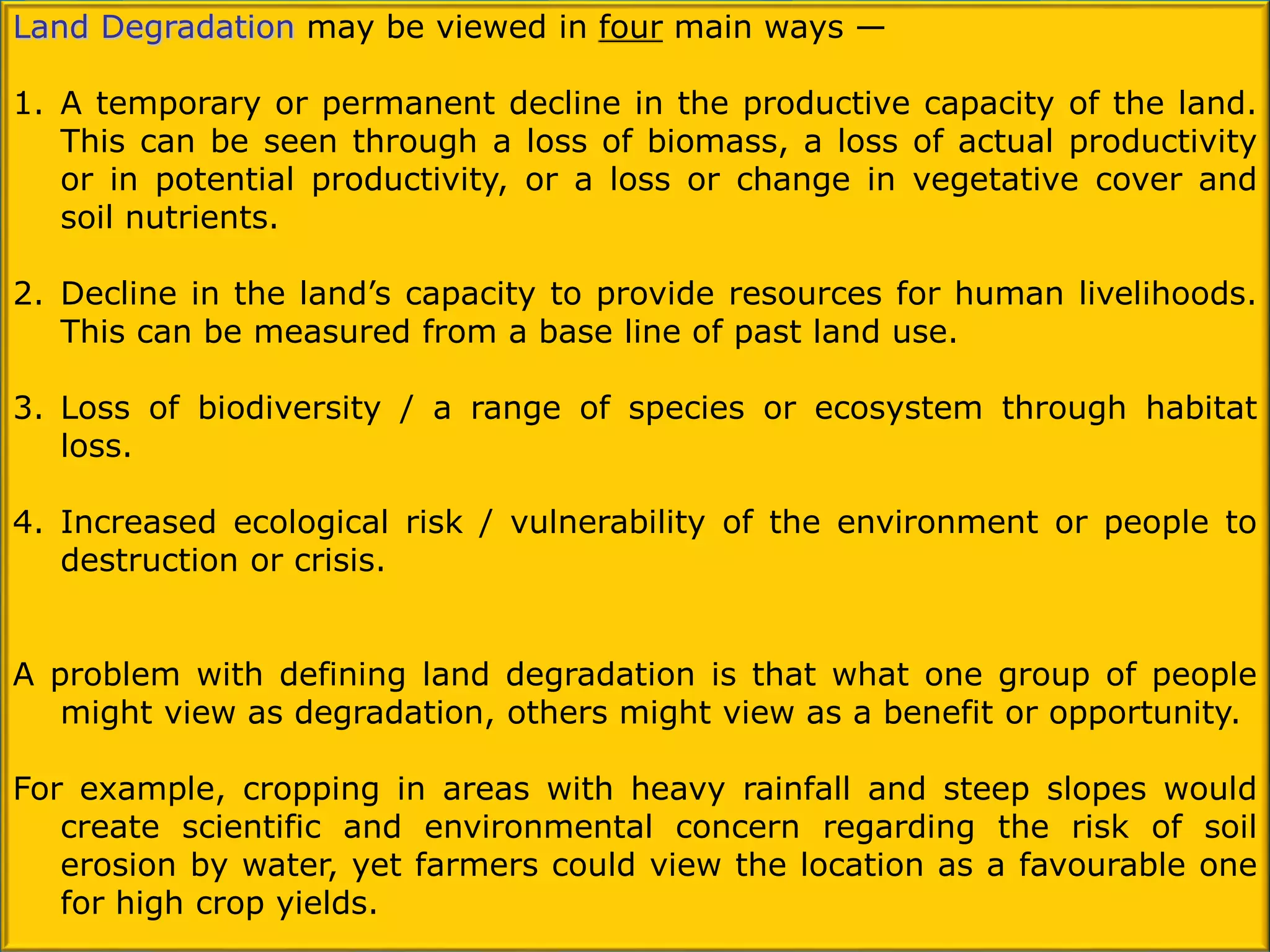
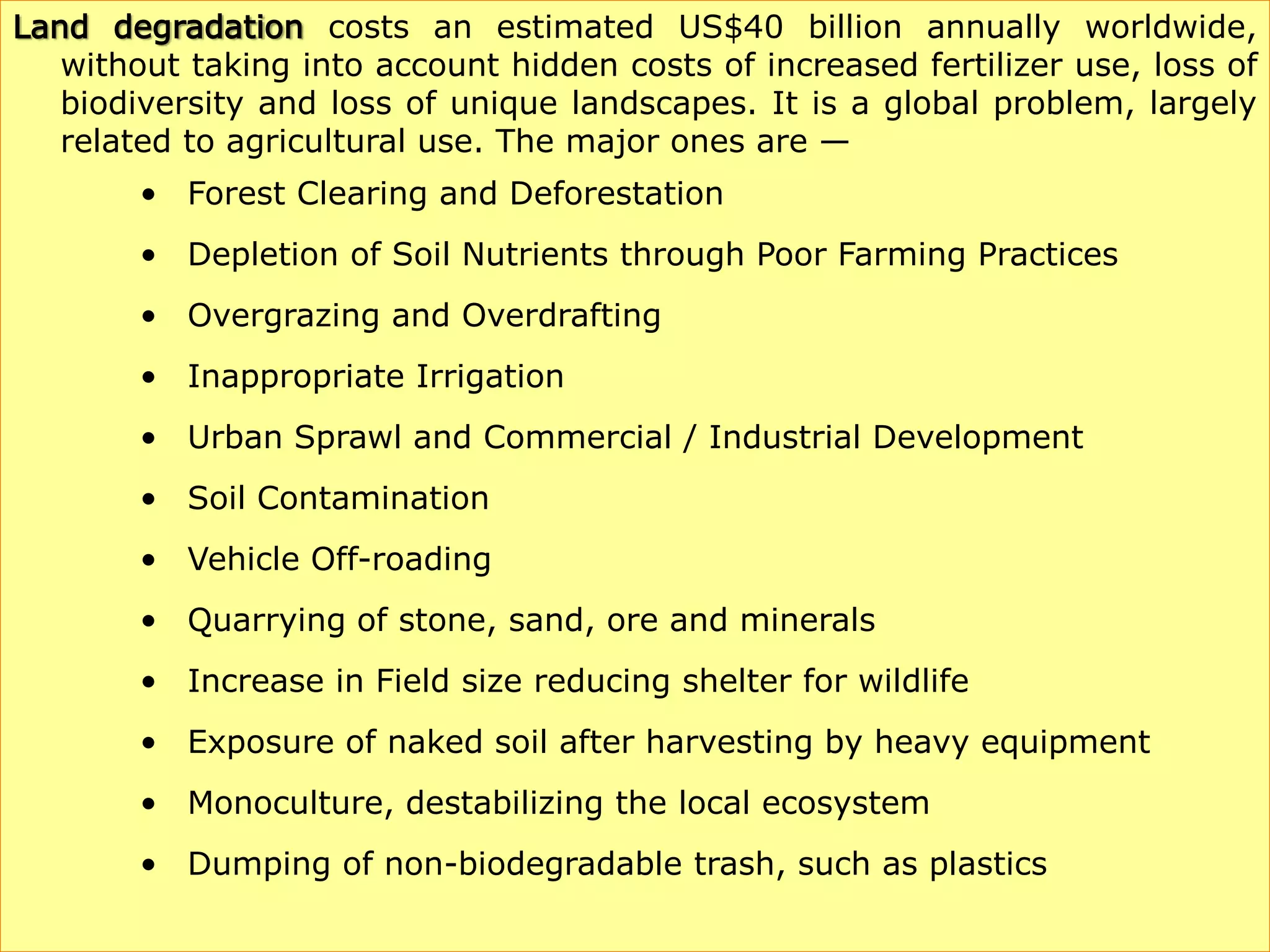
Land degradation simply refers to ‘reduction / decline in the quality of land’.
It is the process by which the capacity of the land to provide the ecosystem
all necessary goods and services is reduced.
The function of land declines over a period of time for its beneficiaries, that
means all the elements of our environment.
In most cases, it is a combination of human-induced processes acting upon
the land.
Degradation
=
Loss of Quality
Land Quality
=
Productivity
(in terms of)
Environmental Sustainability
Land degradation means—
1. Loss of natural fertility
of soil because of loss of
nutrients
1. Less Vegetation Cover
1. Changes in Soil
Properties
1. Water Pollution as it
passes through the
Contaminated Soil to
enter the Ground Water
Table or as runoff to the
water bodies.
1. Changes in Climatic
conditions because of
the imbalance created
in the environment.
Land degradation is considered
to be an important topic of the
21st century due to its
implications upon —
1. The agronomic productivity,
2. The environment, and
3. its effects on food security.
It is estimated that up to 40% of
the world's agricultural land is
seriously degraded.
Land Degradation may be viewed in four main ways —
1. A temporary or permanent decline in the productive capacity of the land.
This can be seen through a loss of biomass, a loss of actual productivity
or in potential productivity, or a loss or change in vegetative cover and
soil nutrients.
2. Decline in the land’s capacity to provide resources for human livelihoods.
This can be measured from a base line of past land use.
3. Loss of biodiversity / a range of species or ecosystem through habitat
loss.
4. Increased ecological risk / vulnerability of the environment or people to
destruction or crisis.
A problem with defining land degradation is that what one group of people
might view as degradation, others might view as a benefit or opportunity.
For example, cropping in areas with heavy rainfall and steep slopes would
create scientific and environmental concern regarding the risk of soil
erosion by water, yet farmers could view the location as a favourable one
for high crop yields.
Types of Land Degradation
1. Land Degradation due to Water Action
2. Land Degradation due to Wind Action
3. Land degradation due to Mechanical Erosion
4. Land degradation due to Physical Degradation
5. Land degradation due to Chemical Degradation
6. Land degradation due to Biological Degradation
7. Land degradation due to Pollution (often chemical, by agricultural,
industrial, mining or commercial activities)
8. Land degradation due to Loss of Arable Land due to urban
construction
9. Land degradation due to Artificial Radioactivity, sometimes accidental
10.Land degradation due to Landuse Constraints associated with armed
conflicts.
Overall, 36 types of land degradation can be assessed. All are induced or
aggravated by human activities —
sheet erosion, silting, aridification, salinization, urbanization, etc.
Causes of Land Degradation
(a) Deforestation
It is taking place at a faster rate due to increasing demands of timber,
fuel and forest products which results into degradation of land resources.
(b) Overgrazing
Overgrazing results into reduced growth of vegetation, reduced diversity
of plant species, excessive growth of unwanted plant species, soil
erosion, and degradation of land due to cattle movement.
(c) Agricultural Practices
The modern agricultural practices, excessive use of fertilizers and
pesticides has adversely degraded the natural quality and fertility of the
cultivation land.
(d) Industrialization
Development of industries for the economic growth of the country leads
to excessive deforestation and utilization of land in such as way that it
has lost its natural up gradation quality.
(e) Urbanization
Increasing growth of population and demand for more residential areas
and commercial sectors is also one of the reasons for land degradation.
Land degradation costs an estimated US$40 billion annually worldwide,
without taking into account hidden costs of increased fertilizer use, loss of
biodiversity and loss of unique landscapes. It is a global problem, largely
related to agricultural use. The major ones are —
• Forest Clearing and Deforestation
• Depletion of Soil Nutrients through Poor Farming Practices
• Overgrazing and Overdrafting
• Inappropriate Irrigation
• Urban Sprawl and Commercial / Industrial Development
• Soil Contamination
• Vehicle Off-roading
• Quarrying of stone, sand, ore and minerals
• Increase in Field size reducing shelter for wildlife
• Exposure of naked soil after harvesting by heavy equipment
• Monoculture, destabilizing the local ecosystem
• Dumping of non-biodegradable trash, such as plastics
Thus,
• Increased population pressures
and excessive human expansion
enhance degradation.
• Introduction of irrigated and non-
irrigated cash crops, and the use
of water for industrial and urban
purposes at the expense of rural
agricultural producers break links
in traditional production chains
that lead to the breakdown of the
entire production systems.
2. The removal of the protective
cover, ploughing, heavy grazing
and deforestation leave the soil
highly vulnerable to wind erosion
particularly during severe
droughts.
3. Heavy grazing around water points
or during long droughts prevents
or delays the regrowth of
vegetation or favours only
unpalatable shrubs.
1. Land degradation is one of the great
challenges of the 21st century.
2. Drought and desertification destroys 12
million hectares a year (an area the size of
Greece) and impacts 1.5 billion people –
mainly the poor and underprivileged.
3. It is mostly caused by human activity: poor
agricultural practices, intensive farming
methods that remove soil nutrients, flood
irrigation, chemical pollution, etc.
The consequences of land degradation are —
Reduced land productivity, socio-economic problems,
including uncertainty in food security, migration,
limited development and damage to ecosystems.
Degraded land is costly to reclaim and, if severely
degraded, may no longer provide a range of
ecosystem functions and services with a loss of
the goods and many other potential
environmental, social, economic and non-material
benefits that are critical for society and
development.
We are now running out of healthy
soil that supports life and human
development.
The dramatic weather conditions we
are experiencing today are the
result of “only” 0.8°C of warming.
Our lack of action to curb
emissions puts us on a path
towards much higher
temperatures leading to the
degradation of land, soil and
environment as a whole.
The good news is that there are
solutions and they do not require
high technology or large
investments.
Innovative, low-tech and low-cost
solutions are available. Their
deployment at scale requires
greater awareness and concerted
action between government,
business and civil society.
We can bring back to life trees and vegetation in areas that were turning into deserts.
Trees can provide protection from extreme temperatures, they maintain moisture,
increase biodiversity, can help protect crops from pests and can dramatically
increase yields.
In ancient times herds of animals were protecting lands from desertification. These
herds are now gone and the land is degrading. The use of cattle to “mimic” nature, a
process called “bio-mimicry”, can help restore degraded lands.
We often forget the long-lasting impacts on land of armed conflicts. The Gulf War
resulted in the largest terrestrial oil spill in history and has permanently contaminated
Kuwait’s groundwater.
Industrial activity and toxic chemicals pollute water, soil and impact the lives of millions.
Globally, obsolete pesticide stockpiles of 5 million tons are awaiting destruction. Their
safe elimination will cost €20 billion and require the cooperation of civil society,
governments and the private sector.
The human activity has created all these problems and time is running out. But through
ingenuity and cooperation we can still repair and restore degraded lands and
ecosystems.
Even some of the worst impacts of climate change can be avoided as well.
Prevention and Control Measures for Land Degradation
1. Strip farming in which cultivated crops are sown in alternative strips to
prevent water movement.
2. Crop Rotation is one of the agricultural practice in which different crops
are grown in same area following a rotation system which helps in
replenishment of the soil.
3. Ridge and Furrow Formation to prevent soil / land degradation during
irrigation which lessens run off.
4. Construction of Dams to check or reduce the velocity of run off so that soil
support vegetation.
5. Contour Farming is useful in collecting and diverting the run off to avoid
erosion.
6. Rainwater Harvesting
7. Sustainable Urbanisation / Smart City Development
8. Use of Non-Conventional Energy
9. Scientific Solid Waste Management
10.Govt. Intention
11.Political Will
12.Public Awareness and Participation
There are no easy solutions and no panaceas to the "land degradation " problem.
Each country will have to develop its own package of land and water husbandry
measures'
with due emphasis
on
1. the central importance of land conservation,
2. the capacity building in human, institution and infrastructure fields,
3. equity, social and political justice
4. people's participation and accountability.
Without attention to these factors, no plan or technical solution stands much chance of
success.
Sl.
No.
Particulars / Type of
land / degraded lands
Area in
Hectares
Area in
Hectares
Total Area /
Forest lands
Degraded
Land
1
Total Geographical
area of West Bengal
88,75,200 -
2 Area under Forest 11,87,900 -
3
Degraded lands in
non-forest areas
- -
(a)
Sheet, Rill & Gullied
Area (major area as
cultivable wasteland)
- 6,66,000
(b)
Water logged (a
portion as cultivable
wasteland)
- 5,76,000
(c) Saline / Saline alkali - 8,20,450
(d) Mining - 14,500
(e) Land slip, land slide - 35,000
(f) Sea coastal - 12,000
(g)
Stream bank erosion
& sand laden area
- 67,350
TOTAL 21,91,300
• PROVIDING LIVELIHOOD SUPPORT
THROUGH IWDP.
• Project-IV is being implemented in
Ausgram-I Panchayat Samity of
Burdwan district since 2006.
• While all out efforts are being made
to harvest every drop of water, at the
same time efforts are being made to
extend livelihood support to the
farmers of the area.
• Department of Sericulture,
Government of West Bengal came up
with technological support. As
cultivation of field crop is very
difficult due to scarcity of water and
arable land, plantation of arjun was
taken up on a piece of land
measuring around 5 ha. These plants
will harbour tasar silk moth and the
farmers will fetch a good harvest
without any financial involvement. An
SHG with women members from BPL
families [ Alo mahila Dal] were
tagged with the project to up keep
the project and get the benefit out of
the same. Within two years the
project will be self sustaining.
Project-III under IWDP is being implemented in
Ausgram-II Panchayat Samity of Burdwan
district since 2004. The treatable area is
completely lateritic with rock strata in the
shallow sub surface. As a result the water
holding capacity of soil of that area ia very low.
It is very difficult to sustain plants planted in
agro forestry or social forestry.
To increase availability of water in
both surface and sub surface, a number of
Water Harvesting Structures have been created
in the project area. But that was not sufficient.
Due to high gradient of land surface in the area
whatever little amount of water reaches in the
subsurface area , get quickly percolated.
Further, the precipitation received drains out
very fast in the common drainage line.
To check this loss of precious water,
help from State Water Investigation Directorate
was solicited. After detail study of the nature of
the topography and soil, they planned to build a
series of check dams [ both RCC and morrum
filled bags across the main drainage line at an
estimated cost of 20.8 lakh rupees.
Construction is now complete and the
stakeholders are waiting for reaping the benefit
of those check dams during ensuing rainy
season
Thank You
Land Degradation – nature and concerns
Prof Ashis Sarkar
profdrashis@gmail.com

Land Degradation – nature and concerns

  • 1.
    Land degradation simplyrefers to ‘reduction / decline in the quality of land’. It is the process by which the capacity of the land to provide the ecosystem all necessary goods and services is reduced. The function of land declines over a period of time for its beneficiaries, that means all the elements of our environment. In most cases, it is a combination of human-induced processes acting upon the land. Degradation = Loss of Quality Land Quality = Productivity (in terms of) Environmental Sustainability
  • 2.
    Land degradation means— 1.Loss of natural fertility of soil because of loss of nutrients 1. Less Vegetation Cover 1. Changes in Soil Properties 1. Water Pollution as it passes through the Contaminated Soil to enter the Ground Water Table or as runoff to the water bodies. 1. Changes in Climatic conditions because of the imbalance created in the environment.
  • 3.
    Land degradation isconsidered to be an important topic of the 21st century due to its implications upon — 1. The agronomic productivity, 2. The environment, and 3. its effects on food security. It is estimated that up to 40% of the world's agricultural land is seriously degraded.
  • 4.
    Land Degradation maybe viewed in four main ways — 1. A temporary or permanent decline in the productive capacity of the land. This can be seen through a loss of biomass, a loss of actual productivity or in potential productivity, or a loss or change in vegetative cover and soil nutrients. 2. Decline in the land’s capacity to provide resources for human livelihoods. This can be measured from a base line of past land use. 3. Loss of biodiversity / a range of species or ecosystem through habitat loss. 4. Increased ecological risk / vulnerability of the environment or people to destruction or crisis. A problem with defining land degradation is that what one group of people might view as degradation, others might view as a benefit or opportunity. For example, cropping in areas with heavy rainfall and steep slopes would create scientific and environmental concern regarding the risk of soil erosion by water, yet farmers could view the location as a favourable one for high crop yields.
  • 5.
    Types of LandDegradation 1. Land Degradation due to Water Action 2. Land Degradation due to Wind Action 3. Land degradation due to Mechanical Erosion 4. Land degradation due to Physical Degradation 5. Land degradation due to Chemical Degradation 6. Land degradation due to Biological Degradation 7. Land degradation due to Pollution (often chemical, by agricultural, industrial, mining or commercial activities) 8. Land degradation due to Loss of Arable Land due to urban construction 9. Land degradation due to Artificial Radioactivity, sometimes accidental 10.Land degradation due to Landuse Constraints associated with armed conflicts. Overall, 36 types of land degradation can be assessed. All are induced or aggravated by human activities — sheet erosion, silting, aridification, salinization, urbanization, etc.
  • 7.
    Causes of LandDegradation (a) Deforestation It is taking place at a faster rate due to increasing demands of timber, fuel and forest products which results into degradation of land resources. (b) Overgrazing Overgrazing results into reduced growth of vegetation, reduced diversity of plant species, excessive growth of unwanted plant species, soil erosion, and degradation of land due to cattle movement. (c) Agricultural Practices The modern agricultural practices, excessive use of fertilizers and pesticides has adversely degraded the natural quality and fertility of the cultivation land. (d) Industrialization Development of industries for the economic growth of the country leads to excessive deforestation and utilization of land in such as way that it has lost its natural up gradation quality. (e) Urbanization Increasing growth of population and demand for more residential areas and commercial sectors is also one of the reasons for land degradation.
  • 8.
    Land degradation costsan estimated US$40 billion annually worldwide, without taking into account hidden costs of increased fertilizer use, loss of biodiversity and loss of unique landscapes. It is a global problem, largely related to agricultural use. The major ones are — • Forest Clearing and Deforestation • Depletion of Soil Nutrients through Poor Farming Practices • Overgrazing and Overdrafting • Inappropriate Irrigation • Urban Sprawl and Commercial / Industrial Development • Soil Contamination • Vehicle Off-roading • Quarrying of stone, sand, ore and minerals • Increase in Field size reducing shelter for wildlife • Exposure of naked soil after harvesting by heavy equipment • Monoculture, destabilizing the local ecosystem • Dumping of non-biodegradable trash, such as plastics
  • 10.
    Thus, • Increased populationpressures and excessive human expansion enhance degradation. • Introduction of irrigated and non- irrigated cash crops, and the use of water for industrial and urban purposes at the expense of rural agricultural producers break links in traditional production chains that lead to the breakdown of the entire production systems. 2. The removal of the protective cover, ploughing, heavy grazing and deforestation leave the soil highly vulnerable to wind erosion particularly during severe droughts. 3. Heavy grazing around water points or during long droughts prevents or delays the regrowth of vegetation or favours only unpalatable shrubs.
  • 11.
    1. Land degradationis one of the great challenges of the 21st century. 2. Drought and desertification destroys 12 million hectares a year (an area the size of Greece) and impacts 1.5 billion people – mainly the poor and underprivileged. 3. It is mostly caused by human activity: poor agricultural practices, intensive farming methods that remove soil nutrients, flood irrigation, chemical pollution, etc. The consequences of land degradation are — Reduced land productivity, socio-economic problems, including uncertainty in food security, migration, limited development and damage to ecosystems. Degraded land is costly to reclaim and, if severely degraded, may no longer provide a range of ecosystem functions and services with a loss of the goods and many other potential environmental, social, economic and non-material benefits that are critical for society and development.
  • 15.
    We are nowrunning out of healthy soil that supports life and human development. The dramatic weather conditions we are experiencing today are the result of “only” 0.8°C of warming. Our lack of action to curb emissions puts us on a path towards much higher temperatures leading to the degradation of land, soil and environment as a whole. The good news is that there are solutions and they do not require high technology or large investments. Innovative, low-tech and low-cost solutions are available. Their deployment at scale requires greater awareness and concerted action between government, business and civil society.
  • 16.
    We can bringback to life trees and vegetation in areas that were turning into deserts. Trees can provide protection from extreme temperatures, they maintain moisture, increase biodiversity, can help protect crops from pests and can dramatically increase yields. In ancient times herds of animals were protecting lands from desertification. These herds are now gone and the land is degrading. The use of cattle to “mimic” nature, a process called “bio-mimicry”, can help restore degraded lands. We often forget the long-lasting impacts on land of armed conflicts. The Gulf War resulted in the largest terrestrial oil spill in history and has permanently contaminated Kuwait’s groundwater. Industrial activity and toxic chemicals pollute water, soil and impact the lives of millions. Globally, obsolete pesticide stockpiles of 5 million tons are awaiting destruction. Their safe elimination will cost €20 billion and require the cooperation of civil society, governments and the private sector. The human activity has created all these problems and time is running out. But through ingenuity and cooperation we can still repair and restore degraded lands and ecosystems. Even some of the worst impacts of climate change can be avoided as well.
  • 17.
    Prevention and ControlMeasures for Land Degradation 1. Strip farming in which cultivated crops are sown in alternative strips to prevent water movement. 2. Crop Rotation is one of the agricultural practice in which different crops are grown in same area following a rotation system which helps in replenishment of the soil. 3. Ridge and Furrow Formation to prevent soil / land degradation during irrigation which lessens run off. 4. Construction of Dams to check or reduce the velocity of run off so that soil support vegetation. 5. Contour Farming is useful in collecting and diverting the run off to avoid erosion. 6. Rainwater Harvesting 7. Sustainable Urbanisation / Smart City Development 8. Use of Non-Conventional Energy 9. Scientific Solid Waste Management 10.Govt. Intention 11.Political Will 12.Public Awareness and Participation
  • 18.
    There are noeasy solutions and no panaceas to the "land degradation " problem. Each country will have to develop its own package of land and water husbandry measures' with due emphasis on 1. the central importance of land conservation, 2. the capacity building in human, institution and infrastructure fields, 3. equity, social and political justice 4. people's participation and accountability. Without attention to these factors, no plan or technical solution stands much chance of success.
  • 19.
    Sl. No. Particulars / Typeof land / degraded lands Area in Hectares Area in Hectares Total Area / Forest lands Degraded Land 1 Total Geographical area of West Bengal 88,75,200 - 2 Area under Forest 11,87,900 - 3 Degraded lands in non-forest areas - - (a) Sheet, Rill & Gullied Area (major area as cultivable wasteland) - 6,66,000 (b) Water logged (a portion as cultivable wasteland) - 5,76,000 (c) Saline / Saline alkali - 8,20,450 (d) Mining - 14,500 (e) Land slip, land slide - 35,000 (f) Sea coastal - 12,000 (g) Stream bank erosion & sand laden area - 67,350 TOTAL 21,91,300
  • 20.
    • PROVIDING LIVELIHOODSUPPORT THROUGH IWDP. • Project-IV is being implemented in Ausgram-I Panchayat Samity of Burdwan district since 2006. • While all out efforts are being made to harvest every drop of water, at the same time efforts are being made to extend livelihood support to the farmers of the area. • Department of Sericulture, Government of West Bengal came up with technological support. As cultivation of field crop is very difficult due to scarcity of water and arable land, plantation of arjun was taken up on a piece of land measuring around 5 ha. These plants will harbour tasar silk moth and the farmers will fetch a good harvest without any financial involvement. An SHG with women members from BPL families [ Alo mahila Dal] were tagged with the project to up keep the project and get the benefit out of the same. Within two years the project will be self sustaining.
  • 21.
    Project-III under IWDPis being implemented in Ausgram-II Panchayat Samity of Burdwan district since 2004. The treatable area is completely lateritic with rock strata in the shallow sub surface. As a result the water holding capacity of soil of that area ia very low. It is very difficult to sustain plants planted in agro forestry or social forestry. To increase availability of water in both surface and sub surface, a number of Water Harvesting Structures have been created in the project area. But that was not sufficient. Due to high gradient of land surface in the area whatever little amount of water reaches in the subsurface area , get quickly percolated. Further, the precipitation received drains out very fast in the common drainage line. To check this loss of precious water, help from State Water Investigation Directorate was solicited. After detail study of the nature of the topography and soil, they planned to build a series of check dams [ both RCC and morrum filled bags across the main drainage line at an estimated cost of 20.8 lakh rupees. Construction is now complete and the stakeholders are waiting for reaping the benefit of those check dams during ensuing rainy season
  • 22.
    Thank You Land Degradation– nature and concerns Prof Ashis Sarkar profdrashis@gmail.com