Immunology   Nonspecific defense
Definition of immunity (Mechnikov, 1903) Immunity  is a possibility of organism to remain healthy after agent of disease penetration
Definition of immunity  (Petrov,  1976 ) Immunity  is a way of organism defense against alive agents and substances  that are genetically foreign. It realizes by specific immune system
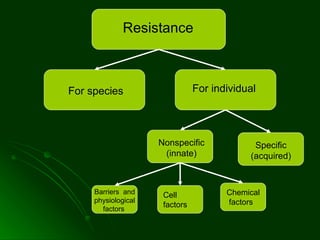
Resistance  For species For individual  Nonspecific (innate) Specific (acquired) Barriers  and physiological factors   Cell factors   Chemical factors
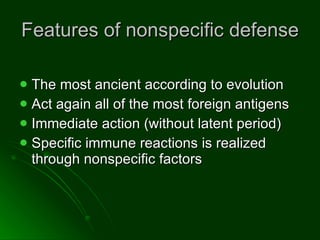
Features of nonspecific defense  The most ancient according to evolution  Act again all of the most foreign antigens Immediate action (without latent period) Specific immune reactions is realized through nonspecific factors
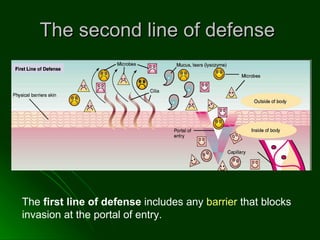
The second line of defense  The  first line of defense  includes any  barrier  that blocks invasion at the portal of entry.
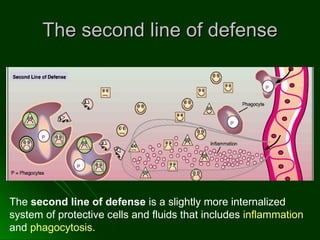
The second line of defense The  second line of defense  is a slightly more internalized system of protective cells and fluids that includes  inflammation  and  phagocytosis .
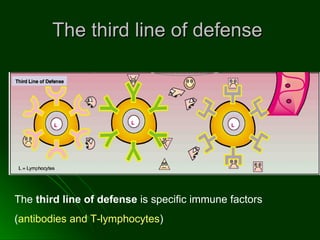
The third line of defense  The  third line of defense  is specific immune factors  ( antibodies and T-lymphocytes )
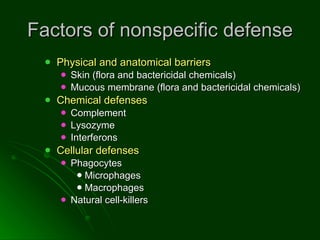
Factors of nonspecific defense Physical and anatomical barriers Skin (flora and bactericidal chemicals) Mucous membrane (flora and bactericidal chemicals) Chemical defenses Complement  Lysozyme  Interferons  Cellular defenses  Phagocytes  Microphages  Macrophages  Natural cell-killers
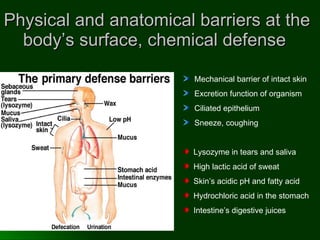
Physical and anatomical barriers at the body’s surface, chemical defense  Mechanical barrier of intact skin  Excretion function of organism  Ciliated epithelium  Sneeze, coughing Lysozyme in tears and saliva  High lactic acid of sweat  Skin’s acidic pH and fatty acid Hydrochloric acid in the stomach  Intestine’s digestive juices
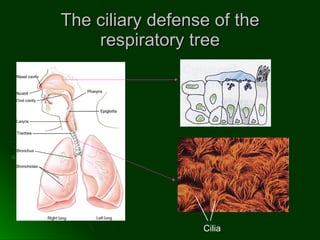
The ciliary defense of the respiratory tree Cilia
The role of normal flora in human organism  Antagonism. Inhibition of growth of potentially pathogenic microorganisms  Stimulation of the immune system  Producing of essential nutrient as vitamins (K, E, B) Normal flora of the digestive tract are essential for degrading cellulose
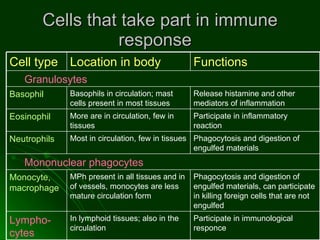
Cells that take part in immune response  Participate in immunological responce In lymphoid tissues; also in the circulation  Lympho-cytes Phagocytosis and digestion of engulfed materials, can participate in killing foreign cells that are not engulfed MPh present in all tissues and in of vessels, monocytes are less mature circulation form Monocyte, macrophage Mononuclear phagocytes  Phagocytosis and digestion of engulfed materials Most in circulation, few in tissues Neutrophils Participate in inflammatory reaction More are in circulation, few in tissues Eosinophil Release histamine and other mediators of inflammation  Basophils in circulation; mast cells present in most tissues  Basophil Granulosytes Functions  Location in body Cell type
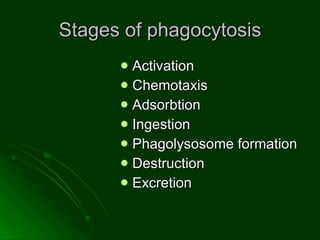
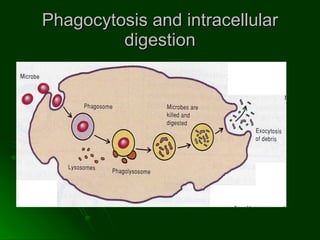
Stages of phagocytosis Activation  Chemotaxis Adsorbtion  Ingestion  Phagolysosome formation Destruction  Excretion
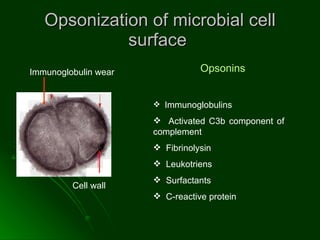
Opsonization of microbial cell surface  Immunoglobulin wear  Cell wall  Opsonins  Immunoglobulins  Activated C3b component of  complement Fibrinolysin  Leukotriens  Surfactants  C-reactive protein
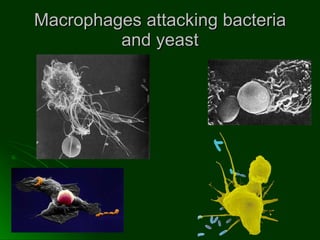
Macrophages attacking bacteria and yeast
Phagocytosis and intracellular digestion
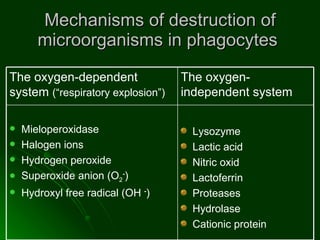
Mechanisms of destruction of microorganisms in phagocytes  Lysozyme  Lactic acid  Nitric oxid  Lactoferrin  Proteases  Hydrolase  Cationic protein Mieloperoxidase  Halogen ions Hydrogen peroxide Superoxide anion (O 2 - ) Hydroxyl free radical (OH  - )  The oxygen-independent system The oxygen-dependent system  (“respiratory explosion”)
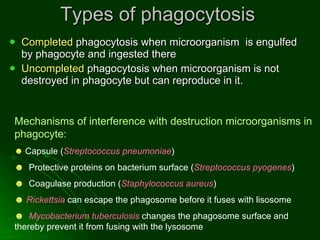
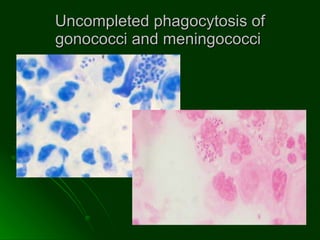
Types of phagocytosis  Completed  phagocytosis when microorganism  is engulfed by phagocyte and ingested there Uncompleted  phagocytosis when microorganism is not destroyed in phagocyte but can reproduce in it.  Mechanisms of interference with destruction microorganisms in phagocyte: Capsule ( Streptococcus pneumoniae ) Protective proteins on bacterium surface ( Streptococcus pyogenes ) Coagulase production ( Staphylococcus aureus ) Rickettsia  can escape the phagosome before it fuses with lisosome Mycobacterium tuberculosis  changes the phagosome surface and thereby prevent it from fusing with the lysosome
Uncompleted phagocytosis of gonococci and meningococci
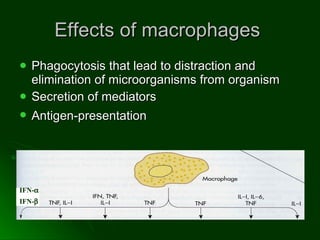
Effects of macrophages  Phagocytosis that lead to distraction and elimination of microorganisms from organism  Secretion of mediators  Antigen-presentation   IFN-  IFN- 
Definition of interferon Interferons  are proteins that cause nonspecific activities and influent to cell metabolism, including RNA and protein synthesis. INFs are the most active in cell that organism where they were produced
Types of interferons  Alpha interferon  (  -IFN).   Produced by lymphocytes and macrophages   Beta interferon  (    -IFN).   Produced by fibroblasts and epithelial cells Gamma interferon  (    -IFN).   Produced by T-lymphocytes  IFNs are a family of inducible glycoproteins produced by eukaryotic cells in response to viral infections and other microbial pathogens that reproduce within host cells.
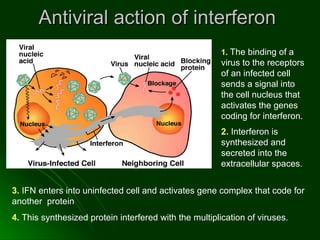
Antiviral action of interferon  1.   The binding of a virus to the receptors of an infected cell sends a signal into the cell nucleus that activates the genes coding for interferon. 2.  Interferon is synthesized and secreted into the extracellular spaces . 3.  IFN enters into uninfected cell and activates gene complex that code for  another  protein  4.  This synthesized protein interfered with the multiplication of viruses.
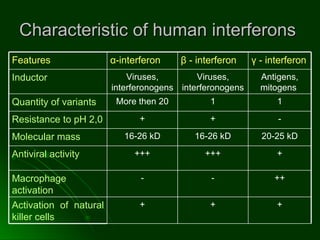
Characteristic of human interferons  + + + Activation of natural killer cells ++ - - Macrophage activation  + +++ +++ Antiviral activity  20-25  kD 16-26  kD 16-26  kD Molecular mass  - + + Resistance to  рН 2,0 1 1 More then 20 Quantity of variants  Antigens, mitogens  Viruses, interferonogens Viruses, interferonogens Inductor  γ  -  interferon β  -  interferon α - interferon  Features
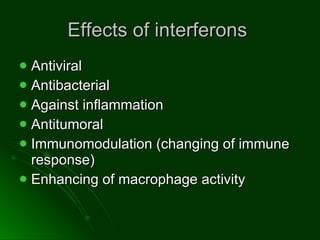
Effects of interferons  Antiviral  Antibacterial  Against inflammation  Antitumoral  Immunomodulation (changing of immune response) Enhancing of macrophage activity
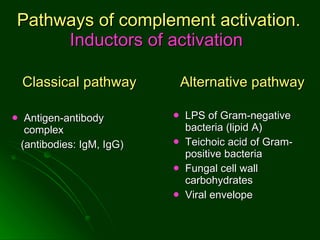
Pathways of complement activation.   Inductors of activation   Classical pathway Antigen-antibody complex (antibodies: IgM, IgG) Alternative pathway   LPS of Gram-negative bacteria (lipid A) Teichoic acid of Gram-positive bacteria Fungal cell wall carbohydrates Viral envelope
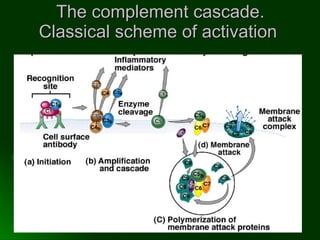
The complement cascade. Classical scheme of activation
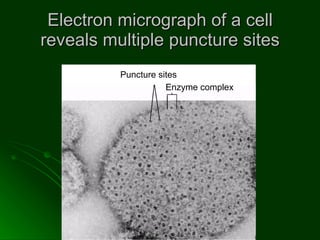
Electron micrograph of a cell reveals multiple puncture sites Puncture sites   Enzyme   complex
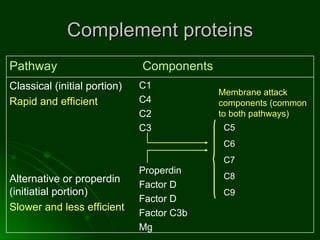
Complement proteins C5 C6 C7 C8 C9 Membrane attack components (common to both pathways) C1 C4 C2 C3 Properdin  Factor D Factor D Factor C3b Mg Classical (initial portion) Rapid and efficient Alternative or properdin (initiatial portion) Slower and less efficient Components  Pathway
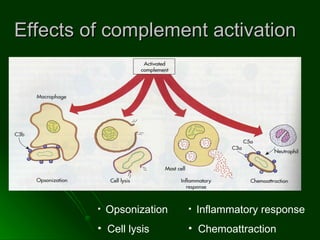
Effects of complement activation Opsonization  Cell lysis  Inflammatory response Chemoattraction
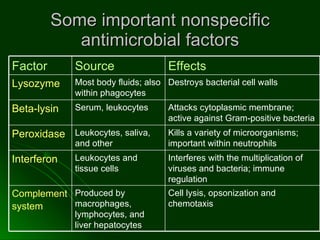
Some important nonspecific antimicrobial factors Cell lysis, opsonization and chemotaxis Produced by macrophages, lymphocytes, and liver hepatocytes Complement system   Interferes with the multiplication of viruses and bacteria; immune regulation Leukocytes and tissue cells Interferon  Kills a variety of microorganisms; important within neutrophils Leukocytes, saliva, and other  Peroxidase  Attacks cytoplasmic membrane; active against Gram-positive bacteria Serum, leukocytes Beta-lysin Destroys bacterial cell walls Most body fluids; also within phagocytes Lysozyme  Effects  Source  Factor

Bohomolets Microbiology Lecture #9

  • 1.
    Immunology Nonspecific defense
  • 2.
    Definition of immunity(Mechnikov, 1903) Immunity is a possibility of organism to remain healthy after agent of disease penetration
  • 3.
    Definition of immunity (Petrov, 1976 ) Immunity is a way of organism defense against alive agents and substances that are genetically foreign. It realizes by specific immune system
  • 4.
    Resistance Forspecies For individual Nonspecific (innate) Specific (acquired) Barriers and physiological factors Cell factors Chemical factors
  • 5.
    Features of nonspecificdefense The most ancient according to evolution Act again all of the most foreign antigens Immediate action (without latent period) Specific immune reactions is realized through nonspecific factors
  • 6.
    The second lineof defense The first line of defense includes any barrier that blocks invasion at the portal of entry.
  • 7.
    The second lineof defense The second line of defense is a slightly more internalized system of protective cells and fluids that includes inflammation and phagocytosis .
  • 8.
    The third lineof defense The third line of defense is specific immune factors ( antibodies and T-lymphocytes )
  • 9.
    Factors of nonspecificdefense Physical and anatomical barriers Skin (flora and bactericidal chemicals) Mucous membrane (flora and bactericidal chemicals) Chemical defenses Complement Lysozyme Interferons Cellular defenses Phagocytes Microphages Macrophages Natural cell-killers
  • 10.
    Physical and anatomicalbarriers at the body’s surface, chemical defense Mechanical barrier of intact skin Excretion function of organism Ciliated epithelium Sneeze, coughing Lysozyme in tears and saliva High lactic acid of sweat Skin’s acidic pH and fatty acid Hydrochloric acid in the stomach Intestine’s digestive juices
  • 11.
    The ciliary defenseof the respiratory tree Cilia
  • 12.
    The role ofnormal flora in human organism Antagonism. Inhibition of growth of potentially pathogenic microorganisms Stimulation of the immune system Producing of essential nutrient as vitamins (K, E, B) Normal flora of the digestive tract are essential for degrading cellulose
  • 13.
    Cells that takepart in immune response Participate in immunological responce In lymphoid tissues; also in the circulation Lympho-cytes Phagocytosis and digestion of engulfed materials, can participate in killing foreign cells that are not engulfed MPh present in all tissues and in of vessels, monocytes are less mature circulation form Monocyte, macrophage Mononuclear phagocytes Phagocytosis and digestion of engulfed materials Most in circulation, few in tissues Neutrophils Participate in inflammatory reaction More are in circulation, few in tissues Eosinophil Release histamine and other mediators of inflammation Basophils in circulation; mast cells present in most tissues Basophil Granulosytes Functions Location in body Cell type
  • 14.
    Stages of phagocytosisActivation Chemotaxis Adsorbtion Ingestion Phagolysosome formation Destruction Excretion
  • 15.
    Opsonization of microbialcell surface Immunoglobulin wear Cell wall Opsonins Immunoglobulins Activated C3b component of complement Fibrinolysin Leukotriens Surfactants C-reactive protein
  • 16.
  • 17.
  • 18.
    Mechanisms of destructionof microorganisms in phagocytes Lysozyme Lactic acid Nitric oxid Lactoferrin Proteases Hydrolase Cationic protein Mieloperoxidase Halogen ions Hydrogen peroxide Superoxide anion (O 2 - ) Hydroxyl free radical (OH - ) The oxygen-independent system The oxygen-dependent system (“respiratory explosion”)
  • 19.
    Types of phagocytosis Completed phagocytosis when microorganism is engulfed by phagocyte and ingested there Uncompleted phagocytosis when microorganism is not destroyed in phagocyte but can reproduce in it. Mechanisms of interference with destruction microorganisms in phagocyte: Capsule ( Streptococcus pneumoniae ) Protective proteins on bacterium surface ( Streptococcus pyogenes ) Coagulase production ( Staphylococcus aureus ) Rickettsia can escape the phagosome before it fuses with lisosome Mycobacterium tuberculosis changes the phagosome surface and thereby prevent it from fusing with the lysosome
  • 20.
    Uncompleted phagocytosis ofgonococci and meningococci
  • 21.
    Effects of macrophages Phagocytosis that lead to distraction and elimination of microorganisms from organism Secretion of mediators Antigen-presentation IFN-  IFN- 
  • 22.
    Definition of interferonInterferons are proteins that cause nonspecific activities and influent to cell metabolism, including RNA and protein synthesis. INFs are the most active in cell that organism where they were produced
  • 23.
    Types of interferons Alpha interferon (  -IFN). Produced by lymphocytes and macrophages Beta interferon (  -IFN). Produced by fibroblasts and epithelial cells Gamma interferon (  -IFN). Produced by T-lymphocytes IFNs are a family of inducible glycoproteins produced by eukaryotic cells in response to viral infections and other microbial pathogens that reproduce within host cells.
  • 24.
    Antiviral action ofinterferon 1. The binding of a virus to the receptors of an infected cell sends a signal into the cell nucleus that activates the genes coding for interferon. 2. Interferon is synthesized and secreted into the extracellular spaces . 3. IFN enters into uninfected cell and activates gene complex that code for another protein 4. This synthesized protein interfered with the multiplication of viruses.
  • 25.
    Characteristic of humaninterferons + + + Activation of natural killer cells ++ - - Macrophage activation + +++ +++ Antiviral activity 20-25 kD 16-26 kD 16-26 kD Molecular mass - + + Resistance to рН 2,0 1 1 More then 20 Quantity of variants Antigens, mitogens Viruses, interferonogens Viruses, interferonogens Inductor γ - interferon β - interferon α - interferon Features
  • 26.
    Effects of interferons Antiviral Antibacterial Against inflammation Antitumoral Immunomodulation (changing of immune response) Enhancing of macrophage activity
  • 27.
    Pathways of complementactivation. Inductors of activation Classical pathway Antigen-antibody complex (antibodies: IgM, IgG) Alternative pathway LPS of Gram-negative bacteria (lipid A) Teichoic acid of Gram-positive bacteria Fungal cell wall carbohydrates Viral envelope
  • 28.
    The complement cascade.Classical scheme of activation
  • 29.
    Electron micrograph ofa cell reveals multiple puncture sites Puncture sites Enzyme complex
  • 30.
    Complement proteins C5C6 C7 C8 C9 Membrane attack components (common to both pathways) C1 C4 C2 C3 Properdin Factor D Factor D Factor C3b Mg Classical (initial portion) Rapid and efficient Alternative or properdin (initiatial portion) Slower and less efficient Components Pathway
  • 31.
    Effects of complementactivation Opsonization Cell lysis Inflammatory response Chemoattraction
  • 32.
    Some important nonspecificantimicrobial factors Cell lysis, opsonization and chemotaxis Produced by macrophages, lymphocytes, and liver hepatocytes Complement system Interferes with the multiplication of viruses and bacteria; immune regulation Leukocytes and tissue cells Interferon Kills a variety of microorganisms; important within neutrophils Leukocytes, saliva, and other Peroxidase Attacks cytoplasmic membrane; active against Gram-positive bacteria Serum, leukocytes Beta-lysin Destroys bacterial cell walls Most body fluids; also within phagocytes Lysozyme Effects Source Factor