
Presented by
Ajith V. A
MBA ITL
Class No: 5
The Factories Act 1948
INTRODUCTION
 In India the first Factories Act was passed in 1881. (more than 130 yeas
before legislation)
 This Act was basically designed
 to protect children
 to provide few measures for health and safety of the workers.
 Applicable to only those factories, which employed 100 or more workers.
 In 1891 another factories Act was passed which extended to the factories
employing 50 or more workers.
2
Definition of a Factory
“Factory” is defined in Section 2(m) of the Act. It means any premises
including the precincts thereof-
i. Where on ten or more workers are working, or were working on any
day of the preceding twelve months, and in any part of which a
manufacturing process is being carried on with the aid of power, or is
ordinarily so carried on; or
ii. Whereon twenty or more workers are working, or were working on
any day of the preceding twelve months, and in any part of which a
manufacturing process is being carried on without the aid of power,
or is ordinarily so carried on;
But does not include a mine subject to the operation of the Mines Act,1952
or a mobile unit belonging to the Armed forces of the Union, a
railway running shed or a hotel, restaurant or eating place.
3
Objectives of factory act 1948.
 To ensure adequate safety measures and to promote the health and
welfare of the workers employed in factories.
 To prevent haphazard growth of factories through the provisions
related to the approval of plans before the creation of a factory.
 To regulate the working condition in factories, regulate the working
hours, leave, holidays, overtime, employment of children, women and
young persons ext.
4
Applicability of factory act 1948.
 At any place wherein manufacturing process is carried on with or without
the aid of power or is so ordinarily carried on, not with standing that:
 The number of persons employed therein is less than ten, if working with
the aid of power and less than twenty if working without the aid of power,
or the persons working therein are not employed by the owner thereof but
are working with the permission of, or under agreement with, such owner.
 The Factories Act extends to whole of India and is applicable to all
'factories' including government factories.
 It applies to all factories employing more than 10 people and working with
the aid of power or employing 20 people and working without the aid of
power.
 Factory however does not include a mine covered under the mines Act,
1952, a mobile unit of the armed forces, a railway shed or a hotel, restaurant
or eating place.
5
 Total No. of Chapters – 11
 Total No. of Sections - 120
Components of The Factories Act - 1948
6
• CHAPTER I - Preliminary
• CHAPTER II - The Inspecting Staff
• CHAPTER III - Health
• CHAPTER IV - Safety
• CHAPTER IVA - Provisions relating to
Hazardous processes
• CHAPTER V - Welfare
• CHAPTER VI - Working hours of
adults
• CHAPTER VII - Employment of
young persons
• CHAPTER VIII - Annual leave with
wages
• CHAPTER IX - Special provisions
• CHAPTER X - Penalties and
procedure
• CHAPTER XI - Supplemental
Components of The Factories Act - 1948
7
Sec 1. Short title, extent and commencement
Sec 2. Interpretation
Sec 3. References to time of day
Sec 4. Power to declare different departments to be separate factories for
two or more factories to be a single factory
Sec 5. Power to exempt during public emergency
Sec 6. Approval, licensing and registration of factories
Sec 7. Notice by occupier
Chapter I - Preliminary
8
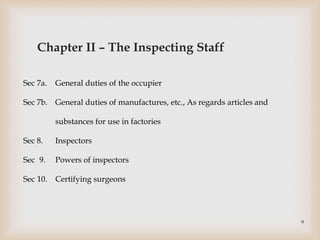
Sec 7a. General duties of the occupier
Sec 7b. General duties of manufactures, etc., As regards articles and
substances for use in factories
Sec 8. Inspectors
Sec 9. Powers of inspectors
Sec 10. Certifying surgeons
Chapter II – The Inspecting Staff
9
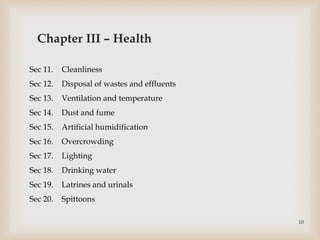
Sec 11. Cleanliness
Sec 12. Disposal of wastes and effluents
Sec 13. Ventilation and temperature
Sec 14. Dust and fume
Sec 15. Artificial humidification
Sec 16. Overcrowding
Sec 17. Lighting
Sec 18. Drinking water
Sec 19. Latrines and urinals
Sec 20. Spittoons
Chapter III – Health
10
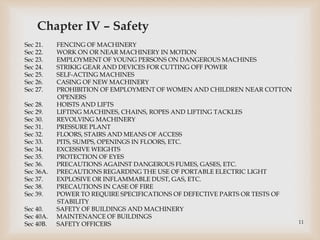
Chapter IV – Safety
Sec 21. FENCING OF MACHINERY
Sec 22. WORK ON OR NEAR MACHINERY IN MOTION
Sec 23. EMPLOYMENT OF YOUNG PERSONS ON DANGEROUS MACHINES
Sec 24. STRIKIG GEAR AND DEVICES FOR CUTTING OFF POWER
Sec 25. SELF-ACTING MACHINES
Sec 26. CASING OF NEW MACHINERY
Sec 27. PROHIBITION OF EMPLOYMENT OF WOMEN AND CHILDREN NEAR COTTON
OPENERS
Sec 28. HOISTS AND LIFTS
Sec 29. LIFTING MACHINES, CHAINS, ROPES AND LIFTING TACKLES
Sec 30. REVOLVING MACHINERY
Sec 31. PRESSURE PLANT
Sec 32. FLOORS, STAIRS AND MEANS OF ACCESS
Sec 33. PITS, SUMPS, OPENINGS IN FLOORS, ETC.
Sec 34. EXCESSIVE WEIGHTS
Sec 35. PROTECTION OF EYES
Sec 36. PRECAUTIONS AGAINST DANGEROUS FUMES, GASES, ETC.
Sec 36A. PRECAUTIONS REGARDING THE USE OF PORTABLE ELECTRIC LIGHT
Sec 37. EXPLOSIVE OR INFLAMMABLE DUST, GAS, ETC.
Sec 38. PRECAUTIONS IN CASE OF FIRE
Sec 39. POWER TO REQUIRE SPECIFICATIONS OF DEFECTIVE PARTS OR TESTS OF
STABILITY
Sec 40. SAFETY OF BUILDINGS AND MACHINERY
Sec 40A. MAINTENANCE OF BUILDINGS
Sec 40B. SAFETY OFFICERS 11
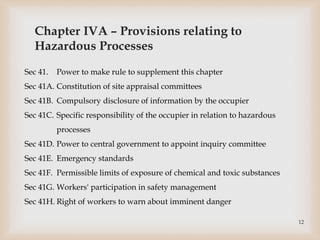
Chapter IVA – Provisions relating to
Hazardous Processes
Sec 41. Power to make rule to supplement this chapter
Sec 41A. Constitution of site appraisal committees
Sec 41B. Compulsory disclosure of information by the occupier
Sec 41C. Specific responsibility of the occupier in relation to hazardous
processes
Sec 41D. Power to central government to appoint inquiry committee
Sec 41E. Emergency standards
Sec 41F. Permissible limits of exposure of chemical and toxic substances
Sec 41G. Workers' participation in safety management
Sec 41H. Right of workers to warn about imminent danger
12
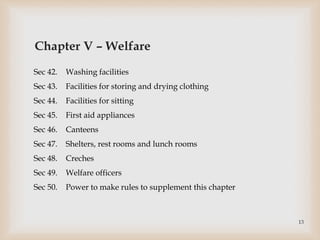
Chapter V – Welfare
Sec 42. Washing facilities
Sec 43. Facilities for storing and drying clothing
Sec 44. Facilities for sitting
Sec 45. First aid appliances
Sec 46. Canteens
Sec 47. Shelters, rest rooms and lunch rooms
Sec 48. Creches
Sec 49. Welfare officers
Sec 50. Power to make rules to supplement this chapter
13
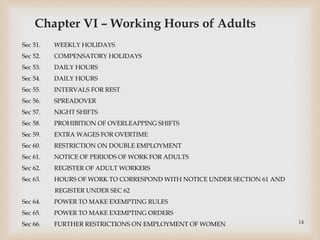
Chapter VI – Working Hours of Adults
Sec 51. WEEKLY HOLIDAYS
Sec 52. COMPENSATORY HOLIDAYS
Sec 53. DAILY HOURS
Sec 54. DAILY HOURS
Sec 55. INTERVALS FOR REST
Sec 56. SPREADOVER
Sec 57. NIGHT SHIFTS
Sec 58. PROHIBITION OF OVERLEAPPING SHIFTS
Sec 59. EXTRA WAGES FOR OVERTIME
Sec 60. RESTRICTION ON DOUBLE EMPLOYMENT
Sec 61. NOTICE OF PERIODS OF WORK FOR ADULTS
Sec 62. REGISTER OF ADULT WORKERS
Sec 63. HOURS OF WORK TO CORRESPOND WITH NOTICE UNDER SECTION 61 AND
REGISTER UNDER SEC 62
Sec 64. POWER TO MAKE EXEMPTING RULES
Sec 65. POWER TO MAKE EXEMPTING ORDERS
Sec 66. FURTHER RESTRICTIONS ON EMPLOYMENT OF WOMEN 14
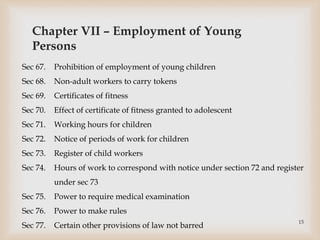
Chapter VII – Employment of Young
Persons
Sec 67. Prohibition of employment of young children
Sec 68. Non-adult workers to carry tokens
Sec 69. Certificates of fitness
Sec 70. Effect of certificate of fitness granted to adolescent
Sec 71. Working hours for children
Sec 72. Notice of periods of work for children
Sec 73. Register of child workers
Sec 74. Hours of work to correspond with notice under section 72 and register
under sec 73
Sec 75. Power to require medical examination
Sec 76. Power to make rules
Sec 77. Certain other provisions of law not barred
15
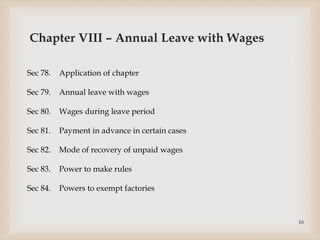
Chapter VIII – Annual Leave with Wages
Sec 78. Application of chapter
Sec 79. Annual leave with wages
Sec 80. Wages during leave period
Sec 81. Payment in advance in certain cases
Sec 82. Mode of recovery of unpaid wages
Sec 83. Power to make rules
Sec 84. Powers to exempt factories
16
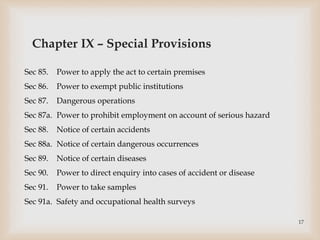
Chapter IX – Special Provisions
Sec 85. Power to apply the act to certain premises
Sec 86. Power to exempt public institutions
Sec 87. Dangerous operations
Sec 87a. Power to prohibit employment on account of serious hazard
Sec 88. Notice of certain accidents
Sec 88a. Notice of certain dangerous occurrences
Sec 89. Notice of certain diseases
Sec 90. Power to direct enquiry into cases of accident or disease
Sec 91. Power to take samples
Sec 91a. Safety and occupational health surveys
17
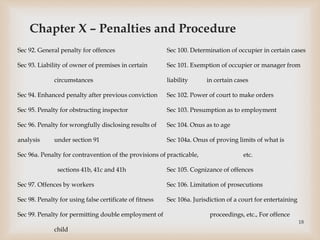
Chapter X – Penalties and Procedure
Sec 92. General penalty for offences
Sec 93. Liability of owner of premises in certain
circumstances
Sec 94. Enhanced penalty after previous conviction
Sec 95. Penalty for obstructing inspector
Sec 96. Penalty for wrongfully disclosing results of
analysis under section 91
Sec 96a. Penalty for contravention of the provisions of
sections 41b, 41c and 41h
Sec 97. Offences by workers
Sec 98. Penalty for using false certificate of fitness
Sec 99. Penalty for permitting double employment of
child
Sec 100. Determination of occupier in certain cases
Sec 101. Exemption of occupier or manager from
liability in certain cases
Sec 102. Power of court to make orders
Sec 103. Presumption as to employment
Sec 104. Onus as to age
Sec 104a. Onus of proving limits of what is
practicable, etc.
Sec 105. Cognizance of offences
Sec 106. Limitation of prosecutions
Sec 106a. Jurisdiction of a court for entertaining
proceedings, etc., For offence
18
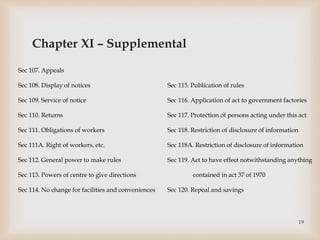
Chapter XI – Supplemental
Sec 107. Appeals
Sec 108. Display of notices
Sec 109. Service of notice
Sec 110. Returns
Sec 111. Obligations of workers
Sec 111A. Right of workers, etc.
Sec 112. General power to make rules
Sec 113. Powers of centre to give directions
Sec 114. No change for facilities and conveniences
Sec 115. Publication of rules
Sec 116. Application of act to government factories
Sec 117. Protection of persons acting under this act
Sec 118. Restriction of disclosure of information
Sec 118A. Restriction of disclosure of information
Sec 119. Act to have effect notwithstanding anything
contained in act 37 of 1970
Sec 120. Repeal and savings
19
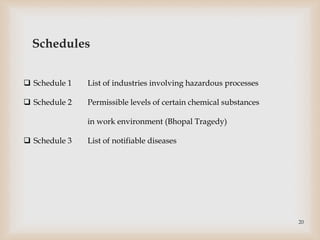
Schedules
 Schedule 1 List of industries involving hazardous processes
 Schedule 2 Permissible levels of certain chemical substances
in work environment (Bhopal Tragedy)
 Schedule 3 List of notifiable diseases
20
Amendments
The Factories Act 1948 was amended in
 1949
 1950
 1954
 1956
 1976
 1989
• 2014 - Pending
21
22

Factories act 1948

  • 1.
     Presented by Ajith V.A MBA ITL Class No: 5 The Factories Act 1948
  • 2.
    INTRODUCTION  In Indiathe first Factories Act was passed in 1881. (more than 130 yeas before legislation)  This Act was basically designed  to protect children  to provide few measures for health and safety of the workers.  Applicable to only those factories, which employed 100 or more workers.  In 1891 another factories Act was passed which extended to the factories employing 50 or more workers. 2
  • 3.
    Definition of aFactory “Factory” is defined in Section 2(m) of the Act. It means any premises including the precincts thereof- i. Where on ten or more workers are working, or were working on any day of the preceding twelve months, and in any part of which a manufacturing process is being carried on with the aid of power, or is ordinarily so carried on; or ii. Whereon twenty or more workers are working, or were working on any day of the preceding twelve months, and in any part of which a manufacturing process is being carried on without the aid of power, or is ordinarily so carried on; But does not include a mine subject to the operation of the Mines Act,1952 or a mobile unit belonging to the Armed forces of the Union, a railway running shed or a hotel, restaurant or eating place. 3
  • 4.
    Objectives of factoryact 1948.  To ensure adequate safety measures and to promote the health and welfare of the workers employed in factories.  To prevent haphazard growth of factories through the provisions related to the approval of plans before the creation of a factory.  To regulate the working condition in factories, regulate the working hours, leave, holidays, overtime, employment of children, women and young persons ext. 4
  • 5.
    Applicability of factoryact 1948.  At any place wherein manufacturing process is carried on with or without the aid of power or is so ordinarily carried on, not with standing that:  The number of persons employed therein is less than ten, if working with the aid of power and less than twenty if working without the aid of power, or the persons working therein are not employed by the owner thereof but are working with the permission of, or under agreement with, such owner.  The Factories Act extends to whole of India and is applicable to all 'factories' including government factories.  It applies to all factories employing more than 10 people and working with the aid of power or employing 20 people and working without the aid of power.  Factory however does not include a mine covered under the mines Act, 1952, a mobile unit of the armed forces, a railway shed or a hotel, restaurant or eating place. 5
  • 6.
     Total No.of Chapters – 11  Total No. of Sections - 120 Components of The Factories Act - 1948 6
  • 7.
    • CHAPTER I- Preliminary • CHAPTER II - The Inspecting Staff • CHAPTER III - Health • CHAPTER IV - Safety • CHAPTER IVA - Provisions relating to Hazardous processes • CHAPTER V - Welfare • CHAPTER VI - Working hours of adults • CHAPTER VII - Employment of young persons • CHAPTER VIII - Annual leave with wages • CHAPTER IX - Special provisions • CHAPTER X - Penalties and procedure • CHAPTER XI - Supplemental Components of The Factories Act - 1948 7
  • 8.
    Sec 1. Shorttitle, extent and commencement Sec 2. Interpretation Sec 3. References to time of day Sec 4. Power to declare different departments to be separate factories for two or more factories to be a single factory Sec 5. Power to exempt during public emergency Sec 6. Approval, licensing and registration of factories Sec 7. Notice by occupier Chapter I - Preliminary 8
  • 9.
    Sec 7a. Generalduties of the occupier Sec 7b. General duties of manufactures, etc., As regards articles and substances for use in factories Sec 8. Inspectors Sec 9. Powers of inspectors Sec 10. Certifying surgeons Chapter II – The Inspecting Staff 9
  • 10.
    Sec 11. Cleanliness Sec12. Disposal of wastes and effluents Sec 13. Ventilation and temperature Sec 14. Dust and fume Sec 15. Artificial humidification Sec 16. Overcrowding Sec 17. Lighting Sec 18. Drinking water Sec 19. Latrines and urinals Sec 20. Spittoons Chapter III – Health 10
  • 11.
    Chapter IV –Safety Sec 21. FENCING OF MACHINERY Sec 22. WORK ON OR NEAR MACHINERY IN MOTION Sec 23. EMPLOYMENT OF YOUNG PERSONS ON DANGEROUS MACHINES Sec 24. STRIKIG GEAR AND DEVICES FOR CUTTING OFF POWER Sec 25. SELF-ACTING MACHINES Sec 26. CASING OF NEW MACHINERY Sec 27. PROHIBITION OF EMPLOYMENT OF WOMEN AND CHILDREN NEAR COTTON OPENERS Sec 28. HOISTS AND LIFTS Sec 29. LIFTING MACHINES, CHAINS, ROPES AND LIFTING TACKLES Sec 30. REVOLVING MACHINERY Sec 31. PRESSURE PLANT Sec 32. FLOORS, STAIRS AND MEANS OF ACCESS Sec 33. PITS, SUMPS, OPENINGS IN FLOORS, ETC. Sec 34. EXCESSIVE WEIGHTS Sec 35. PROTECTION OF EYES Sec 36. PRECAUTIONS AGAINST DANGEROUS FUMES, GASES, ETC. Sec 36A. PRECAUTIONS REGARDING THE USE OF PORTABLE ELECTRIC LIGHT Sec 37. EXPLOSIVE OR INFLAMMABLE DUST, GAS, ETC. Sec 38. PRECAUTIONS IN CASE OF FIRE Sec 39. POWER TO REQUIRE SPECIFICATIONS OF DEFECTIVE PARTS OR TESTS OF STABILITY Sec 40. SAFETY OF BUILDINGS AND MACHINERY Sec 40A. MAINTENANCE OF BUILDINGS Sec 40B. SAFETY OFFICERS 11
  • 12.
    Chapter IVA –Provisions relating to Hazardous Processes Sec 41. Power to make rule to supplement this chapter Sec 41A. Constitution of site appraisal committees Sec 41B. Compulsory disclosure of information by the occupier Sec 41C. Specific responsibility of the occupier in relation to hazardous processes Sec 41D. Power to central government to appoint inquiry committee Sec 41E. Emergency standards Sec 41F. Permissible limits of exposure of chemical and toxic substances Sec 41G. Workers' participation in safety management Sec 41H. Right of workers to warn about imminent danger 12
  • 13.
    Chapter V –Welfare Sec 42. Washing facilities Sec 43. Facilities for storing and drying clothing Sec 44. Facilities for sitting Sec 45. First aid appliances Sec 46. Canteens Sec 47. Shelters, rest rooms and lunch rooms Sec 48. Creches Sec 49. Welfare officers Sec 50. Power to make rules to supplement this chapter 13
  • 14.
    Chapter VI –Working Hours of Adults Sec 51. WEEKLY HOLIDAYS Sec 52. COMPENSATORY HOLIDAYS Sec 53. DAILY HOURS Sec 54. DAILY HOURS Sec 55. INTERVALS FOR REST Sec 56. SPREADOVER Sec 57. NIGHT SHIFTS Sec 58. PROHIBITION OF OVERLEAPPING SHIFTS Sec 59. EXTRA WAGES FOR OVERTIME Sec 60. RESTRICTION ON DOUBLE EMPLOYMENT Sec 61. NOTICE OF PERIODS OF WORK FOR ADULTS Sec 62. REGISTER OF ADULT WORKERS Sec 63. HOURS OF WORK TO CORRESPOND WITH NOTICE UNDER SECTION 61 AND REGISTER UNDER SEC 62 Sec 64. POWER TO MAKE EXEMPTING RULES Sec 65. POWER TO MAKE EXEMPTING ORDERS Sec 66. FURTHER RESTRICTIONS ON EMPLOYMENT OF WOMEN 14
  • 15.
    Chapter VII –Employment of Young Persons Sec 67. Prohibition of employment of young children Sec 68. Non-adult workers to carry tokens Sec 69. Certificates of fitness Sec 70. Effect of certificate of fitness granted to adolescent Sec 71. Working hours for children Sec 72. Notice of periods of work for children Sec 73. Register of child workers Sec 74. Hours of work to correspond with notice under section 72 and register under sec 73 Sec 75. Power to require medical examination Sec 76. Power to make rules Sec 77. Certain other provisions of law not barred 15
  • 16.
    Chapter VIII –Annual Leave with Wages Sec 78. Application of chapter Sec 79. Annual leave with wages Sec 80. Wages during leave period Sec 81. Payment in advance in certain cases Sec 82. Mode of recovery of unpaid wages Sec 83. Power to make rules Sec 84. Powers to exempt factories 16
  • 17.
    Chapter IX –Special Provisions Sec 85. Power to apply the act to certain premises Sec 86. Power to exempt public institutions Sec 87. Dangerous operations Sec 87a. Power to prohibit employment on account of serious hazard Sec 88. Notice of certain accidents Sec 88a. Notice of certain dangerous occurrences Sec 89. Notice of certain diseases Sec 90. Power to direct enquiry into cases of accident or disease Sec 91. Power to take samples Sec 91a. Safety and occupational health surveys 17
  • 18.
    Chapter X –Penalties and Procedure Sec 92. General penalty for offences Sec 93. Liability of owner of premises in certain circumstances Sec 94. Enhanced penalty after previous conviction Sec 95. Penalty for obstructing inspector Sec 96. Penalty for wrongfully disclosing results of analysis under section 91 Sec 96a. Penalty for contravention of the provisions of sections 41b, 41c and 41h Sec 97. Offences by workers Sec 98. Penalty for using false certificate of fitness Sec 99. Penalty for permitting double employment of child Sec 100. Determination of occupier in certain cases Sec 101. Exemption of occupier or manager from liability in certain cases Sec 102. Power of court to make orders Sec 103. Presumption as to employment Sec 104. Onus as to age Sec 104a. Onus of proving limits of what is practicable, etc. Sec 105. Cognizance of offences Sec 106. Limitation of prosecutions Sec 106a. Jurisdiction of a court for entertaining proceedings, etc., For offence 18
  • 19.
    Chapter XI –Supplemental Sec 107. Appeals Sec 108. Display of notices Sec 109. Service of notice Sec 110. Returns Sec 111. Obligations of workers Sec 111A. Right of workers, etc. Sec 112. General power to make rules Sec 113. Powers of centre to give directions Sec 114. No change for facilities and conveniences Sec 115. Publication of rules Sec 116. Application of act to government factories Sec 117. Protection of persons acting under this act Sec 118. Restriction of disclosure of information Sec 118A. Restriction of disclosure of information Sec 119. Act to have effect notwithstanding anything contained in act 37 of 1970 Sec 120. Repeal and savings 19
  • 20.
    Schedules  Schedule 1List of industries involving hazardous processes  Schedule 2 Permissible levels of certain chemical substances in work environment (Bhopal Tragedy)  Schedule 3 List of notifiable diseases 20
  • 21.
    Amendments The Factories Act1948 was amended in  1949  1950  1954  1956  1976  1989 • 2014 - Pending 21
  • 22.