Laboratory Logistic
Management
Module Code:MLT 0501
NTA LEVEL 5,SEMESTER I
PREPARED BY JACOB NOAH (BSC.HEALTH IN HEALTH
LABORATORY SC.
REGISTERED HEALTH LABORATORY SCIENTIST,ACADEMIC TUTOR)
By the end of this module student are
expected to:
• 1.1.1Describe logistics system in health service
delivery
• 1.1.2Describe Procurement processes in health facilities
• 1.1.3Apply skills of procurement in evaluation of
quotation for equipment and supplies in health
facilities
By the end of this module student are
expected to:
• 1.2.1Describe equipment/instruments and supplies
acquisition process in the laboratory set up
• 1.2.2Describe selection criteria for
equipment/instruments and supplies in the laboratory
set up
• 1.2.3Apply knowledge and skills of selection criteria
to develop specifications of equipment/instruments
and supplies during procurement
By the end of this module student are
expected to
• 1.3.1Describe systems of ordering equipment/instruments and
supplies in health facilities
• 1.3.2Describe processes of receiving equipment/instrument and
supplies in health Facilities
• 1.3.3Describe concept of minimum and maximum stock levels in
supplies management
• 1.3.4Apply concept of maximum and minimum stock levels of
supplies management in health facilities according to guidelines
• 1.3.5Apply logistic tools and guidelines to manage stocks in the
laboratory
continued
• 1.4.1Describe Logistics Management Information
System of commodities in health facilities
• 1.4.2 Describe logistic tools for ordering commodities
in health facilities
• 1.4.3 Apply knowledge and skills of LMIS to
determine required quantity of commodities in health
facilities
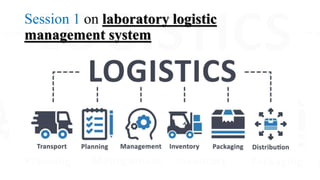
Session 1 on laboratory logistic
management system
logistics system in health service delivery
Definitions of Key Terms
• What Is Logistics?
Logistics is the process of getting resources, storing them, and moving them
to where they need to go.
Logistics systems: The part of supply chain management that plans,
implements, and controls the efficient, effective forward and reverses flow
and storage of goods, services and related information between the point of
origin and the point of consumption in order to meet customers’
requirement…
Logistics management is an integrating function, which coordinates and
optimizes all logistics activities, as well as integrates logistics activities with
other functions including marketing, sales manufacturing, finance, and
information technology.
• Supply chain management includes the logistics activities plus the
coordination and collaboration of staff, levels, and functions.
• The supply chain:
includes global manufacturers and supply and demand dynamics, but
logistics tends to focus more on
specific tasks within a particular program health system.
• Pipeline: The entire chain of physical storage facilities and
transportation links through which supplies move from the
manufacturer to the user, including port facilities, central warehouse,
regional warehouses, district warehouses, all SDPs, and transport
vehicles, including community-based distribution networks
service delivery point. Any facility where users receive supplies related
to health services. Service delivery points (SDPs) are usually hospitals
and health centers, but may also include mobile units, community-
based distributors, laboratories, and health posts.
• Lead time: The time between when new stock is ordered and when it
is received and available for use
• When logistics managers evaluate how well a logistics system is
meeting the six rights, they measure the lead time and try to reduce
it
• Lead time can be calculated within the entire in-country system, from
arrival in port to the end user, between specific levels of the system,
or even the procurement lead time from when a product is ordered
with the manufacturer until it arrives in port
• issues voucher: is a document that records the issuance of supplies
from the inventory. It helps maintain accurate consumption data
• consumption data: are data on the actual quantities of health
commodities
• Consumption data includes actual dispensed-to-user data, or data on
the numbers of commodities that were actually given to clients
• inventory log: An inventory log is a record of all items in stock. It
includes information about stock levels, expiration dates, and other
relevant data
TYPES OF LOGISTIC SYSTEM
• Centralized: In a centralized system, a central authority manages
logistics for multiple facilities. It promotes economies of scale but can
lead to delays.
• Decentralized: In a decentralized system, each facility manages its
logistics. It offers more control but can be less efficient.
• Integrated: An integrated system combines aspects of both
centralized and decentralized systems, aiming for the best of both
worlds
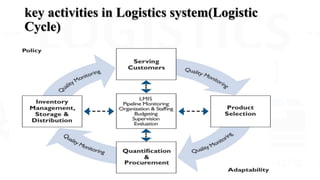
key activities in Logistics system(Logistic
Cycle)
key activities in Logistics system(Logistic
Cycle)
• In the next few sections, you will look briefy at all the elements
shown in the logistics cycle, including the—
• • major activities in the cycle
• • heart of the logistics cycle
• • quality monitoring of the activities
• • logistics environment—policies and adaptability of the system.
• serving customers. Everyone who works in logistics must remember
that they select, procure, store, or distribute products to meet
customer needs
• product selection. In any health logistics system, health programs
must select products.
• In a health logistics system, a national formulary and therapeutics
committee, pharmaceutical board, board of physicians, or other
government-appointed group may be responsible for product
selection.
• quantification. After products have been selected, the required
quantity and cost of each product must be determined.
• Quantification is the process of estimating the quantity and cost of
the products required for a specific health program (or service), and,
to ensure an uninterrupted supply for the program, determining
when the products should be procured and distributed.
• procurement. After a supply plan has been developed as part of the
quantification process, quantities of products must be procured.
• Health systems or programs can procure from international, regional,
or local sources of supply; or they can use a procurement agent for
this logistics activity
• inventory management: storage and distribution. After an item has
been procured and received by the health system or program, it must
be transported to the service delivery level where the client will
receive the products.
• During this process, the products must be stored until they are sent
to the next lower level, or until the customer needs them.

LABORATORY LOGISTIC MANAGEMEN.pptx

  • 1.
    Laboratory Logistic Management Module Code:MLT0501 NTA LEVEL 5,SEMESTER I PREPARED BY JACOB NOAH (BSC.HEALTH IN HEALTH LABORATORY SC. REGISTERED HEALTH LABORATORY SCIENTIST,ACADEMIC TUTOR)
  • 2.
    By the endof this module student are expected to: • 1.1.1Describe logistics system in health service delivery • 1.1.2Describe Procurement processes in health facilities • 1.1.3Apply skills of procurement in evaluation of quotation for equipment and supplies in health facilities
  • 3.
    By the endof this module student are expected to: • 1.2.1Describe equipment/instruments and supplies acquisition process in the laboratory set up • 1.2.2Describe selection criteria for equipment/instruments and supplies in the laboratory set up • 1.2.3Apply knowledge and skills of selection criteria to develop specifications of equipment/instruments and supplies during procurement
  • 4.
    By the endof this module student are expected to • 1.3.1Describe systems of ordering equipment/instruments and supplies in health facilities • 1.3.2Describe processes of receiving equipment/instrument and supplies in health Facilities • 1.3.3Describe concept of minimum and maximum stock levels in supplies management • 1.3.4Apply concept of maximum and minimum stock levels of supplies management in health facilities according to guidelines • 1.3.5Apply logistic tools and guidelines to manage stocks in the laboratory
  • 5.
    continued • 1.4.1Describe LogisticsManagement Information System of commodities in health facilities • 1.4.2 Describe logistic tools for ordering commodities in health facilities • 1.4.3 Apply knowledge and skills of LMIS to determine required quantity of commodities in health facilities
  • 6.
    Session 1 onlaboratory logistic management system
  • 7.
    logistics system inhealth service delivery Definitions of Key Terms • What Is Logistics? Logistics is the process of getting resources, storing them, and moving them to where they need to go. Logistics systems: The part of supply chain management that plans, implements, and controls the efficient, effective forward and reverses flow and storage of goods, services and related information between the point of origin and the point of consumption in order to meet customers’ requirement… Logistics management is an integrating function, which coordinates and optimizes all logistics activities, as well as integrates logistics activities with other functions including marketing, sales manufacturing, finance, and information technology.
  • 8.
    • Supply chainmanagement includes the logistics activities plus the coordination and collaboration of staff, levels, and functions. • The supply chain: includes global manufacturers and supply and demand dynamics, but logistics tends to focus more on specific tasks within a particular program health system.
  • 9.
    • Pipeline: Theentire chain of physical storage facilities and transportation links through which supplies move from the manufacturer to the user, including port facilities, central warehouse, regional warehouses, district warehouses, all SDPs, and transport vehicles, including community-based distribution networks service delivery point. Any facility where users receive supplies related to health services. Service delivery points (SDPs) are usually hospitals and health centers, but may also include mobile units, community- based distributors, laboratories, and health posts.
  • 10.
    • Lead time:The time between when new stock is ordered and when it is received and available for use • When logistics managers evaluate how well a logistics system is meeting the six rights, they measure the lead time and try to reduce it • Lead time can be calculated within the entire in-country system, from arrival in port to the end user, between specific levels of the system, or even the procurement lead time from when a product is ordered with the manufacturer until it arrives in port
  • 11.
    • issues voucher:is a document that records the issuance of supplies from the inventory. It helps maintain accurate consumption data • consumption data: are data on the actual quantities of health commodities • Consumption data includes actual dispensed-to-user data, or data on the numbers of commodities that were actually given to clients • inventory log: An inventory log is a record of all items in stock. It includes information about stock levels, expiration dates, and other relevant data
  • 12.
    TYPES OF LOGISTICSYSTEM • Centralized: In a centralized system, a central authority manages logistics for multiple facilities. It promotes economies of scale but can lead to delays. • Decentralized: In a decentralized system, each facility manages its logistics. It offers more control but can be less efficient. • Integrated: An integrated system combines aspects of both centralized and decentralized systems, aiming for the best of both worlds
  • 13.
    key activities inLogistics system(Logistic Cycle)
  • 14.
    key activities inLogistics system(Logistic Cycle) • In the next few sections, you will look briefy at all the elements shown in the logistics cycle, including the— • • major activities in the cycle • • heart of the logistics cycle • • quality monitoring of the activities • • logistics environment—policies and adaptability of the system.
  • 15.
    • serving customers.Everyone who works in logistics must remember that they select, procure, store, or distribute products to meet customer needs • product selection. In any health logistics system, health programs must select products. • In a health logistics system, a national formulary and therapeutics committee, pharmaceutical board, board of physicians, or other government-appointed group may be responsible for product selection.
  • 16.
    • quantification. Afterproducts have been selected, the required quantity and cost of each product must be determined. • Quantification is the process of estimating the quantity and cost of the products required for a specific health program (or service), and, to ensure an uninterrupted supply for the program, determining when the products should be procured and distributed. • procurement. After a supply plan has been developed as part of the quantification process, quantities of products must be procured. • Health systems or programs can procure from international, regional, or local sources of supply; or they can use a procurement agent for this logistics activity
  • 17.
    • inventory management:storage and distribution. After an item has been procured and received by the health system or program, it must be transported to the service delivery level where the client will receive the products. • During this process, the products must be stored until they are sent to the next lower level, or until the customer needs them.