DISEASES CAUSED BY
WORM INFESTATIONS
SESSION 4
General Pathology Level II
TAENIA SOLIUM (pork tape
worm)(TAENIASIS)
โ€ข Infection only occur in persons eating undercooked pork so is
related to food habits
โ€ข It is therefore absent in those with religious and reservations
against eating pork but cyticercosis may occur in any person
residing in endemic areas even in vegetarians because the
mode of infection is by contamination of food or drink with
eggs deposited in soil
Pathogenesis
โ€ข The adult worms cause indigestion or abdominal discomfort, indigestion or
alternating diarrhoea and constipation
โ€ข It is the larva stage that cause serious trouble. Any organ or tissue can be
involved
โ€ข The most common being subcutaneous tissues and muscles
SIGN $ SYMPTOMS
โ€ข Most is asymptomatic
โ€ข Abdominal pain and discomfort
โ€ข Loss of appetite
โ€ข Weight loss
โ€ข diarrhoe
โ€ข Seisuresor convulsion
โ€ข Loss of vision โ€“due to eye damage
Diagnosis
โ€ข Sign and symptoms and history of eating undercooked pork meat.
โ€ข Cystcercos is diagnosed by biopsy of lesion
โ€ข Microscopy. examination to show scolex with suckers and hooks
โ€ข Infection with the adult worm is diagnosed by demonstration of eggs or
proglottides in faeces
โ€ข Radiography is helpful for diagnosis of cerebral cyticercosis but CT scanning
is more useful
โ€ข Ocular cysticercosis can be made by opthalmoscopy.
โ€ข An indirect haemagllutination test has been reported using antigen
obtained from cyticercus from pigs.
Treatment
โ€ข Preziquantel or niclosamide are effective in treating adult worm
โ€ข For cysticercosis excision is the best method
โ€ข Praziquantel and metrifonate have been reported to be effective in
cysticercosis as well
Prevention and control
โ€ข Treatment of cases
โ€ข Proper meat inspection
โ€ข Adequate cooking of pork
โ€ข Clean personal habits and general sanitary measures
โ€ข Prevention of faecal contamination of soil to make sure that pigs do not get access
to human faeces
โ€ข Proper disposal of sewage and avoiding raw vegetables grown in polluted soil
โ€ข Health education
Definition of terms
โ€ข Ascariasis is a human disease caused by the parasitic
roundworm called Ascaris lumbricoides.
โ€ข Hookworm diseaseโ€ refers primarily to the iron-deficiency
anemia those results from moderate or heavy infection.
Blood loss occurs when the worms use their cutting apparatus
to attach themselves to the intestinal mucosa and submucosa
and contract their muscular esophagi to create negative
pressure, which sucks a plug of tissue into their buccal
capsules
โ€ขMigration of larvae in lungs may cough
โ€ขBreathing difficulties
โ€ขFever
โ€ขUrticaria (hives )
โ€ขVague abdominal discomfort,
โ€ขNausea in mild cases
โ€ขMalnutrition
Symptoms/signs
Causes of Ascariasis & Hookworm infection
(i) Ascariasis:
โ€ข People become infected when they eat food or drink
that contains the embryonated eggs of the
roundworm Ascaris lumbricoides.
โ€ข That can happen when people eat food grown in soil
that has been mixed with human faeces. Once in the
body, the larvae enter the lungs and then the throat,
where they are coughed up and swallowed.
โ€ข Once they swallowed, larvae enter the intestines and
become adults.They can produce eggs for a year or
more.
(ii) Hookworm (ancylostomiasis)
โ€ข Hookworm infection in humans is caused by an infection with
the helminth nematode parasites Necator americanus and
Ancylostoma duodenale.
โ€ข A hookworm infection occurs when filariform larvae come
into contact with human skin, through contaminated soil or
faeces.
โ€ข They penetrate the skin, making their way through the lungs
to the small intestine, where they latch on and grow into
adults, laying more eggs.
โ€ข They feed off the blood of the infected person, which can lead
to anaemia.
โ€ข Children are especially vulnerable to this kind of infection.
These roundworms infect about 25% of the world's
population.
โ€ข The major clinical manifestations of hookworm disease are
the consequences of chronic intestinal blood loss. Iron-
deficiency anemia occurs and hypoalbuminemia develops
when blood loss exceeds the intake and reserves of host iron
and protein.
โ€ข Depending on the status of host iron, a hookworm burden
(i.e., the intensity of infection, or number of worms per
person) of 40 to 160 worms is associated with hemoglobin
levels below 11 g per deciliter.
โ€ข However, other studies have shown that anemia may occur
with a lighter hookworm burden. Because infection with A.
duodenale causes greater blood loss than doeโ€™s infection with
N. americanus, the degree of iron-deficiency anemia induced
by hookworms depends on the species.
โ€ข Relationship between the Hookworm Burden and Anemia.)
Most of the physical signs of chronic hookworm infection
reflect the presence of iron-deficiency anemia.
Signs and Symptoms
The signs and symptoms of roundworm infection (Ascariasis)
include:
โ€ข Cough
โ€ข Shortness of breath
โ€ข Abdominal pain
โ€ข Nausea and diarrhoea
โ€ข Blood in the stool
โ€ข Weight loss
โ€ข Fatigue
โ€ข Presence of worm in vomit or stool
Prognosis and Complications
โ€ข There are several possible complications associated with
roundworm infections.They include:
โ€ข Intestinal obstruction, caused by the roundworm itself
โ€ข Inflammation of the intestines or gall bladder
โ€ข Kidney disease
โ€ข Pus accumulation in the liver
โ€ข Inflammation of the pancreas
โ€ข Appendicitis
Pathology
1. Loefflerโ€™s syndrome: The blood-lung
migration phase of the larvae.
2. Intestinal obstruction:
3. Malnutrition
4. Physical and mental retardation: Due to
heavy worm loads.
5. Death: Sometimes may occur when mass of
worms cause intestinal obstruction.
Diagnosis
1.Parasitic diagnosis:
โ€ข Diagnosis of A lumbricoides infection can be made
by;
i. Demonstration of adult worms: worm may be
passed through anus, mouth, nose and rarely
through ear.
ii.Demonstration of larvae: Ascaris larvae may be
detected in the sputum during the stage of
migration.
iii.Demonstration of both fertilized and unfertilized
eggs: these may be detected by direct microscopy
or concentration of the faeces by salt floatation or
formalin ether concentration method.
Treatment
Drugs of choice for Ascariasis are:
โ€ข Mebendazole
โ€ขAlbendazole, a single oral dose.
Other effective drugs are;
โ€ขLevamizole, Piperazine ,Pyrantel pamoate
Ivermectin
Control and Prevention
โ€ขEarly diagnosis and treatment of cases.
โ€ขSanitary and proper disposal of feces.
โ€ขGood hygienic habits such as cleaning of hands
before meals and after toilet.
โ€ขBoiling drinking water
โ€ขRaw fruits and vegetables should be washed
โ€ขHealth education to all community.
โ€ขMass chemotherapy (deworming) especially to
school children once or twice per year.
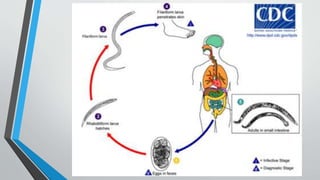
Transmission
โ€ขInfection is normally acquired via skin or mouth)
from filariform (infective) larvae in the soil
contaminated by human faeces.
โ€ขThe larvae leave the faeces and bury themselves
in moist damp soil.These larva are called
rhabditiform and are not infective before they
have changed into the sheathed filariform stage
(about 5 days)
โ€ขThe filariform larvae may attach themselves to
grass or hide in the soil. As soon they are touched
by something, they attach themselves to it when
this happens to be a human leg or foot they
penetrate actively through the skin and the cycle
starts.
Hookworm
Often no symptoms are present. Or they may include:
โ€ข Itchy rash
โ€ข Cough
โ€ข Wheezing
โ€ข Difficulty breathing
โ€ข Abdominal pain
โ€ข Weight loss
โ€ข Diarrhoea
โ€ข Loss of appetite
Treatment
โ€ขAlbendazole
โ€ขAlbendazole is also highly effective against other
intestinal nematodes and is therefore suitable for
mass treatment.
โ€ขMebendazole 100mg twice daily for 3 days is
highly effective against
โ€ขIron deficiency:
โ€ขAnaemia is treated with Iron orally (Ferrous
sulphate for two months)
โ€ขA high protein diet is necessary to replace
protein loss dietary supplements)
โ€ขDe-worming is indicated when the worm load
is severe that treating the anaemia only will
not give results or when reinfection is unlikely
to occur.
Prevention
โ€ขProvision of proper sanitary facilities for the
sanitary disposal of human faeces.
โ€ขWearing shoes will prevent infection but
usually shoes are not worn during shamba
work. It is the shamba that the infection is
acquired.
โ€ขMass chemotherapy
โ€ขHealth education.
Causes of Enterobiasis
โ€ข The causes of a pinworm infection is the worm Enterobius
vermicularis.
โ€ข Pinworm(Seat worm & thread worm) enterobiasis: A
pinworm infection occurs when a person consumes food or
drink contaminated with faeces containing the worm.
โ€ข The eggs hatch in the small intestine, and adult worms
ultimately live in the large intestine.
โ€ข The pregnant female worms move to the anus and deposit
large numbers of eggs in the skin around that area.
โ€ข Pinworm, which is commonly spread in day care centres,
schools, and camps, affects as many as 1/3 of all American
children
Pathogenesis of Enterobiasis
โ€ข The majority of infections with this nematode are
asymptomatic, although in some cases the emerging females
and the sticky masses of eggs that they lay may causes
irritation of the perianal region, which in some cases may be
severe.
โ€ข As the females emerge at night this may give rise to sleep
disturbances, and scratching of the affected perianal area
transfers eggs to the fingers and under the finger nails.
โ€ข This in turn aids the transmission of the eggs, both back to
the original host (autoinfection), and to other hosts.
28
Introduction
โ€ขCommon name: Whip worm
โ€ขDisease: Trichuriasis
โ€ขHabitat: Large intestine; colon, caecum, rectum
& appendix
โ€ขOccurrence: Worldwide, especially in warm and
moist regions with poor sanitation
โ€ขReservoir: Humans
โ€ขOften co-infection occurs with A. lumbricoides
29
TRANSMISSION
โ€ขTransmission is direct from mature eggs to the
mouth via fingers contaminated from infected
soil.
โ€ขSimply through Fecal-oral route
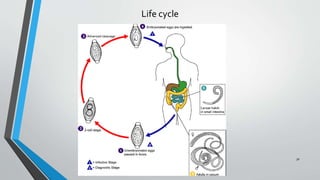
โ€ขEggs appear in the feces 70-90 days after
ingestion of the embryonated eggs; symptoms
may appear much earlier.
โ€ขFemales produce barrel-shaped eggs with clear
โ€œ polar plugsโ€
30
Life cycle
31
Symptoms
โ€ขSlight infection may be asymptomatic
โ€ขHeavy infection there may be
- Bloody and mucoid diarrhea
-Weight loss and weakness
- Abdominal pain or tenderness
- haemorrhages,
-Abdominal cramps,
Nov 2009 32
Pathology
1. Mechanical damage to mucosa
2. Abdominal cramps
3. Rectal prolapse
4. Hypochromic anaemia seen in cases
of prolonged massive infection
5. Peripheral eosinophilia: not always seen,
and degree not correlated to severity of
infection โ€“ usually <15%
6. Appendicitis
Nov 2009 33
Diagnosis
โ€ขMicroscopic examination of eggs in feces โ€“ direct
smear or concentration method
โ€ขAdult worms rarely recovered from stool, usually
visible on the prolapsed rectal mucosa
โ€ขDysentery similar to that of amoebiasis, butT. t.
โ€ขmore chronic,
โ€ขassociated with malnutrition
โ€ขlikely to cause rectal prolapse
34
Treatment
โ€ขMebendazole (Vermox)
โ€ขAlbendazole (Zentel )
RECTAL PROLAPSE
4/16/2024 6:26:53
AM
35
Control and Prevention
โ€ขEarly diagnosis and treatment of cases.
โ€ขSanitary and proper disposal of feces.
โ€ขGood hygienic habits such as cleaning of hands
before meals and after toilet.
โ€ขBoiling drinking water
โ€ขRaw fruits and vegetables should be washed
โ€ขHealth education to all community.
โ€ขMass chemotherapy (deworming) especially to
school children once or twice per year.

SESSION 4_DISEASES CAUSED BY WORM INFESTATIONS.pptx

  • 1.
    DISEASES CAUSED BY WORMINFESTATIONS SESSION 4 General Pathology Level II
  • 2.
    TAENIA SOLIUM (porktape worm)(TAENIASIS) โ€ข Infection only occur in persons eating undercooked pork so is related to food habits โ€ข It is therefore absent in those with religious and reservations against eating pork but cyticercosis may occur in any person residing in endemic areas even in vegetarians because the mode of infection is by contamination of food or drink with eggs deposited in soil
  • 3.
    Pathogenesis โ€ข The adultworms cause indigestion or abdominal discomfort, indigestion or alternating diarrhoea and constipation โ€ข It is the larva stage that cause serious trouble. Any organ or tissue can be involved โ€ข The most common being subcutaneous tissues and muscles
  • 4.
    SIGN $ SYMPTOMS โ€ขMost is asymptomatic โ€ข Abdominal pain and discomfort โ€ข Loss of appetite โ€ข Weight loss โ€ข diarrhoe โ€ข Seisuresor convulsion โ€ข Loss of vision โ€“due to eye damage
  • 5.
    Diagnosis โ€ข Sign andsymptoms and history of eating undercooked pork meat. โ€ข Cystcercos is diagnosed by biopsy of lesion โ€ข Microscopy. examination to show scolex with suckers and hooks โ€ข Infection with the adult worm is diagnosed by demonstration of eggs or proglottides in faeces โ€ข Radiography is helpful for diagnosis of cerebral cyticercosis but CT scanning is more useful
  • 6.
    โ€ข Ocular cysticercosiscan be made by opthalmoscopy. โ€ข An indirect haemagllutination test has been reported using antigen obtained from cyticercus from pigs.
  • 7.
    Treatment โ€ข Preziquantel orniclosamide are effective in treating adult worm โ€ข For cysticercosis excision is the best method โ€ข Praziquantel and metrifonate have been reported to be effective in cysticercosis as well
  • 8.
    Prevention and control โ€ขTreatment of cases โ€ข Proper meat inspection โ€ข Adequate cooking of pork โ€ข Clean personal habits and general sanitary measures โ€ข Prevention of faecal contamination of soil to make sure that pigs do not get access to human faeces โ€ข Proper disposal of sewage and avoiding raw vegetables grown in polluted soil โ€ข Health education
  • 9.
    Definition of terms โ€ขAscariasis is a human disease caused by the parasitic roundworm called Ascaris lumbricoides. โ€ข Hookworm diseaseโ€ refers primarily to the iron-deficiency anemia those results from moderate or heavy infection. Blood loss occurs when the worms use their cutting apparatus to attach themselves to the intestinal mucosa and submucosa and contract their muscular esophagi to create negative pressure, which sucks a plug of tissue into their buccal capsules
  • 10.
    โ€ขMigration of larvaein lungs may cough โ€ขBreathing difficulties โ€ขFever โ€ขUrticaria (hives ) โ€ขVague abdominal discomfort, โ€ขNausea in mild cases โ€ขMalnutrition Symptoms/signs
  • 11.
    Causes of Ascariasis& Hookworm infection (i) Ascariasis: โ€ข People become infected when they eat food or drink that contains the embryonated eggs of the roundworm Ascaris lumbricoides. โ€ข That can happen when people eat food grown in soil that has been mixed with human faeces. Once in the body, the larvae enter the lungs and then the throat, where they are coughed up and swallowed. โ€ข Once they swallowed, larvae enter the intestines and become adults.They can produce eggs for a year or more.
  • 12.
    (ii) Hookworm (ancylostomiasis) โ€ขHookworm infection in humans is caused by an infection with the helminth nematode parasites Necator americanus and Ancylostoma duodenale. โ€ข A hookworm infection occurs when filariform larvae come into contact with human skin, through contaminated soil or faeces. โ€ข They penetrate the skin, making their way through the lungs to the small intestine, where they latch on and grow into adults, laying more eggs. โ€ข They feed off the blood of the infected person, which can lead to anaemia. โ€ข Children are especially vulnerable to this kind of infection. These roundworms infect about 25% of the world's population.
  • 13.
    โ€ข The majorclinical manifestations of hookworm disease are the consequences of chronic intestinal blood loss. Iron- deficiency anemia occurs and hypoalbuminemia develops when blood loss exceeds the intake and reserves of host iron and protein. โ€ข Depending on the status of host iron, a hookworm burden (i.e., the intensity of infection, or number of worms per person) of 40 to 160 worms is associated with hemoglobin levels below 11 g per deciliter. โ€ข However, other studies have shown that anemia may occur with a lighter hookworm burden. Because infection with A. duodenale causes greater blood loss than doeโ€™s infection with N. americanus, the degree of iron-deficiency anemia induced by hookworms depends on the species. โ€ข Relationship between the Hookworm Burden and Anemia.) Most of the physical signs of chronic hookworm infection reflect the presence of iron-deficiency anemia.
  • 14.
    Signs and Symptoms Thesigns and symptoms of roundworm infection (Ascariasis) include: โ€ข Cough โ€ข Shortness of breath โ€ข Abdominal pain โ€ข Nausea and diarrhoea โ€ข Blood in the stool โ€ข Weight loss โ€ข Fatigue โ€ข Presence of worm in vomit or stool
  • 15.
    Prognosis and Complications โ€ขThere are several possible complications associated with roundworm infections.They include: โ€ข Intestinal obstruction, caused by the roundworm itself โ€ข Inflammation of the intestines or gall bladder โ€ข Kidney disease โ€ข Pus accumulation in the liver โ€ข Inflammation of the pancreas โ€ข Appendicitis
  • 16.
    Pathology 1. Loefflerโ€™s syndrome:The blood-lung migration phase of the larvae. 2. Intestinal obstruction: 3. Malnutrition 4. Physical and mental retardation: Due to heavy worm loads. 5. Death: Sometimes may occur when mass of worms cause intestinal obstruction.
  • 17.
    Diagnosis 1.Parasitic diagnosis: โ€ข Diagnosisof A lumbricoides infection can be made by; i. Demonstration of adult worms: worm may be passed through anus, mouth, nose and rarely through ear. ii.Demonstration of larvae: Ascaris larvae may be detected in the sputum during the stage of migration. iii.Demonstration of both fertilized and unfertilized eggs: these may be detected by direct microscopy or concentration of the faeces by salt floatation or formalin ether concentration method.
  • 18.
    Treatment Drugs of choicefor Ascariasis are: โ€ข Mebendazole โ€ขAlbendazole, a single oral dose. Other effective drugs are; โ€ขLevamizole, Piperazine ,Pyrantel pamoate Ivermectin
  • 19.
    Control and Prevention โ€ขEarlydiagnosis and treatment of cases. โ€ขSanitary and proper disposal of feces. โ€ขGood hygienic habits such as cleaning of hands before meals and after toilet. โ€ขBoiling drinking water โ€ขRaw fruits and vegetables should be washed โ€ขHealth education to all community. โ€ขMass chemotherapy (deworming) especially to school children once or twice per year.
  • 20.
    Transmission โ€ขInfection is normallyacquired via skin or mouth) from filariform (infective) larvae in the soil contaminated by human faeces. โ€ขThe larvae leave the faeces and bury themselves in moist damp soil.These larva are called rhabditiform and are not infective before they have changed into the sheathed filariform stage (about 5 days) โ€ขThe filariform larvae may attach themselves to grass or hide in the soil. As soon they are touched by something, they attach themselves to it when this happens to be a human leg or foot they penetrate actively through the skin and the cycle starts.
  • 22.
    Hookworm Often no symptomsare present. Or they may include: โ€ข Itchy rash โ€ข Cough โ€ข Wheezing โ€ข Difficulty breathing โ€ข Abdominal pain โ€ข Weight loss โ€ข Diarrhoea โ€ข Loss of appetite
  • 23.
    Treatment โ€ขAlbendazole โ€ขAlbendazole is alsohighly effective against other intestinal nematodes and is therefore suitable for mass treatment. โ€ขMebendazole 100mg twice daily for 3 days is highly effective against
  • 24.
    โ€ขIron deficiency: โ€ขAnaemia istreated with Iron orally (Ferrous sulphate for two months) โ€ขA high protein diet is necessary to replace protein loss dietary supplements) โ€ขDe-worming is indicated when the worm load is severe that treating the anaemia only will not give results or when reinfection is unlikely to occur.
  • 25.
    Prevention โ€ขProvision of propersanitary facilities for the sanitary disposal of human faeces. โ€ขWearing shoes will prevent infection but usually shoes are not worn during shamba work. It is the shamba that the infection is acquired. โ€ขMass chemotherapy โ€ขHealth education.
  • 26.
    Causes of Enterobiasis โ€ขThe causes of a pinworm infection is the worm Enterobius vermicularis. โ€ข Pinworm(Seat worm & thread worm) enterobiasis: A pinworm infection occurs when a person consumes food or drink contaminated with faeces containing the worm. โ€ข The eggs hatch in the small intestine, and adult worms ultimately live in the large intestine. โ€ข The pregnant female worms move to the anus and deposit large numbers of eggs in the skin around that area. โ€ข Pinworm, which is commonly spread in day care centres, schools, and camps, affects as many as 1/3 of all American children
  • 27.
    Pathogenesis of Enterobiasis โ€ขThe majority of infections with this nematode are asymptomatic, although in some cases the emerging females and the sticky masses of eggs that they lay may causes irritation of the perianal region, which in some cases may be severe. โ€ข As the females emerge at night this may give rise to sleep disturbances, and scratching of the affected perianal area transfers eggs to the fingers and under the finger nails. โ€ข This in turn aids the transmission of the eggs, both back to the original host (autoinfection), and to other hosts.
  • 28.
    28 Introduction โ€ขCommon name: Whipworm โ€ขDisease: Trichuriasis โ€ขHabitat: Large intestine; colon, caecum, rectum & appendix โ€ขOccurrence: Worldwide, especially in warm and moist regions with poor sanitation โ€ขReservoir: Humans โ€ขOften co-infection occurs with A. lumbricoides
  • 29.
    29 TRANSMISSION โ€ขTransmission is directfrom mature eggs to the mouth via fingers contaminated from infected soil. โ€ขSimply through Fecal-oral route โ€ขEggs appear in the feces 70-90 days after ingestion of the embryonated eggs; symptoms may appear much earlier. โ€ขFemales produce barrel-shaped eggs with clear โ€œ polar plugsโ€
  • 30.
  • 31.
    31 Symptoms โ€ขSlight infection maybe asymptomatic โ€ขHeavy infection there may be - Bloody and mucoid diarrhea -Weight loss and weakness - Abdominal pain or tenderness - haemorrhages, -Abdominal cramps,
  • 32.
    Nov 2009 32 Pathology 1.Mechanical damage to mucosa 2. Abdominal cramps 3. Rectal prolapse 4. Hypochromic anaemia seen in cases of prolonged massive infection 5. Peripheral eosinophilia: not always seen, and degree not correlated to severity of infection โ€“ usually <15% 6. Appendicitis
  • 33.
    Nov 2009 33 Diagnosis โ€ขMicroscopicexamination of eggs in feces โ€“ direct smear or concentration method โ€ขAdult worms rarely recovered from stool, usually visible on the prolapsed rectal mucosa โ€ขDysentery similar to that of amoebiasis, butT. t. โ€ขmore chronic, โ€ขassociated with malnutrition โ€ขlikely to cause rectal prolapse
  • 34.
  • 35.
  • 36.
    Control and Prevention โ€ขEarlydiagnosis and treatment of cases. โ€ขSanitary and proper disposal of feces. โ€ขGood hygienic habits such as cleaning of hands before meals and after toilet. โ€ขBoiling drinking water โ€ขRaw fruits and vegetables should be washed โ€ขHealth education to all community. โ€ขMass chemotherapy (deworming) especially to school children once or twice per year.