KNOW YOUR LAB EQUIPMENTS
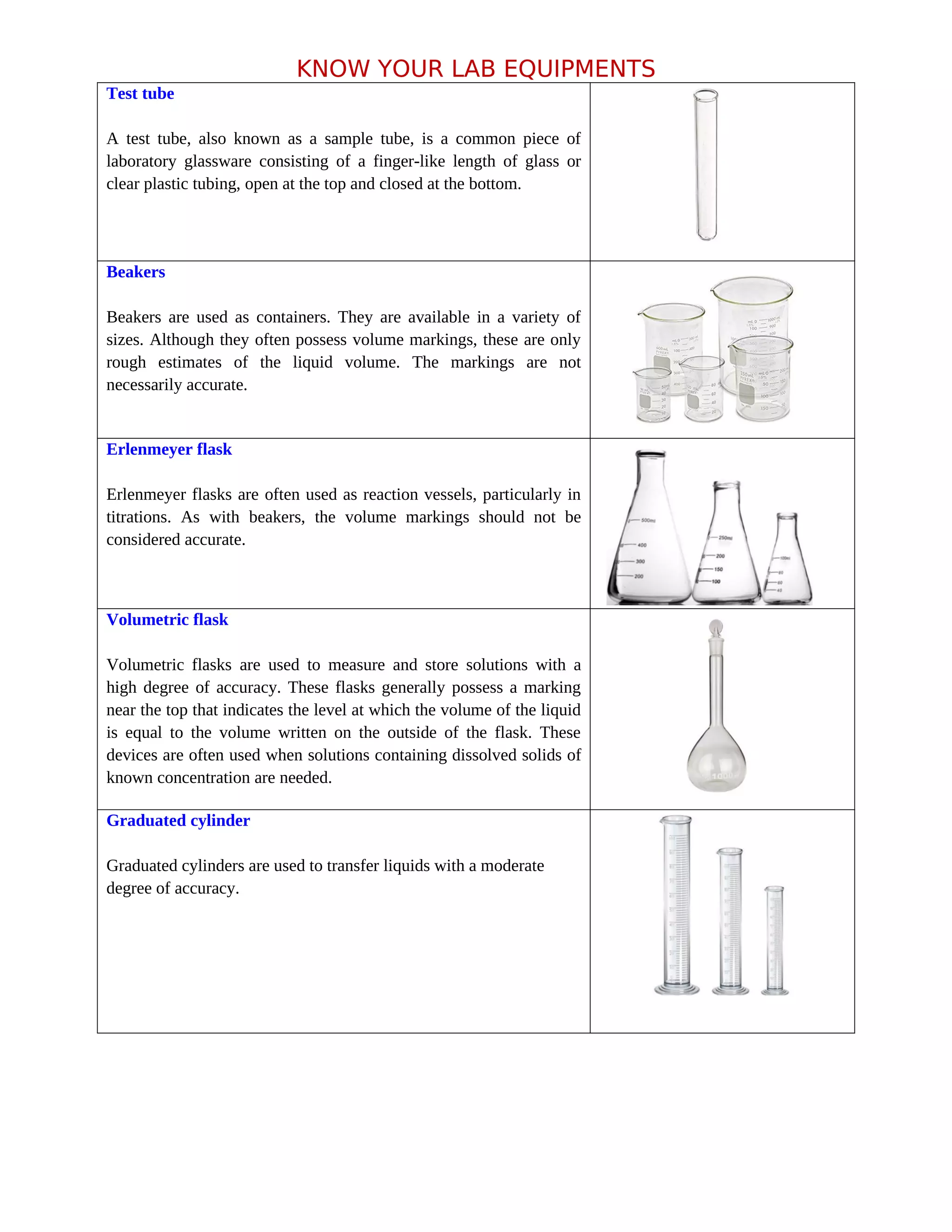
Test tube
A test tube, also known as a sample tube, is a common piece of
laboratory glassware consisting of a finger-like length of glass or
clear plastic tubing, open at the top and closed at the bottom.
Beakers
Beakers are used as containers. They are available in a variety of
sizes. Although they often possess volume markings, these are only
rough estimates of the liquid volume. The markings are not
necessarily accurate.
Erlenmeyer flask
Erlenmeyer flasks are often used as reaction vessels, particularly in
titrations. As with beakers, the volume markings should not be
considered accurate.
Volumetric flask
Volumetric flasks are used to measure and store solutions with a
high degree of accuracy. These flasks generally possess a marking
near the top that indicates the level at which the volume of the liquid
is equal to the volume written on the outside of the flask. These
devices are often used when solutions containing dissolved solids of
known concentration are needed.
Graduated cylinder
Graduated cylinders are used to transfer liquids with a moderate
degree of accuracy.
Pipette
Pipettes are used for transferring liquids with a fixed volume and
quantity of liquid must be known to a high degree of accuracy.
Graduated pipette
These Pipettes are calibrated in the factory to release the desired
quantity of liquid.
Disposable pipette
Disposable transfer. These Pipettes are made of plastic and are useful
for transferring liquids dropwise.
Burette
Burettes are devices used typically in analytical, quantitative
chemistry applications for measuring liquid solution. Differing from
a pipette since the sample quantity delivered is changeable,
graduated Burettes are used heavily in titration experiments. In
Burette and Pipettes it is common to measure the volume delivered.
This means that two volume measurements will be made. The
volume delivered is the difference in these two volumes, Vfinal -
Vinitial.
Burette clamp
Burette clamp is scientific equipment which used specifically to hold
and secure a burette on a stand, so that a burette is fixed and more
convenient for the experiment. Burette clamp can be made by many
materials such as plastic and cast iron. However, iron clamp with
rubber knob to hold burette are likely to be more durable. Usually
Burette clamp comes in double, which means it can hold two
burettes.
Funnel
A tube or pipe that is wide at the top and narrow at the bottom, used
for guiding liquid or powder into a small opening.
Buchner Funnel
A Büchner funnel is a piece of laboratory equipment used in
filtration. It is traditionally made of porcelain, but glass and plastic
funnels are also available. On top of the funnel-shaped part there is a
cylinder with a fritted glass disc/perforated plate separating it from
the funnel.
Buchner funnel vacuum filtration setup
Suction filtration (vacuum filtration) is the standard technique used
for separating a solid-liquid mixture when the goal is to retain the
solid (for example in crystallization). Similar to gravity filtration, a
solid-liquid mixture is poured onto a filter paper, with the main
difference being that the process is aided by suction beneath the
funnel.
Clamp
It is used to hold round laboratory glassware, such as a beaker, and
flasks, etc. This type of clamp is made from stainless steel.
Test tube brush
Test tube brush or spout brush is a brush used for cleaning test tubes
and narrow mouth laboratory glassware, such as graduated cylinders,
burettes, and Erlenmeyer flasks.
Test tube holder
A test tube holder is used to hold test tubes. It is used for holding a
test tube in place when the tube is hot or should not be touched.
Test tube stand
Test tube racks are laboratory equipment used to hold upright
multiple test tubes at the same time.
Bunsen burner
A small adjustable gas burner used in laboratories as a source of
heat.
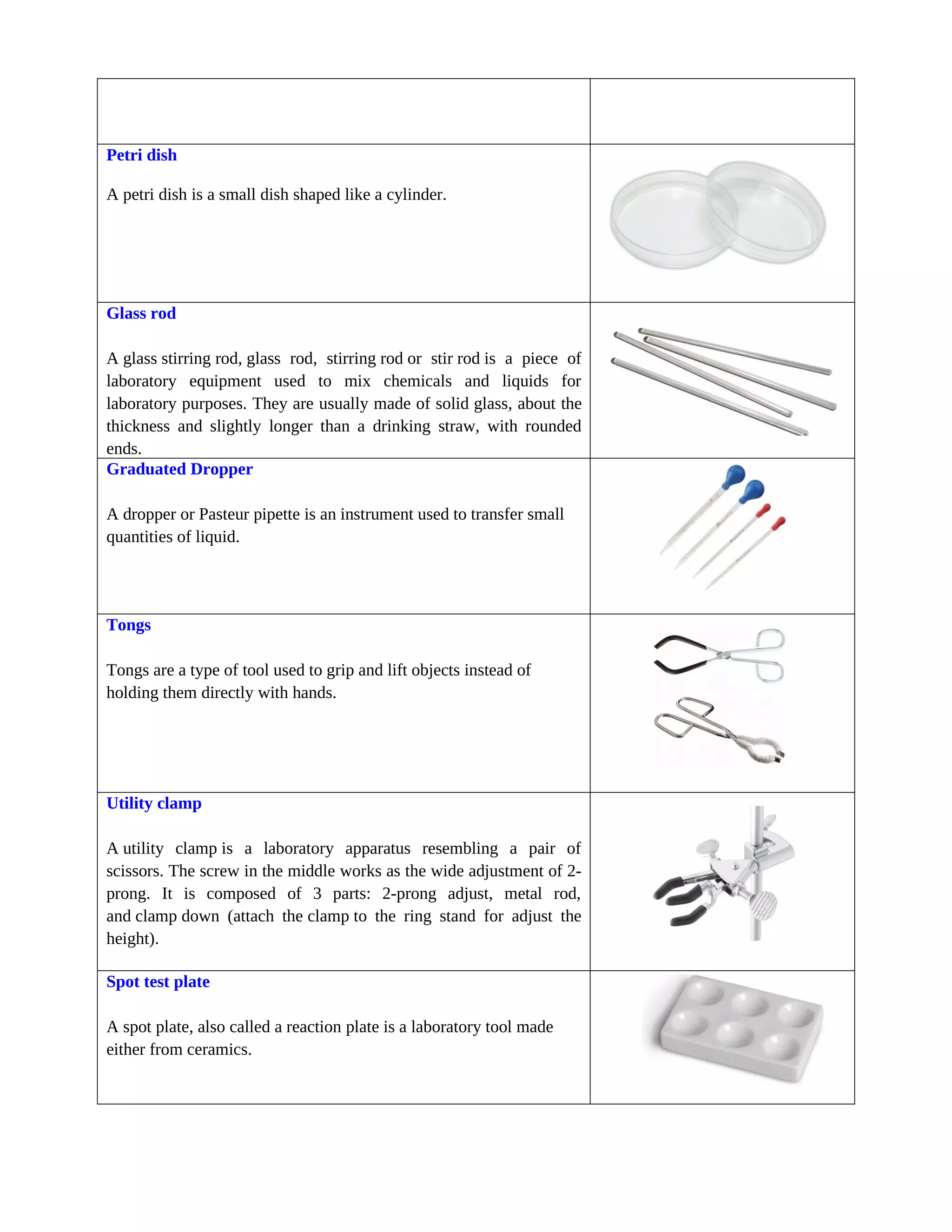
Petri dish
A petri dish is a small dish shaped like a cylinder.
Glass rod
A glass stirring rod, glass rod, stirring rod or stir rod is a piece of
laboratory equipment used to mix chemicals and liquids for
laboratory purposes. They are usually made of solid glass, about the
thickness and slightly longer than a drinking straw, with rounded
ends.
Graduated Dropper
A dropper or Pasteur pipette is an instrument used to transfer small
quantities of liquid.
Tongs
Tongs are a type of tool used to grip and lift objects instead of
holding them directly with hands.
Utility clamp
A utility clamp is a laboratory apparatus resembling a pair of
scissors. The screw in the middle works as the wide adjustment of 2-
prong. It is composed of 3 parts: 2-prong adjust, metal rod,
and clamp down (attach the clamp to the ring stand for adjust the
height).
Spot test plate
A spot plate, also called a reaction plate is a laboratory tool made
either from ceramics.
Tripod for Bunsen burner
A laboratory tripod is a three-legged platform used to support flasks
and beakers.
Wash Bottle
A wash bottle is a squeeze bottle with a nozzle, used to rinse various
pieces of laboratory glassware, such as test tubes and round bottom
flasks. Wash bottles are sealed with a screw-top lid.
Wire Mesh Gauze (Ceramic Centre)
Wire mesh (wire gauze) is used for uniform distribution of flame
heat in base of a heated body. It is made of iron wire strands with or
without ceramic interior cores.
Spatula
In laboratories, spatulas and microspatulas are small stainless steel
utensils, used for scraping, transferring, or applying powders and
paste like chemicals or treatments. Many spatula brands are also
resistant to acids, bases, heat, and solvents, which make them ideal
for use with a wide range of compound.
Round-bottom flasks
Round-bottom flasks (also called round-bottomed flasks or RB
flasks) are types of flasks having spherical bottoms used as
laboratory glassware, mostly for chemical or biochemical work.
Glass Condenser
A condenser is an apparatus or item of equipment used to condense
(change the physical state of a substance from its gaseous to its
liquid state). In the laboratory, condensers are generally used in
procedures involving organic liquids brought into the gaseous state
through heating, with or without lowering the pressure (applying
vacuum)—though applications in inorganic and other chemistry
areas exist.
Filter paper
Filter paper is a semi-permeable paper barrier placed perpendicular
to a liquid or air flow. It is used to separate fine substances from
liquids or air. It is used in science labs to remove solids from liquids.
Separatory funnel
A separatory funnel, also known as a separation funnel, separating
funnel, or colloquially sep funnel, is a piece of laboratory glassware
used in liquid-liquid extractions to separate (partition) the
components of a mixture into two immiscible solvent phases of
different densities.
Filtering flask
A filtering flask is a piece of labware used to separate solids from
fluids in filtration operations. To filter substances, the flask is used
with a filtering funnel, such as a Buchner funnel, which incorporates
a fritted glass disc or perforated plate fitted with a piece
of filter paper to filter particles.
Watch glass
A watch glass is a circular concave piece of glass used in chemistry
as a surface to evaporate a liquid, to hold solids while being
weighed, for heating a small amount of substance and as a cover for
a beaker. The latter use is generally applied to prevent dust or other
particles entering the beaker; the watch glass does not completely
seal the beaker, so gas exchanges still occur.
Fusion tube
Fusion tube is laboratory tube used much in the same way as boiling
tubes expect not being as large and thick walled. A fusion tube made
of thinner glass because it is intended to be broken into a container
of water at the end of the fusion tube.
Mortar and pestle
Mortar and pestle are implements used since ancient times to prepare
ingredients or substances by crushing and grinding them into a fine
paste or powder in the laboratory.
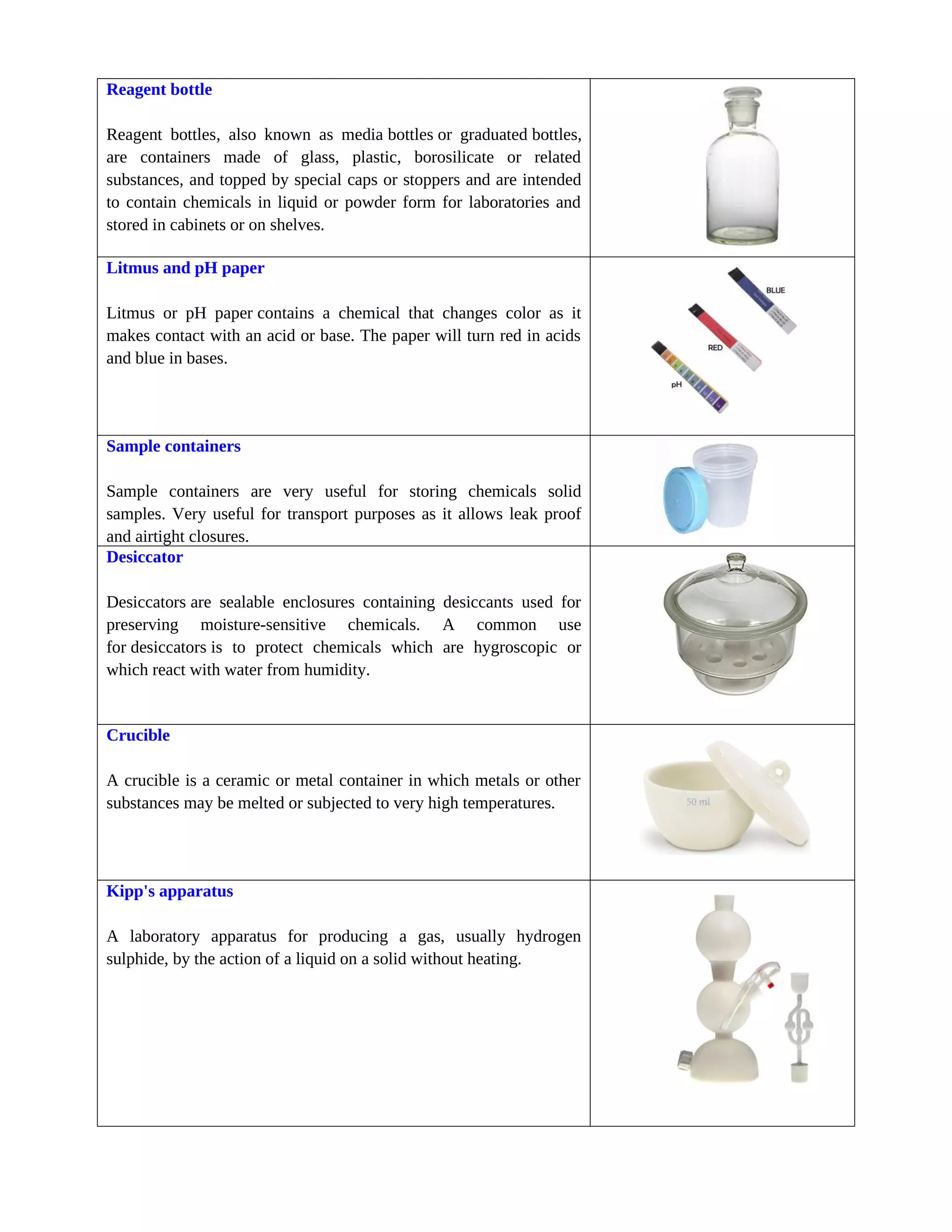
Reagent bottle
Reagent bottles, also known as media bottles or graduated bottles,
are containers made of glass, plastic, borosilicate or related
substances, and topped by special caps or stoppers and are intended
to contain chemicals in liquid or powder form for laboratories and
stored in cabinets or on shelves.
Litmus and pH paper
Litmus or pH paper contains a chemical that changes color as it
makes contact with an acid or base. The paper will turn red in acids
and blue in bases.
Sample containers
Sample containers are very useful for storing chemicals solid
samples. Very useful for transport purposes as it allows leak proof
and airtight closures.
Desiccator
Desiccators are sealable enclosures containing desiccants used for
preserving moisture-sensitive chemicals. A common use
for desiccators is to protect chemicals which are hygroscopic or
which react with water from humidity.
Crucible
A crucible is a ceramic or metal container in which metals or other
substances may be melted or subjected to very high temperatures.
Kipp's apparatus
A laboratory apparatus for producing a gas, usually hydrogen
sulphide, by the action of a liquid on a solid without heating.
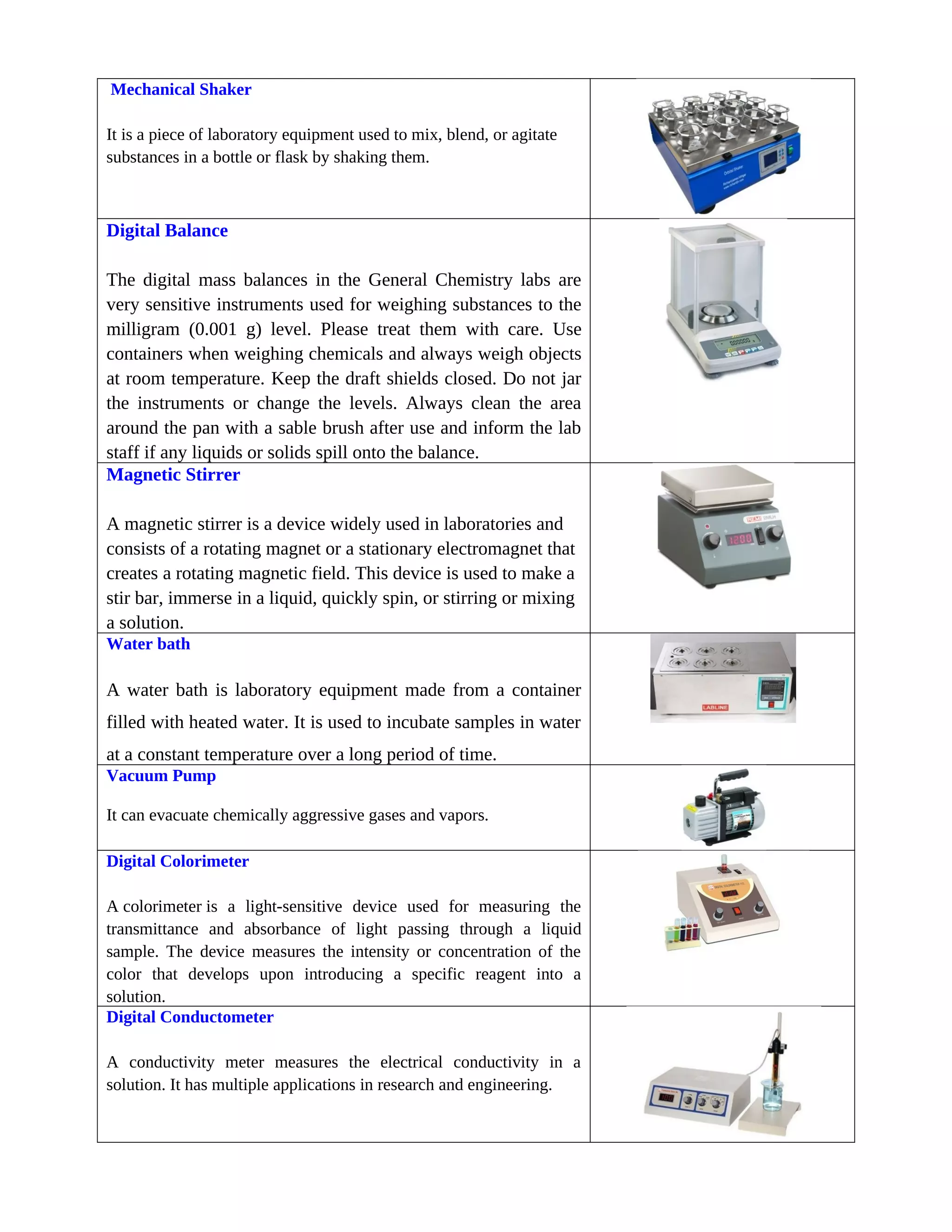
Mechanical Shaker
It is a piece of laboratory equipment used to mix, blend, or agitate
substances in a bottle or flask by shaking them.
Digital Balance
The digital mass balances in the General Chemistry labs are
very sensitive instruments used for weighing substances to the
milligram (0.001 g) level. Please treat them with care. Use
containers when weighing chemicals and always weigh objects
at room temperature. Keep the draft shields closed. Do not jar
the instruments or change the levels. Always clean the area
around the pan with a sable brush after use and inform the lab
staff if any liquids or solids spill onto the balance.
Magnetic Stirrer
A magnetic stirrer is a device widely used in laboratories and
consists of a rotating magnet or a stationary electromagnet that
creates a rotating magnetic field. This device is used to make a
stir bar, immerse in a liquid, quickly spin, or stirring or mixing
a solution.
Water bath
A water bath is laboratory equipment made from a container
filled with heated water. It is used to incubate samples in water
at a constant temperature over a long period of time.
Vacuum Pump
It can evacuate chemically aggressive gases and vapors.
Digital Colorimeter
A colorimeter is a light-sensitive device used for measuring the
transmittance and absorbance of light passing through a liquid
sample. The device measures the intensity or concentration of the
color that develops upon introducing a specific reagent into a
solution.
Digital Conductometer
A conductivity meter measures the electrical conductivity in a
solution. It has multiple applications in research and engineering.
Digital pH meter
A pH meter is a scientific instrument that measures the hydrogen-ion
activity in water-based solutions, indicating its acidity or alkalinity
expressed as pH.
Digital Potentiometer
A potentiometer is an instrument for measuring voltage by
comparison of an unknown voltage with a known reference voltage.
If a sensitive indicating instrument is used, very little current is
drawn from the source of the unknown voltage. Since the reference
voltage can be produced from an accurately calibrated voltage
divider, a potentiometer can provide high precision in measurement.

Laboratory Equipments.pdf

  • 1.
    KNOW YOUR LABEQUIPMENTS Test tube A test tube, also known as a sample tube, is a common piece of laboratory glassware consisting of a finger-like length of glass or clear plastic tubing, open at the top and closed at the bottom. Beakers Beakers are used as containers. They are available in a variety of sizes. Although they often possess volume markings, these are only rough estimates of the liquid volume. The markings are not necessarily accurate. Erlenmeyer flask Erlenmeyer flasks are often used as reaction vessels, particularly in titrations. As with beakers, the volume markings should not be considered accurate. Volumetric flask Volumetric flasks are used to measure and store solutions with a high degree of accuracy. These flasks generally possess a marking near the top that indicates the level at which the volume of the liquid is equal to the volume written on the outside of the flask. These devices are often used when solutions containing dissolved solids of known concentration are needed. Graduated cylinder Graduated cylinders are used to transfer liquids with a moderate degree of accuracy.
  • 2.
    Pipette Pipettes are usedfor transferring liquids with a fixed volume and quantity of liquid must be known to a high degree of accuracy. Graduated pipette These Pipettes are calibrated in the factory to release the desired quantity of liquid. Disposable pipette Disposable transfer. These Pipettes are made of plastic and are useful for transferring liquids dropwise. Burette Burettes are devices used typically in analytical, quantitative chemistry applications for measuring liquid solution. Differing from a pipette since the sample quantity delivered is changeable, graduated Burettes are used heavily in titration experiments. In Burette and Pipettes it is common to measure the volume delivered. This means that two volume measurements will be made. The volume delivered is the difference in these two volumes, Vfinal - Vinitial. Burette clamp Burette clamp is scientific equipment which used specifically to hold and secure a burette on a stand, so that a burette is fixed and more convenient for the experiment. Burette clamp can be made by many materials such as plastic and cast iron. However, iron clamp with rubber knob to hold burette are likely to be more durable. Usually Burette clamp comes in double, which means it can hold two burettes. Funnel A tube or pipe that is wide at the top and narrow at the bottom, used for guiding liquid or powder into a small opening.
  • 3.
    Buchner Funnel A Büchnerfunnel is a piece of laboratory equipment used in filtration. It is traditionally made of porcelain, but glass and plastic funnels are also available. On top of the funnel-shaped part there is a cylinder with a fritted glass disc/perforated plate separating it from the funnel. Buchner funnel vacuum filtration setup Suction filtration (vacuum filtration) is the standard technique used for separating a solid-liquid mixture when the goal is to retain the solid (for example in crystallization). Similar to gravity filtration, a solid-liquid mixture is poured onto a filter paper, with the main difference being that the process is aided by suction beneath the funnel. Clamp It is used to hold round laboratory glassware, such as a beaker, and flasks, etc. This type of clamp is made from stainless steel. Test tube brush Test tube brush or spout brush is a brush used for cleaning test tubes and narrow mouth laboratory glassware, such as graduated cylinders, burettes, and Erlenmeyer flasks. Test tube holder A test tube holder is used to hold test tubes. It is used for holding a test tube in place when the tube is hot or should not be touched. Test tube stand Test tube racks are laboratory equipment used to hold upright multiple test tubes at the same time. Bunsen burner A small adjustable gas burner used in laboratories as a source of heat.
  • 4.
    Petri dish A petridish is a small dish shaped like a cylinder. Glass rod A glass stirring rod, glass rod, stirring rod or stir rod is a piece of laboratory equipment used to mix chemicals and liquids for laboratory purposes. They are usually made of solid glass, about the thickness and slightly longer than a drinking straw, with rounded ends. Graduated Dropper A dropper or Pasteur pipette is an instrument used to transfer small quantities of liquid. Tongs Tongs are a type of tool used to grip and lift objects instead of holding them directly with hands. Utility clamp A utility clamp is a laboratory apparatus resembling a pair of scissors. The screw in the middle works as the wide adjustment of 2- prong. It is composed of 3 parts: 2-prong adjust, metal rod, and clamp down (attach the clamp to the ring stand for adjust the height). Spot test plate A spot plate, also called a reaction plate is a laboratory tool made either from ceramics.
  • 5.
    Tripod for Bunsenburner A laboratory tripod is a three-legged platform used to support flasks and beakers. Wash Bottle A wash bottle is a squeeze bottle with a nozzle, used to rinse various pieces of laboratory glassware, such as test tubes and round bottom flasks. Wash bottles are sealed with a screw-top lid. Wire Mesh Gauze (Ceramic Centre) Wire mesh (wire gauze) is used for uniform distribution of flame heat in base of a heated body. It is made of iron wire strands with or without ceramic interior cores. Spatula In laboratories, spatulas and microspatulas are small stainless steel utensils, used for scraping, transferring, or applying powders and paste like chemicals or treatments. Many spatula brands are also resistant to acids, bases, heat, and solvents, which make them ideal for use with a wide range of compound. Round-bottom flasks Round-bottom flasks (also called round-bottomed flasks or RB flasks) are types of flasks having spherical bottoms used as laboratory glassware, mostly for chemical or biochemical work. Glass Condenser A condenser is an apparatus or item of equipment used to condense (change the physical state of a substance from its gaseous to its liquid state). In the laboratory, condensers are generally used in procedures involving organic liquids brought into the gaseous state through heating, with or without lowering the pressure (applying vacuum)—though applications in inorganic and other chemistry areas exist.
  • 6.
    Filter paper Filter paperis a semi-permeable paper barrier placed perpendicular to a liquid or air flow. It is used to separate fine substances from liquids or air. It is used in science labs to remove solids from liquids. Separatory funnel A separatory funnel, also known as a separation funnel, separating funnel, or colloquially sep funnel, is a piece of laboratory glassware used in liquid-liquid extractions to separate (partition) the components of a mixture into two immiscible solvent phases of different densities. Filtering flask A filtering flask is a piece of labware used to separate solids from fluids in filtration operations. To filter substances, the flask is used with a filtering funnel, such as a Buchner funnel, which incorporates a fritted glass disc or perforated plate fitted with a piece of filter paper to filter particles. Watch glass A watch glass is a circular concave piece of glass used in chemistry as a surface to evaporate a liquid, to hold solids while being weighed, for heating a small amount of substance and as a cover for a beaker. The latter use is generally applied to prevent dust or other particles entering the beaker; the watch glass does not completely seal the beaker, so gas exchanges still occur. Fusion tube Fusion tube is laboratory tube used much in the same way as boiling tubes expect not being as large and thick walled. A fusion tube made of thinner glass because it is intended to be broken into a container of water at the end of the fusion tube. Mortar and pestle Mortar and pestle are implements used since ancient times to prepare ingredients or substances by crushing and grinding them into a fine paste or powder in the laboratory.
  • 7.
    Reagent bottle Reagent bottles,also known as media bottles or graduated bottles, are containers made of glass, plastic, borosilicate or related substances, and topped by special caps or stoppers and are intended to contain chemicals in liquid or powder form for laboratories and stored in cabinets or on shelves. Litmus and pH paper Litmus or pH paper contains a chemical that changes color as it makes contact with an acid or base. The paper will turn red in acids and blue in bases. Sample containers Sample containers are very useful for storing chemicals solid samples. Very useful for transport purposes as it allows leak proof and airtight closures. Desiccator Desiccators are sealable enclosures containing desiccants used for preserving moisture-sensitive chemicals. A common use for desiccators is to protect chemicals which are hygroscopic or which react with water from humidity. Crucible A crucible is a ceramic or metal container in which metals or other substances may be melted or subjected to very high temperatures. Kipp's apparatus A laboratory apparatus for producing a gas, usually hydrogen sulphide, by the action of a liquid on a solid without heating.
  • 8.
    Mechanical Shaker It isa piece of laboratory equipment used to mix, blend, or agitate substances in a bottle or flask by shaking them. Digital Balance The digital mass balances in the General Chemistry labs are very sensitive instruments used for weighing substances to the milligram (0.001 g) level. Please treat them with care. Use containers when weighing chemicals and always weigh objects at room temperature. Keep the draft shields closed. Do not jar the instruments or change the levels. Always clean the area around the pan with a sable brush after use and inform the lab staff if any liquids or solids spill onto the balance. Magnetic Stirrer A magnetic stirrer is a device widely used in laboratories and consists of a rotating magnet or a stationary electromagnet that creates a rotating magnetic field. This device is used to make a stir bar, immerse in a liquid, quickly spin, or stirring or mixing a solution. Water bath A water bath is laboratory equipment made from a container filled with heated water. It is used to incubate samples in water at a constant temperature over a long period of time. Vacuum Pump It can evacuate chemically aggressive gases and vapors. Digital Colorimeter A colorimeter is a light-sensitive device used for measuring the transmittance and absorbance of light passing through a liquid sample. The device measures the intensity or concentration of the color that develops upon introducing a specific reagent into a solution. Digital Conductometer A conductivity meter measures the electrical conductivity in a solution. It has multiple applications in research and engineering.
  • 9.
    Digital pH meter ApH meter is a scientific instrument that measures the hydrogen-ion activity in water-based solutions, indicating its acidity or alkalinity expressed as pH. Digital Potentiometer A potentiometer is an instrument for measuring voltage by comparison of an unknown voltage with a known reference voltage. If a sensitive indicating instrument is used, very little current is drawn from the source of the unknown voltage. Since the reference voltage can be produced from an accurately calibrated voltage divider, a potentiometer can provide high precision in measurement.