ISO/IEC 17025:2017 REQURIEMENT
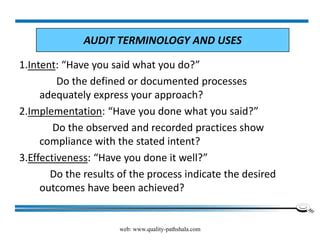
Presented by:
DR SAMBHU CHAKRABORTY
Website: www.sambhuchakraborty.com
Course Delivered By
Institute of Applied Quality Management
386/1 D H Road, Kolkata 700063, India
Website: www.quality-pathshala.com
E.mail : director@iaqmconsultants.com
Phone: +919830051583/ +91-33-24976080
FACULTY
DR SAMBHU CHAKRABORTY
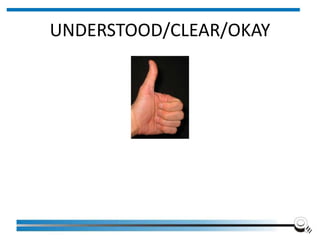
UNDERSTOOD/CLEAR/OKAY
Institute of Applied Quality Management 4
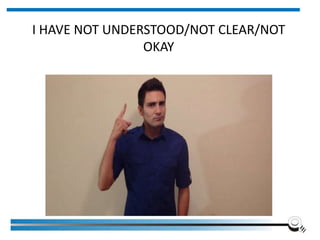
I HAVE NOT UNDERSTOOD/NOT CLEAR/NOT
OKAY
Institute of Applied Quality Management 5
Participant Introduction
Institute of Applied Quality Management 6
Code of conduct
• The participants are expected to be punctual
• The participants are expected to attend every
session
• The use of cell/mobile phone should be
avoided, it should be in silent/vibration mode
• A harmonious and cordial ambiance is
necessary for the program, the participants
are expected to show their team spirit
Institute of Applied Quality Management 7
Important Announcement
• Every day training 9 am to 5.30 PM
• Please make yourself available at 8.50 am
• Tea Break for 15 minutes only
• Lunch for 45 minutes only
• 3.30 PM Group Photogrpah session
• Only 10th April Banquet will be changed, get
confirmation from our Staff
What is Quality in Laboratory
The characteristics of Laboratory services that
bear on its ability to satisfy stated or implied
needs of the user of laboratory services
Institute of Applied Quality Management 9
Quality IS…
• Right specimen/sample/Item
• Right method
• Right Result
• Right time
• Right Delivery
• Right accuracy
• Employee safety
• Soft skill
• Acknowledging feedback
• Showing improvement……ALLLLL
Institute of Applied Quality Management 10
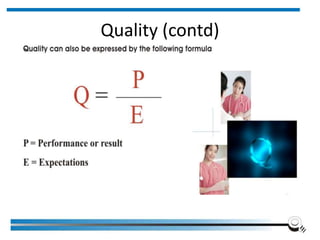
Quality (contd)
Institute of Applied Quality Management 11
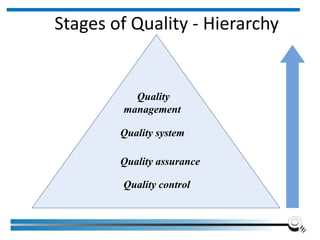
Stages of Quality - Hierarchy
Institute of Applied Quality Management 12
Quality control
Quality assurance
Quality system
Quality
management
Quality Control
• Operational techniques and activities used to
fulfill requirements for quality (ISO)
• Internal quality control (IQC) – set of
procedures for continuously assessing
laboratory work and the emergent results;
immediate effect, should actually control
release of results
Institute of Applied Quality Management 13
Quality Assurance
• A Systematic process approach to ensure the
quality in every input and output area.
• LAB Quality : Right results, at the right time, on the
right specimen, from the right sample with the
result interpretation based on correct reference
data and at the right price
Institute of Applied Quality Management 14
Institute of Applied Quality Management
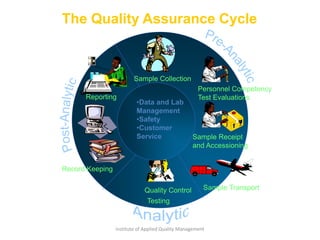
The Quality Assurance Cycle
•Data and Lab
Management
•Safety
•Customer
Service
Sample Collection
Sample Receipt
and Accessioning
Sample Transport
Quality Control
Record Keeping
Reporting
Personnel Competency
Test Evaluations
Testing
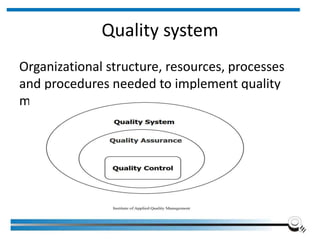
Quality system
Organizational structure, resources, processes
and procedures needed to implement quality
management (ISO, NCCLS)
Institute of Applied Quality Management 16
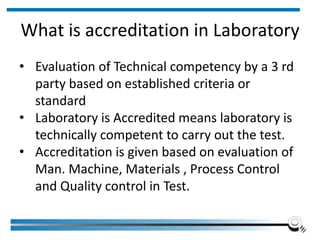
What is accreditation in Laboratory
• Evaluation of Technical competency by a 3 rd
party based on established criteria or
standard
• Laboratory is Accredited means laboratory is
technically competent to carry out the test.
• Accreditation is given based on evaluation of
Man. Machine, Materials , Process Control
and Quality control in Test.
Institute of Applied Quality Management 17
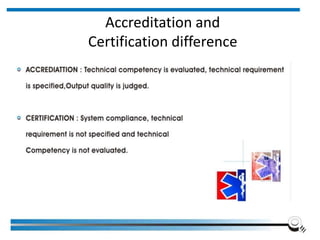
Accreditation and
Certification difference
Institute of Applied Quality Management 18
Why laboratory Accreditation
laboratory Accreditation is the only tool to
convey internal and external customer that
laboratory is technically competent to carry out
the test
Institute of Applied Quality Management 19
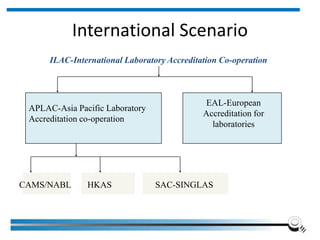
International Scenario
Institute of Applied Quality Management 20
ILAC-International Laboratory Accreditation Co-operation
APLAC-Asia Pacific Laboratory
Accreditation co-operation
EAL-European
Accreditation for
laboratories
CAMS/NABL HKAS SAC-SINGLAS
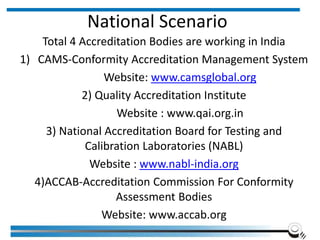
National Scenario
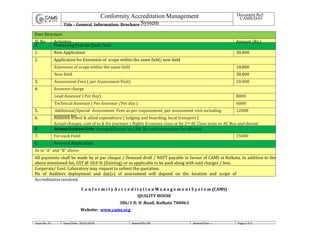
Total 4 Accreditation Bodies are working in India
1) CAMS-Conformity Accreditation Management System
Website: www.camsglobal.org
2) Quality Accreditation Institute
Website : www.qai.org.in
3) National Accreditation Board for Testing and
Calibration Laboratories (NABL)
Website : www.nabl-india.org
4)ACCAB-Accreditation Commission For Conformity
Assessment Bodies
Website: www.accab.org
CONFORMITY ACCREDITATION
MANAGEMENT SYSTEM
Website : www.camsglobal.org
laboratory Global recognition
Accreditation
acceptance is done
globally through
membership of ILAC
Institute of Applied Quality Management 23
ISO/IEC 17025 HISTORY
International Organization for
Standardization (ISO)
About the Standard
• Scope : This document specifies the general
requirements for the competence, impartiality and
consistent operation of laboratories.
• This document is applicable to all organizations
performing laboratory activities, regardless of the
number of personnel.
• Laboratory customers, regulatory authorities,
organizations and schemes using peer-assessment,
• accreditation bodies, and others use this document
in confirming or recognizing the competence of
laboratories..
About the Standard
2 Normative references
• ISO/IEC Guide 99, International vocabulary of
metrology — Basic and general concepts and
associated
• terms (VIM)1
• ISO/IEC 17000, Conformity assessment — Vocabulary
and general principles
About the Standard
3 Terms and definitions
For the purposes of this document, the relevant terms
and definitions given in ISO/IEC 17000 and following
apply.
• ISO and IEC maintain terminological databases for use
in standardization at the following addresses:
• ISO Online browsing platform: available at https://www.iso.org/obp
• IEC Electropedia: available at http://www.electropedia.org/
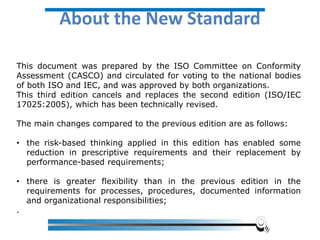
This document was prepared by the ISO Committee on Conformity
Assessment (CASCO) and circulated for voting to the national bodies
of both ISO and IEC, and was approved by both organizations.
This third edition cancels and replaces the second edition (ISO/IEC
17025:2005), which has been technically revised.
The main changes compared to the previous edition are as follows:
• the risk-based thinking applied in this edition has enabled some
reduction in prescriptive requirements and their replacement by
performance-based requirements;
• there is greater flexibility than in the previous edition in the
requirements for processes, procedures, documented information
and organizational responsibilities;
.
About the New Standard
About the
Standard
About the Standard
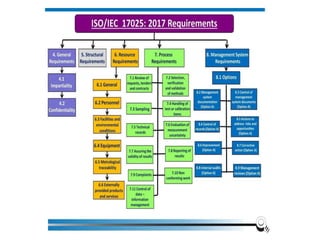
1 Scope
2 Normative reference
3 Terms and definitions
4 General requirements
4.1 Impartiality
4.2 Confidentiality
5 Structural requirements
6 Resource requirements
7 Process requirements
8 Management system requirements
About the Standard
New Terms/Definitions:
• Laboratory
• Intralaboratory comparison
• Decision rule
• Impartiality
Obsolete Terms:
• Quality manager
• Technical manager
• Accommodation -> Facility
• Preventive actions -> risk and opportunities
About the Standard
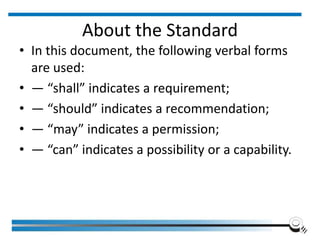
• In this document, the following verbal forms
are used:
• — “shall” indicates a requirement;
• — “should” indicates a recommendation;
• — “may” indicates a permission;
• — “can” indicates a possibility or a capability.
About the New
Standard
4.1 Impartiality
Impartiality (also called evenhandedness or
fair-mindedness) is a principle of justice
holding that decisions should be based on
objective criteria, rather than on the basis of
bias, prejudice, or preferring the benefit to
one person over another for improper
reasons.
4.1 Impartiality
will be independent will not be affiliated
with the producer nor the user of the item
being tested
No commercial bias is present.
Impartial organization structure
shall not allow commercial, financial or
other pressures to compromise impartiality.
Example
• In house testing laboratory is free from any
kind of pressure from Production, stores or
sales or any other management people
• Test productivity is not linked with salary
• If laboratory is the part of a Product
manufacturing company, no false report to
certify the product
• If the laboratory is the part of Inspection
Agency
4.1 Impartiality
• Impartiality Risk : identification on going basis, risk
including from relationship of the personnel
• threats that arise from Analyst or Laboratory
management acting in their own interest
• competition threats : loosing contract or test
4.2 Confidentiality
• The laboratory shall be responsible, through legally
enforceable commitments,
• all other information is considered proprietary
information and shall be regarded as confidential.
• If Confidential information is shared for legal
purpose, client must be informed
• Customer information collected from outside source
is also confidential for customer
• All personnel including committee members,
contractual person will maintain confidentiality.
Legal Requirements
A laboratory must produce relevant evidence of legal
identification which can be any of the following:
• Registration under the Indian Companies Act, Limited
Liability Act, Partnership
• Act, Registration of Business as Sole Proprietor,
Indian Trust Act, Societies Registration Act,
• Any Government notification in support of
establishment of institution / laboratory or any
• approval from local or regulatory bodies. Laboratory
shall also comply with local / regional /national
requirements.
•
Institute of Applied Quality Management 42
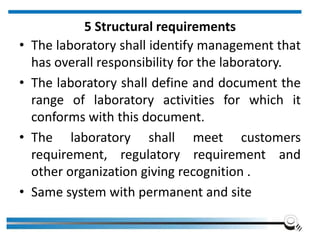
5 Structural requirements
• The laboratory shall identify management that
has overall responsibility for the laboratory.
• The laboratory shall define and document the
range of laboratory activities for which it
conforms with this document.
• The laboratory shall meet customers
requirement, regulatory requirement and
other organization giving recognition .
• Same system with permanent and site
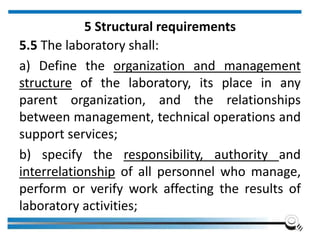
5 Structural requirements
5.5 The laboratory shall:
a) Define the organization and management
structure of the laboratory, its place in any
parent organization, and the relationships
between management, technical operations and
support services;
b) specify the responsibility, authority and
interrelationship of all personnel who manage,
perform or verify work affecting the results of
laboratory activities;
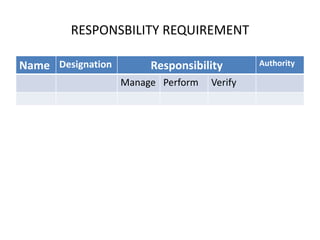
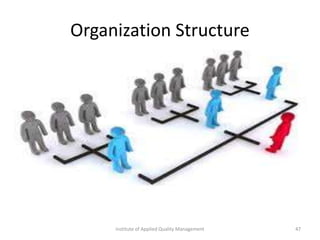
RESPONSBILITY REQUIREMENT
Name Designation Responsibility Authority
Manage Perform Verify
Organization Structure
Institute of Applied Quality Management 47
5 Structural requirements
c) document its procedures to the extent
necessary to ensure the consistent application
of its laboratory activities and the validity of the
results.
5 Structural requirements
5.6 Following responsibility must be addressed other
than regular responsibilities
a) implementation, maintenance and improvement of
the management system; (whatever designation like
QM)
b) identification of deviations from the management
system; (Non conformity)
c) initiation of actions to prevent or minimize such
deviations (Risk assessment)
d) Reporting for improvement and ensure effectiveness
(Audit and MR meeting)
5 Structural requirements
5.7 Laboratory management shall ensure that:
a) Effective communication on effectiveness of
the management system and the importance of
meeting customers' and other requirements;
contract review, statuary and regulatory
requirement/circular mail on system need
b) the integrity of the management system is
maintained when changes to the management
system are planned and implemented.
(Organization structure/ system changes
DOCUMENTATION AND RECORD SUMMARY FOR
5 STRUCTURAL REQUIREMENTS CLAUSE OF ISO/IEC
17025
• Legal Identity
• Impartiality policy and risk identification
• Confidentiality agreement/arrangement with
laboratory staff
• Responsibility interrelationship matrix
• Evidence of communication with laboratory staff
• Circular mail as part of communication
6 Resource requirements
6.1 General
The laboratory shall have available the personnel,
facilities, equipment, systems and support services
necessary to manage and perform its laboratory
activities.
Qualified technical person, required
accommodation, environment facility, calibrated
adequate equipment , quality reagent, CRM/
standard and other facility as required to perform
quality work
6 Resource requirements
6.2 Personnel
6.2.1 All personnel of the laboratory, either internal
or external (including contract person/ sub contract
person/ part time person), that could influence the
laboratory activities shall act impartially, be
competent and work in accordance with the
laboratory's management system
Competence assessment as required
6 Resource requirements
Competence Requirement :
6.2.2 The laboratory shall document the
competence requirements for each function
influencing the results of laboratory activities,
including requirements for education, qualification,
training, technical knowledge, skills and experience.
6.2.3 The laboratory shall ensure that the personnel
have the competence to perform laboratory
activities for which they are responsible and to
evaluate the significance of deviations.. (include
decision rule, non conformity, tolerance limit, LOD)
6.2.3 Personnel (contd)
Competence assessment
• Competence of each person to perform assigned
managerial or technical tasks according to
established criteria.
- Managerial task : duty roaster, lision with vendor
- Technical task : Testing of sample
• Reassessment shall take place at regular intervals.
• Retraining shall occur when necessary.
6.2.3 Personnel (contd)
Competence assessment
a) Direct observation of routine work processes and
procedures, including all applicable safety practices;
b)Direct observation on equip. maintenance and check
c) Monitoring the recording and reporting of
examination results;
d)Review of work records;
e) Assessment of problem solving skills;
f) Examination of specially provided samples, such as
previously examined samples, inter laboratory
comparison materials, or split samples.
6 Resource requirements
6.2.4 The management of the laboratory shall
communicate to personnel their duties,
responsibilities and authorities.
Detailed job description with duties, responsibilities
and authorities
Communication evidence or signature of
acceptance may be required
6 Resource requirements
6.2.5 The laboratory shall have procedure(s) and
retain records for:
a) determining the competence requirements;
(criteria against job)
b) selection of personnel; (selection record/
interview assessment/ joining details )
c) training of personnel; (training need and record)
d) supervision of personnel; (evidence of checking)
e) authorization of personnel; (evidence )
f) monitoring competence of personnel. ( periodical
competence assessment )
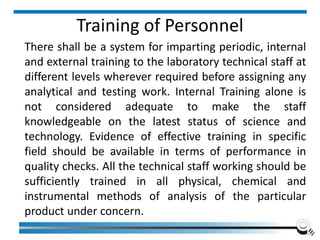
Training of Personnel
There shall be a system for imparting periodic, internal
and external training to the laboratory technical staff at
different levels wherever required before assigning any
analytical and testing work. Internal Training alone is
not considered adequate to make the staff
knowledgeable on the latest status of science and
technology. Evidence of effective training in specific
field should be available in terms of performance in
quality checks. All the technical staff working should be
sufficiently trained in all physical, chemical and
instrumental methods of analysis of the particular
product under concern.
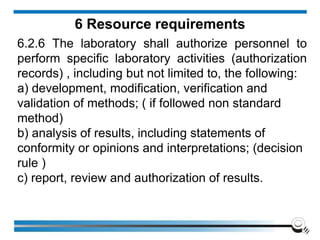
6 Resource requirements
6.2.6 The laboratory shall authorize personnel to
perform specific laboratory activities (authorization
records) , including but not limited to, the following:
a) development, modification, verification and
validation of methods; ( if followed non standard
method)
b) analysis of results, including statements of
conformity or opinions and interpretations; (decision
rule )
c) report, review and authorization of results.
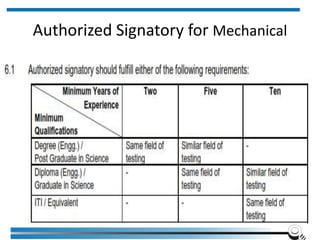
Authorized Signatory for Mechanical
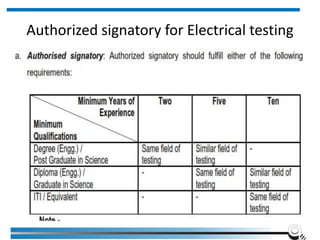
Authorized signatory for Electrical testing
6 Resource requirements
6.3 Facilities and environmental condition
6 Resource requirements
6.3.1 The facilities (it can be
vibration/sound/light/electromagnetic) and
environmental conditions shall be suitable for the
laboratory activities and shall not adversely affect
the validity of results.(following QC activities)
6.3.2 The requirements for facilities and
environmental conditions necessary for the
performance of the laboratory activities shall be
documented. Recording along with testing data.
6.3.3 The laboratory shall monitor, control and record
environmental conditions in accordance with relevant
specifications, methods or procedures or where they
influence the validity of the results.
The laboratory shall provide appropriate environmental
conditions and controls necessary for particular tests,
including temperature, humidity, freedom from
vibration, freedom from airborne and dust borne
microbiological contamination, special lighting adiation
screening. Critical environmental conditions should be
monitored.
6 Resource requirements
6.3.4 Measures to control facilities shall be
implemented, monitored and periodically reviewed
and shall include, but not be limited to:
a) access to and use of areas affecting laboratory
activities;
b) prevention of contamination, interference or
adverse influences on laboratory activities;
c) effective separation between areas with
incompatible laboratory activities.
Example and recommendation
• Restrictions might be made because of security,
safety, or sensitivity to contamination. Typical
examples might be work involving explosives,
radioactive materials, carcinogens, toxic materials
and trace analysis. Where such restrictions are in
force, staff should be aware of:
• i. the intended use of a particular area;
• ii. the restrictions imposed on working within such
areas;
• iii. the reasons for imposing such restrictions
6 Resource requirements
6.3.5 When the laboratory performs laboratory
activities at sites or facilities outside its permanent
control, it shall ensure that the requirements related
to facilities and environmental conditions of this
document are met.
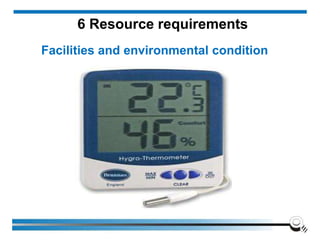
6 Resource requirements
Facilities and environmental condition
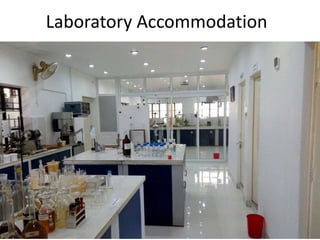
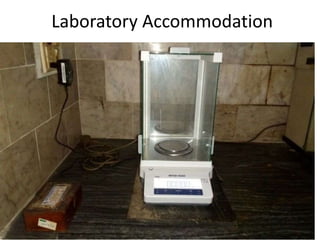
Laboratory Accommodation
6 Resource requirements
6.4 Equipment
6 Resource requirements
6.4.1 The laboratory shall have access to equipment
(including, but not limited to, measuring instruments,
software, measurement standards, reference
materials, reference data, reagents, consumables or
auxiliary apparatus) that is required for the correct
performance of laboratory activities and that can
influence the results.
6 Resource requirements
6.4.2 When the laboratory uses equipment outside
its permanent control, it shall ensure that the
requirements for equipment of this document are
met.
6.4.3 The laboratory shall have a procedure for
handling, transport, storage, use and planned
maintenance of equipment in order to ensure proper
functioning and to prevent contamination or
deterioration.
Example and recommendation
Attention should be paid to the possibility of
contamination arising from the equipment or
cross-contamination from previous use. The
type used (glass, PTFE, etc), cleaning, storage,
and segregation of volumetric equipment is
critical, particularly for trace analyses when
leaching and adsorption can be significant.
6 Resource requirements
6.4.4 The laboratory shall verify that equipment
conforms to specified requirements before being
placed or returned into service.
6.4.5 The equipment used for measurement shall be
capable of achieving the measurement accuracy
and/or measurement uncertainty required to provide
a valid result.
Equipment Validation Overview
[To establish] documented evidence which provides a high
degree of assurance that a specific process will consistently
produce a product meeting pre-determined specifications and
quality attributes.
Institute of Applied Quality Management 78
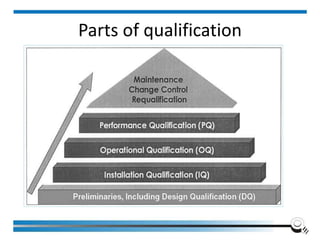
Parts of qualification
Equipment qualification(EQ)/validation
• Design qualification (DQ)
• Installation qualification (IQ)
• Operational qualification (OQ)
• Performance qualification (PQ)
Design qualification
"Design qualification (DQ) defines the functional and operational
specifications of the instrument and details for the conscious
decisions in the selection
of the supplier".
Points to be considered for
inclusion in a DQ
• Description of the analysis problem
• Description of the intended use of the equipment
• Description of the intended environment
• Preliminary selection of the functional and performance
specifications (technical, environmental, safety)
Installation qualification
“Installation qualification establishes that the instrument is
received as designed and specified, that it is properly installed in
the selected environment, and that this environment is suitable
for the operation and use of the instrument.”
Operational qualification
"Operational qualification (OQ) is the process of demonstrating
that an instrument will function according to its operational
specification in the selected environment ."
The content of equipment qualification
• Application S.O.P’s
• Utilization List
• Process Description
• Test Instrument Utilized To Conduct Test
• Test Instrument Calibration
• Critical Parameters
• Test Function (List)
• Test Function Summaries
Performance qualification
"Performance Qualification (PQ) is the process of demonstrating
that an instrument consistently performs according to a
specification appropriate for its routine use "
6 Resource requirements
6.4.6 Measuring equipment shall be calibrated
when:
— the measurement accuracy or measurement
uncertainty affects the validity of the reported
results, and/or
— calibration of the equipment is required to
establish the metrological traceability of the reported
results.
6 Resource requirements
6.4.7 The laboratory shall establish a calibration
programme, which shall be reviewed and adjusted
as necessary in order to maintain confidence in the
status of calibration.
6.4.8 All equipment requiring calibration or which
has a defined period of validity shall be labeled,
coded or otherwise identified to allow the user of the
equipment to readily identify the status of calibration
or period of validity.
EQUIPMENT CALIBRATION INTERVALS (as per
NATA Document)
Laboratory equipment calibration and check programs
should cover:
a) commissioning of new equipment (including initial
calibration and checks after installation);
b) operational checking (checking during use with
reference standards or reference materials);
c) periodic checking (interim but more extensive
checking, possibly including partial calibration); d)
scheduled maintenance by in-house or specialist
contractors; e) complete recalibration.
6 Resource requirements
6.4.9 Equipment that has been subjected to
overloading or mishandling, gives questionable
results, or has been shown to be defective or
outside specified requirements, shall be taken out of
service. It shall be isolated to prevent its use or
clearly labeled or marked as being out of service
until it has been verified to perform correctly. The
laboratory shall examine the effect of the defect or
deviation from specified requirements and shall
initiate the management of nonconforming work
procedure
6 Resource requirements
6.4.10 When intermediate checks are necessary to
maintain confidence in the performance of the
equipment, these checks shall be carried out
according to a procedure.
6.4.11 When calibration and reference material data
include reference values or correction factors, the
laboratory shall ensure the reference values and
correction factors are updated and implemented, as
appropriate, to meet specified requirements.
6 Resource requirements
6.4.12 The laboratory shall take practicable
measures to prevent unintended adjustments of
equipment from invalidating results.
6 Resource requirements
6.4.13 Records shall be retained for equipment
which can influence laboratory activities. The
records shall include the following, where
applicable:
a) the identity of equipment, including software and
firmware version;
b) the manufacturer's name, type identification, and
serial number or other unique identification;
c) evidence of verification that equipment conforms
with specified requirements; Contd.
6 Resource requirements
6.4.13 Records shall be retained for equipment
which can influence laboratory activities. The
records shall include the following, where
applicable:
d) the current location;
e) calibration dates, results of calibrations,
adjustments, acceptance criteria, and the due date
of the next calibration or the calibration interval;
f) documentation of reference materials, results,
acceptance criteria, relevant dates and the period of
validity. Contd.
6 Resource requirements
g) the maintenance plan and maintenance carried
out to date, where relevant to the performance of
the equipment;
h) details of any damage, malfunction, modification
to, or repair of, the equipment.
6 Resource requirements
6.5 Metrological traceability
6.5.1 The laboratory shall establish and maintain
metrological traceability of its measurement results
by means of a documented unbroken chain of
calibrations, each contributing to the measurement
uncertainty, linking them to an appropriate
reference.
6 Resource requirements
6.5.2 The laboratory shall ensure that measurement
results are traceable to the International System of
Units (SI) through:
a) calibration provided by a competent laboratory;
b) certified values of certified reference materials
provided by a competent producer with stated
metrological traceability to the SI;
c) direct realization of the SI units ensured by
comparison, directly or indirectly, with national or
international standards.
6 Resource requirements
6.5.3 When metrological traceability to the SI units is
not technically possible, the laboratory shall
demonstrate metrological traceability to an
appropriate reference, e.g.:
a) certified values of certified reference materials
provided by a competent producer;
b) results of reference measurement procedures,
specified methods or consensus standards that are
clearly described and accepted as providing
measurement results fit for their intended use and
ensured by suitable comparison.
Example and recommendation
Where a test is used to measure an empirical property
of a sample, such as flashpoint, equipment is often
defined in a national or international standard method
and traceable reference materials should be used for
calibration purposes where available. New or newly
acquired equipment should be checked by the
laboratory before use to ensure conformity with
specified design, performance and dimension
requirements.
6 Resource requirements
6.6 Externally provided products and services
6 Resource requirements
Purchase and Subcontract :
6.6.1 The laboratory shall ensure that only suitable
externally provided products and services that affect
laboratory activities are used, when such products
and services:
a) are intended for incorporation into the laboratory’s
own activities;
b) are provided, in part or in full, directly to the
customer by the laboratory, as received from the
external provider;
c) are used to support the operation of the laboratory.
6.6.2 The laboratory shall have a procedure and
retain records for:
a) defining, reviewing and approving the laboratory’s
requirements for externally provided products and
services;
b) defining the criteria for evaluation, selection,
monitoring of performance and re-evaluation of the
external providers; Contd.
6 Resource requirements
c) ensuring that externally provided products and
services conform to the laboratory’s established
requirements, or when applicable, to the relevant
requirements of this document, before they are used
or directly provided to the customer;
d) taking any actions arising from evaluations,
monitoring of performance and re-evaluations of the
external providers.
6 Resource requirements
6.6.3 The laboratory shall communicate its
requirements to external providers for:
a) the products and services to be provided;
b) the acceptance criteria;
c) competence, including any required qualification of
personnel;
d) activities that the laboratory, or its customer,
intends to perform at the external provider's
premises.
6 Resource requirements
6.6.3 The laboratory shall communicate its
requirements to external providers for:
a) the products and services to be provided;
b) the acceptance criteria;
c) competence, including any required qualification of
personnel;
d) activities that the laboratory, or its customer,
intends to perform at the external provider's
premises.
6 Resource requirements
DOCUMENTATION AND RECORD SUMMARY
FOR 6.6 CLAUSE OF ISO/IEC 17025
• Procedure for Purchase/subcontracting
/external service and supplies
• List of approved vendor/subcontractor
• Purchase indent
• Purchase order
• Vendor evaluation record
• Inspection plan for acceptance of laboratory
material and consumables and supplies
7.1 Review of requests, tenders and contracts
7 Process requirements
7.1.1 The laboratory shall have a procedure for the
review of requests, tenders and contracts. The
procedure shall ensure that:
a) the requirements are adequately defined,
documented and understood;
b) the laboratory has the capability and resources to
meet the requirements;
Contd.
7 Process requirements
c) where external providers are used, the
requirements of 6.6 are applied and the laboratory
advises the customer of the specific laboratory
activities to be performed by the external provider and
gains the customer's approval;
d) the appropriate methods or procedures are
selected and are capable of meeting the customers'
requirements.
7 Process requirements
7.1.2 The laboratory shall inform the customer when
the method requested by the customer is considered
to be inappropriate or out of date.
7.1.3 When the customer requests a statement of
conformity to a specification or standard for the test or
calibration (e.g. pass/fail, in-tolerance/out-of-
tolerance), the specification or standard and the
decision rule shall be clearly defined. Unless
inherent in the requested specification or standard,
the decision rule selected shall be communicated to,
and agreed with, the customer.
7 Process requirements
7.1.4 Any differences between the request or tender
and the contract shall be resolved before laboratory
activities commence. Each contract shall be
acceptable both to the laboratory and the customer.
Deviations requested by the customer shall not
impact the integrity of the laboratory or the validity of
the results.
7.1.5 The customer shall be informed of any deviation
from the contract.
7 Process requirements
7.1.6 If a contract is amended after work has
commenced, the contract review shall be repeated
and any amendments shall be communicated to all
affected personnel.
7 Process requirements
7.1.7 The laboratory shall cooperate with customers
or their representatives in clarifying the customer's
request and in monitoring the laboratory’s
performance in relation to the work performed.
a) providing reasonable access to relevant areas of
the laboratory to witness customer-specific
laboratory activities;
b) preparation, packaging, and dispatch of items
needed by the customer for verification purposes.
7 Process requirements
7.1.8 Records of reviews, including any significant
changes, shall be retained. Records shall also be
retained of pertinent discussions with a customer
relating to the customer's requirements or the results
of the laboratory activities.
7 Process requirements
7.2 Selection, verification and validation of
methods
7 Process requirements
7.2.1 Selection and verification of methods:
7.2.1.1 The laboratory shall use appropriate methods
and procedures for all laboratory activities and, where
appropriate, for evaluation of the measurement
uncertainty as well as statistical techniques for
analysis of data.
7 Process requirements
7.2.1.2 All methods, procedures and supporting
documentation, such as instructions, standards,
manuals and reference data relevant to the laboratory
activities, shall be kept up to date and shall be made
readily available to personnel (see 8.3).
7.2.1.3 The laboratory shall ensure that it uses the
latest valid version of a method unless it is not
appropriate or possible to do so. When necessary,
the application of the method shall be supplemented
with additional details to ensure consistent
application.
7 Process requirements
7.2.1.4 When the customer does not specify the
method to be used, the laboratory shall select an
appropriate method and inform the customer of the
method chosen. Methods published either in
international, regional or national standards, or by
reputable technical organizations, or in relevant
scientific texts or journals, or as specified by the
manufacturer of the equipment, are recommended.
Laboratory-developed or modified methods can also
be used.
7 Process requirements
7.2.1.5 The laboratory shall verify that it can properly
perform methods (method verification) before
introducing them by ensuring that it can achieve the
required performance. Records of the verification
shall be retained. If the method is revised by the
issuing body, verification shall be repeated to the
extent necessary.
7 Process requirements
7.2.1.6 When method development is required, this
shall be a planned activity and shall be assigned to
competent personnel equipped with adequate
resources. As method development proceeds,
periodic review shall be carried out to confirm that the
needs of the customer are still being fulfilled. Any
modifications to the development plan shall be
approved and authorized.
7.2.1.7 Deviations from methods for all laboratory
activities shall occur only if the deviation has been
documented, technically justified, authorized, and
accepted by the customer
7 Process requirements
7.2.1.7 Deviations from methods for all laboratory
activities shall occur only if the deviation has been
documented, technically justified, authorized, and
accepted by the customer.
7 Process requirements
7.2.2 Validation of methods:
7.2.2.1 The laboratory shall validate non-standard
methods, laboratory-developed methods and
standard methods used outside their intended scope
or otherwise modified. The validation shall be as
extensive as is necessary to meet the needs of the
given application or field of application.
a) calibration or evaluation of bias and precision
using reference standards or reference
materials;
Contd.
7 Process requirements
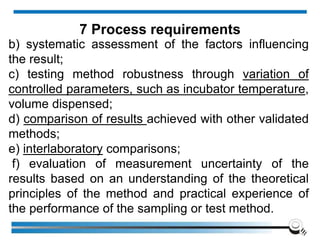
b) systematic assessment of the factors influencing
the result;
c) testing method robustness through variation of
controlled parameters, such as incubator temperature,
volume dispensed;
d) comparison of results achieved with other validated
methods;
e) interlaboratory comparisons;
f) evaluation of measurement uncertainty of the
results based on an understanding of the theoretical
principles of the method and practical experience of
the performance of the sampling or test method.
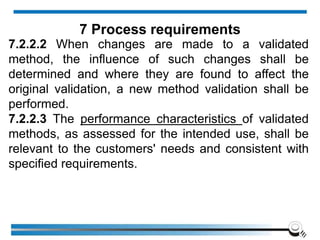
7 Process requirements
7.2.2.2 When changes are made to a validated
method, the influence of such changes shall be
determined and where they are found to affect the
original validation, a new method validation shall be
performed.
7.2.2.3 The performance characteristics of validated
methods, as assessed for the intended use, shall be
relevant to the customers' needs and consistent with
specified requirements.
7 Process requirements
Verification versus Validation
Institute of Applied Quality Management 132
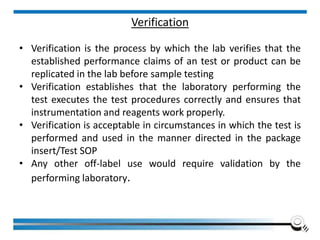
Verification
• Verification is the process by which the lab verifies that the
established performance claims of an test or product can be
replicated in the lab before sample testing
• Verification establishes that the laboratory performing the
test executes the test procedures correctly and ensures that
instrumentation and reagents work properly.
• Verification is acceptable in circumstances in which the test is
performed and used in the manner directed in the package
insert/Test SOP
• Any other off-label use would require validation by the
performing laboratory.
Institute of Applied Quality Management 133
Validation
Validation is the process by which the laboratory measures the
testing efficacy of the test in question by determining its
performance characteristics when used as intended. When
you are following a non standard method at your defined
conditions.
• whenever using non-standard methods or a standard method
beyond the stated limits of operation is required to validate
such test methods
Institute of Applied Quality Management 134
• Verification of performance specifications.
• (i) Demonstrate that it can obtain performance specifications
comparable to those established by the manufacturer for the
following performance characteristics:
• (A) Accuracy
(B) Precision
Institute of Applied Quality Management 135
Verification
Verification
When standard methods are used, laboratories should
verify their own satisfactory performance against the
documented performance characteristics of the
method, before any samples are analyzed. Records of
the verification must be retained. For published test
methods that do not include precision data, the
laboratory must determine its own precision data
based on test data. All methods should include criteria
for rejecting suspect results.
Method selection
Where a test can be performed by more than
one method there must be documented criteria
for method selection. Where relevant the
degree of correlation between the methods
should be established and documented
Validation
Need to establish for each test system the performance
specifications for the following performance characteristics:
(i) Accuracy
(ii) Precision
(iii) Analytical sensitivity
(iv) Analytical specificity to include interfering substances
(v) Reportable range of test results for test system
(vi) Reference intervals (normal values)
Institute of Applied Quality Management 138
Method Validation
Methods developed in-house must be validated and
authorized before use. Where they are available,
certified reference materials should be used to
determine any systematic bias, or where this is not
possible results compared with other technique(s),
preferably based on different principles of analysis.
• Where a change in method involves only minor
adjustments, such as sample size, different reagents,
the amended method should be validated
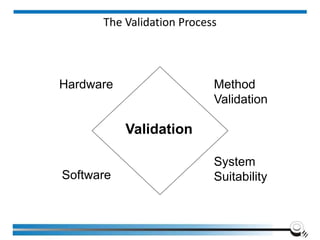
The Validation Process
Validation
Method
Validation
System
Suitability
Hardware
Software
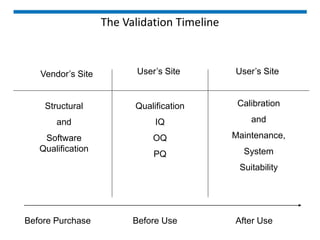
The Validation Timeline
Vendor’s Site User’s Site User’s Site
Structural
and
Software
Qualification
Qualification
IQ
OQ
PQ
Calibration
and
Maintenance,
System
Suitability
Before Purchase Before Use After Use
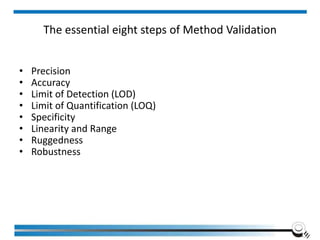
The essential eight steps of Method Validation
• Precision
• Accuracy
• Limit of Detection (LOD)
• Limit of Quantification (LOQ)
• Specificity
• Linearity and Range
• Ruggedness
• Robustness
Accuracy
Is the measure of exactness of an analytical method, or the
closeness of agreement between the measured value and
the value or an accepted reference value.
Precision
Is the measure of the degree of repeatability of an analytical
method under normal operation and is normally expressed as
the percent relative standard deviation for a statistically
significant number of samples.
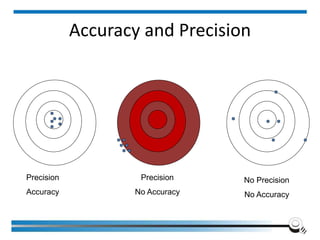
Accuracy and Precision
Precision
Accuracy
Precision
No Accuracy
No Precision
No Accuracy
Specificity
Is the ability to measure accurately and specifically the
analyte of interest in the presence of other components that
may be expected to be present in the sample matrix.
It is a measure of the degree of interference from such things
as other active ingredients, excipients, impurities, and
degradation products, ensuring that a peak response is due
only to a single component; that is, that no co-elutions exist.
Limit of Detection (LOD)
Is defined as the lowest concentration of an
analyte in a sample that can be detected,
though not necessarily quantitated.
It is a limit test that specifies whether or not an
analyte is above or below a certain value.
Limit of Quantification (LOQ)
Is defined as the lowest concentration of ana analyte in a
sample that can be determined with acceptable precision and
accuracy under the stated operational conditions of the
method.
LOQ is directly proportional to the precision.
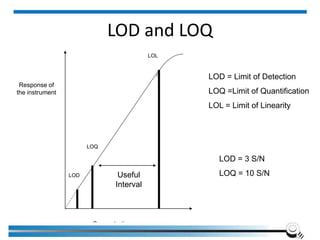
LOD and LOQ
LOL
LOD
LOQ
Useful
Interval
LOD = Limit of Detection
LOQ =Limit of Quantification
LOL = Limit of Linearity
Concentration
Response of
the instrument
LOD = 3 S/N
LOQ = 10 S/N
Linearity and Range
Linearity
Is the ability of the method to elicit test
results that are directly proportional to
analyte concentration within a given range.
Range
Is the interval between the upper and lower levels of
analyte that have been demonstrated to be
determined with precision, accuracy, and linearity
using the method
Ruggedness
Ruggedness
`Is the degree of reproducibility of the results obtained
under a variety of conditions.
These conditions include differences in laboratories,
analysts, instruments, reagents, and experimental
periods.Robustness Is the capacity of a method to
remain unaffeccted by small deliberate variations in
method parameters.These deliberate variations are
change in the percent of organic solvent, pH, ionic
strength, or temperature, and detemining the effect
(if any) on the results of the method.
7.2.2.4 The laboratory shall retain the following
records of validation:
a) the validation procedure used;
b) specification of the requirements; c) determination
of the performance characteristics of the method;
d) results obtained;
e) a statement on the validity of the method, detailing
its fitness for the intended use.
7 Process requirements
7.3 Sampling:
7.3.1 The laboratory shall have a sampling plan and
method when it carries out sampling of substances,
materials or products for subsequent testing or
calibration. The sampling method shall address the
factors to be controlled to ensure the validity of
subsequent testing or calibration results. The
sampling plan and method shall be available at the
site where sampling is undertaken. Sampling plans
shall, whenever reasonable, be based on appropriate
statistical methods.
7 Process requirements
7.3.2 The sampling method shall describe:
a) the selection of samples or sites;
b) the sampling plan;
c) the preparation and treatment of sample(s) from a
substance, material or product to yield the required
item for subsequent testing or calibration.
7 Process requirements
7.3.3 The laboratory shall retain records of sampling
data (sampling data sheet) that forms part of the
testing or calibration that is undertaken. These
records shall include, where relevant:
a) reference to the sampling method used;
b) date and time of sampling;
c) data to identify and describe the sample (e.g.
number, amount, name);
d) identification of the personnel performing sampling;
e) identification of the equipment used;
Contd.
7 Process requirements
f) environmental or transport conditions;
g) diagrams or other equivalent means to identify the
sampling location, when appropriate;
h) deviations, additions to or exclusions from the
sampling method and sampling plan.
7 Process requirements
7.4 Handling of test or calibration items
7.4.1 The laboratory shall have a procedure for the
transportation, receipt, handling, protection, storage,
retention, and disposal or return of test or calibration
items, including all provisions (logistics and storage)
necessary to protect the integrity of the test or
calibration item, and to protect the interests of the
laboratory and the customer. Precautions shall be
taken to avoid deterioration, contamination, loss or
damage to the item during handling, transporting,
storing/waiting, and preparation for testing or
calibration. Handling instructions provided with the
item shall be followed.
7 Process requirements
7.4.2 The laboratory shall have a system for the
unambiguous identification of test or calibration items.
The identification shall be retained while the item is
under the responsibility of the laboratory. The system
shall ensure that items will not be confused physically
(Sample ID/ marking) or when referred to in records or
other documents. The system shall, if appropriate,
accommodate a sub-division of an item or groups of
items and the transfer of items.
7 Process requirements
7.4.3 Upon receipt of the test or calibration item,
deviations from specified conditions (ex. Dimension)
shall be recorded. When there is doubt about the
suitability of an item for test or calibration, or when an
item does not conform to the description provided, the
laboratory shall consult the customer for further
instructions before proceeding and shall record the
results of this consultation. When the customer
requires the item to be tested or calibrated
acknowledging a deviation from specified conditions,
the laboratory shall include a disclaimer in the report
indicating which results may be affected by the
deviation.
7 Process requirements
Planning :
– Sample Acceptance and rejection criteria
– Sample acceptance and rejection record
– Customer communication log if sample is
compromised with deviation
– Disclaimer in the report
7.4.4 When items need to be stored or
conditioned under specified environmental
conditions, (Ex. Temp/humidity) these
conditions shall be maintained, monitored and
recorded.
7.5 Technical records.
7.5.1 The laboratory shall ensure that technical
records for each laboratory activity contain the results,
report and sufficient information to facilitate, if
possible, identification of factors affecting the
measurement result (Type A and Type B factors) and
its associated measurement uncertainty and enable
the repetition of the laboratory activity under
conditions as close as possible to the original.
Contd.
7 Process requirements
7.5.1The technical records shall include the date and
the identity of personnel responsible for each
laboratory activity and for checking data and results.
Original observations (machine print out/ chemist
hand book), data and calculations shall be recorded at
the time they are made and shall be identifiable with
the specific task.
7 Process requirements
7.5.2 The laboratory shall ensure that amendments to
technical records can be tracked to previous versions
or to original observations. Both the original and
amended data and files shall be retained, including
the date of alteration, an indication of the altered
aspects and the personnel responsible for the
alterations.
7 Process requirements
7.6 Evaluation of measurement uncertainty
7 Process requirements
7.6.1 Laboratories shall identify the contributions to
measurement uncertainty. When evaluating
measurement uncertainty, all contributions that are of
significance, including those arising from sampling,
shall be taken into account using appropriate methods
of analysis.
7.6.2 A laboratory performing calibrations, including of
its own equipment, shall evaluate the measurement
uncertainty for all calibrations.
7 Process requirements
7.6.3 A laboratory performing testing shall evaluate
measurement uncertainty. Where the test method
precludes rigorous evaluation of measurement
uncertainty, an estimation shall be made based on an
understanding of the theoretical principles or practical
experience of the performance of the method.
7 Process requirements
7.7 Ensuring the validity of results
7 Process requirements
7.7.1 The laboratory shall have a procedure for
monitoring the validity of results. The resulting data
shall be recorded in such a way that trends (control
chart/ linearity) are detectable and, where practicable,
statistical techniques (UCL &LCL, mean and
precision) shall be applied to review the results. This
monitoring shall be planned and reviewed and shall
include, where appropriate, but not be limited to:
a) use of reference materials(RM) or quality control
materials; (CRM/Standard etc)
Contd.
7 Process requirements
b) use of alternative instrumentation (method
comparability ) that has been calibrated to provide
traceable results;
c) functional check(s) of measuring and testing
equipment; ( other one point/two point etc check
d) use of check or working standards with control
charts, where applicable;
e) intermediate checks (in between calibration) on
measuring equipment;
f) replicate tests or calibrations using the same or
different methods;
Contd.
7 Process requirements
g) retesting or recalibration of retained items;
h) correlation of results for different characteristics of
an item; (ex. Carbon chemical with hardness)
i) review of reported results;
j) intralaboratory comparisons; (within internal
laboratories)
k) testing of blind sample(s). (sample not known)
7 Process requirements
7.7.2 The laboratory shall monitor its performance by
comparison with results of other laboratories, where
available and appropriate. This monitoring shall be
planned and reviewed and shall include, but not be
limited to, either or both of the following:
a) participation in proficiency testing;
b) participation in interlaboratory comparisons other
than proficiency testing.
7 Process requirements
7.7.3 Data from monitoring activities shall be
analyzed, used to control and, if applicable, improve
the laboratory's activities. If the results of the analysis
of data from monitoring activities are found to be
outside pre-defined criteria (acceptable limit),
appropriate action shall be taken to prevent incorrect
results from being reported.
7 Process requirements
7.8 Reporting of results
7 Process requirements
7.8.1 General
7.8.1.1 The results shall be reviewed and authorized
prior to release.
7.8.1.2 The results shall be provided accurately, clearly,
unambiguously and objectively, usually in a report (e.g.
a test report or a calibration certificate or report of
sampling), and shall include all the information agreed
with the customer and necessary for the interpretation
of the results and all information required by the
method used. All issued reports shall be retained as
technical records.
7 Process requirements
7.8.1.3 When agreed with the customer, the results
may be reported in a simplified way. Any information
listed in 7.8.2 to 7.8.7 that is not reported to the
customer shall be readily available.
7 Process requirements
7.8.2 Common requirements for reports (test,
calibration or sampling)
7.8.2.1 Each report shall include at least the following
information, unless the laboratory has valid reasons
for not doing so, thereby minimizing any possibility of
misunderstanding or misuse:
a) a title (e.g. “Test Report”, “Calibration Certificate” or
“Report of Sampling”);
b) the name and address of the laboratory;
Contd.
7 Process requirements
c) the location of performance of the laboratory
activities, including when performed at a customer
facility or at sites away from the laboratory’s
permanent facilities, or in associated temporary or
mobile facilities;
d) unique identification that all its components are
recognized as a portion of a complete report and a
clear identification of the end;
e) the name and contact information of the customer;
f) identification of the method used;
Contd.
7 Process requirements
g) a description, unambiguous identification, and,
when necessary, the condition of the item;
h) the date of receipt of the test or calibration item(s),
and the date of sampling, where this is critical to the
validity and application of the results;
i) the date(s) of performance of the laboratory
activity;
j) the date of issue of the report;
k) reference to the sampling plan and sampling
method used by the laboratory or other bodies where
these are relevant to the validity or application of the
results;
Contd.
7 Process requirements
l) a statement to the effect that the results relate only
to the items tested, calibrated or sampled;
m) the results with, where appropriate, the units of
measurement;
n) additions to, deviations, or exclusions from the
method;
o) identification of the person(s) authorizing the report;
p) clear identification when results are from external
providers.
7 Process requirements
7.8.2.2 The laboratory shall be responsible for all the
information provided in the report, except when
information is provided by the customer. Data
provided by a customer shall be clearly identified. In
addition, a disclaimer shall be put on the report when
the information is supplied by the customer and can
affect the validity of results. Where the laboratory has
not been responsible for the sampling stage (e.g. the
sample has been provided by the customer), it shall
state in the report that the results apply to the sample
as received.
7 Process requirements
7.8.3 Specific requirements for test reports
7 Process requirements
7.8.3.1 In addition to the requirements listed in 7.8.2,
test reports shall, where necessary for the
interpretation of the test results, include the following:
a) information on specific test conditions, such as
environmental conditions;
b) where relevant, a statement of conformity with
requirements or specifications (see 7.8.6);
Contd.
7 Process requirements
c) where applicable, the measurement uncertainty
presented in the same unit as that of the measurand
or in a term relative to the measurand (e.g. percent)
when:
— it is relevant to the validity or application of the test
results;
— a customer's instruction so requires, or
— the measurement uncertainty affects conformity to
a specification limit;
d) where appropriate, opinions and interpretations
(see 7.8.7); Contd.
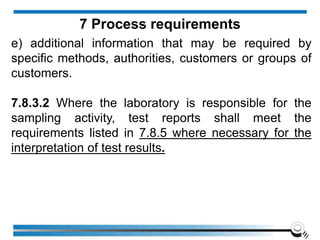
7 Process requirements
e) additional information that may be required by
specific methods, authorities, customers or groups of
customers.
7.8.3.2 Where the laboratory is responsible for the
sampling activity, test reports shall meet the
requirements listed in 7.8.5 where necessary for the
interpretation of test results.
7 Process requirements
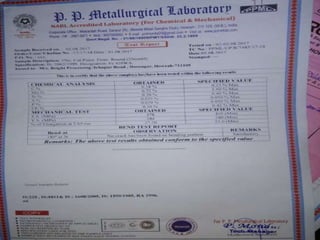
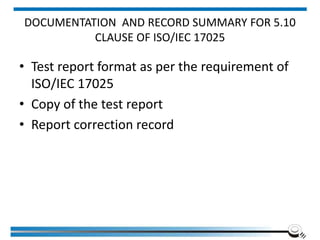
DOCUMENTATION AND RECORD SUMMARY FOR 5.10
CLAUSE OF ISO/IEC 17025
• Test report format as per the requirement of
ISO/IEC 17025
• Copy of the test report
• Report correction record
7.8.4 Specific requirements for calibration
certificates
7 Process requirements
7.8.4.1 In addition to the requirements listed in 7.8.2,
calibration certificates shall include the following:
a) the measurement uncertainty of the measurement
result presented in the same unit as that of the
measured or in a term relative to the measured
(e.g. percent);
b) the conditions (e.g. environmental) under which
the calibrations were made that have an influence
on the measurement results;
c) a statement identifying how the measurements are
metrological traceable (see Annex A);
7 Process requirements
d) the results before and after any adjustment or
repair, if available;
e) where relevant, a statement of conformity with
requirements or specifications (see 7.8.6);
f) where appropriate, opinions and interpretations (see
7.8.7).
7.8.4.2 Where the laboratory is responsible for the
sampling activity, calibration certificates shall meet the
requirements listed in 7.8.5 where necessary for the
interpretation of calibration results.
7 Process requirements
7.8.4.3 A calibration certificate or calibration label
shall not contain any recommendation on the
calibration interval, except where this has been
agreed with the customer.
7 Process requirements
7.8.5 Reporting sampling – specific requirements
7 Process requirements
7.8.5 Reporting sampling – specific requirements
Where the laboratory is responsible for the sampling
activity, in addition to the requirements listed in 7.8.2,
reports shall include the following, where necessary
for the interpretation of results:
a) the date of sampling;
b) unique identification of the item or material sampled
(including the name of the manufacturer, the model or
type of designation and serial numbers, as
appropriate);
Contd.
7 Process requirements
c) the location of sampling, including any diagrams,
sketches or photographs;
d) a reference to the sampling plan and sampling
method;
e) details of any environmental conditions during
sampling that affect the interpretation of the results;
f) information required to evaluate measurement
uncertainty for subsequent testing or calibration.
7 Process requirements
7.8.6 Reporting statements of conformity.
7 Process requirements
7.8.6.1 When a statement of conformity to a
specification or standard is provided, the laboratory
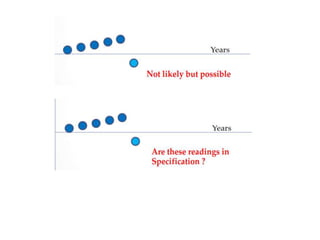
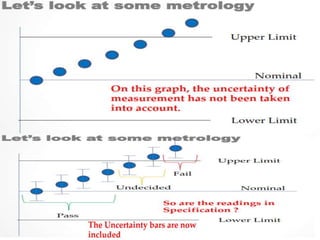
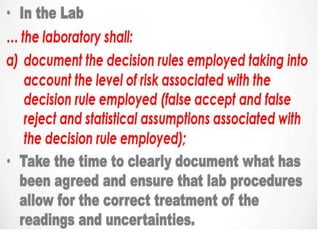
shall document the decision rule employed, taking
into account the level of risk (such as false accept
and false reject and statistical assumptions)
associated with the decision rule employed, and apply
the decision rule.
7.8.6.2 The laboratory shall report on the statement of
conformity, such that the statement clearly identifies:
Contd.
7 Process requirements
a) to which results the statement of conformity
applies;
b) which specifications, standards or parts thereof are
met or not met;
c) the decision rule applied (unless it is inherent in the
requested specification or standard).
7 Process requirements
7.8.7 Reporting opinions and interpretations
7 Process requirements
7.8.7.1 When opinions and interpretations are
expressed, the laboratory shall ensure that only
personnel authorized for the expression of opinions
and interpretations release the respective statement.
The laboratory shall document the basis upon which
the opinions and interpretations have been made.
7.8.7.2 The opinions and interpretations expressed in
reports shall be based on the results obtained from
the tested or calibrated item and shall be clearly
identified as such.
7 Process requirements
7.8.7.3 When opinions and interpretations are directly
communicated by dialogue with the customer, a
record of the dialogue shall be retained.
7 Process requirements
7.8.8 Amendments to reports
7 Process requirements
7.8.8.1 When an issued report needs to be changed,
amended or re-issued, any change of information
shall be clearly identified and, where appropriate, the
reason for the change included in the report.
7.8.8.2 Amendments to a report after issue shall be
made only in the form of a further document, or data
transfer, which includes the statement “Amendment to
Report, serial number... [or as otherwise identified]”, or
an equivalent form of wording.
7 Process requirements
Such amendments shall meet all the requirements of
this document.
7.8.8.3 When it is necessary to issue a complete new
report, this shall be uniquely identified and shall
contain a reference to the original that it replaces.
7 Process requirements
7.9 Complaints
7 Process requirements
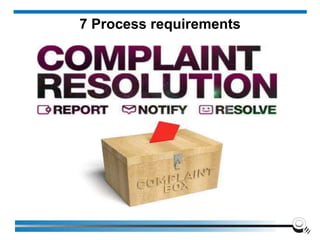
7.9.1 The laboratory shall have a documented
process (flow chart or procedure) to receive, evaluate
and make decisions on complaints. (all staff/client and
others like statutory, legal)
7.9.2 A description of the handling process for
complaints ( how to raise a complaint ) shall be
available to any interested party on request. Upon
receipt of a complaint, the laboratory shall confirm
whether the complaint relates to laboratory activities
that it is responsible for and, if so, shall deal with it.
The laboratory shall be responsible for all decisions at
all levels of the handling process for complaints.
7 Process requirements
7.9.3 The process for handling complaints shall
include at least the following elements and methods:
a) description of the process (flow chart or process)
for receiving (acknowledgement), validating, (initial
confirmation) investigating the complaint (RCA), and
deciding what actions are to be taken in response to
it;
b) tracking and recording complaints, including actions
undertaken to resolve them; (correction and CA)
c) ensuring that any appropriate action(CA) is taken.
7 Process requirements
7.9.4 The laboratory receiving the complaint shall be
responsible for gathering and verifying all necessary
information to validate the complaint.(verification fact)
7.9.5 Whenever possible, the laboratory shall
acknowledge receipt of the complaint, and provide the
complainant with progress reports and the outcome.
7.9.6 The outcomes to be communicated to the
complainant shall be made by, or reviewed and
approved by, individual(s) not involved in the original
laboratory activities in question. (person involved in
the complaint will not investigate)
7 Process requirements
7.9.7 Whenever possible, the laboratory shall give
formal notice (Resolution letter) of the end of the
complaint handling to the complainant.
7 Process requirements
7.10 Nonconforming work.
7 Process requirements
Identification and
control of non-conformities
What is non conformities ?
In quality management, a nonconformity (also
known as a defect) is a deviation from a
specification, a standard, or an expectation.
Institute of Applied Quality Management 212
Identification and
control of non-conformities
• What is non conformities ?
Ex. A sample is processed in less than 300 rpm
or required “g”
A sample requested for fungus culture in
incubated in normal incubate or rather BOD
incubator or incubated at less than temperature
required for test
Institute of Applied Quality Management 213
Control of nonconforming testing and/or
calibration work
What is Non conformance ?
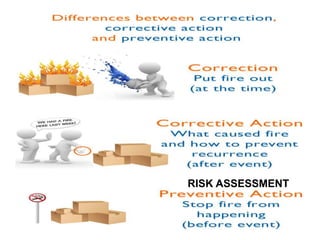
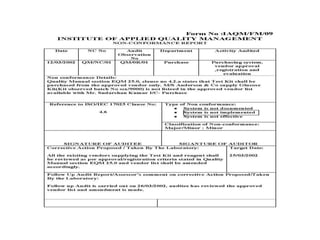
is non fulfillment of the specified requirement of
test
What is corrective action ?
Action taken to prevent reoccurrence
Institute of Applied Quality Management 215
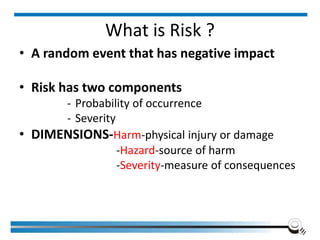
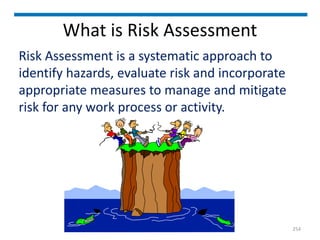
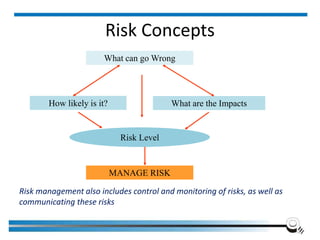
RISK ASSESSMENT
7.10.1 The laboratory shall have a procedure that
shall be implemented when any aspect of its
laboratory activities or results of this work do not
conform to its own procedures (MSP/WI/SOP) or the
agreed requirements of the customer (e.g. equipment
or environmental conditions are out of specified limits,
results of monitoring fail to meet specified criteria).
The procedure shall ensure that:
a) the responsibilities and authorities for the
management of nonconforming work are defined;
Contd.
7 Process requirements
b) actions (including halting or repeating of work and
withholding of reports, as necessary) are based upon
the risk levels established by the laboratory;
c) an evaluation is made of the significance of the
nonconforming work, including an impact analysis on
previous results;
d) a decision is taken on the acceptability of the
nonconforming work;
e) where necessary, the customer is notified and work
is recalled;
f) the responsibility for authorizing the resumption of
work is defined.
.
7 Process requirements
7.10.2 The laboratory shall retain records of
nonconforming work and actions as specified in
7.10.1, bullets b) to f).
7.10.3 Where the evaluation indicates that the
nonconforming work could recur, or that there is doubt
about the conformity of the laboratory's operations
with its own management system, (Deviation from
written down process/procedure) the laboratory
shall
implement corrective action.
7 Process requirements
7.11 Control of data and information management
7.11.1 The laboratory shall have access to the data
and information needed to perform laboratory
activities.
7 Process requirements
7.11.2 The laboratory information management system(s)
(LIMS) used for the collection, processing, recording,
reporting, storage or retrieval of data shall be validated
for functionality (beta testing), including the proper
functioning of interfaces (with uni direction and bi
direction) within the laboratory information management
system(s) by the laboratory before introduction.
Whenever there are any changes, including laboratory
software configuration or modifications to commercial
off-the-shelf software, they shall be authorized,
documented and validated before implementation.
Computerized based analytical system
Such systems will normally be validated by checking for
satisfactory operation (including performance under
extreme circumstances) and establishing the reliability
of the system before it is allowed to run unattended.
An assessment should be made of the likely causes of
system malfunction. Where possible the controlling
software should be tailored to identify and highlight
any such malfunctions and tag associated data.
7.11.3 The laboratory information management
system(s) shall:
a) be protected from unauthorized access;
b) be safeguarded against tampering and loss;
c) be operated in an environment that complies with
provider or laboratory specifications or, in the case of
non-computerized systems, provides conditions which
safeguard the accuracy of manual recording and
transcription;
Contd.
7 Process requirements
d) be maintained in a manner that ensures the
integrity of the data and information;
e) include recording system failures and the
appropriate immediate and corrective actions.
7.11.4 When a laboratory information management
system is managed and maintained off-site or through
an external provider, the laboratory shall ensure that
the provider or operator of the system complies with
all applicable requirements of this document.
7 Process requirements
7.11.5 The laboratory shall ensure that instructions,
manuals and reference data relevant to the laboratory
information management system(s) are made readily
available to personnel.
7.11.6 Calculations and data transfers shall be
checked in an appropriate and systematic manner.
Electronic transfer of data should be checked to
ensure that no corruption has occurred during
transmission. This can be achieved on the computer
by the use of `verification files’ but wherever practical
the transmission should be backed up by a hard copy
of the data.
7 Process requirements
8 Management system requirements
8.1 Options
8.1.1 General.
The laboratory shall establish, document,
implement and maintain a management
system that is capable of supporting and
demonstrating the consistent achievement of
the requirements of this document and
assuring the quality of the laboratory results.
8 Management system requirements
8.1.1 General. (Cont.……..)
In addition to meeting the requirements of
Clauses 4 to 7, the laboratory shall implement a
management system in accordance with Option A or
Option B.
8 Management system requirements
8.1.2 Option A
• As a minimum, the management system of the
laboratory shall address the following:
• management system documentation (8.2)
• control of management system documents (8.3)
• control of records (8.4)
8 Management system requirements
• actions to address risks and opportunities (8.5)
• improvement (8.6)
• corrective actions (8.7)
• internal audits (8.8)
• management reviews (8.9).
8 Management system requirements
8.1.3 Option B
• A laboratory that has established and maintains
a management system, in accordance with the
requirements of ISO 9001, and that is capable of
supporting and demonstrating the consistent
fulfilment of the requirements of Clauses 4 to 7,
also fulfils at least the intent of the management
system requirements specified in 8.2 to 8.9.
8 Management system requirements
8.2 Management system documentation(Option A )
• 8.2.1 Laboratory management shall establish,
document, and maintain policies and objectives
for the fulfilment of the purposes of this
document and shall ensure that the policies and
objectives are acknowledged and implemented at
all levels of the laboratory organization.
8 Management system requirements
8.2.2 The policies and objectives shall address the
competence, impartiality and consistent operation
of the laboratory.
8.2.3 Laboratory management shall provide
evidence of commitment to the development and
implementation of the management system and
to continually improving its effectiveness.
8 Management system requirements
8.2.4 All documentation, processes, systems,
records, related to the fulfilment of the
requirements of this document shall be included
in, referenced from, or linked to the management
system. (documentation linkage with reference)
8.2.5 All personnel involved in laboratory activities
shall have access to the parts of the management
system documentation and related information
that are applicable to their responsibilities.
8 Management system requirements
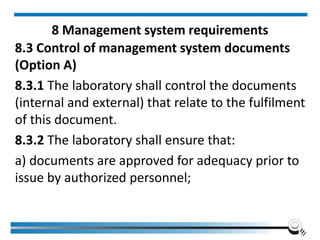
8.3 Control of management system documents
(Option A)
Institute of Applied Quality Management 234
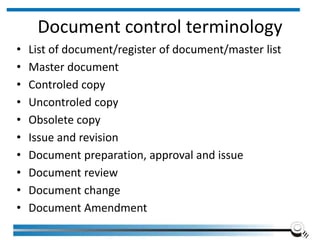
Document control terminology
• List of document/register of document/master list
• Master document
• Controled copy
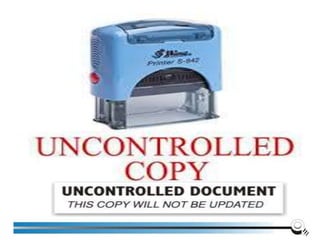
• Uncontroled copy
• Obsolete copy
• Issue and revision
• Document preparation, approval and issue
• Document review
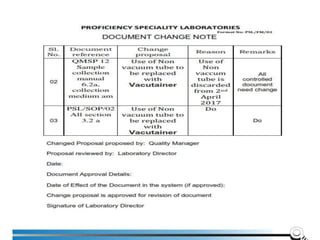
• Document change
• Document Amendment
Institute of Applied Quality Management 235
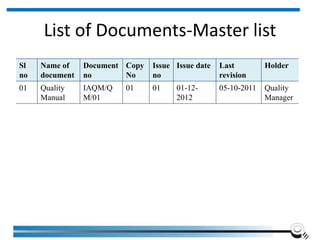
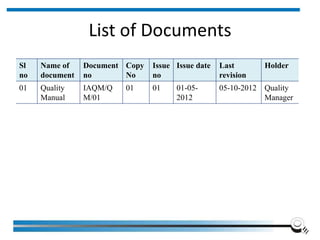
List of Documents-Master list
Institute of Applied Quality Management 236
Sl
no
Name of
document
Document
no
Copy
No
Issue
no
Issue date Last
revision
Holder
01 Quality
Manual
IAQM/Q
M/01
01 01 01-12-
2012
05-10-2011 Quality
Manager
Institute of Applied Quality Management 237
Institute of Applied Quality Management 238
Institute of Applied Quality Management 239
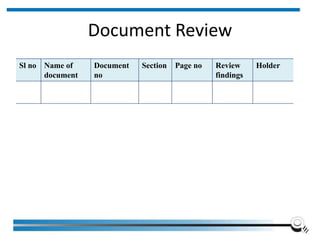
Document Review
Institute of Applied Quality Management 240
Sl no Name of
document
Document
no
Section Page no Review
findings
Holder
Institute of Applied Quality Management 241
List of Documents
Institute of Applied Quality Management 242
Sl
no
Name of
document
Document
no
Copy
No
Issue
no
Issue date Last
revision
Holder
01 Quality
Manual
IAQM/Q
M/01
01 01 01-05-
2012
05-10-2012 Quality
Manager
8 Management system requirements
8.3 Control of management system documents
(Option A)
8.3.1 The laboratory shall control the documents
(internal and external) that relate to the fulfilment
of this document.
8.3.2 The laboratory shall ensure that:
a) documents are approved for adequacy prior to
issue by authorized personnel;
8 Management system requirements
8.3.2 (Cont.….)
b) documents are periodically reviewed, and
updated as necessary;
c) changes and the current revision status of
documents are identified;
d) relevant versions of applicable documents are
available at points of use and, where necessary,
their distribution is controlled;
8 Management system requirements
8.3.2 (Cont.….)
e) documents are uniquely identified
f) the unintended use of obsolete documents is
prevented, and suitable identification is applied to
them if they are retained for any purpose.
8 Management system requirements
8.4 Control of records (Option A)
8 Management system requirements
8.4 Control of records (Option A)
8.4.1 The laboratory shall establish and retain
legible records to demonstrate fulfilment of the
requirements in this document.
8 Management system requirements
8.4 Control of records (Cont.….)
8.4.2 The laboratory shall implement the controls
needed for the identification, storage, protection,
back-up, archive, retrieval, retention time, and
disposal of its records. The laboratory shall retain
records for a period consistent with its contractual
obligations. Access to these records shall be
consistent with the confidentiality commitments,
and records shall be readily available.
8 Management system requirements
8.5 Actions to address risks and opportunities
(Option A)
8 Management system requirements
8.5.1 The laboratory shall consider the risks and
opportunities associated with the laboratory
activities in order to:
a) give assurance that the management system
achieves its intended results;
b) enhance opportunities to achieve the
purpose and objectives of the laboratory;
c) prevent, or reduce, undesired impacts and
potential failures in the laboratory activities;
d) achieve improvement.
8 Management system requirements
8.5.2 The laboratory shall plan:
a) actions to address these risks and
opportunities;
b) how to:
• integrate and implement these actions into its
management system;
• evaluate the effectiveness of these actions.
8 Management system requirements
8.5.3 Actions taken to address risks and
opportunities shall be proportional to the
potential impact on the validity of laboratory
results.
What is Risk ?
• A random event that has negative impact
• Risk has two components
- Probability of occurrence
- Severity
• DIMENSIONS-Harm-physical injury or damage
-Hazard-source of harm
-Severity-measure of consequences
Institute of Applied Quality Management 253
What is Risk Assessment
Risk Assessment is a systematic approach to
identify hazards, evaluate risk and incorporate
appropriate measures to manage and mitigate
risk for any work process or activity.
Institute of Applied Quality Management 254
Risk Concepts
Risk management also includes control and monitoring of risks, as well as
communicating these risks
Institute of Applied Quality Management 255
How likely is it? What are the Impacts
Risk Level
MANAGE RISK
What can go Wrong
Risk Assessment Team
QUALITIES
• Knowledge of the device, method, technology
• Neutral
• Careful
• Creative thinkers
• Confident
• Thick skinned
• Communicators
• Curious
• Finishers
• Cynical – Always questioning, don't accept everything on face value
• Social – Team players
Institute of Applied Quality Management 256
Risk management Plan
• An organized approach to assessing and managing
risk
• Establishes scope & requirements
• Assigns responsibilities
• Sets criteria for acceptability
• Establishes verification activities & feedback
mechanisms
• Provides the roadmap
• Encourages objectivity
• Prevents essential elements being forgotten
Institute of Applied Quality Management 257
Risk management Process
1. Selection of Risk method
2. Information review
3. Process mapping
4. Risk analysis- identify hazards
5. Risk estimation for each hazard
6. Determine acceptability of risks.
7. Evaluation based on acceptance criteria
Institute of Applied Quality Management 258
8. Risk reduction/control/mitigation
9. Evaluate residual risk
10. Periodic review for effectiveness
Institute of Applied Quality Management 259
Risk management process - contd
RISK ASSESSMENT METHOD
– HORIZONTAL RISK ASSESSMENT
– VERTICAL RISK ASSESSMENT
HORIZONTAL RISK ASSESSMENT : Department
or any functional activities,
example : Reception/machine shop area,
mechanical/ chemical test area
VERTICAL RISK ASSESSMENT : Test parameter
wise
• Ex. Vertical risk analysis of Water BOD test
parameter, pre analytic phase, analytic phase and
post analytic phase
Institute of Applied Quality Management 260
RISK ASSESEMENT STEP
Step 1. Selection of risk method :
a) It may be advisable to start with Horizontal risk assessment and
then completing with vertical risk
b) Vertical risk will take more time to complete the work
c) While doing vertical risk many of the horizontal risk may be ignored
Institute of Applied Quality Management 261
RISK ASSESEMENT STEP
• Step 2. Information review. –
All the information on the test.
• pre analytical procedure
• instrument manuals,
• package inserts,
• technical bulletins,
• Regulatory / accrediting organization
requirements,
• QC and PT records,
Institute of Applied Quality Management 262
RISK ASSESEMENT STEP
• Step 2. Information review. – contd…….
• Training procedures,
• Prior failure investigation records,
• Any institutional guidance on the test or
analyte.
Institute of Applied Quality Management 263
Caution - do not rely on memory
RISK ASSESEMENT STEP
Step 3. Process mapping :-
• staff who run the test method,
• the test results,
it’s important to understand what really occurs, not
just what is supposed to occur.
Institute of Applied Quality Management 264
RISK ASSESEMENT STEP contd-----
Step 4. Risk Analysis - Identification of hazards.
“What can go wrong” during routine
operations ?
What hazards are present. ?
Categorize the hazard.
Operator,
Environment,
System (Instrument),
Reagents, or Specimen.
Transcriptional
AIM
Controls necessary to reduce unwanted risk.
Institute of Applied Quality Management 265
RISK ASSESEMENT STEP contd……………
Step 5. Risk estimation
Evaluate the risk for each hazard:
How likely it is that a failure will occur ?
How likely it is that it will lead to harming a
test results issued to customer ?
How severe that harm could be ?
ATTRIBUTES
Subjective
Discussion
customer to understand decision rules
Institute of Applied Quality Management 266
RISK ASSESEMENT STEP contd……
• Step 6. Determine acceptability of risks.
• Severity and probability of harm to determine
whether the risks are acceptable.
• Each lab to determine where to draw the line
between acceptable and unacceptable.
• The team to determine whether a given risk is
acceptable or not.
Institute of Applied Quality Management 267
RISK ASSESEMENT STEP contd……………
• Step 7. Risk reduction/control/mitigation.
• Identify ways to reduce the probability of harm,
using prevention and detection methods,
• Revised operator training, Posted warnings,
• More robust QC rules,
• Greater surveillance of the process, or even repeat
testing
• In cases where the test manufacturer indicates that
certain aspects of the test are monitored through
built-in controls, the lab may wish to conduct a study
to verify the effectiveness of the control before
including it as a control measure.
Institute of Applied Quality Management 268
RISK ASSESEMENT STEP contd…………….
• Step 8. Evaluate residual risk.
• Once controls are assigned, the team
then reviews the risks again and re-
determines the risk level. Any risk not
prevented or detected 100% of the time
is considered residual risk.
Institute of Applied Quality Management 269
RISK ASSESEMENT STEP
• Step 9 Periodic review of Risk:
Once risk assessment, risk control procedure
is adopted , periodic review of the same is
required to understand the effectiveness of
risk
Institute of Applied Quality Management 270
Possible responses to risk analysis
findings
• Accept the risk – do nothing
• Reallocate resources
• Get more information
• Eliminate the risk entirely
• Mitigate the risk
• Have a contingency plan
• Transfer the risk
Institute of Applied Quality Management 271
Risk Assessment
Flowchart
Institute of Applied Quality Management 272
Manage Risk
7. Hazard Control 8. Additional control measures
(Responsible person, timeline)
Review, Approval,
Communicate
Record Keeping and
Document Control
Assess
5. Existing Control Measures 6. Evaluate Risk (Severity, Probability)
Identify
1. Selecting Experiments
2. Break Down into
Successive Tasks
3. Potential Hazards 4. Potential Harm (Ill
health condition)
Risk Evaluation
Risk matrix to determine risk level
Institute of Applied Quality Management 273
Likelihood
Severity
Remote (1) Occasional (2) Frequent (3)
Minor (1) 1 2 3
Moderate (2) 2 4 6
Major (3) 3 6 9
8 Management system requirements
8.6 Improvement (Option A)
8 Management system requirements
8.6 Improvement (Option A)
• 8.6.1 The laboratory shall identify (Quality
Indicator/ compalint/ Non conformance/ IQA
Risk and select opportunities for improvement
and implement any necessary actions.
• 8.6.2 The laboratory shall seek feedback, both
positive and negative, from its customers. The
feedback shall be analyzed and used to improve
the management system, laboratory activities
and customer service.
Tools used for continuous improvement
Institute of Applied Quality Management 276
2. Run Chart
Performance
Time
8 Management system requirements
8.7 Corrective actions (Option A)
8 Management system requirements
8.7 Corrective actions (Option A)
8.7.1 When a nonconformity occurs, the
laboratory shall:
a) react to the nonconformity and, as applicable:
–take action to control and correct it;
–address the consequences;
8 Management system requirements
8.7 Corrective actions (Option A) (Cont.…..)
b) evaluate the need for action to eliminate the
cause(s) of the nonconformity, in order that it
does not recur or occur elsewhere, by:
• reviewing and analyzing the nonconformity;
• determining the causes of the nonconformity
(RCA) ;
• determining if similar nonconformities exist, or
could potentially occur
8 Management system requirements
8.7 Corrective actions (Option A) (Cont.…..)
• c) implement any action needed;
• d) review the effectiveness of any corrective
action taken;
• e) update risks and opportunities determined
during planning, if necessary;
• f) make changes to the management system, if
necessary.
8 Management system requirements
8.7.2 Corrective actions shall be appropriate to the
effects of the nonconformities encountered.
Fishbone diagram analysis
Institute of Applied Quality Management 282
Makes
customer
wait
Absent receiving
party
Working system of
operators
Customer Operator
Absent
Out of office
Not at desk
Lunchtime
Too many phone
calls
Absent
Not giving
receiving party’s
coordinates
Complaining
Leaving a
message
Lengthy talk
Does not know
organization well
Takes too much time
to explain
Does not
understand
customer
DOCUMENTATION AND RECORD SUMMARY
FOR 8.7 CLAUSE OF ISO/IEC 17025
• Corrective action Procedure
• Corrective action record
8 Management system requirements
8.7.3 The laboratory shall retain records as
evidence of:
a) the nature of the nonconformities, cause(s) and
any subsequent actions taken;
b) the results of any corrective action.
8 Management system requirements
8.8 Internal audits (Option A)
8 Management system requirements
8.8 Internal audits (Option A)
8.8.1 The laboratory shall conduct internal audits
at planned intervals to provide information on
whether the management system:
a) conforms to:
• the laboratory’s own requirements for its management
system, including the laboratory activities;
• the requirements of this document;
b) is effectively implemented and maintained.
8 Management system requirements
8.8 Internal audits (Option A) (Cont.…..)
8.8.2 The laboratory shall:
a) plan, establish, implement and maintain an
audit programme including the frequency,
methods, responsibilities, planning requirements
and reporting, which shall take into consideration
the importance of the laboratory activities
concerned, changes affecting the laboratory, and
the results of previous audits
8 Management system requirements
8.8 Internal audits (Option A) (Cont.…..)
b) define the audit criteria and scope for each
audit
c) ensure that the results of the audits are
reported to relevant management;
d) implement appropriate correction and
corrective actions without undue delay;
e) retain records as evidence of the
implementation of the audit programme and the
audit results.
DOCUMENTATION AND RECORD SUMMARY
FOR 8.8 Internal audits CLAUSE OF ISO/IEC
17025
• Internal audit procedure
• List of Internal Auditors
• Internal Audit Plan
• Internal Audit Schedule
• Internal audit checklist
• Internal audit observation/ record
• Internal audit nonconformance
• Internal audit summary record
8 Management system requirements
8.9 Management reviews (Option A)
8 Management system requirements
8.9 Management reviews (Option A)
8.9.1 The laboratory management shall review its
management system at planned intervals, in order
to ensure its continuing suitability, adequacy and
effectiveness, including the stated policies and
objectives related to the fulfillment of this
document.
Institute of Applied Quality Management 292
8 Management system requirements
8.9.2 The inputs to management review shall be
recorded and shall include information related to
the following:
a) changes in internal and external issues that are
relevant to the laboratory;
b) fulfilment of objectives;
c) suitability of policies and procedures;
d) status of actions from previous management
reviews;
8 Management system requirements
f) corrective actions;
g) assessments by external bodies
h) changes in the volume and type of the work or in
the range of laboratory activities
i) customer and personnel feedback
j) Complaints
k) effectiveness of any implemented improvements
8 Management system requirements
Minimum Management review agenda (cont.…)
l) adequacy of resources;
m) results of risk identification;
n) outcomes of the assurance of the validity of results;
and
o) other relevant factors, such as monitoring activities
and training.
8 Management system requirements
8.9.3 The outputs from the management review
shall record all decisions and actions related to at
least:
a) the effectiveness of the management system and
its processes
b) improvement of the laboratory activities related
to the fulfillment of the requirements of this
document
c) provision of required resources;
d) any need for change.
8 Management system requirements
8.9 Management reviews (Option A) (Cont.….)
8.9.2 The inputs to management review shall be
recorded and shall include information related to
the following:
DOCUMENTATION AND RECORD SUMMARY
FOR 8.9 Management reviews CLAUSE OF
ISO/IEC 17025
• Management Review Procedure
• Management Review meeting Notice/Agenda
• Minutes of Management review and follow up
action record
Dr. Sambhu Chakraborty
I
INTENRAL QUALITYAUDIT PRACTICES
PRESENTED BY
Dr S Chakraborty
www.sambhuchakraborty.com
web: www.quality-pathshala.com
 Formal training for conducting laboratory Internal
Audit to comply with requirement of ISO/IEC 17025 :
2017 standard
 Assist in implementing laboratory accreditation
system as per requirement of accreditation body
 To Qualify as Internal Auditor for doing laboratory
Audit Internally
 Can help in carrying out second Party audit
COURSE OBJECTIVES
web: www.quality-pathshala.com
Principles of Auditing
Audit Planning and execution
NC Reporting and system effectiveness
Checklist preparation
Close examination of requirements in
laboratory accreditation
Case Studies
COURSE OUTLINE
web: www.quality-pathshala.com
GENERAL PRINCIPLES OF AUDITING
AUDIT OF laboratory
QUALITY MANAGEMENT SYSTEM
web: www.quality-pathshala.com
DEFINITION
Quality Management system audit is-----------
Systematic and Independent Examination of
activities to.
Verify compliance.
Judge Effectiveness-of quality management
system
web: www.quality-pathshala.com
A FORMAL activity carried out against policy,
quality manual and procedures to INDEPENDENTLY
examine OBJECTIVE EVIDENCE and verify
compliance or otherwise with SPECIFIED
REQUIREMENT and also judge EFFECTIVENESS
FORMAL DEFINATION
web: www.quality-pathshala.com
INTERNAL VERSUS EXTERNAL AUDIT
External auditor
- has to stick to the norm
- will almost exclusively report on non-
conformities
- examines a limited scope of services
web: www.quality-pathshala.com
INTERNAL VERSUS EXTERNAL AUDIT
Internal auditor
has to detect non-conformities,
but can also report on other issues
covers the complete scope
is unrelated to the audited section of the
organization,
knows the inner workings of the
organization
web: www.quality-pathshala.com
THE INTERNAL AUDIT PROCESS
• Scheduled Audits
programme managed by Quality Assurance Officer
examine documents, results, processes
identify problems
improve
• Unscheduled Audits
investigate problem
improve
web: www.quality-pathshala.com
WHY INTERNAL AUDITING ?
Self evaluation for Adequacy &
compliance
Assessing Effectiveness of Management
System (Specially under changing
scenario)
Evaluation of Vendors for Acceptance as
supplier
Evaluation of supplier competence
• Demonstration of Quality competence (As per
Designed Assessment Type)
• Requirements of Applicable Standards (eg. ISO
9001; ISO/IEC 17025
• Ascertain Effectiveness of Corrective Actions
• Looking for Areas of Improvement
web: www.quality-pathshala.com
WHY INTERNAL AUDITING ?
web: www.quality-pathshala.com
AUDIT STAGES
STAGE-I : ADEQUACY/INTENT
• Is the system defined ?
• Is the system documented as per standard
• Quality Manual versus ISO/IEC 17025 :
2017 requirement
web: www.quality-pathshala.com
AUDIT STAGES
STAGE-II : COMPLIANCE/IMPLEMENTATION
• Is the documented system Implemented ?
• Is the specified requirement is full fill
• Objective evidence of activities versus the
manual/procedures
web: www.quality-pathshala.com
AUDIT STAGES
STAGE- III : EFFECTIVENESS
• Is the implemented system effective ?
• Is the desired Output/objective Achieved
• Objective evidence of the effectiveness of the
quality system
REQUIREMENTS OF ISO/IEC 17025
• Need to demonstrate compliance as per clause 8.8.1
The laboratory shall conduct internal audits at planned intervals
to provide information on whether the management system:
• a) conforms to:
• — the laboratory’s own requirements for its management
system, including the laboratory activities;
• the requirements of this document;
b) is effectively implemented and maintained.
web: www.quality-pathshala.com
REQUIREMENTS OF ISO/IEC 17025
8.8.2 The laboratory shall:
a)plan, establish, implement and maintain an audit programme
including the frequency, methods, responsibilities, planning
requirements and reporting, which shall take into consideration
the importance of the laboratory activities concerned, changes
affecting the laboratory, and the results of previous audits;
b) define the audit criteria and scope for each audit;
c) ensure that the results of the audits are reported to relevant
management;
d) implement appropriate correction and corrective actions
without undue delay;
e) retain records as evidence of the implementation of the
audit programme and the audit results.
web: www.quality-pathshala.com
QUALITY AUDIT TYPES
 1st Party - WE auditing our own system
(Internal)
 2nd Party - WE auditing our subcontractor
(External)- vendor laboratory, suppliers
3rd Party - We being audited by an
Certification Body-laboratory
web: www.quality-pathshala.com
AUDIT SCHEDULE
Annual
Address all elements of the quality system
- not all departments
Frequency ?
-critical areas
web: www.quality-pathshala.com
DOCUMENTS USED IN
INTERNAL AUDITING
Checklists
Non conformance & Corrective action
request forms
Audit report forms
web: www.quality-pathshala.com
DOCUMENTING THE AUDIT PROGRAM
• Internal audit procedure (s)
– selection and training of auditors
– scheduling audits
– responsibilities of auditors
– preparation, conducting and reporting on
audits
– identifying, resolving and following up
corrective actions
– reporting audit results to management
web: www.quality-pathshala.com
EFFECTIVE AUDITING
Gather evidence about compliance with
quality management system or standard
web: www.quality-pathshala.com
EFFECTIVE AUDITING
Gather information about:
– organization structures , job description,
various process and sub process of the
department, internal customer or
interrelationship matrix, laboratory
management system, MIS, Departmental
standard operating procedures,
web: www.quality-pathshala.com
SPECIFIED REQUIREMENTS FOR QUALITY MANAGEMENT
SYSTEM AUDIT:
Can be stated as follows :
 Customer requirements
 Quality System requirements
- Quality manual
- SOPs/Procedures/Work instructions
- ISO/IEC 17025 : 2005 Standard requirement
 Legal requirements-statutory, regulatory or industry body
 Regulation of certification body
AUDIT TERMINOLOGY AND USES
web: www.quality-pathshala.com
OBJECTIVE EVIDENCE :
Evidence which exists
Uninfluenced by emotion or prejudice
Can be stated
Can be documented
Is about quality
Can be quantitative (countable)
Can be qualitative (measured by degree)
Can be verified
AUDIT TERMINOLOGY AND USES
web: www.quality-pathshala.com
OBJECTIVE EVIDENCE (SOURCE):
• Available from
– Quality Manual and other documents
– Quality records
– Statement of Auditee
• Objective evidence need to be
– Verifiable
– Traceable
AUDIT TERMINOLOGY AND USES
web: www.quality-pathshala.com
AUDIT SAMPLE :
Need to representative from
People
Work station stages/Process
client records
Documents
General Records
AUDIT TERMINOLOGY AND USES
web: www.quality-pathshala.com
• NON CONFORMANCE :
This is a judgmental term, in that we are stating
that the quality system, or part of it, does not
comply with requirements. Action is required!
Noncompliance must be substantiated with
observations or findings, and backed by objective
evidence.
AUDIT TERMINOLOGY AND USES
web: www.quality-pathshala.com
NONCONFORMITY :
• Non fulfillment of a specified requirement
• Condition averse to quality
• Specified requirements:
– Conditions of contract
– ISO/IEC 17025 : 2005 standard
– Quality manual
– Procedures
– Legal requirements
– Specified opinion by auditee
AUDIT TERMINOLOGY AND USES
web: www.quality-pathshala.com
JUDGING SYSTEM EFFECTIVENESS :
Based on conclusions from audit findings
AUDIT TERMINOLOGY AND USES
web: www.quality-pathshala.com
1.Intent: “Have you said what you do?”
Do the defined or documented processes
adequately express your approach?
2.Implementation: “Have you done what you said?”
Do the observed and recorded practices show
compliance with the stated intent?
3.Effectiveness: “Have you done it well?”
Do the results of the process indicate the desired
outcomes have been achieved?
AUDIT TERMINOLOGY AND USES
web: www.quality-pathshala.com
REPEATED NON CONFORMANCE :
This may also be an example that
corrective action is not effective
Effectiveness of system
AUDIT TERMINOLOGY AND USES
DEFINITIONS
Auditor
Person with the competence to conduct
and audit
Auditor Qualification
The combination of minimum Educational
qualification, Training, developed audit skill &
personal attributes demonstrating competency
web: www.quality-pathshala.com
AUDITORS CRITERIA
Knowledge of specified requirement:
 Collecting objective evidence for compliance
or otherwise
 Drawing representative sample
 Asking right questions.
web: www.quality-pathshala.com
AUDIT EXECUTION
ASKING RIGHT QUESTION :
Do not ask close ended question, ask open ended
question
Close ended question : where your are directly asking
for objective evidences, where you are not getting
scope for verifying the scope
Close ended question : give me your adverse event
record, where is your maintenance record, show me
your purchase register etc
web: www.quality-pathshala.com
AUDIT EXECUTION
√ Open ended question : where question
creates opportunity for further opening of the
question to verify the system and
methodologies
√ Open ended question : what is your Quality
control policy, how do you transport sample in
the laboratory from site
web: www.quality-pathshala.com
AUDIT EXECUTION
• ASKING RIGHT QUESTION/OPEN QUESTION
There are 7 Friends
 Who (does it)
 What (is done)
 Where (is it done)
 Why (is it done)
 When (does it get done)
 How (is it done; often is it done)
 Show me
web: www.quality-pathshala.com
AUDIT EXECUTION
7 Friends in other way
(6 W and 1 H) - Who - What - Where - When –
Which - Why - How
web: www.quality-pathshala.com
AUDITORS CRITERIA (GENERAL)
 Following Audit Trails
 Recognizing non conformances
 Judging effectiveness
 Audit Frequency
web: www.quality-pathshala.com
AUDITORS CRITERIA (GENERAL)
Knowledge of specified requirement :
 Knowledge on ISO/IEC 17025 : 2005
standard,
 Knowledge on local govt. statutory &
regulatory body such as pollution control
board, various Licensing department for
operation of Laboratory
web: www.quality-pathshala.com
AUDITORS CRITERIA (GENERAL)
Collecting objective evidence:
 Collect objective evidence against each audit
sample
 Objective evidences may be any quality
system document reference
 Objective evidence may be any client record,
general record, any data, equipment label,
physical observation etc.
web: www.quality-pathshala.com
AUDITORS CRITERIA (GENERAL)
Auditor should know the characteristics of
representative sample, so that audit finding lead to
the fact of the system.
Auditor will do the audit by asking open ended
question.
Drawing representative sample :
Asking right questions :
web: www.quality-pathshala.com
AUDITORS CRITERIA (GENERAL)
• Following AUDIT TRAIL :
AUDIT TRAIL : A record of transactions in an
information system that provides verification of
the activity of the system. The simplest audit trail
is the transaction itself. If any adverse event is
happened, when it is happened, who reported,
what happened
web: www.quality-pathshala.com
AUDITORS CRITERIA (GENERAL)
Recognizing non conformances :
To know the condition of non conformances and reporting non
conformance
Judging effectiveness :
Auditor shall determine and judge the effectiveness of the quality
system
web: www.quality-pathshala.com
Audit Frequency :
Auditor should determine from the audit findings the
frequency of audit
AUDITORS CRITERIA (GENERAL)
web: www.quality-pathshala.com
THE AUDIT LIFE CYCLE
The audit life cycle is often referred to as
P.E.R.C
 Planning
 Execution and Preparation
 Reporting/Recording
 Close out :Follow up/closing of Non
conformance/confirmation of corrective action
web: www.quality-pathshala.com
1. Audit Plan
2. Develop Checklists
3. Opening Meeting
4. Gather Evidence
5. Record Result
6. Closing Meeting
7. Audit Report
web: www.quality-pathshala.com
AUDIT PREPARATION
AUDIT PLANNING
&
PREPARATION FOR THE AUDIT
web: www.quality-pathshala.com
AUDIT PLANNING
CHECKLIST
BENEFITS:
• Keeps audit objectives clear
• Evidence of audit planning
• Maintains audit pace and continuity
• Reduces auditor bias
• Reduces workload during audit
DRAWBACKS :
• Checklists tend to lose value if they are:
• Tick lists
• Questionnaire
• Prepare them as aides-memoir
web: www.quality-pathshala.com
AUDIT PLANNING
CHECKLIST PREPARATION
1. Convert clauses of the standard into questions
2. Using these questions and the quality manual
• Plan what to look at and why i.e. look for
• Consider sample sizes
web: www.quality-pathshala.com
AUDIT SKILLS
AUDITING SKILLS :
 It is fact finding technique
 Not fault finding
- ASK
- VERIFY
- OBSERVE
web: www.quality-pathshala.com
AUDIT SKILL
• Horizontal audit :This examines one element
in a process on more than one item. It is a
detailed check of a particular aspect of the
documentation and implementation of the
quality management system or examination
processes.
• Vertical audit :
– This examines more than one element in a
process, on one item.
AUDIT SAMPLE AT CUSTOMER CELL
Horizontal Sample Vertical sample Location What to check
Reception, contract review,
laboratory information,
sample storage
Space adequacy in
laboratory area
Store Ergonomics , availability
and use
reagent, receiving and
dispatch from store
Chemical Sample ID No Laboratory receiving
chemical reporting section
Collection time, receiving
time, processing, CRM, QC
identification of sample
Mechanical Sample ID No Laboratory receiving ,
Mechanical and reporting
Receiving time, method,
storage, Reference standard
QC
web: www.quality-pathshala.com
REPORTING
Taking Notes
Recording audit sample examined for Dept. audited
Person contacted –laboratory clauses involved
Area seen - Process stage involved
Documents examined- Records verified
Audit trails identified/followed
Compliance/Non compliance
Reference of non compliance
web: www.quality-pathshala.com
REPORTING
NOTE TAKING
• Notes could be used as reference for:
- Immediate investigation
- Investigation later
- Use by a colleague
- Subsequent audits
• Notes must therefore be :
- Legible
- Retrievable
- Positive reporting helps to determine depth in Auditing, Basis for
- selecting samples and judging system effectiveness.
web: www.quality-pathshala.com
REPORTING
• Recording of Non Compliance/Non conformance Report
• Aspect to be considered
• Exact observation of the facts
• Where was it found ?
• What was found ?
• Why it is a non-compliance?
• Who was there ?
• Use local terminology
• Make it retrievable
• Make it helpful : Why?
• Non conformance shall be neatly worded and should not be subjected
to interpretation
web: www.quality-pathshala.com
 Informed judgments of Assessors (conclusions to
be drawn from all positive and negative findings)
 Major/Minor nonconformities
 System intent
 System implementation
 System effectiveness
 Strength and weakness of departments
 Strength and weakness of quality system
 Any failure internal and external
 Audit results, Trends, corrective and preventive
action
SYSTEM EFFECTIVENESS
web: www.quality-pathshala.com
Audit checklist Format
Clause
No
Requirements of
ISO/IEC 17025 :
Yes/No N/A Comments
web: www.quality-pathshala.com
•Checklist always should be tailor made based
laboratory facility and scope
•Find out the application area of each standard
•Find out the scope of horizontal and vertical
audit
•Prepare checklist in detailed, preferable
mentioned reference of objective evidence
web: www.quality-pathshala.com
HOW TO PREPARE CHECKLIST FOR DEPARTMENT
• 1ST Find out the scope of service of the department
• Find out the application of various clauses of ISO/IEC
17025 : 2005 requirement
• This application of chapter Horizontally and Vertically
• Find out the applicable standard and as well as
objective elements
Audit Checklist
5.2.4 Staff facilities
• Does the laboratory have adequate access to washrooms, supply
of drinking water and facilities for storage of personal protective
equipment and clothing?
5.2.5 Customer sample collection facilities
• Do the Customer sample collection facilities have separate
reception/ waiting and collection areas?
• Are appropriate first aid materials available and maintained for
both Customer and staff at sample collection facilities?
web: www.quality-pathshala.com
Institute of Applied Quality Management
LABORATORY ACCREDITATION PROCESS
PRESENTED BY
DR. S Chakraborty
ASSESSMENT CRITERIA
• ASSESSMENT
STANDARDS
– ISO/IEC 17025:2017
QUALITY SYSTEM
STANDARD
– TECHNICAL CRITERIA
OR TECHNICAL
CRITERIA PRESCRIBED
BY ACCREDITATION
BODY
Institute of Applied Quality Management
How to Prepare for Accreditation
• STAGE I
– DEFINITE PLAN OF ACTION FOR OBTAINING
ACCREDITATION
– APPOINT A PERSON AS MR/QUALITY MANAGER
WHO WILL LOOK AFTER QUALITY SYSTEM AND
SHALL COORDINATE ALL ACTIVITIES RELATED TO
ACCREDITATION AND
Institute of Applied Quality Management
How to Prepare for Accreditation
• STAGE II
– SECURE ALL RELEVANT RECOMMENDED
DOCUMENT FROM ACCREDITATION BODY
WEBSITE AND ISO/IEC 17025:2017 STANDARD ISO
STORE
– PREPARE QUALITY MANUAL AND OTHER
RELEVANT QUALITY SYSTEM DOCUMENT
– IMPLEMENT THE SYSTEM AS DOCUMENTED
Institute of Applied Quality Management
How to Prepare for Accreditation
• STAGE III
– CONDUCTING
INTERNAL QUALITY
AUDIT AND ASCERTAIN
TECHNICAL
COMPETENCE ON
QUALITY SYSTEM
Institute of Applied Quality Management
How to Prepare for Accreditation
• STAGE IV
– PREPARE THE ACCREDITATION APPLICATION ENLISTING
THE TESTS WITH RANGES AND ACCURACY (USE FORMAT
151,152 as applicable for NABL For CAMS-D-05/ D-06 04)
– SUBMIT FIVE SETS OF APPLICATION ALONG WITH TWO
COPIES OF THE QUALITY MANUAL FOR NABL (As per 2005
standard)
– For CAMS TWO COPIES APPLICATION ALONG WITH SELF
ASSESSMENT TOOLKIT
Institute of Applied Quality Management
ACCREDITATION FLOW CHART
Adequacy audit on lab
documentation
Compliance assessment
Assessment report review by
CAMS
Verification –
Documentary/onsite, if
necessary
Re-assessment – 3 months before expiry date
Continuation of Accreditation intimation
Desktop surveillance assessment – 10 months after date of award
Accreditation awarded for 2 years
Presentation to the accreditation committee for Accreditation.
Additional Inputs/ Clarification
Submit application along with self-assessment toolkit other documents and fees.
Potential applicant obtains information and documents from CAMS website/office
CAMS/D-01
C o n f o r m i t y A c c r e d i t a t i o n M a n a g e m e n t S y s t e m (CAMS)
QUALITY HOUSE
386/1 D. H .Road, Kolkata 700063
Website: www.cams.org
Issue No. 01 Issue Date: 20.03.2018 Amend No: 00 Amend Date: -- Page 2 of 2
Fees Structure
Sl. No Activities Amount (Rs.)
A Processing Fees for Each Field
1. New Application 30,000
2. Application for Extension of scope within the same field/ new field
Extension of scope within the same field 10,000
New field 30,000
3. Assessment Fees ( per Assessment Visit) 10,000
4. Assessor charge
Lead Assessor ( Per Day) 8000
Technical Assessor ( Per Assessor /Per day ) 6000
5. Additional/Special Assessment Fees as per requirement, per assessment visit including
assessor fee.
12000
6. Assessor travel & allied expenditure ( lodging and boarding, local transport )
Actual charges, cost of to & fro journeys ( flights Economy class or by 2nd AC Class train or AC Bus and decent
accommodation to be arranged/borne by CAB. No cash transaction be effected
B Annual Renewal Fees
7. For each Field 15000
C. Renewal Application
As in “A” and “B” above
All payments shall be made by at par cheque / Demand draft / NEFT payable in favour of CAMS at Kolkata. In addition to the
above mentioned fee, GST @ 18.0 % (Existing) or as applicable to be paid along with said charges / fees.
Corporate/ Govt. Laboratory may request to submit the quotation.
No of Auditors deployment and day(s) of assessment will depend on the location and scope of
Accreditation involved.
Conformity Accreditation Management
System
Document Ref:
Title : General Information Brochure
ACCREDITTION PROCESS
Institute of Applied Quality Management
ACCREDIATTION BY CAMS
• NO PREASSESSMENT
• ASSESSOR FROM LOCAL REGION
• IF ASESSOR FROM OTHER REGION IF NOT
AVAILABLE WITH MINIMUM TRAVEL COST
• NO ADDITONAL TRAVEL COST IF AUDITOR
CANCEL THE TRAVEL PLAN
• MINIMUM BUDGET FOR ACCREDITATION
Institute of Applied Quality Management
Acknowledgement and Registration of Application
• AB Secretariat on receipt of application form, the quality
manual and the fees issues an
• acknowledgement to the CAB. After scrutiny of application for
its completeness in all
• respects, a unique ID number is allocated to the CAB, which is
used for correspondence with
• the CAB. NABL/CAM Secretariat may ask for additional
information/ clarification(s) at this stage, if found necessary.
Institute of Applied Quality Management
Lead Assessor appointment and Document Adequacy
• Appointment of Lead Assessor
• AB secretariat appoints a Lead assessor from the list of
empanelled assessors. The lead
• assessor evaluates the adequacy of the quality manual on
behalf of AB and submits the
• report to AB secretariat.
• Adequacy of Quality Manual
• The preliminary review for the adequacy of the application
and quality manual submitted by
• the CAB is carried out by AB Secretariat whereas the detailed
review is carried out by
• Lead Assessor.
Institute of Applied Quality Management
Pre Assessment
The pre-assessment by NABL of the CAB is conducted to:
a. evaluate non-conformities (if any) in the implementation of
the quality system.
b. assess the degree of preparedness of the CAB for the
assessment
c. determine the number of assessors required in various fields
based on the scope of accreditation, number of key location
to be visited etc.
The lead assessor submits a pre-assessment report to AB
Secretariat with a copy to the CAB. The CAB takes corrective
actions on the non-conformities raised on the documented
management system and its implementation and submits a
report to AB Secretariat.
ASSESSMENT
• After the CAB has taken corrective actions, AB proposes
constitution of an assessment
• team. The team includes the lead assessor (generally same
who is already appointed for
• pre-assessment), the technical assessor(s)/ expert(s) in order
to cover various fields within the scope of accreditation
sought.
• After the constitution of assessment team is finalized, AB fixes
dates for on-site
• assessment in consultation with the CAB, the lead assessor
and technical assessor(s)/ expert(s).
Institute of Applied Quality Management
ASSESSMENT
• The assessment team reviews the CAB ‟s
documented management system and verifies its
• compliance with the requirements ISO/IEC
17025:2005
• specific criteria and other AB policies. The
documented Management system, SOPs, work
instructions, test methods etc. are assessed for their
implementation and effectiveness. The CAB‟s
technical competence to perform specific tasks is
also evaluated.
Institute of Applied Quality Management
Scrutiny of Assessment Report
• The assessment report is examined by AB
Secretariat and follow up action as required is
• initiated. CAB has to take necessary corrective
action on non - conformities/ concerns and
• submit a report to AB Secretariat within 60
days. AB monitors the progress of closing of
• non -conformities.
Institute of Applied Quality Management
Accreditation Committee
• After satisfactory corrective action by the CAB, the
Accreditation Committee examines the assessment report,
additional information received from the CAB and the
consequent verification, if any.
• In case the Accreditation Committee finds deficiencies in the
assessment report, the AB Secretariat obtains clarification
from the Lead Assessor/ Assessor/ CAB concerned. In case
everything is in order, the Accreditation Committee makes
appropriate recommendations regarding accreditation of the
CAB to the AB.
Institute of Applied Quality Management
Grant of Accreditation and Surveillance
Grant of Accreditation
• When the recommendation results in the grant of
accreditation, AB issues an accreditation certificate which has
an unique number and AB hologram / Unique Code,
discipline, date of validity along with the scope of
accreditation.
On-Site Surveillance
• For the newly accredited CABs, in the first cycle of
Accreditation, AB conducts an on-site surveillance within 12
months from the date of accreditation. The first surveillance is
similar to initial assessment and covers entire extension to the
scope, (if any).
Institute of Applied Quality Management
Desktop Surveillance
• The desktop surveillance consists of calling of records from
the CAB to ascertain that the CAB continues to maintain the
requirements of ISO/IEC 17025 : 2017 and relevant AB
specific criteria. From the second cycle onwards the CAB is
subjected to desktop surveillance within 12 months of each
re-accreditation.
Reassessment
• The accredited CAB is subjected to re-assessment every 2
years. The CAB has to apply 6 months before the expiry of
accreditation to allow AB to organise assessment of the CAB,
so that the continuity of the accreditation status is
maintained.
Institute of Applied Quality Management
Thank you
Dr. S. Chakraborty
Institute of Applied Quality Management, Kolkata
Phone: 9830051583

17025 - 2017 Training Manual for the Laboratory

  • 1.
    ISO/IEC 17025:2017 REQURIEMENT Presentedby: DR SAMBHU CHAKRABORTY Website: www.sambhuchakraborty.com
  • 2.
    Course Delivered By Instituteof Applied Quality Management 386/1 D H Road, Kolkata 700063, India Website: www.quality-pathshala.com E.mail : director@iaqmconsultants.com Phone: +919830051583/ +91-33-24976080
  • 3.
  • 4.
  • 5.
    I HAVE NOTUNDERSTOOD/NOT CLEAR/NOT OKAY Institute of Applied Quality Management 5
  • 6.
    Participant Introduction Institute ofApplied Quality Management 6
  • 7.
    Code of conduct •The participants are expected to be punctual • The participants are expected to attend every session • The use of cell/mobile phone should be avoided, it should be in silent/vibration mode • A harmonious and cordial ambiance is necessary for the program, the participants are expected to show their team spirit Institute of Applied Quality Management 7
  • 8.
    Important Announcement • Everyday training 9 am to 5.30 PM • Please make yourself available at 8.50 am • Tea Break for 15 minutes only • Lunch for 45 minutes only • 3.30 PM Group Photogrpah session • Only 10th April Banquet will be changed, get confirmation from our Staff
  • 9.
    What is Qualityin Laboratory The characteristics of Laboratory services that bear on its ability to satisfy stated or implied needs of the user of laboratory services Institute of Applied Quality Management 9
  • 10.
    Quality IS… • Rightspecimen/sample/Item • Right method • Right Result • Right time • Right Delivery • Right accuracy • Employee safety • Soft skill • Acknowledging feedback • Showing improvement……ALLLLL Institute of Applied Quality Management 10
  • 11.
    Quality (contd) Institute ofApplied Quality Management 11
  • 12.
    Stages of Quality- Hierarchy Institute of Applied Quality Management 12 Quality control Quality assurance Quality system Quality management
  • 13.
    Quality Control • Operationaltechniques and activities used to fulfill requirements for quality (ISO) • Internal quality control (IQC) – set of procedures for continuously assessing laboratory work and the emergent results; immediate effect, should actually control release of results Institute of Applied Quality Management 13
  • 14.
    Quality Assurance • ASystematic process approach to ensure the quality in every input and output area. • LAB Quality : Right results, at the right time, on the right specimen, from the right sample with the result interpretation based on correct reference data and at the right price Institute of Applied Quality Management 14
  • 15.
    Institute of AppliedQuality Management The Quality Assurance Cycle •Data and Lab Management •Safety •Customer Service Sample Collection Sample Receipt and Accessioning Sample Transport Quality Control Record Keeping Reporting Personnel Competency Test Evaluations Testing
  • 16.
    Quality system Organizational structure,resources, processes and procedures needed to implement quality management (ISO, NCCLS) Institute of Applied Quality Management 16
  • 17.
    What is accreditationin Laboratory • Evaluation of Technical competency by a 3 rd party based on established criteria or standard • Laboratory is Accredited means laboratory is technically competent to carry out the test. • Accreditation is given based on evaluation of Man. Machine, Materials , Process Control and Quality control in Test. Institute of Applied Quality Management 17
  • 18.
  • 19.
    Why laboratory Accreditation laboratoryAccreditation is the only tool to convey internal and external customer that laboratory is technically competent to carry out the test Institute of Applied Quality Management 19
  • 20.
    International Scenario Institute ofApplied Quality Management 20 ILAC-International Laboratory Accreditation Co-operation APLAC-Asia Pacific Laboratory Accreditation co-operation EAL-European Accreditation for laboratories CAMS/NABL HKAS SAC-SINGLAS
  • 21.
    National Scenario Total 4Accreditation Bodies are working in India 1) CAMS-Conformity Accreditation Management System Website: www.camsglobal.org 2) Quality Accreditation Institute Website : www.qai.org.in 3) National Accreditation Board for Testing and Calibration Laboratories (NABL) Website : www.nabl-india.org 4)ACCAB-Accreditation Commission For Conformity Assessment Bodies Website: www.accab.org
  • 22.
  • 23.
    laboratory Global recognition Accreditation acceptanceis done globally through membership of ILAC Institute of Applied Quality Management 23
  • 24.
  • 25.
  • 28.
    About the Standard •Scope : This document specifies the general requirements for the competence, impartiality and consistent operation of laboratories. • This document is applicable to all organizations performing laboratory activities, regardless of the number of personnel. • Laboratory customers, regulatory authorities, organizations and schemes using peer-assessment, • accreditation bodies, and others use this document in confirming or recognizing the competence of laboratories..
  • 29.
    About the Standard 2Normative references • ISO/IEC Guide 99, International vocabulary of metrology — Basic and general concepts and associated • terms (VIM)1 • ISO/IEC 17000, Conformity assessment — Vocabulary and general principles
  • 30.
    About the Standard 3Terms and definitions For the purposes of this document, the relevant terms and definitions given in ISO/IEC 17000 and following apply. • ISO and IEC maintain terminological databases for use in standardization at the following addresses: • ISO Online browsing platform: available at https://www.iso.org/obp • IEC Electropedia: available at http://www.electropedia.org/
  • 31.
    This document wasprepared by the ISO Committee on Conformity Assessment (CASCO) and circulated for voting to the national bodies of both ISO and IEC, and was approved by both organizations. This third edition cancels and replaces the second edition (ISO/IEC 17025:2005), which has been technically revised. The main changes compared to the previous edition are as follows: • the risk-based thinking applied in this edition has enabled some reduction in prescriptive requirements and their replacement by performance-based requirements; • there is greater flexibility than in the previous edition in the requirements for processes, procedures, documented information and organizational responsibilities; . About the New Standard
  • 32.
  • 33.
    About the Standard 1Scope 2 Normative reference 3 Terms and definitions 4 General requirements 4.1 Impartiality 4.2 Confidentiality 5 Structural requirements 6 Resource requirements 7 Process requirements 8 Management system requirements
  • 34.
    About the Standard NewTerms/Definitions: • Laboratory • Intralaboratory comparison • Decision rule • Impartiality Obsolete Terms: • Quality manager • Technical manager • Accommodation -> Facility • Preventive actions -> risk and opportunities
  • 35.
    About the Standard •In this document, the following verbal forms are used: • — “shall” indicates a requirement; • — “should” indicates a recommendation; • — “may” indicates a permission; • — “can” indicates a possibility or a capability.
  • 36.
  • 37.
    4.1 Impartiality Impartiality (alsocalled evenhandedness or fair-mindedness) is a principle of justice holding that decisions should be based on objective criteria, rather than on the basis of bias, prejudice, or preferring the benefit to one person over another for improper reasons.
  • 38.
    4.1 Impartiality will beindependent will not be affiliated with the producer nor the user of the item being tested No commercial bias is present. Impartial organization structure shall not allow commercial, financial or other pressures to compromise impartiality.
  • 39.
    Example • In housetesting laboratory is free from any kind of pressure from Production, stores or sales or any other management people • Test productivity is not linked with salary • If laboratory is the part of a Product manufacturing company, no false report to certify the product • If the laboratory is the part of Inspection Agency
  • 40.
    4.1 Impartiality • ImpartialityRisk : identification on going basis, risk including from relationship of the personnel • threats that arise from Analyst or Laboratory management acting in their own interest • competition threats : loosing contract or test
  • 41.
    4.2 Confidentiality • Thelaboratory shall be responsible, through legally enforceable commitments, • all other information is considered proprietary information and shall be regarded as confidential. • If Confidential information is shared for legal purpose, client must be informed • Customer information collected from outside source is also confidential for customer • All personnel including committee members, contractual person will maintain confidentiality.
  • 42.
    Legal Requirements A laboratorymust produce relevant evidence of legal identification which can be any of the following: • Registration under the Indian Companies Act, Limited Liability Act, Partnership • Act, Registration of Business as Sole Proprietor, Indian Trust Act, Societies Registration Act, • Any Government notification in support of establishment of institution / laboratory or any • approval from local or regulatory bodies. Laboratory shall also comply with local / regional /national requirements. • Institute of Applied Quality Management 42
  • 44.
    5 Structural requirements •The laboratory shall identify management that has overall responsibility for the laboratory. • The laboratory shall define and document the range of laboratory activities for which it conforms with this document. • The laboratory shall meet customers requirement, regulatory requirement and other organization giving recognition . • Same system with permanent and site
  • 45.
    5 Structural requirements 5.5The laboratory shall: a) Define the organization and management structure of the laboratory, its place in any parent organization, and the relationships between management, technical operations and support services; b) specify the responsibility, authority and interrelationship of all personnel who manage, perform or verify work affecting the results of laboratory activities;
  • 46.
    RESPONSBILITY REQUIREMENT Name DesignationResponsibility Authority Manage Perform Verify
  • 47.
    Organization Structure Institute ofApplied Quality Management 47
  • 48.
    5 Structural requirements c)document its procedures to the extent necessary to ensure the consistent application of its laboratory activities and the validity of the results.
  • 49.
    5 Structural requirements 5.6Following responsibility must be addressed other than regular responsibilities a) implementation, maintenance and improvement of the management system; (whatever designation like QM) b) identification of deviations from the management system; (Non conformity) c) initiation of actions to prevent or minimize such deviations (Risk assessment) d) Reporting for improvement and ensure effectiveness (Audit and MR meeting)
  • 50.
    5 Structural requirements 5.7Laboratory management shall ensure that: a) Effective communication on effectiveness of the management system and the importance of meeting customers' and other requirements; contract review, statuary and regulatory requirement/circular mail on system need b) the integrity of the management system is maintained when changes to the management system are planned and implemented. (Organization structure/ system changes
  • 51.
    DOCUMENTATION AND RECORDSUMMARY FOR 5 STRUCTURAL REQUIREMENTS CLAUSE OF ISO/IEC 17025 • Legal Identity • Impartiality policy and risk identification • Confidentiality agreement/arrangement with laboratory staff • Responsibility interrelationship matrix • Evidence of communication with laboratory staff • Circular mail as part of communication
  • 52.
    6 Resource requirements 6.1General The laboratory shall have available the personnel, facilities, equipment, systems and support services necessary to manage and perform its laboratory activities. Qualified technical person, required accommodation, environment facility, calibrated adequate equipment , quality reagent, CRM/ standard and other facility as required to perform quality work

  • 53.
    6 Resource requirements 6.2Personnel 6.2.1 All personnel of the laboratory, either internal or external (including contract person/ sub contract person/ part time person), that could influence the laboratory activities shall act impartially, be competent and work in accordance with the laboratory's management system Competence assessment as required
  • 54.
    6 Resource requirements CompetenceRequirement : 6.2.2 The laboratory shall document the competence requirements for each function influencing the results of laboratory activities, including requirements for education, qualification, training, technical knowledge, skills and experience. 6.2.3 The laboratory shall ensure that the personnel have the competence to perform laboratory activities for which they are responsible and to evaluate the significance of deviations.. (include decision rule, non conformity, tolerance limit, LOD)
  • 55.
    6.2.3 Personnel (contd) Competenceassessment • Competence of each person to perform assigned managerial or technical tasks according to established criteria. - Managerial task : duty roaster, lision with vendor - Technical task : Testing of sample • Reassessment shall take place at regular intervals. • Retraining shall occur when necessary.
  • 56.
    6.2.3 Personnel (contd) Competenceassessment a) Direct observation of routine work processes and procedures, including all applicable safety practices; b)Direct observation on equip. maintenance and check c) Monitoring the recording and reporting of examination results; d)Review of work records; e) Assessment of problem solving skills; f) Examination of specially provided samples, such as previously examined samples, inter laboratory comparison materials, or split samples.
  • 57.
    6 Resource requirements 6.2.4The management of the laboratory shall communicate to personnel their duties, responsibilities and authorities. Detailed job description with duties, responsibilities and authorities Communication evidence or signature of acceptance may be required
  • 58.
    6 Resource requirements 6.2.5The laboratory shall have procedure(s) and retain records for: a) determining the competence requirements; (criteria against job) b) selection of personnel; (selection record/ interview assessment/ joining details ) c) training of personnel; (training need and record) d) supervision of personnel; (evidence of checking) e) authorization of personnel; (evidence ) f) monitoring competence of personnel. ( periodical competence assessment )
  • 59.
    Training of Personnel Thereshall be a system for imparting periodic, internal and external training to the laboratory technical staff at different levels wherever required before assigning any analytical and testing work. Internal Training alone is not considered adequate to make the staff knowledgeable on the latest status of science and technology. Evidence of effective training in specific field should be available in terms of performance in quality checks. All the technical staff working should be sufficiently trained in all physical, chemical and instrumental methods of analysis of the particular product under concern.
  • 60.
    6 Resource requirements 6.2.6The laboratory shall authorize personnel to perform specific laboratory activities (authorization records) , including but not limited to, the following: a) development, modification, verification and validation of methods; ( if followed non standard method) b) analysis of results, including statements of conformity or opinions and interpretations; (decision rule ) c) report, review and authorization of results.
  • 61.
  • 62.
    Authorized signatory forElectrical testing
  • 63.
    6 Resource requirements 6.3Facilities and environmental condition
  • 64.
    6 Resource requirements 6.3.1The facilities (it can be vibration/sound/light/electromagnetic) and environmental conditions shall be suitable for the laboratory activities and shall not adversely affect the validity of results.(following QC activities) 6.3.2 The requirements for facilities and environmental conditions necessary for the performance of the laboratory activities shall be documented. Recording along with testing data.
  • 65.
    6.3.3 The laboratoryshall monitor, control and record environmental conditions in accordance with relevant specifications, methods or procedures or where they influence the validity of the results. The laboratory shall provide appropriate environmental conditions and controls necessary for particular tests, including temperature, humidity, freedom from vibration, freedom from airborne and dust borne microbiological contamination, special lighting adiation screening. Critical environmental conditions should be monitored.
  • 66.
    6 Resource requirements 6.3.4Measures to control facilities shall be implemented, monitored and periodically reviewed and shall include, but not be limited to: a) access to and use of areas affecting laboratory activities; b) prevention of contamination, interference or adverse influences on laboratory activities; c) effective separation between areas with incompatible laboratory activities.
  • 67.
    Example and recommendation •Restrictions might be made because of security, safety, or sensitivity to contamination. Typical examples might be work involving explosives, radioactive materials, carcinogens, toxic materials and trace analysis. Where such restrictions are in force, staff should be aware of: • i. the intended use of a particular area; • ii. the restrictions imposed on working within such areas; • iii. the reasons for imposing such restrictions
  • 68.
    6 Resource requirements 6.3.5When the laboratory performs laboratory activities at sites or facilities outside its permanent control, it shall ensure that the requirements related to facilities and environmental conditions of this document are met.
  • 70.
    6 Resource requirements Facilitiesand environmental condition
  • 71.
  • 72.
  • 73.
  • 74.
    6 Resource requirements 6.4.1The laboratory shall have access to equipment (including, but not limited to, measuring instruments, software, measurement standards, reference materials, reference data, reagents, consumables or auxiliary apparatus) that is required for the correct performance of laboratory activities and that can influence the results.
  • 75.
    6 Resource requirements 6.4.2When the laboratory uses equipment outside its permanent control, it shall ensure that the requirements for equipment of this document are met. 6.4.3 The laboratory shall have a procedure for handling, transport, storage, use and planned maintenance of equipment in order to ensure proper functioning and to prevent contamination or deterioration.
  • 76.
    Example and recommendation Attentionshould be paid to the possibility of contamination arising from the equipment or cross-contamination from previous use. The type used (glass, PTFE, etc), cleaning, storage, and segregation of volumetric equipment is critical, particularly for trace analyses when leaching and adsorption can be significant.
  • 77.
    6 Resource requirements 6.4.4The laboratory shall verify that equipment conforms to specified requirements before being placed or returned into service. 6.4.5 The equipment used for measurement shall be capable of achieving the measurement accuracy and/or measurement uncertainty required to provide a valid result.
  • 78.
    Equipment Validation Overview [Toestablish] documented evidence which provides a high degree of assurance that a specific process will consistently produce a product meeting pre-determined specifications and quality attributes. Institute of Applied Quality Management 78
  • 79.
  • 80.
    Equipment qualification(EQ)/validation • Designqualification (DQ) • Installation qualification (IQ) • Operational qualification (OQ) • Performance qualification (PQ)
  • 81.
    Design qualification "Design qualification(DQ) defines the functional and operational specifications of the instrument and details for the conscious decisions in the selection of the supplier".
  • 82.
    Points to beconsidered for inclusion in a DQ • Description of the analysis problem • Description of the intended use of the equipment • Description of the intended environment • Preliminary selection of the functional and performance specifications (technical, environmental, safety)
  • 83.
    Installation qualification “Installation qualificationestablishes that the instrument is received as designed and specified, that it is properly installed in the selected environment, and that this environment is suitable for the operation and use of the instrument.”
  • 84.
    Operational qualification "Operational qualification(OQ) is the process of demonstrating that an instrument will function according to its operational specification in the selected environment ."
  • 85.
    The content ofequipment qualification • Application S.O.P’s • Utilization List • Process Description • Test Instrument Utilized To Conduct Test • Test Instrument Calibration • Critical Parameters • Test Function (List) • Test Function Summaries
  • 86.
    Performance qualification "Performance Qualification(PQ) is the process of demonstrating that an instrument consistently performs according to a specification appropriate for its routine use "
  • 87.
    6 Resource requirements 6.4.6Measuring equipment shall be calibrated when: — the measurement accuracy or measurement uncertainty affects the validity of the reported results, and/or — calibration of the equipment is required to establish the metrological traceability of the reported results.
  • 88.
    6 Resource requirements 6.4.7The laboratory shall establish a calibration programme, which shall be reviewed and adjusted as necessary in order to maintain confidence in the status of calibration. 6.4.8 All equipment requiring calibration or which has a defined period of validity shall be labeled, coded or otherwise identified to allow the user of the equipment to readily identify the status of calibration or period of validity.
  • 89.
    EQUIPMENT CALIBRATION INTERVALS(as per NATA Document) Laboratory equipment calibration and check programs should cover: a) commissioning of new equipment (including initial calibration and checks after installation); b) operational checking (checking during use with reference standards or reference materials); c) periodic checking (interim but more extensive checking, possibly including partial calibration); d) scheduled maintenance by in-house or specialist contractors; e) complete recalibration.
  • 90.
    6 Resource requirements 6.4.9Equipment that has been subjected to overloading or mishandling, gives questionable results, or has been shown to be defective or outside specified requirements, shall be taken out of service. It shall be isolated to prevent its use or clearly labeled or marked as being out of service until it has been verified to perform correctly. The laboratory shall examine the effect of the defect or deviation from specified requirements and shall initiate the management of nonconforming work procedure
  • 91.
    6 Resource requirements 6.4.10When intermediate checks are necessary to maintain confidence in the performance of the equipment, these checks shall be carried out according to a procedure. 6.4.11 When calibration and reference material data include reference values or correction factors, the laboratory shall ensure the reference values and correction factors are updated and implemented, as appropriate, to meet specified requirements.
  • 92.
    6 Resource requirements 6.4.12The laboratory shall take practicable measures to prevent unintended adjustments of equipment from invalidating results.
  • 93.
    6 Resource requirements 6.4.13Records shall be retained for equipment which can influence laboratory activities. The records shall include the following, where applicable: a) the identity of equipment, including software and firmware version; b) the manufacturer's name, type identification, and serial number or other unique identification; c) evidence of verification that equipment conforms with specified requirements; Contd.
  • 94.
    6 Resource requirements 6.4.13Records shall be retained for equipment which can influence laboratory activities. The records shall include the following, where applicable: d) the current location; e) calibration dates, results of calibrations, adjustments, acceptance criteria, and the due date of the next calibration or the calibration interval; f) documentation of reference materials, results, acceptance criteria, relevant dates and the period of validity. Contd.
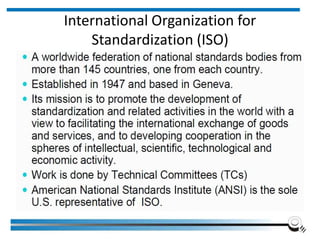
  • 95.
    6 Resource requirements g)the maintenance plan and maintenance carried out to date, where relevant to the performance of the equipment; h) details of any damage, malfunction, modification to, or repair of, the equipment.
  • 96.
    6 Resource requirements 6.5Metrological traceability 6.5.1 The laboratory shall establish and maintain metrological traceability of its measurement results by means of a documented unbroken chain of calibrations, each contributing to the measurement uncertainty, linking them to an appropriate reference.
  • 97.
    6 Resource requirements 6.5.2The laboratory shall ensure that measurement results are traceable to the International System of Units (SI) through: a) calibration provided by a competent laboratory; b) certified values of certified reference materials provided by a competent producer with stated metrological traceability to the SI; c) direct realization of the SI units ensured by comparison, directly or indirectly, with national or international standards.
  • 98.
    6 Resource requirements 6.5.3When metrological traceability to the SI units is not technically possible, the laboratory shall demonstrate metrological traceability to an appropriate reference, e.g.: a) certified values of certified reference materials provided by a competent producer; b) results of reference measurement procedures, specified methods or consensus standards that are clearly described and accepted as providing measurement results fit for their intended use and ensured by suitable comparison.
  • 99.
    Example and recommendation Wherea test is used to measure an empirical property of a sample, such as flashpoint, equipment is often defined in a national or international standard method and traceable reference materials should be used for calibration purposes where available. New or newly acquired equipment should be checked by the laboratory before use to ensure conformity with specified design, performance and dimension requirements.
  • 100.
    6 Resource requirements 6.6Externally provided products and services
  • 101.
    6 Resource requirements Purchaseand Subcontract : 6.6.1 The laboratory shall ensure that only suitable externally provided products and services that affect laboratory activities are used, when such products and services: a) are intended for incorporation into the laboratory’s own activities; b) are provided, in part or in full, directly to the customer by the laboratory, as received from the external provider; c) are used to support the operation of the laboratory.
  • 102.
    6.6.2 The laboratoryshall have a procedure and retain records for: a) defining, reviewing and approving the laboratory’s requirements for externally provided products and services; b) defining the criteria for evaluation, selection, monitoring of performance and re-evaluation of the external providers; Contd. 6 Resource requirements
  • 103.
    c) ensuring thatexternally provided products and services conform to the laboratory’s established requirements, or when applicable, to the relevant requirements of this document, before they are used or directly provided to the customer; d) taking any actions arising from evaluations, monitoring of performance and re-evaluations of the external providers. 6 Resource requirements
  • 104.
    6.6.3 The laboratoryshall communicate its requirements to external providers for: a) the products and services to be provided; b) the acceptance criteria; c) competence, including any required qualification of personnel; d) activities that the laboratory, or its customer, intends to perform at the external provider's premises. 6 Resource requirements
  • 105.
    6.6.3 The laboratoryshall communicate its requirements to external providers for: a) the products and services to be provided; b) the acceptance criteria; c) competence, including any required qualification of personnel; d) activities that the laboratory, or its customer, intends to perform at the external provider's premises. 6 Resource requirements
  • 106.
    DOCUMENTATION AND RECORDSUMMARY FOR 6.6 CLAUSE OF ISO/IEC 17025 • Procedure for Purchase/subcontracting /external service and supplies • List of approved vendor/subcontractor • Purchase indent • Purchase order • Vendor evaluation record • Inspection plan for acceptance of laboratory material and consumables and supplies
  • 107.
    7.1 Review ofrequests, tenders and contracts 7 Process requirements
  • 108.
    7.1.1 The laboratoryshall have a procedure for the review of requests, tenders and contracts. The procedure shall ensure that: a) the requirements are adequately defined, documented and understood; b) the laboratory has the capability and resources to meet the requirements; Contd. 7 Process requirements
  • 109.
    c) where externalproviders are used, the requirements of 6.6 are applied and the laboratory advises the customer of the specific laboratory activities to be performed by the external provider and gains the customer's approval; d) the appropriate methods or procedures are selected and are capable of meeting the customers' requirements. 7 Process requirements
  • 110.
    7.1.2 The laboratoryshall inform the customer when the method requested by the customer is considered to be inappropriate or out of date. 7.1.3 When the customer requests a statement of conformity to a specification or standard for the test or calibration (e.g. pass/fail, in-tolerance/out-of- tolerance), the specification or standard and the decision rule shall be clearly defined. Unless inherent in the requested specification or standard, the decision rule selected shall be communicated to, and agreed with, the customer. 7 Process requirements
  • 117.
    7.1.4 Any differencesbetween the request or tender and the contract shall be resolved before laboratory activities commence. Each contract shall be acceptable both to the laboratory and the customer. Deviations requested by the customer shall not impact the integrity of the laboratory or the validity of the results. 7.1.5 The customer shall be informed of any deviation from the contract. 7 Process requirements
  • 118.
    7.1.6 If acontract is amended after work has commenced, the contract review shall be repeated and any amendments shall be communicated to all affected personnel. 7 Process requirements
  • 119.
    7.1.7 The laboratoryshall cooperate with customers or their representatives in clarifying the customer's request and in monitoring the laboratory’s performance in relation to the work performed. a) providing reasonable access to relevant areas of the laboratory to witness customer-specific laboratory activities; b) preparation, packaging, and dispatch of items needed by the customer for verification purposes. 7 Process requirements
  • 120.
    7.1.8 Records ofreviews, including any significant changes, shall be retained. Records shall also be retained of pertinent discussions with a customer relating to the customer's requirements or the results of the laboratory activities. 7 Process requirements
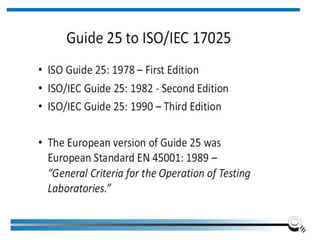
  • 121.
    7.2 Selection, verificationand validation of methods 7 Process requirements
  • 122.
    7.2.1 Selection andverification of methods: 7.2.1.1 The laboratory shall use appropriate methods and procedures for all laboratory activities and, where appropriate, for evaluation of the measurement uncertainty as well as statistical techniques for analysis of data. 7 Process requirements
  • 123.
    7.2.1.2 All methods,procedures and supporting documentation, such as instructions, standards, manuals and reference data relevant to the laboratory activities, shall be kept up to date and shall be made readily available to personnel (see 8.3). 7.2.1.3 The laboratory shall ensure that it uses the latest valid version of a method unless it is not appropriate or possible to do so. When necessary, the application of the method shall be supplemented with additional details to ensure consistent application. 7 Process requirements
  • 124.
    7.2.1.4 When thecustomer does not specify the method to be used, the laboratory shall select an appropriate method and inform the customer of the method chosen. Methods published either in international, regional or national standards, or by reputable technical organizations, or in relevant scientific texts or journals, or as specified by the manufacturer of the equipment, are recommended. Laboratory-developed or modified methods can also be used. 7 Process requirements
  • 125.
    7.2.1.5 The laboratoryshall verify that it can properly perform methods (method verification) before introducing them by ensuring that it can achieve the required performance. Records of the verification shall be retained. If the method is revised by the issuing body, verification shall be repeated to the extent necessary. 7 Process requirements
  • 126.
    7.2.1.6 When methoddevelopment is required, this shall be a planned activity and shall be assigned to competent personnel equipped with adequate resources. As method development proceeds, periodic review shall be carried out to confirm that the needs of the customer are still being fulfilled. Any modifications to the development plan shall be approved and authorized. 7.2.1.7 Deviations from methods for all laboratory activities shall occur only if the deviation has been documented, technically justified, authorized, and accepted by the customer 7 Process requirements
  • 127.
    7.2.1.7 Deviations frommethods for all laboratory activities shall occur only if the deviation has been documented, technically justified, authorized, and accepted by the customer. 7 Process requirements
  • 128.
    7 Process requirements 7.2.2Validation of methods:
  • 129.
    7.2.2.1 The laboratoryshall validate non-standard methods, laboratory-developed methods and standard methods used outside their intended scope or otherwise modified. The validation shall be as extensive as is necessary to meet the needs of the given application or field of application. a) calibration or evaluation of bias and precision using reference standards or reference materials; Contd. 7 Process requirements
  • 130.
    b) systematic assessmentof the factors influencing the result; c) testing method robustness through variation of controlled parameters, such as incubator temperature, volume dispensed; d) comparison of results achieved with other validated methods; e) interlaboratory comparisons; f) evaluation of measurement uncertainty of the results based on an understanding of the theoretical principles of the method and practical experience of the performance of the sampling or test method. 7 Process requirements
  • 131.
    7.2.2.2 When changesare made to a validated method, the influence of such changes shall be determined and where they are found to affect the original validation, a new method validation shall be performed. 7.2.2.3 The performance characteristics of validated methods, as assessed for the intended use, shall be relevant to the customers' needs and consistent with specified requirements. 7 Process requirements
  • 132.
    Verification versus Validation Instituteof Applied Quality Management 132
  • 133.
    Verification • Verification isthe process by which the lab verifies that the established performance claims of an test or product can be replicated in the lab before sample testing • Verification establishes that the laboratory performing the test executes the test procedures correctly and ensures that instrumentation and reagents work properly. • Verification is acceptable in circumstances in which the test is performed and used in the manner directed in the package insert/Test SOP • Any other off-label use would require validation by the performing laboratory. Institute of Applied Quality Management 133
  • 134.
    Validation Validation is theprocess by which the laboratory measures the testing efficacy of the test in question by determining its performance characteristics when used as intended. When you are following a non standard method at your defined conditions. • whenever using non-standard methods or a standard method beyond the stated limits of operation is required to validate such test methods Institute of Applied Quality Management 134
  • 135.
    • Verification ofperformance specifications. • (i) Demonstrate that it can obtain performance specifications comparable to those established by the manufacturer for the following performance characteristics: • (A) Accuracy (B) Precision Institute of Applied Quality Management 135 Verification
  • 136.
    Verification When standard methodsare used, laboratories should verify their own satisfactory performance against the documented performance characteristics of the method, before any samples are analyzed. Records of the verification must be retained. For published test methods that do not include precision data, the laboratory must determine its own precision data based on test data. All methods should include criteria for rejecting suspect results.
  • 137.
    Method selection Where atest can be performed by more than one method there must be documented criteria for method selection. Where relevant the degree of correlation between the methods should be established and documented
  • 138.
    Validation Need to establishfor each test system the performance specifications for the following performance characteristics: (i) Accuracy (ii) Precision (iii) Analytical sensitivity (iv) Analytical specificity to include interfering substances (v) Reportable range of test results for test system (vi) Reference intervals (normal values) Institute of Applied Quality Management 138
  • 139.
    Method Validation Methods developedin-house must be validated and authorized before use. Where they are available, certified reference materials should be used to determine any systematic bias, or where this is not possible results compared with other technique(s), preferably based on different principles of analysis. • Where a change in method involves only minor adjustments, such as sample size, different reagents, the amended method should be validated
  • 140.
  • 141.
    The Validation Timeline Vendor’sSite User’s Site User’s Site Structural and Software Qualification Qualification IQ OQ PQ Calibration and Maintenance, System Suitability Before Purchase Before Use After Use
  • 142.
    The essential eightsteps of Method Validation • Precision • Accuracy • Limit of Detection (LOD) • Limit of Quantification (LOQ) • Specificity • Linearity and Range • Ruggedness • Robustness
  • 143.
    Accuracy Is the measureof exactness of an analytical method, or the closeness of agreement between the measured value and the value or an accepted reference value.
  • 144.
    Precision Is the measureof the degree of repeatability of an analytical method under normal operation and is normally expressed as the percent relative standard deviation for a statistically significant number of samples.
  • 145.
  • 146.
    Specificity Is the abilityto measure accurately and specifically the analyte of interest in the presence of other components that may be expected to be present in the sample matrix. It is a measure of the degree of interference from such things as other active ingredients, excipients, impurities, and degradation products, ensuring that a peak response is due only to a single component; that is, that no co-elutions exist.
  • 147.
    Limit of Detection(LOD) Is defined as the lowest concentration of an analyte in a sample that can be detected, though not necessarily quantitated. It is a limit test that specifies whether or not an analyte is above or below a certain value.
  • 148.
    Limit of Quantification(LOQ) Is defined as the lowest concentration of ana analyte in a sample that can be determined with acceptable precision and accuracy under the stated operational conditions of the method. LOQ is directly proportional to the precision.
  • 149.
    LOD and LOQ LOL LOD LOQ Useful Interval LOD= Limit of Detection LOQ =Limit of Quantification LOL = Limit of Linearity Concentration Response of the instrument LOD = 3 S/N LOQ = 10 S/N
  • 150.
    Linearity and Range Linearity Isthe ability of the method to elicit test results that are directly proportional to analyte concentration within a given range. Range Is the interval between the upper and lower levels of analyte that have been demonstrated to be determined with precision, accuracy, and linearity using the method
  • 151.
    Ruggedness Ruggedness `Is the degreeof reproducibility of the results obtained under a variety of conditions. These conditions include differences in laboratories, analysts, instruments, reagents, and experimental periods.Robustness Is the capacity of a method to remain unaffeccted by small deliberate variations in method parameters.These deliberate variations are change in the percent of organic solvent, pH, ionic strength, or temperature, and detemining the effect (if any) on the results of the method.
  • 152.
    7.2.2.4 The laboratoryshall retain the following records of validation: a) the validation procedure used; b) specification of the requirements; c) determination of the performance characteristics of the method; d) results obtained; e) a statement on the validity of the method, detailing its fitness for the intended use. 7 Process requirements
  • 153.
  • 154.
    7.3.1 The laboratoryshall have a sampling plan and method when it carries out sampling of substances, materials or products for subsequent testing or calibration. The sampling method shall address the factors to be controlled to ensure the validity of subsequent testing or calibration results. The sampling plan and method shall be available at the site where sampling is undertaken. Sampling plans shall, whenever reasonable, be based on appropriate statistical methods. 7 Process requirements
  • 155.
    7.3.2 The samplingmethod shall describe: a) the selection of samples or sites; b) the sampling plan; c) the preparation and treatment of sample(s) from a substance, material or product to yield the required item for subsequent testing or calibration. 7 Process requirements
  • 156.
    7.3.3 The laboratoryshall retain records of sampling data (sampling data sheet) that forms part of the testing or calibration that is undertaken. These records shall include, where relevant: a) reference to the sampling method used; b) date and time of sampling; c) data to identify and describe the sample (e.g. number, amount, name); d) identification of the personnel performing sampling; e) identification of the equipment used; Contd. 7 Process requirements
  • 157.
    f) environmental ortransport conditions; g) diagrams or other equivalent means to identify the sampling location, when appropriate; h) deviations, additions to or exclusions from the sampling method and sampling plan. 7 Process requirements
  • 158.
    7 Process requirements 7.4Handling of test or calibration items
  • 159.
    7.4.1 The laboratoryshall have a procedure for the transportation, receipt, handling, protection, storage, retention, and disposal or return of test or calibration items, including all provisions (logistics and storage) necessary to protect the integrity of the test or calibration item, and to protect the interests of the laboratory and the customer. Precautions shall be taken to avoid deterioration, contamination, loss or damage to the item during handling, transporting, storing/waiting, and preparation for testing or calibration. Handling instructions provided with the item shall be followed. 7 Process requirements
  • 160.
    7.4.2 The laboratoryshall have a system for the unambiguous identification of test or calibration items. The identification shall be retained while the item is under the responsibility of the laboratory. The system shall ensure that items will not be confused physically (Sample ID/ marking) or when referred to in records or other documents. The system shall, if appropriate, accommodate a sub-division of an item or groups of items and the transfer of items. 7 Process requirements
  • 161.
    7.4.3 Upon receiptof the test or calibration item, deviations from specified conditions (ex. Dimension) shall be recorded. When there is doubt about the suitability of an item for test or calibration, or when an item does not conform to the description provided, the laboratory shall consult the customer for further instructions before proceeding and shall record the results of this consultation. When the customer requires the item to be tested or calibrated acknowledging a deviation from specified conditions, the laboratory shall include a disclaimer in the report indicating which results may be affected by the deviation. 7 Process requirements
  • 162.
    Planning : – SampleAcceptance and rejection criteria – Sample acceptance and rejection record – Customer communication log if sample is compromised with deviation – Disclaimer in the report 7.4.4 When items need to be stored or conditioned under specified environmental conditions, (Ex. Temp/humidity) these conditions shall be maintained, monitored and recorded.
  • 163.
    7.5 Technical records. 7.5.1The laboratory shall ensure that technical records for each laboratory activity contain the results, report and sufficient information to facilitate, if possible, identification of factors affecting the measurement result (Type A and Type B factors) and its associated measurement uncertainty and enable the repetition of the laboratory activity under conditions as close as possible to the original. Contd. 7 Process requirements
  • 164.
    7.5.1The technical recordsshall include the date and the identity of personnel responsible for each laboratory activity and for checking data and results. Original observations (machine print out/ chemist hand book), data and calculations shall be recorded at the time they are made and shall be identifiable with the specific task. 7 Process requirements
  • 165.
    7.5.2 The laboratoryshall ensure that amendments to technical records can be tracked to previous versions or to original observations. Both the original and amended data and files shall be retained, including the date of alteration, an indication of the altered aspects and the personnel responsible for the alterations. 7 Process requirements
  • 166.
    7.6 Evaluation ofmeasurement uncertainty 7 Process requirements
  • 167.
    7.6.1 Laboratories shallidentify the contributions to measurement uncertainty. When evaluating measurement uncertainty, all contributions that are of significance, including those arising from sampling, shall be taken into account using appropriate methods of analysis. 7.6.2 A laboratory performing calibrations, including of its own equipment, shall evaluate the measurement uncertainty for all calibrations. 7 Process requirements
  • 168.
    7.6.3 A laboratoryperforming testing shall evaluate measurement uncertainty. Where the test method precludes rigorous evaluation of measurement uncertainty, an estimation shall be made based on an understanding of the theoretical principles or practical experience of the performance of the method. 7 Process requirements
  • 169.
    7.7 Ensuring thevalidity of results 7 Process requirements
  • 170.
    7.7.1 The laboratoryshall have a procedure for monitoring the validity of results. The resulting data shall be recorded in such a way that trends (control chart/ linearity) are detectable and, where practicable, statistical techniques (UCL &LCL, mean and precision) shall be applied to review the results. This monitoring shall be planned and reviewed and shall include, where appropriate, but not be limited to: a) use of reference materials(RM) or quality control materials; (CRM/Standard etc) Contd. 7 Process requirements
  • 171.
    b) use ofalternative instrumentation (method comparability ) that has been calibrated to provide traceable results; c) functional check(s) of measuring and testing equipment; ( other one point/two point etc check d) use of check or working standards with control charts, where applicable; e) intermediate checks (in between calibration) on measuring equipment; f) replicate tests or calibrations using the same or different methods; Contd. 7 Process requirements
  • 172.
    g) retesting orrecalibration of retained items; h) correlation of results for different characteristics of an item; (ex. Carbon chemical with hardness) i) review of reported results; j) intralaboratory comparisons; (within internal laboratories) k) testing of blind sample(s). (sample not known) 7 Process requirements
  • 173.
    7.7.2 The laboratoryshall monitor its performance by comparison with results of other laboratories, where available and appropriate. This monitoring shall be planned and reviewed and shall include, but not be limited to, either or both of the following: a) participation in proficiency testing; b) participation in interlaboratory comparisons other than proficiency testing. 7 Process requirements
  • 174.
    7.7.3 Data frommonitoring activities shall be analyzed, used to control and, if applicable, improve the laboratory's activities. If the results of the analysis of data from monitoring activities are found to be outside pre-defined criteria (acceptable limit), appropriate action shall be taken to prevent incorrect results from being reported. 7 Process requirements
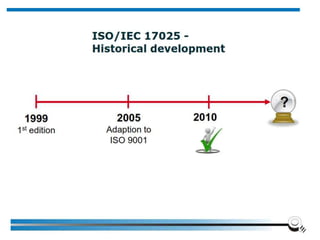
  • 175.
    7.8 Reporting ofresults 7 Process requirements
  • 176.
    7.8.1 General 7.8.1.1 Theresults shall be reviewed and authorized prior to release. 7.8.1.2 The results shall be provided accurately, clearly, unambiguously and objectively, usually in a report (e.g. a test report or a calibration certificate or report of sampling), and shall include all the information agreed with the customer and necessary for the interpretation of the results and all information required by the method used. All issued reports shall be retained as technical records. 7 Process requirements
  • 177.
    7.8.1.3 When agreedwith the customer, the results may be reported in a simplified way. Any information listed in 7.8.2 to 7.8.7 that is not reported to the customer shall be readily available. 7 Process requirements
  • 178.
    7.8.2 Common requirementsfor reports (test, calibration or sampling) 7.8.2.1 Each report shall include at least the following information, unless the laboratory has valid reasons for not doing so, thereby minimizing any possibility of misunderstanding or misuse: a) a title (e.g. “Test Report”, “Calibration Certificate” or “Report of Sampling”); b) the name and address of the laboratory; Contd. 7 Process requirements
  • 179.
    c) the locationof performance of the laboratory activities, including when performed at a customer facility or at sites away from the laboratory’s permanent facilities, or in associated temporary or mobile facilities; d) unique identification that all its components are recognized as a portion of a complete report and a clear identification of the end; e) the name and contact information of the customer; f) identification of the method used; Contd. 7 Process requirements
  • 180.
    g) a description,unambiguous identification, and, when necessary, the condition of the item; h) the date of receipt of the test or calibration item(s), and the date of sampling, where this is critical to the validity and application of the results; i) the date(s) of performance of the laboratory activity; j) the date of issue of the report; k) reference to the sampling plan and sampling method used by the laboratory or other bodies where these are relevant to the validity or application of the results; Contd. 7 Process requirements
  • 181.
    l) a statementto the effect that the results relate only to the items tested, calibrated or sampled; m) the results with, where appropriate, the units of measurement; n) additions to, deviations, or exclusions from the method; o) identification of the person(s) authorizing the report; p) clear identification when results are from external providers. 7 Process requirements
  • 182.
    7.8.2.2 The laboratoryshall be responsible for all the information provided in the report, except when information is provided by the customer. Data provided by a customer shall be clearly identified. In addition, a disclaimer shall be put on the report when the information is supplied by the customer and can affect the validity of results. Where the laboratory has not been responsible for the sampling stage (e.g. the sample has been provided by the customer), it shall state in the report that the results apply to the sample as received. 7 Process requirements
  • 183.
    7.8.3 Specific requirementsfor test reports 7 Process requirements
  • 184.
    7.8.3.1 In additionto the requirements listed in 7.8.2, test reports shall, where necessary for the interpretation of the test results, include the following: a) information on specific test conditions, such as environmental conditions; b) where relevant, a statement of conformity with requirements or specifications (see 7.8.6); Contd. 7 Process requirements
  • 185.
    c) where applicable,the measurement uncertainty presented in the same unit as that of the measurand or in a term relative to the measurand (e.g. percent) when: — it is relevant to the validity or application of the test results; — a customer's instruction so requires, or — the measurement uncertainty affects conformity to a specification limit; d) where appropriate, opinions and interpretations (see 7.8.7); Contd. 7 Process requirements
  • 186.
    e) additional informationthat may be required by specific methods, authorities, customers or groups of customers. 7.8.3.2 Where the laboratory is responsible for the sampling activity, test reports shall meet the requirements listed in 7.8.5 where necessary for the interpretation of test results. 7 Process requirements
  • 188.
    DOCUMENTATION AND RECORDSUMMARY FOR 5.10 CLAUSE OF ISO/IEC 17025 • Test report format as per the requirement of ISO/IEC 17025 • Copy of the test report • Report correction record
  • 189.
    7.8.4 Specific requirementsfor calibration certificates 7 Process requirements
  • 190.
    7.8.4.1 In additionto the requirements listed in 7.8.2, calibration certificates shall include the following: a) the measurement uncertainty of the measurement result presented in the same unit as that of the measured or in a term relative to the measured (e.g. percent); b) the conditions (e.g. environmental) under which the calibrations were made that have an influence on the measurement results; c) a statement identifying how the measurements are metrological traceable (see Annex A); 7 Process requirements
  • 191.
    d) the resultsbefore and after any adjustment or repair, if available; e) where relevant, a statement of conformity with requirements or specifications (see 7.8.6); f) where appropriate, opinions and interpretations (see 7.8.7). 7.8.4.2 Where the laboratory is responsible for the sampling activity, calibration certificates shall meet the requirements listed in 7.8.5 where necessary for the interpretation of calibration results. 7 Process requirements
  • 192.
    7.8.4.3 A calibrationcertificate or calibration label shall not contain any recommendation on the calibration interval, except where this has been agreed with the customer. 7 Process requirements
  • 193.
    7.8.5 Reporting sampling– specific requirements 7 Process requirements
  • 194.
    7.8.5 Reporting sampling– specific requirements Where the laboratory is responsible for the sampling activity, in addition to the requirements listed in 7.8.2, reports shall include the following, where necessary for the interpretation of results: a) the date of sampling; b) unique identification of the item or material sampled (including the name of the manufacturer, the model or type of designation and serial numbers, as appropriate); Contd. 7 Process requirements
  • 195.
    c) the locationof sampling, including any diagrams, sketches or photographs; d) a reference to the sampling plan and sampling method; e) details of any environmental conditions during sampling that affect the interpretation of the results; f) information required to evaluate measurement uncertainty for subsequent testing or calibration. 7 Process requirements
  • 196.
    7.8.6 Reporting statementsof conformity. 7 Process requirements
  • 197.
    7.8.6.1 When astatement of conformity to a specification or standard is provided, the laboratory shall document the decision rule employed, taking into account the level of risk (such as false accept and false reject and statistical assumptions) associated with the decision rule employed, and apply the decision rule. 7.8.6.2 The laboratory shall report on the statement of conformity, such that the statement clearly identifies: Contd. 7 Process requirements
  • 198.
    a) to whichresults the statement of conformity applies; b) which specifications, standards or parts thereof are met or not met; c) the decision rule applied (unless it is inherent in the requested specification or standard). 7 Process requirements
  • 199.
    7.8.7 Reporting opinionsand interpretations 7 Process requirements
  • 200.
    7.8.7.1 When opinionsand interpretations are expressed, the laboratory shall ensure that only personnel authorized for the expression of opinions and interpretations release the respective statement. The laboratory shall document the basis upon which the opinions and interpretations have been made. 7.8.7.2 The opinions and interpretations expressed in reports shall be based on the results obtained from the tested or calibrated item and shall be clearly identified as such. 7 Process requirements
  • 201.
    7.8.7.3 When opinionsand interpretations are directly communicated by dialogue with the customer, a record of the dialogue shall be retained. 7 Process requirements
  • 202.
    7.8.8 Amendments toreports 7 Process requirements
  • 203.
    7.8.8.1 When anissued report needs to be changed, amended or re-issued, any change of information shall be clearly identified and, where appropriate, the reason for the change included in the report. 7.8.8.2 Amendments to a report after issue shall be made only in the form of a further document, or data transfer, which includes the statement “Amendment to Report, serial number... [or as otherwise identified]”, or an equivalent form of wording. 7 Process requirements
  • 204.
    Such amendments shallmeet all the requirements of this document. 7.8.8.3 When it is necessary to issue a complete new report, this shall be uniquely identified and shall contain a reference to the original that it replaces. 7 Process requirements
  • 205.
  • 206.
  • 207.
    7.9.1 The laboratoryshall have a documented process (flow chart or procedure) to receive, evaluate and make decisions on complaints. (all staff/client and others like statutory, legal) 7.9.2 A description of the handling process for complaints ( how to raise a complaint ) shall be available to any interested party on request. Upon receipt of a complaint, the laboratory shall confirm whether the complaint relates to laboratory activities that it is responsible for and, if so, shall deal with it. The laboratory shall be responsible for all decisions at all levels of the handling process for complaints. 7 Process requirements
  • 208.
    7.9.3 The processfor handling complaints shall include at least the following elements and methods: a) description of the process (flow chart or process) for receiving (acknowledgement), validating, (initial confirmation) investigating the complaint (RCA), and deciding what actions are to be taken in response to it; b) tracking and recording complaints, including actions undertaken to resolve them; (correction and CA) c) ensuring that any appropriate action(CA) is taken. 7 Process requirements
  • 209.
    7.9.4 The laboratoryreceiving the complaint shall be responsible for gathering and verifying all necessary information to validate the complaint.(verification fact) 7.9.5 Whenever possible, the laboratory shall acknowledge receipt of the complaint, and provide the complainant with progress reports and the outcome. 7.9.6 The outcomes to be communicated to the complainant shall be made by, or reviewed and approved by, individual(s) not involved in the original laboratory activities in question. (person involved in the complaint will not investigate) 7 Process requirements
  • 210.
    7.9.7 Whenever possible,the laboratory shall give formal notice (Resolution letter) of the end of the complaint handling to the complainant. 7 Process requirements
  • 211.
    7.10 Nonconforming work. 7Process requirements
  • 212.
    Identification and control ofnon-conformities What is non conformities ? In quality management, a nonconformity (also known as a defect) is a deviation from a specification, a standard, or an expectation. Institute of Applied Quality Management 212
  • 213.
    Identification and control ofnon-conformities • What is non conformities ? Ex. A sample is processed in less than 300 rpm or required “g” A sample requested for fungus culture in incubated in normal incubate or rather BOD incubator or incubated at less than temperature required for test Institute of Applied Quality Management 213
  • 214.
    Control of nonconformingtesting and/or calibration work What is Non conformance ? is non fulfillment of the specified requirement of test What is corrective action ? Action taken to prevent reoccurrence
  • 215.
    Institute of AppliedQuality Management 215 RISK ASSESSMENT
  • 216.
    7.10.1 The laboratoryshall have a procedure that shall be implemented when any aspect of its laboratory activities or results of this work do not conform to its own procedures (MSP/WI/SOP) or the agreed requirements of the customer (e.g. equipment or environmental conditions are out of specified limits, results of monitoring fail to meet specified criteria). The procedure shall ensure that: a) the responsibilities and authorities for the management of nonconforming work are defined; Contd. 7 Process requirements
  • 217.
    b) actions (includinghalting or repeating of work and withholding of reports, as necessary) are based upon the risk levels established by the laboratory; c) an evaluation is made of the significance of the nonconforming work, including an impact analysis on previous results; d) a decision is taken on the acceptability of the nonconforming work; e) where necessary, the customer is notified and work is recalled; f) the responsibility for authorizing the resumption of work is defined. . 7 Process requirements
  • 218.
    7.10.2 The laboratoryshall retain records of nonconforming work and actions as specified in 7.10.1, bullets b) to f). 7.10.3 Where the evaluation indicates that the nonconforming work could recur, or that there is doubt about the conformity of the laboratory's operations with its own management system, (Deviation from written down process/procedure) the laboratory shall implement corrective action. 7 Process requirements
  • 219.
    7.11 Control ofdata and information management 7.11.1 The laboratory shall have access to the data and information needed to perform laboratory activities. 7 Process requirements
  • 220.
    7 Process requirements 7.11.2The laboratory information management system(s) (LIMS) used for the collection, processing, recording, reporting, storage or retrieval of data shall be validated for functionality (beta testing), including the proper functioning of interfaces (with uni direction and bi direction) within the laboratory information management system(s) by the laboratory before introduction. Whenever there are any changes, including laboratory software configuration or modifications to commercial off-the-shelf software, they shall be authorized, documented and validated before implementation.
  • 221.
    Computerized based analyticalsystem Such systems will normally be validated by checking for satisfactory operation (including performance under extreme circumstances) and establishing the reliability of the system before it is allowed to run unattended. An assessment should be made of the likely causes of system malfunction. Where possible the controlling software should be tailored to identify and highlight any such malfunctions and tag associated data.
  • 222.
    7.11.3 The laboratoryinformation management system(s) shall: a) be protected from unauthorized access; b) be safeguarded against tampering and loss; c) be operated in an environment that complies with provider or laboratory specifications or, in the case of non-computerized systems, provides conditions which safeguard the accuracy of manual recording and transcription; Contd. 7 Process requirements
  • 223.
    d) be maintainedin a manner that ensures the integrity of the data and information; e) include recording system failures and the appropriate immediate and corrective actions. 7.11.4 When a laboratory information management system is managed and maintained off-site or through an external provider, the laboratory shall ensure that the provider or operator of the system complies with all applicable requirements of this document. 7 Process requirements
  • 224.
    7.11.5 The laboratoryshall ensure that instructions, manuals and reference data relevant to the laboratory information management system(s) are made readily available to personnel. 7.11.6 Calculations and data transfers shall be checked in an appropriate and systematic manner. Electronic transfer of data should be checked to ensure that no corruption has occurred during transmission. This can be achieved on the computer by the use of `verification files’ but wherever practical the transmission should be backed up by a hard copy of the data. 7 Process requirements
  • 225.
    8 Management systemrequirements 8.1 Options 8.1.1 General. The laboratory shall establish, document, implement and maintain a management system that is capable of supporting and demonstrating the consistent achievement of the requirements of this document and assuring the quality of the laboratory results.
  • 226.
    8 Management systemrequirements 8.1.1 General. (Cont.……..) In addition to meeting the requirements of Clauses 4 to 7, the laboratory shall implement a management system in accordance with Option A or Option B.
  • 227.
    8 Management systemrequirements 8.1.2 Option A • As a minimum, the management system of the laboratory shall address the following: • management system documentation (8.2) • control of management system documents (8.3) • control of records (8.4)
  • 228.
    8 Management systemrequirements • actions to address risks and opportunities (8.5) • improvement (8.6) • corrective actions (8.7) • internal audits (8.8) • management reviews (8.9).
  • 229.
    8 Management systemrequirements 8.1.3 Option B • A laboratory that has established and maintains a management system, in accordance with the requirements of ISO 9001, and that is capable of supporting and demonstrating the consistent fulfilment of the requirements of Clauses 4 to 7, also fulfils at least the intent of the management system requirements specified in 8.2 to 8.9.
  • 230.
    8 Management systemrequirements 8.2 Management system documentation(Option A ) • 8.2.1 Laboratory management shall establish, document, and maintain policies and objectives for the fulfilment of the purposes of this document and shall ensure that the policies and objectives are acknowledged and implemented at all levels of the laboratory organization.
  • 231.
    8 Management systemrequirements 8.2.2 The policies and objectives shall address the competence, impartiality and consistent operation of the laboratory. 8.2.3 Laboratory management shall provide evidence of commitment to the development and implementation of the management system and to continually improving its effectiveness.
  • 232.
    8 Management systemrequirements 8.2.4 All documentation, processes, systems, records, related to the fulfilment of the requirements of this document shall be included in, referenced from, or linked to the management system. (documentation linkage with reference) 8.2.5 All personnel involved in laboratory activities shall have access to the parts of the management system documentation and related information that are applicable to their responsibilities.
  • 233.
    8 Management systemrequirements 8.3 Control of management system documents (Option A)
  • 234.
    Institute of AppliedQuality Management 234
  • 235.
    Document control terminology •List of document/register of document/master list • Master document • Controled copy • Uncontroled copy • Obsolete copy • Issue and revision • Document preparation, approval and issue • Document review • Document change • Document Amendment Institute of Applied Quality Management 235
  • 236.
    List of Documents-Masterlist Institute of Applied Quality Management 236 Sl no Name of document Document no Copy No Issue no Issue date Last revision Holder 01 Quality Manual IAQM/Q M/01 01 01 01-12- 2012 05-10-2011 Quality Manager
  • 237.
    Institute of AppliedQuality Management 237
  • 238.
    Institute of AppliedQuality Management 238
  • 239.
    Institute of AppliedQuality Management 239
  • 240.
    Document Review Institute ofApplied Quality Management 240 Sl no Name of document Document no Section Page no Review findings Holder
  • 241.
    Institute of AppliedQuality Management 241
  • 242.
    List of Documents Instituteof Applied Quality Management 242 Sl no Name of document Document no Copy No Issue no Issue date Last revision Holder 01 Quality Manual IAQM/Q M/01 01 01 01-05- 2012 05-10-2012 Quality Manager
  • 243.
    8 Management systemrequirements 8.3 Control of management system documents (Option A) 8.3.1 The laboratory shall control the documents (internal and external) that relate to the fulfilment of this document. 8.3.2 The laboratory shall ensure that: a) documents are approved for adequacy prior to issue by authorized personnel;
  • 244.
    8 Management systemrequirements 8.3.2 (Cont.….) b) documents are periodically reviewed, and updated as necessary; c) changes and the current revision status of documents are identified; d) relevant versions of applicable documents are available at points of use and, where necessary, their distribution is controlled;
  • 245.
    8 Management systemrequirements 8.3.2 (Cont.….) e) documents are uniquely identified f) the unintended use of obsolete documents is prevented, and suitable identification is applied to them if they are retained for any purpose.
  • 246.
    8 Management systemrequirements 8.4 Control of records (Option A)
  • 247.
    8 Management systemrequirements 8.4 Control of records (Option A) 8.4.1 The laboratory shall establish and retain legible records to demonstrate fulfilment of the requirements in this document.
  • 248.
    8 Management systemrequirements 8.4 Control of records (Cont.….) 8.4.2 The laboratory shall implement the controls needed for the identification, storage, protection, back-up, archive, retrieval, retention time, and disposal of its records. The laboratory shall retain records for a period consistent with its contractual obligations. Access to these records shall be consistent with the confidentiality commitments, and records shall be readily available.
  • 249.
    8 Management systemrequirements 8.5 Actions to address risks and opportunities (Option A)
  • 250.
    8 Management systemrequirements 8.5.1 The laboratory shall consider the risks and opportunities associated with the laboratory activities in order to: a) give assurance that the management system achieves its intended results; b) enhance opportunities to achieve the purpose and objectives of the laboratory; c) prevent, or reduce, undesired impacts and potential failures in the laboratory activities; d) achieve improvement.
  • 251.
    8 Management systemrequirements 8.5.2 The laboratory shall plan: a) actions to address these risks and opportunities; b) how to: • integrate and implement these actions into its management system; • evaluate the effectiveness of these actions.
  • 252.
    8 Management systemrequirements 8.5.3 Actions taken to address risks and opportunities shall be proportional to the potential impact on the validity of laboratory results.
  • 253.
    What is Risk? • A random event that has negative impact • Risk has two components - Probability of occurrence - Severity • DIMENSIONS-Harm-physical injury or damage -Hazard-source of harm -Severity-measure of consequences Institute of Applied Quality Management 253
  • 254.
    What is RiskAssessment Risk Assessment is a systematic approach to identify hazards, evaluate risk and incorporate appropriate measures to manage and mitigate risk for any work process or activity. Institute of Applied Quality Management 254
  • 255.
    Risk Concepts Risk managementalso includes control and monitoring of risks, as well as communicating these risks Institute of Applied Quality Management 255 How likely is it? What are the Impacts Risk Level MANAGE RISK What can go Wrong
  • 256.
    Risk Assessment Team QUALITIES •Knowledge of the device, method, technology • Neutral • Careful • Creative thinkers • Confident • Thick skinned • Communicators • Curious • Finishers • Cynical – Always questioning, don't accept everything on face value • Social – Team players Institute of Applied Quality Management 256
  • 257.
    Risk management Plan •An organized approach to assessing and managing risk • Establishes scope & requirements • Assigns responsibilities • Sets criteria for acceptability • Establishes verification activities & feedback mechanisms • Provides the roadmap • Encourages objectivity • Prevents essential elements being forgotten Institute of Applied Quality Management 257
  • 258.
    Risk management Process 1.Selection of Risk method 2. Information review 3. Process mapping 4. Risk analysis- identify hazards 5. Risk estimation for each hazard 6. Determine acceptability of risks. 7. Evaluation based on acceptance criteria Institute of Applied Quality Management 258
  • 259.
    8. Risk reduction/control/mitigation 9.Evaluate residual risk 10. Periodic review for effectiveness Institute of Applied Quality Management 259 Risk management process - contd
  • 260.
    RISK ASSESSMENT METHOD –HORIZONTAL RISK ASSESSMENT – VERTICAL RISK ASSESSMENT HORIZONTAL RISK ASSESSMENT : Department or any functional activities, example : Reception/machine shop area, mechanical/ chemical test area VERTICAL RISK ASSESSMENT : Test parameter wise • Ex. Vertical risk analysis of Water BOD test parameter, pre analytic phase, analytic phase and post analytic phase Institute of Applied Quality Management 260
  • 261.
    RISK ASSESEMENT STEP Step1. Selection of risk method : a) It may be advisable to start with Horizontal risk assessment and then completing with vertical risk b) Vertical risk will take more time to complete the work c) While doing vertical risk many of the horizontal risk may be ignored Institute of Applied Quality Management 261
  • 262.
    RISK ASSESEMENT STEP •Step 2. Information review. – All the information on the test. • pre analytical procedure • instrument manuals, • package inserts, • technical bulletins, • Regulatory / accrediting organization requirements, • QC and PT records, Institute of Applied Quality Management 262
  • 263.
    RISK ASSESEMENT STEP •Step 2. Information review. – contd……. • Training procedures, • Prior failure investigation records, • Any institutional guidance on the test or analyte. Institute of Applied Quality Management 263 Caution - do not rely on memory
  • 264.
    RISK ASSESEMENT STEP Step3. Process mapping :- • staff who run the test method, • the test results, it’s important to understand what really occurs, not just what is supposed to occur. Institute of Applied Quality Management 264
  • 265.
    RISK ASSESEMENT STEPcontd----- Step 4. Risk Analysis - Identification of hazards. “What can go wrong” during routine operations ? What hazards are present. ? Categorize the hazard. Operator, Environment, System (Instrument), Reagents, or Specimen. Transcriptional AIM Controls necessary to reduce unwanted risk. Institute of Applied Quality Management 265
  • 266.
    RISK ASSESEMENT STEPcontd…………… Step 5. Risk estimation Evaluate the risk for each hazard: How likely it is that a failure will occur ? How likely it is that it will lead to harming a test results issued to customer ? How severe that harm could be ? ATTRIBUTES Subjective Discussion customer to understand decision rules Institute of Applied Quality Management 266
  • 267.
    RISK ASSESEMENT STEPcontd…… • Step 6. Determine acceptability of risks. • Severity and probability of harm to determine whether the risks are acceptable. • Each lab to determine where to draw the line between acceptable and unacceptable. • The team to determine whether a given risk is acceptable or not. Institute of Applied Quality Management 267
  • 268.
    RISK ASSESEMENT STEPcontd…………… • Step 7. Risk reduction/control/mitigation. • Identify ways to reduce the probability of harm, using prevention and detection methods, • Revised operator training, Posted warnings, • More robust QC rules, • Greater surveillance of the process, or even repeat testing • In cases where the test manufacturer indicates that certain aspects of the test are monitored through built-in controls, the lab may wish to conduct a study to verify the effectiveness of the control before including it as a control measure. Institute of Applied Quality Management 268
  • 269.
    RISK ASSESEMENT STEPcontd……………. • Step 8. Evaluate residual risk. • Once controls are assigned, the team then reviews the risks again and re- determines the risk level. Any risk not prevented or detected 100% of the time is considered residual risk. Institute of Applied Quality Management 269
  • 270.
    RISK ASSESEMENT STEP •Step 9 Periodic review of Risk: Once risk assessment, risk control procedure is adopted , periodic review of the same is required to understand the effectiveness of risk Institute of Applied Quality Management 270
  • 271.
    Possible responses torisk analysis findings • Accept the risk – do nothing • Reallocate resources • Get more information • Eliminate the risk entirely • Mitigate the risk • Have a contingency plan • Transfer the risk Institute of Applied Quality Management 271
  • 272.
    Risk Assessment Flowchart Institute ofApplied Quality Management 272 Manage Risk 7. Hazard Control 8. Additional control measures (Responsible person, timeline) Review, Approval, Communicate Record Keeping and Document Control Assess 5. Existing Control Measures 6. Evaluate Risk (Severity, Probability) Identify 1. Selecting Experiments 2. Break Down into Successive Tasks 3. Potential Hazards 4. Potential Harm (Ill health condition)
  • 273.
    Risk Evaluation Risk matrixto determine risk level Institute of Applied Quality Management 273 Likelihood Severity Remote (1) Occasional (2) Frequent (3) Minor (1) 1 2 3 Moderate (2) 2 4 6 Major (3) 3 6 9
  • 274.
    8 Management systemrequirements 8.6 Improvement (Option A)
  • 275.
    8 Management systemrequirements 8.6 Improvement (Option A) • 8.6.1 The laboratory shall identify (Quality Indicator/ compalint/ Non conformance/ IQA Risk and select opportunities for improvement and implement any necessary actions. • 8.6.2 The laboratory shall seek feedback, both positive and negative, from its customers. The feedback shall be analyzed and used to improve the management system, laboratory activities and customer service.
  • 276.
    Tools used forcontinuous improvement Institute of Applied Quality Management 276 2. Run Chart Performance Time
  • 277.
    8 Management systemrequirements 8.7 Corrective actions (Option A)
  • 278.
    8 Management systemrequirements 8.7 Corrective actions (Option A) 8.7.1 When a nonconformity occurs, the laboratory shall: a) react to the nonconformity and, as applicable: –take action to control and correct it; –address the consequences;
  • 279.
    8 Management systemrequirements 8.7 Corrective actions (Option A) (Cont.…..) b) evaluate the need for action to eliminate the cause(s) of the nonconformity, in order that it does not recur or occur elsewhere, by: • reviewing and analyzing the nonconformity; • determining the causes of the nonconformity (RCA) ; • determining if similar nonconformities exist, or could potentially occur
  • 280.
    8 Management systemrequirements 8.7 Corrective actions (Option A) (Cont.…..) • c) implement any action needed; • d) review the effectiveness of any corrective action taken; • e) update risks and opportunities determined during planning, if necessary; • f) make changes to the management system, if necessary.
  • 281.
    8 Management systemrequirements 8.7.2 Corrective actions shall be appropriate to the effects of the nonconformities encountered.
  • 282.
    Fishbone diagram analysis Instituteof Applied Quality Management 282 Makes customer wait Absent receiving party Working system of operators Customer Operator Absent Out of office Not at desk Lunchtime Too many phone calls Absent Not giving receiving party’s coordinates Complaining Leaving a message Lengthy talk Does not know organization well Takes too much time to explain Does not understand customer
  • 283.
    DOCUMENTATION AND RECORDSUMMARY FOR 8.7 CLAUSE OF ISO/IEC 17025 • Corrective action Procedure • Corrective action record
  • 284.
    8 Management systemrequirements 8.7.3 The laboratory shall retain records as evidence of: a) the nature of the nonconformities, cause(s) and any subsequent actions taken; b) the results of any corrective action.
  • 285.
    8 Management systemrequirements 8.8 Internal audits (Option A)
  • 286.
    8 Management systemrequirements 8.8 Internal audits (Option A) 8.8.1 The laboratory shall conduct internal audits at planned intervals to provide information on whether the management system: a) conforms to: • the laboratory’s own requirements for its management system, including the laboratory activities; • the requirements of this document; b) is effectively implemented and maintained.
  • 287.
    8 Management systemrequirements 8.8 Internal audits (Option A) (Cont.…..) 8.8.2 The laboratory shall: a) plan, establish, implement and maintain an audit programme including the frequency, methods, responsibilities, planning requirements and reporting, which shall take into consideration the importance of the laboratory activities concerned, changes affecting the laboratory, and the results of previous audits
  • 288.
    8 Management systemrequirements 8.8 Internal audits (Option A) (Cont.…..) b) define the audit criteria and scope for each audit c) ensure that the results of the audits are reported to relevant management; d) implement appropriate correction and corrective actions without undue delay; e) retain records as evidence of the implementation of the audit programme and the audit results.
  • 289.
    DOCUMENTATION AND RECORDSUMMARY FOR 8.8 Internal audits CLAUSE OF ISO/IEC 17025 • Internal audit procedure • List of Internal Auditors • Internal Audit Plan • Internal Audit Schedule • Internal audit checklist • Internal audit observation/ record • Internal audit nonconformance • Internal audit summary record
  • 290.
    8 Management systemrequirements 8.9 Management reviews (Option A)
  • 291.
    8 Management systemrequirements 8.9 Management reviews (Option A) 8.9.1 The laboratory management shall review its management system at planned intervals, in order to ensure its continuing suitability, adequacy and effectiveness, including the stated policies and objectives related to the fulfillment of this document.
  • 292.
    Institute of AppliedQuality Management 292
  • 293.
    8 Management systemrequirements 8.9.2 The inputs to management review shall be recorded and shall include information related to the following: a) changes in internal and external issues that are relevant to the laboratory; b) fulfilment of objectives; c) suitability of policies and procedures; d) status of actions from previous management reviews;
  • 294.
    8 Management systemrequirements f) corrective actions; g) assessments by external bodies h) changes in the volume and type of the work or in the range of laboratory activities i) customer and personnel feedback j) Complaints k) effectiveness of any implemented improvements
  • 295.
    8 Management systemrequirements Minimum Management review agenda (cont.…) l) adequacy of resources; m) results of risk identification; n) outcomes of the assurance of the validity of results; and o) other relevant factors, such as monitoring activities and training.
  • 296.
    8 Management systemrequirements 8.9.3 The outputs from the management review shall record all decisions and actions related to at least: a) the effectiveness of the management system and its processes b) improvement of the laboratory activities related to the fulfillment of the requirements of this document c) provision of required resources; d) any need for change.
  • 297.
    8 Management systemrequirements 8.9 Management reviews (Option A) (Cont.….) 8.9.2 The inputs to management review shall be recorded and shall include information related to the following:
  • 299.
    DOCUMENTATION AND RECORDSUMMARY FOR 8.9 Management reviews CLAUSE OF ISO/IEC 17025 • Management Review Procedure • Management Review meeting Notice/Agenda • Minutes of Management review and follow up action record
  • 300.
  • 301.
    I INTENRAL QUALITYAUDIT PRACTICES PRESENTEDBY Dr S Chakraborty www.sambhuchakraborty.com
  • 302.
    web: www.quality-pathshala.com  Formaltraining for conducting laboratory Internal Audit to comply with requirement of ISO/IEC 17025 : 2017 standard  Assist in implementing laboratory accreditation system as per requirement of accreditation body  To Qualify as Internal Auditor for doing laboratory Audit Internally  Can help in carrying out second Party audit COURSE OBJECTIVES
  • 303.
    web: www.quality-pathshala.com Principles ofAuditing Audit Planning and execution NC Reporting and system effectiveness Checklist preparation Close examination of requirements in laboratory accreditation Case Studies COURSE OUTLINE
  • 304.
    web: www.quality-pathshala.com GENERAL PRINCIPLESOF AUDITING AUDIT OF laboratory QUALITY MANAGEMENT SYSTEM
  • 305.
    web: www.quality-pathshala.com DEFINITION Quality Managementsystem audit is----------- Systematic and Independent Examination of activities to. Verify compliance. Judge Effectiveness-of quality management system
  • 306.
    web: www.quality-pathshala.com A FORMALactivity carried out against policy, quality manual and procedures to INDEPENDENTLY examine OBJECTIVE EVIDENCE and verify compliance or otherwise with SPECIFIED REQUIREMENT and also judge EFFECTIVENESS FORMAL DEFINATION
  • 307.
    web: www.quality-pathshala.com INTERNAL VERSUSEXTERNAL AUDIT External auditor - has to stick to the norm - will almost exclusively report on non- conformities - examines a limited scope of services
  • 308.
    web: www.quality-pathshala.com INTERNAL VERSUSEXTERNAL AUDIT Internal auditor has to detect non-conformities, but can also report on other issues covers the complete scope is unrelated to the audited section of the organization, knows the inner workings of the organization
  • 309.
    web: www.quality-pathshala.com THE INTERNALAUDIT PROCESS • Scheduled Audits programme managed by Quality Assurance Officer examine documents, results, processes identify problems improve • Unscheduled Audits investigate problem improve
  • 310.
    web: www.quality-pathshala.com WHY INTERNALAUDITING ? Self evaluation for Adequacy & compliance Assessing Effectiveness of Management System (Specially under changing scenario) Evaluation of Vendors for Acceptance as supplier Evaluation of supplier competence
  • 311.
    • Demonstration ofQuality competence (As per Designed Assessment Type) • Requirements of Applicable Standards (eg. ISO 9001; ISO/IEC 17025 • Ascertain Effectiveness of Corrective Actions • Looking for Areas of Improvement web: www.quality-pathshala.com WHY INTERNAL AUDITING ?
  • 312.
    web: www.quality-pathshala.com AUDIT STAGES STAGE-I: ADEQUACY/INTENT • Is the system defined ? • Is the system documented as per standard • Quality Manual versus ISO/IEC 17025 : 2017 requirement
  • 313.
    web: www.quality-pathshala.com AUDIT STAGES STAGE-II: COMPLIANCE/IMPLEMENTATION • Is the documented system Implemented ? • Is the specified requirement is full fill • Objective evidence of activities versus the manual/procedures
  • 314.
    web: www.quality-pathshala.com AUDIT STAGES STAGE-III : EFFECTIVENESS • Is the implemented system effective ? • Is the desired Output/objective Achieved • Objective evidence of the effectiveness of the quality system
  • 315.
    REQUIREMENTS OF ISO/IEC17025 • Need to demonstrate compliance as per clause 8.8.1 The laboratory shall conduct internal audits at planned intervals to provide information on whether the management system: • a) conforms to: • — the laboratory’s own requirements for its management system, including the laboratory activities; • the requirements of this document; b) is effectively implemented and maintained. web: www.quality-pathshala.com
  • 316.
    REQUIREMENTS OF ISO/IEC17025 8.8.2 The laboratory shall: a)plan, establish, implement and maintain an audit programme including the frequency, methods, responsibilities, planning requirements and reporting, which shall take into consideration the importance of the laboratory activities concerned, changes affecting the laboratory, and the results of previous audits; b) define the audit criteria and scope for each audit; c) ensure that the results of the audits are reported to relevant management; d) implement appropriate correction and corrective actions without undue delay; e) retain records as evidence of the implementation of the audit programme and the audit results. web: www.quality-pathshala.com
  • 317.
    web: www.quality-pathshala.com QUALITY AUDITTYPES  1st Party - WE auditing our own system (Internal)  2nd Party - WE auditing our subcontractor (External)- vendor laboratory, suppliers 3rd Party - We being audited by an Certification Body-laboratory
  • 318.
    web: www.quality-pathshala.com AUDIT SCHEDULE Annual Addressall elements of the quality system - not all departments Frequency ? -critical areas
  • 319.
    web: www.quality-pathshala.com DOCUMENTS USEDIN INTERNAL AUDITING Checklists Non conformance & Corrective action request forms Audit report forms
  • 320.
    web: www.quality-pathshala.com DOCUMENTING THEAUDIT PROGRAM • Internal audit procedure (s) – selection and training of auditors – scheduling audits – responsibilities of auditors – preparation, conducting and reporting on audits – identifying, resolving and following up corrective actions – reporting audit results to management
  • 321.
    web: www.quality-pathshala.com EFFECTIVE AUDITING Gatherevidence about compliance with quality management system or standard
  • 322.
    web: www.quality-pathshala.com EFFECTIVE AUDITING Gatherinformation about: – organization structures , job description, various process and sub process of the department, internal customer or interrelationship matrix, laboratory management system, MIS, Departmental standard operating procedures,
  • 323.
    web: www.quality-pathshala.com SPECIFIED REQUIREMENTSFOR QUALITY MANAGEMENT SYSTEM AUDIT: Can be stated as follows :  Customer requirements  Quality System requirements - Quality manual - SOPs/Procedures/Work instructions - ISO/IEC 17025 : 2005 Standard requirement  Legal requirements-statutory, regulatory or industry body  Regulation of certification body AUDIT TERMINOLOGY AND USES
  • 324.
    web: www.quality-pathshala.com OBJECTIVE EVIDENCE: Evidence which exists Uninfluenced by emotion or prejudice Can be stated Can be documented Is about quality Can be quantitative (countable) Can be qualitative (measured by degree) Can be verified AUDIT TERMINOLOGY AND USES
  • 325.
    web: www.quality-pathshala.com OBJECTIVE EVIDENCE(SOURCE): • Available from – Quality Manual and other documents – Quality records – Statement of Auditee • Objective evidence need to be – Verifiable – Traceable AUDIT TERMINOLOGY AND USES
  • 326.
    web: www.quality-pathshala.com AUDIT SAMPLE: Need to representative from People Work station stages/Process client records Documents General Records AUDIT TERMINOLOGY AND USES
  • 327.
    web: www.quality-pathshala.com • NONCONFORMANCE : This is a judgmental term, in that we are stating that the quality system, or part of it, does not comply with requirements. Action is required! Noncompliance must be substantiated with observations or findings, and backed by objective evidence. AUDIT TERMINOLOGY AND USES
  • 328.
    web: www.quality-pathshala.com NONCONFORMITY : •Non fulfillment of a specified requirement • Condition averse to quality • Specified requirements: – Conditions of contract – ISO/IEC 17025 : 2005 standard – Quality manual – Procedures – Legal requirements – Specified opinion by auditee AUDIT TERMINOLOGY AND USES
  • 329.
    web: www.quality-pathshala.com JUDGING SYSTEMEFFECTIVENESS : Based on conclusions from audit findings AUDIT TERMINOLOGY AND USES
  • 330.
    web: www.quality-pathshala.com 1.Intent: “Haveyou said what you do?” Do the defined or documented processes adequately express your approach? 2.Implementation: “Have you done what you said?” Do the observed and recorded practices show compliance with the stated intent? 3.Effectiveness: “Have you done it well?” Do the results of the process indicate the desired outcomes have been achieved? AUDIT TERMINOLOGY AND USES
  • 331.
    web: www.quality-pathshala.com REPEATED NONCONFORMANCE : This may also be an example that corrective action is not effective Effectiveness of system AUDIT TERMINOLOGY AND USES
  • 332.
    DEFINITIONS Auditor Person with thecompetence to conduct and audit Auditor Qualification The combination of minimum Educational qualification, Training, developed audit skill & personal attributes demonstrating competency web: www.quality-pathshala.com
  • 333.
    web: www.quality-pathshala.com AUDITORS CRITERIA Knowledgeof specified requirement:  Collecting objective evidence for compliance or otherwise  Drawing representative sample  Asking right questions.
  • 334.
    web: www.quality-pathshala.com AUDIT EXECUTION ASKINGRIGHT QUESTION : Do not ask close ended question, ask open ended question Close ended question : where your are directly asking for objective evidences, where you are not getting scope for verifying the scope Close ended question : give me your adverse event record, where is your maintenance record, show me your purchase register etc
  • 335.
    web: www.quality-pathshala.com AUDIT EXECUTION √Open ended question : where question creates opportunity for further opening of the question to verify the system and methodologies √ Open ended question : what is your Quality control policy, how do you transport sample in the laboratory from site
  • 336.
    web: www.quality-pathshala.com AUDIT EXECUTION •ASKING RIGHT QUESTION/OPEN QUESTION There are 7 Friends  Who (does it)  What (is done)  Where (is it done)  Why (is it done)  When (does it get done)  How (is it done; often is it done)  Show me
  • 337.
    web: www.quality-pathshala.com AUDIT EXECUTION 7Friends in other way (6 W and 1 H) - Who - What - Where - When – Which - Why - How
  • 338.
    web: www.quality-pathshala.com AUDITORS CRITERIA(GENERAL)  Following Audit Trails  Recognizing non conformances  Judging effectiveness  Audit Frequency
  • 339.
    web: www.quality-pathshala.com AUDITORS CRITERIA(GENERAL) Knowledge of specified requirement :  Knowledge on ISO/IEC 17025 : 2005 standard,  Knowledge on local govt. statutory & regulatory body such as pollution control board, various Licensing department for operation of Laboratory
  • 340.
    web: www.quality-pathshala.com AUDITORS CRITERIA(GENERAL) Collecting objective evidence:  Collect objective evidence against each audit sample  Objective evidences may be any quality system document reference  Objective evidence may be any client record, general record, any data, equipment label, physical observation etc.
  • 341.
    web: www.quality-pathshala.com AUDITORS CRITERIA(GENERAL) Auditor should know the characteristics of representative sample, so that audit finding lead to the fact of the system. Auditor will do the audit by asking open ended question. Drawing representative sample : Asking right questions :
  • 342.
    web: www.quality-pathshala.com AUDITORS CRITERIA(GENERAL) • Following AUDIT TRAIL : AUDIT TRAIL : A record of transactions in an information system that provides verification of the activity of the system. The simplest audit trail is the transaction itself. If any adverse event is happened, when it is happened, who reported, what happened
  • 343.
    web: www.quality-pathshala.com AUDITORS CRITERIA(GENERAL) Recognizing non conformances : To know the condition of non conformances and reporting non conformance Judging effectiveness : Auditor shall determine and judge the effectiveness of the quality system
  • 344.
    web: www.quality-pathshala.com Audit Frequency: Auditor should determine from the audit findings the frequency of audit AUDITORS CRITERIA (GENERAL)
  • 345.
    web: www.quality-pathshala.com THE AUDITLIFE CYCLE The audit life cycle is often referred to as P.E.R.C  Planning  Execution and Preparation  Reporting/Recording  Close out :Follow up/closing of Non conformance/confirmation of corrective action
  • 346.
    web: www.quality-pathshala.com 1. AuditPlan 2. Develop Checklists 3. Opening Meeting 4. Gather Evidence 5. Record Result 6. Closing Meeting 7. Audit Report
  • 347.
    web: www.quality-pathshala.com AUDIT PREPARATION AUDITPLANNING & PREPARATION FOR THE AUDIT
  • 348.
    web: www.quality-pathshala.com AUDIT PLANNING CHECKLIST BENEFITS: •Keeps audit objectives clear • Evidence of audit planning • Maintains audit pace and continuity • Reduces auditor bias • Reduces workload during audit DRAWBACKS : • Checklists tend to lose value if they are: • Tick lists • Questionnaire • Prepare them as aides-memoir
  • 349.
    web: www.quality-pathshala.com AUDIT PLANNING CHECKLISTPREPARATION 1. Convert clauses of the standard into questions 2. Using these questions and the quality manual • Plan what to look at and why i.e. look for • Consider sample sizes
  • 350.
    web: www.quality-pathshala.com AUDIT SKILLS AUDITINGSKILLS :  It is fact finding technique  Not fault finding - ASK - VERIFY - OBSERVE
  • 351.
    web: www.quality-pathshala.com AUDIT SKILL •Horizontal audit :This examines one element in a process on more than one item. It is a detailed check of a particular aspect of the documentation and implementation of the quality management system or examination processes. • Vertical audit : – This examines more than one element in a process, on one item.
  • 352.
    AUDIT SAMPLE ATCUSTOMER CELL Horizontal Sample Vertical sample Location What to check Reception, contract review, laboratory information, sample storage Space adequacy in laboratory area Store Ergonomics , availability and use reagent, receiving and dispatch from store Chemical Sample ID No Laboratory receiving chemical reporting section Collection time, receiving time, processing, CRM, QC identification of sample Mechanical Sample ID No Laboratory receiving , Mechanical and reporting Receiving time, method, storage, Reference standard QC web: www.quality-pathshala.com
  • 353.
    web: www.quality-pathshala.com REPORTING Taking Notes Recordingaudit sample examined for Dept. audited Person contacted –laboratory clauses involved Area seen - Process stage involved Documents examined- Records verified Audit trails identified/followed Compliance/Non compliance Reference of non compliance
  • 354.
    web: www.quality-pathshala.com REPORTING NOTE TAKING •Notes could be used as reference for: - Immediate investigation - Investigation later - Use by a colleague - Subsequent audits • Notes must therefore be : - Legible - Retrievable - Positive reporting helps to determine depth in Auditing, Basis for - selecting samples and judging system effectiveness.
  • 355.
    web: www.quality-pathshala.com REPORTING • Recordingof Non Compliance/Non conformance Report • Aspect to be considered • Exact observation of the facts • Where was it found ? • What was found ? • Why it is a non-compliance? • Who was there ? • Use local terminology • Make it retrievable • Make it helpful : Why? • Non conformance shall be neatly worded and should not be subjected to interpretation
  • 356.
    web: www.quality-pathshala.com  Informedjudgments of Assessors (conclusions to be drawn from all positive and negative findings)  Major/Minor nonconformities  System intent  System implementation  System effectiveness  Strength and weakness of departments  Strength and weakness of quality system  Any failure internal and external  Audit results, Trends, corrective and preventive action SYSTEM EFFECTIVENESS
  • 357.
  • 358.
    Audit checklist Format Clause No Requirementsof ISO/IEC 17025 : Yes/No N/A Comments web: www.quality-pathshala.com •Checklist always should be tailor made based laboratory facility and scope •Find out the application area of each standard •Find out the scope of horizontal and vertical audit •Prepare checklist in detailed, preferable mentioned reference of objective evidence
  • 359.
    web: www.quality-pathshala.com HOW TOPREPARE CHECKLIST FOR DEPARTMENT • 1ST Find out the scope of service of the department • Find out the application of various clauses of ISO/IEC 17025 : 2005 requirement • This application of chapter Horizontally and Vertically • Find out the applicable standard and as well as objective elements
  • 360.
    Audit Checklist 5.2.4 Stafffacilities • Does the laboratory have adequate access to washrooms, supply of drinking water and facilities for storage of personal protective equipment and clothing? 5.2.5 Customer sample collection facilities • Do the Customer sample collection facilities have separate reception/ waiting and collection areas? • Are appropriate first aid materials available and maintained for both Customer and staff at sample collection facilities? web: www.quality-pathshala.com
  • 365.
    Institute of AppliedQuality Management LABORATORY ACCREDITATION PROCESS PRESENTED BY DR. S Chakraborty
  • 366.
    ASSESSMENT CRITERIA • ASSESSMENT STANDARDS –ISO/IEC 17025:2017 QUALITY SYSTEM STANDARD – TECHNICAL CRITERIA OR TECHNICAL CRITERIA PRESCRIBED BY ACCREDITATION BODY Institute of Applied Quality Management
  • 367.
    How to Preparefor Accreditation • STAGE I – DEFINITE PLAN OF ACTION FOR OBTAINING ACCREDITATION – APPOINT A PERSON AS MR/QUALITY MANAGER WHO WILL LOOK AFTER QUALITY SYSTEM AND SHALL COORDINATE ALL ACTIVITIES RELATED TO ACCREDITATION AND Institute of Applied Quality Management
  • 368.
    How to Preparefor Accreditation • STAGE II – SECURE ALL RELEVANT RECOMMENDED DOCUMENT FROM ACCREDITATION BODY WEBSITE AND ISO/IEC 17025:2017 STANDARD ISO STORE – PREPARE QUALITY MANUAL AND OTHER RELEVANT QUALITY SYSTEM DOCUMENT – IMPLEMENT THE SYSTEM AS DOCUMENTED Institute of Applied Quality Management
  • 369.
    How to Preparefor Accreditation • STAGE III – CONDUCTING INTERNAL QUALITY AUDIT AND ASCERTAIN TECHNICAL COMPETENCE ON QUALITY SYSTEM Institute of Applied Quality Management
  • 370.
    How to Preparefor Accreditation • STAGE IV – PREPARE THE ACCREDITATION APPLICATION ENLISTING THE TESTS WITH RANGES AND ACCURACY (USE FORMAT 151,152 as applicable for NABL For CAMS-D-05/ D-06 04) – SUBMIT FIVE SETS OF APPLICATION ALONG WITH TWO COPIES OF THE QUALITY MANUAL FOR NABL (As per 2005 standard) – For CAMS TWO COPIES APPLICATION ALONG WITH SELF ASSESSMENT TOOLKIT Institute of Applied Quality Management
  • 371.
    ACCREDITATION FLOW CHART Adequacyaudit on lab documentation Compliance assessment Assessment report review by CAMS Verification – Documentary/onsite, if necessary Re-assessment – 3 months before expiry date Continuation of Accreditation intimation Desktop surveillance assessment – 10 months after date of award Accreditation awarded for 2 years Presentation to the accreditation committee for Accreditation. Additional Inputs/ Clarification Additional Inputs/ Clarification Additional Inputs/ Clarification Submit application along with self-assessment toolkit other documents and fees. Potential applicant obtains information and documents from CAMS website/office
  • 372.
    CAMS/D-01 C o nf o r m i t y A c c r e d i t a t i o n M a n a g e m e n t S y s t e m (CAMS) QUALITY HOUSE 386/1 D. H .Road, Kolkata 700063 Website: www.cams.org Issue No. 01 Issue Date: 20.03.2018 Amend No: 00 Amend Date: -- Page 2 of 2 Fees Structure Sl. No Activities Amount (Rs.) A Processing Fees for Each Field 1. New Application 30,000 2. Application for Extension of scope within the same field/ new field Extension of scope within the same field 10,000 New field 30,000 3. Assessment Fees ( per Assessment Visit) 10,000 4. Assessor charge Lead Assessor ( Per Day) 8000 Technical Assessor ( Per Assessor /Per day ) 6000 5. Additional/Special Assessment Fees as per requirement, per assessment visit including assessor fee. 12000 6. Assessor travel & allied expenditure ( lodging and boarding, local transport ) Actual charges, cost of to & fro journeys ( flights Economy class or by 2nd AC Class train or AC Bus and decent accommodation to be arranged/borne by CAB. No cash transaction be effected B Annual Renewal Fees 7. For each Field 15000 C. Renewal Application As in “A” and “B” above All payments shall be made by at par cheque / Demand draft / NEFT payable in favour of CAMS at Kolkata. In addition to the above mentioned fee, GST @ 18.0 % (Existing) or as applicable to be paid along with said charges / fees. Corporate/ Govt. Laboratory may request to submit the quotation. No of Auditors deployment and day(s) of assessment will depend on the location and scope of Accreditation involved. Conformity Accreditation Management System Document Ref: Title : General Information Brochure
  • 373.
    ACCREDITTION PROCESS Institute ofApplied Quality Management
  • 374.
    ACCREDIATTION BY CAMS •NO PREASSESSMENT • ASSESSOR FROM LOCAL REGION • IF ASESSOR FROM OTHER REGION IF NOT AVAILABLE WITH MINIMUM TRAVEL COST • NO ADDITONAL TRAVEL COST IF AUDITOR CANCEL THE TRAVEL PLAN • MINIMUM BUDGET FOR ACCREDITATION Institute of Applied Quality Management
  • 375.
    Acknowledgement and Registrationof Application • AB Secretariat on receipt of application form, the quality manual and the fees issues an • acknowledgement to the CAB. After scrutiny of application for its completeness in all • respects, a unique ID number is allocated to the CAB, which is used for correspondence with • the CAB. NABL/CAM Secretariat may ask for additional information/ clarification(s) at this stage, if found necessary. Institute of Applied Quality Management
  • 376.
    Lead Assessor appointmentand Document Adequacy • Appointment of Lead Assessor • AB secretariat appoints a Lead assessor from the list of empanelled assessors. The lead • assessor evaluates the adequacy of the quality manual on behalf of AB and submits the • report to AB secretariat. • Adequacy of Quality Manual • The preliminary review for the adequacy of the application and quality manual submitted by • the CAB is carried out by AB Secretariat whereas the detailed review is carried out by • Lead Assessor. Institute of Applied Quality Management
  • 377.
    Pre Assessment The pre-assessmentby NABL of the CAB is conducted to: a. evaluate non-conformities (if any) in the implementation of the quality system. b. assess the degree of preparedness of the CAB for the assessment c. determine the number of assessors required in various fields based on the scope of accreditation, number of key location to be visited etc. The lead assessor submits a pre-assessment report to AB Secretariat with a copy to the CAB. The CAB takes corrective actions on the non-conformities raised on the documented management system and its implementation and submits a report to AB Secretariat.
  • 378.
    ASSESSMENT • After theCAB has taken corrective actions, AB proposes constitution of an assessment • team. The team includes the lead assessor (generally same who is already appointed for • pre-assessment), the technical assessor(s)/ expert(s) in order to cover various fields within the scope of accreditation sought. • After the constitution of assessment team is finalized, AB fixes dates for on-site • assessment in consultation with the CAB, the lead assessor and technical assessor(s)/ expert(s). Institute of Applied Quality Management
  • 379.
    ASSESSMENT • The assessmentteam reviews the CAB ‟s documented management system and verifies its • compliance with the requirements ISO/IEC 17025:2005 • specific criteria and other AB policies. The documented Management system, SOPs, work instructions, test methods etc. are assessed for their implementation and effectiveness. The CAB‟s technical competence to perform specific tasks is also evaluated. Institute of Applied Quality Management
  • 380.
    Scrutiny of AssessmentReport • The assessment report is examined by AB Secretariat and follow up action as required is • initiated. CAB has to take necessary corrective action on non - conformities/ concerns and • submit a report to AB Secretariat within 60 days. AB monitors the progress of closing of • non -conformities. Institute of Applied Quality Management
  • 381.
    Accreditation Committee • Aftersatisfactory corrective action by the CAB, the Accreditation Committee examines the assessment report, additional information received from the CAB and the consequent verification, if any. • In case the Accreditation Committee finds deficiencies in the assessment report, the AB Secretariat obtains clarification from the Lead Assessor/ Assessor/ CAB concerned. In case everything is in order, the Accreditation Committee makes appropriate recommendations regarding accreditation of the CAB to the AB. Institute of Applied Quality Management
  • 382.
    Grant of Accreditationand Surveillance Grant of Accreditation • When the recommendation results in the grant of accreditation, AB issues an accreditation certificate which has an unique number and AB hologram / Unique Code, discipline, date of validity along with the scope of accreditation. On-Site Surveillance • For the newly accredited CABs, in the first cycle of Accreditation, AB conducts an on-site surveillance within 12 months from the date of accreditation. The first surveillance is similar to initial assessment and covers entire extension to the scope, (if any). Institute of Applied Quality Management
  • 383.
    Desktop Surveillance • Thedesktop surveillance consists of calling of records from the CAB to ascertain that the CAB continues to maintain the requirements of ISO/IEC 17025 : 2017 and relevant AB specific criteria. From the second cycle onwards the CAB is subjected to desktop surveillance within 12 months of each re-accreditation. Reassessment • The accredited CAB is subjected to re-assessment every 2 years. The CAB has to apply 6 months before the expiry of accreditation to allow AB to organise assessment of the CAB, so that the continuity of the accreditation status is maintained. Institute of Applied Quality Management
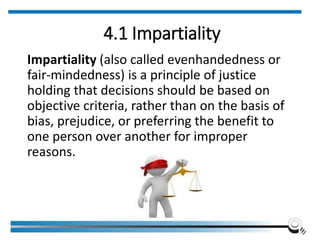
  • 384.
    Thank you Dr. S.Chakraborty Institute of Applied Quality Management, Kolkata Phone: 9830051583

Editor's Notes